














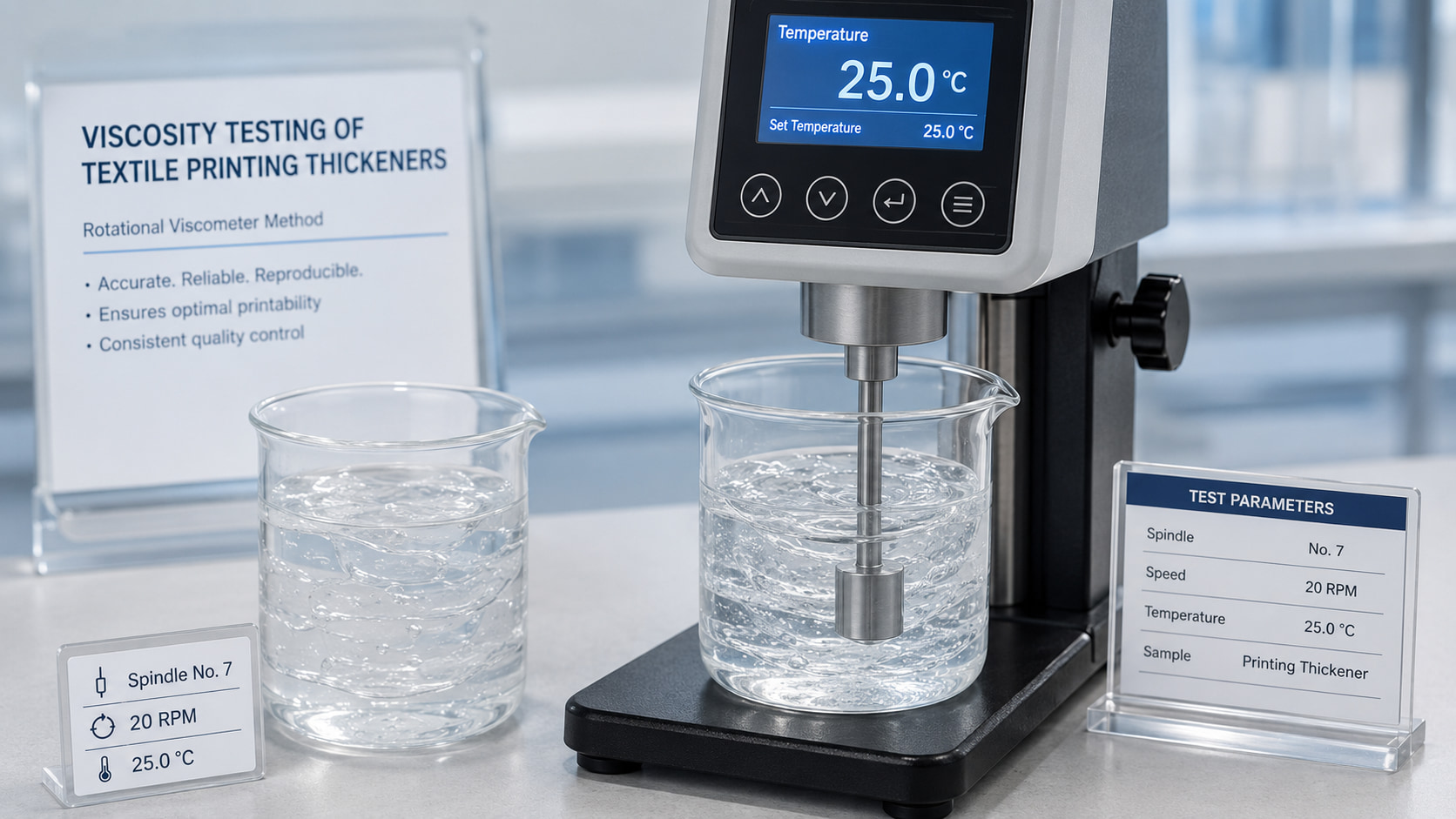
How Salt, Alkali and Temperature Affect CMS Printing Paste Viscosity

Salt, alkali and temperature can all change CMS printing-paste viscosity, but through different mechanisms. Salt...

Salt, alkali and temperature can all change the apparent viscosity of carboxymethyl starch (CMS) printing paste, but they do not act through one simple rule. Salt changes ionic strength and can alter polymer-chain expansion; alkali changes both pH and electrolyte level; temperature changes molecular mobility, hydration rate and the viscosity measured at that moment. The response also depends on CMS degree of substitution, molecular weight, concentration, substitution distribution, water quality and holding time. This guide shows textile mills how to separate these variables, build realistic salt/pH/temperature response curves and evaluate the complete printing paste before changing CMS grade or dosage.

Why CMS Printing Paste Viscosity Changes After Formulation

A CMS supplier may report viscosity under a controlled test such as a defined CMS concentration in water at 25°C. That number is useful for incoming quality control, but it does not describe every printing formula.

Production paste can contain:

  • Dyes or pigments
  • Salts
  • Alkali
  • Acids or buffers
  • Binders
  • Reducing or oxidizing auxiliaries
  • Dispersants
  • Softeners and other additives

These ingredients change the chemical environment around the CMS polymer.

At the same time, operators may prepare or store the paste at a temperature different from the laboratory test temperature.

The resulting viscosity is therefore a system property:

CMS Grade + Concentration + Water + Salt + pH/Alkali + Temperature + Shear + Holding Time

This is why two factories can receive the same CMS batch and report different viscosity behavior.

CMS as an Anionic Polymer: The Basic Mechanism

Carboxymethyl starch contains carboxymethyl groups that can carry negative charge in suitable aqueous conditions.

This makes sodium CMS an anionic polymer whose chains respond to the surrounding ionic environment.

Polymer-chain behavior is influenced by:

  • Electrostatic repulsion between charged groups
  • Hydrogen bonding
  • Water-polymer interaction
  • Counterions in solution
  • Polymer concentration and chain overlap

Changing salt, pH or temperature changes one or more of these interactions.

Published CMS studies confirm that viscosity can respond to temperature, pH, electrolyte concentration, degree of substitution and shear rate.

The important production lesson is that CMS viscosity should be treated as formulation-dependent rather than as a fixed property printed on a TDS.

1. How Salt Affects CMS Viscosity

Adding salt changes the ionic strength of the CMS solution.

For an anionic polymer, dissolved ions can screen electrostatic repulsion between charged polymer segments.

This can change:

  • Chain expansion
  • Hydrodynamic volume
  • Görünür viskozite
  • Kesme tepkisi
  • Solution stability

Some CMS grades show a significant viscosity decrease after sodium chloride is added. Other modified CMS structures can show better salt tolerance.

A study of mechanically activated cassava CMS reported high sensitivity to NaCl for that specific product, while research on acetylated CMS showed that structural modification could improve viscosity stability and salt tolerance.

Therefore, the correct conclusion is not:

“Salt always causes the same percentage viscosity loss.”

It is:

“Salt response is grade-specific and should be measured at the concentration used in the actual printing paste.”

Why Salt Type and Ion Valence Matter

Not all salts create the same response.

Variables include:

  • Cation type
  • Anion type
  • Monovalent vs. multivalent ions
  • Total concentration
  • Water hardness

Sodium chloride is useful for a standardized screening test, but a production formula may contain sodium carbonate, sodium bicarbonate, sodium sulfate, calcium, magnesium or other ionic species.

A result obtained with NaCl therefore does not automatically predict the response to every other salt.

For textile formulation work, use both:

  1. A standardized salt test for supplier comparison.
  2. The actual production electrolyte package for final approval.

2. How Alkali Affects CMS Viscosity

Alkali creates a more complicated change because adding an alkaline chemical usually changes both:

  • pH
  • Ionic strength

CMS carboxyl groups change ionization state with pH.

At low pH, more carboxyl groups can become protonated, reducing charge repulsion and changing solubility or chain expansion.

As pH rises into a more favorable region, ionization can increase and the polymer can show a different hydrodynamic state.

However, adding more alkali also adds counterions and increases ionic strength.

At stronger alkaline conditions, selected CMS grades may therefore show viscosity loss, instability or a different rheological profile.

One published cassava-CMS study found the highest paste viscosity near neutral conditions for that particular sample and reported limited resistance to both acid and alkali. Another recent sodium-CMS rheology study reported a viscosity maximum around mildly alkaline pH for its tested polymer.

These different results reinforce the correct rule:

There is no universal “best pH” for every commercial CMS grade.

Separate the pH Effect from the Ionic-Strength Effect

This is one of the most important laboratory controls.

If sodium hydroxide is added and viscosity changes, the operator may say:

“CMS is unstable at this pH.”

But two variables changed at the same time:

  • The pH increased.
  • The sodium-ion concentration increased.

To understand the cause, a technical lab can compare:

  • CMS at several pH values with controlled ionic conditions
  • CMS at similar ionic strength but different pH where practical
  • The actual production alkali package

For normal mill QC, the objective is not to perform academic electrochemistry.

The practical objective is to avoid blaming “pH” when the real issue may be electrolyte loading, addition order or local high concentration during alkali dosing.

3. How Temperature Affects CMS Viscosity

Temperature directly affects the viscosity measured at that moment.

As temperature increases, molecular motion increases and many polymer solutions show lower apparent viscosity.

Recent sodium-CMS rheology work reported a clear viscosity decrease as temperature increased for the tested grades.

Another study of mechanically activated cassava CMS found the paste relatively stable between 25°C and 40°C, followed by a gradual decrease above 40°C for that specific sample.

These values should be treated as research examples, not universal CMS specifications.

A commercial CMS can have a different:

  • DS
  • Molecular weight
  • Raw starch source
  • Purification level
  • Structural modification

Therefore, every viscosity comparison should use a defined measurement temperature.

Instant Temperature Effect vs. Long-Term Stability

Temperature testing should distinguish two different questions.

Question 1: What Is the Viscosity at the Higher Temperature?

This measures the immediate thermal effect on flow.

Question 2: Does the Paste Return to Its Original Viscosity After Cooling?

This checks whether the change was mainly reversible or whether prolonged heat exposure changed the system more permanently.

A useful test is:

25°C Initial → Heat to Target Temperature → Measure → Hold for Defined Time → Cool Back to 25°C → Recondition → Measure Again

If viscosity returns close to the initial value, the change may be mainly a reversible temperature effect.

If it does not recover, investigate:

  • Polymer stability
  • Bekletme süresi
  • pH
  • Salt concentration
  • Evaporation

This test is especially useful when production mixing heats the paste through mechanical shear.

How Degree of Substitution Changes the Response

Degree of substitution (DS) changes the number and distribution of carboxymethyl groups on the starch structure.

This affects:

  • Water compatibility
  • Charge density
  • Tuz tepkisi
  • pH response
  • Reoloji

CMS studies with different DS have shown different viscosity and stability behavior.

This means the response curve for one CMS grade should not be copied to another grade simply because both products are called carboxymethyl starch.

FSX Chemical’s current CMS guidance similarly recommends evaluating DS, viscosity, water quality, dyes, auxiliaries, pH and the complete formulation together.

Molecular Weight and CMS Concentration

CMS concentration can dramatically change the baseline viscosity and the way chains overlap or interact.

Molecular weight influences the thickening efficiency of the polymer.

Therefore, salt or temperature response measured at one concentration may not transfer directly to another concentration.

For supplier comparison, keep constant:

  • CMS concentration
  • Water-to-powder ratio
  • Su içme zamanı
  • Sıcaklık
  • Viskozite yöntemi

If Grade A is tested at 5% and Grade B at 8%, the absolute viscosity values should not be compared as if the test conditions were identical.

Water Quality as a Fourth Hidden Variable

Plant water already contains dissolved ions before any deliberate salt or alkali is added.

Hardness, conductivity and pH can therefore shift the starting point of every CMS formulation.

If the same formula behaves differently in the laboratory and production, compare:

  • Deionized/reference water
  • Actual plant water
  • Total hardness
  • Calcium and magnesium
  • Conductivity
  • pH

Otherwise, an apparent “salt tolerance” problem may partly be a plant-water problem.

Why Salt, Alkali and Temperature Must Also Be Tested Together

One-factor tests are useful for understanding mechanisms, but production uses multiple variables at the same time.

Örneğin:

CMS + Plant Water + Alkali + Salt + 35°C Mixing + 4-Hour Holding

may behave differently from:

CMS + DI Water at 25°C

even if both samples started with the same CMC concentration.

After individual screening, always test the realistic combination.

A practical qualification matrix may compare:

ÖrnekSuSaltAlkaliSıcaklıkPurpose
AReferenceNoneNoneStandardBaseline
BReferenceProduction levelNoneStandardSalt effect
CReferenceNoneProduction levelStandardAlkali effect
DPlantProduction levelProduction levelProduction rangeRealistic formula

Reactive Printing Formulations

Reactive printing is a clear example of why CMS must be evaluated inside the complete formulation.

The paste may contain:

  • Reaktif boya
  • Alkali
  • Salt or ionic auxiliaries
  • Anti-reducing components
  • Other process chemicals

All of these can affect viscosity or dye-thickener interaction.

CMS can be evaluated in selected reactive formulations, but it should not be presented as a universal one-to-one sodium alginate replacement.

Final approval should include:

  • Tam macun viskozitesi
  • Tutma stabilitesi
  • Screen running
  • Renk verimi
  • Arka plan temizliği
  • Yıkanarak çıkarılır
  • Fabric hand

Disperse Printing Formulations

For polyester disperse printing, salt and pH effects should be considered together with:

  • Disperse dye dispersion
  • Dispersing agents
  • Screen rheology
  • Termal sabitleme
  • Dye release from the thickener film

A CMS grade that retains viscosity after salt addition can still be unsuitable if it runs poorly through the screen or restricts dye release during fixation.

Therefore, the final polyester print remains the acceptance standard.

Vat, Discharge and Other Specialty Routes

Selected vat, discharge, burn-out or specialty printing systems can expose starch-derived thickeners to stronger alkaline, reducing or chemically aggressive conditions.

In these routes, do not extrapolate from a neutral-water CMS viscosity test.

Değerlendirin:

  • Actual alkali/reducing package
  • Bekletme süresi
  • Sıcaklık
  • Screen behavior
  • Pattern development
  • Post-treatment removal

FSX Chemical currently separates CMS grades by application route, including disperse, reactive and selected specialty-printing directions, because chemical tolerance requirements differ.

How to Build a Salt-Response Curve

Step 1: Prepare One CMS Stock Solution

Use the same batch, concentration, water and hydration method.

Step 2: Divide into Equal Samples

This reduces preparation variability.

Step 3: Add Several Defined Salt Levels

Use the salt relevant to production.

Step 4: Standardize Mixing and Holding

Measure after the same mixing time and equilibration period.

Step 5: Measure at the Same Temperature

Do not compare a warm salted sample with a cooler reference.

Step 6: Record More Than Viscosity

Also observe clarity, flocs, gel particles, separation and filtration residue.

The output should be a working curve rather than one pass/fail number.

How to Build an Alkali/pH Response Curve

Use the same CMS stock and vary the alkaline condition in controlled steps.

Record:

  • Alkali identity
  • Alkali dosage
  • Final pH
  • Conductivity where useful
  • Örnek sıcaklığı
  • Immediate viscosity
  • Delayed viscosity

When possible, include the exact alkali used in production rather than assuming sodium hydroxide, sodium carbonate and sodium bicarbonate behave identically.

If viscosity changes sharply, repeat around the transition region to establish a practical working window.

How to Build a Temperature-Response Curve

A meaningful temperature study should use the same CMS sample and the same measurement method.

Test several temperatures relevant to:

  • Laboratory QC
  • Karıştırma
  • Color kitchen
  • Machine circulation
  • Seasonal production

At each point, allow enough time for the sample to reach the target temperature before reading.

Then return the sample to the standard QC temperature and remeasure.

This separates:

Temperature-dependent viscosity

from:

Heat-induced stability change.

How to Test the Complete Printing Formula

After salt, alkali and temperature curves are understood individually, prepare the real printing paste.

Use:

  • Actual plant water
  • Actual dye/pigment
  • Production CMS dosage
  • Actual salt and alkali levels
  • Normal mixing sequence
  • Normal working temperature

Measure at:

  • Hazırlıktan hemen sonra
  • After the normal holding time
  • Near the end of the intended working period

Then print under controlled machine conditions and evaluate the finished fabric.

This is the stage that determines whether the CMS grade is commercially suitable.

Troubleshooting Viscosity Changes by Symptom

Observed SymptomFirst Variables to CheckDo Not Assume
Viscosity drops immediately after saltSalt type, dosage, DS, CMS concentrationEvery CMS grade will lose the same percentage
Viscosity changes after alkaliFinal pH, ionic strength, addition order, local concentrationpH is the only variable
Warm paste reads lower viscosityActual sample temperatureThe CMS has permanently degraded
Viscosity does not recover after coolingHeat exposure time, pH, salt, evaporation, stabilityTemperature effect was fully reversible
Lab formula is stable; plant paste is notPlant water, production temperature, mixing shear, holding timeThe CMS batch is necessarily different
Same CMS behaves differently with another dyeDye dispersion, electrolyte package, pHOnly thickener viscosity matters

Production QC and Batch Control

A useful CMS production-control record can include:

  • CMS batch number
  • CMS concentration
  • Su kaynağı
  • Water hardness/conductivity where relevant
  • Salt dosage
  • Alkali identity and dosage
  • Final pH
  • Mixing temperature
  • Ölçüm sıcaklığı
  • Viskozite yöntemi
  • Bekletme süresi
  • Tam macun viskozitesi

FSX Chemical’s CMS guidance recommends comparing viscosity only when concentration, temperature, viscometer, spindle, RPM, hydration time and sample preparation are aligned.

This control prevents ordinary process variation from being misclassified as raw-material failure.

What Information Should You Send to a CMS Supplier?

If salt, alkali or temperature is changing your CMS paste, send:

  • Current CMS product, TDS or sample
  • CMS concentration
  • Degree of substitution where known
  • Viscosity and full test method
  • Water source and hardness where relevant
  • Salt identity and dosage
  • Alkali identity and dosage
  • Final pH
  • Mixing temperature
  • Viscosity measurement temperature
  • Complete or simplified printing formula
  • Dye/pigment system
  • Bekletme süresi
  • Printing route and machine
  • Current viscosity or printing defect

FSX Chemical can use this information through Örnekler ve Eşleştirme to compare a relevant CMS grade under matched formulation conditions.

How Should Textile Mills Control CMS Viscosity?

A practical decision chain is:

Define CMS Test Method → Measure Baseline → Build Salt Curve → Build Alkali/pH Curve → Build Temperature Curve → Test Combined Formula → Print → Approve Working Window

The key principles are:

  1. Salt changes CMS viscosity through ionic interactions, but the response is grade-specific.
  2. Alkali changes both pH and ionic strength, so these effects should not be confused.
  3. Temperature changes the viscosity measured at that moment and may also affect longer-term stability.
  4. DS, molecular weight, concentration and water quality change the response.
  5. One-factor tests explain the system; the complete production formula approves the product.
  6. Same viscosity in water does not mean the same performance after salt, alkali and heat.

Sık Sorulan Sorular

1. Does salt reduce CMS printing-paste viscosity?

Salt can reduce viscosity in many CMS systems by changing ionic interactions and polymer-chain expansion, but the magnitude depends on CMS structure, concentration, salt type and dosage.

2. Is CMS resistant to sodium chloride?

Salt tolerance varies by CMS grade. Some published CMS samples are highly sensitive to NaCl, while modified CMS structures can show improved salt tolerance.

3. Does alkali reduce CMS viscosity?

It can, but the response is not universal. Alkali changes both pH and ionic strength, and different CMS grades can have different viscosity-pH curves.

4. What is the best pH for CMS?

There is no universal best pH for all CMS products. Published studies report different maxima depending on CMS structure. Test the actual grade in the production formula.

5. Why does CMS viscosity decrease when temperature increases?

Higher temperature generally increases molecular mobility and can reduce apparent viscosity. The magnitude depends on CMS structure, concentration and formulation.

6. Is a viscosity loss at high temperature permanent?

Not necessarily. Cool the sample back to the standard temperature and remeasure. Recovery suggests a mainly reversible thermal effect; poor recovery requires further stability investigation.

7. Can CMS be stable from 25°C to 40°C?

One published cassava-CMS study reported relative stability in that range, but this is a research-specific result and should not be treated as a universal CMS specification.

8. Why does the same CMS give different viscosity in two factories?

Water quality, salt/alkali dosage, temperature, hydration, mixing, holding time and viscosity test method can all create differences.

9. Should salt be added before CMS hydration?

For many systems, fully hydrating CMS before introducing a high electrolyte load is a useful starting approach, but the actual production sequence should be validated.

10. Should CMS viscosity be measured while the sample is still warm?

Only if the specification defines that temperature. Supplier comparison should normally condition all samples to the same agreed measurement temperature.

11. Can high-DS CMS tolerate salt and alkali better?

DS influences ionic behavior and stability, but higher DS alone does not guarantee universal salt or alkali resistance. Grade structure and formulation still matter.

12. What should I send FSX Chemical for CMS viscosity troubleshooting?

Send the current CMS TDS/sample, concentration, viscosity method, water data, salt and alkali levels, final pH, temperature, complete formula, holding time and current printing problem.

Evaluate CMS Viscosity Under Your Real Printing Formula

If your CMS shows a large viscosity change after salt, alkali or temperature variation, FSX Chemical can help determine whether the next trial should focus on CMS grade, dosage, mixing sequence or the complete chemical environment.

For a useful technical comparison, send:

  • Your current CMS TDS, COA or sample
  • CMS concentration
  • Degree of substitution where known
  • Viskozite ve tam test yöntemi
  • Plant-water information
  • Salt type and dosage
  • Alkali type and dosage
  • Final pH
  • Mixing and measurement temperatures
  • Complete or simplified printing formula
  • Dye/pigment system
  • Bekletme süresi
  • Yolun yazdırılması
  • Current viscosity, screen-running or print-quality target

Şöyle başlayın: Örnekler ve Eşleştirme to establish controlled salt, alkali and temperature comparisons.

İnceleme FSX Chemical Carboxymethyl Starch (CMS) for current printing-grade options.

You can also Fabrikadan Doğrudan Fiyat Teklifi İsteyin after the suitable CMS route is confirmed or FSX Chemical ile İletişime Geçin for technical discussion📧 E-posta: Service@fsxchemical.com

CMS viscosity is not a fixed number once the product enters a textile printing formula. Salt, alkali and temperature reshape the polymer environment, so the useful specification is the viscosity and rheology that remain inside the validated production window.

Hızlı İletişim

İhtiyacınızı Bildirin

veya

Ücretsiz numuneler · 24 saat içinde yanıt

Ürün Soruları ve Destek

Ürün İhtiyacınızı Bildirin

Ürün adını, kullanım alanını, miktarı, teslimat yerini ve elinizde bulunan TDS, örnek fotoğraf veya belgeleri bizimle paylaşın. FSX Chemical bu bilgileri inceleyerek fiyat teklifi, numune eşleştirme veya ürün seçimi için atılması gereken bir sonraki adımı önerecektir.

Ürün Bilgileri Ürün adı, sınıfı, modeli, etiket fotoğrafı veya tedarikçi referansı.
Mevcut Belgeler TDS, SDS, COA, numune fotoğrafı, ürün listesi veya test verileri.
Sipariş Detayları Tahmini miktar, ambalaj, varış ülkesi, liman veya ticaret şartı.
Başvuru veya Sorun Tekstil baskı süreci, formülasyon gereksinimi, mevcut sorun veya hedeflenen performans.