The Benefits of Direct Factory Supply for Textile Printing Chemicals
Direct factory supply can offer more than a lower purchasing price. For textile printing chemicals,...
Textile printing chemicals are not simple commodities. Sodium alginate, CMC, CMS, digital printing paste and compound thickeners can differ in viscosity, rheology, hydration, filtration, chemical compatibility and application performance even when their commercial descriptions appear similar.
This is one reason direct factory supply can be particularly valuable in textile printing. When the buyer communicates directly with the manufacturer, questions about product specifications, test methods, samples, formulation requirements, commercial batches and technical problems can often be connected more directly with the people responsible for producing and evaluating the product.
Factory-direct sourcing should not, however, be treated as an automatic guarantee of lower price, better quality or faster delivery. A manufacturer still needs to be qualified through technical documents, sample testing, manufacturing information, batch quality control and commercial supply performance.
This guide explains the main benefits of direct factory supply for textile printing chemicals, where the factory-direct model provides the greatest value, where distributors may still offer advantages and how buyers can qualify a manufacturer before moving from sample testing to bulk purchasing.
What Does Direct Factory Supply Mean?
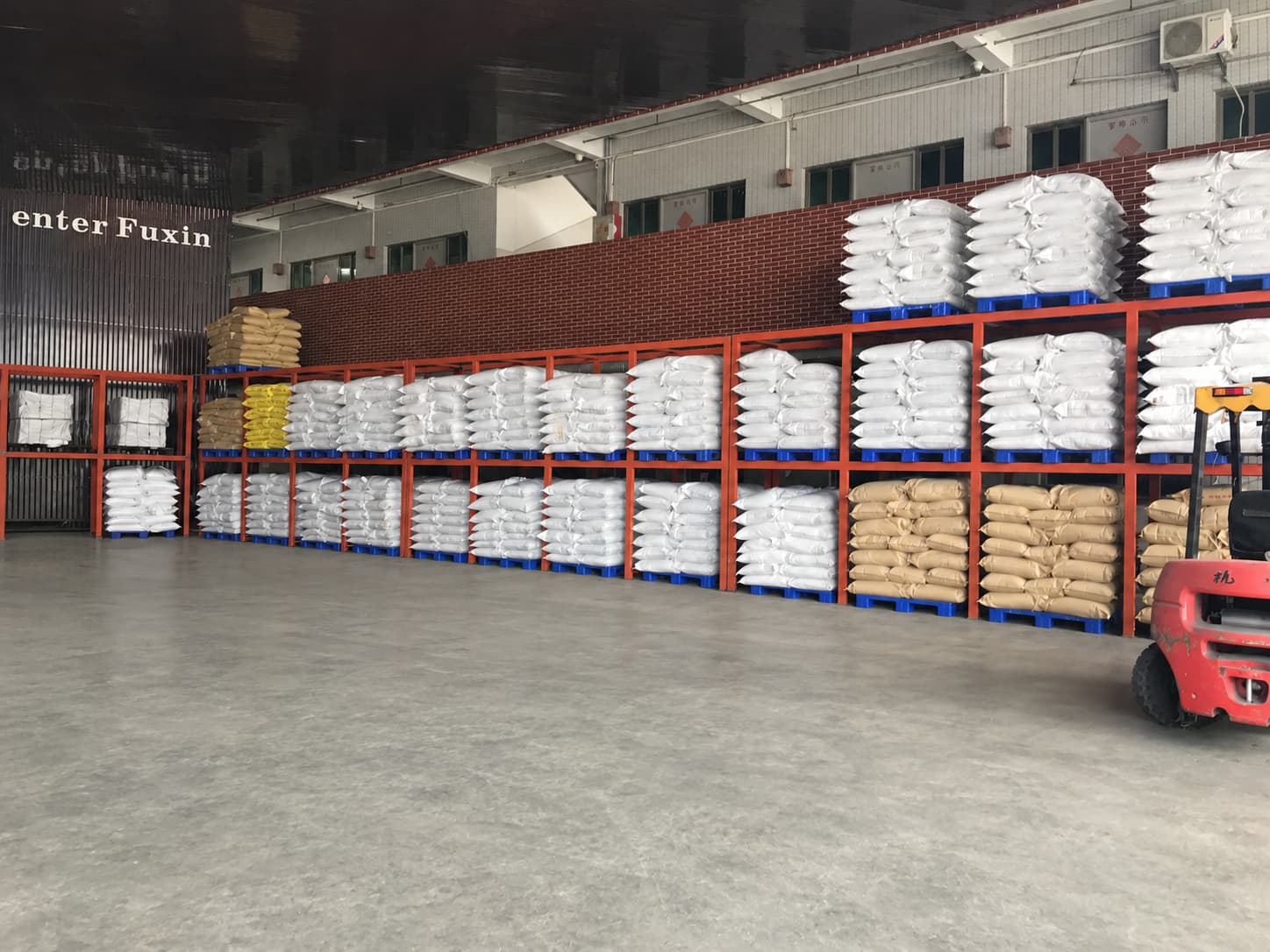
Direct factory supply generally means that the buyer purchases the commercial product from the manufacturing organization or its direct sales structure rather than sourcing the material through several independent trading layers.
The commercial benefit is not simply the removal of an intermediary. The more important advantage for technical products is the possibility of connecting procurement directly with manufacturing, quality control, laboratory evaluation and product development.
A factory-direct relationship can connect
Customer application requirements
Commercial product grade
Technical Data Sheet
Customer reference sample
Laboratory grade matching
Manufacturing specification
Production batch
Certificate of Analysis
Packaging and export requirements
Customer production feedback
The strength of direct supply therefore depends on how well the manufacturer connects these elements.
Why Factory-Direct Sourcing Matters More for Technical Chemicals
Factory-direct sourcing has different value for a standard commodity than for an application-sensitive polymer.
Textile printing thickeners are affected by concentration, water quality, hydration, temperature, dyes, salts, alkalis, binders, equipment, fabric and post-treatment.
Two products can therefore satisfy a similar basic specification while producing different printing results.
A technical inquiry often requires more than a quotation
A printing mill may ask for better fine-line definition, improved filtration, stronger black printing, lower effective dosage or an alternative to an existing commercial thickener.
These questions require technical comparison rather than simply matching a product name.
Direct communication with the manufacturer can make it easier to exchange the information required for this comparison.
1. Direct Access to Technical Knowledge
One of the most important benefits of direct factory supply is shorter communication between the customer and the technical source of the product.
Technical questions can be more specific
Instead of asking only whether a product is high viscosity or low viscosity, a customer can provide the complete measurement method, concentration, fabric, printing system and current problem.
Laboratory results can be discussed directly
If the customer reports viscosity loss after alkali addition, excessive filtration residue or poor definition, the information can be reviewed as an application problem rather than only as a sales complaint.
Technical feedback can improve grade selection
A manufacturer may have several viscosity or polymer routes that are not obvious from a general product catalog.
Direct technical communication can therefore reduce the risk of selecting a product only because its specification appears similar.
2. Better Grade Matching
Many textile chemical buyers are not searching for a completely new product. They are trying to qualify an alternative to a grade already used successfully in production.
Direct manufacturer access can make grade matching more practical.
The buyer can provide
Current product manufacturer
Commercial grade
TDS
Recent COA
Physical reference sample
Viscosity and complete test method
Current dosage
Printing formulation
Fabric and equipment
Current problem or improvement target
The factory can select a technically relevant candidate
The objective should not be to claim an immediate exact replacement. A candidate product should first be selected for controlled side-by-side testing.
FSX Chemical provides a Samples & Matching route for this type of evaluation.
3. Greater Visibility into Manufacturing
A factory-direct supplier can potentially provide more direct information about how the commercial product is manufactured and controlled.
Important manufacturing questions include
What is the permanent commercial grade?
How are critical raw materials controlled?
Which manufacturing stages influence the product?
How is the final batch sampled?
Which parameters are tested before release?
How is the batch connected to the package and COA?
Buyers can review FSX Chemical’s general production and QC information through Manufacturing & Quality .
Factory access does not eliminate the need for supplier qualification, but it can make that qualification more transparent.
4. Better Control of Sample-to-Bulk Conversion
One of the highest-risk points in textile chemical sourcing is the transition from a successful laboratory sample to the first commercial shipment.
The approved sample should connect to
A permanent commercial product code
A current TDS
An agreed technical specification
The commercial quotation
The purchase order
The production batch
The package label
The batch COA where applicable
If a sample is approved under an informal name but the commercial shipment cannot be linked back to it, the buyer has unnecessary qualification risk.
A direct factory relationship can make this chain easier to establish because the organization supplying the sample is also connected with commercial production.
5. Product-Specific Batch QC
Textile printing chemicals should not all use the same quality-control panel.
The relevant batch checks depend on the chemistry and intended application.
Potential QC parameters can include
Product identity
Appearance
Moisture or solids
pH
Viscosity under a defined method
Hydration
Filtration
Physical stability
Other product-specific parameters
Viscosity must remain method-controlled
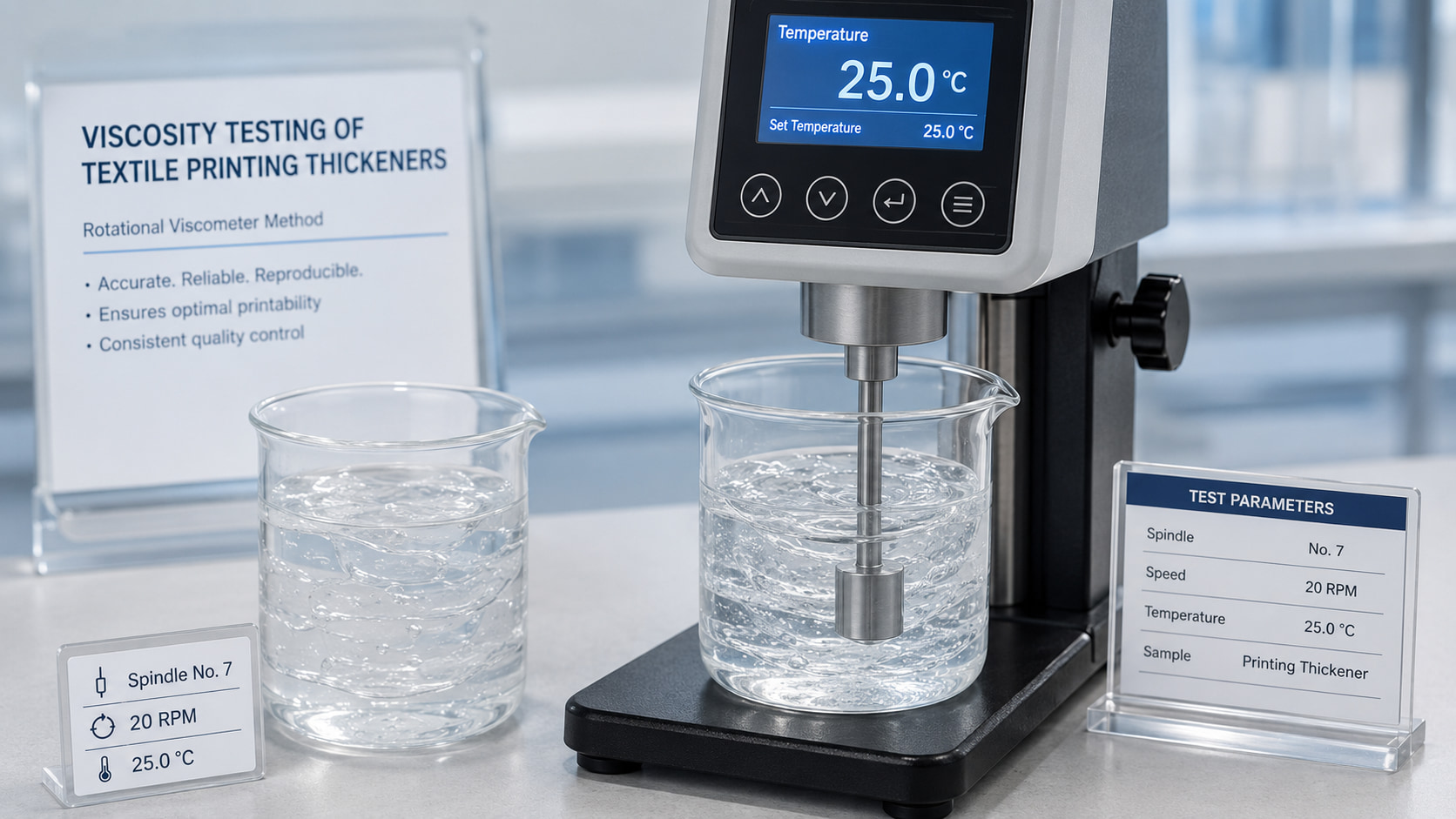
Concentration, preparation, hydration time, temperature, instrument, spindle and rotational speed can all affect the reported result.
Direct access to the producer makes it easier for buyer and supplier laboratories to align methods when the reported results differ.
6. More Flexible Customization
Standard grades are normally the most efficient option because they already have established production and quality-control systems.
However, some textile printing customers have requirements that do not match a standard grade exactly.
Customization may involve
Viscosity range
Grade selection
Polymer blend direction
Application-specific rheology
Preparation behavior
Commercial packaging requirements
Direct manufacturer communication can make it easier to determine whether the requirement can be met by an existing grade or requires a controlled development trial.
Customized products still require testing and should not be treated as automatically equivalent to the customer’s current material.
7. Technical Documentation from the Source
Documentation is an important part of international textile chemical purchasing.
Technical Data Sheet
The TDS identifies the commercial product and provides relevant technical characteristics and test information.
Safety Data Sheet
The SDS supports safety, handling, storage and transport review.
Certificate of Analysis
A COA can report selected batch-specific quality results for the commercial material.
Export documents
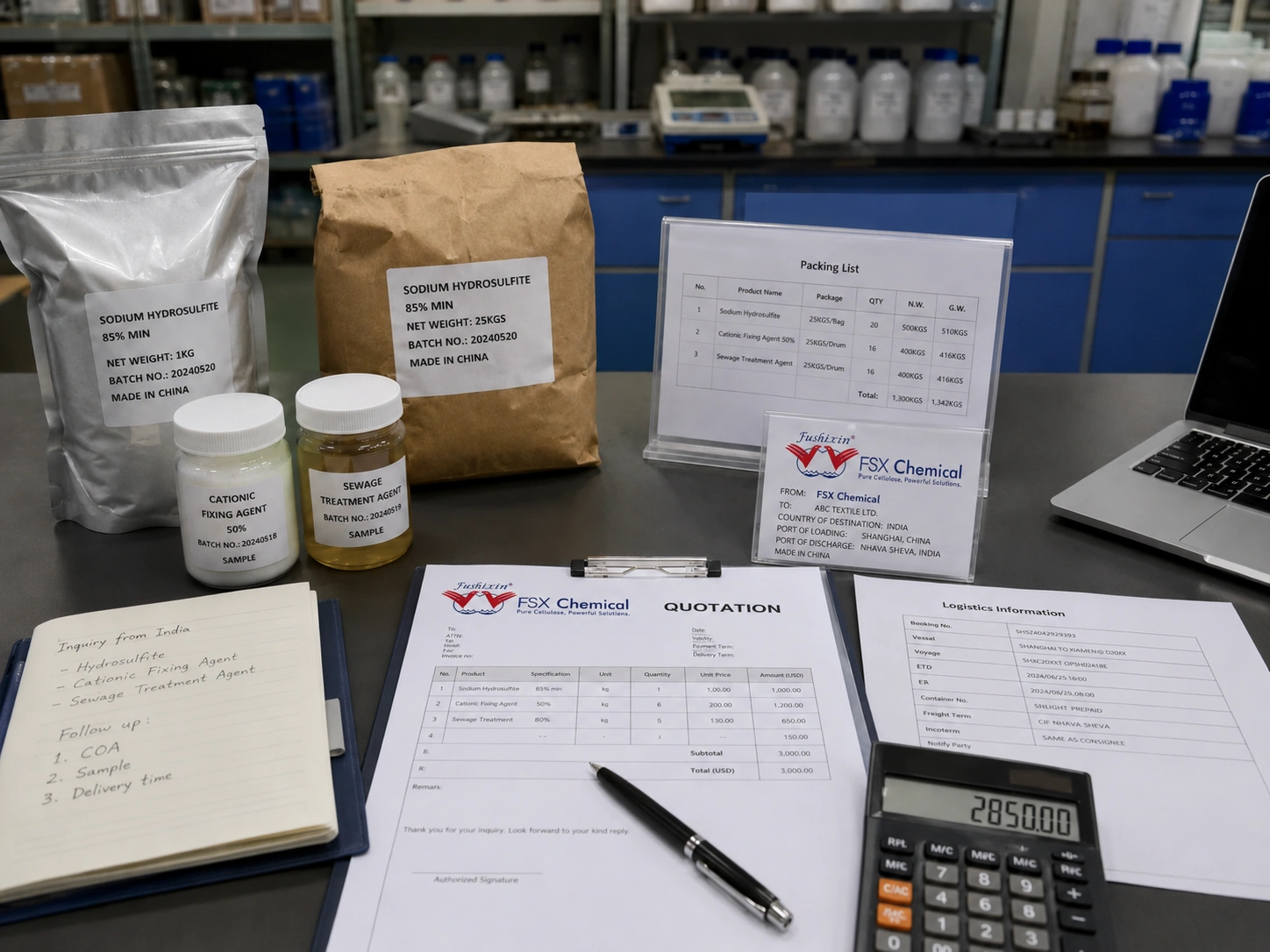
International orders may also require commercial invoices, packing lists, labels, shipment data and destination-specific documents.
Any certification should be checked according to its actual scope, holder, issuer and validity rather than generalized to unrelated products.
8. Potential Cost Advantages
Direct factory sourcing can create a more efficient commercial structure for suitable bulk orders, but it should not be described as automatically cheaper.
Factory pricing may reduce some commercial layers
For larger repeat orders, direct sourcing can reduce the number of independent margins between producer and industrial buyer.
But the buyer may take on more responsibilities
International freight, customs, inventory planning, currency exposure and local warehousing may be managed differently when buying directly from an overseas factory.
Compare delivered cost
FOB price alone should not be compared with a distributor’s delivered local price.
Compare cost in use
Effective dosage, preparation, filtration, machine productivity and final fabric quality can be more important than a small difference in purchase price.
9. Better Bulk Supply Planning
Buyers using large volumes of textile chemicals need more than an attractive first quotation. They need repeatable commercial supply.
Direct planning can include
Forecast volume
Production planning
Packaging
Container loading
Shipment schedule
Destination requirements
Inventory planning
When demand is predictable, direct communication between the buyer and manufacturer can support more structured production and shipping planning.
This is especially useful for importers, distributors and larger printing mills buying repeat container quantities.
10. Faster Product Feedback and Development
Textile printing processes change over time. Customers may move to a new machine, increase printing speed, change ink suppliers or introduce new fabrics.
These changes can alter thickener requirements.
A direct feedback loop can connect
Customer production problem
Technical information
Laboratory evaluation
Candidate grade
Customer trial
Printed-fabric feedback
Further grade adjustment where appropriate
This process can be particularly useful when the buyer needs more than a standard catalog product.
Direct Factory vs Distributor: Which Is Better?
Direct factory supply is not the best purchasing model for every customer. Distributors provide important services that factories may not offer locally.
Evaluation Area
Direct Factory
Distributor
Technical Communication
Potentially direct access to manufacturer and laboratory
Depends on distributor technical capability
Grade Matching
Can be connected directly with product selection
May require communication with upstream producer
Customization
Potentially more flexible for qualified volume
Usually depends on manufacturer support
Small Orders
Factory MOQ may be higher
Often more flexible
Local Inventory
May require international lead time
Can provide local stock
Local Delivery
Depends on export and logistics structure
Often faster for small local orders
Bulk Pricing
Potentially efficient for larger volumes
Includes local inventory and service structure
Import Handling
Buyer may manage more import responsibilities
Distributor can simplify local purchasing
Large repeat buyers and importers may benefit more from factory-direct supply, while smaller users may find the local inventory and logistics support of a distributor more valuable.
Why Price per Kilogram Is Not Enough
A factory quote should be evaluated using total cost rather than price per kilogram alone.
Material cost
Calculate the delivered price multiplied by the actual optimized dosage.
Preparation cost
Include mixing, hydration, filtration, labor and energy.
Machine cost
Consider screen cleaning, pumping, downtime and printing speed.
Quality cost
Include rework, rejected fabric, additional washing and other quality-related losses.
Inventory cost
Larger factory-direct shipments may require more working capital and storage than local distributor purchases.
The most economical source is therefore the supplier that provides an acceptable combination of product performance, delivered cost and supply reliability.
Factory-Direct Supply for Sodium Alginate
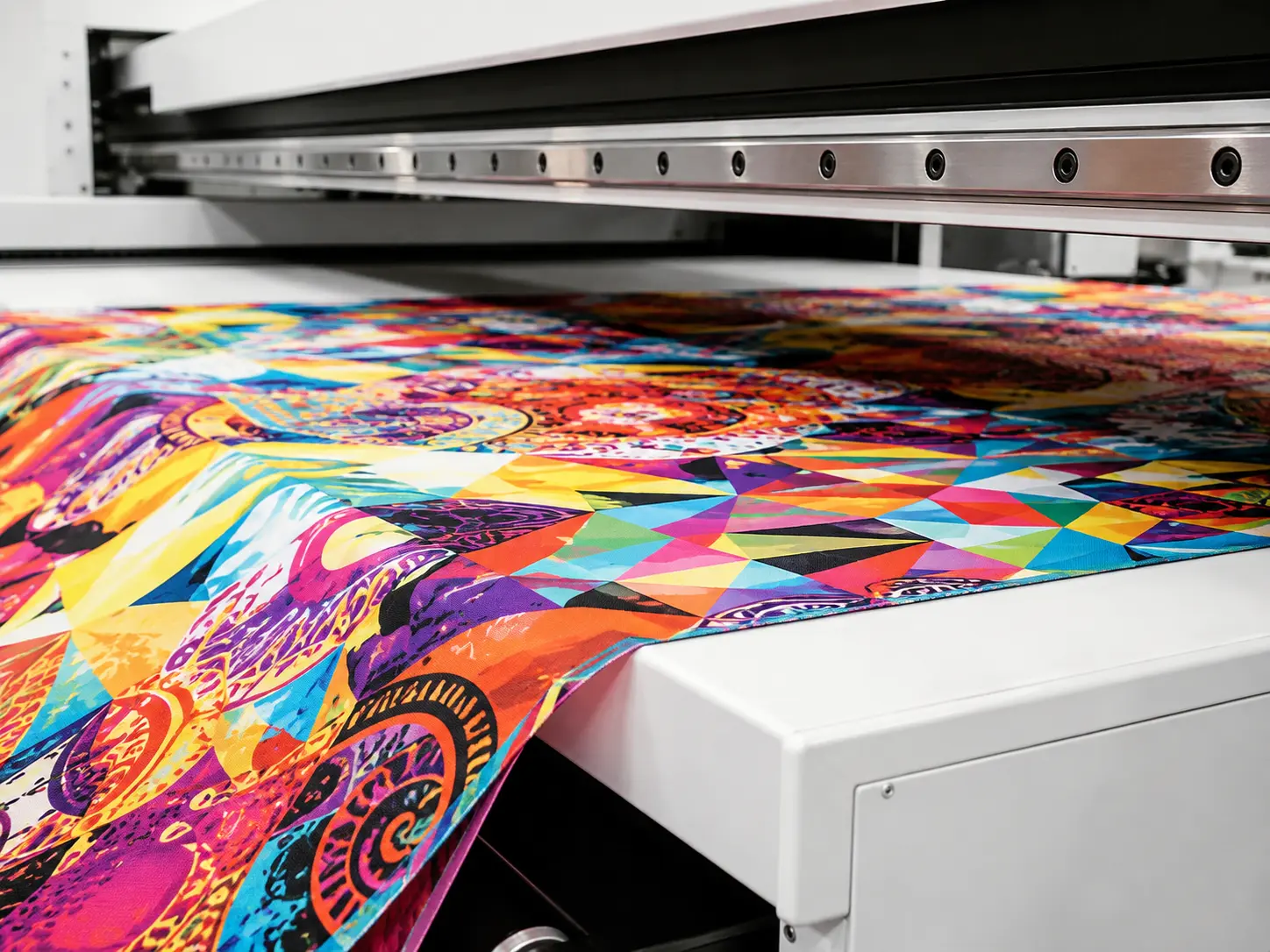
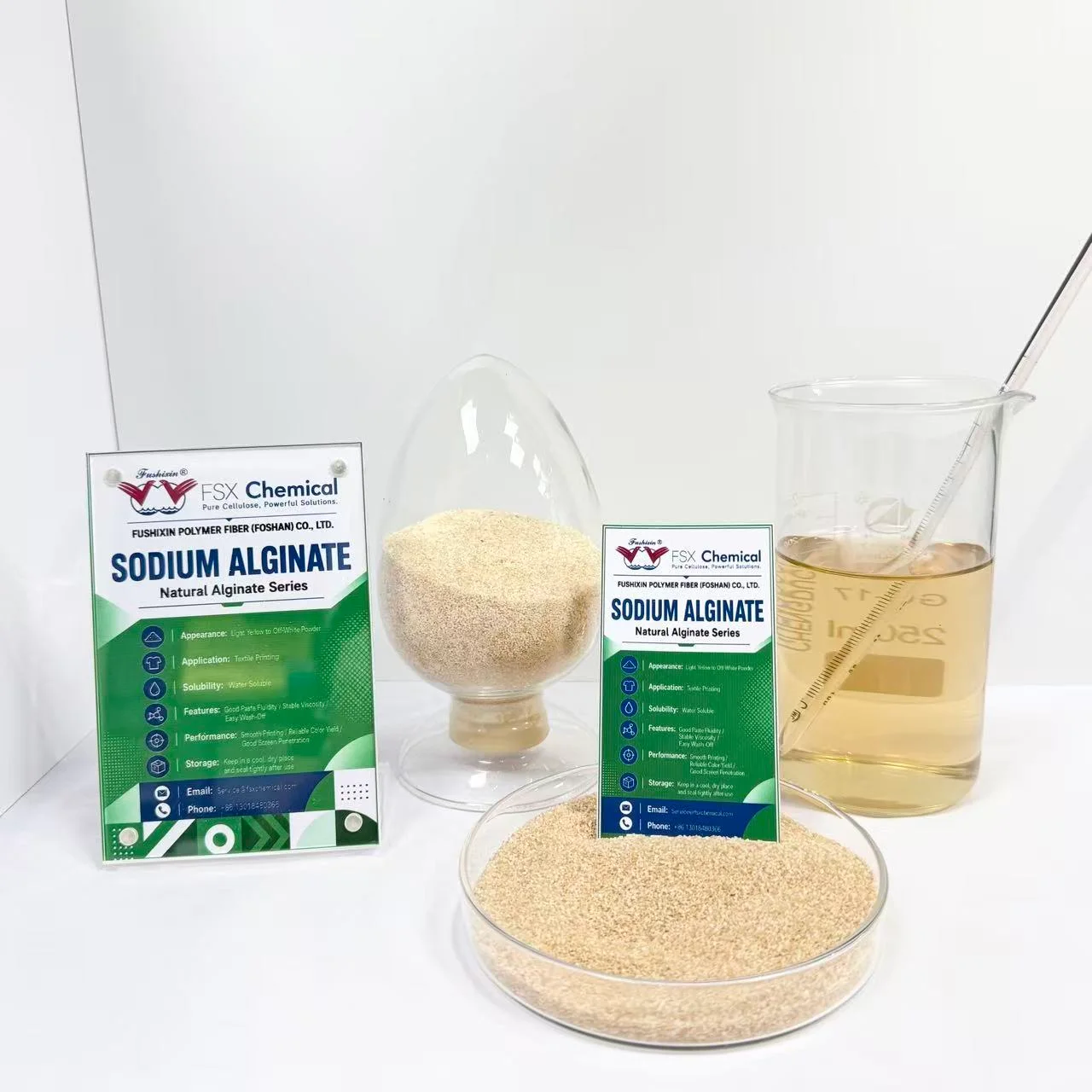
Sodium alginate is commonly evaluated as a thickener for conventional reactive dye printing on suitable cellulosic textiles.
Direct factory communication can be useful because sodium alginate grades may differ in viscosity classification, rheology, hydration and filtration.
Buyers should provide
Current HV, MV or LV grade where applicable
Actual viscosity value
Test concentration
Viscometer and speed
Current dosage
Reactive printing formulation
Fabric and machine
The HV, MV or LV designation alone is not sufficient for an accurate cross-supplier comparison.
Factory-Direct Supply for CMC
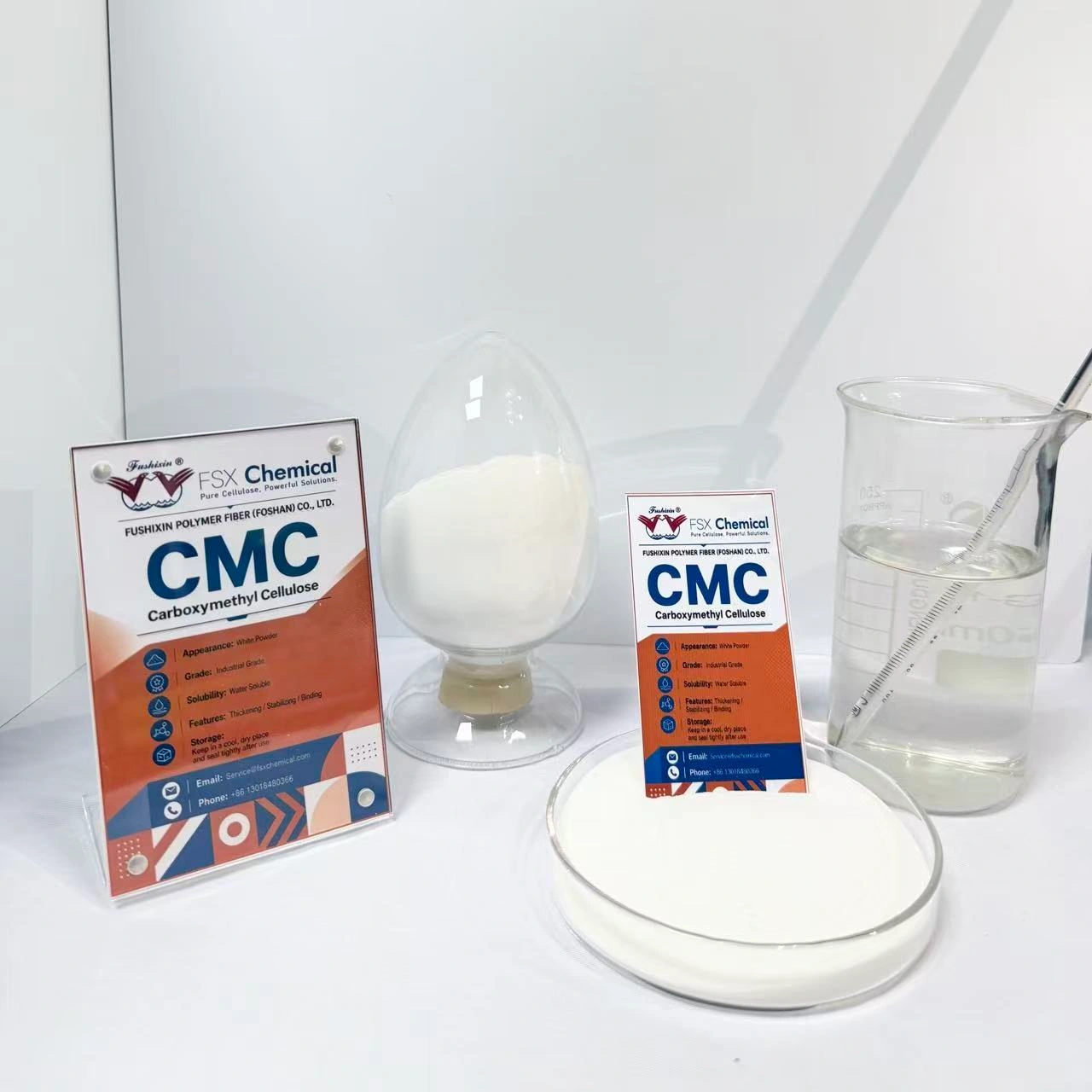
Carboxymethyl Cellulose is available in multiple commercial grades that can differ in viscosity, substitution, hydration and application behavior.
Factory-direct CMC sourcing can help buyers compare
Viscosity
Degree of substitution where relevant
Purity-related parameters where applicable
Dissolution
Hydration
Filtration
Rheology
Complete-formula compatibility
Two CMC products with the same viscosity should not automatically be considered interchangeable.
Factory-Direct Supply for CMS
Carboxymethyl Starch can be evaluated in selected printing and compound thickener systems.
Buyers considering CMS often need to balance viscosity efficiency, screen passage, stability, printing quality and total cost.
A direct factory trial can compare
Current thickener
Candidate CMS grade
Compound CMS formulation where appropriate
Effective dosage
Filtration
Print definition
Finished-fabric performance
CMS should not automatically be treated as a universal one-to-one replacement for sodium alginate or CMC.
Factory-Direct Supply for Digital Printing Paste
Digital Printing Paste requires particularly close application matching because reactive, disperse and pigment ink systems are chemically different.
The factory should first understand
Ink system
Fabric composition
Pretreatment method
Current paste
Current dosage
pH
Drying process
Fixation or curing process
Current printing problem
Digital printing paste should be evaluated as a textile pretreatment or application-specific paste route rather than assumed to be a direct additive for inkjet ink.
How to Verify a Real Manufacturer
A supplier describing itself as factory-direct should still be verified before a significant purchase.
Review company identity
Check the legal company information, factory location, contact information and commercial documents.
Review manufacturing information
Ask which products are actually manufactured and which may be sourced externally.
Review product documentation
TDS, SDS, labels, COA structure and grade names should remain consistent.
Request a representative sample
A sample allows the buyer to compare technical performance before committing to a bulk purchase.
Check sample-to-bulk identity
Confirm that the approved sample has a permanent commercial grade that can later appear on the quotation, package and batch documents.
Verify the first commercial shipment
The first production lot should receive stronger incoming and application verification before routine use.
How to Compare Two Factory Suppliers
Two companies can both be genuine manufacturers and still provide very different value.
Evaluation Area
What the Buyer Should Compare
Product Fit
Does the proposed grade match the actual printing process?
Test Method
Are viscosity and other parameters clearly defined?
Sample Support
Can the buyer test before bulk conversion?
Grade Matching
Can the existing product be used as a technical benchmark?
Batch QC
Which parameters are checked before release?
Documentation
Are the required TDS, SDS and batch documents available?
Customization
Can technically justified adjustments be evaluated?
Price
What is the delivered cost at the optimized dosage?
Supply
Can repeat volume and shipping requirements be supported?
Communication
How quickly are technical and commercial issues resolved?
The lowest quotation should therefore be only one component of the supplier decision.
Recommended Sample-to-Bulk Qualification Workflow
Step 1: Define the current product
Record the existing supplier, commercial grade, dosage and TDS.
Step 2: Define the application
Identify the fabric, printing route, dye or ink system and equipment.
Step 3: Align test methods
Standardize viscosity, pH, filtration and other important laboratory methods.
Step 4: Request a candidate sample
The proposed grade should have a clear commercial identity.
Step 5: Conduct side-by-side laboratory testing
Compare reference and candidate under identical conditions.
Step 6: Test the complete formulation
Add the actual dyes, salts, alkalis, binders or auxiliaries used in production.
Step 7: Print the actual fabric
Evaluate fine details, solid areas, penetration and machine behavior.
Step 8: Complete post-treatment
Evaluate the fabric after fixation, washing or curing.
Step 9: Optimize dosage
Determine the candidate’s practical operating level before calculating final cost.
Step 10: Review the commercial quotation
Confirm product code, quantity, packing, destination and trade terms.
Step 11: Verify the first bulk batch
Compare batch documents and critical properties with the approved reference.
Step 12: Establish routine supply
After successful qualification, define repeat-order and incoming QC requirements.
International Shipping and Incoterms
Direct factory sourcing often involves international logistics, so the quotation should clearly define what is included.
EXW
The buyer takes responsibility for collection and most transport arrangements from the factory.
FOB
The supplier delivers the shipment according to the agreed FOB port responsibilities, while the buyer manages the main ocean freight and destination side.
CIF
The supplier arranges the applicable ocean freight and insurance to the named destination port under the agreed term.
Delivered arrangements
Depending on destination and available logistics, buyers may also request more comprehensive delivered quotations.
The buyer should compare quotations under the same trade term before concluding that one factory is cheaper than another.
Common Factory-Direct Purchasing Mistakes
Selecting only from the lowest price
A low unit price does not prove equivalent application performance.
Assuming every factory manufactures every listed product
Buyers should verify which product families are actually produced internally.
Ordering from a generic product name
Terms such as high viscosity, textile grade or printing grade are not sufficient for technical matching.
Comparing viscosity without the method
Concentration and instrument conditions must be aligned.
Skipping the sample trial
The TDS cannot reproduce the customer’s complete printing process.
Approving a sample without a commercial grade
Sample identity should connect with future bulk production.
Ignoring first-batch verification
The first commercial shipment is an important stage of supplier qualification.
Comparing FOB with local delivered pricing
Freight, customs, storage and working capital can change the real sourcing cost.
Assuming factory-direct always means lower MOQ
Manufacturers may operate most efficiently at larger production and shipment quantities.
How FSX Chemical Supports Direct Factory Supply
FSX Chemical provides textile printing thickener routes including CMC, CMS, sodium alginate and digital printing paste for printing mills, formulators, importers and distributors.
The current TDS, COA, physical sample and test method can be used to select a more relevant candidate rather than relying only on a generic product name.
For customers developing a new formulation
The selection process can begin with the printing route, fabric, dye or ink chemistry, target viscosity and required application behavior.
For commercial sourcing
Buyers can provide the required quantity, packaging, destination and trade term through Request a Quote .
For sample comparison
Customers can use Samples & Matching to evaluate an FSX candidate against their current product before bulk purchasing.
Factory-direct supply should remain a controlled qualification process. Final product suitability depends on the customer’s actual formulation, fabric, equipment and production conditions.
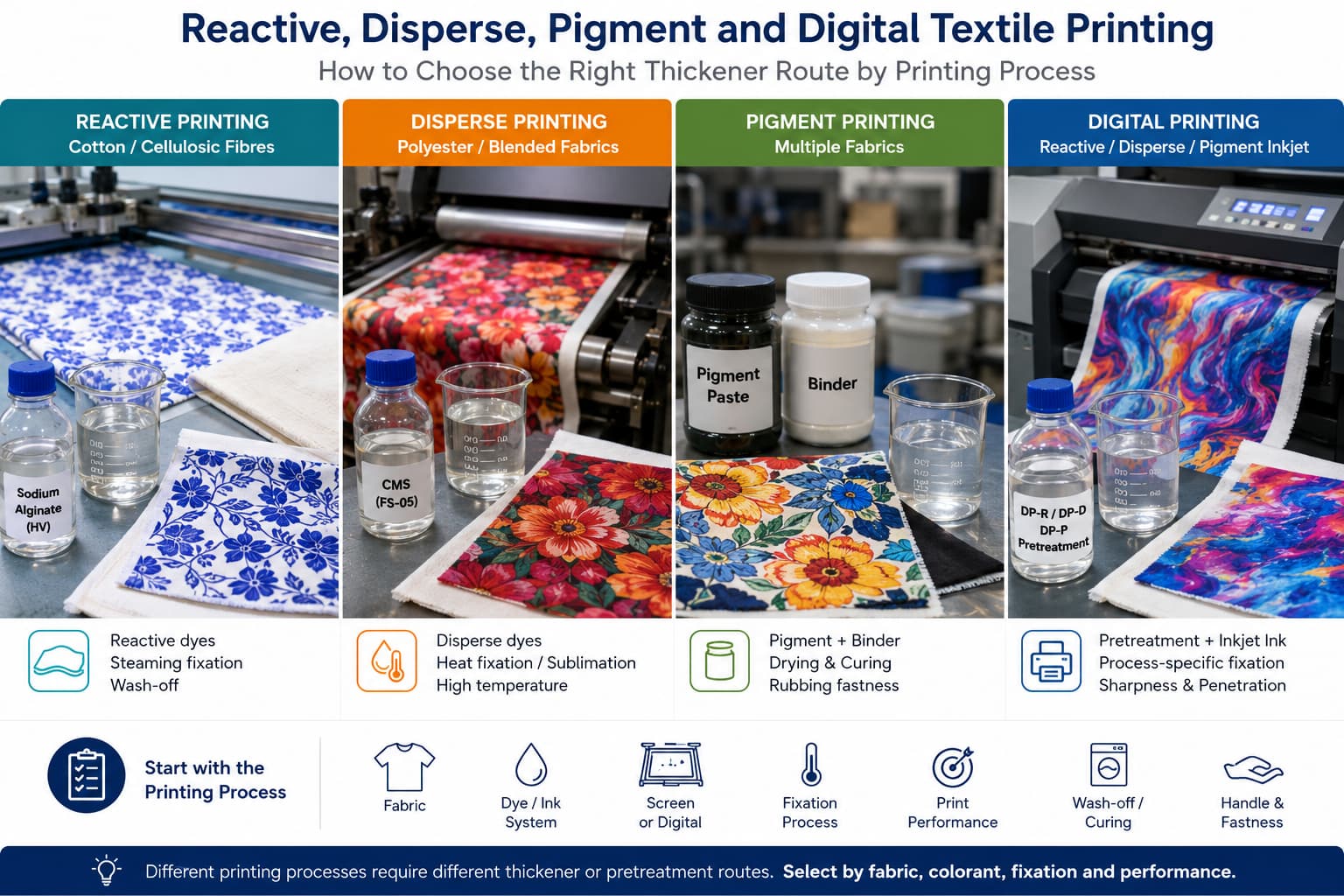
Learn how to choose thickener and pretreatment routes for reactive, disperse, pigment and digital textile printing based on fabric, dye or ink, fixation, wash-off and print-quality requirements.
Compare CMC, CMS, sodium alginate and digital printing paste for textile printing. Learn how each route fits reactive, disperse, pigment and digital processes, and what buyers should review before sample testing, grade matching and bulk purchase.
Sodium alginate is widely used in textile printing as a stable and washable thickener for reactive printing paste. Learn how to evaluate viscosity grade, purity, and application suitability before purchasing, and how FSX Chemical supports global buyers with technical data and samples.
Carboxymethyl cellulose (CMC) is widely used in the printing, sizing, and dyeing processes of textiles. This guide will explain how to evaluate CMC grades, which parameters are most important, and how FSX Chemical can support purchasing decisions.
Carboxymethyl cellulose is used as a thickener and stabilizer in water-based inks, gravure printing, and inkjet pre-treatment. This guide covers the key grade parameters and sourcing considerations for procurement teams.
Both sodium alginate and CMC are used as thickeners in textile printing, but they suit different dye systems and process conditions. This guide explains the key differences and when to use each.
Digital inkjet printing on textiles has different paste and pre-treatment requirements compared to screen printing. This guide explains how sodium alginate is used in digital textile printing and what grade parameters procurement teams should specify.
Food-grade and industrial-grade CMC share the same base chemistry but differ significantly in purity, DS range, and regulatory requirements. This guide explains the key differences and why using the wrong grade creates production problems.
Correct paste preparation is as important as grade selection in reactive dye textile printing. This guide covers sodium alginate dissolution methods, concentration ranges by application, storage conditions, and how to troubleshoot common preparation problems.
Sodium alginate is a natural, biodegradable polymer, but its use in textile printing generates wastewater that requires management. This guide covers the environmental profile of sodium alginate, washout effluent characteristics, and what procurement teams should understand about thickener choice and environmental impact.
Dye fixation rate directly affects color yield, wash fastness, and wastewater load in reactive dye printing. This guide explains how sodium alginate supports dye fixation, what paste parameters influence fixation rate, and how to troubleshoot low fixation in production.
Share the product name, application, quantity, destination and any TDS,
sample photo or document you already have. FSX Chemical will review the
information and recommend the next step for quotation, sample matching
or product selection.
Product InformationProduct name, grade, model, label photo or supplier reference.
Available DocumentsTDS, SDS, COA, sample photo, product list or test data.
Order DetailsEstimated quantity, packaging, destination country, port or trade term.
Application or IssueTextile printing process, formulation need, current issue or target performance.