Comparing Bulk Supply Options: FSX Chemical vs. Other Manufacturers
Bulk textile chemical sourcing should be evaluated through more than price per metric ton. Buyers...
Compare bulk textile chemical suppliers on the same application, exact commercial grade, agreed specification and delivered-cost basis. First qualify each candidate in the complete printing process; then calculate cost per accepted fabric output and review sample-to-bulk traceability, lead time and documentation. This framework applies equally to FSX Chemical and other suppliers and does not rank suppliers without comparable evidence.
What Should Buyers Compare in Bulk Textile Chemical Supply?
Bulk textile chemical purchasing is often discussed as a volume-pricing exercise. In practice, large orders create additional technical and supply-chain risks that are less important in small sample transactions.
For industrial textile printing, the buyer should compare the full supply relationship:
Product Grade → Sample → Test Method → Commercial Specification → Production Batch → Packaging → Shipping → Incoming QC → Production Performance → Repeat Order
This is particularly important for application-sensitive materials such as:
The first bulk-supply question should be technical:
Is the supplier offering the correct commercial grade for the customer’s actual application?
A supplier may offer sodium alginate, CMC, CMS or digital printing paste, but the product family alone is not enough.
Buyers should confirm:
Exact grade or product code
Target application
Viscosity and test concentration
Relevant substitution characteristics where applicable
Hydration
Filtration
Recommended dosage
Complete-formulation compatibility
For example, a high-viscosity sodium alginate grade should not be approved because its viscosity number appears higher than another supplier’s grade.
The test method, rheology, reactive dye compatibility, fixation and wash-off should also be evaluated.
Similarly, a CMC or CMS grade should not be treated as a universal replacement simply because the dry-powder viscosity appears similar.
2. Sample-to-Bulk Continuity
Bulk purchasing creates a critical question:
Will the commercial shipment represent the same product that passed the customer’s laboratory and production trial?
A robust supply chain should connect:
Candidate Grade → Representative Sample → Approved TDS → Production Trial → Bulk Order → Commercial Batch
Before placing a large order, buyers should verify:
The exact commercial grade represented by the sample
The applicable TDS version
The agreed viscosity or QC method
The packaging intended for bulk shipment
The commercial specification
The batch documentation available with shipment
After receipt of the first bulk order, retain a reference sample and repeat selected incoming QC tests.
This is one of the most important differences between buying a sample and qualifying a long-term bulk supplier.
3. Batch Consistency and Incoming QC
For repeat bulk supply, one good sample is not enough.
Buyers need confidence that commercial batches remain inside an application-relevant operating range.
Depending on the product, incoming QC may include:
Appearance
Batch number
Moisture
pH
Viscosity under a standardized method
Hydration behavior
Filtration
Laboratory application test
Consistency should not be misunderstood as zero variation.
Industrial chemicals are normally produced within specification ranges.
The key question is whether normal batch variation still produces stable printing performance.
For large printing mills, repeat-batch stability can have more economic value than a small purchase-price difference.
4. MOQ, Capacity and Order Flexibility
MOQ is an important commercial variable, but it should be evaluated together with production capacity and order planning.
Buyers should ask:
What is the standard MOQ?
Can different grades be combined in one shipment?
Can the supplier support trial-to-bulk scaling?
What is the normal monthly production capacity?
Can repeat orders be scheduled?
Are customized grades subject to different MOQs?
A very low MOQ can be useful for qualification, while reliable capacity becomes more important after conversion to commercial supply.
The ideal supplier structure depends on the buyer’s actual consumption pattern.
5. Lead Time and Supply Reliability
Bulk textile chemical supply must align with production planning.
Buyers should consider:
Normal production lead time
Packaging preparation
Export documentation time
Shipping schedule
Port congestion risk
Inventory planning
Safety stock
A lower-priced supplier can create a higher operational risk if lead times are inconsistent or the required grade is not routinely produced.
For repeat business, buyers should ask whether the supplier can maintain a stable production schedule rather than relying on one-time stock availability.
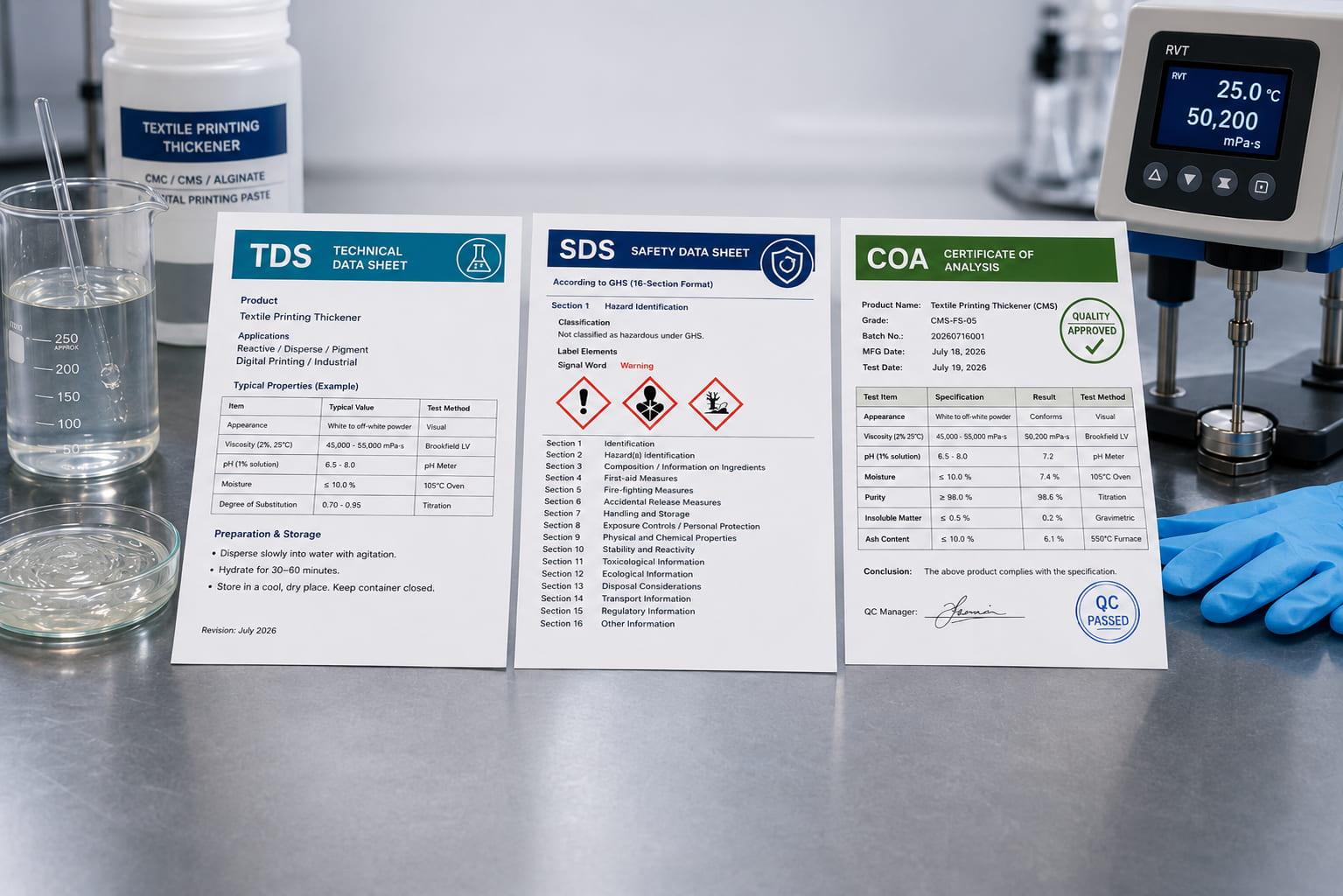
6. TDS, SDS, COA and Traceability
Bulk orders require clear documentation.
Document
Purpose
What Buyers Should Check
TDS
Defines technical properties and application guidance
Exact grade, specification logic, viscosity conditions and preparation guidance
SDS
Provides safety, handling and storage information
Correct product identity and transport/handling relevance
COA
Provides batch-specific quality data
Batch number, tested parameters and relationship to specification
Shipping documents
Support customs and commercial movement
Product description, quantity, packaging and consignee information
Buyers should understand the difference between a typical value on a TDS and an actual batch result on a COA.
Clear documentation supports incoming inspection, complaint investigation and repeat-order traceability.
7. Technical Support and Grade Matching
Bulk customers often need more technical support than sample buyers because a product change can affect a larger production volume.
A useful supplier should be able to discuss:
Current benchmark grade
Viscosity method
Effective dosage
Water quality
Mixing and hydration
Complete printing formula
Fabric
Printing machine
Fixation or curing
Current technical problem
FSX Chemical’s Samples & Matching process is designed to identify a technically relevant candidate before commercial conversion.
The correct objective is not to promise:
“Our product is exactly the same as your current supplier.”
It is to identify a candidate that can be tested side by side under controlled conditions.
8. Customization and Compound Thickener Development
Some bulk customers require more than a standard commercial grade.
Examples may include:
Target viscosity ranges
Specific dosage targets
Improved salt response
Different hydration characteristics
Compound thickener systems
Process-specific digital pretreatments
Customization can be useful when a standard product does not provide the required balance.
However, buyers should ask:
Is the customized grade reproducible?
What specification will control it?
What MOQ applies?
Will future batches use the same formulation logic?
Can a batch-specific COA be provided?
A customized product is only commercially useful when it can be manufactured consistently after approval.
9. Factory-Direct Communication vs. Multi-Layer Supply Chains
Factory-direct supply can reduce communication layers between the buyer and production/QC teams.
This can be useful for:
Grade matching
Test-method clarification
Sample-to-bulk control
Batch investigations
Customization
Repeat-order planning
However, factory-direct should not be treated as proof that a supplier is automatically better.
Distributors and trading companies can provide valuable services such as:
Local inventory
Small quantities
Local-language communication
Credit terms
Domestic delivery
Multi-product consolidation
The buyer should therefore compare supply models according to technical control, logistics efficiency and commercial needs.
10. Total Cost in Use for Bulk Purchasing
Bulk purchasing decisions should be finalized after the technically suitable dosage is known.
A practical Total Cost in Use model includes:
Delivered product cost
Effective dosage
Preparation time
Hydration energy
Filtration loss
Screen cleaning
Paste waste
Machine downtime
Fixation or curing impact
Washing demand
Rejected fabric
A useful formula is:
Cost per accepted output = (actual chemical consumption cost + preparation cost + attributable process-loss and interruption costs + additional post-treatment and rework costs) ÷ accepted fabric output. Use one currency and an output unit such as accepted m² or kg. Chemical consumption cost is delivered price per kg multiplied by actual kg consumed; dosage is an input to consumption, not a monetary term to add to price.
Use the same accounting boundary for every supplier. Include actual losses in consumption and count accepted output consistently. Avoid adding the same waste, downtime or rejected-fabric cost twice when it is already captured in batch costs or the output denominator. A lower quotation only becomes a saving after equivalent finished quality is achieved.
Normalize the Comparison Before Scoring Suppliers
Comparison item
Evidence to request from each supplier
Common mismatch to resolve
Product and application
Exact grade code, current TDS/SDS, intended dye or pigment system, sample label and commercial specification.
A generic family name or a laboratory sample is not a confirmed commercial purchase line.
Batch evidence
Lot-linked COA, specified versus typical values, agreed test method and retained sample.
Water viscosity without concentration, spindle, speed, temperature and preparation cannot rank grades.
An origin-port price and a delivered price have different cost boundaries.
Consumption
Actual supplied-product mass used at an approved recipe and measured process losses.
Powder and liquid supplied-product dosages are not directly comparable; nonvolatile solids do not always equal active polymer.
Accepted output
Finished fabric meeting the same definition, shade, handle and fastness requirements.
Gross printed length before rejection is not accepted output.
Service and supply
Agreed lead time, batch-release documentation, change-notification process and observed response to a defined technical issue.
Marketing claims about capacity or support are not proof of delivered performance.
Use “not obtained” where evidence is missing rather than giving an automatic zero or assuming performance. This is a proposed buyer worksheet. For rotational test comparability, see the Brookfield viscosity FAQ; it does not establish any supplier’s application performance.
FSX Chemical vs. Other Manufacturers: A Practical Comparison Framework
A responsible comparison should avoid unsupported claims about competitors.
Instead, buyers can apply the same evaluation criteria to FSX Chemical and any other manufacturer.
Evaluation Area
What to Verify with FSX Chemical
What to Verify with Other Manufacturers
Commercial grade
Exact product code, TDS and intended application
Exact product code, TDS and intended application
Sample quality
Representative sample linked to commercial grade
Representative sample linked to commercial grade
Viscosity method
Concentration, temperature, instrument and speed
Concentration, temperature, instrument and speed
Application matching
Ability to evaluate current product, formula and process
Ability to evaluate current product, formula and process
Batch consistency
Specification, COA and repeat-order verification
Specification, COA and repeat-order verification
Technical support
Response to laboratory and production feedback
Response to laboratory and production feedback
Customization
Availability subject to technical feasibility and MOQ
Availability subject to technical feasibility and MOQ
Supply reliability
Lead time, capacity, packaging and export execution
Lead time, capacity, packaging and export execution
Commercial value
Total Cost in Use after dosage optimization
Total Cost in Use after dosage optimization
This framework deliberately does not assume that FSX Chemical will be superior in every category.
The correct conclusion should come from the buyer’s own controlled evaluation.
FSX Chemical’s role is to provide a relevant candidate, clear technical information, sample support and commercial supply options for comparison.
How Bulk-Supply Evaluation Changes by Product Type
For a product offered under the FSX CMS series, first confirm the exact commercial identity and intended dye system through current grade-specific TDS/SDS. Use the documented QC panel; do not assign CMC substitution or a pure-starch specification to every commercial CMS grade. Then evaluate:
Viscosity efficiency
Hydration
Paste stability
Screen passage
Effective dosage
Dye-system compatibility
Digital Printing Products
For digital printing paste or pretreatment, first define whether the process is:
Reactive
Disperse
Pigment
The supplier should then be evaluated according to ink compatibility, fabric pretreatment, fixation and finished-textile performance.
Bulk Supplier Qualification Workflow
Step 1: Define the Current Benchmark
Record the current grade, TDS, dosage and process.
Step 2: Define the Bulk Requirement
Record expected order quantity, reorder frequency, packaging and delivery requirements.
Step 3: Shortlist Manufacturers
Compare technical fit, product range, production capability and communication.
Step 4: Request the Exact Candidate Grade
Avoid approving generic product descriptions.
Step 5: Align the Test Method
Standardize viscosity and other relevant QC conditions.
Step 6: Obtain Representative Samples
Confirm the sample is linked to routine commercial production.
Step 7: Test the Complete Formulation
Use the actual dyes, pigments, binders, salts, alkalis and auxiliaries.
Step 8: Run the Real Printing Process
Print the relevant fabric and complete fixation, curing or washing.
Step 9: Optimize Dosage
Do not assume one-to-one dosage replacement.
Step 10: Compare Total Cost in Use
Only compare commercial value after technical optimization.
Step 11: Review Bulk Supply Terms
Confirm MOQ, lead time, packaging, payment terms and documentation.
Step 12: Verify the First Bulk Shipment
Retain a reference sample and repeat key incoming QC tests.
Step 13: Monitor Repeat Orders
Long-term supplier approval should include multiple commercial batches.
Common Bulk-Supply Red Flags
Red Flag 1: Price Is the Only Differentiator
A low quotation without technical information creates supply risk.
Red Flag 2: No Exact Commercial Grade
The sample, TDS and commercial order should be linked to an identifiable product.
Red Flag 3: Viscosity Without Test Conditions
Viscosity cannot be compared reliably without concentration and measurement method.
Red Flag 4: “Guaranteed Identical Replacement” Without Testing
Red Flag 5: Sample Cannot Be Linked to Bulk Production
This creates a sample-to-bulk continuity risk.
Red Flag 6: No Batch Traceability
Commercial complaints are difficult to investigate without batch identification.
Red Flag 7: Unclear Lead Time
Supply uncertainty becomes more serious when production depends on large repeat orders.
Red Flag 8: Unsupported Competitor Claims
Buyers should rely on comparative testing rather than one supplier’s unverified statements about another manufacturer.
How Should Buyers Compare FSX Chemical with Other Bulk Manufacturers?
The comparison should be evidence-based and use the same criteria for every supplier.
A practical decision chain is:
Application Requirement → Candidate Grade → Sample → Standardized Test → Complete Formula → Production Trial → Bulk Terms → First Shipment Verification → Repeat-Batch Monitoring → Total Cost in Use
The strongest supplier is not automatically the cheapest, largest or closest manufacturer.
It is the supplier that provides the best overall fit for the buyer’s technical, supply and commercial requirements.
FSX Chemical should therefore be evaluated on the same basis as any other manufacturer: product suitability, batch consistency, technical support, sample-to-bulk control, documentation, supply reliability and optimized production cost.
Frequently Asked Questions
1. Is FSX Chemical cheaper than other textile chemical manufacturers?
That should not be assumed without comparing the exact grade, quantity, delivery terms and effective dosage. The better commercial comparison is Total Cost in Use.
2. What should I compare when buying textile chemicals in bulk?
Compare exact commercial grade, technical suitability, sample quality, batch consistency, MOQ, lead time, documentation, technical support, supply reliability and Total Cost in Use.
3. How can I verify that the bulk product matches the approved sample?
Confirm the exact grade and TDS, retain the approved sample, review batch-specific quality information and repeat key incoming QC tests on the first shipment.
4. Is factory-direct supply always better than buying from a distributor?
No. Factory-direct supply can improve technical communication and grade control, while distributors may provide local inventory, smaller quantities, credit or local service.
5. How should I compare sodium alginate manufacturers?
Compare viscosity under the same method, hydration, filtration, rheology, reactive printing performance, fixation, wash-off, batch consistency and commercial supply reliability.
6. How should I compare CMC or CMS manufacturers?
Compare the exact commercial grade, viscosity method, hydration, filtration, substitution characteristics where relevant, formulation compatibility and effective dosage.
7. Does a lower bulk price mean lower production cost?
Not necessarily. Higher dosage, downtime, waste or rejected fabric can eliminate the purchase-price saving.
8. What is a reasonable way to qualify a new bulk supplier?
Start with documentation and representative samples, complete laboratory and production validation, then verify the first bulk shipment before full conversion.
9. Can FSX Chemical provide customized textile thickener systems?
Customized or compound routes can be evaluated when the technical target and purchasing requirement justify development. Feasibility, specification and MOQ should be confirmed for the specific project.
10. What documents should accompany bulk textile chemicals?
Depending on the product and shipment, buyers commonly review the TDS, SDS, COA and relevant commercial or shipping documentation.
11. How important is lead time for bulk chemical sourcing?
Lead time is critical because delayed chemicals can affect production planning. Buyers should evaluate production time, shipping time and appropriate safety stock.
12. What information should I send to compare FSX with my current manufacturer?
Start with your current grade or TDS and intended printing application. Once a candidate is identified, align the viscosity method and test recipe; quantity, delivery, packaging and commercial targets can be confirmed when preparing a comparable quotation.
Compare Your Current Bulk Supplier with FSX Chemical
If you are evaluating a second source or comparing your current textile chemical manufacturer with FSX Chemical, start with a controlled technical comparison rather than quotation price alone.
The most useful bulk-supply comparison is not FSX Chemical versus another manufacturer’s marketing claims. It is an evidence-based comparison of grade suitability, consistency, support, supply reliability and Total Cost in Use under your actual production conditions.
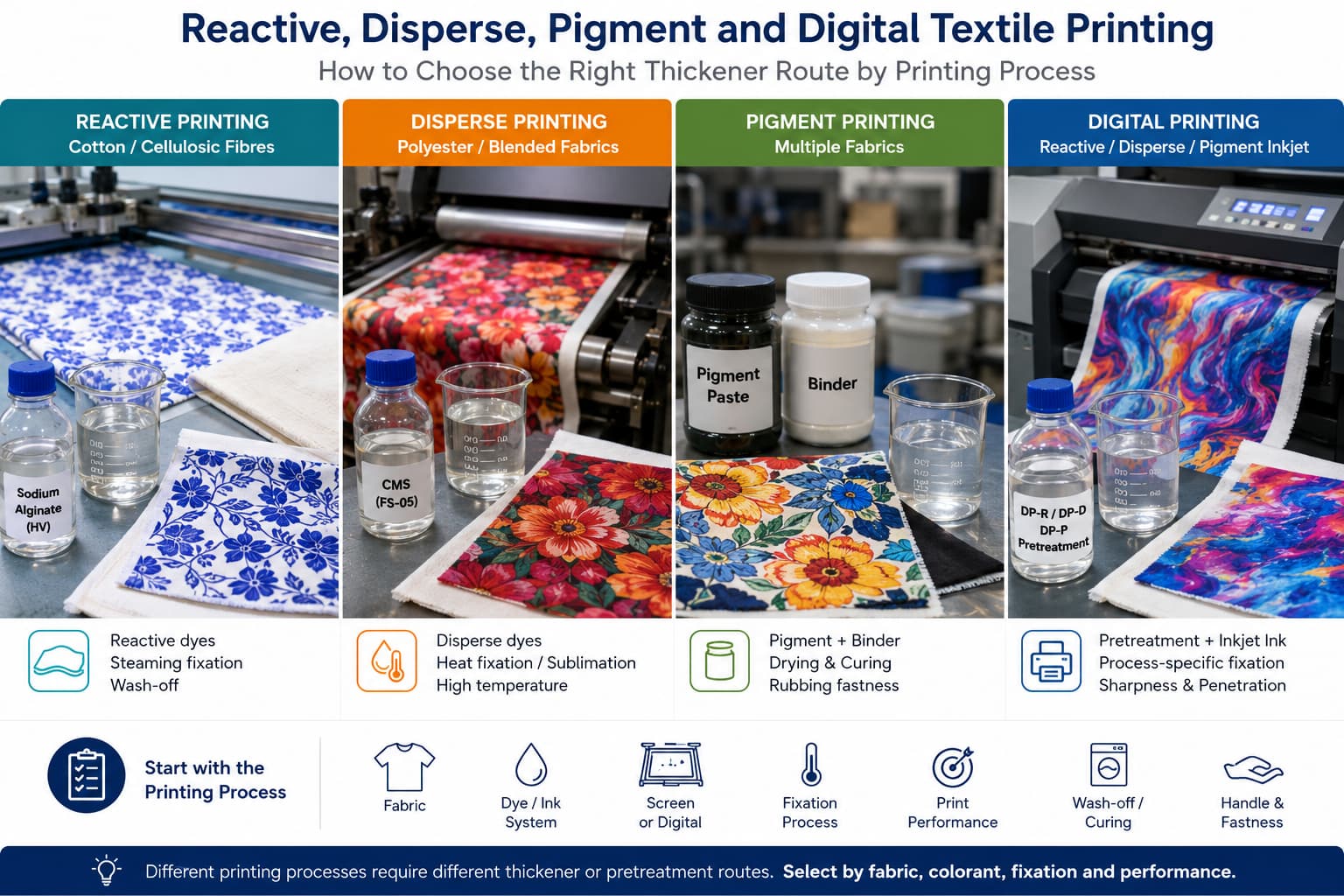
Learn how to choose thickener and pretreatment routes for reactive, disperse, pigment and digital textile printing based on fabric, dye or ink, fixation, wash-off and print-quality requirements.
Learn the difference between TDS, SDS and COA documents, what textile printing buyers should verify, and how to check specifications, safety data, test methods, batch results and document issuers.
Compare CMC, CMS, sodium alginate and digital printing paste for textile printing. Learn how each route fits reactive, disperse, pigment and digital processes, and what buyers should review before sample testing, grade matching and bulk purchase.
Sodium alginate is widely used in textile printing as a stable and washable thickener for reactive printing paste. Learn how to evaluate viscosity grade, purity, and application suitability before purchasing, and how FSX Chemical supports global buyers with technical data and samples.
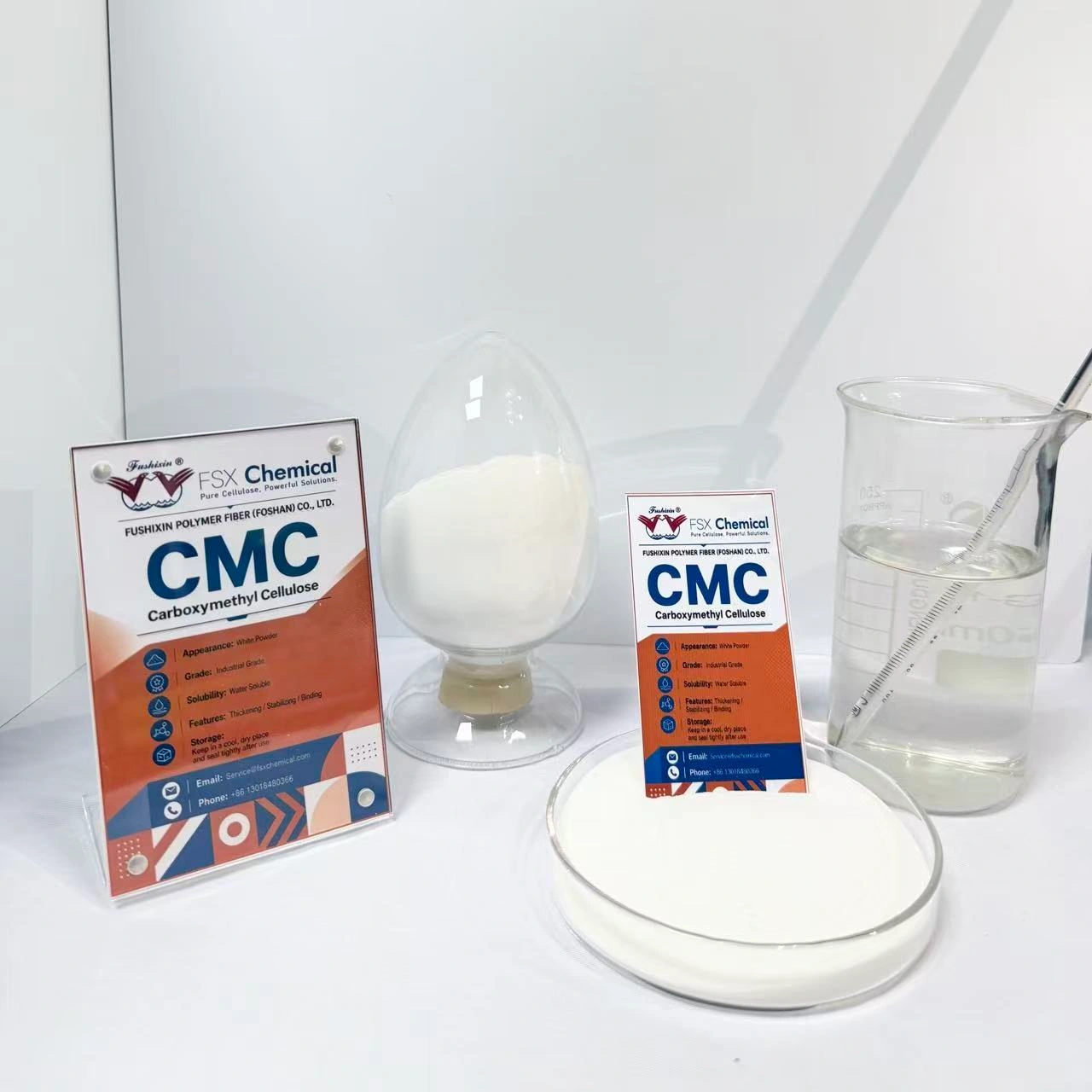
Carboxymethyl cellulose (CMC) is widely used in the printing, sizing, and dyeing processes of textiles. This guide will explain how to evaluate CMC grades, which parameters are most important, and how FSX Chemical can support purchasing decisions.
Carboxymethyl cellulose is used as a thickener and stabilizer in water-based inks, gravure printing, and inkjet pre-treatment. This guide covers the key grade parameters and sourcing considerations for procurement teams.
Both sodium alginate and CMC are used as thickeners in textile printing, but they suit different dye systems and process conditions. This guide explains the key differences and when to use each.
Digital inkjet printing on textiles has different paste and pre-treatment requirements compared to screen printing. This guide explains how sodium alginate is used in digital textile printing and what grade parameters procurement teams should specify.
Food-grade and industrial-grade CMC share the same base chemistry but differ significantly in purity, DS range, and regulatory requirements. This guide explains the key differences and why using the wrong grade creates production problems.
Correct paste preparation is as important as grade selection in reactive dye textile printing. This guide covers sodium alginate dissolution methods, concentration ranges by application, storage conditions, and how to troubleshoot common preparation problems.
Assess sodium alginate in reactive-printing wastewater using measured COD load, product-specific biodegradation evidence and controlled process comparisons. Includes a buyer checklist and illustrative load calculation.
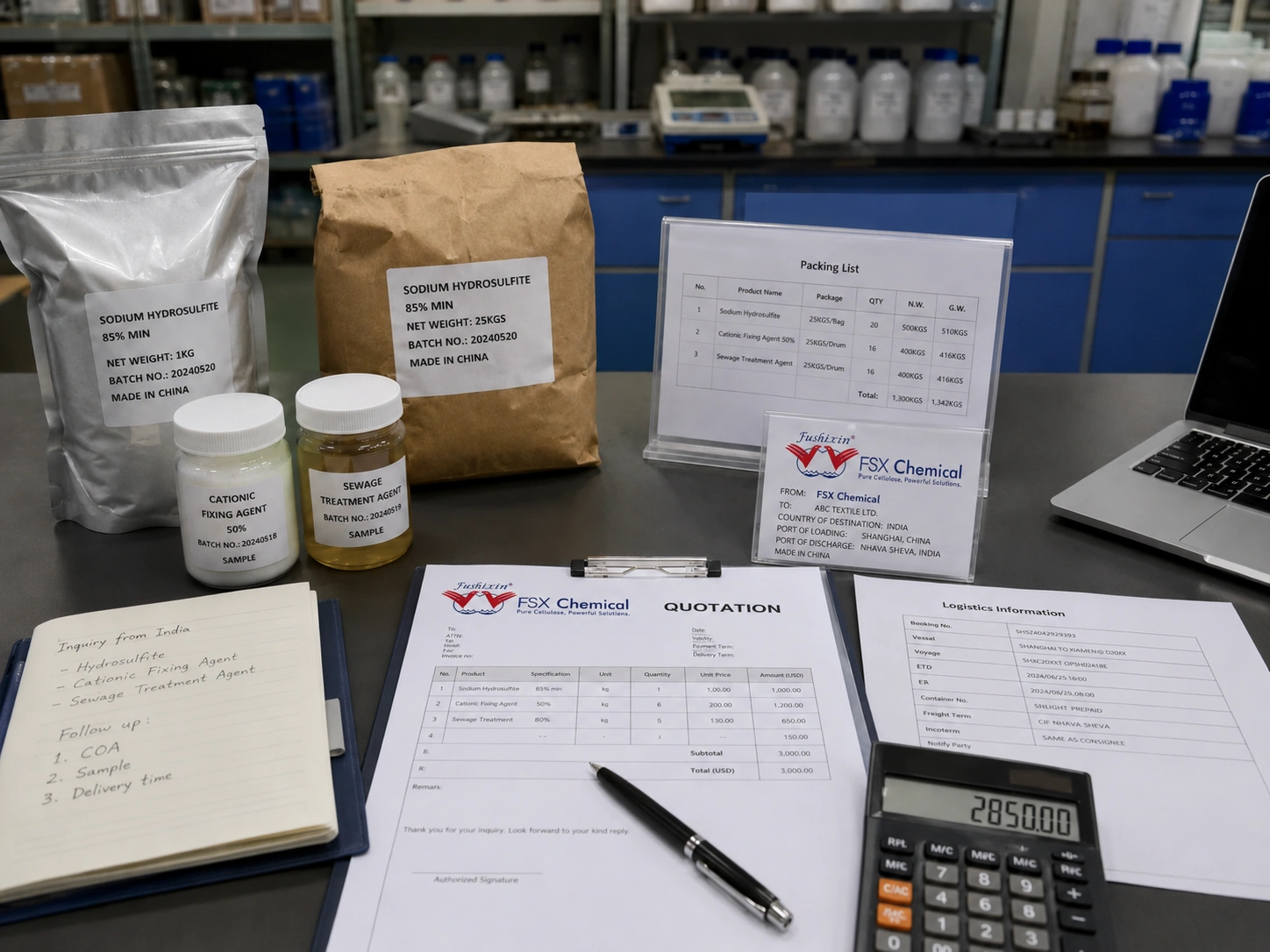
Share the product name, application, quantity, destination and any TDS,
sample photo or document you already have. FSX Chemical will review the
information and recommend the next step for quotation, sample matching
or product selection.
Product InformationProduct name, grade, model, label photo or supplier reference.
Available DocumentsTDS, SDS, COA, sample photo, product list or test data.
Order DetailsEstimated quantity, packaging, destination country, port or trade term.
Application or IssueTextile printing process, formulation need, current issue or target performance.