














CMS vs. Tamarind Gum for Polyester Disperse Printing: A Practical Comparison
Carboxymethyl starch (CMS) and tamarind-derived thickeners are both established candidates for polyester disperse screen printing, but they should not be compared by raw-material price or stock-paste viscosity alone. The two thickener families can differ in hydration, rheology, elasticity, screen running, dye release, wash-off and batch consistency. Modified tamarind products such as carboxymethyl tamarind gum can provide strong pseudoplastic behavior and good screenability, while CMS can offer useful flow, elasticity and compound-thickener flexibility in selected systems. This guide shows textile mills how to compare CMS and tamarind gum under the same dye, fabric, screen, fixation and post-treatment conditions before choosing a production route.
What Are We Actually Comparing?
In polyester disperse printing, a thickener has to do more than create a high viscosity.
It must help the print paste:
- Remain stable after disperse dye and auxiliaries are added
- Flow through flat or rotary screens under shear
- Recover enough structure after printing
- Maintain pattern definition
- Allow useful dye transfer into polyester during thermal fixation
- Wash or clear away without excessive residue
CMS and tamarind-based thickeners can both satisfy these requirements in selected formulations.
The correct comparison is therefore:
Hydration → Complete Paste Rheology → Screen Running → Thermal Dye Release → Wash-Off → Finished Polyester → Total Cost in Use
not simply:
CMS viscosity vs. tamarind viscosity.
CMS and Tamarind Gum Are Product Families, Not Single Specifications
CMS
Carboxymethyl starch is produced by introducing carboxymethyl groups into starch.
Commercial CMS grades can differ in:
- درجة الاستبدال
- Molecular size
- Starch source
- Oxidation level
- التنقية
- Particle form
- اللزوجة
Published research on CMS for polyester disperse printing shows pseudoplastic behavior and print color strength comparable with conventional thickener systems under selected conditions.
See research on CMS products used as textile printing thickeners.
Tamarind Gum
Tamarind seed polysaccharides are obtained from the kernel of Tamarindus indica.
Commercial textile products may include:
- Tamarind kernel powder
- Purified tamarind gum
- Carboxymethyl tamarind gum
- Other chemically modified tamarind derivatives
These products should not be treated as identical.
Research on tamarind gum in polyester disperse printing has shown good color strength, sharpness, handle and fastness for selected tamarind materials, while carboxymethyl tamarind gum has also demonstrated strong pseudoplastic behavior and good screenability.
See tamarind gum research in polyester disperse printing.
CMS vs. Tamarind Gum: Practical Comparison
| مجال التقييم | مسار CMS | Tamarind / CTG Route |
|---|---|---|
| Raw-material family | النشا المعدل | Tamarind seed polysaccharide / modified tamarind gum |
| Main printing role | Thickening and rheology control | Thickening and rheology control |
| Typical rheology | Can be pseudoplastic; grade-dependent | Can be strongly pseudoplastic; modification-dependent |
| الترطيب | Depends on grade, particle form and preparation | Depends strongly on raw vs. modified grade |
| Screen running | Can be good when shear flow and recovery are matched | Modified CTG can provide strong screenability in selected systems |
| Dye release | CMS film structure can support disperse dye release | Must be validated by final K/S after fixation |
| قابل للغسل | Grade and dosage dependent | Modification and film hydration dependent |
| Batch variability | Depends on manufacturing control and starch source | Raw tamarind source and purification can create variation |
| Compound thickener use | Often useful | Often useful |
The table describes useful comparison directions, not a universal winner.
1. Hydration and Stock-Paste Preparation
Stock-paste preparation affects every later result.
When comparing CMS and tamarind, record:
- Powder concentration
- جودة المياه
- Powder addition method
- Mixing speed
- Mixing time
- وقت الترطيب
- درجة الحرارة
A modified tamarind product may be engineered for rapid cold-water hydration, while an untreated tamarind kernel product can require a different preparation route.
Likewise, CMS grades can vary in dissolution rate and paste body.
Therefore, do not compare a fully optimized CTG stock paste with a poorly hydrated CMS stock paste—or the reverse.
Each product should first be prepared using a method appropriate to that grade, then compared under production-relevant conditions.
2. Rheology: More Important Than One Viscosity Number
Both CMS and tamarind derivatives can show pseudoplastic or shear-thinning behavior.
This is important because the paste experiences different shear conditions during:
- التخزين
- Pumping
- الخلط
- Squeegee movement
- Rotary-screen transfer
Research on carboxymethyl tamarind gum has shown typical pseudoplastic behavior, rapid shear thinning and useful viscosity recovery in disperse-printing applications.
Research on CMS also shows pseudoplastic behavior, with rheology changing according to CMS structure and molecular characteristics.
This means:
Same low-shear viscosity does not mean the same flow under the screen.
A useful comparison should include:
- Low-shear paste body
- Flow under printing shear
- Recovery after shear
- Elasticity / stringiness
- Screen release
3. Screen Running and Structural Recovery
The thickener should flow through the screen but then recover enough structure to maintain the printed shape.
If Recovery Is Too Slow
The print may show:
- Spreading
- Soft outlines
- Lower detail
- Excess penetration
If the Paste Is Too Elastic or Resistant
The machine may show:
- Poor screen passage
- Stringiness
- Incomplete pattern filling
- Higher squeegee pressure requirement
Published CTG research reported better screenability than sodium alginate in the specific georgette disperse-printing system studied.
That result should not be generalized into “tamarind always runs better than CMS,” because CMS and CTG have different grade structures and can also be blended.
4. Color Yield and Dye Release During Fixation
Wet printing is only the first half of disperse printing.
After drying, the disperse dye is trapped in a thickener film on the polyester surface.
During thermal fixation, the dye must leave that film and diffuse into polyester.
Research on thickener films has shown that polymer-film structure can influence disperse dye release during thermal processing.
Sodium carboxymethyl starch has been reported to behave differently from more homogeneous film-forming polymers because its dried film can be more heterogeneous.
See research on disperse dye release from thickener films.
Therefore, the relevant comparison is final:
- K/S or color strength
- Shade
- Brightness
- Penetration
- الاستواء
after identical:
- التجفيف
- التثبيت الحراري
- Washing / reduction clearing
A paste that looks darker before fixation does not automatically deliver higher final color.
5. Wash-Off, Residue and Fabric Hand
After fixation, the thickener film should be removed sufficiently by the selected post-treatment.
Compare:
- Wash-off speed
- Residual surface film
- Fabric harshness
- ثبات اللون عند الفرك
- نظافة الخلفية
Modified tamarind thickeners are often marketed around rapid film rehydration and wash-off, while CMS grades can also show good post-treatment removal when correctly matched.
However, supplier claims should be verified with the same fabric and washing route.
Do not judge hand feel immediately after thermal fixation if the production process includes later reduction clearing or washing.
6. Salt, pH and Water-Quality Response
CMS and modified tamarind gum are commonly anionic systems.
Their viscosity can respond to:
- الرقم الهيدروجيني
- Electrolytes
- Hard water
- Calcium and magnesium
- Disperse dye dispersants
For supplier comparison, use the same:
- Plant water
- Dye dispersion
- Auxiliary package
- pH adjustment
If one product is tested in DI water and the other in production water, the comparison is not controlled.
A grade with excellent stock-paste viscosity can still change after the full disperse formula is added.
7. Paste Holding Stability
Color paste should remain inside a usable rheological window during the real working period.
Measure:
- Initial viscosity
- Viscosity after the normal waiting period
- Viscosity near the end of the planned shift
- الرغوة
- جزيئات الهلام
- Phase separation
- Evaporation sensitivity
CMS and tamarind may age differently in the same color paste.
Do not choose from the first viscosity reading only.
8. Batch Consistency and Raw-Material Variation
Natural-polymer-derived thickeners require manufacturing control.
Tamarind gum can vary with:
- Seed source
- التنقية
- Protein and polysaccharide composition
- Chemical modification
A study comparing tamarind gums from different regions of Thailand with a commercial Indian tamarind gum found only slight printing differences under the reported test conditions, showing that multiple sources can work when composition and processing are suitable.
CMS consistency can also vary with:
- Starch source
- Oxidation level
- درجة الاستبدال
- Molecular size
- التنقية
Supplier qualification should therefore include repeat-batch testing for either thickener family.
9. Polyester Construction and Printing Style
The preferred thickener can change with fabric structure.
Evaluate separately for:
- Dense woven polyester
- Lightweight polyester
- Knitted polyester
- Georgette
- Microfiber
- Brushed fabric
- Stretch fabric
A route requiring high penetration or double-sided appearance may favor different rheology from a surface-definition print.
This is why published georgette results should not automatically be transferred to every polyester substrate.
10. Double-Sided and High-Penetration Printing
Double-sided printing creates a useful example of the trade-off between:
Penetration ↔ Levelness ↔ Outline Sharpness
Too little penetration gives poor back-side color.
Too much uncontrolled flow reduces definition.
A 2017 study comparing CTG, CMS and CTG/CMS mixtures on disperse-printed georgette found that the blended systems could improve the balance among color yield, penetrability, levelness, hand, fastness and outline sharpness.
This does not establish one universal blend ratio.
It demonstrates a more important principle:
CMS and tamarind can be complementary rheology components rather than only competing raw materials.
Why CMS + Tamarind Compound Thickeners Can Be Worth Testing
Mixing two thickeners can change:
- Flowability
- Elasticity
- Weak-gel structure
- Shear recovery
- Penetration
- Dye release
Research on carboxymethyl tamarind gum and CMS mixtures showed that increasing CMS proportion changed flowability and elasticity, and selected blends outperformed either thickener alone in that specific double-sided georgette printing system.
A compound-thickener trial can therefore make sense when:
- CTG gives good screenability but penetration needs adjustment
- CMS gives useful flow but recovery needs adjustment
- The mill wants to balance cost and print performance
- One product alone leaves a wash-off or handling gap
However:
Do not copy a published CTG:CMS ratio as a universal commercial formula.
Build the blend around the actual fabric, screen and fixation route.
Thermal Fixation: The Thickener Must Release the Dye
The thermal process can include high-temperature steaming, dry heat or another dye-supplier-approved route.
The exact temperature/time should not be determined by the thickener article alone.
During fixation, compare CMS and tamarind for:
- Dye release
- Final color strength
- Shade change
- Thickener yellowing
- Surface residue
The most important technical principle is:
The thickener must control the dye before fixation and then interfere as little as possible with dye transfer during fixation.
How to Compare CMS and Tamarind Gum in the Lab
Step 1: Define the Current Benchmark
Record the current thickener, dosage, stock-paste concentration and printing formula.
Step 2: Prepare Each Candidate Correctly
Use its recommended hydration method, but record all differences.
Step 3: Standardize Final Paste Conditions
Use the same:
- Disperse dye
- Dye concentration
- Auxiliaries
- الماء
- الرقم الهيدروجيني
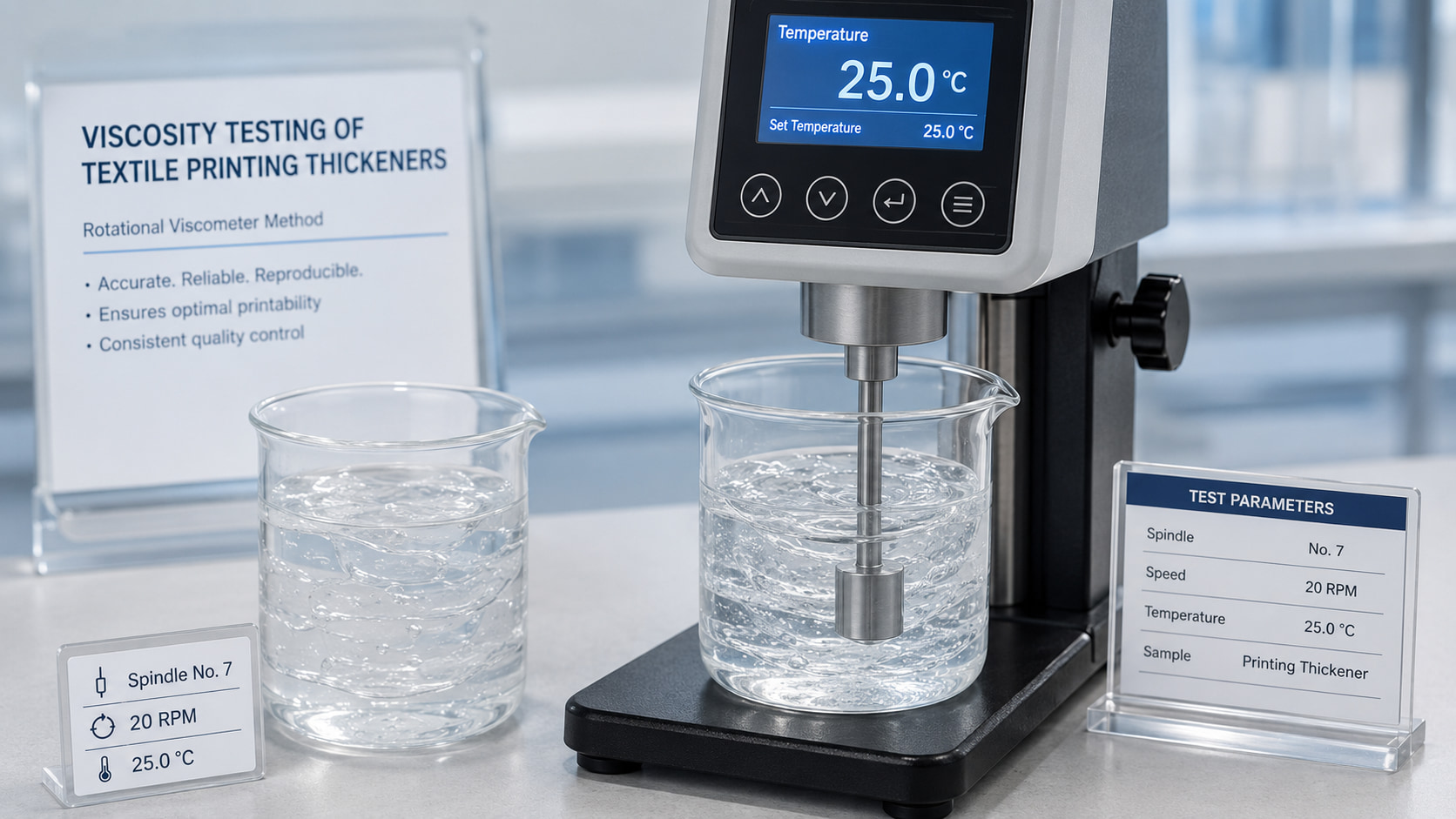
Step 4: Measure Stock and Complete-Paste Viscosity
Use the same test temperature, viscometer, spindle/rotor, RPM and reading time.
Step 5: Check Holding Stability
Recheck after realistic waiting periods.
Step 6: Print a Diagnostic Pattern
Include fine lines, small text, solids and high-coverage areas.
Step 7: Record Screen Behavior
Observe flow, release, foam, clogging and recovery.
Step 8: Fix and Wash Identically
Use one thermal and post-treatment process.
Step 9: Evaluate Finished Polyester
Compare:
- K/S
- الحدة
- الاستواء
- Penetration
- Fastness
- قابل للغسل
- Fabric hand
How to Run a Production Trial
After laboratory screening, test the best candidates at production scale.
Verify:
- Large-batch hydration
- Color-kitchen consistency
- Pump and circulation stability
- Screen running over realistic machine length
- Left-center-right uniformity
- Thermal fixation consistency
- Washing/clearing behavior
- Repeatability between batches
Production approval should be based on an operating window rather than one successful laboratory swatch.
Troubleshooting Comparison Table
| Observed Difference | What to Check | Do Not Conclude Too Quickly |
|---|---|---|
| Tamarind stock paste is easier to prepare | Modified vs. raw grade, hydration method | All tamarind products hydrate faster than all CMS |
| CMS runs better through one screen | Shear response, mesh, squeegee, concentration | CMS is universally better for screen running |
| Tamarind gives higher K/S | Dye release, deposit, fixation, wash-off | The raw thickener inherently gives more color in every system |
| CMS gives stronger penetration | Rheology, deposit weight, screen settings | Higher penetration is always better |
| Blend outperforms both single thickeners | Flowability, elasticity, weak-gel balance | The same blend ratio will work on every fabric |
| One route gives softer hand | Dosage, wash-off, residue, fixation | Polymer family alone controls hand |
| Lab winner performs poorly in production | Scale-up mixing, water, machine shear, holding time | The research or lab result guarantees production |
How to Compare Total Cost in Use
Do not compare only the purchase price per kilogram.
Compare:
- Thickener price
- Required stock-paste concentration
- Required printing dosage
- وقت الترطيب
- Energy and labor
- Screen-running efficiency
- Dye utilization
- Wash-off load
- Rework
- القماش المرفوض
A useful commercial model is:
Total Cost in Use = Thickener Cost + Preparation + Machine Efficiency + Fixation/Washing + Rework + Quality Loss
A higher-priced tamarind derivative may be economical if it uses less material or improves long-run screenability.
A CMS route may be more economical if it delivers stable printing at a lower effective dosage.
A compound system may be better than either if it reduces total process losses.
The correct comparison is production cost per acceptable printed meter—not powder price alone.
When Should You Test CMS, Tamarind or a Blend?
Test CMS When:
- The mill wants a starch-based disperse thickener route
- Paste flow or elasticity needs adjustment
- A compound-thickener strategy is being developed
- Current tamarind economics or supply consistency needs an alternative
Test Tamarind / CTG When:
- Strong pseudoplasticity and screenability are priority targets
- The mill already has good experience with tamarind-based disperse pastes
- Wash-off and hand are important evaluation points
Test a CMS + Tamarind Blend When:
- Neither single thickener balances penetration and definition
- Long-run rheology needs adjustment
- Cost-performance optimization requires a compound system
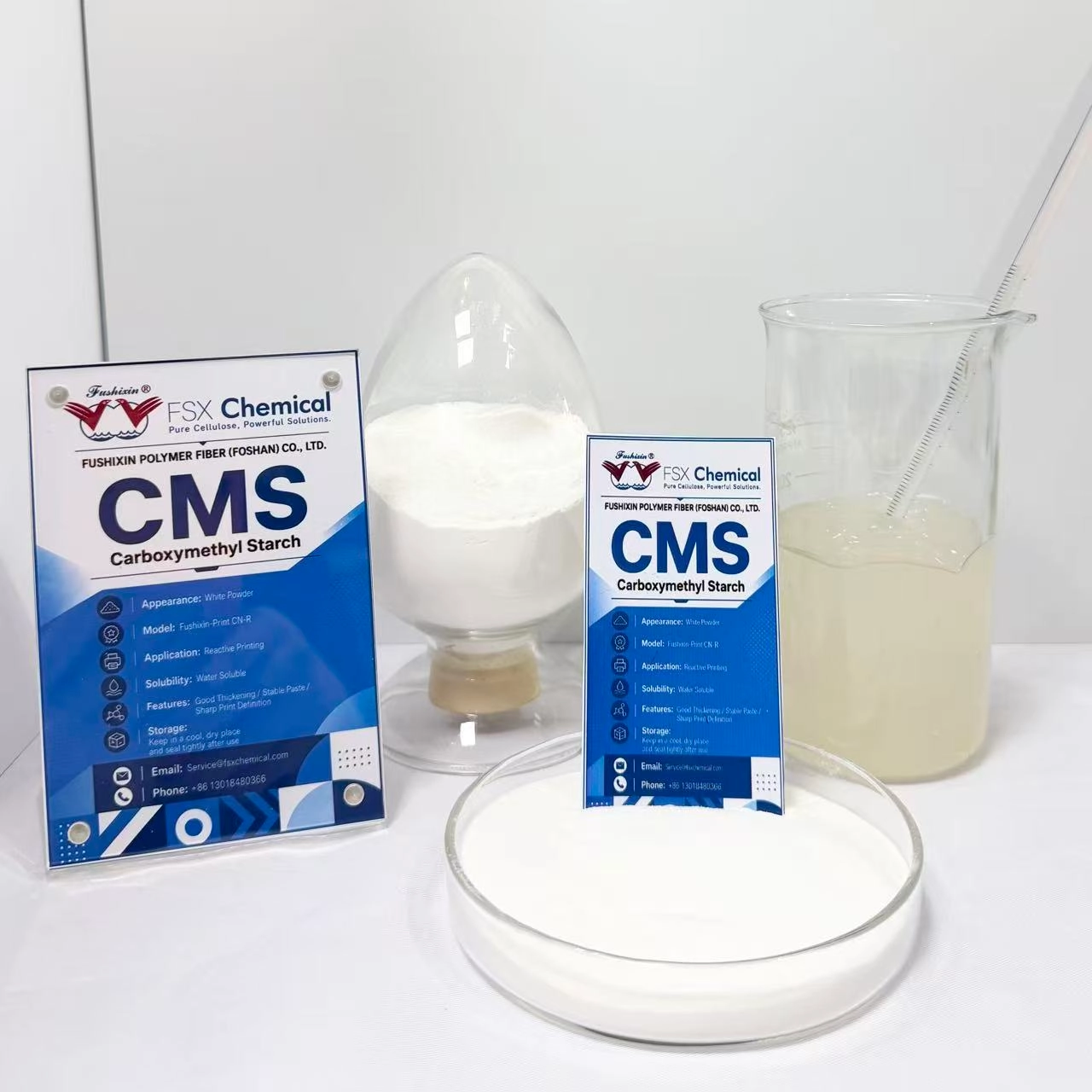
FSX Chemical’s current FS-05 route is developed for disperse-printing evaluation and should be compared against the customer’s existing tamarind or compound thickener under the same formulation and machine conditions.
مراجعة FSX Chemical Carboxymethyl Starch (CMS) for current grade information.
What Information Should You Send to a Thickener Supplier?
For a useful CMS-vs-tamarind comparison, provide:
- Current tamarind/CMS product or TDS
- Current stock-paste concentration
- Current printing dosage
- Viscosity and full test method
- Polyester construction and weight
- Flat or rotary screen
- Screen mesh/engraving where available
- Disperse dye brand/type
- Dye loading
- Complete or simplified formula
- Water quality where relevant
- Paste holding time
- Thermal fixation route
- Washing/reduction clearing conditions
- Main target: screen running, K/S, penetration, wash-off, hand or cost
FSX Chemical can use this information through العينات والمطابقة to compare FS-05 against the current tamarind route or to evaluate a compound-thickener direction.
Which Thickener Is Better for Polyester Disperse Printing?
There is no universal winner.
A practical decision chain is:
Hydration → Complete Paste Rheology → Screen Running → Pattern Definition / Penetration → Thermal Dye Release → Wash-Off → Hand → Repeatability → Total Cost in Use
The key principles are:
- CMS and tamarind gum are product families, so compare specific grades—not generic names.
- Same viscosity does not mean the same rheology or screen behavior.
- Final K/S must be measured after identical fixation and post-treatment.
- Raw tamarind gum and modified CTG should not be treated as the same material.
- CMS and CTG can be complementary in compound-thickener systems.
- The lowest Total Cost in Use is more important than the lowest powder price.
الأسئلة الشائعة
1. Is CMS suitable for polyester disperse printing?
Yes, selected CMS grades can be used as disperse printing thickeners or compound-thickener components when paste stability, screen running, fixation and wash-off are validated.
2. Is tamarind gum suitable for polyester disperse printing?
Yes. Tamarind and modified tamarind derivatives have a long history in disperse screen printing and published studies show useful color, sharpness, hand and fastness in selected polyester systems.
3. Is tamarind gum better than CMS?
Not universally. Performance depends on the specific CMS or tamarind grade, dosage, rheology, polyester, screen and fixation route.
4. Does tamarind gum always give better screen running?
No. Modified CTG has shown strong screenability in published systems, but commercial CMS grades can also run well when their rheology is correctly matched.
5. Which gives higher color strength?
Either can give high K/S in an optimized system. Final color depends on paste deposit, dye release, fixation and post-treatment as well as thickener type.
6. Can CMS and tamarind be mixed?
Yes. Published research shows CTG/CMS mixtures can change flowability, elasticity, penetration and print performance. The optimum ratio is formulation-specific.
7. Should I copy a published CTG:CMS blend ratio?
No. A research optimum belongs to its specific fabric, dye, concentration and printing conditions. Build your own blend curve.
8. Which thickener is easier to wash off?
That depends on product modification, dosage, thermal history and washing route. Compare residual film and fabric hand after the same post-treatment.
9. Does natural tamarind gum have more batch variation?
Raw-material origin can affect composition, but good purification and modification can control commercial consistency. CMS also requires repeat-batch qualification.
10. Which is cheaper: CMS or tamarind gum?
Raw-material price varies by grade and market. Compare required dosage, preparation, screen efficiency, wash-off and rejected fabric to determine Total Cost in Use.
11. What should I compare besides viscosity?
Compare hydration, shear behavior, recovery, holding stability, screen running, K/S, penetration, wash-off, hand and batch repeatability.
12. What should I send FSX Chemical for CMS-vs-tamarind matching?
Send the current thickener/TDS, dosage, viscosity method, polyester, disperse dye, formula, screen route, fixation, washing conditions and main performance target.
Compare CMS and Tamarind Gum with FSX Chemical
If you are currently using tamarind gum, CTG or another disperse thickener and want to evaluate a CMS route, FSX Chemical can help structure a controlled comparison rather than relying on viscosity or price alone.
For a useful trial, send:
- Your current thickener sample, TDS or COA
- Current stock-paste concentration
- الجرعة الحالية
- Viscosity and complete test method
- Polyester fabric construction
- Flat or rotary screen conditions
- Disperse dye type and loading
- Complete or simplified formula
- Plant-water information where relevant
- Paste holding time
- Thermal fixation route
- Washing/reduction clearing
- Current screen-running, penetration, color, hand or cost target
ابدأ بـ العينات والمطابقة for a side-by-side evaluation.
مراجعة FSX Chemical Carboxymethyl Starch (CMS) for the current disperse-printing route.
You can also اطلب عرض أسعار مباشر من المصنع after the technically suitable route is identified or اتصل بشركة FSX Chemical for a formulation discussion📧 البريد الإلكتروني: Service@fsxchemical.com
For polyester disperse printing, the best thickener is not the one with the most familiar name or the highest stock viscosity. It is the CMS, tamarind or compound system that delivers the required rheology, screen running, dye release, wash-off and finished-fabric quality at the lowest stable Total Cost in Use.
مقالات ذات صلة
كيفية مقارنة طرق اختبار لزوجة مكثفات طباعة المنسوجات
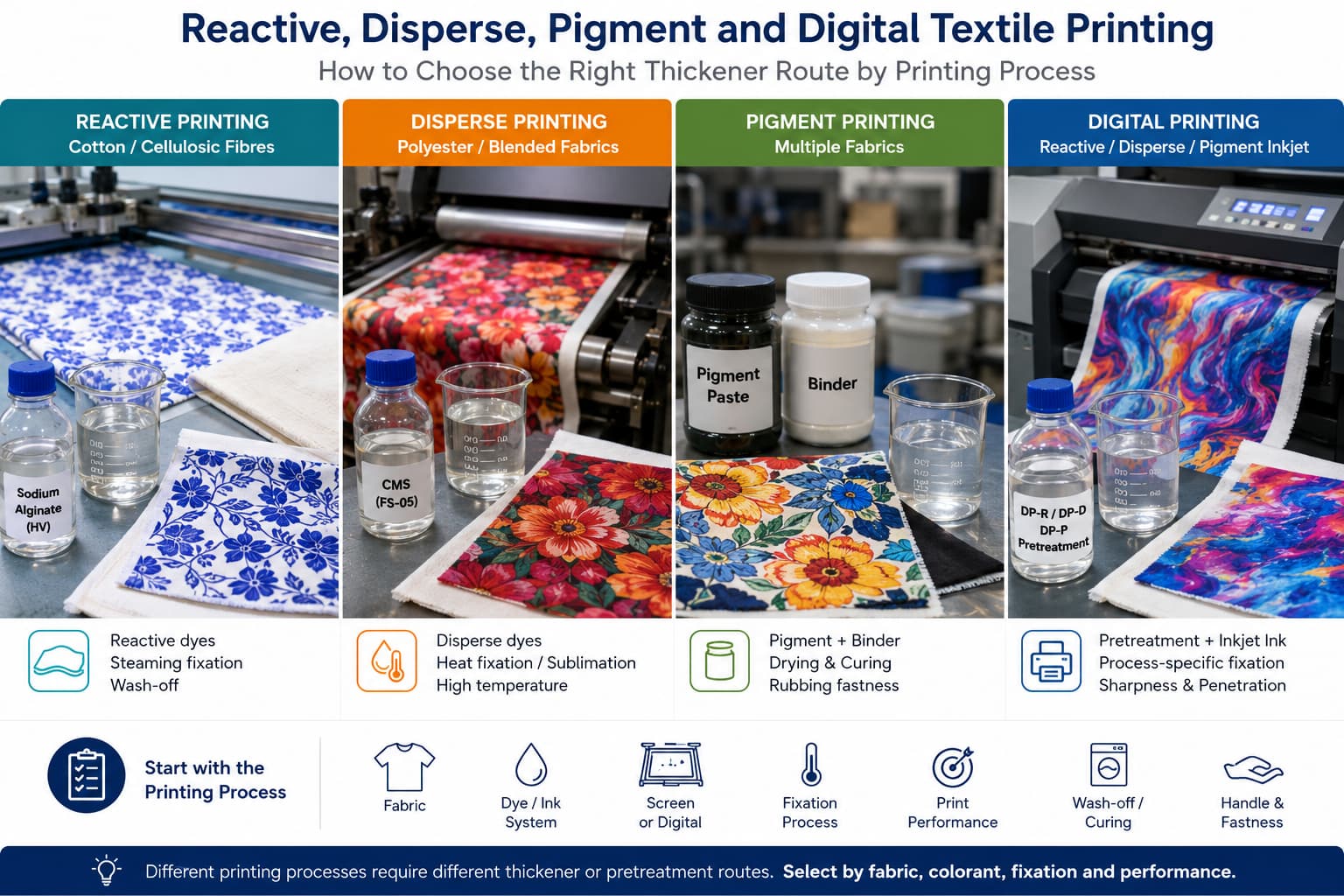
الطباعة النسيجية التفاعلية، والمشتتة، والصبغية، والرقمية: كيفية اختيار طريقة المكثف المناسبة
CMC مقابل CMS مقابل ألجينات الصوديوم مقابل معجون الطباعة الرقمية: دليل عملي للاختيار
الطباعة باستخدام ألجينات الصوديوم والبوليستر: فهم القيود
نظام إدارة المحتوى (CMS) لمعجون طباعة المنسوجات: دليل مطابقة الدرجات واختبار العينات
مورد المواد الخام السليلوزية لقطاعي النسيج والطباعة: ما يجب على المشترين التأكد منه
مورد مشتقات السليلوز لقطاعي المنسوجات والطباعة: دليل شامل للتوريد والتصدير
مورد المواد الكيميائية لصناعة النسيج: دليل مطابقة المنتجات لمشتري منتجات الطباعة
دعم التركيبات الكيميائية لقطاع المنسوجات والطباعة: ما يجب على المشترين توفيره
كيفية اختيار نشا الكربوكسي ميثيل (CMS) لتثبيت المنسوجات والطباعة الرقمية
كيفية اختيار المُكثِّف المناسب لطباعة المنسوجات على القماش الخاص بك
أهم 10 مواد كيميائية لطباعة المنسوجات يجب على كل مصنع أقمشة معرفتها
روابط سريعة
أرسل متطلبات منتجك
يرجى إرسال اسم المنتج، والتطبيق، والكمية، والوجهة، وأي بيانات تقنية (TDS)، أو صورة عينة أو مستند متوفر لديكم بالفعل. وستقوم شركة FSX Chemical بمراجعة هذه المعلومات وتقديم توصية بشأن الخطوة التالية سواء كانت تقديم عرض أسعار، أو مطابقة العينة، أو اختيار المنتج.