ASE vs. HASE Acrylic Thickeners for Pigment Printing: What Changes in Rheology, Salt Tolerance and Binder Compatibility?
ASE and HASE acrylic thickeners share pH-responsive chemistry, but HASE adds hydrophobic associative thickening. This...
ASE and HASE acrylic thickeners both use pH-responsive acrylic chemistry, but they build rheology through different mechanisms. ASE primarily develops viscosity after neutralization causes the polymer to swell and expand in water. HASE starts from a similar alkali-swellable backbone but adds hydrophobic groups that can associate with each other, binders, surfactants and other hydrophobic components in the formulation. In pigment printing, this difference can change low-, medium- and high-shear viscosity, structural recovery, salt sensitivity, binder response and holding stability. The correct choice is therefore not “HASE is better than ASE,” but which architecture produces the most stable complete pigment paste and finished print under the mill’s actual binder, pigment, electrolyte and machine conditions.
ASE vs. HASE: What Changes in Pigment Printing?
ASE and HASE are both acrylic rheology-modifier families, but HASE adds a second thickening mechanism.
A simplified comparison is:
ASE = Alkali Swelling + Polymer Expansion
HASE = Alkali Swelling + Polymer Expansion + Hydrophobic Association
This extra associative mechanism means HASE can respond more strongly to the composition of the complete pigment-printing paste.
In practice, the difference can appear in:
Low-shear body
Medium-shear flow
High-shear transfer
Structural recovery
Binder interaction
Surfactant sensitivity
Salt / electrolyte response
Holding stability
The correct selection should therefore be based on the complete:
The main thickening mechanism is therefore the swollen polymer occupying a larger volume in the aqueous phase.
Practical advantages can include:
Easy liquid handling before activation
Strong low-shear thickening
Clear pH-dependent viscosity response
High efficiency in suitable water-based systems
Potential limitations include:
pH sensitivity
Electrolyte sensitivity
Calcium / multivalent-ion sensitivity in some grades
Large viscosity changes if neutralization is poorly controlled
These are family-level tendencies. The exact commercial grade must be tested.
What Is a HASE Acrylic Thickener?
HASE means Hydrophobically Modified Alkali-Swellable Emulsion.
HASE uses a pH-responsive acrylic backbone similar to ASE but contains additional hydrophobic groups.
After neutralization, two mechanisms can contribute to viscosity:
Polymer expansion from ionized carboxyl groups
Association between hydrophobic groups and other hydrophobic components
Those associative interactions can involve:
Other thickener chains
Binder polymer particles
Surfactant structures
Pigment-dispersion components
This can provide more flexibility across a wider range of shear conditions.
But it also means HASE performance can depend strongly on the rest of the formulation.
Volume Exclusion vs. Associative Thickening
This is the most important technical difference.
ASE: Volume Exclusion Dominates
When the polymer swells, it occupies more water volume and creates resistance to flow.
Viscosity is therefore strongly connected to:
Degree of neutralization
Polymer concentration
Molecular architecture
Electrolyte environment
HASE: Volume Exclusion + Association
In addition to swelling, hydrophobic groups form temporary associations.
These associations can create a transient network inside the liquid.
That network can change:
Shear response
Elasticity
Recovery
Binder dependence
Surfactant dependence
Therefore, HASE can sometimes maintain useful rheology at lower molecular weight than a conventional ASE route, but this does not make HASE universally superior.
pH and Neutralization: What Both Routes Share
Both ASE and HASE commonly need neutralization to develop their full thickening behavior.
The key principle is:
Correct Activation Window ≠ Maximum pH
For each commercial grade, control:
Neutralizer type
Neutralizer concentration
Addition rate
Mixing
Final pH
Equilibration time
Do not compare an ASE sample at one pH with a HASE sample at another and attribute all viscosity differences to polymer architecture.
First activate each grade according to its validated operating window.
Low-Shear Rheology
Low-shear viscosity controls how the paste behaves in the color kitchen, at rest on the screen and immediately after transfer.
ASE often provides strong low-shear body through polymer swelling and entanglement.
HASE can also create high low-shear viscosity, but the associative network may change the balance between body and elasticity.
Too little low-shear structure can lead to spreading, bleeding and excess penetration. Too much structure can create poor pumping or difficult screen filling.
Medium-Shear Rheology
Medium shear matters during pumping, circulation, paste movement across the screen and machine handling.
HASE systems can show strong sensitivity in this region because associative interactions are progressively disrupted and rebuilt as shear changes.
Depending on the grade, this can produce a smoother transition from rest to flow.
ASE can also provide useful pseudoplastic flow, but the profile may be more dominated by the swollen polymer network.
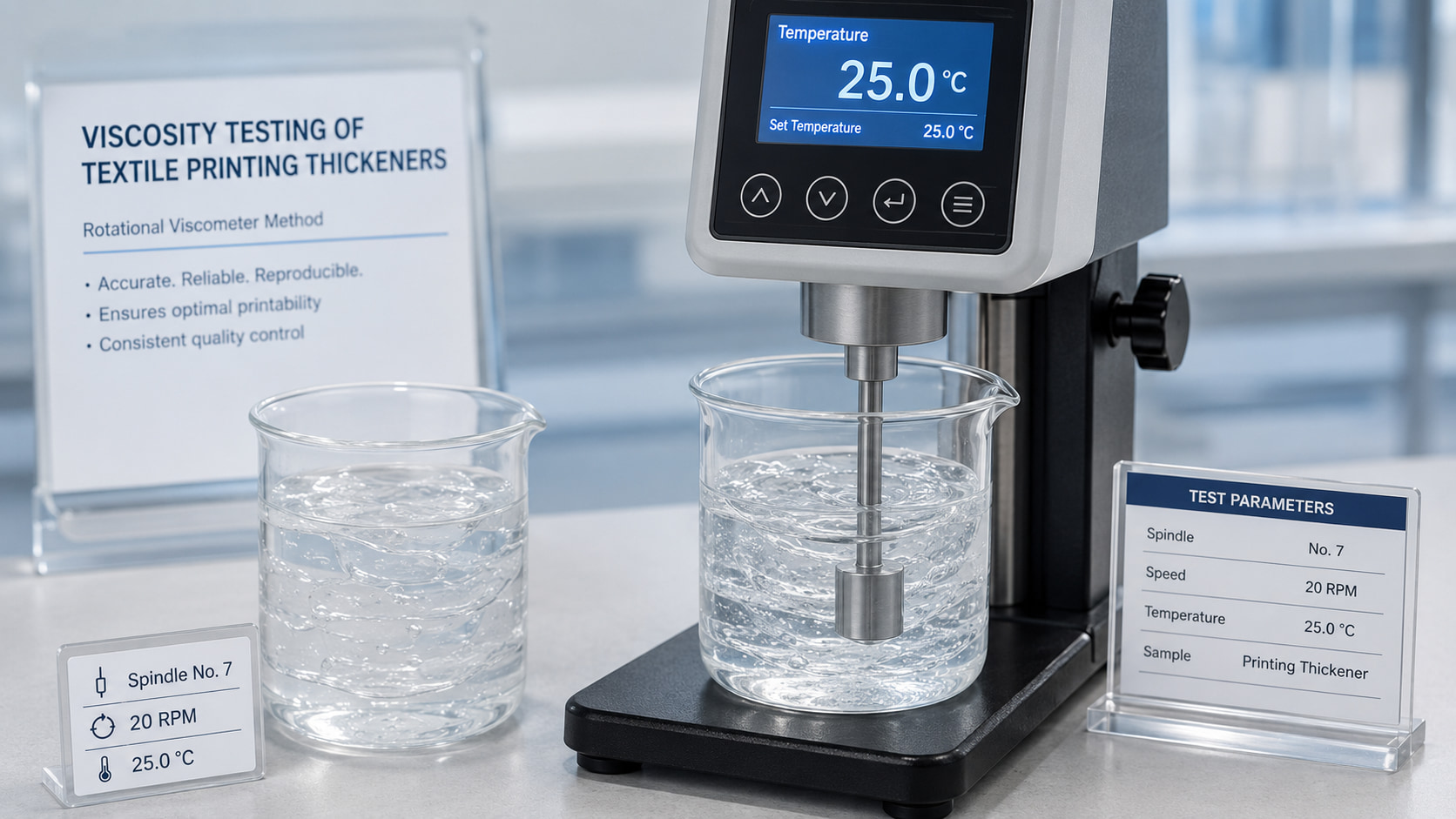
This is one reason a single Brookfield reading cannot fully compare the two.
High-Shear Flow and Screen Transfer
Under the squeegee and through the screen opening, the paste experiences much higher shear.
The thickener should allow efficient screen passage, controlled paste transfer, reasonable squeegee pressure and low stringing.
HASE can be designed to provide different high-shear responses depending on its hydrophobic architecture and interactions with the binder.
ASE can provide strong shear thinning but may not show the same associative high-shear behavior.
The correct test is the real machine or a representative screen trial.
Structural Recovery and Print Definition
After the paste passes through the screen, shear falls rapidly.
The paste should recover enough structure to keep the printed pattern stable.
If recovery is too slow, edges can spread, fine lines can blur and penetration can increase.
If recovery is too fast or elasticity is excessive, leveling can decrease, mesh marks can remain and surface texture can increase.
HASE associative networks can produce recovery behavior that differs significantly from ASE even at the same low-shear viscosity.
Same Viscosity ≠ Same Recovery ≠ Same Print Definition.
Why Binder Chemistry Matters More for HASE
HASE contains hydrophobic groups designed to associate with other hydrophobic structures.
Pigment binders are polymer dispersions and can provide surfaces that participate in that network.
This means the same HASE grade can behave differently with pure acrylic, styrene-acrylic, acrylic-polyurethane or other binder systems, and with different binder surfactant packages.
Associative-thickener research confirms that binder chemistry can materially change HASE thickening efficiency and elasticity.
ASE is also affected by binder through pH, ionic load and dilution, but it does not rely on hydrophobic association to the same degree.
This is why HASE qualification should always use the actual production binder.
Surfactants and Associative Networks
Surfactants can influence HASE strongly because they can interact with hydrophobic groups.
Depending on concentration and chemistry, surfactants can strengthen associative interactions, compete for hydrophobic sites, change micelle structure, or reduce or increase viscosity.
Pigment dispersions and binders already contain surfactants.
Therefore, changing pigment supplier, binder supplier, wetting agent or defoamer can shift HASE rheology even when thickener dosage is unchanged.
ASE can also respond to surfactants indirectly, but its primary mechanism is less associative.
Salt and Electrolyte Tolerance
ASE and HASE both contain ionized carboxylate groups after neutralization.
Electrolytes can screen those charges and reduce polymer expansion.
For a conventional ASE route, this can cause a strong loss of viscosity.
HASE may show improved viscosity retention in some formulations because hydrophobic association provides a second thickening mechanism.
However:
HASE ≠ Automatically Salt-Proof.
High ionic load can still change polymer conformation, association strength, surfactant structure and binder interaction.
The correct comparison is a grade-specific electrolyte challenge in the real pigment formula.
Water Hardness and Multivalent Ions
Calcium and magnesium deserve separate attention from simple sodium-salt testing.
Some ASE/HASE acrylic systems can be sensitive to multivalent ions.
Hard water can therefore change activation efficiency, viscosity, holding stability and pigment/binder dispersion behavior.
Use the same process water for all candidate tests.
If water hardness varies seasonally or between factories, include representative hard-water conditions in qualification.
Pigment Dispersion and Color Loading
Pigment dispersions add more than color: they can introduce electrolytes, surfactants, dispersants, water and pH-control chemicals.
HASE associative rheology may respond strongly to these formulation components.
ASE can also lose viscosity through dilution and ionic screening.
When the mill prints both light and dark shades, test low, normal and high pigment loading.
A candidate that works in a light shade may not remain stable in a heavy pigment formula.
Dosage, Active Solids and Thickening Efficiency
Do not compare ASE and HASE only at equal as-supplied dosage.
Different grades can have different solids content, molecular weight, hydrophobic modification and activation efficiency.
For each grade, build:
Dosage → Complete-Paste Viscosity → Rheology → Printing Result
Then compare as-supplied dosage, active solids introduced, neutralizer usage, screen performance, fabric hand and cost.
The fair comparison is the dosage each grade needs to reach the same useful production window.
Holding Stability
Associative networks can change over time as formulation components equilibrate.
Therefore, HASE should not be approved from an immediate viscosity result.
ASE can also drift if pH, temperature or electrolyte interaction changes during holding.
Measure fresh viscosity, intermediate viscosity, end-of-shift viscosity, pH, temperature and appearance using the actual production holding period.
Foam and Mixing Behavior
ASE and HASE are both liquid water-based polymers, but formulation interaction can create different foam behavior.
Surfactant-rich pigment and binder systems can amplify this difference.
Check foam generation, foam collapse time, defoamer compatibility and viscosity after defoamer addition.
This last point is important for HASE because defoamers can contain hydrophobic components that may influence associative networks.
Flat Screen vs. Rotary Screen
Flat Screen
Pay special attention to low-shear hold, squeegee flow, pause/restart and recovery.
Rotary Screen
Pay special attention to pumpability, continuous shear, repeated network breakdown/recovery, mid-run viscosity and end-run viscosity.
An ASE or HASE grade that works in a short flat-screen trial should still be verified on rotary equipment if that is the production route.
How to Compare ASE and HASE Rheology in the Lab
Use the same water, pigment, binder, fixer, temperature and viscosity method.
Step 1: Low-Shear Viscosity
Measure the controlled rest condition.
Step 2: Multi-Speed Profile
Measure at several appropriate speeds to estimate shear-thinning behavior.
Step 3: Controlled High-Shear Step
Apply the same defined mixing or rheometer shear.
Step 4: Recovery
Measure immediately and after defined recovery times.
Step 5: Screen Trial
Confirm that laboratory rheology predicts actual transfer and definition.
Build a Binder–Thickener Compatibility Map
Sample
Condition
Main Question
A
ASE + water
Baseline activation
B
ASE + production binder
Binder response
C
HASE + water
Baseline activation
D
HASE + production binder
Associative binder response
Record pH, viscosity, multi-speed profile, foam and holding stability.
Then repeat the most useful pair with pigment present.
This separates generic thickening efficiency from binder-specific association.
Build an Electrolyte-Tolerance Curve
Use the actual ionic environment relevant to production.
A candidate with lower initial viscosity but much better retention may be more useful in production.
Practical ASE vs. HASE Selection Matrix
Selection Area
ASE
HASE
Primary mechanism
Alkali swelling / volume exclusion
Alkali swelling + hydrophobic association
pH activation
Common
Common
Low-shear thickening
Often strong
Strong, grade-dependent
Shear-profile flexibility
Good
Often broader / more tunable
Binder dependence
Moderate
Can be high
Surfactant sensitivity
Usually lower associative dependence
Can be significant
Electrolyte tolerance
Can be limited
Can improve, but grade-dependent
Formulation complexity
Often simpler
Can require more compatibility work
Best decision basis
Complete-paste production test
Complete-paste production test
This table describes typical family-level behavior, not a guarantee for every commercial product.
When Does ASE Usually Make More Sense?
ASE can be a strong starting route when the mill wants simple pH-driven viscosity development, strong low-shear body, a more volume-exclusion-dominated rheology and less dependence on binder hydrophobic interaction.
It may be especially attractive when binder chemistry changes frequently, surfactant package is difficult to control, or the current formula already has a proven ASE window.
But salt and multivalent-ion tolerance must still be verified.
When Does HASE Usually Make More Sense?
HASE can be worth prioritizing when the mill needs broader rheology-profile control, stronger medium-shear control, binder-responsive thickening, potentially improved electrolyte tolerance in a matched formulation, or a different flow/leveling balance.
It may be especially useful when the production binder and surfactant package are stable and well defined.
However, every major binder or surfactant change should trigger a compatibility recheck.
Can ASE and HASE Be Used in a Compound System?
Yes, compound rheology systems can be evaluated to balance low-shear body, medium-shear flow, recovery, electrolyte tolerance and cost.
But there is no universal ASE:HASE ratio.
Blending two thickeners can create unexpected synergy, competition, foam or binder response.
Build a controlled blend matrix and compare it with both single-polymer references.
Production Trial Approval
After laboratory screening, run the best ASE and/or HASE candidate on the real machine.
Record:
Grade and batch
Dosage
Final pH
Complete pigment formula
Start / mid / end-run viscosity
Machine speed
Screen / squeegee settings
Pattern definition
Penetration
Color consistency
Curing
Dry / wet rubbing
Fabric hand
Approve a working window, not one successful short print.
Common Comparison Mistakes
1. Saying HASE Is Always Better Than ASE
HASE adds associative thickening, but formulation dependence also increases.
2. Comparing at Different pH
Activation differences can be mistaken for architecture differences.
3. Comparing Equal Dosage Only
Solids and efficiency can differ.
4. Testing in Water Only
HASE especially needs the real binder / surfactant environment.
5. Assuming HASE Is Salt-Proof
Electrolyte tolerance is grade- and formula-specific.
6. Ignoring Defoamer
Hydrophobic defoamer components can shift associative rheology.
7. Using One Brookfield Reading
ASE and HASE can have the same viscosity but different shear profiles.
Troubleshooting Table
Observed Difference
First Variables to Check
Do Not Assume
HASE gives much higher viscosity after binder
Associative binder interaction, pH, solids
HASE is universally more efficient
HASE loses viscosity after surfactant change
Surfactant competition / micelles
Polymer batch is defective
ASE loses viscosity after salt addition
Charge screening, pH, ionic strength
More neutralizer will solve everything
HASE also loses viscosity after high salt
Grade-specific tolerance, binder system
HASE must be salt-proof
Same viscosity but HASE transfers better
Medium/high-shear profile, recovery
Brookfield viscosity predicts transfer
Same viscosity but HASE is stringier
Elasticity / associative network
More association is always beneficial
ASE works in lab but rotary run drifts
Continuous shear, pH, temperature, electrolytes
Fresh viscosity proves long-run stability
HASE changes after binder supplier change
Binder polymer / surfactant package
Thickener dosage should stay unchanged
Total Cost in Use
Compare ASE and HASE using:
Total Cost in Use = Thickener + Neutralizer + Preparation + Binder / Auxiliary Adjustment + Machine Efficiency + Rework + Quality Loss
HASE can justify a higher purchase price if it provides lower working dosage, better medium-shear control, higher production stability or better electrolyte retention.
ASE can be lower cost when its rheology already matches the process, formula components change often, or the associative benefit of HASE is not needed.
The correct comparison is cost per acceptable printed meter.
What Information Should You Send to a Supplier?
For a useful ASE-vs-HASE evaluation, provide:
Current thickener or TDS
Current dosage
Viscosity method
Activation pH / neutralizer
Pigment dispersion
Binder grade and dosage
Fixer / auxiliaries
Water hardness
Fabric
Flat or rotary screen
Machine speed
Holding time
Main issue: viscosity loss, transfer, salt tolerance, hand or cost
FSX Chemical can use this information through Samples & Matching to identify whether a conventional synthetic acrylic grade or a more associative rheology route deserves the next trial.
Identify Architecture → Standardize pH → Build Dosage Curve → Compare Multi-Shear Rheology → Add Binder → Add Pigment → Challenge Electrolytes → Hold → Screen Print → Cure → Calculate Total Cost in Use
ASE and HASE share pH-responsive acrylic chemistry, but HASE adds hydrophobic association.
HASE can offer a wider rheology-design space, but it can also be more dependent on binder and surfactant chemistry.
Salt tolerance must be measured; HASE should not be assumed to be universally salt-proof.
Same viscosity does not mean the same shear thinning, elasticity or recovery.
The real production binder, pigment and water should be included in qualification.
The best choice is the architecture that gives the most stable production window at the lowest practical Total Cost in Use.
Frequently Asked Questions
1. What does ASE mean in acrylic thickener?
ASE means Alkali-Swellable Emulsion. It develops viscosity mainly when neutralization ionizes acid groups and expands the polymer in water.
2. What does HASE mean?
HASE means Hydrophobically Modified Alkali-Swellable Emulsion. It combines pH-driven swelling with hydrophobic associative thickening.
3. Is HASE always better than ASE for pigment printing?
No. HASE offers additional rheology control but is also more dependent on binder, surfactant and formulation chemistry.
4. Which one gives higher low-shear viscosity?
Either can, depending on grade, solids, dosage and activation. Compare commercial products under matched conditions.
5. Which one has better salt tolerance?
Some HASE grades can retain viscosity better because associative interactions add a second thickening mechanism, but salt tolerance remains grade- and formula-specific.
6. Why does HASE change viscosity when binder changes?
Hydrophobic HASE groups can associate with binder particles and surfactants, so changing binder chemistry can change the rheological network.
7. Why can surfactants reduce HASE viscosity?
Surfactants can compete for hydrophobic sites or reorganize associative structures. Depending on chemistry and concentration, viscosity can increase or decrease.
8. Are ASE and HASE both pH activated?
Many commercial ASE and HASE products are pH-responsive and require neutralization, but the exact activation window depends on the grade.
9. Can HASE be used with high-electrolyte pigment formulas?
Potentially, but the actual grade must be tested with the real binder, pigment, fixer and water. Do not rely on the HASE label alone.
10. Can ASE and HASE be blended?
Yes. Compound systems can be evaluated to balance low-shear body, high-shear flow, recovery and cost, but the blend ratio must be tested.
11. How should I compare ASE and HASE fairly?
Activate each grade correctly, determine its useful dosage, then compare complete-paste rheology, electrolyte retention, screen performance, holding stability and cost.
12. What should I send FSX Chemical for ASE/HASE matching?
Send the current thickener/TDS, dosage, pH, viscosity method, pigment, binder, fixer, water hardness, machine route, holding time and the main technical problem.
Match Acrylic Thickener Architecture to Your Pigment Formula
If your pigment-printing paste loses viscosity after binder or electrolyte addition, or if the current synthetic thickener reaches the viscosity target but gives poor screen transfer or unstable recovery, FSX Chemical can help structure a controlled acrylic-thickener comparison.
For a useful technical review, send:
Your current synthetic thickener sample, TDS or COA
Dosage and activation pH
Viscosity test method
Pigment dispersion
Binder grade and dosage
Fixer / auxiliaries
Water hardness
Fabric and machine route
Holding time
Current salt-tolerance, rheology or compatibility problem
Start with Samples & Matching for a controlled current-vs-candidate trial.
The practical difference between ASE and HASE is not simply that one is more advanced. HASE adds associative thickening to pH-driven swelling, which can expand the rheology-design window but also makes binder, surfactant and electrolyte compatibility more important. The best grade is the one that remains stable in the complete production formula.
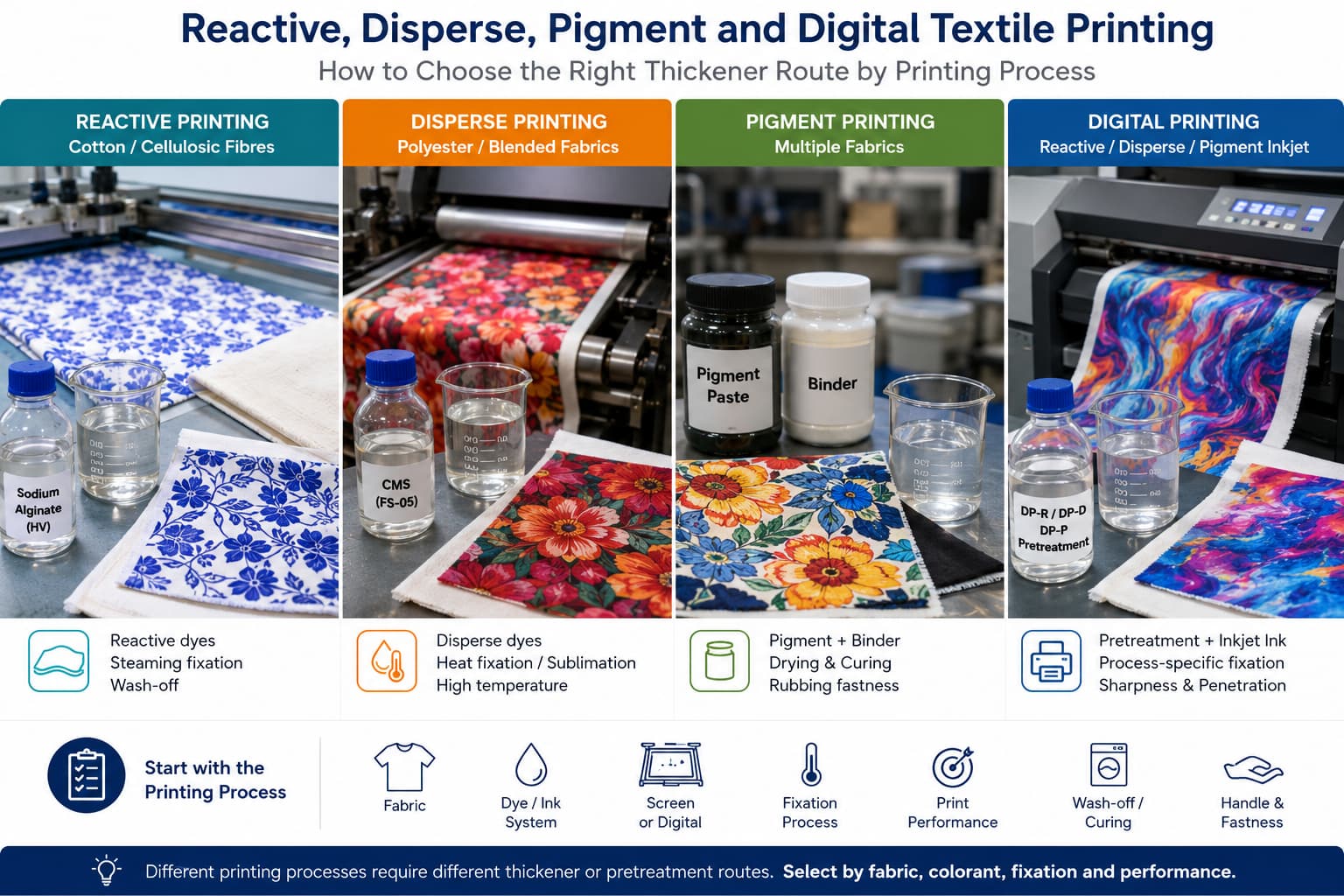
Learn how to choose thickener and pretreatment routes for reactive, disperse, pigment and digital textile printing based on fabric, dye or ink, fixation, wash-off and print-quality requirements.
CMC-based printing paste is used across pigment, reactive, and digital textile printing. This guide explains what parameters matter, how to compare suppliers, and what to request before placing a bulk order.
Both sodium alginate and CMC are used as thickeners in textile printing, but they suit different dye systems and process conditions. This guide explains the key differences and when to use each.
The right textile printing thickener is determined by more than fabric type. Buyers should match the thickener to the dye or pigment system, printing method, target rheology, wash-off requirements and actual factory trial conditions.
Textile printing performance depends on a coordinated chemical system, not one universal additive. This guide explains ten important chemical groups, their functions, where they fit and what buyers should verify before production trials.
Textile printing thickeners differ in chemistry, rheology, dye compatibility and wash-off behavior. This guide compares the main thickener families, their common application directions and the parameters buyers should verify before production trials.
Digital printing pastes should be selected by ink chemistry, fabric, application method and post-treatment. This guide compares sodium alginate, CMC, CMS, synthetic polymer and compound pretreatment routes for textile inkjet printing.
FSX Chemical offers separate digital printing paste routes for reactive, disperse and pigment systems, supported by application review, sample matching and technical documentation. This guide explains how buyers can evaluate the right route before bulk purchasing.
Stable digital printing paste requires more than a target viscosity. This guide explains how product selection, water quality, addition sequence, mixing, pH, temperature, filtration, hygiene, storage and quality records influence pretreatment and production consistency.
Reliable textile printing thickener evaluation requires more than checking viscosity. This guide explains the essential raw-material, solution, paste, stability, application and finished-fabric testing parameters.
This product review examines FSX Digital Printing Paste as a textile inkjet pretreatment and thickening route, focusing on ink-system matching, rheology, filtration, print definition, stability and real production testing.
Share the product name, application, quantity, destination and any TDS,
sample photo or document you already have. FSX Chemical will review the
information and recommend the next step for quotation, sample matching
or product selection.
Product InformationProduct name, grade, model, label photo or supplier reference.
Available DocumentsTDS, SDS, COA, sample photo, product list or test data.
Order DetailsEstimated quantity, packaging, destination country, port or trade term.
Application or IssueTextile printing process, formulation need, current issue or target performance.