Sodium alginate is a reactive screen-printing thickener, not a dye-fixing agent. A suitable grade must give workable flow in the complete dye-and-auxiliary paste through the actual printing queue and be removable during the specified wash-off. Qualify it on the target cotton or viscose fabric using the intended screen, fixation and washing process. A clean-water viscosity result is a reference measurement; it does not establish complete-paste compatibility or finished-print quality.
This guide explains what buyers should review when sourcing sodium alginate for reactive dye printing applications.
Why Sodium Alginate Is Used as a Reactive Dye Thickener
It Helps Build Printing Paste Viscosity
In reactive dye printing, the thickener helps build the paste structure needed for preparation and application. Sodium alginate is often selected where viscosity control, paste formation, and printing paste handling are important.
The suitable grade depends on the target paste viscosity, printing method, fabric type, dye system, and production conditions. A higher viscosity grade is not always the best choice for every process.
Dissolution Behavior Affects Paste Preparation
Dissolution behavior is important during paste preparation. If sodium alginate hydrates unevenly, it may create lumps, poor paste smoothness, or filtration difficulty.
Buyers should test how the product dissolves under their own water quality, stirring method, addition method, preparation time, and formulation conditions.
Final Performance Depends on the Whole Formulation
Sodium alginate performance cannot be judged only by powder appearance or a single viscosity number. Dyes, auxiliaries, pH, water quality, fabric type, paste concentration, and storage time can all affect the final result.
This is why sample testing in the buyer’s own formulation is necessary before confirming a bulk order.
Key Specifications Buyers Should Review
Viscosity Grade and Test Method
A comparable viscosity result needs the concentration and its mass basis, water quality, preparation and hydration history, sample age, temperature, instrument model, spindle, speed, container and reading time. Record the value and unit together with a suitable instrument operating range. Use the same method for the reference and candidate; the supplier’s powder-grade test and the mill’s complete working-paste test are separate records.
Without a clear test method, viscosity values from different suppliers may not be directly comparable.
जाली का आकार और घुलन व्यवहार
Mesh size can influence dispersion and hydration during paste preparation. However, the actual dissolution result also depends on stirring speed, water quality, addition method, and preparation time.
Buyers should not select a grade only by mesh size. The product should be tested in the real paste preparation process.
नमी, पीएच और उपस्थिति
नमी, pH और दिखावट बुनियादी लेकिन महत्वपूर्ण गुणवत्ता संकेतक हैं। ये भंडारण, हैंडलिंग, गुणवत्ता नियंत्रण और पुनः खरीद को प्रभावित करते हैं।.
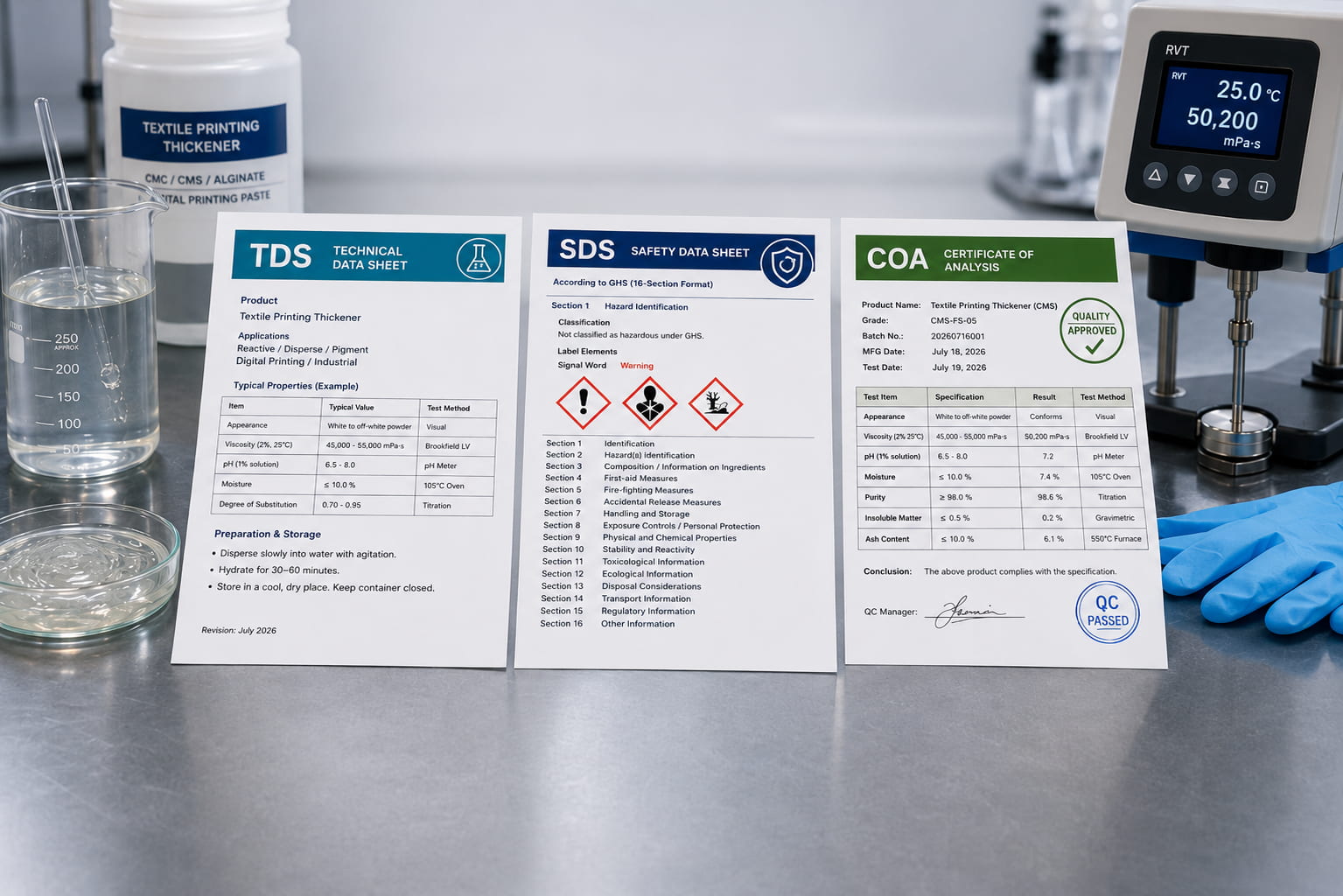
These parameters should be reviewed in the TDS and confirmed through COA data for each batch.
Batch Consistency and COA Data
For repeat orders, batch consistency matters. If viscosity, moisture, or dissolution behavior changes significantly between batches, the printing factory may need to adjust the formulation again.
The COA helps buyers confirm actual batch data and compare whether the shipment remains within the agreed specification range.
Check Compatibility Through the Actual Paste Holding Period
Use this comparison record to plan a trial under your mill’s conditions; it does not specify a universal recipe. Prepare the approved reference and candidate with the same water, fabric lot and final recipe mass. Record every product code and dose; keep mixing and temperature history comparable.
| Stage | Record and compare | What the result can establish |
|---|---|---|
| Hydrated stock | Powder-as-supplied concentration, hydration time, water quality, smoothness and retained filter residue. | Whether preparation is repeatable before dye and auxiliary effects are introduced. |
| Complete paste at preparation | Dye and auxiliary additions, addition order, pH, temperature and apparent viscosity using the same method. | The starting condition of the actual working formulation. |
| Complete paste after holding | Elapsed time under production-representative covered storage, mixing before measurement, flow and screen transfer. | Whether the paste remains usable over the required printing queue. |
| Finished fabric | Registered fine lines and solid areas after specified drying, fixation and wash-off; shade, background, handle and agreed fastness. | Application acceptance, rather than approval from paste viscosity alone. |
If a fault appears after an addition, investigate a paired trial using only addition sequences permitted by the ingredient suppliers. Keep the final composition and balancing water identical. Changing order, dosage and hold time together prevents a clear diagnosis. A stable viscosity value does not demonstrate stable dye reactivity or acceptable final color.
Published reactive-printing rheology research assesses flow and finished-print quality separately. Its specific blend results are not a recipe or performance guarantee for another commercial grade.
थोक खरीद से पहले सोडियम अल्गीनेट का परीक्षण कैसे करें
Test in the Actual Reactive Printing Paste Formulation
Sample testing should be done in the buyer’s own reactive printing paste formulation whenever possible. Dyes, auxiliaries, water quality, pH, stirring method, paste concentration, and storage time can all affect final paste behavior.
केवल स्वच्छ पानी में परीक्षण करना यह पुष्टि करने के लिए पर्याप्त नहीं हो सकता कि सोडियम अल्गीनेट ग्रेड उत्पादन के लिए उपयुक्त है या नहीं।.
पेस्ट की चिकनाई और छानन का अवलोकन करें
नमूना परीक्षण के दौरान, खरीदारों को घुलनशीलता की गति, पेस्ट की चिकनाई, गांठें, छानने का व्यवहार, चिपचिपापन स्थिरता और उपयोग में हैंडलिंग का अवलोकन करना चाहिए।.
टेक्सटाइल प्रिंटिंग पेस्ट के लिए, ये व्यावहारिक अवलोकन अक्सर TDS में दिखाए गए मूल विनिर्देश डेटा जितने ही महत्वपूर्ण होते हैं।.
Check Printing Trial Results Carefully
If a printing trial is arranged, buyers can review paste handling, screen passing, pattern edge condition, bleeding tendency, and washing behavior under their own production conditions.
The evaluation should be based on the buyer’s process and internal quality standard rather than broad supplier claims.
अनुमोदित नमूने की थोक शिपमेंट से तुलना करें
Before confirming a bulk order, buyers should ask whether the approved sample and the bulk shipment will follow the same viscosity range, mesh size, packaging format, batch traceability, and COA requirements.
यह नमूने और कुल के बीच असंगति के जोखिम को कम करने में मदद करता है।.
Common Mistakes When Choosing Reactive Dye Thickener Sodium Alginate
Selecting Only by High Viscosity
A high viscosity grade may not automatically match every reactive printing paste system. If the viscosity is too high for the formulation, preparation and application handling may become difficult.
Buyers should select the grade according to the target paste viscosity, process requirement, and testing result.
Comparing Supplier Data Without Test Method
Viscosity values measured under different concentrations, temperatures, or instruments may show different results.
Before comparing suppliers, buyers should ask how the viscosity was tested and whether the method matches their own evaluation process.
Relying on Broad Performance or Compliance Claims
Claims such as “eco-friendly,” “compliant,” “high-performance,” or “preferred solution” should be supported by actual documents or test data when they are important to the buyer’s purchasing process.
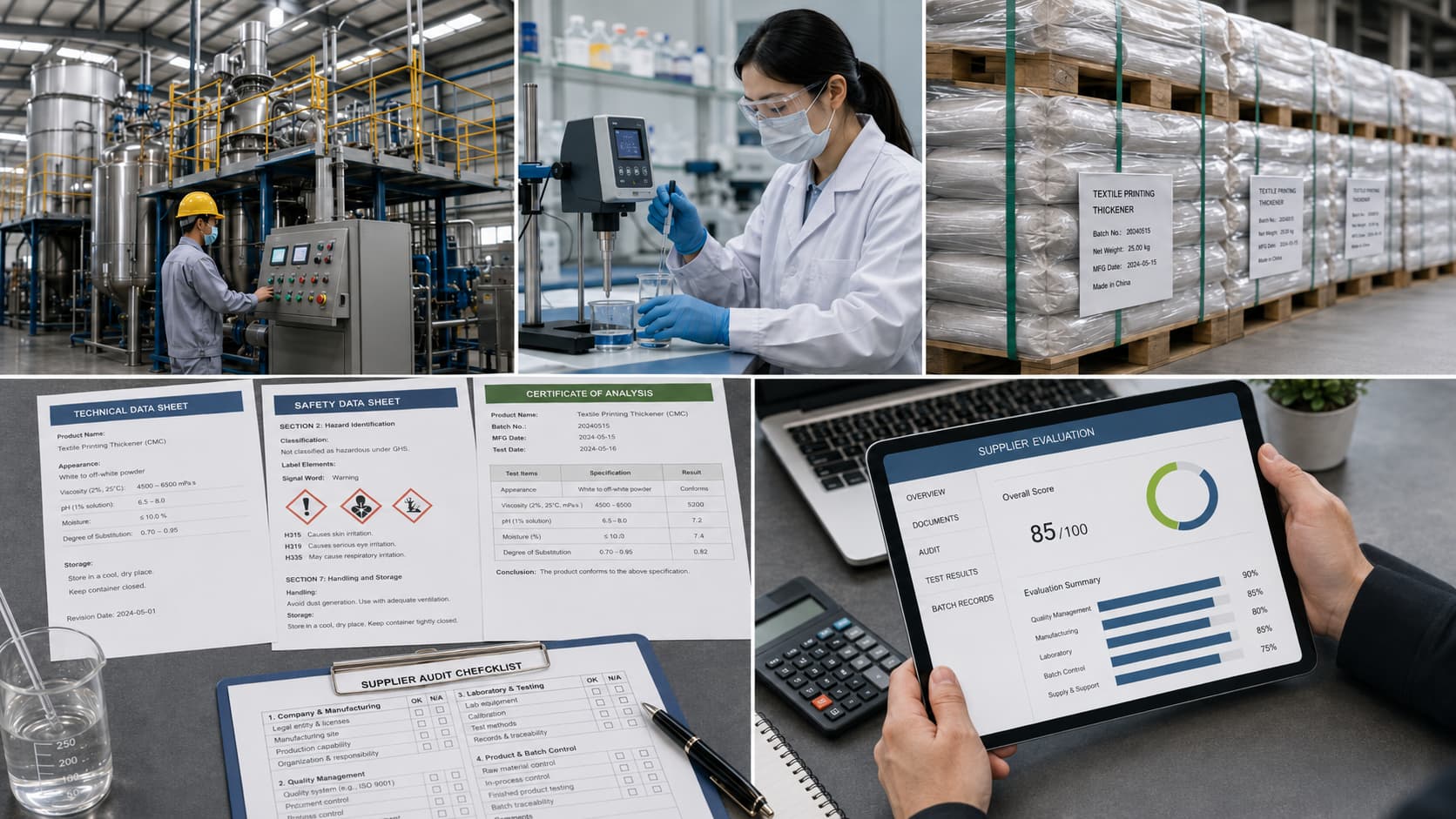
For practical product selection, buyers should focus first on TDS, COA, sample testing, batch consistency, and application suitability.
Documents Buyers Should Request
विनिर्देश समीक्षा के लिए टीडीएस
The Technical Data Sheet should include key parameters such as appearance, viscosity, mesh size, moisture, pH, storage conditions, and testing method.
For reactive dye thickener sodium alginate, the viscosity test method should be clearly stated.
बैच पुष्टि के लिए सीओए
विश्लेषण प्रमाणपत्र एक विशिष्ट उत्पादन बैच के वास्तविक डेटा की पुष्टि करता है। यह थोक ऑर्डर, पुनः खरीद, वितरक आपूर्ति और आंतरिक गुणवत्ता नियंत्रण के लिए महत्वपूर्ण है।.
खरीदार शिपमेंट्स में COA रिकॉर्ड्स की तुलना करके यह जांच सकते हैं कि प्रमुख पैरामीटर सहमत सीमा के भीतर बने रहते हैं या नहीं।.
SDS and Export Documents When Required
For international purchasing, buyers may also need SDS, invoice, packing list, labels, and other export-related documents. The required document list may vary by destination country, product type, and internal purchasing process.
Document requirements should be confirmed before shipment to avoid delays in internal review or customs communication.

FSX केमिकल सोडियम अल्गीनेट खरीदारों का कैसे समर्थन करता है
FSX केमिकल, कपड़ा मुद्रण कारखानों, रंगाई और मुद्रण मिलों, तथा रासायनिक वितरकों के लिए सोडियम अल्जिनेट और संबंधित वस्त्र मुद्रण रसायन प्रदान करता है।.
We do not suggest confirming reactive dye thickener sodium alginate only by price, product name, or broad supplier claims. The recommended grade should be reviewed through technical documents and tested in the buyer’s own formulation before bulk purchase.
अगले कदम
- टीडीएस का अनुरोध करें — चिपचिपापन सीमा, जाल आकार, पीएच, नमी, उपस्थिति, भंडारण की स्थिति, और परीक्षण विधि की समीक्षा करें।.
- COA का अनुरोध करें — शिपमेंट से पहले यह पुष्टि करें कि बैच डेटा सहमत विनिर्देश सीमा से मेल खाता है।.
- ग्रेड मिलान के लिए अनुरोध करें — share your reactive printing process, fabric type, target viscosity, current formulation, and existing product grade if available.
- नमूना अनुरोध करें थोक ऑर्डर की पुष्टि करने से पहले, अपने स्वयं के पेस्ट मिश्रण और मुद्रण परिस्थितियों में अनुशंसित सोडियम अल्जीनेट ग्रेड का परीक्षण करें।.
- पैकेजिंग और निर्यात दस्तावेज़ों की पुष्टि करें — शिपमेंट से पहले बैग का आकार, लेबल, बैच की ट्रेसबिलिटी, एसडीएस, इनवॉइस, पैकिंग लिस्ट और अन्य आवश्यक दस्तावेज़ों की जाँच करें।.
- Request sample and grade matching — send the current grade, fabric, reactive-printing route, complete recipe basis and the specific trial result you need to improve. एफएसएक्स केमिकल से संपर्क करें to discuss the next evaluation step.