Synthetic Thickener for Pigment Printing: How to Choose the Right Grade for Textile Production
Synthetic thickener selection for pigment printing should be based on the complete pigment-binder system. Compare...
Choose a synthetic thickener for conventional textile pigment printing by testing the complete pigment-binder paste, the screen-printing process and the cured fabric. Confirm the grade’s activation or pre-neutralised supply form, preparation instructions, viscosity method, holding stability, transfer, fastness and fabric hand. Then compare the effective dose and cost per accepted printed output; one water-viscosity result cannot qualify the grade.
How Do You Choose a Synthetic Thickener for Pigment Printing?
Choose a synthetic thickener by matching the grade to the complete pigment-printing system.
The most important questions are:
What pigment dispersion is used?
What binder and fixer are used?
Does the thickener require pH activation or neutralization?
What electrolyte load is present?
What viscosity and rheology are needed on the actual machine?
What dosage is required to reach that rheology?
How stable is the paste during the expected holding time?
What happens after curing to color strength, rubbing fastness and fabric hand?
A strong pigment-printing thickener should therefore be evaluated as:
Activation → Complete-Paste Compatibility → Rheology → Screen Transfer → Curing → Fastness → Hand → Cost in Use
Do not select a grade only because its water viscosity is higher.
Why Pigment Printing Needs Both Thickener and Binder
Pigments are insoluble color particles. Unlike reactive dyes, they are not fixed to the fiber through a fiber-specific chemical reaction.
In a waterborne pigment paste, the binder must form a continuous film that holds the pigment on the textile. Water removal and polymer-particle coalescence can develop that film during drying; any chemical crosslinking and required cure depend on the binder system. A dry-to-touch print does not establish completion of its required cure. Follow the actual binder instructions. See the manufacturer’s general explanation of film-formation mechanisms; it is background, not a cure schedule for an FSX product.
The thickener has a different job.
Thickener Responsibilities
Build the required paste viscosity
Control flow during mixing and pumping
Allow transfer through the screen
Limit unwanted spreading
Control deposit and penetration
Keep pigment and auxiliaries uniformly distributed
Binder Responsibilities
Attach pigment particles to the textile surface
Develop rubbing and washing resistance
Develop the required film under the approved drying conditions and complete any required binder cure
Balance durability with softness
This distinction is important.
A thickener cannot compensate for an under-performing binder, and a stronger binder cannot automatically correct poor paste rheology.
What Is a Synthetic Printing Thickener?
“Synthetic thickener” is a broad product family rather than one universal chemical.
Textile pigment-printing systems can use synthetic rheology modifiers based on:
Polyacrylate / polyacrylic-acid chemistry
Acrylic emulsion polymers
Associative or hydrophobically modified synthetic polymers
Therefore, the label “acrylic thickener” is not a complete technical specification.
Acrylic / Polyacrylate Liquid Thickeners
Liquid acrylic and polyacrylate thickeners are widely evaluated for pigment printing because they can develop useful viscosity at relatively low polymer dosage and are easier to disperse than many powdered hydrocolloids.
Potential advantages to evaluate include:
Rapid incorporation
High thickening efficiency
Low-solids formulation potential
Tailored shear-thinning behavior
Consistent industrial product design
But these advantages depend on the specific grade.
Important risks include:
Incorrect pH activation
Electrolyte-induced viscosity loss
Binder incompatibility
Excess foam
Over-thickening after neutralization
The correct question is not “Is acrylic better?” It is “Does this acrylic grade remain stable in this pigment-binder formula?”
Why pH and Neutralization Can Control Viscosity Development
Some acrylic thickeners are supplied as acid-functional systems that develop viscosity after neutralisation. Others are supplied pre-neutralised: a manufacturer example for textile pigment printing illustrates that additional neutraliser is not always required. Confirm the current instructions for the actual commercial grade; this example does not establish the chemistry or activation procedure of an FSX product.
For a compatible acid-functional, alkali-swellable grade, one simplified activation sequence is:
Is the product already neutralized or does the mill need to neutralize it?
If the pH is too low, the thickener may appear weak.
If neutralization is excessive, the final paste can move outside the intended viscosity or compatibility window.
Do not copy a pH target from another acrylic grade. Different polymer designs can have different activation windows.
Electrolyte Tolerance: One of the Most Important Grade Differences
Polyacrylate thickeners contain charged groups and can be sensitive to salts and other electrolytes.
Electrolytes can screen electrostatic repulsion along the polymer chain and reduce the expanded structure responsible for thickening.
In a real pigment paste, electrolytes can come from:
Pigment dispersion
Binder
Fixer
Water hardness
Other auxiliaries
Therefore, compare:
Water Viscosity
with:
Complete Pigment-Paste Viscosity
A grade with impressive water viscosity but poor viscosity retention after binder or pigment addition may be less useful than a lower headline-viscosity grade with better electrolyte tolerance.
Binder Compatibility: Do Not Test the Thickener in Water Only
The pigment binder is one of the largest formulation components that can affect the final paste.
Binder compatibility can change:
संधानशीलता
पीएच
फोम
Paste homogeneity
Curing behavior
Fabric hand
Use a staged compatibility test based on the candidate grade’s current preparation instructions. The following is a test-planning example, not a universal mixing order:
Confirm Supply Form → Follow the Grade-Specific Incorporation / Activation Route → Add Pigment, Binder and Auxiliaries in the Validated Order → Hold → Recheck
Record the final-paste mass basis, temperature, pH, mixing and rest history at each selected checkpoint. For a pre-neutralised product, do not add alkali merely because a different grade required it. Measure apparent viscosity with the same instrument, spindle or geometry, container, speed, reading time and valid torque range. Record component additions and their dilution so a viscosity change is not confused with a concentration change.
If the thickener is anionic and the formula contains strongly cationic components, compatibility should be checked especially carefully.
Do not assume that a paste is compatible because no immediate precipitate is visible. Long holding and curing performance still need validation.
Pigment Dispersion Compatibility
Commercial pigment dispersions can contain pigment particles, dispersants, surfactants, electrolytes, pH-control chemicals and other formulation components.
Two pigments of the same color family can therefore affect viscosity differently.
A useful grade-selection project should test:
At least one representative light shade
One normal production shade
A heavy or dark shade if pigment loading varies widely
A viscosity drop at high pigment loading is a symptom, not proof of electrolyte sensitivity. Compare staged additions at matched final mass, temperature, pH, mixing and paste age. Where suitable, use a matched dispersion-vehicle or dilution control agreed with the pigment supplier. Then test the suspected cause before changing thickener grade or dose; the dispersion can introduce several formulation variables at once.
Rheology: Low-Shear Body, Shear Thinning and Recovery
Screen printing exposes paste to different shear conditions.
At low shear, the paste needs enough structure to resist spreading.
Under the squeegee, the paste should become easier to move through the screen.
After transfer, enough structure should recover to hold the printed pattern.
A useful rheological sequence is:
Low-Shear Body → Shear Thinning During Transfer → Structural Recovery After Printing
Stringing or poor release can justify checking extensional response and elasticity, but visible stringing alone does not identify the cause. Also examine screen geometry, wetting, tack and deposit.
If it shear-thins too strongly and recovers too slowly, edges can spread.
If it does not shear-thin enough, machine pressure may need to increase.
A decrease in apparent viscosity with increasing speed describes rate-dependent response under that method; it does not measure recovery time. Use a separate timed preshear, shear exposure and low-shear or rest sequence, with temperature and reading times defined. RPM is not a universal shear rate across different spindles or geometries. Brookfield’s measurement guide distinguishes these behaviors. The same single-point reading can therefore accompany different transfer and print results.
Flat Screen vs. Rotary Screen Requirements
Flat and rotary screen machines do not expose the paste to the same mechanical history.
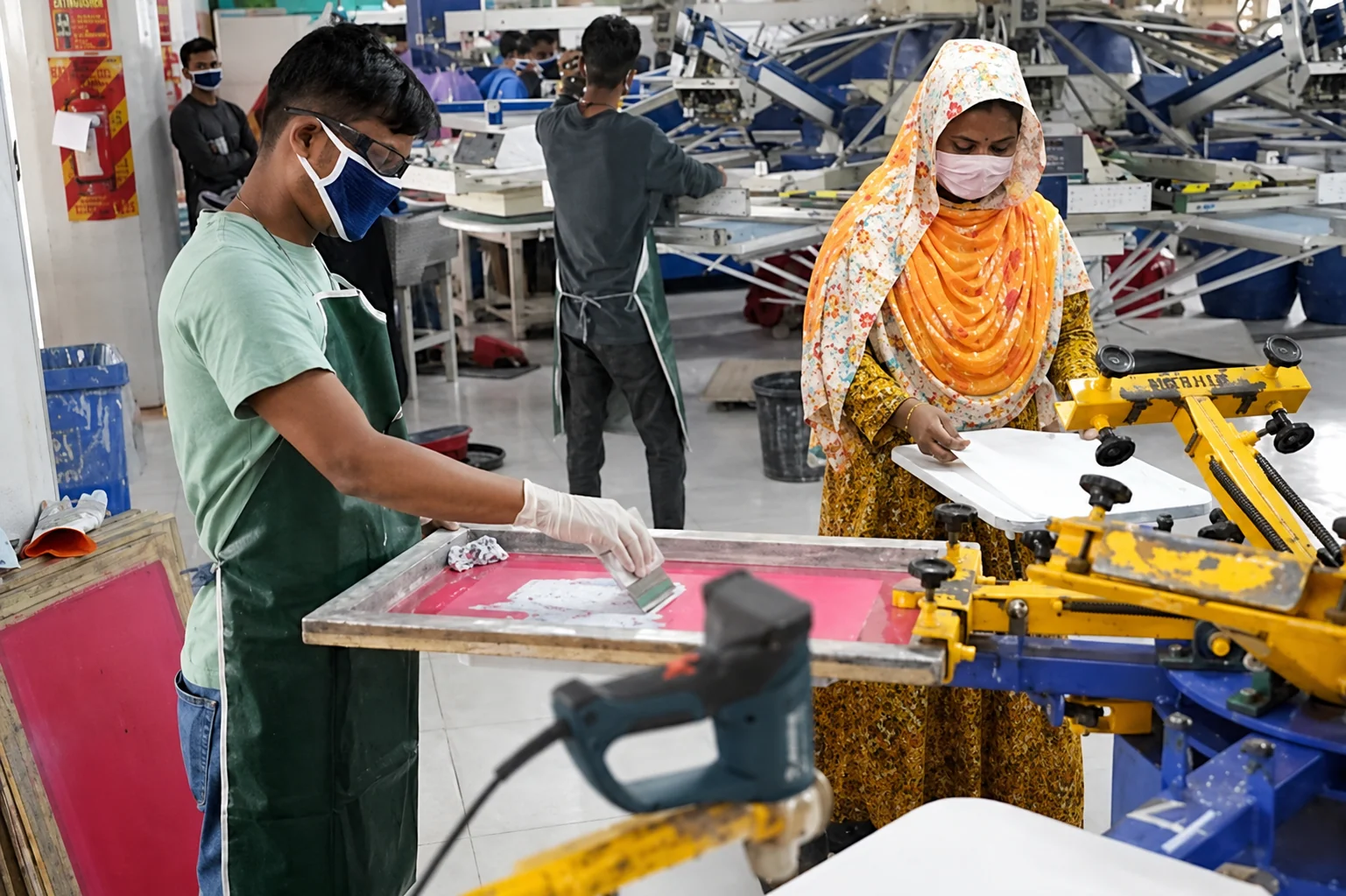
Flat-screen printing includes repeated strokes and dwell periods.
Rotary-screen printing adds continuous feed, circulation and repeated shear.
For flat screen, check low-shear hold, pause/restart behavior, screen drying and recovery after the stroke.
For rotary screen, check pumpability, continuous-shear stability, foam, mid-run viscosity and end-run viscosity.
Do not label one grade “rotary” or “flat” based only on viscosity.
Dosage vs. Viscosity: Build a Working Curve
Do not compare candidate grades only at one equal dosage.
Different synthetic thickeners can have very different thickening efficiency.
Build a dosage ladder around the expected working range.
Do not force two grades to use the same dosage if one is significantly more efficient.
Solids Content and Thickening Efficiency
Liquid synthetic thickeners can differ in documented active-polymer fraction and measured total nonvolatile content. Keep these quantities separate; dried residue may contain other nonvolatile ingredients.
Compare as-supplied dose and any method-defined nonvolatile addition. Calculate active-polymer addition only when the supplier separately documents that mass fraction. State the concentration basis and measurement method, and compare final printed deposit and performance rather than treating either solids figure as a universal equivalence factor.
A low dosage can be attractive because it reduces thickener solids, but only if viscosity remains stable, rheology remains correct, binder and pigment remain compatible and fabric hand remains acceptable.
Low dosage by itself is not proof of low Total Cost in Use.
Holding and Storage Stability
The completed pigment paste should remain within the approved viscosity and appearance window for the expected production period.
Check fresh paste, after 2 hours, after 4 hours and at the end of the expected production window or another realistic time point.
Record viscosity, pH, temperature, separation, foam and gel/floc formation.
A grade that looks excellent immediately after neutralization but drifts during the production shift is not fully qualified.
Foam, Mixing and Paste Preparation
Liquid synthetic thickeners are convenient to dose, but preparation conditions still matter.
Check addition order, mixing speed, neutralization sequence, defoamer compatibility and air incorporation.
Excess high-speed mixing can create foam and temperature rise.
Poor addition order can create local over-neutralization or high electrolyte concentration.
The approved grade should therefore include an approved preparation procedure.
Fabric Type and Print Coverage
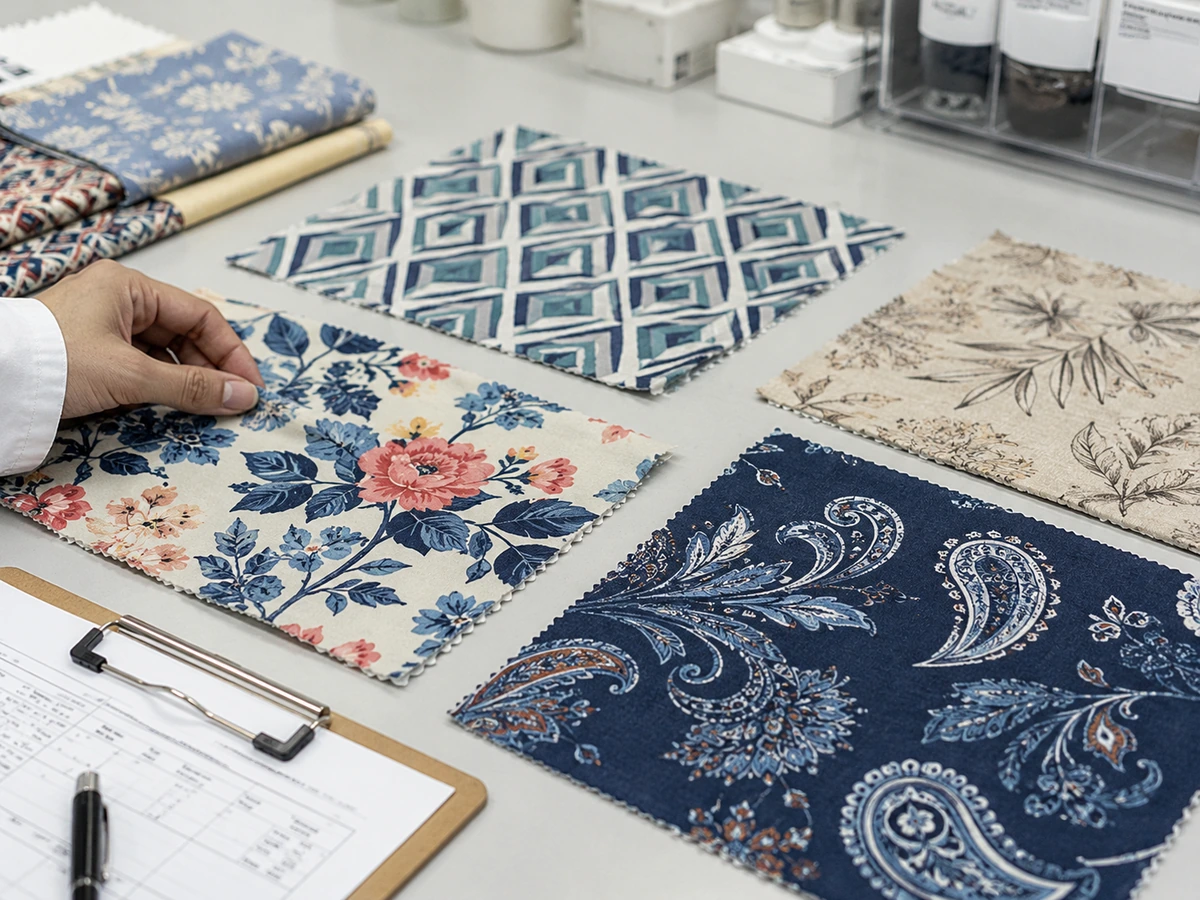
Pigment printing can be applied across different fiber types because the binder fixes pigment on the textile surface, but the same paste does not behave identically on every fabric.
Compare cotton, polyester, CVC/PC blends, knitted vs. woven fabrics, and light vs. heavy constructions where relevant.
Fabric absorbency and surface structure affect paste deposit, penetration, surface color and hand.
A synthetic thickener should be approved on representative production fabrics, not only on one laboratory substrate.
Curing: Why Thickener Selection Cannot Stop at the Printing Machine
Pigment printing requires an adequate binder film and the durability specified for that binder–pigment–fabric combination. Drying/film formation and a required chemical cure are related but distinct; the approved process may combine them in one thermal pass.
A paste can run perfectly on the screen and still fail after curing.
Use the binder supplier’s validated drying and curing route for the intended fabric. Record measured fabric thermal exposure and dwell time where available, together with machine setpoints, line speed and loading. A matched oven setpoint alone does not establish matched fabric curing.
Do not compare two thickeners using different curing conditions and attribute the finished difference to the thickener alone.
Rubbing Fastness and Binder Film Performance
Rubbing fastness in pigment printing depends strongly on the binder system and curing process.
The thickener still matters indirectly because it changes paste deposit, pigment distribution, binder distribution and surface-film uniformity.
Evaluate dry rubbing fastness, wet rubbing fastness, wash fastness where relevant, and shade/K/S.
Do not choose a synthetic thickener solely because it gives the deepest wet print before curing.
Fabric Hand: Why More Viscosity Can Create the Wrong Result
Pigment printing already introduces a binder film to the textile surface.
Excessive binder, thickener solids or paste deposit can contribute to a stiffer fabric.
Do not treat a heavier binder film as an automatic fastness improvement. Compare the complete cured print at matched coverage, recorded paste deposit and the agreed fastness and hand criteria; extra deposit can change several properties together.
For grade selection, establish a dosage range that repeatedly meets the required printing and finished-fabric criteria. Challenge its practical limits with representative preparation, holding and production variation before choosing the working dose; one passing low-dose print does not establish a robust minimum.
The commercial target is not maximum viscosity.
It is:
Stable Printing + Required Fastness + Acceptable Hand
Practical Grade-Selection Matrix
Selection Factor
क्या जाँचें
यह क्यों मायने रखता है
सक्रियण
Ready-to-use or pH-neutralized
Controls viscosity development
Electrolyte tolerance
Viscosity retention after pigment/binder
Prevents paste collapse
बाइंडर अनुकूलता
Viscosity, floc, holding stability
Protects complete formula
रियोलॉजी
Low-shear body, shear thinning, recovery
Controls screen transfer and definition
Dosage efficiency
Working curve
Determines cost and polymer solids
स्थिरता बनाए रखना
Fresh to end-of-shift
Protects production consistency
Curing result
K/S, rubbing, hand
Confirms finished-fabric suitability
बैच की एकरूपता
Incoming viscosity, pH, solids
Supports repeat bulk supply
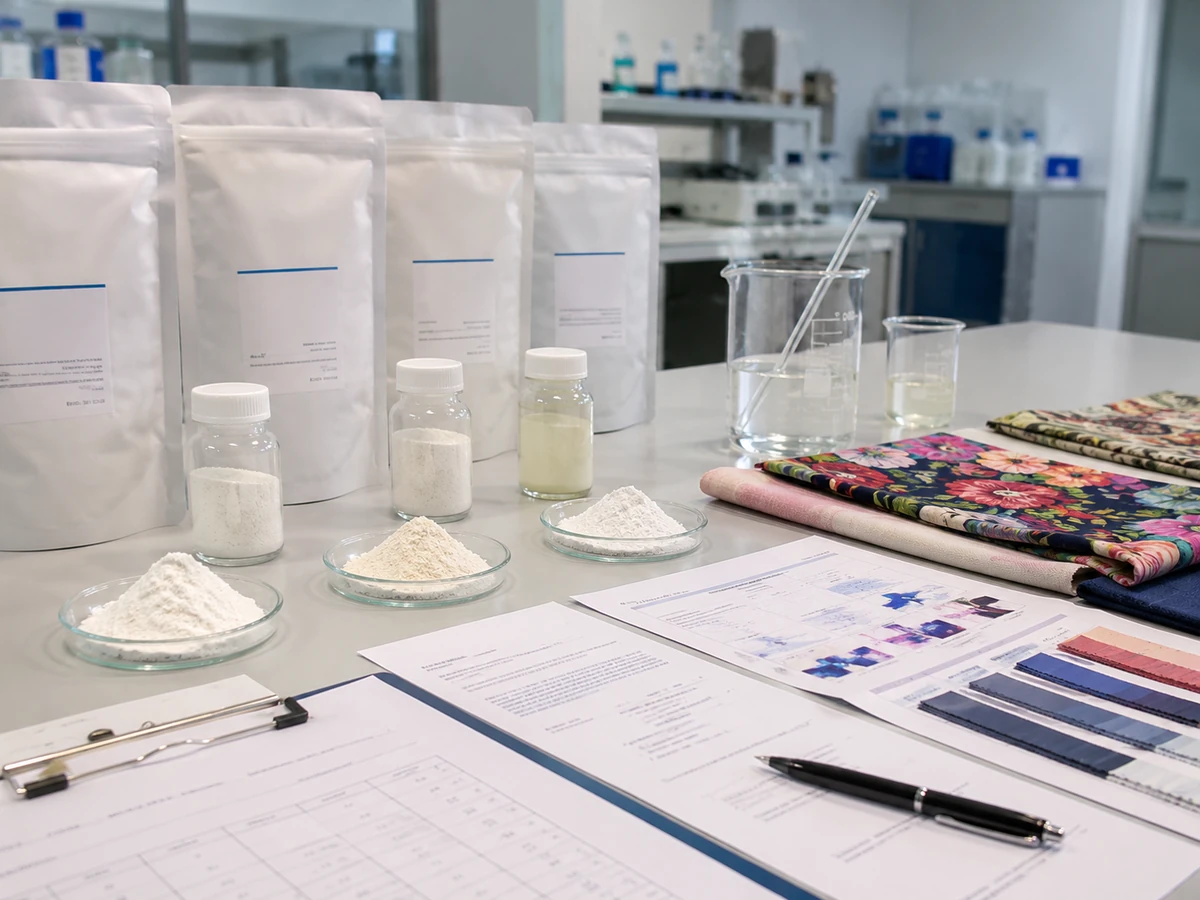
Laboratory Selection Workflow
Step 1: Define the Current Reference
Record the current thickener, dosage, viscosity method and production formula.
Step 2: Review Candidate TDS / SDS
Identify solids, pH, activation requirement, ionic nature, storage and intended use where available.
Step 3: Prepare the Candidate Under Its Correct Activation Method
Do not use the current product’s neutralization procedure automatically.
Step 4: Build a Dosage Curve
Find the useful complete-paste viscosity window.
Step 5: Add Pigment and Binder
Measure viscosity after each critical component.
Step 6: Hold the Paste
Check viscosity and appearance across the expected working period.
Step 7: Print the Same Fabric
Keep screen, squeegee and machine conditions matched.
Step 8: Complete the Approved Drying and Curing Route
Use the same approved binder-specific drying and, where required, curing route for reference and candidate. Record actual fabric exposure where available, then evaluate color, rubbing fastness and hand.
For a supplier-supported trial, FSX Chemical can review the current product or TDS through नमूने और मिलान.
उत्पादन परीक्षण अनुमोदन
Only the most promising laboratory grade should move to production.
Approve a documented operating window, with named grade and batch, formula, fabric, machine settings, cure route, critical acceptance criteria and first-bulk-batch verification. A promising result with an unresolved critical failure may proceed only to the next authorised controlled test; it is not commercial production approval. Use the synthetic-thickener production approval tests to record each stage and its limits.
Incoming QC After the Grade Is Approved
Once a commercial grade is approved, define batch controls.
For a liquid synthetic thickener, common incoming parameters can include appearance, pH, viscosity where specified, solids content, and batch/COA.
Periodic verification can include activation behavior, electrolyte tolerance, complete-paste compatibility and production performance.
The exact incoming specification should be agreed for the selected grade.
Common Synthetic Thickener Selection Mistakes
1. Choosing the Highest Water Viscosity
The complete pigment-binder formula may behave differently.
2. Ignoring pH Activation
An alkali-swellable acrylic thickener can appear weak if it is not correctly neutralized.
3. Comparing Equal Dosage Only
Different grades can have different thickening efficiency.
4. Ignoring Electrolyte Sensitivity
Pigment, binder and auxiliaries can collapse viscosity.
5. Approving Before Curing
Screen running alone does not prove rubbing fastness or hand.
6. Treating Thickener and Binder as the Same Function
Rheology and pigment fixation are separate roles.
7. Changing Thickener, Binder and Curing at the Same Time
The cause of any improvement or failure becomes unclear.
8. Selecting by Price per Kilogram
Working dosage and machine efficiency can reverse the apparent price advantage.
Cost per accepted printed output = attributable material and operating costs for the trial run ÷ accepted printed metres at the same finished width, or ÷ accepted printed area (m²) when widths differ.
Use one currency and the same costing boundary. Chemical cost is the delivered price per kg multiplied by the actual kg consumed; add only attributable neutraliser, preparation, printing, cure, cleaning, rework and loss costs that are not already counted. Dosage determines consumption, speed changes operating time and rejected output changes the denominator. None should be added as a bare percentage or speed.
A higher-priced grade can be cheaper in production if it requires lower dosage and provides better electrolyte stability.
A low-priced grade can become expensive if it needs more product, more adjustments or creates downtime.
What Information Should You Send to a Thickener Supplier?
For efficient synthetic-thickener matching, provide:
Current thickener name, sample or TDS
वर्तमान खुराक
संधानशीलता और पूर्ण परीक्षण विधि
Pigment dispersion type / color family
Binder type and dosage
Fixer / auxiliary information
Final paste pH
कपड़ा
Flat or rotary screen
Machine speed
Current curing condition
Main problem: viscosity loss, transfer, sharpness, rubbing, hand or cost
Estimated monthly usage
A complete confidential formula is not always necessary for the first review. A current TDS or sample, binder route, pigment system and clear problem description are enough to identify a starting trial direction.
How Should a Mill Choose the Right Synthetic Thickener Grade?
A practical selection chain is:
Identify Synthetic Chemistry → Confirm Activation → Build Dosage Curve → Add Pigment → Add Binder / Auxiliaries → Check Electrolyte Tolerance → Measure Rheology → Hold → Print → Complete Approved Drying / Required Cure → Test Fastness & Hand → Calculate Total Cost in Use
Water viscosity alone does not qualify a pigment-printing thickener.
Some acrylic grades need correct pH neutralization before full thickening develops.
Electrolyte and binder compatibility can be more important than headline viscosity.
Rheology should be evaluated under screen shear, not from one low-shear number only.
The grade must pass the binder-specific drying/film-formation and any required cure route, followed by the agreed rubbing-fastness and fabric-hand evaluation.
The best grade is the one that delivers a stable production window at the lowest practical Total Cost in Use.
अक्सर पूछे जाने वाले प्रश्न
1. What synthetic thickener is commonly used for pigment printing?
Polyacrylate and acrylic-based synthetic thickeners are common starting routes, but the specific grade must be matched to the pigment, binder, pH, electrolyte level and printing machine.
2. Is acrylic thickener the same as pigment binder?
No. The thickener controls paste rheology and transfer. The binder holds pigment through an adequately formed film; complete its specified drying and any required curing or crosslinking before judging durability.
3. Why does an acrylic thickener need alkali?
Some acrylic thickeners are alkali-swellable emulsions. Neutralization ionizes acid groups in the polymer and allows the polymer structure to expand and build viscosity.
4. Why does synthetic thickener lose viscosity after binder is added?
Binder and auxiliaries can introduce electrolytes or change pH. The candidate should be evaluated for complete-formula compatibility rather than water viscosity only.
5. Does higher synthetic-thickener viscosity give better print sharpness?
Not automatically. Excess viscosity or elasticity can reduce screen transfer, while insufficient post-shear recovery can allow spreading. The full rheology matters.
6. How should I compare two acrylic thickeners with different solids content?
Compare as-supplied working dose, method-defined nonvolatile addition, complete-paste behaviour and cured print performance. Compare active-polymer addition only if its fraction is separately documented, then calculate cost per accepted output.
7. Can the same synthetic thickener be used on flat and rotary screen machines?
Possibly, but it should be validated on each machine because shear history, feed and recovery requirements differ.
8. How important is electrolyte tolerance?
Very important in many pigment systems. Pigment dispersions, binders, fixers and auxiliaries can introduce ions that reduce thickening efficiency.
9. Why does pigment-printed fabric become stiff?
Binder film, paste deposit, thickener solids and curing all contribute. More thickener is not always the correct way to improve printing.
10. What should be tested after curing?
After the approved drying and required cure route, evaluate K/S or shade, dry and wet rubbing fastness, wash fastness where relevant, surface appearance and fabric hand.
11. Should I choose the lowest-dose synthetic thickener?
Not automatically. Low dosage is useful only if the grade remains stable in the complete formula and delivers the required machine and finished-fabric performance.
12. What should I send FSX Chemical for synthetic thickener matching?
Send your current thickener or TDS, dosage, viscosity method, pigment, binder, fabric, machine route, curing condition and the main performance target or problem.
Match a Synthetic Thickener to Your Pigment Printing Formula
If your mill is evaluating an acrylic or polyacrylate synthetic thickener for pigment printing, FSX Chemical can review the current product or TDS and help define a controlled comparison around activation, complete-paste viscosity, binder compatibility, rheology, curing and finished-fabric performance.
For a useful technical review, send:
Your current thickener sample, TDS or COA
वर्तमान खुराक
संधानशीलता और पूर्ण परीक्षण विधि
Pigment dispersion
Binder and fixer route
Final paste pH
कपड़ा
Flat or rotary screen
उपचार की परिस्थितियाँ
Current viscosity, rubbing, hand or cost target
से शुरू करें नमूने और मिलान for a controlled current-vs-candidate trial.
The right synthetic thickener is not simply the product that creates the highest viscosity. It is the grade that remains stable with pigment and binder, flows correctly under printing shear, survives the production holding period, and gives the required fastness and fabric hand after the binder’s approved drying and any required cure.
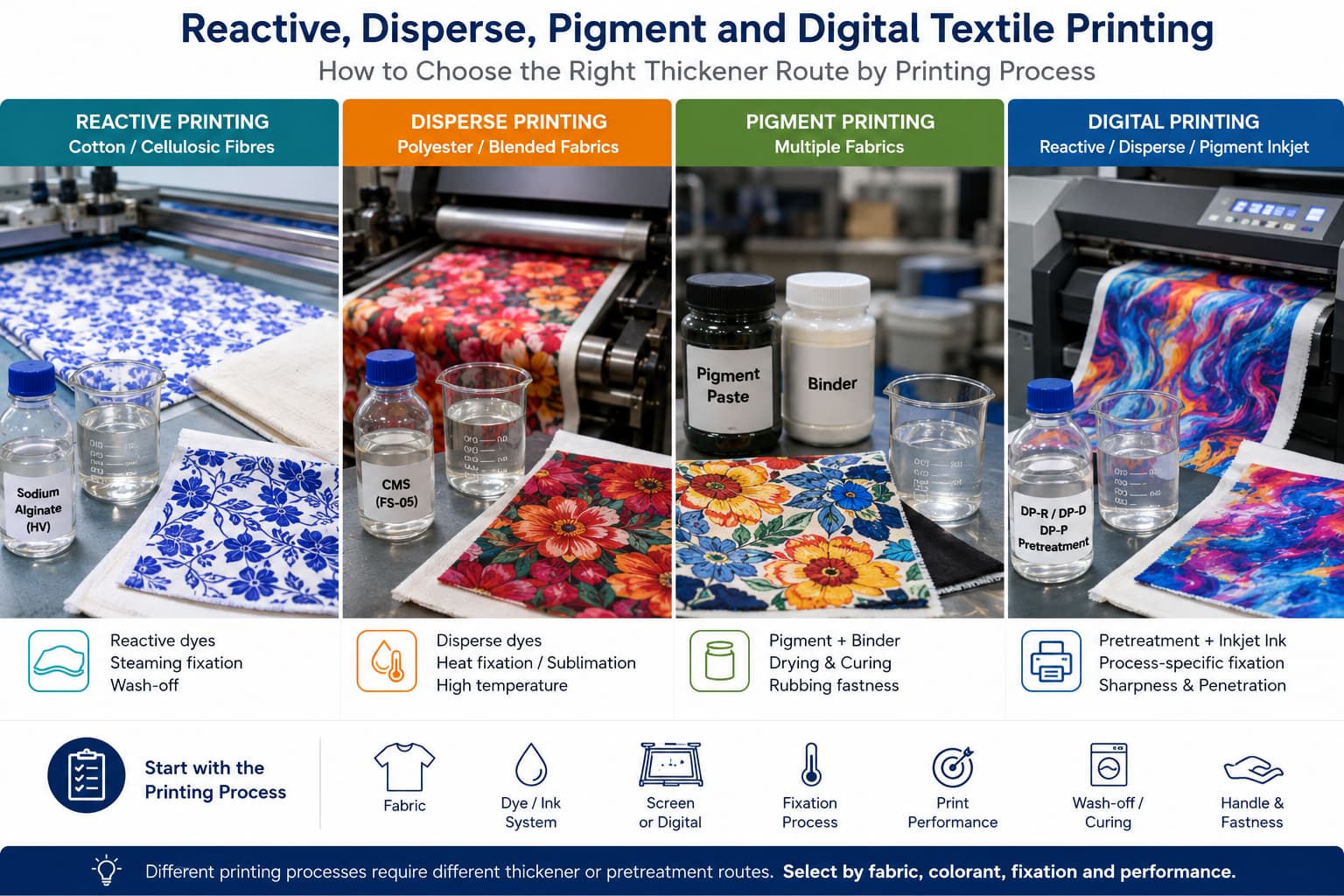
कपड़े, रंग या स्याही, स्थिरीकरण, धोने पर छूटना और मुद्रण गुणवत्ता की आवश्यकताओं के आधार पर प्रतिक्रियाशील, डिस्पर्स, पिगमेंट और डिजिटल टेक्सटाइल प्रिंटिंग के लिए गाढ़ा करने वाले पदार्थ और पूर्व-उपचार मार्ग चुनने का तरीका जानें।.
CMC-आधारित प्रिंटिंग पेस्ट का उपयोग पिगमेंट, रिएक्टिव और डिजिटल टेक्सटाइल प्रिंटिंग में किया जाता है। यह मार्गदर्शिका बताती है कि किन मापदंडों का महत्व है, आपूर्तिकर्ताओं की तुलना कैसे करें, और थोक ऑर्डर देने से पहले क्या अनुरोध करना चाहिए।.
सोडियम अल्जिनेट और सीएमसी दोनों का उपयोग वस्त्र मुद्रण में गाढ़ा करने वाले पदार्थ के रूप में किया जाता है, लेकिन ये विभिन्न रंग प्रणाली और प्रक्रिया की शर्तों के लिए उपयुक्त होते हैं। यह मार्गदर्शिका प्रमुख अंतर और प्रत्येक का उपयोग कब करना चाहिए, यह बताती है।.
सही टेक्सटाइल प्रिंटिंग थिकनर का निर्धारण केवल कपड़े के प्रकार से नहीं होता। खरीदारों को थिकनर को डाई या पिगमेंट सिस्टम, प्रिंटिंग विधि, लक्षित रेओलॉजी, धोकर हटाने की आवश्यकताओं और वास्तविक फैक्ट्री परीक्षण परिस्थितियों के अनुरूप चुनना चाहिए।.
टेक्सटाइल प्रिंटिंग की कार्यक्षमता एक समन्वित रासायनिक प्रणाली पर निर्भर करती है, न कि किसी एक सार्वभौमिक योजक पर। यह मार्गदर्शिका दस महत्वपूर्ण रासायनिक समूहों, उनके कार्यों, उनकी उपयुक्तता और उत्पादन परीक्षणों से पहले खरीदारों को किन बातों की जांच करनी चाहिए, समझाती है।.
टेक्सटाइल प्रिंटिंग थिकनर रासायनिक संरचना, प्रवाह विज्ञान, रंग संगतता और धोने पर छूटने के व्यवहार में भिन्न होते हैं। यह मार्गदर्शिका मुख्य थिकनर परिवारों, उनके सामान्य अनुप्रयोग दिशा-निर्देशों और उन मापदंडों की तुलना करती है जिन्हें खरीदारों को उत्पादन परीक्षणों से पहले सत्यापित करना चाहिए।.
डिजिटल प्रिंटिंग पेस्ट का चयन स्याही रसायन, कपड़े, अनुप्रयोग विधि और पश्चात-उपचार के आधार पर किया जाना चाहिए। यह मार्गदर्शिका वस्त्र इंकजेट प्रिंटिंग के लिए सोडियम अल्जिनेट, सीएमसी, सीएमएस, सिंथेटिक पॉलीमर और यौगिक पूर्व-उपचार मार्गों की तुलना करती है।.
An FSX-authored guide to checking digital pretreatment fit, trial evidence, product documents and sample-to-bulk traceability before supplier approval.
Stable digital printing paste requires more than a target viscosity. This guide explains how product selection, water quality, addition sequence, mixing, pH, temperature, filtration, hygiene, storage and quality records influence pretreatment and production consistency.
Evaluate FSX fabric pretreatment by confirmed grade, ink route, application architecture and measured add-on. Compare DG-20 or DP-P in a defined trial, and qualify any disperse candidate separately.
डिजिटल टेक्सटाइल प्रिंटिंग के लिए उन्नत स्याही और प्रिंटहेड से कहीं अधिक की आवश्यकता होती है। प्रतिक्रियाशील, डिस्पर्स और पिगमेंट इंकजेट प्रिंटिंग के लिए प्रक्रिया-विशिष्ट रासायनिक समाधानों का अन्वेषण करें, प्रीट्रीटमेंट और रियोलॉजी से लेकर फ़िल्ट्रेशन, फिक्सेशन और उत्पादन सत्यापन तक।.
Textile printing chemistry is evolving beyond simple viscosity and price comparisons. Explore five innovation directions shaping 2026, including safer chemical inputs, hybrid biopolymer thickeners, advanced pigment binders, shorter digital processes and multifunctional formulations.
उत्पाद का नाम, उपयोग, मात्रा, गंतव्य और आपके पास पहले से मौजूद कोई भी टीडीएस, नमूना फोटो या दस्तावेज़ साझा करें। FSX केमिकल इस जानकारी की समीक्षा करेगा और कोटेशन, नमूना मिलान या उत्पाद चयन के लिए अगले कदम की सिफारिश करेगा।.
उत्पाद की जानकारीउत्पाद का नाम, ग्रेड, मॉडल, लेबल की तस्वीर या आपूर्तिकर्ता संदर्भ।.
उपलब्ध दस्तावेज़टीडीएस, एसडीएस, सीओए, नमूना फोटो, उत्पाद सूची या परीक्षण डेटा।.
आदेश विवरणअनुमानित मात्रा, पैकेजिंग, गंतव्य देश, बंदरगाह या व्यापारिक शर्त।.
आवेदन या समस्याटेक्सटाइल मुद्रण प्रक्रिया, सूत्रीकरण आवश्यकता, वर्तमान समस्या या लक्षित प्रदर्शन।.