How to Achieve Sharp Pattern Edges with Proper Thickener Selection
Sharp textile print edges depend on more than viscosity. Learn how thickener chemistry, rheology, structural...
Sharp pattern edges in textile printing do not come from viscosity alone. They depend on the interaction between thickener chemistry, rheology, structural recovery, filtration, fabric absorbency, paste transfer and machine settings. This guide explains how proper thickener selection can help improve edge definition in reactive, disperse, pigment and selected digital textile printing processes.
Sharp edges are one of the clearest visual indicators of a well-controlled textile printing process. Fine lines should remain narrow, corners should stay defined, small text should remain legible and adjacent colors should not bleed into one another.
When pattern edges become blurred, the first reaction is often to increase viscosity. In some cases this changes spreading, but it is not a reliable universal solution.
A paste can have high standing viscosity and still show weak print definition if it transfers poorly, recovers structure too slowly after shear, penetrates the fabric excessively or interacts poorly with the full printing formula.
The correct objective is therefore not maximum viscosity. It is a controlled rheological operating window that allows the paste to flow during application and then recover enough structure to limit unwanted movement on the textile.
This guide explains how to select and evaluate textile printing thickeners when sharp pattern edges, fine details and clean color boundaries are the primary performance targets.
What Do Sharp Pattern Edges Mean in Textile Printing?
Sharp pattern edges mean that the printed boundary remains close to the intended design after paste transfer, fixation or curing and any required washing.
Useful indicators include
Fine lines remain continuous and narrow
Small text remains readable
Sharp corners remain angular rather than rounded
Dots remain distinct
Adjacent colors remain separated
Pattern boundaries do not feather excessively
Edge definition should be evaluated after the complete printing process, because fixation, washing, curing and fabric movement can change the final appearance.
Why Pattern Edges Become Blurred
Blurred edges can originate from several different parts of the printing process.
Possible thickener-related causes include
Insufficient structural recovery
Hindi angkop na pagbabawas ng lapot dahil sa shearing
Viscosity outside the practical operating range
Poor hydration
Low filtration quality
Chemical incompatibility in the complete paste
Other causes can include
Highly absorbent fabric
Excessive paste pickup
Incorrect squeegee pressure
Screen condition
Excess ink or paste laydown
Drying conditions
Fixation or washing differences
A professional troubleshooting process should therefore confirm the source of the problem before changing thickener concentration.
Why Viscosity Alone Is Not Enough
Viscosity is important because it influences how easily the paste moves, but a single reading represents only one measurement condition.
Textile printing exposes the paste to changing shear. The paste may be nearly stationary in storage, move through pipes, experience stronger forces during screen passage and then recover after reaching the fabric.
Two thickeners with the same single-point viscosity can therefore produce different edge definition.
The difference may come from
Shear-thinning behavior
Structural recovery
Yield-like structure
Hydration quality
Pagsasala
Fabric interaction
The better thickener is not necessarily the one with the higher viscosity. It is the one that gives the required balance of transfer and recovery.
Rheology and Edge Definition
Rheology describes how the paste behaves as mechanical force changes. This makes it especially important when the performance target is sharp printing.
At relatively low shear
Sufficient structure can help the paste remain stable before printing.
Under application shear
The paste should become easy enough to transfer through the screen or application zone.
After transfer
The paste should recover enough structure to reduce continued spreading.
This sequence helps explain why one viscosity reading may not account for edge-definition differences. Rheological measurements are supporting evidence and must be checked against the actual print result.
Shear Thinning During Printing
Many useful textile printing pastes show shear-thinning behavior. Their apparent viscosity decreases as the applied shear increases.
This can help the paste pass through a screen or move under a squeegee without requiring a permanently low-viscosity system.
Too little shear thinning
The paste may resist transfer, creating incomplete lines or uneven solid areas.
Excessive flow without adequate recovery
The paste may transfer easily but continue spreading after application, reducing pattern sharpness.
Sharp printing therefore depends on the balance between flow under shear and recovery after shear.
Structural Recovery After Paste Transfer
Structural recovery is one of the most important concepts in edge definition.
After transfer, continued lateral flow must become limited enough to preserve the pattern. Do not infer time-dependent structural recovery from one viscosity reading: its extent and timing need an appropriate controlled test for the actual paste.
Slow or weak recovery can contribute to
Feathered edges
Loss of fine-line width
Rounded corners
Color migration between adjacent areas
Excessively rigid recovery can create other problems
If the paste becomes too resistant, transfer and leveling may become less uniform.
The optimum recovery profile is therefore application-specific.
Penetration vs Lateral Spreading
Paste movement on fabric occurs both into the textile structure and across the surface.
These two directions should be distinguished.
Excessive lateral spreading
This is the main contributor to blurred edges.
Excessive penetration
This can reduce surface color appearance and make fine details less visible.
Insufficient penetration
This may create a surface-heavy result that is not suitable for some fabric constructions.
Proper thickener selection should therefore control both lateral movement and depth of penetration rather than focusing on one direction only.
How Fabric Absorbency Changes Edge Sharpness
A thickener cannot be selected independently of the fabric.
Highly absorbent cellulosic fabrics can pull liquid rapidly into yarn and fiber structures, increasing the risk of migration.
Important fabric variables include
Fiber composition
Knitted or woven construction
Timbang ng tela
Density
Tekstura ng ibabaw
Previous finishing
Moisture content
A thickener that produces sharp lines on dense woven cotton may require different optimization on viscose knit or an open fabric.
Filtration and Fine-Pattern Reproduction
Fine patterns are less tolerant of gels, lumps and poorly hydrated material.
High filtration residue can contribute to
Blocked screen openings
Broken fine lines
Local missing print
Inconsistent transfer
Use a standardized filtration test
Compare products using the same concentration, hydration time, sample quantity and filter condition.
Filtration does not guarantee perfect printing, but it is a useful supporting indicator when fine pattern reproduction is important.
Screen Passage and Transfer
Sharp edges depend on clean transfer through the printing system.
If the paste is too resistant, fine openings may not transfer enough material. If the paste is too fluid or recovers too slowly, the printed boundary may spread after transfer.
Evaluate together
Lapot
Rheolohiya
Pagsasala
Screen mesh
Squeegee settings
Printing speed
The thickener should be matched to the complete mechanical printing condition rather than tested only in a beaker.
Sodium Alginate for Sharp Reactive Printing
Sodium alginate Ito ay isang karaniwang panukat ng pampalapot para sa karaniwang reaktibong pagpi-print sa angkop na mga telang selulósiko.
For sharp pattern edges, evaluate
Viscosity under a defined method
Pag-hydrate
Pagsasala
Shear-thinning behavior
Structural recovery
Reactive-paste compatibility
Fine-line definition
Fixation and wash-off
HV sodium alginate should not automatically be assumed to provide the sharpest printing. The best grade is the one that provides the correct rheological balance for the formula, fabric and machine.
CMC in Selected Sharp-Definition Systems
CMC can be evaluated in selected textile printing and compound thickener systems.
Important matching parameters include
Degree of substitution where relevant
Lapot
Pag-hydrate
Pagsasala
Electrolyte response
Rheolohiya
Kagamitang-kompatibilidad ng kumpletong pandikit
Two CMC grades with similar viscosity can still produce different edge definition because their shear response and recovery may differ.
CMC should not be assumed to replace sodium alginate 1:1 in reactive printing without full formulation and fabric testing.
CMS in Selected Disperse and Compound Systems
CMS maaaring masuri sa piniling mga sistema ng pagpi-print ng tela na pang-disperse, pang-compound, at espesyalidad.
For pattern definition, compare
Viscosity efficiency
Pag-hydrate
Pagsasala
Paglilipat sa screen
Rheological recovery
Katatagan ng pandikit
Color-system compatibility
Sharpness should be confirmed on the finished textile after the relevant thermal or post-treatment process.
Compound Thickeners for Balanced Edge Control
A compound thickener can combine several rheology-control components when one polymer alone does not provide the preferred balance.
A compound system may be designed to balance
Base viscosity
Shear thinning
Structural recovery
Pagsasala
Electrolyte tolerance
Pagpapanatili ng katatagan
Edge definition
Effective dosage
Compound does not automatically mean sharper. The formulation still needs to be evaluated against a current benchmark and actual printing conditions.
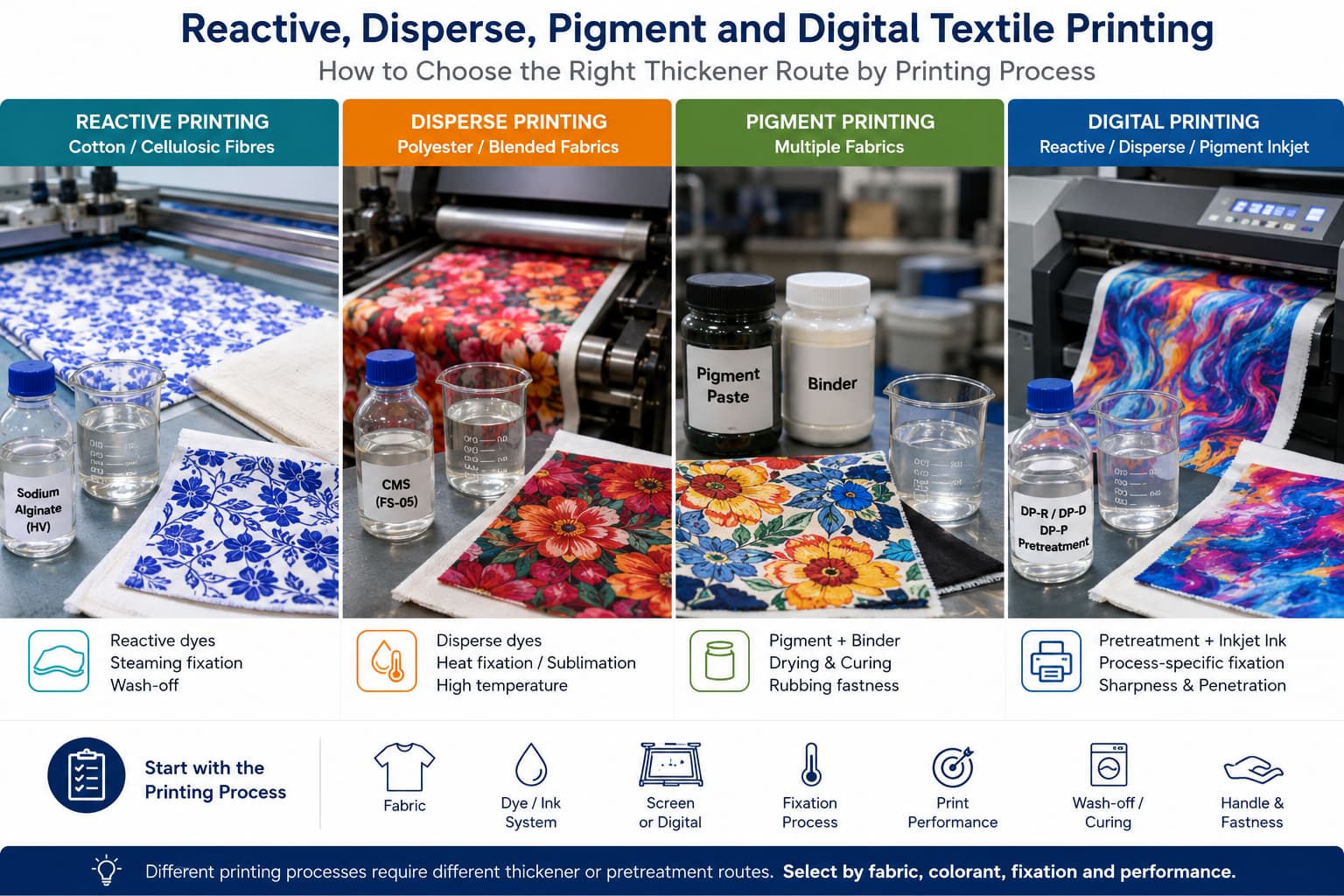
Pigment Printing and Binder-Compatible Rheology
Pigment printing requires the thickener to operate together with pigment dispersion, binder and curing chemistry.
A thickener that gives good edge definition but interacts poorly with the binder is not a successful solution.
Evaluate
Katugmang ng binder
Electrolyte response
Katatagan ng pandikit
I-print ang depinisyon
Pagpapagaling
Pagganap ng pag-pahid
Fabric hand feel
Sharp pigment printing requires a balance between rheology and film-forming performance.
Digital Printing Pretreatment and Edge Definition
Digital inkjet printing uses a different chemistry from conventional screen printing.
Reactive, disperse and pigment digital systems should be evaluated separately because their fabric and fixation chemistry differ.
Flat-Screen Printing
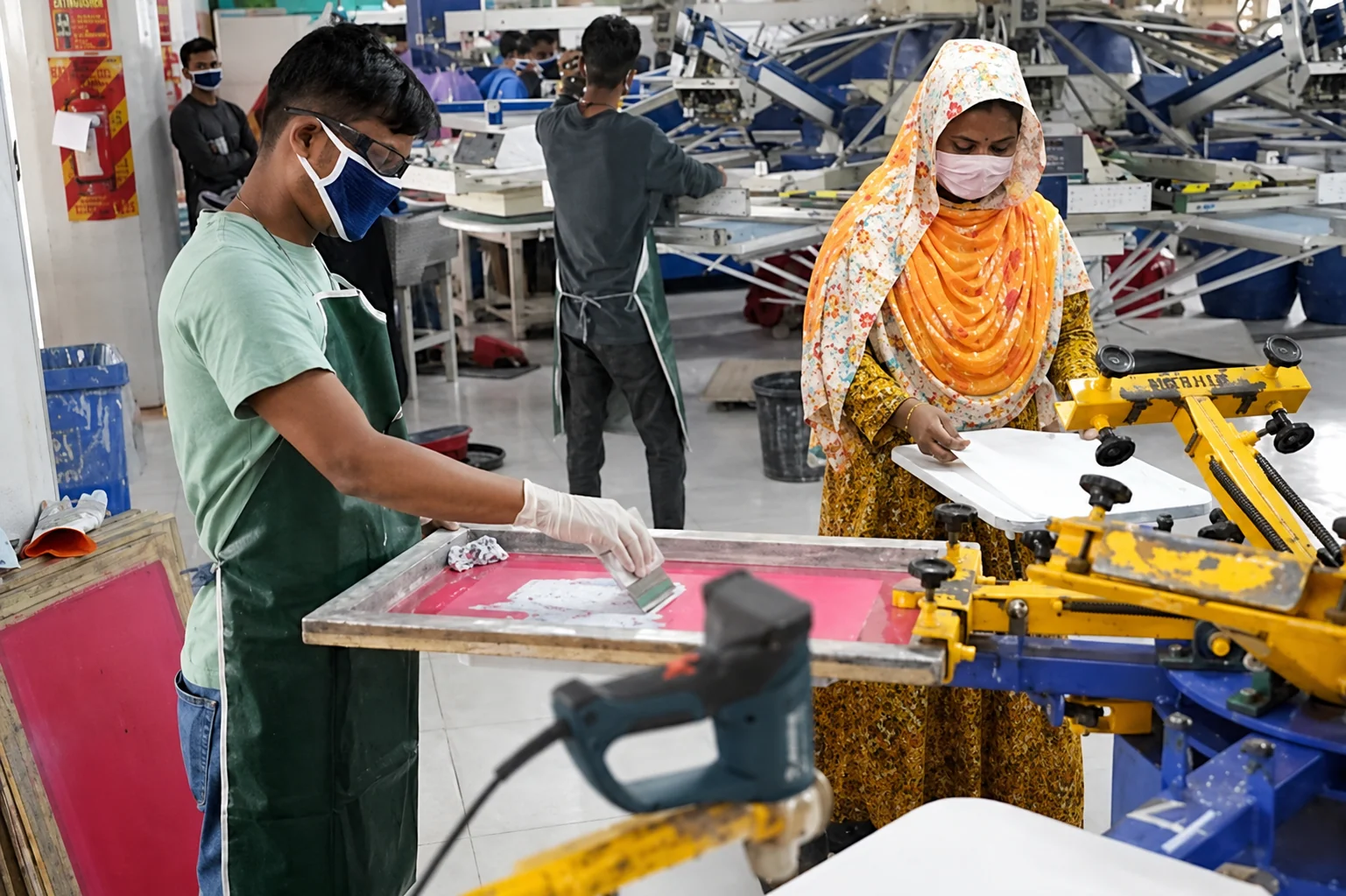
Flat-screen printing is strongly affected by the interaction between squeegee conditions, screen parameters and paste rheology.
When edge definition is poor, check
Squeegee pressure
Squeegee speed
Screen mesh
Paste viscosity
Rheolohiya
Pagsasala
Fabric absorbency
Increasing viscosity without controlling the squeegee and screen can hide the real source of the defect.
Rotary-Screen Printing
Rotary-screen printing adds continuous pumping and circulation to the requirements of sharp pattern reproduction.
Important thickener properties include
Stable circulation
Practical filtration
Shear stability
Fast enough structural recovery
Long-run holding stability
A paste that prints sharply during a short trial should still be checked through the beginning, middle and end of a production run.
Fine Lines, Small Text and Corners
Fine-detail test patterns are one of the best ways to compare two thickeners for edge definition.
A useful diagnostic design should include
Fine horizontal lines
Fine vertical lines
Small text
Sharp corners
Fine dots
Closely spaced parallel lines
Adjacent color boundaries
These features can reveal spreading and transfer differences that are easy to miss in a simple solid block.
Why Solid Areas Must Also Be Tested
A thickener can produce excellent fine lines but poor large-area coverage if the paste does not transfer or level correctly.
Solid areas reveal
Transfer efficiency
Paste leveling
Penetration uniformity
Color-paste delivery
Machine consistency
The preferred thickener should therefore balance fine-detail sharpness with acceptable solid-area performance.
Dark Shades as a Stress Test
Black and other deep colors make edge defects easier to observe.
Dark shades can reveal
Feathering
Uneven solid coverage
Excessive penetration
Broken fine details
Boundary contamination
However, dark-shade performance depends on the dye or pigment system as well as the thickener. The same colorant, concentration, fabric and post-treatment should be used during comparison.
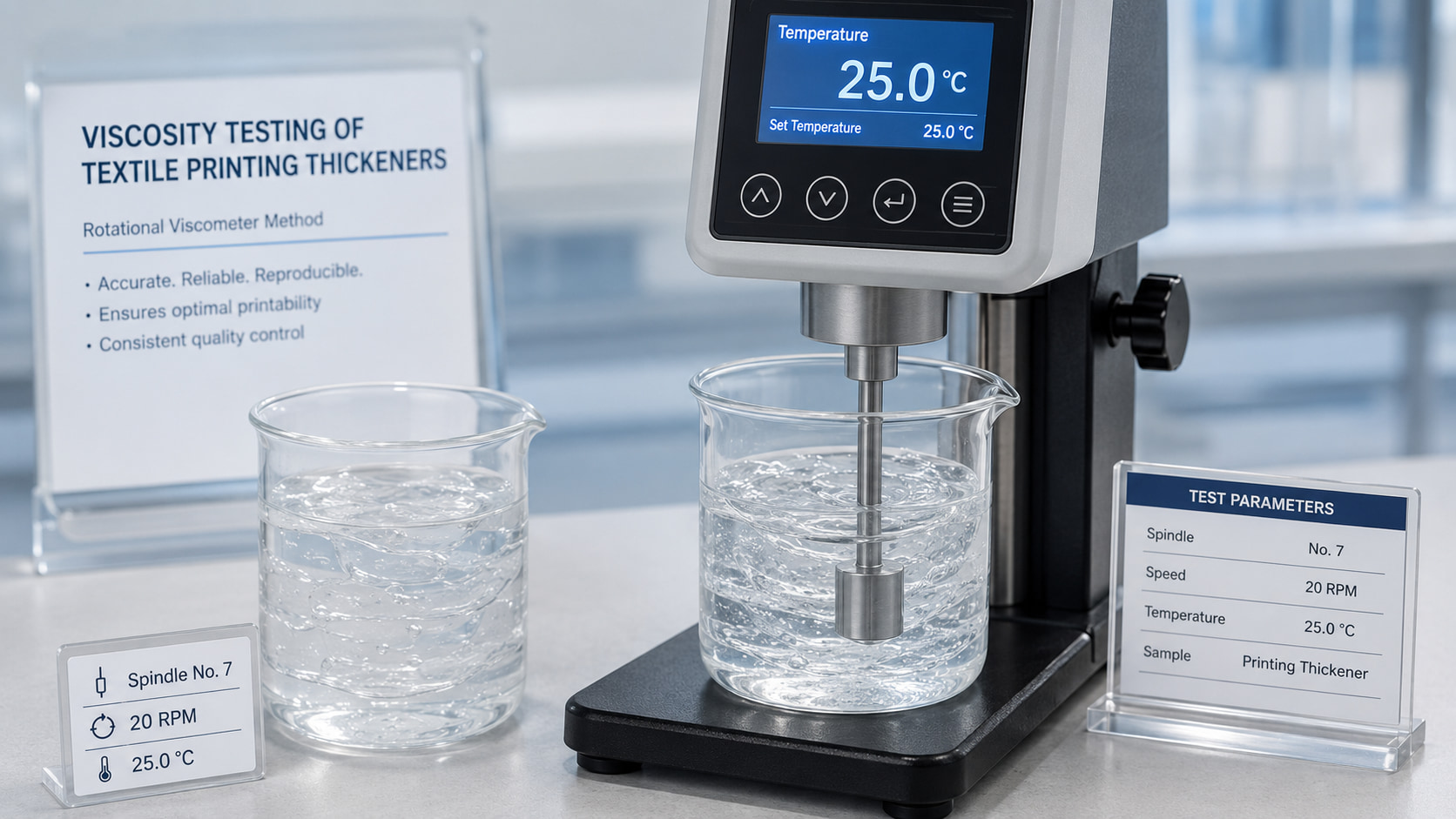
Standardizing the Viscosity Method
Thickener comparison is unreliable if viscosity is measured under different conditions.
Always record
Konsentrasyon ng produkto
Pinagmumulan ng tubig
Mixing method
Oras ng pag-hydrate
Temperatura
Viscometer
Spindle, rotor o geometriya
Bilisan ng pag-ikot
Oras ng pagbabasa
Edge-definition problems should not be attributed to a product until the viscosity comparison itself is technically valid.
Optimizing Thickener Dosage
The initial comparison should use a controlled baseline. After a candidate passes the basic technical comparison, dosage can be optimized.
Do not optimize only for viscosity
A lower dosage may still meet a viscosity target but produce weaker edge recovery or different penetration.
Adjust gradually
Test several controlled dosage levels around the successful condition.
Reprint the same diagnostic design
Compare fine lines, solid areas and final fabric after every meaningful dosage change.
The best dosage is the lowest practical level that maintains the required production and quality performance, not simply the lowest number tested.
Testing the Complete Printing Paste
A thickener should never be approved for edge definition from water solution alone.
The complete paste may contain
Dyes
Pigments
Mga asin
Mga alkali
Mga binder
Mga pampanatili ng kahalumigmigan
Mga ahente ng pagbabad
Pang-alis ng bula
These components can change viscosity, rheology, filtration and stability.
Sharpness should therefore be evaluated only after the candidate thickener has been tested in the real production formula.
Recommended Laboratory Workflow
Step 1: Define the edge-definition problem
Record whether the issue is feathering, broken lines, rounded corners, color bleeding or poor small-text clarity.
Step 2: Record the current benchmark
Use the currently approved thickener whenever possible.
Step 3: Standardize the viscosity method
Align concentration, preparation, hydration, temperature and instrument.
Step 4: Compare hydration and filtration
Eliminate obvious preparation problems before printing.
Step 5: Compare rheology where possible
Multi-speed measurements can help reveal differences in shear behavior.
Step 6: Prepare the complete production paste
Use the same colorant and auxiliaries.
Step 7: Print the same fabric
Use a diagnostic design containing fine details and large solid areas.
Step 8: Complete fixation, curing or washing
Evaluate edge definition on the finished textile.
Step 9: Optimize dosage
Adjust the candidate only after it has passed the baseline comparison.
Locate the Stage Where the Edge First Changes
Keep labeled companion swatches from the same diagnostic print and compare them at consistent elapsed times. Photograph the same line, corner and adjacent-color features at a fixed scale and orientation. Record dimensional change separately: fabric shrinkage can alter measured line width without proving lateral paste flow.
First visible defect
Priority checks
Useful comparison
Already present in the wet print
Transfer, screen condition, pickup, fabric wetting and complete-paste flow.
Compare the reference paste and candidate on the same fabric with unchanged machine settings; distinguish missing transfer from spreading.
Appears during drying
Liquid load, drying profile and movement before immobilization.
Compare wet and dried companion swatches before changing the thickener. Record actual drying conditions.
Appears after steaming or thermal fixation
Process-specific fixation, moisture or heat exposure, migration and fabric movement.
Compare dried and fixed swatches. Use the relevant reactive or disperse route rather than a common heat-setting assumption.
Appears after washing in a dye-printing route
Removal of unfixed colorant, rinsing, back-staining and wash conditions.
Compare fixed and washed swatches plus unprinted background. Do not diagnose poor wash-off as a wet-paste recovery failure.
Edge survives but pigment rub fastness fails
Binder system, curing and the specified fastness test.
Keep edge definition and cured-film performance as separate acceptance results; not every pigment route includes washing.
The table is an investigation sequence, not proof of a particular root cause. Change one controlled variable after locating the first failing stage, then repeat the complete route. If the initial paste comparison is uncertain, first align the viscosity method and shear history.
Production Trial and Scale-Up
Laboratory sharpness does not automatically guarantee production sharpness.
Scale-up changes
Batch size
Mixer geometry
Pagpapanatili ng oras
Pumping
Circulation
Machine speed
Fabric tension
During the production trial, monitor
Paglilipat sa screen
Paste transfer
Fine-line definition
Solid-area uniformity
Pagpasok
Katatagan ng pandikit
Compare fabric from the beginning, middle and end of the run before approving the new grade.
Troubleshooting Blurred Pattern Edges
Napansin na Problema
Posibleng sanhi
What to Check
Fine lines spread wider
Weak structural recovery or high fabric absorbency
Rheology, dosage, pickup and fabric
Edges feather after printing
Excess lateral migration
Recovery, liquid load, fabric and machine settings
Fine lines are incomplete
Poor transfer, excessive resistance or blocked screen openings
Viscosity, filtration, screen and squeegee
Corners become rounded
Paste continues to flow after transfer
Structural recovery and dosage
Adjacent colors bleed
Migration, excess liquid or insufficient surface control
Rheology, paste load, fabric and drying
Sharpness is good but solids are weak
Transfer is too restricted
Viscosity, squeegee pressure and screen passage
Lab print is sharp but production blurs
Scale-up, circulation or speed difference
Machine conditions, shear history and holding time
Same viscosity but different sharpness
Different rheology or recovery
Multi-speed behavior, filtration and full-paste trial
Blurred edges should be treated as a system problem. Thickener selection is important, but the machine, fabric, colorant and post-treatment should be investigated at the same time.
Sharpness and Total Cost in Use
A sharper-printing thickener can have economic value when it reduces rework, rejected fabric or repeated machine adjustment.
Ihambing
Delivered thickener price
Effective dosage
Preparation time
Pagsasala
Screen cleaning
Printing speed
Rejected fabric
Reprinting
The preferred product is not necessarily the cheapest per kilogram or the highest in viscosity. It is the grade that achieves the required edge definition and overall production stability at an acceptable total cost.
How to Compare Thickener Suppliers for Edge Definition
Supplier comparison should begin with a current successful product whenever one is available.
Ask the supplier to align
Paraan ng viskosidad
Polymer concentration
Hydration conditions
Filtration method
Printing route
Tela
Kasalukuyang dosis
Main edge-definition problem
A supplier should recommend a candidate for testing rather than guarantee sharper printing before seeing the actual formulation and application.
How FSX Chemical Supports Sharp-Definition Grade Matching
Customers seeking sharper edges can use their current commercial product and printed fabric as the technical benchmark.
Sa pamamagitan ng Mga Halimbawa at Pagtutugma , the current TDS, physical sample, viscosity method, formula and printing conditions can be reviewed before a candidate grade is selected.
Kasama sa kapaki-pakinabang na impormasyon ang
Current thickener manufacturer and grade
TDS or available COA
Pisikal na sangguniang halimbawa
Konsentrasyon ng viskosidad at pamamaraan ng pagsubok
Kasalukuyang dosis
Reaktibo, magkalat, pigmento o digital na ruta
Komposisyon at pagkakagawa ng tela
Patag na salaan, paikot na salaan o digital na kagamitan
Screen mesh where relevant
Current print image or defect photo
Main issue: bleeding, feathering, broken lines or weak solids
Final suitability should be confirmed through controlled side-by-side printing and production validation rather than from viscosity data alone📧 I-email: Service@fsxchemical.com
Alamin kung bakit hindi maaaring ikumpara ang mga halaga ng viskosidad ng pampapalapot sa pagpi-print ng tela nang hindi tinutugma ang konsentrasyon, temperatura, instrumento, spindle, bilis, paraan ng paghahanda, at oras ng pagsubok.
Matutong pumili ng pampatigas at mga paraan ng paunang paggamot para sa reaktibo, disperse, pigment, at digital na pagpi-print sa tela batay sa tela, tina o tinta, fiksasyon, paghuhugas, at mga kinakailangan sa kalidad ng pagpi-print.
Ihambing ang CMC, CMS, sodium alginate, at digital printing paste para sa pagpi-print ng tela. Alamin kung paano nababagay ang bawat uri sa mga prosesong reaktibo, disperse, pigment, at digital, at kung ano ang dapat suriin ng mga mamimili bago magsagawa ng pagsubok ng sample, pagtutugma ng grado, at malakihang pagbili.
Malawakang ginagamit ang sodium alginate sa pagpi-print ng tela bilang matatag at maaaring hugasan na pampalapot para sa reaktibong pasta sa pagpi-print. Alamin kung paano suriin ang grado ng viskosidad, kadalisayan, at pagiging angkop sa aplikasyon bago bumili, at kung paano sinusuportahan ng FSX Chemical ang mga mamimili sa buong mundo sa pamamagitan ng teknikal na datos at mga sample.
Choose CMC for textile printing by application, DS, viscosity method and formulation trials. Use a practical checklist to compare grades before bulk purchase.
Ang carboxymethyl cellulose ay ginagamit bilang pampalapot at pampatatag sa mga tinta na nakabase sa tubig, sa gravure printing, at sa paunang paggamot para sa inkjet. Saklaw ng gabay na ito ang mga pangunahing parameter ng grado at mga konsiderasyon sa pagkuha para sa mga koponan sa pagbili.
Ang CMC-based printing paste ay ginagamit sa pigment, reactive, at digital na pagpi-print ng tela. Ipinapaliwanag ng gabay na ito kung aling mga parameter ang mahalaga, kung paano ihambing ang mga supplier, at kung ano ang dapat hilingin bago maglagay ng maramihang order.
Parehong ginagamit ang sodium alginate at CMC bilang pampalapot sa pagpi-print ng tela, ngunit angkop ang mga ito sa iba't ibang sistema ng pangkulay at kondisyon ng proseso. Ipinapaliwanag ng gabay na ito ang mga pangunahing pagkakaiba at kung kailan dapat gamitin ang bawat isa.
Ang digital inkjet printing sa tela ay may iba't ibang kinakailangan sa paste at paunang paggamot kumpara sa screen printing. Ipinapaliwanag ng gabay na ito kung paano ginagamit ang sodium alginate sa digital na pagpi-print ng tela at kung anong mga parameter ng grado ang dapat tukuyin ng mga koponan sa pagbili.
Ang CMC na pang-pagkain at pang-industriya ay pareho ang batayang kemistri ngunit malaki ang pinagkaiba sa kadalisayan, saklaw ng DS, at mga kinakailangang regulasyon. Ipinapaliwanag ng gabay na ito ang mga pangunahing pagkakaiba at kung bakit nagdudulot ng mga problema sa produksyon ang paggamit ng maling uri.
Prepare sodium alginate printing paste with a grade-specific concentration and controlled powder dispersion. Validate hydration, viscosity, filtration, air removal and holding time before production.
Assess sodium alginate in reactive-printing wastewater using measured COD load, product-specific biodegradation evidence and controlled process comparisons. Includes a buyer checklist and illustrative load calculation.
Ibahagi ang pangalan ng produkto, aplikasyon, dami, destinasyon, at anumang TDS, larawan ng sample o dokumento na mayroon ka na. Susuriin ng FSX Chemical ang impormasyon at irekomenda ang susunod na hakbang para sa quotation, pagtutugma ng sample, o pagpili ng produkto.
Impormasyon ng ProduktoPangalan ng produkto, grado, modelo, larawan sa etiketa o sanggunian ng tagapagtustos.
Magagamit na mga dokumentoTDS, SDS, COA, larawan ng sample, listahan ng produkto o datos ng pagsubok.
Mga Detalye ng OrderTinatayang dami, pag-iimpake, bansang patutunguhan, pantalan o termino sa kalakalan.
Aplikasyon o IsyuProseso ng pagpi-print sa tela, pangangailangan sa pormulasyon, kasalukuyang isyu o target na pagganap.