FSX Chemical’ın Uzman Çözümleriyle Tekstil Baskı Kalitenizi Artırın
Improving textile printing quality requires more than changing one chemical. This guide explains how FSX...
Improving textile printing quality rarely depends on one chemical or one machine setting. Print definition, color yield, paste stability, wash-off, fastness and fabric handle are influenced by the interaction among the fabric, dye or ink, thickener, auxiliaries, equipment and fixation process.
FSX Chemical supplies several textile printing thickener and paste routes, including sodium alginate, carboxymethyl cellulose (CMC), carboxymethyl starch (CMS) and digital printing paste. The appropriate route depends on the printing process rather than on a universal product recommendation.
In this article, “expert solutions” means process-based product selection, sample matching, technical-document support and controlled trial guidance. It does not mean that a product can guarantee a specific result without testing under the buyer’s actual production conditions.
Quick takeaway: Begin with the fabric, dye or ink system and production problem. Select a technically relevant product route, test it against the approved reference and confirm the commercial grade before bulk purchasing.
What Does Textile Printing Quality Include?
Printing quality is not a single laboratory value. A product can provide acceptable viscosity but still produce poor screen passage, excessive penetration or difficult wash-off.
Yazdırma Tanımı
Print definition includes line sharpness, clean edges, small details and control of color spreading. It is influenced by paste rheology, fabric absorbency, screen conditions, ink-drop behavior and drying.
Color Performance
Color performance includes shade depth, color difference, levelness and reproducibility. In dye printing, fixation and washing determine how much color remains on the fabric after processing.
Production Stability
A paste needs to remain sufficiently stable during preparation, storage, pumping and printing. Viscosity drift, separation, foam, gels or incomplete hydration can create machine and quality problems.
Wash-Off and Fabric Handle
After fixation, unfixed dye, thickener and auxiliaries need to be removed to the extent required by the process. Poor removal may affect shade, rubbing fastness and fabric handle.
Batch Reproducibility
Large-scale production requires results to remain within agreed tolerances across raw-material and production batches. This depends on both supplier control and the mill’s preparation and process control.
Quality Area
Possible Measurements
Yapıştır
Viscosity, pH, filtration, hydration and holding stability
Yazdırma
Screen passage, line sharpness, bleeding, penetration and levelness
Color
K/S, color difference, shade and batch reproducibility
Bitmiş Kumaş
Wash-off, fastness, residue and handle
Production
Paste consumption, downtime, cleaning, rework and rejected fabric
A Process-Based Approach to Printing Problems
Before recommending a product, the printing route and problem should be defined. A statement such as “we need a high-viscosity thickener” does not explain the fabric, dye, machine or defect.
Step 1: Identify the Printing Route
Reactive printing on cotton, viscose or another compatible fiber
Polyester üzerine dağınık baskı
Pigment printing with a binder
Vat or discharge printing
Reactive, disperse or pigment digital inkjet printing
Step 2: Define the Defect
Record whether the problem is low viscosity, viscosity drift, bleeding, poor sharpness, screen blockage, low color yield, difficult wash-off or harsh handle.
Step 3: Separate Chemical and Process Causes
A defect may come from the thickener, but it can also come from fabric absorbency, water quality, mixing, screen condition, dye, alkali, binder, drying, fixation or washing.
Changing the chemical before checking the complete process may move the problem rather than solve it.
Step 4: Define an Acceptance Test
The buyer and supplier should agree on how a candidate will be compared. Use the same fabric, formulation, preparation, printing and finishing conditions for the reference and trial product.
FSX Chemical Product Routes
Ürün Yolu
Tipik Değerlendirme Yöntemi
Alıcılar İçin Önemli Kontroller
Sodyum Aljinat
Pamuk ve diğer selülozik kumaşlar üzerine reaktif boya baskısı
Viscosity method, filtration, color yield, definition and wash-off
CMC
Selected printing, viscosity-control and compound thickener systems
İkame derecesi, viskozite, çözünürlük, tuz toleransı ve uyumluluk
CMS
Selected reactive, disperse, vat, discharge or compound systems
Paste stability, screen passage, wash-off and total cost in use
Dijital Baskı Macunu
Reactive, direct disperse or pigment digital pretreatment routes
Ink system, fabric, pH, filtration, pickup, fixation and final print result
Custom Matched Route
Current supplier replacement or process-specific requirements
Current TDS, sample, test method, target performance and production validation
Reaktif Baskı için Sodyum Aljinat
Sodium alginate is commonly used as a benchmark thickener for reactive dye printing. Its anionic structure generally limits interaction with many reactive dyes and can support wash-off under a properly controlled process.
Grade selection should consider viscosity, hydration, filtration, water quality and the complete printing recipe. Sodium alginate alone does not guarantee color yield or fastness.
CMC for Selected Printing Systems
CMC is a cellulose ether available in different viscosity and substitution ranges. Selected grades may be evaluated for printing-paste adjustment, compound systems or supplier replacement.
For reactive printing, compatibility depends on the CMC grade, degree of substitution, dye and formulation. General-purpose CMC should not automatically be used as a reactive printing thickener.
CMS for Process and Cost Evaluation
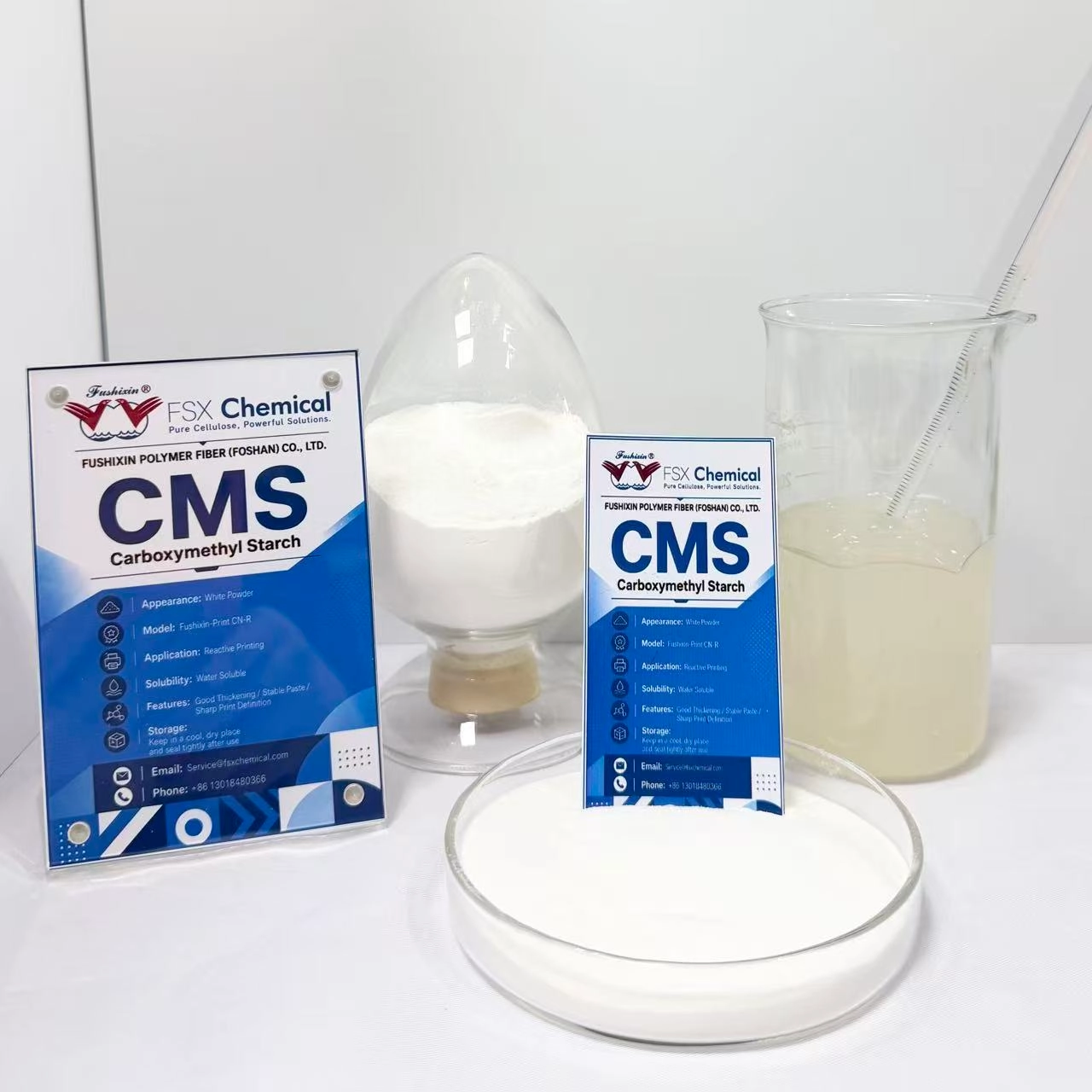
CMS is a starch-derived polymer evaluated in selected reactive, disperse, vat, discharge and compound systems. It may be considered when the buyer needs a different balance of paste body, wash-off and cost.
A lower material price is not sufficient for approval. Dosage, preparation, print quality and washing should be included in the comparison.
Dijital Baskı Macunu
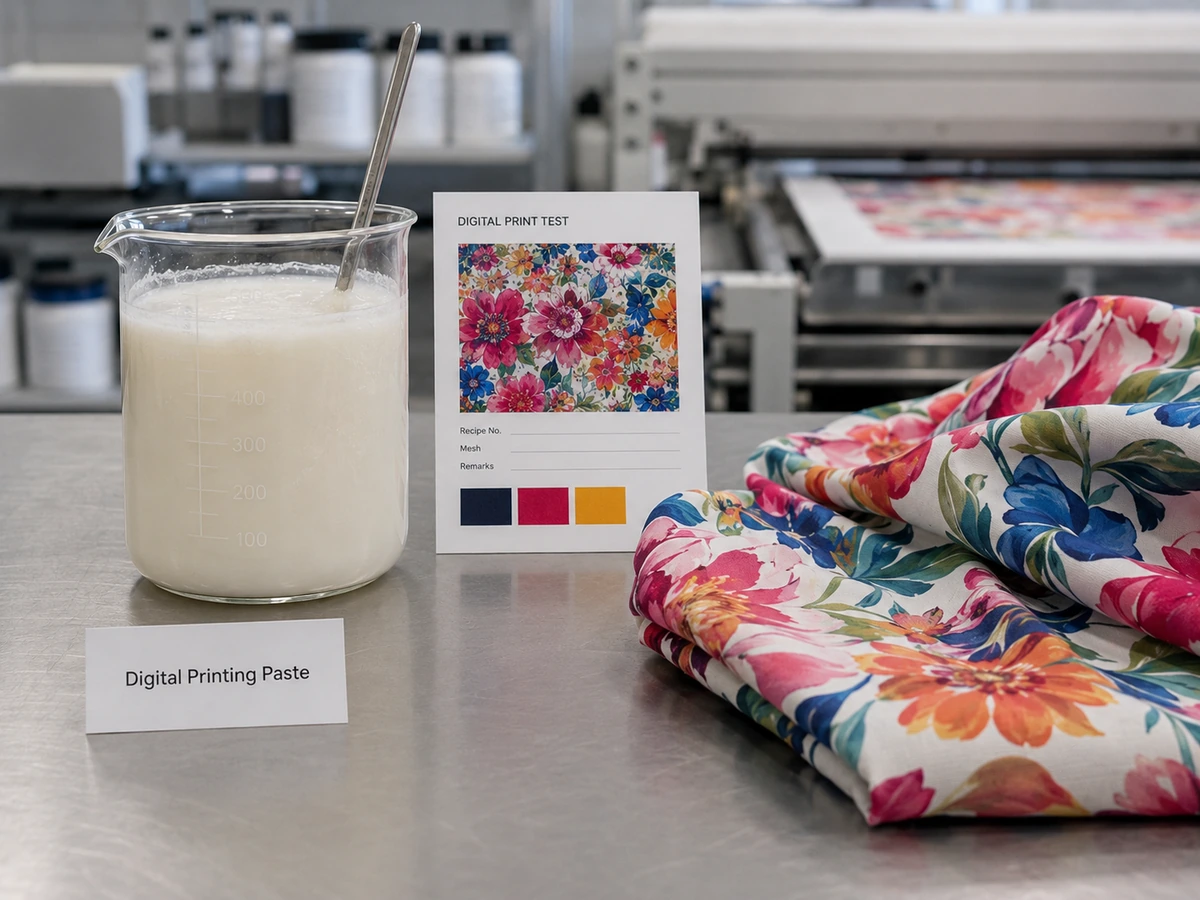
Digital printing requires separate product routes for reactive, direct disperse and pigment inks. FSX Chemical currently identifies DP-R, DP-D and DP-P as different starting routes.
These are internal product directions rather than universal industry codes. The current TDS, ink system and fabric should be reviewed before requesting a sample.
Improving Print Sharpness and Bleeding Control
Begin with Rheology
Paste needs to move under the shear created by a pump, squeegee or screen, then recover enough structure to hold the printed design. A single viscosity number may not describe this behavior completely.
If the paste is too fluid, it may spread or penetrate excessively. If it is too thick, it may reduce transfer, block screens or create uneven coverage.
Check Fabric Absorbency
Highly absorbent or unevenly prepared fabric can change line width and penetration. Test the candidate on the actual production fabric rather than a laboratory fabric only.
Check Paste Add-On
Machine speed, pressure, screen and paste viscosity influence the quantity transferred to the fabric. A thickener change may require production adjustment, but each change should be documented.
How FSX Chemical Can Support the Evaluation
Buyers can provide the current grade, viscosity method, screen process, fabric and defect photographs. A candidate sample can then be compared under the same conditions.
Stabilizing Paste Viscosity and Preparation
Standardize Powder Addition
Adding powder too quickly can create partially hydrated lumps. Record addition rate, mixing time, water temperature and hydration time.
Use the Same Viscosity Method
Concentration, temperature, hydration, viscometer, spindle and speed should be the same when comparing grades. Values from different methods are not directly comparable.
Test the Complete Formulation
A thickener may be stable in water but lose or gain viscosity after dye, salt, alkali, binder or other auxiliaries are added. Measure the complete paste immediately and after the normal holding period.
Use Actual Process Water
Hardness, conductivity and metal ions can affect hydration and filtration. Sodium alginate systems can form gel particles in the presence of multivalent ions such as calcium.
Review Storage and Hygiene
Water-based pastes can change because of temperature, contamination or microbial activity. Do not assume that a prepared paste can be stored indefinitely.
Supporting Wash-Off and Fabric Handle
The thickener needs to perform during printing and then be removed as required after fixation. Residual polymer, hydrolyzed dye or other auxiliaries can affect fabric handle and fastness.
Reaktif Baskı
Sodium alginate is often selected because it can support clean removal in reactive printing. Actual wash-off still depends on grade, dosage, dye, fixation and washing conditions.
CMC and CMS Systems
Removal behavior varies by grade and formulation. Evaluate the candidate after the complete fixation and washing process rather than judging only the printed fabric before washing.
Measure What Matters
Color depth before and after washing
White-area staining
Dry and wet rubbing fastness
Kumaş sap
Visible or measurable residue
Water and washing time required
Do not claim that changing the thickener directly improves fastness unless the complete test conditions and results support that conclusion.
Matching Digital Printing Pretreatment
Reaktif Mürekkep Püskürtmeli
Reactive pretreatment needs to control ink spreading and provide suitable conditions for dye fixation. Fabric, ink, alkali, moisture, steaming and washing should be evaluated together.
Direct Disperse Inkjet
Direct disperse printing on polyester requires control of wetting, penetration, migration and thermal fixation. It should not be confused with sublimation transfer through coated paper.
Pigment Inkjet
Pigment systems require compatibility among the pretreatment, pigment ink, binder or fixation chemistry and fabric. Finished-fabric handle and rubbing fastness are important approval criteria.
Digital Trial Requirements
Ink system and printer
Kumaş lifleri ve yapısı
Application method and pickup
Filtration and coating uniformity
Drying and storage of treated fabric
Fixation and washing route
Color, definition, fastness and handle
Supporting Batch and Procurement Control
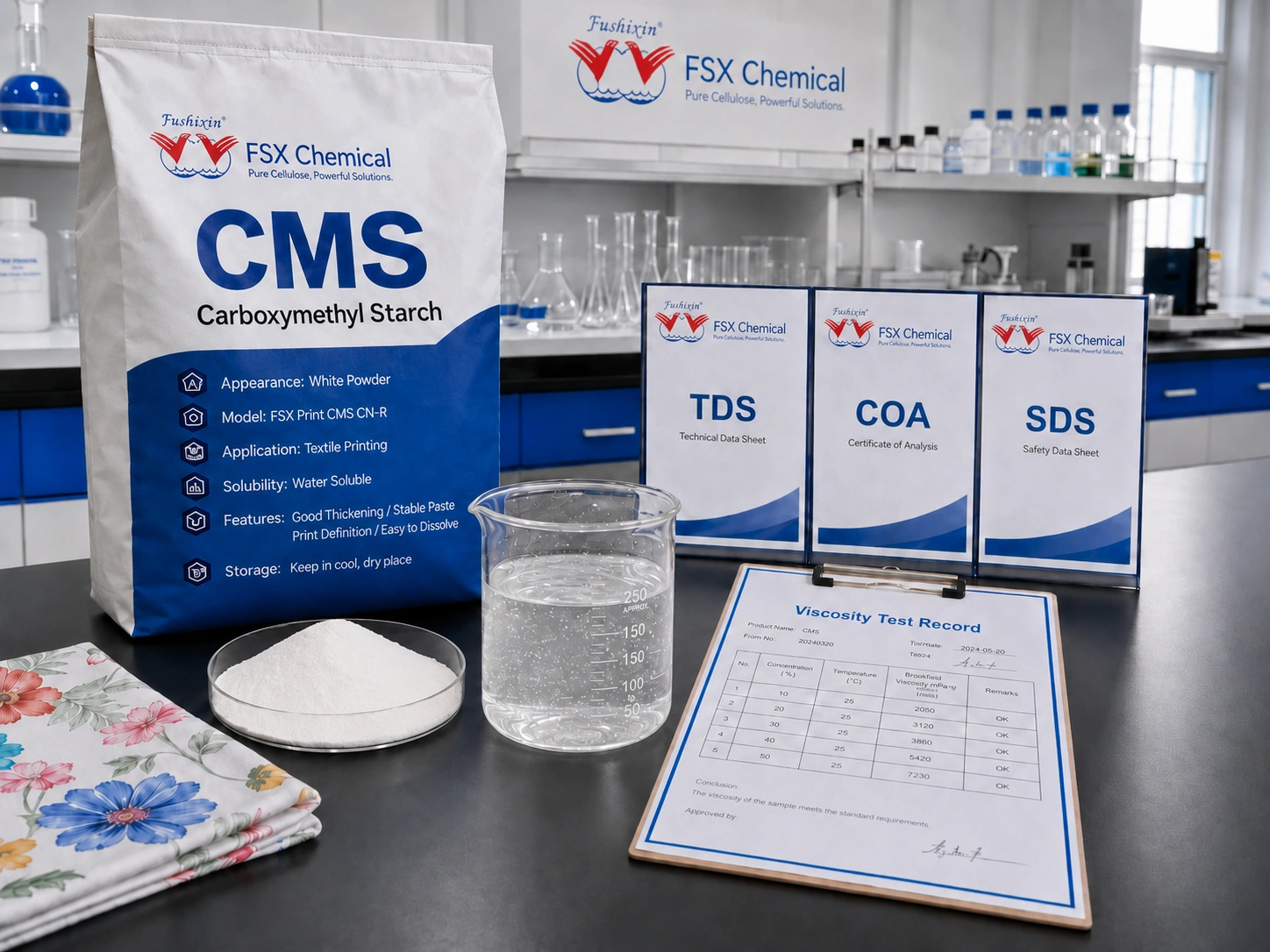
TDS for Product Evaluation
The Technical Data Sheet identifies the product, application direction, typical properties and test information. It supports sample selection but is not a batch-release record.
SDS for Safety Review
The Safety Data Sheet supports handling, storage and workplace review. Buyers should request a current version appropriate to their market where required.
COA for the Confirmed Batch
A batch-specific Certificate of Analysis should identify the product, batch and selected results. COA parameters should be compared with the purchasing specification.
Product Identity Across Documents
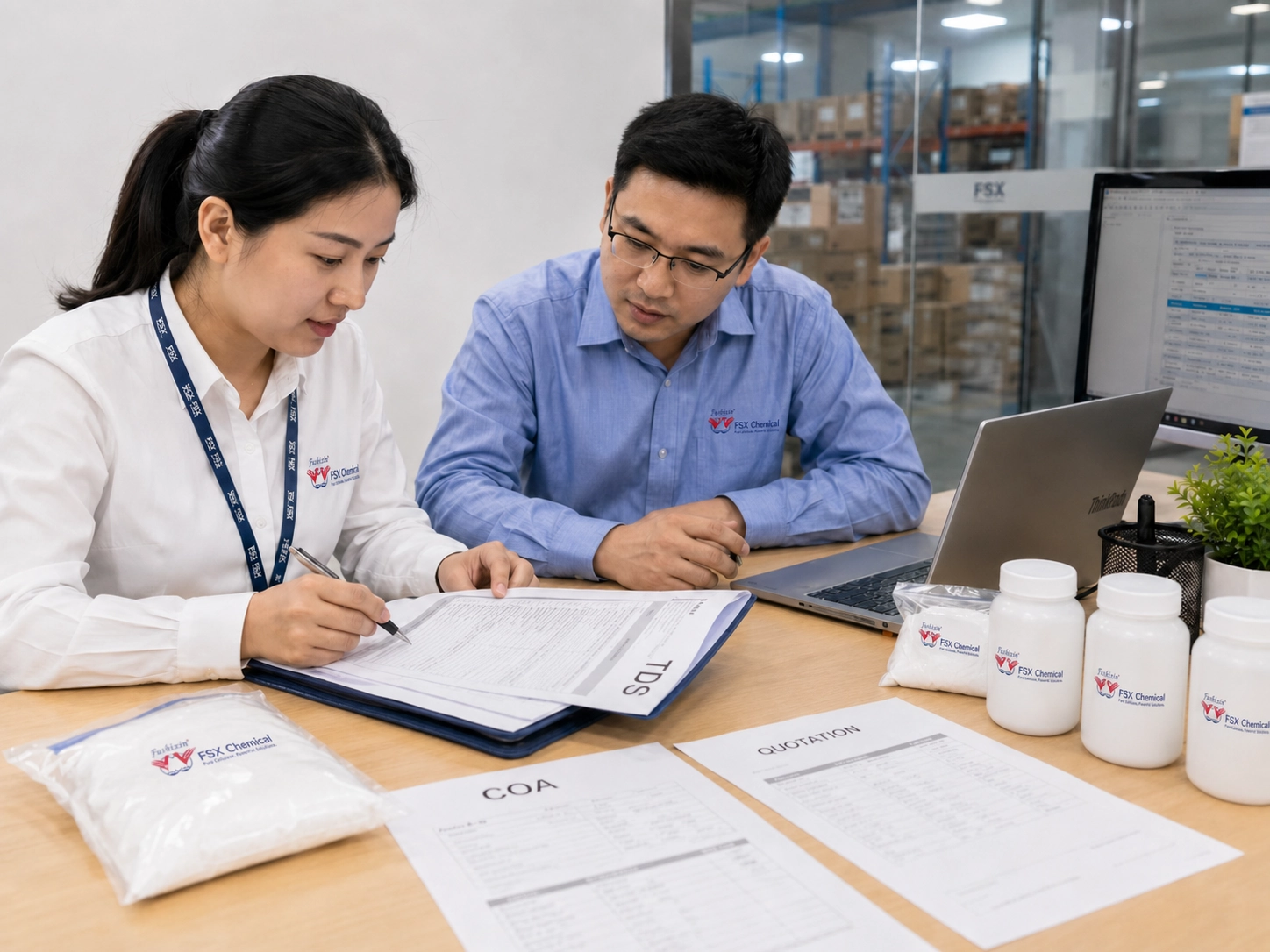
The sample label, TDS, quotation, purchase order, package label and COA should use the same approved grade code. This connects the tested sample to the commercial shipment.
Certificates Require Verification
If certificates are required, verify the holder, product scope, issuing organization and validity period. A general website logo is not sufficient evidence.
How the Grade-Matching Process Works
Define the process. Confirm the fabric, dye or ink, printing method and current problem.
Review the reference. Provide the current TDS, grade, sample and viscosity method where available.
Select a product route. Determine whether sodium alginate, CMC, CMS, digital printing paste or a compound system is the appropriate starting point.
Prepare a candidate sample. Request the proposed grade, TDS and preparation instructions.
Run laboratory comparison. Compare hydration, viscosity, filtration and complete-paste stability.
Conduct an application trial. Print, fix and wash the reference and candidate under the same conditions.
Complete a production trial. Confirm preparation and machine behavior at normal operating scale.
Ticari şartnameyi onaylayın. Confirm the grade code, test methods, packaging and batch documents.
A recommendation should be treated as the beginning of testing rather than final proof of suitability.
Alıcıların Sağlaması Gereken Bilgiler
Flat-screen, rotary-screen or digital printing method
Kumaş lifleri ve yapısı
Reaktif, dispers, pigment, vat veya deşarj yöntemi
Current product, TDS or sample
Current dosage
Target viscosity and complete method
Water quality
Mixing and hydration procedure
Drying, fixation and washing conditions
Main defect or improvement target
Estimated quantity and order frequency
Packaging, destination and document requirements
Providing more relevant process information helps narrow the correct product route. The buyer does not need to disclose unnecessary proprietary details during the initial review.
Recommended Trial and Acceptance Criteria
Trial Stage
Önerilen Kontroller
Product
Appearance, moisture, pH, particle size and product-specific parameters
Hazırlık
Dispersion, hydration, foam, filtration and mixing time
Yapıştır
Viscosity, rheology, pH, homogeneity and holding stability
Yazdırma
Screen or coating behavior, definition, bleeding, penetration and levelness
Bitmiş Kumaş
Color, wash-off, fastness, residue and handle
Ticari
Dosage, cost in use, packaging, MOQ and documents
Use an Approved Reference
Test the candidate against the current approved grade wherever possible. This reduces the influence of normal variation in fabric, dye, water and equipment.
Define Critical Requirements
A serious failure such as dye incompatibility, screen blockage or unacceptable fastness should not be offset by a lower price or a small advantage in another parameter.
Repeat Before Bulk Approval
For critical production, confirm the result in more than one trial or complete a controlled production run before approving a large order.
What Chemical Selection Cannot Fix Alone
A printing thickener cannot correct every production defect. The following factors should be reviewed separately:
Sodyum aljinat, tekstil baskıcılığında reaktif baskı macunu için kararlı ve yıkanabilir bir kıvam arttırıcı olarak yaygın olarak kullanılmaktadır. Satın almadan önce viskozite derecesini, saflığı ve uygulamaya uygunluğu nasıl değerlendireceğinizi öğrenin; ayrıca FSX Chemical’ın teknik veriler ve numunelerle küresel alıcılara nasıl destek sağladığını keşfedin.
CMS for textile printing paste can help adjust viscosity, improve paste handling, and support stable formulation performance. This guide explains how buyers can evaluate CMS grades by viscosity, DS, solubility, pH, moisture, and sample testing before bulk purchase.
Selüloz bazlı hammaddeler, tekstil baskısı, baskı macunu hazırlığı, kıvam artırma ve formülasyon desteği alanlarında kullanılmaktadır. Bu kılavuz, alıcıların CMC, CMS, sodyum aljinat, tekstil baskı kıvam arttırıcıları ve baskı macunu ürünlerini teknik özellikler, belgeler, numune testleri ve tedarikçi desteği açısından nasıl değerlendirebileceklerini açıklamaktadır.
Tekstil baskısı için kimyasal formülasyon desteği, net uygulama bilgileriyle başlamalıdır. Bu kılavuz, alıcıların CMC, CMS, sodyum aljinat, tekstil baskı kıvamlaştırıcıları ve baskı macunu ürünleri için ürün eşleştirme, formülasyon ayarlaması, numune testi, TDS, COA, SDS ve teknik destek talep ederken neleri sağlamaları gerektiğini açıklamaktadır.
Karboksimetil Nişasta (CMS), belirli tekstil apaylaştırma, baskı macunu ve dijital baskı formülasyon sistemleri için değerlendirilebilir. Bu kılavuz, alıcıların toplu satın alma öncesinde viskozite derecesini, çözünme davranışını, pH değerini, nem oranını, film davranışını, formülasyon uyumluluğunu, TDS, COA, SDS belgelerini, numune testlerini ve parti tutarlılığını nasıl incelemeleri gerektiğini açıklamaktadır.
Kıvam eşleştirme, sadece benzer viskoziteye sahip bir ürün bulmaktan ibaret değildir. Bu kılavuzda, tekstil baskı tesislerinin uygulama incelemesi, kontrollü hazırlık, baskı denemeleri ve numune-toplu üretim karşılaştırması yoluyla pasta kıvamlarını nasıl karşılaştırabilecekleri açıklanmaktadır.
Tekstil baskı performansı, tek bir evrensel katkı maddesine değil, uyumlu bir kimyasal sisteme bağlıdır. Bu kılavuzda, on önemli kimyasal grup, işlevleri, hangi aşamalarda kullanıldıkları ve alıcıların üretim denemelerinden önce neleri doğrulamaları gerektiği açıklanmaktadır.
Dijital tekstil baskısında viskozite kontrolü, iki farklı sistemi içerir: mürekkep püskürtme sistemi ve kumaş ön işleme formülasyonu. Bu kılavuzda, sıcaklık, formülasyon, ölçüm yöntemleri ve proses koşullarının püskürtme istikrarını ve baskı kalitesini nasıl etkilediği açıklanmaktadır.
Bir baskı kıvamlaştırıcısının laboratuvar değerlendirmesi, birden fazla viskozite sonucunu kapsamalıdır. Bu kılavuzda toz muayenesi, hamur hazırlığı, reoloji, formülasyon uyumluluğu, baskı denemeleri, yıkama ve nihai performans değerlendirmesi konuları ele alınmaktadır.
Dijital baskı pastaları, mürekkep kimyası, kumaş, uygulama yöntemi ve son işlem dikkate alınarak seçilmelidir. Bu kılavuz, tekstil mürekkep püskürtmeli baskı için sodyum aljinat, CMC, CMS, sentetik polimer ve bileşik ön işlem yöntemlerini karşılaştırmaktadır.
Özel kalite eşleştirme, tekstil baskı üreticilerinin yeni bir kıvam artırıcıyı veya baskı macununu, tanımlanmış test koşulları altında onaylanmış bir referans ürünle karşılaştırmasına yardımcı olur. Bu kılavuzda, gerekli bilgiler, laboratuvar ve üretim doğrulama aşamaları ile alıcıların ilk numuneden üzerinde anlaşmaya varılmış ticari şartnameye nasıl geçebilecekleri açıklanmaktadır.
En iyi dijital baskı macunu, mürekkebin kimyasal yapısına, kumaşa ve sabitleme yöntemine uygun olandır. Bu kılavuzda, selülozik kumaşlarda reaktif mürekkep püskürtme baskı ile polyesterde doğrudan disperse mürekkep püskürtme baskı için ön işlem gereksinimleri karşılaştırılmakta ve ardından alıcıların toplu satın almadan önce numuneleri nasıl değerlendirmeleri gerektiği açıklanmaktadır.
Ürün adını, kullanım alanını, miktarı, teslimat yerini ve elinizde bulunan TDS,
örnek fotoğraf veya belgeleri bizimle paylaşın. FSX Chemical bu
bilgileri inceleyerek fiyat teklifi, numune eşleştirme
veya ürün seçimi için atılması gereken bir sonraki adımı önerecektir.
Ürün BilgileriÜrün adı, sınıfı, modeli, etiket fotoğrafı veya tedarikçi referansı.
Mevcut BelgelerTDS, SDS, COA, numune fotoğrafı, ürün listesi veya test verileri.
Sipariş DetaylarıTahmini miktar, ambalaj, varış ülkesi, liman veya ticaret şartı.
Başvuru veya SorunTekstil baskı süreci, formülasyon gereksinimi, mevcut sorun veya hedeflenen performans.

 TR
TR  EN
EN  BN
BN  ES
ES  FR
FR  ID
ID  RU
RU  AR
AR  UR
UR