How Water Hardness and Calcium Ions Affect Sodium Alginate Printing Paste
Calcium in hard water can change sodium alginate from a normal viscous solution toward stronger...
Water hardness can change sodium alginate printing paste in a way that ordinary sodium salts cannot. Calcium ions (Ca²⁺) can bind to alginate carboxylate groups and connect neighboring polymer chains, increasing association, apparent viscosity and—at higher local or overall calcium levels—creating gel particles or insoluble calcium alginate. Magnesium is also part of water hardness but should not be treated as chemically identical to calcium. For textile printing mills, the practical question is not simply whether water is “hard,” but whether the actual plant water keeps sodium alginate inside a stable hydration, rheology, filtration and wash-off window. This guide explains how to diagnose hard-water effects before blaming the alginate grade.
Why Water Hardness Matters to Sodium Alginate
Sodium alginate is an anionic polysaccharide containing mannuronic-acid (M) and guluronic-acid (G) residues.
Its carboxylate groups help the polymer interact strongly with water and build a viscous printing paste.
But those same carboxylate groups can also interact with multivalent metal ions.
In textile plants, water hardness usually reflects dissolved calcium and magnesium introduced through:
Municipal water
Well or groundwater
Seasonal source changes
Incomplete softening
Blending of treated and untreated water
Scale or mineral contamination from equipment
For sodium alginate, calcium is especially important because it can create ionic junctions between polymer chains.
That means water quality can change:
Hidrasyon
Viskozite
Kesme tepkisi
Gel-particle formation
Filtreleme
Screen running
Yıkamayla Uzaklaştırılabilirlik
Water should therefore be treated as part of the printing formulation rather than as a neutral utility.
Why Calcium Is More Than Just Another Salt
Monovalent salts such as sodium chloride mainly change ionic strength and electrostatic screening around alginate chains.
Calcium behaves differently.
Ca²⁺ carries two positive charges and can coordinate with carboxylate groups on neighboring alginate chains.
This can create:
Stronger interchain association
Higher apparent viscosity
More elastic behavior
Localized gel particles
A continuous gel network at sufficiently high calcium availability
A classic textile-printing study found that small additions of Ca²⁺ or Mg²⁺ could strongly increase sodium alginate viscosity under the specific tested conditions, while further increases led toward gelation or precipitation of metal alginate. See research on divalent metal ions in sodium alginate reactive-printing pastes.
For production control, this means a viscosity increase after a water-source change should not automatically be interpreted as “better thickening efficiency.”
It may be the beginning of calcium-driven association.
What the “Egg-Box” Mechanism Means in a Printing Paste
Calcium-induced alginate gelation is commonly explained through the “egg-box” model.
In simplified terms, Ca²⁺ ions coordinate with carboxylate-rich regions—especially guluronate-rich sequences—and form junctions between alginate chains.
In a printing paste, the practical progression may be:
Normal Sodium Alginate Solution → Increased Chain Association → Local Thickening → Soft Gel Particles → Stronger Gel Network / Insoluble Calcium Alginate
The process does not have to reach a visible solid gel before it becomes a production problem.
Even partial crosslinking can change:
Flow through a screen
Paste recovery after shear
Deposit uniformity
İnce çizgilerin belirginliği
Filtration pressure
This is why “no visible precipitation” is not sufficient proof that the water is harmless.
Calcium vs. Magnesium: Do Not Treat Them as Identical
Both calcium and magnesium contribute to conventional water-hardness measurements, but they do not necessarily interact with alginate in the same way.
Calcium is a well-established alginate crosslinker and readily promotes ionotropic association and gelation.
Magnesium is much more strongly hydrated and generally has a weaker tendency than calcium to create the classic alginate gel network.
However, magnesium can still contribute to the ionic environment and may affect rheology in real textile formulations.
Therefore, two plant waters with similar total hardness can behave differently if one is calcium-dominant and the other contains a larger magnesium fraction.
For difficult cases, record:
Total hardness
Calcium hardness or Ca²⁺ concentration
Magnesium concentration
Conductivity
pH
Do not diagnose sodium alginate only from a single “ppm hardness” number if the chemistry is changing from batch to batch.
From Viscosity Increase to Gel Particles and Precipitation
One of the most important practical observations is that calcium contamination can create different symptoms at different levels.
Low or Trace Calcium Interaction
The paste may show:
Higher viscosity
More body
Greater shear thinning
No obvious particles
Intermediate Calcium Interaction
The paste may show:
Rapid viscosity drift
Higher elasticity
Soft gel particles
Poor repeatability between readings
Severe Calcium Interaction
The system may develop:
Visible gels
Insoluble particles
Filter blockage
Screen defects
Difficult wash-off
The important point is:
Calcium contamination does not always begin with a viscosity drop.
For sodium alginate, an unexpected viscosity increase can be an equally important warning signal.
How Hard Water Can Affect Alginate Hydration
Ideally, sodium alginate powder should first disperse and hydrate into a uniform sodium-alginate solution.
If significant calcium is present during this stage, local high-polymer/high-calcium zones can form while individual powder particles are still hydrating.
Olası belirtiler şunlardır:
Fish-eyes
Gel skins around partially hydrated particles
Longer mixing time
Uneven solution body
Filter residue
The problem can be worsened by:
Adding powder too quickly
Poor agitation
Very concentrated stock paste
High local calcium concentration
This is why preparation order matters.
A useful default development route is:
Controlled Water → Sodium Alginate Addition → Full Hydration → Remaining Formula Components
rather than exposing incompletely hydrated alginate to concentrated mineral or electrolyte zones.
How Calcium Changes Rheology and Screen Running
Screen printing requires a paste that can flow under shear and then regain enough structure after deposition.
Calcium-induced association can alter that balance.
The paste may become:
More shear-thinning
More elastic
Less homogeneous
More difficult to transfer consistently
A small apparent viscosity increase may initially look useful, but excessive association can create:
High squeegee pressure
Uneven screen release
Pattern variation during long runs
Gel streaks
Ekran tıkanması
Therefore:
Higher viscosity caused by calcium is not automatically equivalent to higher-quality sodium alginate.
Always compare the screen-running behavior and finished print.
Why This Matters in Reactive Dye Printing
Sodium alginate is widely used as a benchmark thickener for conventional reactive dye printing on suitable cellulosic fabrics because it provides useful rheology while minimizing undesirable reaction with reactive dyes.
The complete reactive paste can also contain:
Reaktif boya
Alkali
Urea or moisture-management components where used
Anti-reducing auxiliaries
Other salts and process chemicals
Hard water adds another ionic variable before these ingredients are even considered.
Potential consequences include:
Unstable paste viscosity
Gel residue
Different paste transfer
Color-depth variation
Poor wash-off
Harsh hand
The final acceptance test should therefore be the complete sequence:
One major advantage of sodium alginate in reactive printing is that the sodium form is water-compatible and can be removed effectively during the appropriate washing process.
Calcium alginate is much less water-soluble.
If excessive Ca²⁺ converts part of the sodium alginate film toward calcium-alginate-type structures, post-print washing can become more difficult.
Olası belirtiler şunlardır:
Artık film
Harsh or boardy hand
White or translucent residue
Higher washing load
Deposits in washing equipment
Textile-industry guidance has long warned that hard water can convert sodium alginate toward insoluble calcium alginate and impair wash-off.
This means water quality can influence not only the color kitchen but also Total Cost in Use through washing, rework and fabric hand.
Why Alginate M/G Structure Can Change Calcium Sensitivity
Alginate is not one chemically uniform polymer.
It contains different sequences of mannuronic-acid (M) and guluronic-acid (G) residues.
Calcium interacts particularly strongly with suitable G-rich sequences.
Therefore, two sodium alginate grades with similar pure-water viscosity can respond differently to calcium if their:
M/G ratio
G-block length
Block distribution
Molecular structure
differ.
Published gelation research shows that alginate composition strongly influences Ca²⁺ binding, elasticity and gel-network development.
For textile buyers, the practical lesson is:
Same viscosity does not mean the same calcium tolerance.
This is another reason to qualify specific grades rather than buying from one viscosity specification alone.
Molecular Weight, Concentration and Calcium Response
Alginate molecular weight and concentration also influence calcium response.
Higher molecular weight generally increases chain entanglement and baseline viscosity.
Higher polymer concentration puts more alginate chains and calcium-binding sites into the same volume of water.
Therefore, the same calcium level may produce a different effect in:
A low-concentration high-molecular-weight grade
A higher-concentration medium-viscosity grade
A low-viscosity alginate used at a higher dosage
When comparing calcium tolerance, use the intended commercial concentration—not an arbitrary concentration chosen only because it is easy to measure.
Plant Water vs. Soft/DI Water: The First Diagnostic Test
When a sodium alginate paste suddenly becomes too thick, develops particles or behaves differently between factories, start with a two-water comparison.
Sample A: Plant Water
Prepare sodium alginate using the actual production water.
Sample B: Reference Water
Prepare the same alginate using softened or deionized water.
Keep constant:
Alginate batch
Konsantrasyon
Powder-addition rate
Mixer speed
Karıştırma süresi
Su içme zamanı
Sıcaklık
Viskozite yöntemi
Şimdi karşılaştırın:
Hydration speed
Viskozite
Görünüm
Jel parçacıkları
Filtreleme artığı
If the reference-water sample is clean and stable while the plant-water sample is not, investigate water chemistry before rejecting the sodium alginate batch.
How to Build a Controlled Calcium-Challenge Test
Start with a plant-water analysis and an identified alginate grade. The objective is to reproduce relevant exposure, not to create the strongest possible gel. This is a suggested comparison protocol; acceptance limits require validation in the mill’s recipe.
Keep calcium, total hardness and conductivity distinct
Record calcium and magnesium separately where possible, alongside total hardness, pH and conductivity. Hardness reported as mg/L CaCO3 is an equivalent concentration, not the concentration of dissolved calcium metal or calcium chloride. As an analytical conversion, 1 mg/L calcium contributes approximately 2.50 mg/L hardness as CaCO3. Total hardness cannot be converted to calcium by that factor unless the calcium contribution has been separated from magnesium and other relevant ions.
USGS water-quality guidance distinguishes hardness from specific conductance. Conductivity reflects the wider ionic mixture and is not a substitute for a calcium or hardness measurement. Softened water can still contain substantial dissolved salts.
Use two different tests for two different questions
Test
Hazırlık
Question answered
Hydration-water comparison
Prepare the same powder lot separately in plant water and reference water, using matched procedures
Does the available water interfere during wetting and hydration?
Post-hydration calcium challenge
Split a fully hydrated reference paste; add documented calcium levels and a matched carrier-water control
How does the hydrated system respond to additional calcium exposure?
One test does not replace the other. For challenge additions, record the calcium source, purity, hydration state and final concentration basis. Account for dilution and use a repeatable addition rate and mixing method; concentrated local contact can create particles not representative of uniform plant-water exposure.
Measure process suitability, not viscosity alone
At the agreed initial and holding times, record temperature, pH, viscosity method, visible gel and separation. Compare filtration using the same filter, sample mass, pressure or head and procedure. A viscosity increase can accompany loss of usable paste through gel formation, so it is not automatically better thickening.
Finally repeat the comparison in the complete printing recipe and inspect the fixed, washed fabric. If investigating a sequestrant, use supplier-supported conditions and verify its compatibility with the dye and auxiliaries. Do not assume a chelator can reliably restore a paste that has already gelled.
Why the Complete Printing Paste Must Be Tested
A calcium challenge in alginate and water is a useful diagnostic, but production includes more components.
The complete paste may change the system through:
Additional sodium salts
Alkali
Dye electrolytes
pH changes
Other complexing or sequestering species
After the water-only comparison, prepare the full printing paste using:
Bitkiye su vermek
Actual sodium alginate concentration
Actual reactive dye
Actual alkali
Normal auxiliaries
Real holding time
Then compare the final:
Paste viscosity
Screen behavior
Color strength
Desen tanımı
Yıkamayla Uzaklaştırılabilirlik
Kumaş el
This prevents a technically interesting water test from being mistaken for production approval.
Should You Use Soft Water or a Sequestering Agent?
Softened or appropriately controlled water is normally the cleanest way to reduce calcium-related variability in sodium alginate preparation.
Some textile processes also use sequestering or complexing agents to control multivalent metal ions.
However, a sequestering agent should not be added blindly.
Check:
Compatibility with reactive dyes
Compatibility with alkali
Effect on paste viscosity
Effect on steaming
Yıkamayla Uzaklaştırılabilirlik
Supplier and wastewater requirements
The goal is not to make the water chemically complicated.
The goal is to keep free calcium below the level that destabilizes the validated alginate system.
Hidden Sources of Calcium in the Printing Process
If the water-softening system appears normal but alginate still develops gels, inspect other calcium sources.
Possible sources include:
Untreated make-up water
Residual hard water in tanks or pipes
Calcium-containing dust or mineral contamination
Improperly cleaned mixing equipment
Auxiliaries carrying multivalent ions
Cross-contamination from other chemical processes
Also inspect local concentration effects.
A small total amount of calcium can still cause gel particles if it enters one concentrated zone before it is properly dispersed.
Gel Particles, Filter Residue and Screen Problems
Calcium-related instability may appear first at the filter or screen rather than in a beaker.
Possible signs include:
Rapid filter loading
Soft translucent gel particles
Screen streaks
Blocked fine mesh
Intermittent print defects
Do not assume every particle is calcium alginate.
Also investigate:
Yetersiz sıvı alımı
Yabancı maddelerle kirlenme
Undissolved powder
Dye dispersion instability
A useful diagnostic is to filter equivalent plant-water and reference-water alginate preparations through the same laboratory procedure and compare the retained material.
Water and Alginate QC for Production
Once the mill defines a validated working window, routine control can include:
Control Item
Neden Önemli?
Total hardness
Tracks overall Ca/Mg loading
Calcium level where needed
More directly relates to alginate crosslinking risk
Conductivity
Tracks broader ionic variation
Water pH
Supports consistent preparation
Alginate batch
Enables material traceability
Standard solution viscosity
Confirms incoming thickener consistency
Su içme zamanı
Prevents premature viscosity comparison
Tam macun viskozitesi
Confirms formulation behavior
Filter residue
Early indicator of hydration or ion problems
Do not set a universal hardness specification from an article.
Establish the acceptable range using the mill’s sodium alginate grade, concentration, water-treatment capability and complete printing formula.
Troubleshooting Table
Gözlemlenen Sorun
İlk Kontrol Edilecek Değişkenler
Varsaymayın
Alginate viscosity suddenly increases
Calcium, water source, concentration, temperature
Higher viscosity means a better alginate batch
Soft gel particles appear
Ca²⁺, local addition zones, hydration, contamination
More mixing will always remove them
Filter blocks faster than normal
Hardness, gel residue, hydration quality
The filter is too fine
Paste works in lab but not in factory
DI water vs. plant water, calcium, mixing scale
The supplier test is necessarily wrong
Fabric feels harsh after washing
Calcium alginate residue, washing, paste dosage
Reactive dye itself is the only cause
Same alginate behaves differently after seasonal water change
Bir sodyum alginat tedarikçisine hangi bilgileri iletmelisiniz?
If you suspect hard water or calcium is affecting printing paste, send:
Current sodium alginate product/TDS
Aljinat konsantrasyonu
Viscosity and full test method
Plant-water source
Total hardness
Calcium and magnesium data where available
Conductivity
Water pH
Mixing method and hydration time
Complete or simplified reactive printing formula
Alkali and salt levels
Yapıştırma bekleme süresi
Filter-residue observations
Screen route
Kumaş türü
Current viscosity, gel, wash-off or hand-feel problem
FSX Chemical bu bilgileri şu yollarla kullanabilir: Numune ve Ürün Eşleştirme to compare a suitable sodium alginate grade under matched water and formulation conditions.
How Should a Textile Mill Control Calcium Risk in Sodium Alginate?
A practical sequence is:
Measure Water → Compare Plant vs. Reference Water → Hydrate Alginate → Check Calcium Response → Prepare Complete Paste → Print → Steam → Wash → Approve Water/Alginate Window
Temel ilkeler şunlardır:
Water hardness is part of the sodium alginate formulation.
Calcium can crosslink alginate; it is not simply another monovalent salt.
A calcium problem can begin as a viscosity increase before visible gelation appears.
Magnesium contributes to hardness but should not automatically be treated as identical to calcium.
M/G structure, molecular weight and alginate concentration can change calcium sensitivity.
Final approval should include printing, steaming and wash-off—not only a beaker viscosity test.
Sık Sorulan Sorular
1. Does hard water affect sodium alginate viscosity?
Yes. Calcium and other dissolved ions can change sodium alginate chain interactions and rheology. Calcium can strongly increase association and can eventually cause gelation.
2. Does calcium increase or decrease sodium alginate viscosity?
Calcium can increase apparent viscosity at lower interaction levels and then cause gel formation or precipitation as crosslinking becomes stronger. The response depends on alginate grade, concentration and calcium level.
3. Why does calcium gel sodium alginate?
Ca²⁺ can coordinate with alginate carboxylate groups, particularly suitable guluronate-rich sequences, creating ionic junctions between polymer chains.
4. Is magnesium the same as calcium for alginate?
No. Both contribute to hardness, but magnesium is more strongly hydrated and generally has weaker classic alginate-gelling behavior than calcium. Actual plant-water effects should still be measured.
5. Can hard water cause gel particles in sodium alginate paste?
Yes. Calcium can create localized crosslinking, especially during incomplete hydration or where local calcium concentration is high.
6. Can calcium cause screen blockage?
It can contribute through gel particles or insoluble calcium-alginate-type residue. Incomplete hydration and dye-dispersion problems should also be checked.
7. Why does sodium alginate wash off poorly in hard-water conditions?
Excess calcium can convert part of the water-compatible sodium alginate toward less-soluble calcium alginate, increasing residual film and washing difficulty.
8. Does high-viscosity sodium alginate tolerate calcium better?
Not necessarily. Pure-water viscosity and calcium tolerance are different properties. M/G structure, molecular weight, concentration and grade design all matter.
9. Should reactive printing use soft water for sodium alginate?
Controlled low-hardness water is generally preferable when calcium variability affects paste preparation or wash-off. The exact water limit should be validated for the mill’s process.
10. Should a sequestering agent always be added?
No. Use one only when technically justified and confirmed compatible with the reactive dye, alkali, steaming and wastewater requirements.
11. What is the fastest way to diagnose a calcium problem?
Prepare the same sodium alginate batch with plant water and a controlled soft/DI reference water, then compare hydration, viscosity, gel particles and filtration residue.
12. What should I send FSX Chemical for hard-water sodium alginate matching?
Send the current alginate TDS/sample, concentration, viscosity method, plant-water hardness, Ca/Mg data if available, formula, hydration method, screen route and current gel, viscosity or wash-off problem.
Match Sodium Alginate to Your Plant Water with FSX Chemical
If your sodium alginate paste becomes unexpectedly thick, develops gel particles, blocks filters or washes off differently after a water-source change, FSX Chemical can help separate water-quality effects from alginate-grade effects.
Yararlı bir teknik karşılaştırma için lütfen şunu gönderin:
Elinizdeki sodyum aljinat numunesi, TDS veya COA
Aljinat konsantrasyonu
Viskozite ve tam test yöntemi
Plant-water hardness
Calcium and magnesium data where available
Conductivity and pH
Mixing and hydration method
Reactive dye and formula
Alkali and salt conditions
Yapıştırma bekleme süresi
Screen-printing conditions
Steaming and washing route
Current viscosity, gel, residue or fabric-hand target
For sodium alginate printing paste, calcium control is not only about preventing a visible gel. The real target is a validated water window in which hydration, viscosity, screen running and wash-off remain predictable from preparation through the finished fabric.
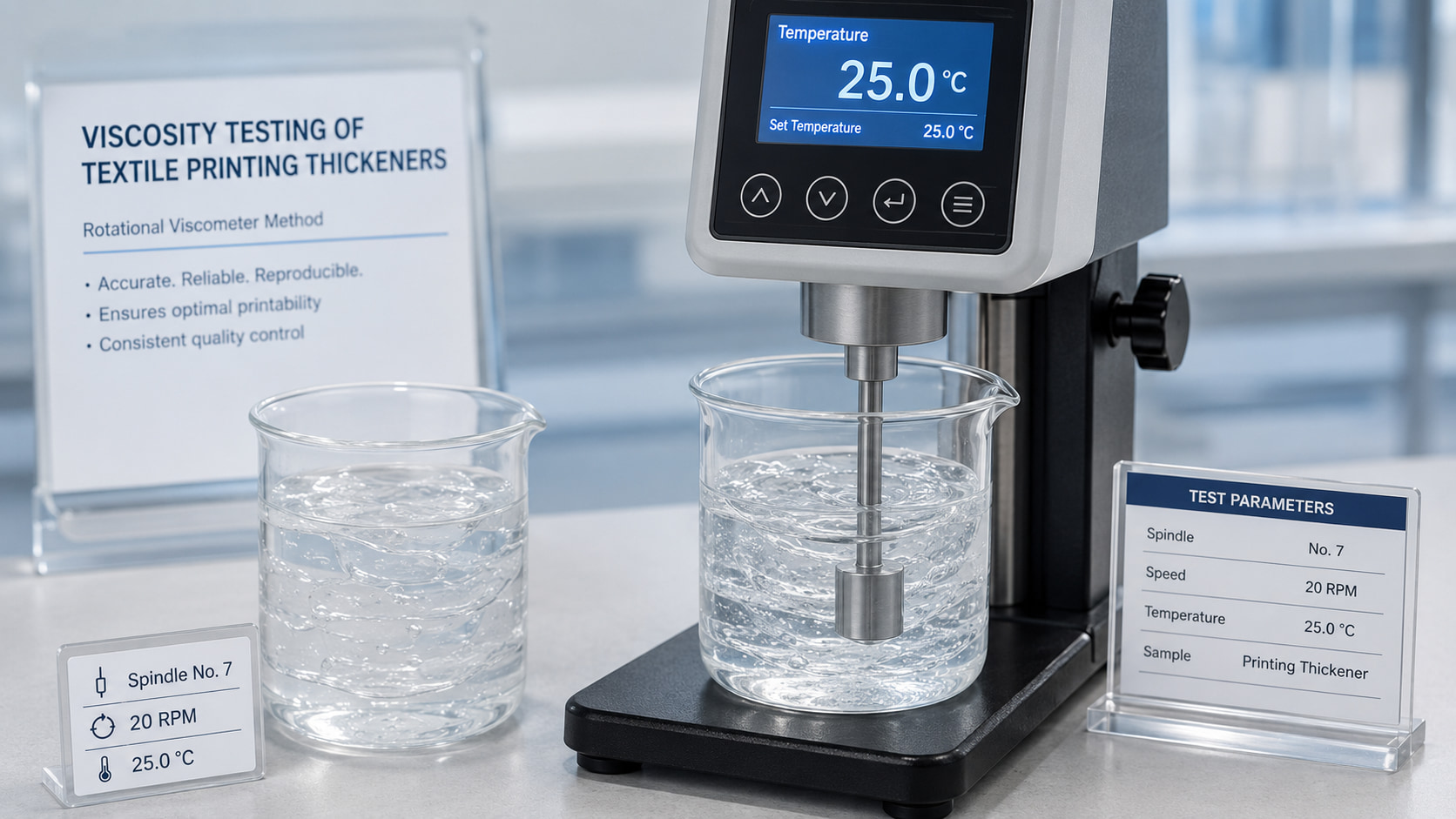
Konsantrasyon, sıcaklık, ölçüm cihazı, mil, hız, hazırlık yöntemi ve test süresi gibi faktörler eşleştirilmeden tekstil baskı kıvamlaştırıcılarının viskozite değerlerinin neden karşılaştırılamayacağını öğrenin.
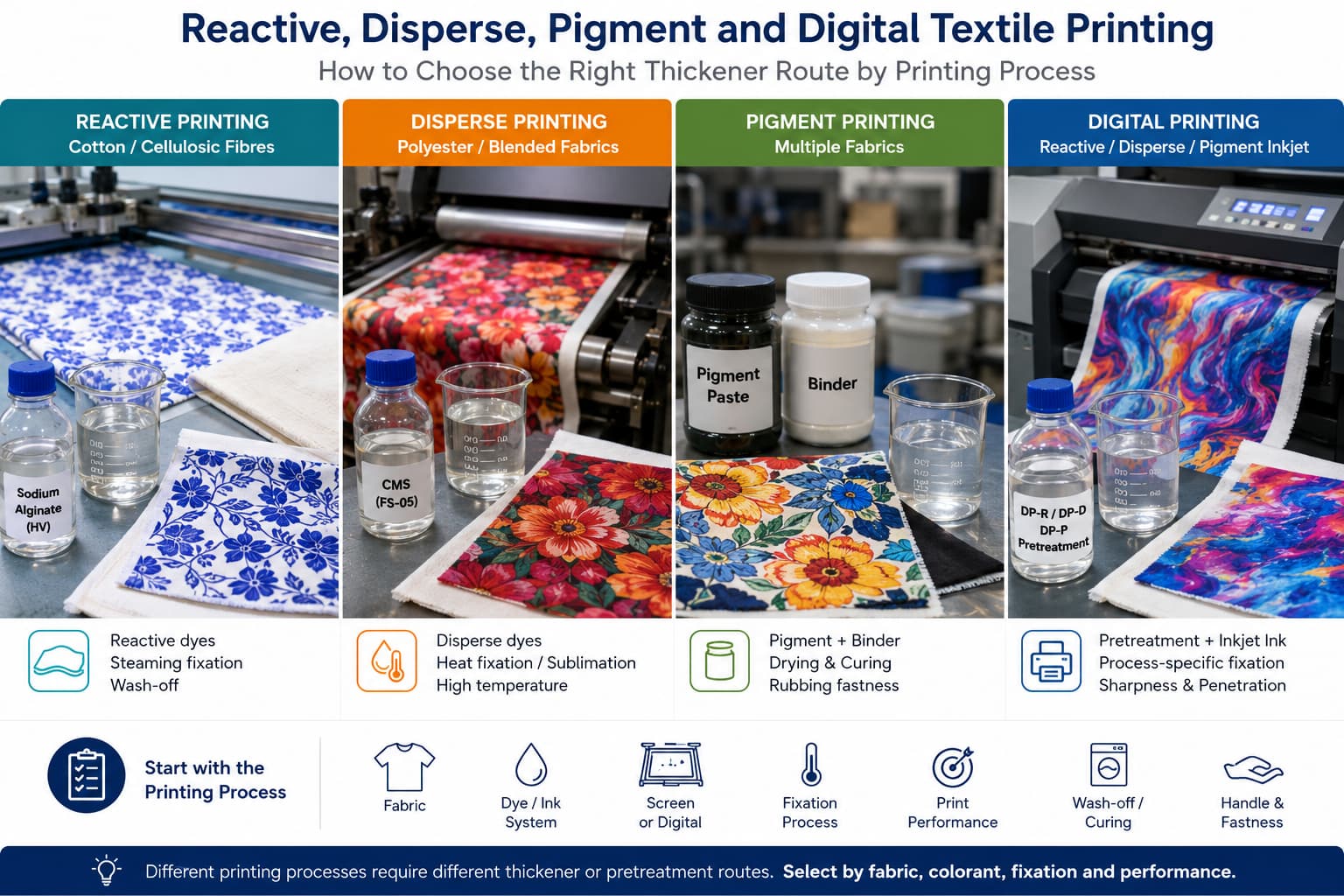
Kumaş, boya veya mürekkep, fiksaj, yıkamayla uzaklaştırılabilirlik ve baskı kalitesi gereksinimlerine göre reaktif, dispers, pigment ve dijital tekstil baskısı için kıvamlaştırıcı ve ön işlem seçeneklerini nasıl seçeceğinizi öğrenin.
Tekstil baskısı için CMC, CMS, sodyum aljinat ve dijital baskı patını karşılaştırın. Her ürün seçeneğinin reaktif, dispers, pigment ve dijital baskı süreçlerine nasıl uygun olduğunu ve alıcıların numune testi, ürün sınıfı eşleştirme ve toplu satın alma öncesinde neleri incelemesi gerektiğini öğrenin.
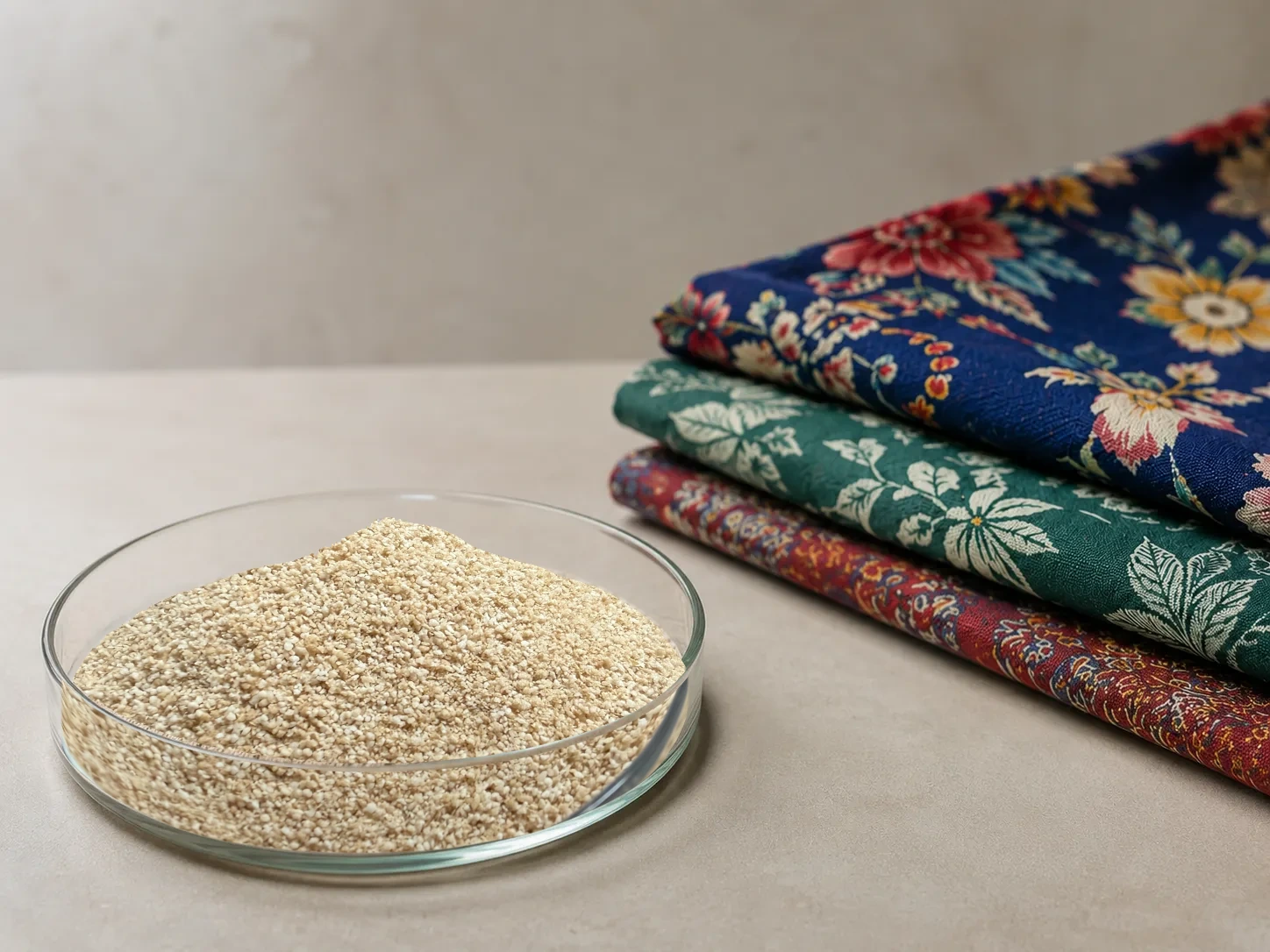
Sodyum aljinat, tekstil baskısında reaktif baskı patı için kararlı ve yıkamayla uzaklaştırılabilir bir kıvamlaştırıcı olarak yaygın kullanılır. Satın almadan önce viskozite sınıfını, saflığı ve uygulamaya uygunluğu nasıl değerlendireceğinizi ve FSX Chemical’ın teknik veriler ve numunelerle küresel alıcılara nasıl destek sağladığını öğrenin.
Karboksimetil selüloz (CMC), tekstillerin baskı, haşıllama ve boyama işlemlerinde yaygın kullanılır. Bu kılavuz; CMC sınıflarının nasıl değerlendirileceğini, hangi parametrelerin en önemli olduğunu ve FSX Chemical’ın satın alma kararlarını nasıl destekleyebileceğini açıklar.
CMC bazlı baskı patı, pigmentli, reaktif ve dijital tekstil baskı alanlarında kullanılmaktadır. Bu kılavuzda, hangi parametrelerin önemli olduğu, tedarikçilerin nasıl karşılaştırılacağı ve toplu sipariş vermeden önce nelerin talep edilmesi gerektiği açıklanmaktadır.
Sodyum aljinat ve CMC, tekstil baskısında kıvamlaştırıcı olarak kullanılır; ancak farklı boyarmadde sistemlerine ve proses koşullarına uygundur. Bu kılavuz, temel farkları ve her birinin ne zaman kullanılacağını açıklar.
Tekstillerde dijital mürekkep püskürtmeli baskı, serigrafi baskıya kıyasla farklı macun ve ön işlem gereksinimlerine sahiptir. Bu kılavuz, dijital tekstil baskısında sodyum aljinatın nasıl kullanıldığını ve tedarik ekiplerinin hangi kalite parametrelerini belirtmeleri gerektiğini açıklamaktadır.
Reaktif boya ile tekstil baskısında, macunun doğru şekilde hazırlanması, renk tonu seçimi kadar önemlidir. Bu kılavuzda sodyum aljinatın çözünme yöntemleri, uygulamaya göre konsantrasyon aralıkları, saklama koşulları ve hazırlık aşamasında sık karşılaşılan sorunların nasıl giderileceği ele alınmaktadır.
Assess sodium alginate in reactive-printing wastewater using measured COD load, product-specific biodegradation evidence and controlled process comparisons. Includes a buyer checklist and illustrative load calculation.
Reaktif boya baskısında boya sabitlenme oranı, renk verimini, yıkama haslığını ve atık su yükünü doğrudan etkiler. Bu kılavuzda, sodyum aljinatın boya sabitlenmesini nasıl desteklediği, hangi macun parametrelerinin sabitlenme oranını etkilediği ve üretimde düşük sabitlenme sorunlarının nasıl giderileceği açıklanmaktadır.
Sodyum aljinatın parçacık boyutu (mesh), tozun ne kadar hızlı çözündüğünü, ne kadar homojen bir şekilde su emdiğini ve elde edilen macunun serigrafi baskısında nasıl bir performans gösterdiğini etkiler. Bu kılavuz, tekstil baskı macunu uygulamalarında mesh değerinin pratik sonuçlarını açıklamaktadır.
Ürün adını, uygulama alanını, miktarı, teslimat yerini ve elinizdeki TDS, numune fotoğrafı veya belgeleri paylaşın. FSX Chemical bu bilgileri inceleyerek fiyat teklifi, numune karşılaştırması veya ürün seçimi için bir sonraki adımı önerecektir.
Ürün BilgileriÜrün adı, sınıfı, modeli, etiket fotoğrafı veya tedarikçi referansı.
Mevcut BelgelerTDS, SDS, COA, numune fotoğrafı, ürün listesi veya test verileri.
Sipariş DetaylarıTahmini miktar, ambalaj, varış ülkesi, liman veya teslim şekli.
Uygulama veya SorunTekstil baskı süreci, formülasyon gereksinimi, mevcut sorun veya hedeflenen performans.