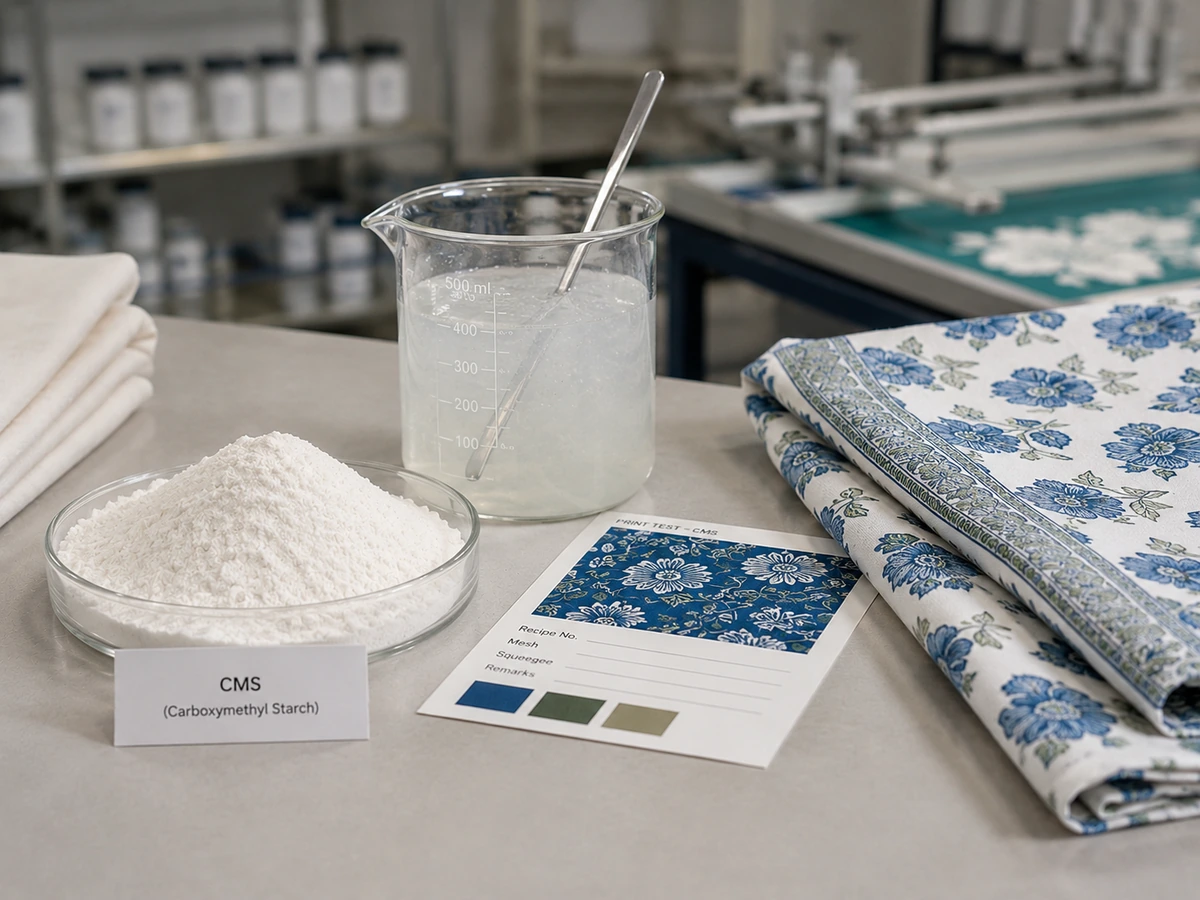
CMS for Vat and Discharge Printing: What Should You Test Before Production Approval?
CMS for vat and discharge printing should be approved through the complete chemical process—not from...
A product offered within a CMS thickener range should enter a vat or discharge trial only after its exact grade, documented composition and intended application have been confirmed, but production approval should never be based on stock-paste viscosity alone. These routes can expose the thickener to strong alkali, reducing agents, electrolytes, heat, steaming and intensive washing. A CMS grade must therefore maintain useful paste rheology before printing, pass the screen consistently, resist unacceptable viscosity collapse during the realistic holding period, allow the vat or discharge chemistry to develop correctly, and wash away without leaving excessive residue. This guide explains how textile mills should separate vat and discharge trials and what to test before bulk production approval.
Why Vat and Discharge Printing Need a Special CMS Qualification
Vat and discharge printing are chemically more demanding than a simple neutral thickener-in-water test.
Depending on the route, the printing paste may contain:
Strong alkali
Reducing agents
الیکٹرولائٹس
Humectants
Oxidation or post-treatment chemicals
Dyes or pigments for colored discharge
These ingredients can change CMS viscosity, hydration state and rheology.
At the same time, the thickener must not prevent the color chemistry from working.
Research on two-phase vat dye printing has shown that thickeners undergo several transformations during spreading, drying and coagulation, so both wet-paste rheology and dried-thickener behavior matter. See research on thickeners in vat dye textile printing.
For an FSX product, request current grade-specific documentation before selecting a candidate. A CMS range name or a reference to a modified starch in technical literature does not establish the composition or suitability of every commercial grade.
Vat Printing and Discharge Printing Are Not the Same Test
Vat Printing
Vat dyes are normally applied in a form that must be converted into a soluble reduced state under alkaline conditions and then returned to the insoluble colored form through oxidation.
The exact sequence depends on whether the mill uses a one-phase, two-phase or other vat-printing route.
Discharge Printing
Discharge printing starts with a dyed ground. A discharge paste is printed only where the mill wants to remove or modify the ground color.
A simplified process may be:
Ground-Dyed Fabric → Discharge Printing → Drying → Steaming / Heat Development → Washing → Finished White or Colored Discharge
The chemical package depends on the ground dye, fabric and whether the target is white discharge or colored discharge.
لہٰذا:
Passing a vat-printing trial does not automatically approve the same CMS grade for discharge printing.
What Role Does CMS Play in These Systems?
This guide uses CMS as the product-range label being evaluated. Confirm the chemical identity of the specific grade from current supplier documentation rather than inferring it from that label. A process-matched thickener may be used to:
Build paste viscosity
Control paste transfer through the screen
Limit uncontrolled lateral spreading
Hold reactive chemicals in the printed pattern
Support uniform application before steaming or development
The required grade should be process-specific.
A CMS designed for disperse printing should not automatically be moved into vat or discharge printing because the chemical environment can be completely different.
A grade reference such as H5 is not, by itself, evidence of vat, discharge or burn-out suitability. These are different application claims and require current documentation plus separate process validation.
The Main Chemical Stresses: Alkali, Reducing Agents and Electrolytes
The thickener may experience several stresses at the same time.
الکلی
The response to alkali depends on the documented polymer chemistry, grade and complete recipe. Measure the actual paste response instead of assigning one mechanism to the whole product range.
Reducing Agents
Vat and discharge systems may use different reducing agents according to dye chemistry and process design.
The thickener must remain sufficiently stable for the intended holding period while still allowing the reducing chemistry to function.
الیکٹرولائٹس
Alkali salts, reducing-agent salts and other auxiliaries increase ionic strength.
Depending on the identified grade and formulation, the changed ionic environment can affect:
Apparent viscosity
متن چسپاں کریں
Flow under shear
استحکام برقرار رکھنا
Do not evaluate these variables independently only. After one-factor screening, test the full chemical package.
What to Test in a Vat Printing Paste
For vat printing, the CMS qualification should include:
Stock-paste preparation
Viscosity after the full vat-printing formula is prepared
Alkali tolerance
Reducing-agent compatibility where present in the selected route
استحکام برقرار رکھنا
اسکرین ٹرانسفر
Pattern sharpness
Drying behavior
Steaming/development
Oxidation
Soaping/wash-off
Final color strength and shade
In two-phase vat printing, the printed thickener layer can affect the later penetration and action of reducing and alkaline development chemicals.
This is one reason the dried CMS film should be evaluated together with wet-paste rheology rather than judged from viscosity alone.
What to Test in a Discharge Printing Paste
For discharge printing, the thickener must hold the discharge chemicals precisely where the effect is required.
جائزہ لیں:
Compatibility with the selected discharge agent
Compatibility with alkali or acid components in that discharge system
Paste stability during the realistic color-kitchen holding time
However, historic recipe levels should not be copied as modern production specifications. The actual discharge chemistry must be supplied by the mill or dye/auxiliary supplier.
Why Stock Viscosity Is Not Enough
A CMS TDS may list viscosity at a defined concentration and temperature.
That value is useful for incoming QC.
But the vat or discharge paste can contain much higher ionic and chemical loading than the standard water test.
The meaningful sequence is:
CMS Stock Paste → Add Full Chemical Package → Measure Again → Hold → Measure Again → Print
ریکارڈ:
CMS concentration
پانی کا معیار
درجہ حرارت
Viscometer
Spindle/rotor
RPM
پڑھنے کا وقت
وقت پکڑنا
Same stock viscosity does not mean the same chemical resistance.
Paste Holding Stability Before Printing
Vat and discharge pastes can change while waiting before printing.
Possible changes include:
Viscosity loss
Viscosity increase
جیل کی تشکیل
Phase separation
Foaming
Loss of discharge/reducing activity
A useful holding test uses realistic time points:
Immediately after formula preparation
After the normal waiting period
Near the end of the planned production window
At each point, record both paste properties and printing effect.
A paste can retain viscosity while the discharge chemistry loses activity, so viscosity stability alone is not enough.
Screen Running and Pattern Definition
CMS must provide enough structure at rest while still flowing under printing shear.
جائزہ لیں:
Flat vs. rotary screen behavior
اسکرین کا گزرگاہ
سکویجی دباؤ
جھاگ
اسکرین خشک کرنا
Pattern filling
Edge definition
دراندازی
If the paste is too weak, discharge chemicals or vat dye can spread beyond the intended pattern.
If it is too resistant to flow, screen transfer may become incomplete.
لہٰذا:
Higher viscosity is not automatically better pattern control.
Drying, Steaming and Process Temperature
After printing, the paste usually enters a thermal stage.
The exact process depends on the printing route.
Temperature can change:
Moisture retention
Chemical mobility
Reducing-agent activity
Alkali transport
Thickener-film structure
Do not publish or copy one universal steaming temperature or time for all vat/discharge systems.
Use the actual dye and auxiliary supplier process, then check whether CMS remains compatible with that thermal window.
Vat Dye Reduction, Development and Oxidation
The vat route depends on controlled reduction and later oxidation.
CMS should not interfere with the transfer of reducing/alkaline chemicals or create a dried film that prevents effective development.
After printing and development, evaluate:
رنگ کی شدت
Shade
ہموار پن
باریک لکیر کی تعریف
دراندازی
Oxidation completeness
Soaping cleanliness
Research on vat printing shows that modified starch, alginate and other thickeners can behave differently through drying and chemical development, so the dried thickener morphology is part of the process, not just a passive carrier.
Discharge Effect: What Should Be Measured?
A discharge trial should quantify more than “it looks white.”
Useful observations include:
Ground-color removal
Residual ground shade
کنارے کی تیزی
Haloing
Fabric penetration
Colored-discharge shade where used
Uniformity across large areas
Compare the same ground-dyed fabric and the same discharge chemistry when evaluating two CMS candidates.
If the CMS grade changes and the discharge depth changes, investigate both:
Chemical compatibility
Paste deposit / penetration
A stronger discharge effect is not useful if the pattern edge becomes unacceptable or the fabric is damaged.
Wash-Off, Soaping and Residue Removal
Vat and discharge printing normally require substantial post-treatment.
The thickener should wash away sufficiently after the chemical process.
جائزہ لیں:
Residual paste
Surface harshness
پس منظر کا رنگنا
Color redeposition
رَگڑ سے رنگ کی پائیداری
کپڑے کا ہاتھ
A CMS grade that gives excellent screen behavior but requires excessive washing can increase:
Water use
Energy
Processing time
Total cost
Final approval should therefore be made after the full washing sequence.
Fabric and Ground-Dye Variables
Vat printing is used mainly on suitable cellulosic materials, while discharge printing can involve several fabric and ground-color systems.
Important variables include:
کپاس بمقابلہ وِسکو س
Woven vs. knitted structure
کپڑے کا وزن
جذب کرنے کی صلاحیت
Ground-dye class
Ground-dye depth
Finishing history
Not every ground dye is equally dischargeable.
If a discharge test is weak, do not blame CMS before confirming that the ground dye and discharge agent are chemically compatible.
Water Quality and Formula Variation
CMS behavior can change with water hardness, conductivity and dissolved multivalent ions.
Vat/discharge formulas already contain significant ionic loading, so plant water can become an additional variable.
If laboratory results do not match production, compare:
Reference water
پودوں کو پانی دیں
Hardness
Conductivity
پی ایچ
Also confirm that production follows the same chemical addition order as the laboratory.
Test Paste Stability and Chemical Activity Separately
The following is a proposed qualification design. Confirm the candidate grade and the dye or auxiliary supplier’s process before testing; it does not establish that any named FSX grade has already passed.
Control or trial
تیاری
مقصد
Candidate stock paste
Defined concentration, water, hydration and measurement method
Reference physical behavior before process chemicals
Candidate complete paste
Actual supported chemical package, final mass and addition sequence
Combined physical and chemical response
Approved production thickener
Matched chemical levels, fabric and process, with its documented recipe
Practical performance reference
Chemical-package control where the assay permits
Same chemical concentrations and aging conditions without thickener
Help investigate loss of chemical activity independently of paste flow
Keep aging and sampling comparable
Record vessel, exposure conditions, temperature and elapsed time from preparation. Check fresh paste, the normal waiting period and the intended end of use. Measure viscosity, pH and physical defects separately from the chemical activity assessment. Apply a chemical assay only if it is appropriate for the reducing or discharge agent and the matrix; a viscosity result cannot establish retained reducing-agent concentration.
If oxidation-reduction potential is monitored, record the electrode system, temperature and measurement procedure. Treat it as a method-dependent process indicator, not a universal assay of reducer concentration or proof of discharge performance.
Verify the actual color process
For vat printing, complete the specified development, oxidation and washing route. For discharge, use a known, documented ground-dyed fabric and distinguish white from colored discharge. Compare ground-color removal, any retained colorant, edge definition and fabric condition after the full finishing sequence. A weak result on an unsuitable ground dye cannot establish that the thickener failed.
Approve only the tested grade–recipe–fabric–process combination. Retaining viscosity while losing chemical activity is a failure of the complete process; retaining chemical activity while losing printable rheology is also insufficient.
How to Run a Controlled Printing Trial
Use one fabric lot and keep the dye/chemical system constant.
Print a diagnostic pattern containing:
Fine lines
چھوٹا متن
Solid blocks
Half-tone or gradient areas where relevant
Large discharge areas
Then use identical:
سکھانا
Steaming/development
Oxidation where relevant
دھونا
Soaping
جائزہ لیں:
پیٹرن کی تعریف
Vat color yield or discharge depth
Shade
دراندازی
روزہ
باقیات
ہاتھ
Production Approval Checklist
Before bulk approval, verify:
Large-batch CMS hydration
Full formula viscosity
Holding-time stability
Screen running over realistic production length
Left-center-right pattern consistency
Thermal process repeatability
Vat development or discharge depth
Post-treatment cleanliness
Fabric strength and hand
Repeat-batch CMS consistency
Retain the final approved:
CMS batch
Printing formula version
کپڑے کا لاٹ
Ground-dye information for discharge
Machine settings
Steaming/development record
Finished fabric reference
This creates a practical production standard rather than relying on memory.
حل مسائل کی جدول
مشاہدہ شدہ مسئلہ
چیک کرنے کے لیے اولین متغیرات
فرض نہ کریں
Viscosity collapses after alkali/reducer addition
CMS grade, chemical concentration, ionic load, addition order
CMS dosage, post-treatment, film formation, process temperature
Good printing automatically means good wash-off
لیب کے نتائج پاس ہو گئے لیکن پیداوار ناکام ہو گئی۔
Batch scale, water, machine shear, steam uniformity, chemical addition
The laboratory sample proves production approval
استعمال میں کل لاگت
A vat/discharge thickener should not be selected from price per kilogram alone.
موازنہ کریں:
CMS dosage
Paste preparation time
Chemical stability
Screen interruptions
Discharge/vat effect
Steam/development efficiency
Washing and soaping load
دوبارہ کام
رد شدہ کپڑا
ایک مفید فریم ورک یہ ہے:
Total cost per accepted metre = attributable material, preparation, machine-time, finishing and quality-loss costs divided by accepted metres
A grade with higher powder cost may still be commercially better if it uses a lower dosage and maintains stability through the full production window.
What Information Should You Send to a CMS Supplier?
For vat or discharge CMS matching, send:
Printing route: vat or discharge
کپڑے کی ترکیب اور بناوٹ
Ground-dye class and shade depth for discharge
Current thickener sample/TDS
Current thickener dosage
Target viscosity and full test method
Alkali type and dosage
Reducing/discharge agent type and dosage
مکمل یا آسان فارمولا
پیسٹ رکھنے کا وقت
فلیٹ یا گھومنے والی اسکرین
Drying and steaming/development conditions
Oxidation/soaping/washing route
Current stability, pattern, discharge, color or residue problem
FSX کیمیکل اس معلومات کو کے ذریعے استعمال کر سکتا ہے۔ نمونے اور ملاپ to review a documented candidate grade for a controlled trial. A trial recommendation is not production approval.
How Should CMS Be Approved for Vat and Discharge Printing?
A practical qualification chain is:
CMS Stock Paste → Full Chemical Formula → Holding Stability → Screen Printing → Drying → Vat/Discharge Development → Washing/Soaping → Finished Fabric → Production Repeatability
اہم اصول یہ ہیں:
Vat and discharge printing require separate qualification.
Stock-paste viscosity does not prove alkali or reducing-agent tolerance.
Paste holding stability and chemical activity must both be monitored.
Screen performance must be judged together with pattern development.
Final approval should be made after steaming/development and full washing.
The complete formula, fabric and process—not the CMS name alone—determine suitability.
اکثر پوچھے جانے والے سوالات
1. Can CMS be used for vat dye printing?
Selected CMS grades can be evaluated for vat printing when they maintain useful rheology under the actual alkaline/reducing process and do not interfere with development, oxidation and wash-off.
2. Can CMS be used for discharge printing?
Selected CMS or modified-starch grades can be evaluated for discharge printing, but compatibility with the actual discharge agent, ground dye, fabric and steaming process must be confirmed.
3. Is the same CMS grade suitable for both vat and discharge printing?
Not automatically. The chemical systems and quality targets differ, so each route should be approved separately.
4. What is the most important CMS test for vat printing?
There is no single test. Evaluate full-formula viscosity, holding stability, screen running, vat development, oxidation, wash-off and final color.
5. What is the most important CMS test for discharge printing?
Evaluate chemical compatibility, holding stability, screen definition, degree of discharge, edge sharpness and final washing result.
6. Does high CMS viscosity mean good alkali resistance?
No. Stock viscosity and chemical resistance are different properties. Test the full alkaline formula.
7. Can a CMS paste remain viscous but still fail in discharge printing?
Yes. The discharge agent may lose activity or fail to penetrate/develop correctly even if viscosity remains stable.
8. Why does discharge paste lose viscosity after preparation?
Possible causes include electrolyte loading, pH, reducing-agent chemistry, addition order, temperature or unsuitable CMS grade.
9. Why is the discharge effect good but the pattern edge poor?
The chemistry may be active while paste rheology or screen-transfer conditions allow excessive spreading.
10. Should production approval be based on a laboratory viscosity target?
No. The CMS should be approved through the complete vat/discharge process and finished-fabric result.
11. Is H5 automatically suitable for every vat/discharge mill?
No. Confirm the current H5 technical documentation and recommended application first. Any candidate still needs separate validation with the actual fabric, chemicals, machine and post-treatment.
12. What should I send FSX Chemical for vat/discharge matching?
Send the current thickener, formula, fabric, ground dye where relevant, alkali/reducing agent, viscosity method, screen route, steaming/development and washing conditions.
Evaluate CMS for Vat and Discharge Printing with FSX Chemical
If your current vat or discharge thickener loses viscosity after chemical addition, runs poorly through the screen, gives weak discharge, reduces vat color development or leaves difficult residue, FSX Chemical can help structure a controlled comparison.
مفید تکنیکی جائزے کے لیے بھیجیں:
آپ کے موجودہ گاڑھا کرنے والے نمونے کا TDS یا COA
Vat or discharge printing route
کپڑے کی ترکیب اور بناوٹ
Ground dye and shade depth for discharge
Current thickener dosage
سانچاقی اور مکمل آزمائشی طریقہ
Alkali and reducing/discharge agents
Complete or simplified printing formula
پیسٹ رکھنے کا وقت
Flat/rotary screen information
Drying and steaming/development conditions
Oxidation and washing/soaping route
Current viscosity, pattern, discharge, color or residue target
کے ساتھ شروع کریں نمونے اور ملاپ for a controlled comparison.
For vat and discharge printing, production approval should answer two separate questions: does the CMS keep the paste printable under aggressive chemistry, and does the complete chemical process still deliver the required color or discharge effect after steaming and washing?
جانیں کہ ٹیکسٹائل پرنٹنگ کے گاڑھا کرنے والے کے وسکوسیٹی اقدار کا موازنہ کیوں نہیں کیا جا سکتا جب تک کہ ارتکاز، درجہ حرارت، آلہ، اسپنڈل، رفتار، تیاری کا طریقہ اور ٹیسٹ کا وقت یکساں نہ ہوں۔.
سیکھیں کہ ردعمل کرنے والی، منتشر، رنگین اور ڈیجیٹل ٹیکسٹائل پرنٹنگ کے لیے کپڑے، رنگ یا سیاہی کی بنیاد پر گاڑھا کرنے والا مادہ اور پری ٹریٹمنٹ کے راستے کیسے منتخب کیے جائیں، تاکہ فکسیشن، دھونے کے قابل ہٹانے اور پرنٹ کے معیار کی ضروریات پوری ہوں۔.
ٹیکسٹائل پرنٹنگ کے لیے CMC، CMS، سوڈیم الگینٹ اور ڈیجیٹل پرنٹنگ پیسٹ کا موازنہ کریں۔ جانیں کہ ہر طریقہ کار ری ایکٹیو، ڈسپرز، پگمنٹ اور ڈیجیٹل عمل کے لیے کیسے موزوں ہے، اور خریداروں کو سیمپل ٹیسٹنگ، گریڈ میچنگ اور بڑے پیمانے پر خریداری سے پہلے کن باتوں کا جائزہ لینا چاہیے۔.
کاربوکسی میتھل سیلولوز (CMC) ٹیکسٹائل کی پرنٹنگ، سائزنگ اور رنگائی کے عمل میں وسیع پیمانے پر استعمال ہوتا ہے۔ یہ رہنما بتائے گا کہ CMC گریڈز کا جائزہ کیسے لیا جائے، کون سے پیرامیٹرز سب سے زیادہ اہم ہیں، اور FSX کیمیکل خریداری کے فیصلوں میں کس طرح معاونت کر سکتا ہے۔.
سوڈیم الگینیٹ کے ذرات کے سائز (میش) سے یہ اثر پڑتا ہے کہ پاؤڈر کتنی تیزی سے حل ہوتا ہے، کتنی یکساں طور پر ہائیڈریٹ ہوتا ہے، اور اس سے بننے والی پیسٹ سکرین پرنٹنگ میں کیسی کارکردگی دکھاتی ہے۔ یہ رہنما ٹیکسٹائل پرنٹنگ پیسٹ کے اطلاقات کے لیے میش کی وضاحت کے عملی مضمرات کی وضاحت کرتی ہے۔.
سوڈیم الگینٹ کی خالصت کی وضاحتیں صرف ایک عدد تک محدود نہیں ہوتیں۔ یہ رہنما بتاتی ہے کہ فعال مواد، سوڈیم کلورائیڈ (NaCl)، غیر حل پذیر مادہ، اور بھاری دھاتوں کے اعداد و شمار ٹیکسٹائل پرنٹنگ پیسٹ کی کارکردگی کے لیے کیا معنی رکھتے ہیں — اور کب معیاری صنعتی گریڈ کے مقابلے میں زیادہ خالصت کو مخصوص کرنا فائدہ مند ہوتا ہے۔.
سوڈیم الگنیٹ کے ساتھ ردعمل کرنے والی ڈائی اسکرین پرنٹنگ کے لیے درست پیسٹ ترکیب، چپچپا پن کے کنٹرول اور بھاپ دینے کے حالات ضروری ہیں۔ یہ رہنما فلیٹ اور روٹری اسکرین پیسٹ کی ضروریات، الکلی ٹائمنگ، عام پیداوار کے نقائص اور پیسٹ سے متعلق وجوہات کی تشخیص کے طریقے بیان کرتا ہے۔.
ٹیکسٹائل پرنٹنگ پیسٹ کے لیے سی ایم ایس گاڑھاپن کو ایڈجسٹ کرنے، پیسٹ کے استعمال کو بہتر بنانے، اور فارمولیشن کی مستحکم کارکردگی کو یقینی بنانے میں مدد کر سکتا ہے۔ یہ رہنما بتاتا ہے کہ خریدار بڑے پیمانے پر خریداری سے قبل سی ایم ایس گریڈز کا گاڑھاپن، ڈی ایس، حل پذیری، پی ایچ، نمی اور نمونہ ٹیسٹنگ کے ذریعے کیسے جائزہ لے سکتے ہیں۔.
سيلولوز پر مبنی خام مال ٹیکسٹائل پرنٹنگ، پرنٹنگ پیسٹ کی تیاری، گاڑھا کرنے اور فارمولیشن کی معاونت میں استعمال ہوتے ہیں۔ یہ رہنما بتاتا ہے کہ خریدار کس طرح CMC، CMS، سوڈیم الگنیٹ، ٹیکسٹائل پرنٹنگ تھکنرز اور پرنٹنگ پیسٹ مصنوعات کو وضاحت، دستاویزات، نمونہ جانچ اور سپلائر کی معاونت کی بنیاد پر جانچ سکتے ہیں۔.
سیلولوز کے مشتقات ٹیکسٹائل پرنٹنگ، پرنٹنگ پیسٹ کی تیاری، گاڑھا کرنے اور فارمولیشن کی معاونت میں وسیع پیمانے پر استعمال ہوتے ہیں۔ یہ رہنما بتاتا ہے کہ غیر ملکی خریدار FSX کیمیکل سے TDS، COA، نمونہ جانچ، گریڈ میچنگ اور برآمدی دستاویزات کی معاونت کے ساتھ CMC، CMS، سوڈیم الگنیٹ، ٹیکسٹائل پرنٹنگ تھکنرز اور پرنٹنگ پیسٹ مصنوعات کیسے حاصل کر سکتے ہیں۔.
ٹیکسٹائل انڈسٹری کے کیمیکلز کا انتخاب صرف مصنوعات کے ناموں کا موازنہ کرنے سے کہیں زیادہ ضروری ہے۔ یہ رہنما بتاتا ہے کہ ٹیکسٹائل پرنٹنگ کے خریدار CMC، CMS، سوڈیم الگنیٹ، ٹیکسٹائل پرنٹنگ تھکنرز اور پرنٹنگ پیسٹ کی مصنوعات کو ان کے استعمال، وضاحت، TDS، COA، نمونہ کی جانچ اور بیچ کی یکسانیت کی بنیاد پر کیسے ملا سکتے ہیں۔.
ٹیکسٹائل پرنٹنگ کے لیے کیمیائی فارمولیشن کی معاونت کا آغاز واضح اطلاعی معلومات سے ہونا چاہیے۔ یہ رہنما بتاتی ہے کہ خریداروں کو پروڈکٹ میچنگ، فارمولیشن ایڈجسٹمنٹ، نمونہ جانچ، TDS، COA، SDS، اور CMC، CMS، سوڈیم الگنیٹ، ٹیکسٹائل پرنٹنگ تھکنرز، اور پرنٹنگ پیسٹ مصنوعات کے لیے تکنیکی معاونت طلب کرتے وقت کیا فراہم کرنا چاہیے۔.
پروڈکٹ کا نام، استعمال، مقدار، منزل اور کوئی بھی TDS، نمونہ کی تصویر یا دستاویز جو آپ کے پاس موجود ہو، فراہم کریں۔ FSX کیمیکل اس معلومات کا جائزہ لے گا اور کوٹیشن، نمونہ کی مطابقت یا پروڈکٹ کے انتخاب کے لیے اگلا قدم تجویز کرے گا۔.
مصنوعات کی معلوماتمصنوعہ کا نام، گریڈ، ماڈل، لیبل کی تصویر یا سپلائر کا حوالہ.
دستیاب دستاویزاتٹی ڈی ایس، ایس ڈی ایس، سی او اے، نمونہ کی تصویر، مصنوعات کی فہرست یا ٹیسٹ کے اعداد و شمار۔.
آرڈر کی تفصیلاتمتوقع مقدار، پیکیجنگ، منزل ملک، بندرگاہ یا تجارتی اصطلاح۔.
درخواست یا مسئلہٹیکسٹائل پرنٹنگ کا عمل، فارمولیشن کی ضرورت، موجودہ مسئلہ یا ہدف کارکردگی۔.