CMS for Vat and Discharge Printing: What Should You Test Before Production Approval?
CMS for vat and discharge printing should be approved through the complete chemical process—not from...
A product offered within a CMS thickener range should enter a vat or discharge trial only after its exact grade, documented composition and intended application have been confirmed, but production approval should never be based on stock-paste viscosity alone. These routes can expose the thickener to strong alkali, reducing agents, electrolytes, heat, steaming and intensive washing. A CMS grade must therefore maintain useful paste rheology before printing, pass the screen consistently, resist unacceptable viscosity collapse during the realistic holding period, allow the vat or discharge chemistry to develop correctly, and wash away without leaving excessive residue. This guide explains how textile mills should separate vat and discharge trials and what to test before bulk production approval.
Why Vat and Discharge Printing Need a Special CMS Qualification
Vat and discharge printing are chemically more demanding than a simple neutral thickener-in-water test.
Depending on the route, the printing paste may contain:
Strong alkali
Reducing agents
Electrolytes
Agents hydratants
Oxidation or post-treatment chemicals
Dyes or pigments for colored discharge
These ingredients can change CMS viscosity, hydration state and rheology.
At the same time, the thickener must not prevent the color chemistry from working.
Research on two-phase vat dye printing has shown that thickeners undergo several transformations during spreading, drying and coagulation, so both wet-paste rheology and dried-thickener behavior matter. See research on thickeners in vat dye textile printing.
For an FSX product, request current grade-specific documentation before selecting a candidate. A CMS range name or a reference to a modified starch in technical literature does not establish the composition or suitability of every commercial grade.
Vat Printing and Discharge Printing Are Not the Same Test
Impression sur cuve
Vat dyes are normally applied in a form that must be converted into a soluble reduced state under alkaline conditions and then returned to the insoluble colored form through oxidation.
The exact sequence depends on whether the mill uses a one-phase, two-phase or other vat-printing route.
Impression par décharge
Discharge printing starts with a dyed ground. A discharge paste is printed only where the mill wants to remove or modify the ground color.
A simplified process may be:
Ground-Dyed Fabric → Discharge Printing → Drying → Steaming / Heat Development → Washing → Finished White or Colored Discharge
The chemical package depends on the ground dye, fabric and whether the target is white discharge or colored discharge.
Therefore:
Passing a vat-printing trial does not automatically approve the same CMS grade for discharge printing.
What Role Does CMS Play in These Systems?
This guide uses CMS as the product-range label being evaluated. Confirm the chemical identity of the specific grade from current supplier documentation rather than inferring it from that label. A process-matched thickener may be used to:
Build paste viscosity
Control paste transfer through the screen
Limit uncontrolled lateral spreading
Hold reactive chemicals in the printed pattern
Support uniform application before steaming or development
The required grade should be process-specific.
A CMS designed for disperse printing should not automatically be moved into vat or discharge printing because the chemical environment can be completely different.
A grade reference such as H5 is not, by itself, evidence of vat, discharge or burn-out suitability. These are different application claims and require current documentation plus separate process validation.
The Main Chemical Stresses: Alkali, Reducing Agents and Electrolytes
The thickener may experience several stresses at the same time.
Alcalin
The response to alkali depends on the documented polymer chemistry, grade and complete recipe. Measure the actual paste response instead of assigning one mechanism to the whole product range.
Reducing Agents
Vat and discharge systems may use different reducing agents according to dye chemistry and process design.
The thickener must remain sufficiently stable for the intended holding period while still allowing the reducing chemistry to function.
Electrolytes
Alkali salts, reducing-agent salts and other auxiliaries increase ionic strength.
Depending on the identified grade and formulation, the changed ionic environment can affect:
Viscosité apparente
Paste body
Flow under shear
Stabilité de la prise
Do not evaluate these variables independently only. After one-factor screening, test the full chemical package.
What to Test in a Vat Printing Paste
For vat printing, the CMS qualification should include:
Stock-paste preparation
Viscosity after the full vat-printing formula is prepared
Alkali tolerance
Reducing-agent compatibility where present in the selected route
Stabilité de la prise
Screen transfer
Pattern sharpness
Drying behavior
Steaming/development
Oxidation
Soaping/wash-off
Final color strength and shade
In two-phase vat printing, the printed thickener layer can affect the later penetration and action of reducing and alkaline development chemicals.
This is one reason the dried CMS film should be evaluated together with wet-paste rheology rather than judged from viscosity alone.
What to Test in a Discharge Printing Paste
For discharge printing, the thickener must hold the discharge chemicals precisely where the effect is required.
Evaluate:
Compatibility with the selected discharge agent
Compatibility with alkali or acid components in that discharge system
Paste stability during the realistic color-kitchen holding time
However, historic recipe levels should not be copied as modern production specifications. The actual discharge chemistry must be supplied by the mill or dye/auxiliary supplier.
Why Stock Viscosity Is Not Enough
A CMS TDS may list viscosity at a defined concentration and temperature.
That value is useful for incoming QC.
But the vat or discharge paste can contain much higher ionic and chemical loading than the standard water test.
The meaningful sequence is:
CMS Stock Paste → Add Full Chemical Package → Measure Again → Hold → Measure Again → Print
Record:
CMS concentration
Qualité de l'eau
Température
Viscometer
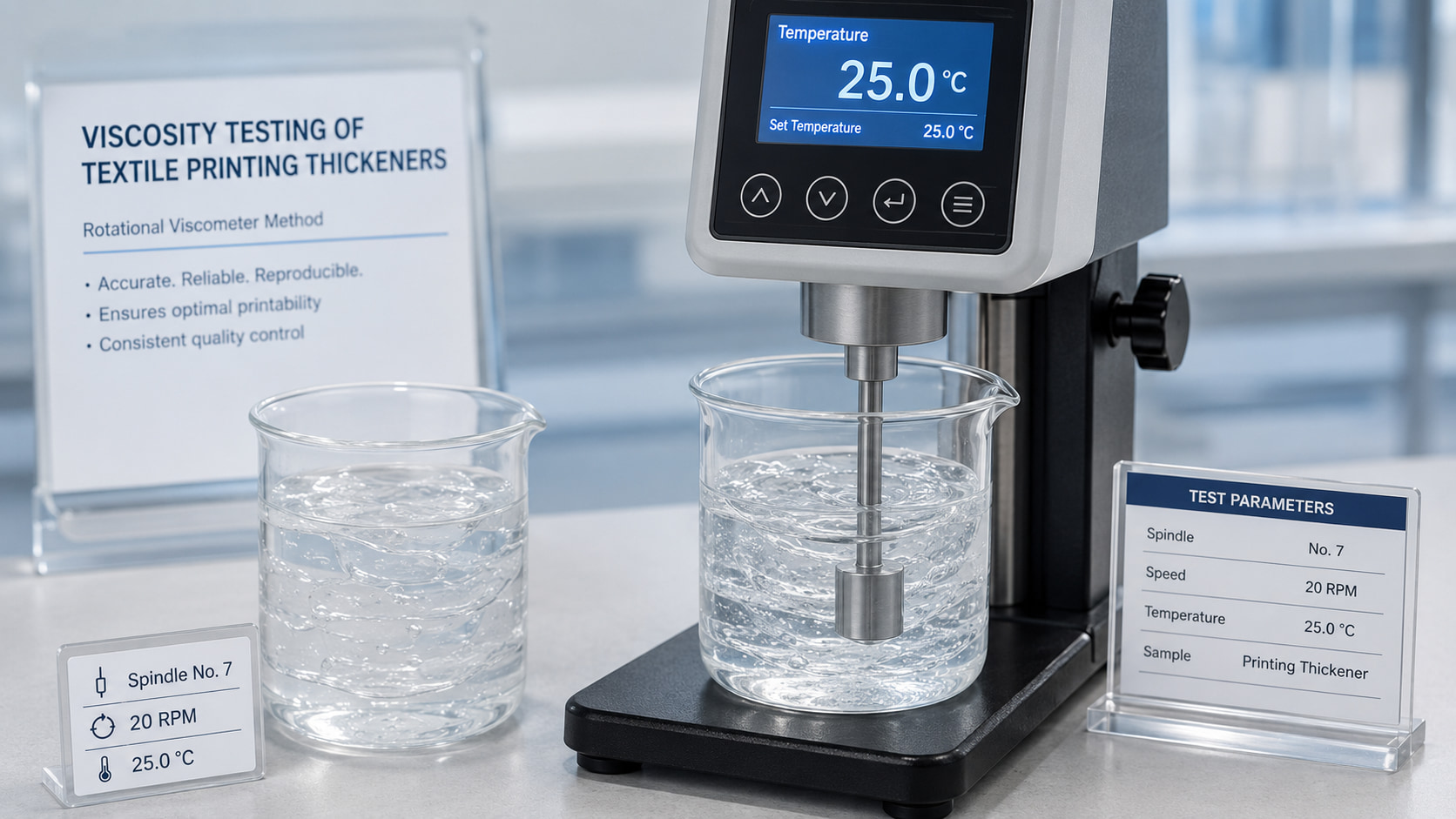
Spindle/rotor
RPM
Temps de lecture
Durée de maintien
Same stock viscosity does not mean the same chemical resistance.
Paste Holding Stability Before Printing
Vat and discharge pastes can change while waiting before printing.
Possible changes include:
Viscosity loss
Viscosity increase
Gel formation
Phase separation
Foaming
Loss of discharge/reducing activity
A useful holding test uses realistic time points:
Immediately after formula preparation
After the normal waiting period
Near the end of the planned production window
At each point, record both paste properties and printing effect.
A paste can retain viscosity while the discharge chemistry loses activity, so viscosity stability alone is not enough.
Screen Running and Pattern Definition
CMS must provide enough structure at rest while still flowing under printing shear.
Evaluate:
Flat vs. rotary screen behavior
Passage à l'écran
Squeegee pressure
Mousse
Screen drying
Pattern filling
Edge definition
Pénétration
If the paste is too weak, discharge chemicals or vat dye can spread beyond the intended pattern.
If it is too resistant to flow, screen transfer may become incomplete.
Therefore:
Higher viscosity is not automatically better pattern control.
Drying, Steaming and Process Temperature
After printing, the paste usually enters a thermal stage.
The exact process depends on the printing route.
Temperature can change:
Moisture retention
Chemical mobility
Reducing-agent activity
Alkali transport
Thickener-film structure
Do not publish or copy one universal steaming temperature or time for all vat/discharge systems.
Use the actual dye and auxiliary supplier process, then check whether CMS remains compatible with that thermal window.
Vat Dye Reduction, Development and Oxidation
The vat route depends on controlled reduction and later oxidation.
CMS should not interfere with the transfer of reducing/alkaline chemicals or create a dried film that prevents effective development.
After printing and development, evaluate:
Intensité de la couleur
Shade
Planéité
Définition des traits fins
Pénétration
Oxidation completeness
Soaping cleanliness
Research on vat printing shows that modified starch, alginate and other thickeners can behave differently through drying and chemical development, so the dried thickener morphology is part of the process, not just a passive carrier.
Discharge Effect: What Should Be Measured?
A discharge trial should quantify more than “it looks white.”
Useful observations include:
Ground-color removal
Residual ground shade
Netteté des contours
Haloing
Fabric penetration
Colored-discharge shade where used
Uniformity across large areas
Compare the same ground-dyed fabric and the same discharge chemistry when evaluating two CMS candidates.
If the CMS grade changes and the discharge depth changes, investigate both:
Chemical compatibility
Paste deposit / penetration
A stronger discharge effect is not useful if the pattern edge becomes unacceptable or the fabric is damaged.
Wash-Off, Soaping and Residue Removal
Vat and discharge printing normally require substantial post-treatment.
The thickener should wash away sufficiently after the chemical process.
Evaluate:
Residual paste
Surface harshness
Background staining
Color redeposition
Résistance au frottement
Tissu à la main
A CMS grade that gives excellent screen behavior but requires excessive washing can increase:
Water use
Energy
Processing time
Total cost
Final approval should therefore be made after the full washing sequence.
Fabric and Ground-Dye Variables
Vat printing is used mainly on suitable cellulosic materials, while discharge printing can involve several fabric and ground-color systems.
Important variables include:
Cotton vs. viscose
Woven vs. knitted structure
Poids du tissu
Absorbency
Ground-dye class
Ground-dye depth
Finishing history
Not every ground dye is equally dischargeable.
If a discharge test is weak, do not blame CMS before confirming that the ground dye and discharge agent are chemically compatible.
Water Quality and Formula Variation
CMS behavior can change with water hardness, conductivity and dissolved multivalent ions.
Vat/discharge formulas already contain significant ionic loading, so plant water can become an additional variable.
If laboratory results do not match production, compare:
Reference water
Plant water
Hardness
Conductivity
pH
Also confirm that production follows the same chemical addition order as the laboratory.
Test Paste Stability and Chemical Activity Separately
The following is a proposed qualification design. Confirm the candidate grade and the dye or auxiliary supplier’s process before testing; it does not establish that any named FSX grade has already passed.
Control or trial
Préparation
Purpose
Candidate stock paste
Defined concentration, water, hydration and measurement method
Reference physical behavior before process chemicals
Candidate complete paste
Actual supported chemical package, final mass and addition sequence
Combined physical and chemical response
Approved production thickener
Matched chemical levels, fabric and process, with its documented recipe
Practical performance reference
Chemical-package control where the assay permits
Same chemical concentrations and aging conditions without thickener
Help investigate loss of chemical activity independently of paste flow
Keep aging and sampling comparable
Record vessel, exposure conditions, temperature and elapsed time from preparation. Check fresh paste, the normal waiting period and the intended end of use. Measure viscosity, pH and physical defects separately from the chemical activity assessment. Apply a chemical assay only if it is appropriate for the reducing or discharge agent and the matrix; a viscosity result cannot establish retained reducing-agent concentration.
If oxidation-reduction potential is monitored, record the electrode system, temperature and measurement procedure. Treat it as a method-dependent process indicator, not a universal assay of reducer concentration or proof of discharge performance.
Verify the actual color process
For vat printing, complete the specified development, oxidation and washing route. For discharge, use a known, documented ground-dyed fabric and distinguish white from colored discharge. Compare ground-color removal, any retained colorant, edge definition and fabric condition after the full finishing sequence. A weak result on an unsuitable ground dye cannot establish that the thickener failed.
Approve only the tested grade–recipe–fabric–process combination. Retaining viscosity while losing chemical activity is a failure of the complete process; retaining chemical activity while losing printable rheology is also insufficient.
How to Run a Controlled Printing Trial
Use one fabric lot and keep the dye/chemical system constant.
Print a diagnostic pattern containing:
Rides fines
Petit texte
Solid blocks
Half-tone or gradient areas where relevant
Large discharge areas
Then use identical:
Séchage
Steaming/development
Oxidation where relevant
Lavage
Soaping
Evaluate:
Pattern definition
Vat color yield or discharge depth
Shade
Pénétration
Fastness
Residue
Hand
Production Approval Checklist
Before bulk approval, verify:
Large-batch CMS hydration
Full formula viscosity
Holding-time stability
Screen running over realistic production length
Left-center-right pattern consistency
Thermal process repeatability
Vat development or discharge depth
Post-treatment cleanliness
Fabric strength and hand
Repeat-batch CMS consistency
Retain the final approved:
CMS batch
Printing formula version
Fabric lot
Ground-dye information for discharge
Machine settings
Steaming/development record
Finished fabric reference
This creates a practical production standard rather than relying on memory.
Troubleshooting Table
Problème constaté
First Variables to Check
Do Not Assume
Viscosity collapses after alkali/reducer addition
CMS grade, chemical concentration, ionic load, addition order
CMS dosage, post-treatment, film formation, process temperature
Good printing automatically means good wash-off
Les résultats des tests en laboratoire sont satisfaisants, mais la production échoue
Batch scale, water, machine shear, steam uniformity, chemical addition
The laboratory sample proves production approval
Coût total d'utilisation
A vat/discharge thickener should not be selected from price per kilogram alone.
Comparez :
CMS dosage
Paste preparation time
Chemical stability
Screen interruptions
Discharge/vat effect
Steam/development efficiency
Washing and soaping load
Rework
Tissu rejeté
A useful framework is:
Total cost per accepted metre = attributable material, preparation, machine-time, finishing and quality-loss costs divided by accepted metres
A grade with higher powder cost may still be commercially better if it uses a lower dosage and maintains stability through the full production window.
What Information Should You Send to a CMS Supplier?
For vat or discharge CMS matching, send:
Printing route: vat or discharge
Composition et fabrication du tissu
Ground-dye class and shade depth for discharge
Current thickener sample/TDS
Current thickener dosage
Target viscosity and full test method
Alkali type and dosage
Reducing/discharge agent type and dosage
Complete or simplified formula
Paste holding time
Flat or rotary screen
Drying and steaming/development conditions
Oxidation/soaping/washing route
Current stability, pattern, discharge, color or residue problem
FSX Chemical can use this information through Échantillons et correspondances to review a documented candidate grade for a controlled trial. A trial recommendation is not production approval.
How Should CMS Be Approved for Vat and Discharge Printing?
A practical qualification chain is:
CMS Stock Paste → Full Chemical Formula → Holding Stability → Screen Printing → Drying → Vat/Discharge Development → Washing/Soaping → Finished Fabric → Production Repeatability
Les principes fondamentaux sont les suivants :
Vat and discharge printing require separate qualification.
Stock-paste viscosity does not prove alkali or reducing-agent tolerance.
Paste holding stability and chemical activity must both be monitored.
Screen performance must be judged together with pattern development.
Final approval should be made after steaming/development and full washing.
The complete formula, fabric and process—not the CMS name alone—determine suitability.
Foire aux questions
1. Can CMS be used for vat dye printing?
Selected CMS grades can be evaluated for vat printing when they maintain useful rheology under the actual alkaline/reducing process and do not interfere with development, oxidation and wash-off.
2. Can CMS be used for discharge printing?
Selected CMS or modified-starch grades can be evaluated for discharge printing, but compatibility with the actual discharge agent, ground dye, fabric and steaming process must be confirmed.
3. Is the same CMS grade suitable for both vat and discharge printing?
Not automatically. The chemical systems and quality targets differ, so each route should be approved separately.
4. What is the most important CMS test for vat printing?
There is no single test. Evaluate full-formula viscosity, holding stability, screen running, vat development, oxidation, wash-off and final color.
5. What is the most important CMS test for discharge printing?
Evaluate chemical compatibility, holding stability, screen definition, degree of discharge, edge sharpness and final washing result.
6. Does high CMS viscosity mean good alkali resistance?
No. Stock viscosity and chemical resistance are different properties. Test the full alkaline formula.
7. Can a CMS paste remain viscous but still fail in discharge printing?
Yes. The discharge agent may lose activity or fail to penetrate/develop correctly even if viscosity remains stable.
8. Why does discharge paste lose viscosity after preparation?
Possible causes include electrolyte loading, pH, reducing-agent chemistry, addition order, temperature or unsuitable CMS grade.
9. Why is the discharge effect good but the pattern edge poor?
The chemistry may be active while paste rheology or screen-transfer conditions allow excessive spreading.
10. Should production approval be based on a laboratory viscosity target?
No. The CMS should be approved through the complete vat/discharge process and finished-fabric result.
11. Is H5 automatically suitable for every vat/discharge mill?
No. Confirm the current H5 technical documentation and recommended application first. Any candidate still needs separate validation with the actual fabric, chemicals, machine and post-treatment.
12. What should I send FSX Chemical for vat/discharge matching?
Send the current thickener, formula, fabric, ground dye where relevant, alkali/reducing agent, viscosity method, screen route, steaming/development and washing conditions.
Evaluate CMS for Vat and Discharge Printing with FSX Chemical
If your current vat or discharge thickener loses viscosity after chemical addition, runs poorly through the screen, gives weak discharge, reduces vat color development or leaves difficult residue, FSX Chemical can help structure a controlled comparison.
For a useful technical review, send:
Your current thickener sample, TDS or COA
Vat or discharge printing route
Composition et fabrication du tissu
Ground dye and shade depth for discharge
Current thickener dosage
Viscosity and complete test method
Alkali and reducing/discharge agents
Complete or simplified printing formula
Paste holding time
Flat/rotary screen information
Drying and steaming/development conditions
Oxidation and washing/soaping route
Current viscosity, pattern, discharge, color or residue target
For vat and discharge printing, production approval should answer two separate questions: does the CMS keep the paste printable under aggressive chemistry, and does the complete chemical process still deliver the required color or discharge effect after steaming and washing?
Découvrez pourquoi les valeurs de viscosité des épaississants utilisés dans l'impression textile ne peuvent pas être comparées sans tenir compte de la concentration, de la température, de l'instrument, de l'axe, de la vitesse, de la méthode de préparation et de la durée de l'essai.
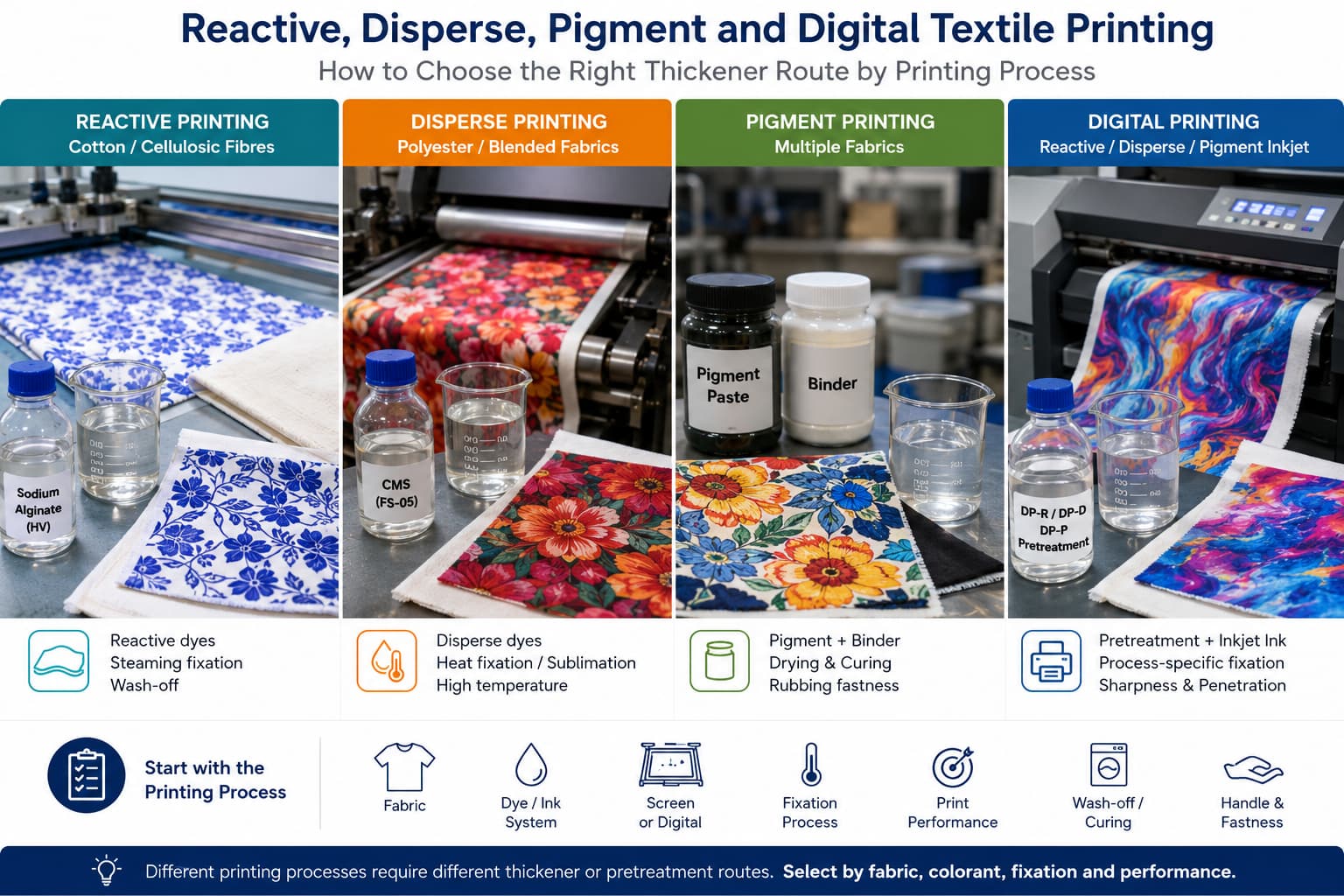
Découvrez comment choisir les agents épaississants et les procédés de prétraitement adaptés à l'impression textile réactive, dispersée, pigmentée et numérique, en fonction des exigences liées au tissu, à la teinture ou à l'encre, à la fixation, à l'élimination au lavage et à la qualité d'impression.
Comparez le CMC, le CMS, l'alginate de sodium et la pâte d'impression numérique pour l'impression textile. Découvrez comment chaque solution s'adapte aux procédés réactifs, dispersés, pigmentés et numériques, et ce que les acheteurs doivent vérifier avant de procéder à des tests d'échantillons, à la mise en correspondance des qualités et à l'achat en gros.
La carboxyméthylcellulose (CMC) est largement utilisée dans les processus d'impression, d'encollage et de teinture des textiles. Ce guide explique comment évaluer les différentes qualités de CMC, quels sont les paramètres les plus importants et comment FSX Chemical peut vous aider dans vos décisions d'achat.
La granulométrie (maillage) de l'alginate de sodium influe sur la vitesse de dissolution de la poudre, l'uniformité de son hydratation et les performances de la pâte obtenue en sérigraphie. Ce guide explique les implications pratiques du choix du maillage pour les applications de pâte d'impression textile.
Les spécifications de pureté de l'alginate de sodium ne se résument pas à un simple chiffre. Ce guide explique ce que signifient les données relatives à la teneur en substance active, au NaCl, aux matières insolubles et aux métaux lourds pour les performances des pâtes d'impression textile — et dans quels cas il est préférable de privilégier une pureté supérieure à celle d'un produit de qualité industrielle standard.
Reactive dye screen printing with sodium alginate requires correct paste formulation, viscosity control, and steaming conditions. This guide covers flat and rotary screen paste requirements, alkali timing, common production defects, and how to diagnose paste-related causes.
CMS for textile printing paste can help adjust viscosity, improve paste handling, and support stable formulation performance. This guide explains how buyers can evaluate CMS grades by viscosity, DS, solubility, pH, moisture, and sample testing before bulk purchase.
Les matières premières à base de cellulose sont utilisées dans l'impression textile, la préparation des pâtes d'impression, l'épaississement et l'optimisation des formulations. Ce guide explique comment les acheteurs peuvent évaluer le CMC, le CMS, l'alginate de sodium, les épaississants pour l'impression textile et les pâtes d'impression en se basant sur les spécifications, la documentation, les essais d'échantillons et l'assistance fournie par les fournisseurs.
Les dérivés de la cellulose sont largement utilisés dans l'impression textile, la préparation des pâtes d'impression, l'épaississement et comme adjuvants de formulation. Ce guide explique comment les acheteurs étrangers peuvent s'approvisionner en CMC, CMS, alginate de sodium, épaississants pour l'impression textile et pâtes d'impression auprès de FSX Chemical, avec à leur disposition des fiches techniques (TDS), des certificats d'analyse (COA), des tests d'échantillons, la mise en correspondance des qualités et une assistance pour les documents d'exportation.
Le choix des produits chimiques destinés à l'industrie textile ne se résume pas à une simple comparaison des noms de produits. Ce guide explique comment les acheteurs spécialisés dans l'impression textile peuvent sélectionner les produits CMC, CMS, l'alginate de sodium, les épaississants pour l'impression textile et les pâtes d'impression en fonction de l'application, des spécifications, des fiches techniques (TDS), des certificats d'analyse (COA), des tests sur échantillons et de l'uniformité des lots.
L'accompagnement en matière de formulation chimique pour l'impression textile doit commencer par des informations claires sur l'application. Ce guide explique ce que les acheteurs doivent fournir lorsqu'ils sollicitent une mise en adéquation de produits, un ajustement de formulation, des essais d'échantillons, des fiches techniques (TDS), des certificats d'analyse (COA), des fiches de données de sécurité (SDS) et une assistance technique concernant le CMC, le CMS, l'alginate de sodium, les épaississants pour l'impression textile et les pâtes d'impression.
Veuillez nous communiquer le nom du produit, son application, la quantité, la destination, ainsi que toute fiche technique (TDS),
photo ou document dont vous disposez déjà. FSX Chemical examinera ces
informations et vous recommandera la marche à suivre pour obtenir un devis, trouver un échantillon correspondant
ou choisir un produit.
Informations sur le produitNom du produit, référence, modèle, photo de l'étiquette ou référence du fournisseur.
Documents disponiblesFiche technique (TDS), fiche de données de sécurité (SDS), certificat d'analyse (COA), photo d'exemple, liste des produits ou données d'essai.
Détails de la commandeQuantité estimée, conditionnement, pays de destination, port ou conditions commerciales.
Demande ou problèmeProcédé d'impression textile, besoins en matière de formulation, problème actuel ou performances visées.