Why Pretreated Fabric Becomes Sticky or Tacky Before Digital Printing: Moisture, Polymer and Drying Causes
Sticky pretreated fabric can reflect moisture, treatment add-on, formulation and storage interactions. Compare matched fabric...
Pretreated fabric can become sticky or tacky before digital printing even when the formulation has not visibly separated and the fabric appears dry. Possible causes include residual moisture, humidity regain, excessive or uneven treatment add-on, hygroscopic components, uneven drying and prolonged contact during storage. First record whether tack appears at dryer exit, after conditioning or only in certain width zones. Timing helps prioritize checks; it does not identify the root cause by itself. Compare moisture, deposited treatment, thermal history and storage conditions before changing the pretreatment or increasing dryer severity.
Why Does Pretreated Fabric Become Sticky or Tacky Before Digital Printing?
Pretreated fabric may become sticky through excess retained water, humidity regain, concentrated or soft treatment layers, contamination, or prolonged contact during storage. These are diagnostic possibilities, not a conclusion from touch alone. The reactive-specific discussions of urea, steaming and wash-off below do not prescribe those steps for pigment or disperse workflows.
The most common causes are:
Excess residual moisture
Moisture regain from humid air
High polymer or total-solids add-on
Hygroscopic pretreatment components
Incomplete or uneven drying
Soft film-forming components in compound systems
Roll pressure before the fabric surface has stabilized
Do not begin by reducing the thickener unless the moisture and application variables have already been controlled.
What Do “Sticky” and “Tacky” Mean in Pretreated Fabric?
In mill language, the terms are often used interchangeably.
Typical symptoms include:
Fabric surface feels slightly adhesive to the hand.
Two layers resist separating after winding or stacking.
Fabric sticks lightly to guides or rollers.
The surface feels soft, damp or rubbery even though no visible water is present.
This should be distinguished from:
Wet fabric that is simply under-dried
Hard polymer residue after over-application
Powdery salts crystallized on the surface
Oil / silicone contamination
The tactile symptom alone does not identify the chemical cause.
The Three Main Root-Cause Pathways
Pathway
Typical Mechanism
پہلی جانچ
Moisture-driven
Residual water or humidity uptake softens / swells the pretreatment layer
Residual moisture + ambient RH
Polymer / formulation-driven
High add-on, soft film, hygroscopic formulation or unsuitable polymer balance
Dry add-on + polymer / solids ladder
Process-driven
Uneven drying, hot winding, storage pressure or application nonuniformity
Dryer profile + winding / storage conditions
Many real production problems involve more than one pathway.
مثال کے طور پر:
High Polymer Add-On + High Residual Moisture + Roll Pressure
can create much stronger tack than any one factor alone.
1. Excess Residual Moisture After Drying
Residual moisture is the first variable to check.
Hydrophilic pretreatment polymers can absorb and retain water.
If too much water remains after drying, the surface can stay:
Soft
Swollen
Damp-feeling
Tacky under pressure
Water can act as a plasticizing medium for many hydrophilic polymer films, increasing chain mobility and softening the surface.
A published study of calcium-crosslinked alginate films found humidity- and plasticizer-dependent changes in water uptake and mechanical response. The original film study supports a moisture-sensitivity hypothesis; its edible-film samples are not a textile pretreatment tack test.
This does not mean every alginate-pretreated fabric becomes sticky at high humidity.
It means polymer moisture state must be included in the diagnosis.
2. Moisture Regain from Ambient Humidity
A fabric can leave the dryer correctly and become tacky later.
This often points to moisture regain.
ممکنہ وجوہات میں شامل ہیں:
High ambient relative humidity
Storage in an unconditioned room
Long waiting time before printing
A cold fabric surface exposed to warmer humid air, when its temperature is below the local dew point
Condensation inside protective packaging
Hydrophilic polymers and hygroscopic auxiliaries can reabsorb moisture from air.
لہٰذا:
Dry at Dryer Exit ≠ Same Surface Condition Several Hours Later.
Measure both dryer-exit moisture and pre-print moisture when storage is part of the process.
3. Urea and Other Hygroscopic Components
Urea may be used in selected reactive textile pretreatments to support dye solubility and moisture during fixation. Its role and dosage belong to the validated reactive system; urea is not a default ingredient for pigment or disperse pretreatment.
Its hygroscopic nature also means the pretreated fabric can become more sensitive to ambient humidity.
A high-urea system can therefore show:
More moisture regain
Softer surface under humid storage
Greater difference between immediate printing and delayed printing
This does not mean urea is inherently a tackiness problem.
It means urea level should be evaluated together with:
Residual moisture
Ambient humidity
Storage time
Polymer add-on
when tackiness appears.
4. Excessive Polymer Add-On
More thickener or migration-control polymer is not always better.
Excess add-on can create a thicker hydrophilic surface layer.
This can increase:
پانی کا جمع ہونا
Surface softness
Blocking tendency under pressure
Wash-off demand
A common troubleshooting mistake is increasing polymer to reduce bleeding and then creating tackiness before printing.
The correct target is:
Minimum Polymer Add-On That Provides Stable Ink Localization and Print Definition.
Use actual dry add-on rather than bath concentration alone.
5. Polymer Chemistry and Moisture Sensitivity
Different pretreatment polymers have different moisture responses.
Common routes can include:
سوڈیم الگینٹ
سی ایم سی
FSX CMS commercial synthetic printing-thickener grade, or another exact product identified by its current documents
HEC or other nonionic cellulose ethers
Synthetic / compound polymers
Hydrophilic polysaccharide films can absorb water and swell.
But the degree of tackiness depends on:
پولیمر کیمسٹری
مالیکیولر وزن
Carboxymethyl degree of substitution where applicable to an identified derivative such as CMC; this is not a sodium alginate grading parameter
Blend composition
Add-on
نمی
Do not label one entire polymer family as “sticky” without a controlled comparison.
6. Soft / Film-Forming Components in Compound Pretreatments
Some digital pretreatments are compound systems rather than single-polysaccharide thickeners.
They can contain film-forming or surface-modifying polymers.
If the surface film is relatively soft under production temperature and humidity, tackiness can increase.
Water can also plasticize hydrophilic polymer phases and reduce effective film stiffness.
This mechanism is especially relevant when:
Tackiness is strong even at moderate residual moisture.
The problem increases with temperature or humidity.
Two fabric layers block together under pressure.
Ask the supplier whether the pretreatment contains film-forming components and whether storage humidity / temperature limits have been validated.
7. Insufficient Drying
If the dryer does not remove enough water, the fabric can remain tacky immediately after the process.
ممکنہ وجوہات میں شامل ہیں:
Line speed too high
Low effective dryer temperature
Low airflow
Excess wet pick-up
High fabric GSM
High pretreatment solids / water retention
Do not correct under-drying only by increasing temperature.
یہ بھی دیکھیں:
Water load entering the dryer
Dwell time
Airflow
Fabric thickness
because the limiting factor can be drying capacity rather than setpoint temperature.
8. Uneven or Over-Aggressive Surface Drying
More severe drying is not always more uniform drying.
If the surface dries much faster than the textile interior, moisture can remain nonuniform through the structure.
This is more likely when:
Wet pick-up is high.
Fabric is heavy.
Airflow is concentrated strongly at the surface.
The fabric can appear dry to the hand while internal moisture later redistributes toward the surface during winding or storage.
Therefore, if tackiness develops only after waiting, investigate moisture redistribution rather than assuming the polymer suddenly changed.
9. Widthwise Drying Nonuniformity
If tackiness occurs only:
At one edge
At the center
In a repeated longitudinal band
first check a local application or drying difference. A uniform formulation can still become tacky only where local moisture, temperature or add-on exceeds its working window.
چیک کریں:
Airflow profile
Nozzle blockage
Fabric pick-up across width
Temperature distribution
Residual moisture across width
A widthwise sticky zone can later become a widthwise printing defect.
10. Roll Storage, Pressure and Blocking
A surface that feels only slightly soft can become strongly tacky under roll pressure.
In a wound roll, fabric layers remain in prolonged contact.
If the pretreatment surface contains too much moisture or remains soft:
Layers can block together.
Surface chemistry can transfer between faces.
Unwinding tension can increase.
Surface damage can occur.
Blocking risk generally increases when moisture, temperature, pressure and storage time act together.
Do not approve a pretreatment only from immediate post-dryer touch.
Include a realistic roll-storage check.
11. Fabric Temperature at Winding
Hot fabric should not automatically be wound tightly and treated as fully stabilized.
High fabric temperature can:
Keep soft polymers more mobile
Change moisture redistribution
Increase pressure-sensitive blocking behavior in selected systems
Allow the process to reach a stable winding condition.
ریکارڈ:
Fabric exit temperature
Cooling condition
Winding tension
when tackiness occurs after winding but not immediately at dryer exit.
12. Wetting Agents and Other Auxiliaries
Wetting agents, humectants and other low-molecular-weight auxiliaries can change the softness and water affinity of the pretreatment layer.
Excess dosage or poor compatibility can contribute to:
Surface softness
Moisture retention
Slow drying
Blocking tendency
Do not reduce these components blindly.
They may be needed for:
Uniform application
Ink wetting
تثبیت
Use a controlled dosage ladder.
13. Water Quality and Ionic Load
Plant-water hardness, conductivity and pH can change polymer hydration and film behavior.
Water composition can affect individual anionic systems differently. Calcium is particularly relevant to alginate association or gel formation; hardness and conductivity do not establish the ion identity or predict the same response for every polymer. Review changes in:
سَانچَر
Association
Gel / residue formation
These effects can indirectly change:
Application add-on
Drying behavior
Surface condition
If tackiness changes after a water-source or treatment-system change, compare plant water with a validated reference water.
14. Fabric Absorbency and Construction
The same pretreatment can feel dry on one fabric and tacky on another.
Fabric variables include:
Fiber type
جی ایس ایم
موٹائی
مسامت
جذب کرنے کی صلاحیت
سطحی بالداری
A highly absorbent fabric can pull more pretreatment into the structure, while a less absorbent or highly surface-treated fabric can retain more chemistry near the face.
Therefore, tackiness should always be evaluated on the actual production substrate.
کپاس
Cotton response depends strongly on:
Scouring
Mercerization
کپڑے کی تیاری
جی ایس ایم
Highly absorbent cotton can carry high wet pick-up in padding.
If that water load is not matched by dryer capacity, tackiness can appear even when the pretreatment chemistry itself is suitable.
Viscose / Modal
Viscose and modal generally have high water uptake and swelling.
This can increase:
Wet pick-up
خشک کرنے کی طلب
Moisture regain
A pretreatment / dryer window developed on cotton should not be transferred directly to viscose.
Lyocell
Lyocell is regenerated cellulose but should be evaluated independently.
Fiber variant, fabric construction and finishing history can change moisture uptake and surface behavior.
Record actual:
Wet add-on
خشک کرنے کی حالت
Residual moisture
ذخیرہ کرنے کا رویہ
on the production lyocell fabric.
Padding Route: Why Tackiness Can Appear
Padding can carry a relatively high liquid load into the textile.
Possible tackiness routes include:
Wet pick-up too high
Uneven nip pressure
Fabric absorbency too high
Dryer capacity too low
The relevant chain is:
Wet Pick-Up → Water Load + Chemical Add-On → Drying → Residual Moisture / Surface Condition
Record measured wet pick-up rather than padder pressure alone.
Coating Route: Why Tackiness Can Appear
Coating can concentrate more polymer near the printable face.
This can improve ink localization, but excessive surface add-on can also create:
Soft film
Higher moisture sensitivity
Blocking under pressure
چیک کریں:
Wet coating weight
Dry coating add-on
Film uniformity
Dryer condition
before changing polymer chemistry.
Spray Route: Why Tackiness Can Appear
Spray can reduce carrier-water load compared with a high-pick-up padding route.
But tackiness can still occur if:
Spray add-on is too high.
Nozzle overlap creates local over-application.
Surface polymer concentration becomes too high.
Drying is adjusted for average add-on but not local wet spots.
Map spray deposition across width if tackiness follows nozzle patterns.
When Does the Tackiness Appear?
The timing of the defect is one of the best diagnostic clues.
Blocking, roll pressure, fabric temperature, moisture
Only in width zones
Application / drying nonuniformity
Only on one fabric lot
Fabric absorbency / finish / incoming moisture
Sticky Immediately After the Dryer
Prioritize:
Residual moisture
Wet pick-up
Dry add-on
Line speed
Airflow
If tack decreases after lowering line speed, treat it as a process response to investigate rather than proof of a particular drying mechanism or a dryer-capacity limitation. Speed changes residence time and thermal exposure; reducing liquid load can also change chemical add-on. Use adjacent specimens from one fabric lot and treatment batch, keep or measure the individual chemical deposits, and record actual fabric temperature, moisture at a fixed sampling time and widthwise variation. Include the existing drying condition as a reference. A changed dryer set point is not proof of a changed fabric moisture state.
Sticky After Conditioning or Waiting
Prioritize:
Ambient RH
Urea / humectant level
Hydrophilic polymer add-on
Moisture regain
Run the same pretreated fabric under controlled lower- and higher-humidity conditioning.
If tack changes strongly with humidity, prioritize measuring moisture uptake on matched specimens at the tack-assessment time. A humidity response alone does not identify sorption as the cause; contact pressure, treatment distribution and temperature can interact with it.
Sticky Only After Roll Storage
Prioritize:
Winding temperature
Winding tension / pressure
Storage time
پیکیجنگ
Ambient humidity
This pattern often indicates blocking rather than simple under-drying alone.
Sticky Only at Edges, Center or Specific Width Zones
Prioritize mapping:
Wet pick-up / coating add-on
Residual moisture
Dryer airflow
درجہ حرارت
If the formula were uniformly too tacky, the problem would usually be broader.
Localized tackiness directs the first checks toward process uniformity, while formulation sensitivity may determine where the defect appears.
How Tackiness Affects Digital Printing
A tacky pretreated surface can create problems before any dye fixation occurs.
Potential effects include:
Fabric feeding / transport instability
Contact with guides or belts
Surface marking
Uneven ink wetting
Higher local residual moisture
Therefore, tackiness should be treated as both a chemistry and machine-runability issue.
Effect on Ink Spreading and Bleeding
A tacky surface often contains more mobile water or softer polymer structure.
This can increase liquid mobility after the ink droplet lands.
Possible effects include:
Wider lines
Feathering
Color-to-color bleeding
But do not assume tackiness always means more bleeding.
A very concentrated polymer film can feel tacky yet still strongly localize the droplet.
Measure actual print geometry.
Effect on Fabric Transport and Printing Reliability
Tacky fabric can:
Stick to rollers
Change web tension
Unwind unevenly
Pick up dust / lint
These mechanical effects can create:
Registration problems
Wrinkles
سطحی آلودگی
even if the chemical pretreatment would otherwise produce acceptable color.
Effect on Reactive Fixation and Color Yield
Tackiness often signals a moisture or add-on change.
That can also change:
Alkali add-on
Residual moisture
Ink penetration
Steaming response
لہٰذا، موازنہ کریں:
Pre-steam appearance
Post-wash K/S
Fixation / fastness
before deciding that a tacky but dark-looking print is acceptable.
Effect on Wash-Off and Fabric Hand
Excess polymer or auxiliary add-on can increase the amount of chemistry that must later be removed.
Possible effects include:
Higher wash-off demand
Residual surface film
Harsh or coated hand after washing
The pretreatment should therefore be optimized for both pre-print runability and post-wash fabric quality.
How to Measure Moisture Before Blaming the Polymer
Use a standardized moisture method.
Possible approaches include:
Gravimetric moisture measurement
Validated textile moisture meter
Other calibrated plant method
Standardize:
Sampling position
Time after dryer exit
Conditioning time
آلہ
Measure at the same moment the tackiness is assessed.
A dryer-exit moisture value may not represent the fabric several hours later.
Build a Simple Tack / Blocking Test
For internal comparison, use a consistent method rather than finger feel alone.
A practical screening test can compare:
Two pretreated fabric faces placed together
A defined contact pressure
A defined time
A defined temperature / humidity
Ease of separation afterward
Record results as a simple internal scale such as:
No tack
Slight tack
Moderate blocking
Strong blocking
This is an internal comparative method, not a universal standard.
Build a Humidity / Conditioning Comparison
Condition identical pretreated samples under:
Lower controlled humidity
Reference production humidity
Higher controlled humidity
پھر موازنہ کریں:
Moisture gain / loss
Tack score
Fabric blocking
Print spreading
This comparison tests whether tack changes with the defined conditioning environment. Interpret it together with measured moisture, temperature and contact history; a humidity association alone does not identify the responsible ingredient.
Separate Humidity Response from Contact Pressure in a Blocking Trial
Humidity conditioning and winding pressure can act together. A comparison in which both change at once cannot show whether the formulation is more moisture-sensitive or the roll contact is more severe. Use paired specimens from one treated fabric lot after the same application and drying history. This is a proposed internal screen, not a standardized blocking method or an FSX performance claim.
Comparison cell
Humidity and temperature
Face-to-face contact
ریکارڈ
A
Reference storage condition
Agreed low-contact condition
Conditioned mass, tack and separation behavior
B
Higher humidity at the same temperature
Same contact condition as A
Humidity-associated change relative to A
C
Same reference condition as A
Agreed production-representative pressure
Contact-associated change relative to A
D
Same higher-humidity condition as B
Same pressure as C
Combined effect and any interaction
Set contact time, specimen area, face orientation, loading geometry and cooling history before the trial. Report applied pressure from load and contact area where possible; a stack weight without an area is not a comparable pressure specification. Include an untreated fabric blank and a previously acceptable treated reference to check fabric or test-fixture effects.
Measure mass and separation without changing the test
Assign separate, adjacent specimens to destructive moisture analysis, blocking assessment and printing. Weigh at a defined interval after conditioning and record the specimen transfer conditions; leaving a humid specimen exposed during weighing can change it. Use the same separation geometry and rate for every cell. If a force gauge is used, report specimen width and repeatability, and distinguish adhesive separation from fabric tearing or treatment transfer. A comparative tack score is an ordered rating, not a percentage measure.
Loss on drying is not automatically water content: non-water volatile loss or changes in treatment components can affect the result. METTLER TOLEDO’s method guidance distinguishes thermogravimetric mass loss from water-specific analysis. Validate the chosen method on the treated substrate and report its denominator and heating endpoint; compare a reference blank where useful.
Print matched specimens after the defined waiting period and complete the applicable fixation or cure and finishing route. A condition that prevents blocking but worsens outlines, finished shade, rubbing durability or hand is not a successful correction. Use ISO 139 where the agreed textile test requires standard conditioning; the humidity stress cells above remain separate, documented process trials.
Build a Polymer Add-On Ladder
Choose one question for the first ladder. To test polymer dosage, vary only the identified polymer and keep other component add-ons, application and drying controlled. To test total treatment add-on, keep formulation ratios constant and vary applied mass; record that polymer, auxiliaries and any fixation chemistry change together.
موازنہ کریں:
Lower add-on
Current add-on
Higher stress point
At each level, measure:
Tackiness
Residual moisture
Bleeding
Finished color after the selected ink’s approved processing and test sequence
Required finishing, durability testing and conditioned hand
This identifies the minimum effective polymer window.
Build a Drying × Moisture Matrix
Condition
Drying Severity
Residual Moisture
Tack
پرنٹ شدہ نتیجہ
A
Lower
ماپیں
Score
Print, then follow the ink-specific fixation or cure and required finishing
B
Reference
ماپیں
Score
کنٹرول
C
Higher controlled
ماپیں
Score
Print, then follow the ink-specific fixation or cure and required finishing
Do not change polymer dosage at the same time in the first matrix.
First test whether controlled drying changes tack while treatment deposit is held constant or measured. A response may reflect water removal, treatment redistribution or other thermal changes; it does not prove a single mechanism. Add an untreated fabric blank and an acceptable treated reference, assess specimens at the same declared temperature and waiting time, then confirm the candidate drying window through the required finished-print tests.
Record fabric GSM, construction and incoming moisture.
Record pretreatment solids, polymer dosage, urea / auxiliaries and viscosity.
Apply at controlled wet / dry add-on.
Build a controlled drying matrix.
Measure residual moisture immediately after drying.
Score tack immediately.
Condition samples at defined humidity / time and rescore tack.
Run a simple blocking test under defined pressure.
Print one diagnostic pattern.
Complete the same applicable fixation or binder-cure and finishing sequence for the selected ink system; use steaming and wash-off only where that validated route requires them.
Compare bleeding, finished color, required durability, conditioned hand and process runnability after the selected ink’s approved finishing and test sequence.
For controlled pretreatment matching, use نمونے اور ملاپ.
پیداواری آزمائش کی منظوری
ریکارڈ:
Fabric fiber / construction / GSM
Pretreatment product / batch
Pretreatment solids
Polymer / thickener dosage
Urea / humectant level
دیگر معاون ادارے
Application route
Wet pick-up / coating / spray add-on
Drying temperature / speed / airflow
Residual moisture
Fabric exit temperature
Winding tension
Storage time / RH / temperature
Tack / blocking observation
Final print and wash-off result
Approve a pretreatment–drying–storage window rather than one dryer setting or one polymer dosage.
Common Sticky-Fabric Troubleshooting Mistakes
1. Reducing Thickener Before Measuring Residual Moisture
Under-drying can create tackiness even when polymer dosage is correct.
2. Raising Dryer Temperature Without Checking Wet Pick-Up
Excess water load may be the real cause.
3. Judging Dryness Only by Touch
Surface feel can miss internal moisture that later redistributes.
4. Ignoring Ambient Humidity
Hydrophilic polymers and hygroscopic auxiliaries can regain moisture after drying.
5. Ignoring Roll Pressure
A slightly soft surface can block strongly after winding.
6. Assuming Urea Is Always the Cause
Urea increases moisture sensitivity, but tackiness depends on the complete formula and process.
7. Treating Local Tackiness as a Uniform Chemistry Problem
Widthwise tack often points to application or drying nonuniformity.
8. Fixing Tackiness Without Rechecking Printing
Over-drying or under-dosing polymer can remove tack but worsen bleeding, penetration or fixation.
حل مسائل کی جدول
مشاہدہ شدہ مسئلہ
چیک کرنے کے لیے اولین متغیرات
فرض نہ کریں
Fabric sticky immediately after dryer
Residual moisture, wet pick-up, line speed, airflow
Tack disappears after stronger drying but bleeding increases
Residual moisture vs. polymer localization balance
Maximum dryness is the optimum
Tacky surface gives good color but poor hand after wash
Excess polymer / auxiliaries, wash-off
High K/S proves good total performance
استعمال میں کل لاگت
Tacky pretreated fabric can increase:
Dryer energy
Slower line speed
Unwinding problems
Printer contamination / transport issues
دوبارہ کام
Wash-off demand
ایک مفید ماڈل یہ ہے:
Cost per accepted m² = allocated monetary cost of materials, application, drying, storage and handling, printing, required fixation or cure, finishing and rework ÷ accepted finished-fabric area (m²).
The lowest-cost correction is not always a cheaper polymer or higher dryer temperature.
A lower wet pick-up, better widthwise airflow or optimized polymer add-on may solve the problem more efficiently.
Calculate with measured material and utility consumption and stated labor, equipment and storage rates. Count lost treatment, rejected fabric, rework and disposal once under a consistent boundary; do not repeat their material value if already included in consumption. Keep unpriced reduced line speed, blocking frequency and downtime as operating metrics, and report any lost-capacity estimate separately. Use equivalent finished width if results are expressed per linear meter.
آپ کو سپلائر کو کون سی معلومات بھیجنی چاہئیں؟
For useful tackiness troubleshooting, provide:
Fabric fiber / construction / GSM
Current pretreatment product / TDS
Pretreatment solids
Polymer / thickener dosage
Urea / humectant dosage
دیگر معاون ادارے
Application route
Wet pick-up / dry add-on
Drying temperature / speed
Residual moisture if available
Fabric temperature at winding
Storage RH / temperature / time
Whether tack appears immediately or later
Whether tack is uniform or width-specific
Main printing issue: blocking, feeding, bleeding, penetration or hand
FSX کیمیکل اس معلومات کو کے ذریعے استعمال کر سکتا ہے۔ نمونے اور ملاپ to separate moisture, polymer and drying causes.
How Should a Mill Troubleshoot Sticky Pretreated Fabric?
ایک عملی تسلسل یہ ہے:
Check Tack Timing → Measure Moisture → Confirm Add-On → Map Widthwise Drying → Condition / Store Sample → Run Blocking Test → Print → Follow the Ink-Specific Fixation or Cure and Finishing Route → Compare Controlled Changes Before Adjusting Chemistry
اہم اصول یہ ہیں:
Tackiness is usually a combined moisture–polymer–drying result rather than proof that one thickener is unsuitable.
Residual moisture should be measured before reducing polymer dosage.
Hydrophilic polymers and hygroscopic auxiliaries can regain moisture after drying, so storage humidity matters.
Roll pressure can turn a slightly soft surface into a blocking problem.
Localized tackiness usually points to application or drying nonuniformity rather than uniform chemistry.
The best process is the pretreatment–drying–storage window that keeps the fabric non-tacky while preserving ink localization, fixation, washability and hand.
اکثر پوچھے جانے والے سوالات
1. Why is my pretreated fabric sticky even though it looks dry?
The fabric can retain internal moisture, regain humidity after drying, or carry a soft / moisture-sensitive polymer layer. Measure moisture and storage conditions rather than relying on visual dryness.
2. Does sticky fabric always mean too much thickener?
No. Under-drying, high wet pick-up, high humidity, urea, roll pressure and fabric absorbency can produce similar symptoms.
3. Can urea make pretreated fabric tacky?
Urea is hygroscopic and can increase moisture sensitivity, but whether tackiness occurs depends on dosage, residual moisture, polymer, humidity and storage conditions.
4. Can sodium alginate become moisture-sensitive after drying?
Yes. Alginate is hydrophilic and alginate-based films can absorb water vapor and swell. Actual tackiness depends on the complete formulation and add-on.
5. Why does tackiness appear only after overnight storage?
Moisture regain, redistribution inside the roll, ambient humidity and roll pressure are strong suspects.
6. Why is only the center or edge of the fabric sticky?
Check widthwise wet pick-up, coating/spray add-on, dryer airflow and residual moisture. A localized problem usually points to process nonuniformity.
7. Should I increase dryer temperature?
Not automatically. First check wet pick-up, line speed, airflow and residual moisture. Higher temperature can over-dry other zones without fixing the root cause.
8. Can over-drying cause problems even if it removes tackiness?
Excessively severe drying can change treatment distribution, fabric condition and the subsequent printing response. The direction of spreading or penetration must be measured on the actual system; recheck definition and the applicable fixation or cure instead of assuming capillary uptake always increases.
9. Why does viscose become tacky more easily than cotton in my process?
Higher measured liquor retention, different drying or moisture regain can leave the viscose fabric in a different surface state. Confirm these on the actual construction and finish; fiber identity alone does not diagnose why one fabric is tackier than another.
10. How can I test tackiness more objectively?
Use a controlled blocking test with defined pressure, contact time, temperature and humidity, then record ease of separation using a repeatable internal scale.
11. Does a tacky surface always cause more bleeding?
No. Tack often correlates with moisture or soft polymer structure, which can increase spreading, but a concentrated polymer film may still localize ink strongly. Measure the printed result.
12. What should I send FSX Chemical for sticky-fabric troubleshooting?
Send the fabric, pretreatment/TDS, polymer and urea dosage, application add-on, drying conditions, residual moisture, winding/storage conditions, tack timing and the related printing defect.
Separate Moisture, Polymer and Drying Before Changing the Pretreatment
If pretreated fabric becomes sticky before digital printing, FSX Chemical can help structure a controlled comparison of wet pick-up, polymer add-on, residual moisture, storage humidity and final printing performance.
کے ساتھ شروع کریں نمونے اور ملاپ and provide the current pretreatment, fabric and drying / storage conditions.
The correct solution is not simply to make the fabric drier or use less polymer. It is to establish a pretreatment, drying and storage window in which the surface remains non-tacky and production-safe while preserving the validated application, ink localization, fixation or cure and finished-fabric requirements for the chosen printing route.
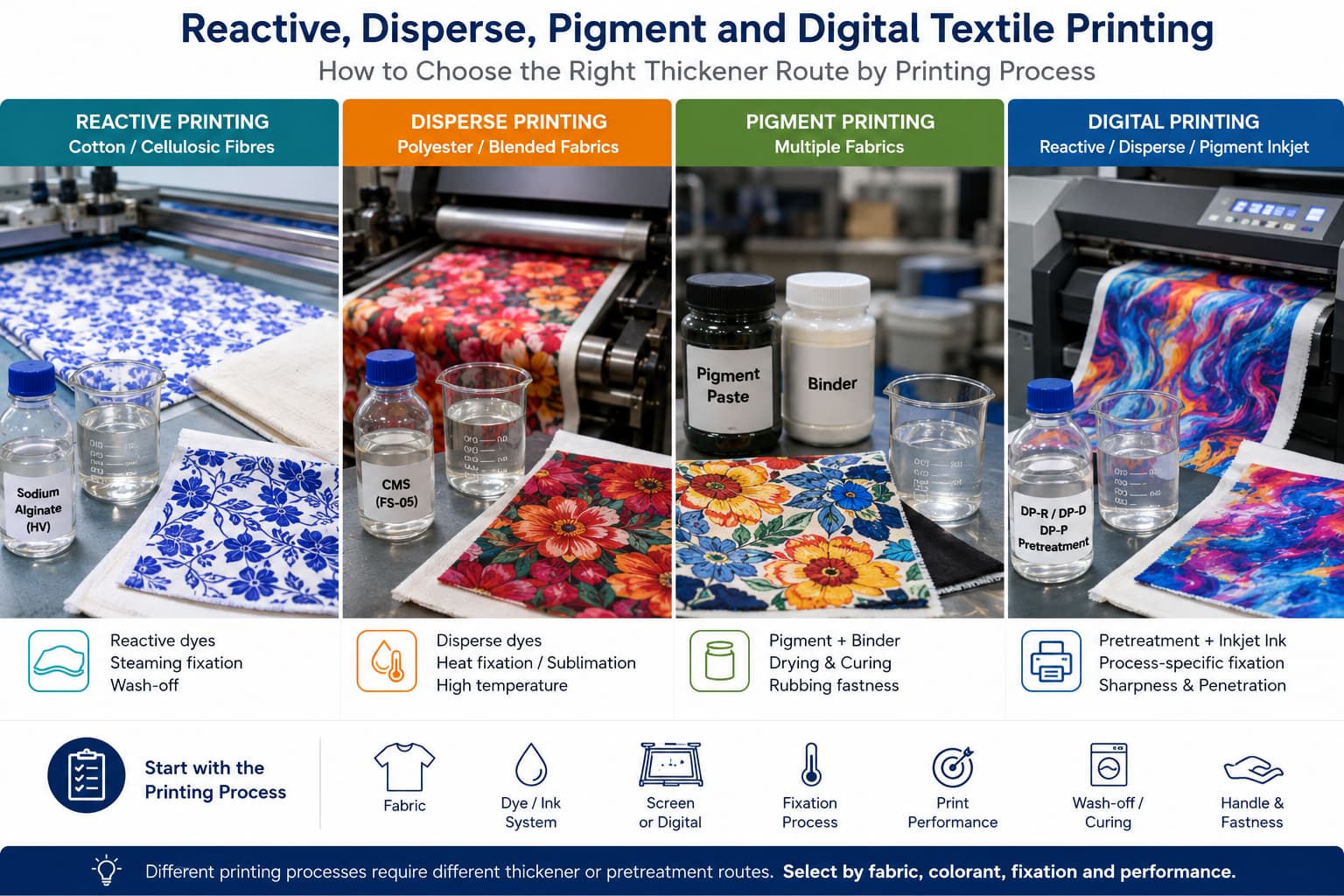
سیکھیں کہ ردعمل کرنے والی، منتشر، رنگین اور ڈیجیٹل ٹیکسٹائل پرنٹنگ کے لیے کپڑے، رنگ یا سیاہی کی بنیاد پر گاڑھا کرنے والا مادہ اور پری ٹریٹمنٹ کے راستے کیسے منتخب کیے جائیں، تاکہ فکسیشن، دھونے کے قابل ہٹانے اور پرنٹ کے معیار کی ضروریات پوری ہوں۔.
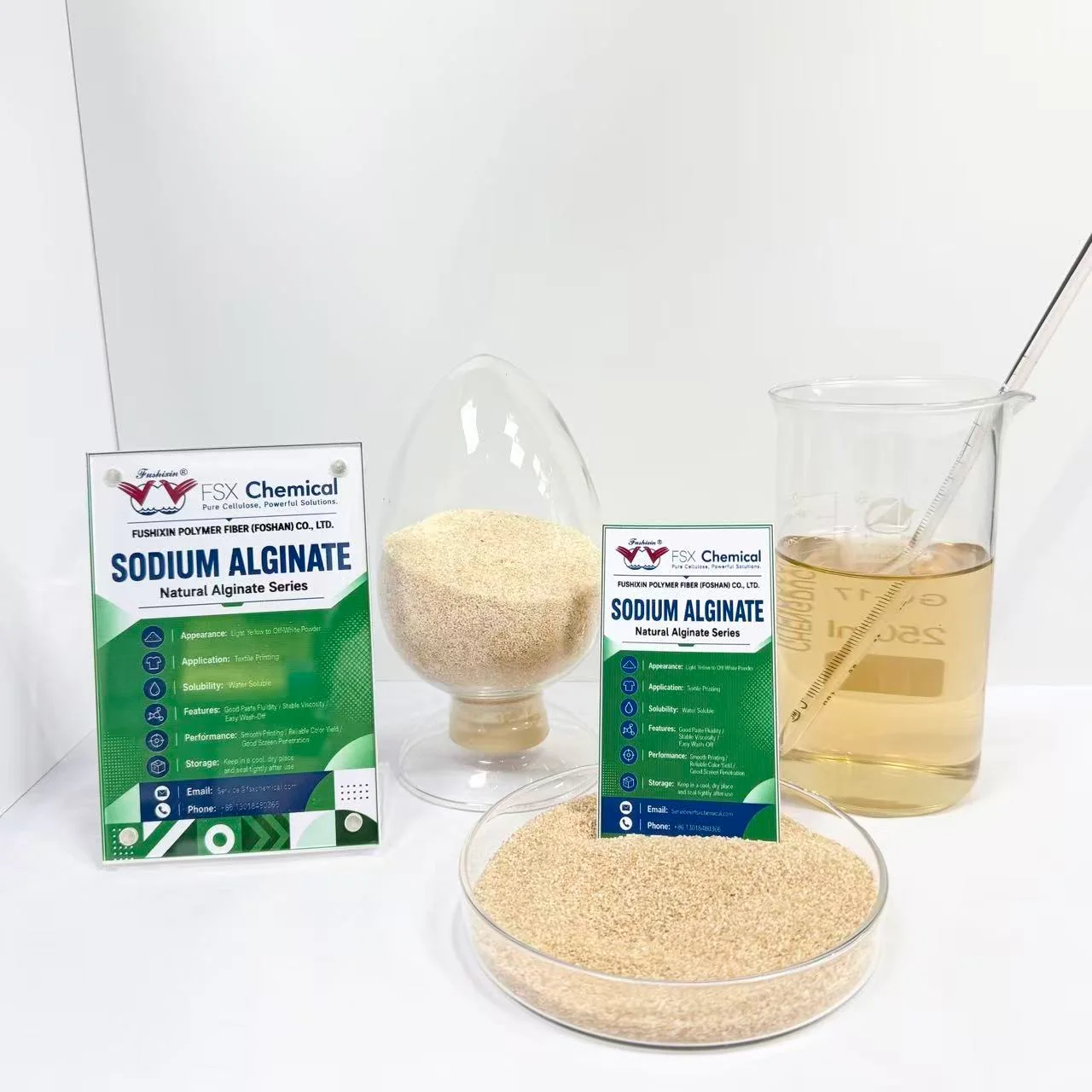
ٹیکسٹائل پر ڈیجیٹل انک جیٹ پرنٹنگ کے لیے اسکرین پرنٹنگ کے مقابلے میں مختلف پیسٹ اور پیش علاج کی ضروریات ہوتی ہیں۔ یہ رہنما بتاتی ہے کہ ڈیجیٹل ٹیکسٹائل پرنٹنگ میں سوڈیم الگنیٹ کا استعمال کیسے کیا جاتا ہے اور خریداری کی ٹیموں کو کون سے گریڈ کے پیرامیٹرز متعین کرنے چاہئیں۔.
سوڈیم الگینٹ عام طور پر ردعمل کرنے والی ٹیکسٹائل پرنٹنگ پیسٹ میں گاڑھا کرنے والا مادہ کے طور پر استعمال ہوتا ہے، لیکن دیگر ٹیکسٹائل استعمالات کے لیے مخصوص اطلاق کی توثیق درکار ہوتی ہے۔ یہ رہنما فنکشن، تکنیکی ضروریات، خطرات، دستاویزات اور نمونہ ٹیسٹوں کی بنیاد پر پرنٹنگ، ڈیجیٹل پری ٹریٹمنٹ، وارپ سائزنگ، رنگائی سے متعلق فارمولیشنز، کوٹنگ اور فنشنگ کا موازنہ پیش کرتا ہے۔.
ڈیجیٹل ٹیکسٹائل پرنٹنگ میں چپچپا پن کے کنٹرول میں دو مختلف نظام شامل ہیں: جیٹنگ انک اور کپڑے کی پری ٹریٹمنٹ فارمولیشن۔ یہ رہنما بتاتا ہے کہ درجہ حرارت، فارمولیشن، پیمائش کے طریقے اور عمل کے حالات جیٹنگ کی استحکام اور پرنٹ کے معیار کو کیسے متاثر کرتے ہیں۔.
بہترین ڈیجیٹل پرنٹنگ پیسٹ وہ ہے جو سیاہی کی کیمسٹری، کپڑے اور فکسیشن کے عمل کے مطابق ہو۔ یہ رہنما سیلولوزک کپڑوں پر ری ایکٹیو انک جیٹ اور پالئیےسٹر پر ڈائریکٹ ڈسپرز انک جیٹ کے لیے پری ٹریٹمنٹ کی ضروریات کا موازنہ کرتا ہے، اور پھر بتاتا ہے کہ خریداروں کو بڑے پیمانے پر خریداری سے پہلے نمونوں کا جائزہ کیسے لینا چاہیے۔.
The future of textile printing thickeners will be shaped by application-specific rheology, digital pretreatment, bio-based materials, hybrid formulations, faster preparation and data-driven process control. This guide explains which trends are commercially relevant and which still require industrial validation.
An FSX-authored guide to checking digital pretreatment fit, trial evidence, product documents and sample-to-bulk traceability before supplier approval.
مستحکم ڈیجیٹل پرنٹنگ پیسٹ کے لیے مطلوبہ چپچپا پن سے زیادہ درکار ہوتا ہے۔ یہ رہنما بتاتا ہے کہ مصنوعات کے انتخاب، پانی کے معیار، اضافے کے تسلسل، مکسنگ، پی ایچ، درجہ حرارت، فلٹریشن، حفظانِ صحت، ذخیرہ اور معیار کے ریکارڈز پری ٹریٹمنٹ اور پیداوار کی یکسانیت کو کیسے متاثر کرتے ہیں۔.
Textile printing chemical innovation in 2026 is moving beyond higher viscosity and stronger color. The leading developments focus on safer inputs, renewable polymers, waterborne nano-binders, stable pigment dispersions, lower-energy fixation and multifunctional printing systems.
Viscosity control in digital textile printing is not about reaching one number. Reliable performance requires the right pretreatment rheology, test method, temperature, chemical compatibility, filtration, fabric pickup and holding stability.
ڈیجیٹل ٹیکسٹائل پرنٹنگ کے لیے صرف جدید سیاہی اور پرنٹ ہیڈز کافی نہیں ہیں۔ ردعمل، منتشر اور رنگدانہ انک جیٹ پرنٹنگ کے لیے عمل مخصوص کیمیائی حل دریافت کریں، پری ٹریٹمنٹ اور ریولوجی سے لے کر فلٹریشن، فکسیشن اور پیداوار کی توثیق تک۔.
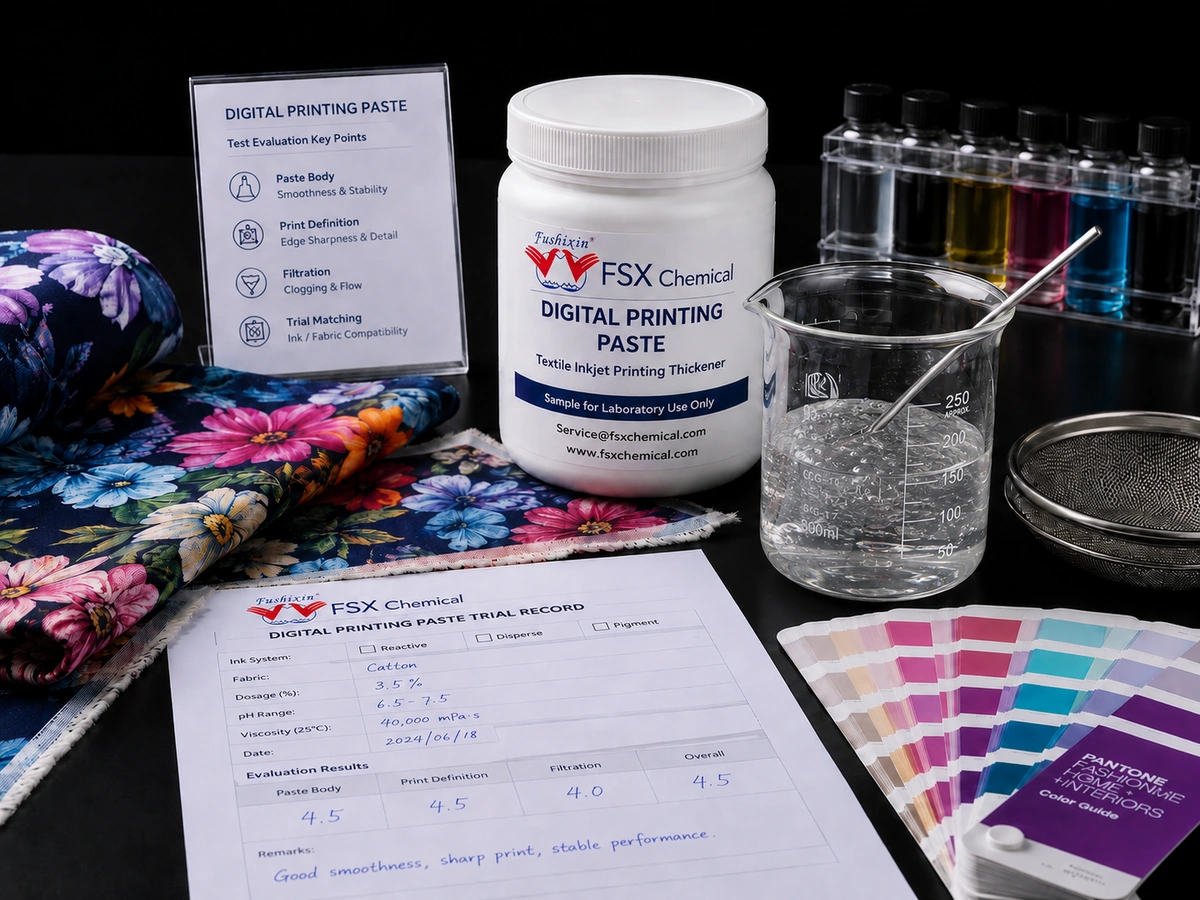
A top-performing digital printing paste is not defined by viscosity alone. Reactive, disperse and pigment textile inks require different pretreatment chemistry, rheology and post-treatment conditions. This guide explains how to select digital printing pastes by ink system, fabric, print definition, color performance, fixation and total production performance.
پروڈکٹ کا نام، استعمال، مقدار، منزل اور کوئی بھی TDS، نمونہ کی تصویر یا دستاویز جو آپ کے پاس موجود ہو، فراہم کریں۔ FSX کیمیکل اس معلومات کا جائزہ لے گا اور کوٹیشن، نمونہ کی مطابقت یا پروڈکٹ کے انتخاب کے لیے اگلا قدم تجویز کرے گا۔.
مصنوعات کی معلوماتمصنوعہ کا نام، گریڈ، ماڈل، لیبل کی تصویر یا سپلائر کا حوالہ.
دستیاب دستاویزاتٹی ڈی ایس، ایس ڈی ایس، سی او اے، نمونہ کی تصویر، مصنوعات کی فہرست یا ٹیسٹ کے اعداد و شمار۔.
آرڈر کی تفصیلاتمتوقع مقدار، پیکیجنگ، منزل ملک، بندرگاہ یا تجارتی اصطلاح۔.
درخواست یا مسئلہٹیکسٹائل پرنٹنگ کا عمل، فارمولیشن کی ضرورت، موجودہ مسئلہ یا ہدف کارکردگی۔.