Ready-to-Use vs. Alkali-Activated Acrylic Thickener: Which Route Fits Textile Pigment Printing?
Ready-to-use and alkali-activated acrylic thickeners shift production control to different places. Compare pH control, batching...
Ready-to-use and alkali-activated acrylic thickeners can both work in textile pigment printing, but they shift process control to different places. A ready-to-use grade is designed to simplify addition and viscosity adjustment, while an alkali-activated grade relies more explicitly on neutralization, pH control and mixing to develop its full rheology. The best route is not determined by convenience alone. Mills should compare batching time, pH sensitivity, binder and pigment compatibility, electrolyte tolerance, holding stability, screen rheology, fabric hand, incoming QC and Total Cost in Use. “Ready-to-use” is also a handling description rather than one universal chemistry: some products are pre-neutralized, while others can be added directly to an already alkaline formulation and become activated there.
Ready-to-Use vs. Alkali-Activated: Which Route Fits Pigment Printing?
Choose the route that gives the most stable complete pigment paste with the simplest practical production control.
A ready-to-use acrylic thickener is generally attractive when the mill values:
Fast batching
Fewer neutralization steps
Lower operator dependency
Simpler viscosity correction
An alkali-activated acrylic thickener can be attractive when the mill values:
Low-viscosity product handling before activation
More direct control over activation
Ability to tune viscosity through neutralization and dosage
A process already designed around controlled pH adjustment
But neither route should be approved from handling convenience alone.
The final decision should follow:
Handling Route → Activation / pH → Complete-Paste Compatibility → Rheology → Screen Trial → Curing → Finished Fabric → Total Cost in Use
What Does “Ready-to-Use” Actually Mean?
“Ready-to-use” is not one universal polymer category.
In commercial acrylic rheology modifiers, the phrase can describe different supply forms.
Pre-Neutralized Ready-to-Use
The polymer is supplied in a form that can be incorporated without a separate pre-neutralization step.
The mill may still need to control final formulation pH.
Direct-Addition Product
The product can be dosed directly into a formulation that is already alkaline enough to activate or maintain the intended rheology.
The product itself may still be acidic as supplied.
Self-Associative / Pre-Adjusted Commercial System
Some acrylic thickeners are designed for easy post-addition or direct viscosity adjustment with minimal extra preparation.
لہٰذا:
Ready-to-Use ≠ Automatically Fully Neutralized
اور:
Ready-to-Use ≠ pH-Independent.
Always read the grade-specific TDS before deciding how the product should be added.
What Is an Alkali-Activated Acrylic Thickener?
An alkali-activated acrylic thickener is commonly supplied as a relatively low-viscosity acidic emulsion or dispersion.
After a base is added, the polymer develops much more viscosity.
Common neutralizers can include:
امیونیا / امیونیم ہائیڈروکسائیڈ
سوڈیم ہائیڈروکسائیڈ
Selected amines
Supplier-specified alkaline systems
The correct neutralizer depends on the commercial product and formulation.
One product may be designed for strong inorganic alkali; another may perform better with a different neutralization route.
Do not assume every acrylic thickener uses the same neutralizer or target pH.
Many alkali-swellable acrylic thickeners contain carboxylic acid groups.
At relatively low pH, the polymer remains more compact.
When a suitable base raises the pH:
Acid Groups Neutralize → Carboxylate Groups Form → Electrostatic Repulsion Increases → Polymer Swells / Expands → Hydrodynamic Volume Increases → Viscosity Builds
Commercial ASE products can remain easy-to-handle, low-viscosity liquids before activation and then thicken quickly after the formulation moves above the relevant pH threshold.
This mechanism gives useful processing flexibility, but it also makes:
نیوٹرلائزر کی خوراک
پی ایچ
ملاپ
الیکٹرولائٹ بوجھ
critical process variables.
Where Does Process Control Sit in Each Route?
Control Area
Ready-to-Use Route
Alkali-Activated Route
Product addition
Usually simpler
Requires activation planning
Neutralizer control
Reduced or formula-dependent
Critical
حتمی پی ایچ
Still important
Critical for activation
Mixing sensitivity
اکثر کم
Can be higher during neutralization
Viscosity correction
Can be convenient
Must separate pH from dosage effects
Operator dependency
Potentially lower
Potentially higher
The ready-to-use route moves more formulation control into the product design.
The alkali-activated route leaves more activation control at the mill.
Neither is automatically more technically advanced.
Batching Speed and Operator Simplicity
Ready-to-use products can reduce:
Neutralizer preparation
Activation waiting time
pH correction steps
Risk of local over-neutralization
This can be useful in color kitchens where:
Many small batches are prepared
Operators change frequently
Fast shade change is important
Alkali-activated products can still be very fast if the process is well designed.
Some commercial ASE/HASE products thicken rapidly after alkali addition.
The actual batching-time difference should therefore be measured rather than assumed.
pH Control and Neutralizer Accuracy
This is the main control point for alkali-activated thickener.
If the pH is too low:
Viscosity can remain below target.
Dosage may appear inefficient.
Spreading can increase.
If too much alkali is added:
pH can move outside the preferred formulation range.
Ionic load can increase.
Binder / pigment compatibility can change.
The target should be:
Supplier-Validated Activation Window
نہیں:
Maximum Possible pH.
A ready-to-use product can simplify neutralization, but final paste pH should still be checked because pigment, binder and auxiliaries can shift it.
Mixing, Local pH and Homogeneity
Concentrated alkali added too quickly can create a local pH much higher than the average tank pH.
Possible problems include:
مقامی سوجن
Gel-like regions
غیر یکساں چپکاوٹ کی ترقی
خراب بیچ کی تکرار پذیری
For alkali-activated grades, define:
نیوٹرلائزر کی مقدار
Addition rate
ملاپن کی رفتار
ملاپنے کا وقت
توازن کا وقت
A ready-to-use product can reduce this particular risk, although it still needs adequate dispersion through the complete paste.
Viscosity Adjustment During Production
Ready-to-use grades can be attractive for direct viscosity adjustment when the commercial product is designed for post-addition.
But do not assume any acrylic thickener can be poured into a completed pigment paste safely.
چیک کریں:
Supplier addition instructions
Local concentration risk
Mixing capacity
حتمی پی ایچ
For alkali-activated systems, a low viscosity problem should first be separated into:
Under-Activation?
or:
Insufficient Thickener Dosage?
Adding more product to an under-activated system can increase cost without fixing the root cause.
بائنڈر مطابقت
Both routes must be tested with the production binder.
بائنڈر تبدیل ہو سکتا ہے:
پی ایچ
الیکٹرولائٹ بوجھ
سرفیکٹنٹ کا توازن
سَانچَر
لچک
A ready-to-use grade is not automatically binder-compatible just because it requires fewer activation steps.
An alkali-activated grade can also remain stable if its pH and electrolyte window match the binder system.
Use a water-dilution control to separate simple dilution from binder chemistry.
رنگدانے کی منتشر مطابقت
Pigment dispersions can introduce:
پانی
پھیلانے والے مادے
سطح فعال مادّے
الیکٹرولائٹس
pH-adjusting chemicals
Therefore, the route should be checked at:
Light pigment loading
Normal production loading
High / dark-shade loading
A ready-to-use paste can still lose viscosity after high pigment loading.
An alkali-activated system can also shift because pigment changes the pH and ionic environment.
Electrolyte Tolerance
Many acrylic/polyacrylate thickeners are polyelectrolytes.
Electrolytes can reduce polymer expansion by screening charged groups.
This can lower viscosity even after correct activation.
جائزہ لیں:
Viscosity Retention (%) = Viscosity After Formula Challenge ÷ Reference Viscosity × 100
for:
Pigment addition
Binder addition
Fixer addition
Representative salt / hard-water conditions
Ready-to-use and alkali-activated grades can both be electrolyte-sensitive.
The label alone does not predict salt tolerance.
Process Water and Hardness
Use the real production water when qualifying either route.
Calcium and magnesium can influence:
فعال کاری
Viscosity retention
Binder / pigment stability
If water hardness varies significantly between factories or seasons, include representative high-hardness conditions.
A ready-to-use grade can simplify neutralization but cannot eliminate poor water compatibility.
Rheology: Same Viscosity, Different Flow
Do not compare the two routes from one Brookfield number.
A ready-to-use product is not automatically lower-solids.
An alkali-activated grade is not automatically higher-solids.
موازنہ کریں:
مصنوعات کے ٹھوس مادے
Working dosage
Active polymer introduced
بائنڈر ٹھوس مادّے
Cured fabric hand
The fair comparison is the polymer load required to reach the same useful printing window.
Color Yield, Rubbing Fastness and Curing
Thickener controls rheology, but binder and curing create the main pigment-fixation film.
After printing, compare:
K/S / color yield
تعریف پرنٹ کریں
دراندازی
خشک رگڑ
گیلی رگڑ
کپڑے کا ہاتھ
Keep curing constant during the comparison.
If rubbing differs, investigate:
بائنڈر کی تقسیم
پیسٹ کا جمع
پختہ کرنا
before concluding that one activation route is inherently better.
فلیٹ اسکرین بمقابلہ روٹری اسکرین
فلیٹ اسکرین
چیک کریں:
کم کٹاؤ برقرار رکھنا
Squeegee stroke
وقف / دوبارہ شروع
بحالی
روٹری اسکرین
چیک کریں:
پمپ ایبلٹی
مسلسل کٹاؤ
درمیانی روانائی
اینڈ رن وسکوسیٹی
جھاگ
A simple ready-to-use addition route can be valuable in fast color kitchens, but the production rheology still must survive the intended machine shear.
How to Compare the Two Routes in the Laboratory
Step 1: Define the Current Reference
Record the current formula, viscosity method and finished-print standard.
Step 2: Prepare Each Candidate by Its Correct Route
Do not force a ready-to-use grade into an unnecessary activation procedure, and do not test an alkali-activated grade without proper neutralization.
Step 3: Build a Dosage Curve
Find the useful viscosity/rheology range for each grade.
Step 4: Add Pigment and Binder
Record pH and viscosity after critical additions.
Step 5: Hold
Check stability over the production time.
Step 6: Print and Cure
Use the same fabric, screen, binder and curing conditions.
Step 7: Compare Finished Fabric and Cost
Evaluate color, rubbing, hand and Total Cost in Use.
This prevents a technically promising grade from being rejected too early while also preventing endless adjustments to a fundamentally poor fit.
Practical Route-Selection Matrix
انتخابی علاقہ
Ready-to-Use Route
Alkali-Activated Route
Preparation simplicity
Usually higher
More activation control required
Neutralizer handling
Reduced or formulation-dependent
Usually required
pH sensitivity
Still relevant
Critical
Operator dependency
Potentially lower
Potentially higher
Batching speed
Potentially faster
Can be fast with good SOP
Viscosity tunability
درجے پر منحصر
Often strong via pH + dosage
الیکٹرولائٹ برداشت
درجے پر منحصر
درجے پر منحصر
بائنڈر مطابقت
تصدیق کرنا ضروری ہے
تصدیق کرنا ضروری ہے
Best decision basis
Complete-paste trial
Complete-paste trial
This matrix describes operating tendencies, not universal product specifications.
When Does Ready-to-Use Usually Make More Sense?
Ready-to-use is often attractive when:
Fast color-kitchen batching is important.
Operator skill levels vary.
Reducing manual pH correction is a priority.
Many small production batches are prepared.
The approved formulation is relatively stable and standardized.
It can also be useful when post-addition viscosity adjustment is required and the commercial grade is explicitly designed for that use.
When Does Alkali-Activated Usually Make More Sense?
Alkali-activated can be attractive when:
The mill already has strong pH-control procedures.
Neutralizer addition is automated.
The operator wants direct control over activation.
Low-viscosity product handling before activation is useful.
The formula is already alkaline.
It can also provide a clear technical window for troubleshooting because pH and dosage can be studied separately.
But this only works if measurement and mixing are controlled.
How to Convert from One Route to the Other
Do not make a universal 1:1 replacement.
Use this sequence:
Document current thickener, dosage, solids and pH.
Document current viscosity method.
Define current print standard.
Prepare the new grade by its own recommended method.
Build a dosage curve.
Test pigment and binder compatibility.
Compare rheology and holding stability.
Run screen trial and curing.
Compare finished fabric and cost.
The new route may require changes to:
Water balance
Neutralizer
اضافی حکم
ملاپنے کا وقت
That is normal formulation optimization, not evidence that the new route is unsuitable.
پیداواری آزمائش کی منظوری
Run the best laboratory condition on the real machine.
ریکارڈ:
Grade / batch
مقدار
Neutralizer if used
حتمی پی ایچ
مکمل فارمولا
ابتدائی / درمیانی / اختتامی دوڑ کی چپچپا پن
مشین کی رفتار
اسکرین / سکویجی کی ترتیبات
تعریف پرنٹ کریں
Color consistency
پختہ کرنا
خشک/گیلی رگڑ
کپڑے کا ہاتھ
Approve the route only when both process stability and finished fabric pass.
Incoming QC After Approval
For either route, incoming QC can include:
Grade identity
ظاہری شکل
پی ایچ
Solids
جہاں معنی خیز ہو، فراہم کردہ چپچپا پن
Standardized activation / application check
Batch / COA traceability
For alkali-activated products, a standardized activation test can be especially useful.
For ready-to-use products, direct-addition viscosity response can be included in periodic application verification.
Common Selection Mistakes
1. Assuming Ready-to-Use Means Fully Pre-Neutralized
Some direct-addition products are still acidic as supplied.
2. Assuming Ready-to-Use Means pH Does Not Matter
The complete formula pH can still affect viscosity and compatibility.
3. Assuming Alkali-Activated Is Always More Efficient
Efficiency is grade- and formula-specific.
4. Comparing Equal Dosage Only
Solids and polymer architecture can differ.
5. Correcting Low Viscosity with More Thickener Before Checking pH
The real problem may be under-activation.
6. Approving on Water Viscosity
Pigment and binder can shift viscosity significantly.
7. Choosing Only by Batching Convenience
Finished-fabric performance and cost remain essential.
حل مسائل کی جدول
مشاہدہ شدہ مسئلہ
چیک کرنے کے لیے اولین متغیرات
فرض نہ کریں
Alkali-activated grade stays thin
pH, neutralizer, mixing, dosage
The product is weak
Ready-to-use grade changes after binder
Binder dilution, pH, electrolytes
Ready-to-use means fully compatible
Viscosity rises too fast during neutralization
مقامی پی ایچ، نیوٹرلائزر کی مقدار، ملاوٹ
زیادہ چپچپا پن بہتر ہے
Same pH gives different batch viscosity
Solids, temperature, neutralizer addition
pH is the only variable
Ready-to-use route gives lower viscosity in dark shades
Pigment load, dilution, electrolytes
Dosage should stay fixed
Alkali route is stable in lab but drifts in rotary run
Holding, continuous shear, temperature
Fresh viscosity proves production stability
Ready-to-use route costs more per kilogram
Working dosage, labor, batching time
Higher price/kg means higher production cost
Alkali route uses less product but hand is harder
Active solids, binder, paste deposit
Lower dosage always gives softer hand
استعمال میں کل لاگت
موازنہ کریں:
Total Cost in Use = Thickener + Neutralizer + Preparation Labor + Mixing Time + QC + Machine Efficiency + Rework + Quality Loss
Ready-to-Use Cost Drivers
Product price
Working dosage
Reduced preparation steps
Potentially lower operator / pH-adjustment time
Alkali-Activated Cost Drivers
Product price
Working dosage
Neutralizer
pH control
Mixing / equilibration
Operator variation risk
A ready-to-use product can justify a higher purchase price if it reduces batching time and correction losses.
An alkali-activated product can be more economical if the factory already controls activation efficiently.
Compare cost per acceptable printed meter, not only price per kilogram.
آپ کو سپلائر کو کون سی معلومات بھیجنی چاہئیں؟
For a useful ready-to-use vs. alkali-activated comparison, provide:
Current thickener / TDS
موجودہ خوراک
Product solids if available
Neutralizer and final pH
سانچاقی اور مکمل آزمائشی طریقہ
رنگدانے کی منتشر
بائنڈر گریڈ اور خوراک
فکسر / معاون
پانی کی سختی
کپڑا
فلیٹ یا گھومنے والی اسکرین
مشین کی رفتار
وقت پکڑنا
Main objective: faster batching, viscosity stability, hand, cost or process simplification
FSX کیمیکل اس معلومات کو کے ذریعے استعمال کر سکتا ہے۔ نمونے اور ملاپ to compare the current process with a suitable synthetic thickener starting route.
How Should a Mill Choose Between Ready-to-Use and Alkali-Activated Acrylic Thickener?
ایک عملی فیصلہ سازی کا سلسلہ ہے:
Define Current Process → Identify Supply Form → Confirm Activation Requirement → Build Dosage Curve → Add Pigment / Binder → Check Electrolytes → Hold → Screen Print → Cure → Compare Cost and Operator Simplicity
اہم اصول یہ ہیں:
Ready-to-use is a handling description, not one universal chemistry.
Some ready-to-use products are pre-neutralized; others are direct-addition products that still depend on the formulation pH.
Alkali-activated grades can offer precise activation control but require disciplined pH and mixing procedures.
Neither route is automatically more electrolyte-tolerant or more binder-compatible.
Same viscosity does not mean the same screen rheology or finished-fabric result.
The best route is the one that meets production, print quality and cost targets with the most reliable operating window.
اکثر پوچھے جانے والے سوالات
1. What is a ready-to-use acrylic thickener?
It is a commercial thickener designed for direct or simplified incorporation without a separate complex pre-activation step. Some grades are pre-neutralized, while others can be added directly into an already alkaline formulation.
2. Does ready-to-use mean the product is fully neutralized?
No. “Ready-to-use” is a handling term. The actual pH and neutralization state depend on the commercial grade.
3. What is an alkali-activated acrylic thickener?
It is usually an acidic ASE/HASE-type polymer dispersion that develops viscosity after neutralization with a suitable base.
4. Which route is easier for a textile color kitchen?
Ready-to-use can reduce preparation steps and operator dependency, but a well-controlled automated alkali-activation system can also be fast and repeatable.
5. Which route gives higher viscosity?
Neither universally. Viscosity depends on grade, solids, dosage, pH, pigment, binder and electrolytes.
6. Is ready-to-use more salt tolerant?
Not automatically. Electrolyte tolerance depends on polymer architecture and the complete formula.
7. Why does an alkali-activated thickener stay thin?
Possible causes include insufficient pH, incorrect neutralizer, poor mixing, low dosage, dilution or electrolyte interference.
8. Can I add ready-to-use thickener directly to a completed pigment paste?
Only if the product is specifically designed for post-addition. Follow the supplier’s addition procedure and check final pH and homogeneity.
9. Which route gives softer fabric hand?
Hand depends on active thickener solids, binder solids, paste deposit and curing. Compare the dosage required for the same useful rheology.
10. Can the same binder be used with both routes?
Possibly, but compatibility should be tested. Binder pH, electrolytes and surfactants can change each thickener’s response.
11. Can I replace an alkali-activated product 1:1 with a ready-to-use product?
No universal 1:1 replacement should be assumed. Build a new dosage/rheology curve and compare the complete printing result.
12. What should I send FSX Chemical for route matching?
Send the current thickener/TDS, dosage, pH/neutralizer, viscosity method, pigment, binder, water hardness, fabric, machine route, holding time and main process target.
Choose the Acrylic Thickener Route That Fits Your Color Kitchen
If your pigment-printing process spends too much time on pH adjustment, suffers from batch-to-batch viscosity variation, or needs a simpler liquid-thickener route, FSX Chemical can help compare your current process with a matched synthetic thickener grade.
مفید تکنیکی جائزے کے لیے بھیجیں:
آپ کے موجودہ گاڑھا کرنے والے نمونے کا TDS یا COA
Current dosage and product solids
Neutralizer and final pH
سانچاقی اور مکمل آزمائشی طریقہ
رنگدانے کی منتشر
بائنڈر/فکسر سسٹم
پانی کی سختی
Fabric and machine route
وقت پکڑنا
Main target: faster batching, easier viscosity adjustment, improved stability, softer hand or lower cost
کے ساتھ شروع کریں نمونے اور ملاپ for a controlled current-vs-candidate comparison.
The better route is not the one with the shorter product description. It is the route that gives the mill the most repeatable viscosity, cleanest screen performance, acceptable finished-fabric hand and lowest practical Total Cost in Use with the level of pH and operator control the factory can actually maintain.
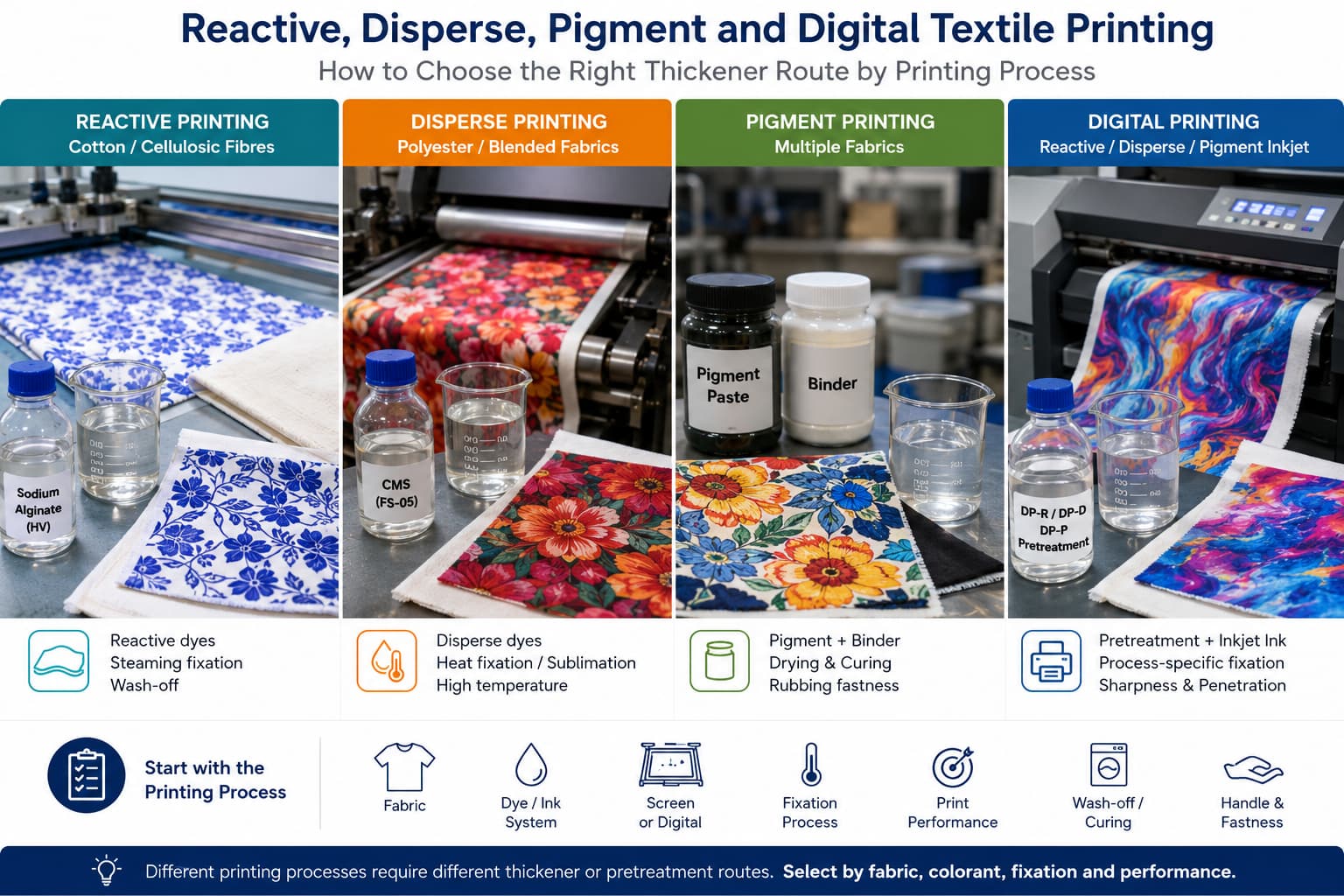
سیکھیں کہ ردعمل کرنے والی، منتشر، رنگین اور ڈیجیٹل ٹیکسٹائل پرنٹنگ کے لیے کپڑے، رنگ یا سیاہی کی بنیاد پر گاڑھا کرنے والا مادہ اور پری ٹریٹمنٹ کے راستے کیسے منتخب کیے جائیں، تاکہ فکسیشن، دھونے کے قابل ہٹانے اور پرنٹ کے معیار کی ضروریات پوری ہوں۔.
CMC پر مبنی پرنٹنگ پیسٹ کو رنگدار، ردعمل پذیر اور ڈیجیٹل ٹیکسٹائل پرنٹنگ میں استعمال کیا جاتا ہے۔ یہ رہنما بتاتا ہے کہ کون سے پیرامیٹرز اہم ہیں، سپلائرز کا موازنہ کیسے کریں اور بڑے آرڈر دینے سے پہلے کیا درخواست کریں۔.
سوڈیم الگینٹ اور سی ایم سی دونوں ٹیکسٹائل پرنٹنگ میں گاڑھا کرنے کے لیے استعمال ہوتے ہیں، لیکن یہ مختلف رنگ ساز نظاموں اور عمل کے حالات کے لیے موزوں ہیں۔ یہ رہنما اہم فرق اور ہر ایک کے استعمال کے اوقات کی وضاحت کرتی ہے۔.
صحیح ٹیکسٹائل پرنٹنگ تھکنر کا تعین صرف کپڑے کی قسم سے نہیں ہوتا۔ خریداروں کو چاہیے کہ وہ تھکنر کو رنگ یا پگمنٹ کے نظام، پرنٹنگ کے طریقہ کار، مطلوبہ ریولوجی، دھونے کی ضروریات اور حقیقی فیکٹری ٹرائل کے حالات کے مطابق منتخب کریں۔.
ٹیکسٹائل پرنٹنگ کی کارکردگی ایک مربوط کیمیائی نظام پر منحصر ہوتی ہے، نہ کہ کسی ایک یونیورسل اضافی مادّے۔ یہ رہنما دس اہم کیمیائی گروپوں، ان کے افعال، ان کی جگہ اور وہ چیزیں جن کی خریداروں کو پیداواری تجربات سے پہلے تصدیق کرنی چاہیے، بیان کرتی ہے۔.
ٹیکسٹائل پرنٹنگ کے گاڑھا کرنے والے مادے کیمسٹری، ریولوجی، رنگ کے مطابقت اور دھونے پر اثر پذیری کے لحاظ سے مختلف ہوتے ہیں۔ یہ رہنما اہم گاڑھا کرنے والے خاندانوں، ان کے عام استعمال کے طریقہ کار اور ان پیرامیٹرز کا موازنہ پیش کرتا ہے جن کی خریداروں کو پیداواری تجربات سے قبل تصدیق کرنی چاہیے۔.
ڈیجیٹل پرنٹنگ کے پیسٹ کا انتخاب سیاہی کی کیمسٹری، کپڑے، اطلاق کے طریقہ کار اور بعد از علاج کی بنیاد پر کیا جانا چاہیے۔ یہ رہنما ٹیکسٹائل انک جیٹ پرنٹنگ کے لیے سوڈیم الگنیٹ، سی ایم سی، سی ایم ایس، مصنوعی پولیمر اور مرکب پری ٹریٹمنٹ کے راستوں کا موازنہ پیش کرتا ہے۔.
FSX کیمیکل ردعمل پذیر، منتشر اور رنگدانہ نظاموں کے لیے الگ الگ ڈیجیٹل پرنٹنگ پیسٹ کے راستے پیش کرتا ہے، جنہیں درخواست کے جائزے، نمونہ ملاپ اور تکنیکی دستاویزات کی حمایت حاصل ہے۔ یہ رہنما بتاتا ہے کہ خریدار بڑے پیمانے پر خریداری سے پہلے مناسب راستہ کیسے منتخب کر سکتے ہیں۔.
مستحکم ڈیجیٹل پرنٹنگ پیسٹ کے لیے مطلوبہ چپچپا پن سے زیادہ درکار ہوتا ہے۔ یہ رہنما بتاتا ہے کہ مصنوعات کے انتخاب، پانی کے معیار، اضافے کے تسلسل، مکسنگ، پی ایچ، درجہ حرارت، فلٹریشن، حفظانِ صحت، ذخیرہ اور معیار کے ریکارڈز پری ٹریٹمنٹ اور پیداوار کی یکسانیت کو کیسے متاثر کرتے ہیں۔.
یہ پروڈکٹ جائزہ FSX ڈیجیٹل پرنٹنگ پیسٹ کو ٹیکسٹائل انک جیٹ پری ٹریٹمنٹ اور گاڑھا کرنے کے ایک طریقہ کار کے طور پر جانچتا ہے، جس میں سیاہی کے نظام کی مطابقت، ریولوجی، فلٹریشن، پرنٹ کی وضاحت، استحکام اور حقیقی پیداواری جانچ پر توجہ مرکوز کی گئی ہے۔.
ڈیجیٹل ٹیکسٹائل پرنٹنگ کے لیے صرف جدید سیاہی اور پرنٹ ہیڈز کافی نہیں ہیں۔ ردعمل، منتشر اور رنگدانہ انک جیٹ پرنٹنگ کے لیے عمل مخصوص کیمیائی حل دریافت کریں، پری ٹریٹمنٹ اور ریولوجی سے لے کر فلٹریشن، فکسیشن اور پیداوار کی توثیق تک۔.
Textile printing chemistry is evolving beyond simple viscosity and price comparisons. Explore five innovation directions shaping 2026, including safer chemical inputs, hybrid biopolymer thickeners, advanced pigment binders, shorter digital processes and multifunctional formulations.
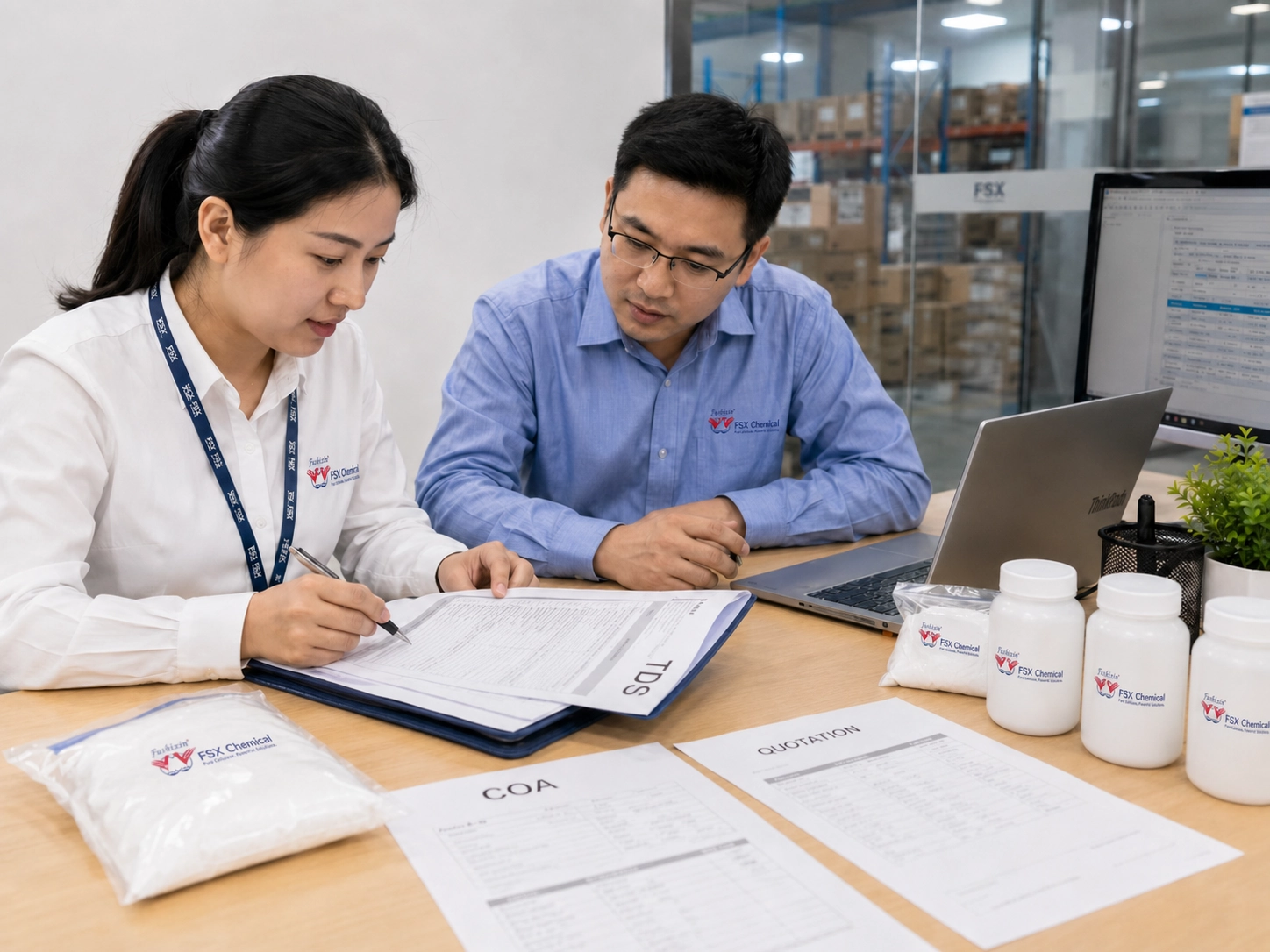
پروڈکٹ کا نام، استعمال، مقدار، منزل اور کوئی بھی TDS، نمونہ کی تصویر یا دستاویز جو آپ کے پاس موجود ہو، فراہم کریں۔ FSX کیمیکل اس معلومات کا جائزہ لے گا اور کوٹیشن، نمونہ کی مطابقت یا پروڈکٹ کے انتخاب کے لیے اگلا قدم تجویز کرے گا۔.
مصنوعات کی معلوماتمصنوعہ کا نام، گریڈ، ماڈل، لیبل کی تصویر یا سپلائر کا حوالہ.
دستیاب دستاویزاتٹی ڈی ایس، ایس ڈی ایس، سی او اے، نمونہ کی تصویر، مصنوعات کی فہرست یا ٹیسٹ کے اعداد و شمار۔.
آرڈر کی تفصیلاتمتوقع مقدار، پیکیجنگ، منزل ملک، بندرگاہ یا تجارتی اصطلاح۔.
درخواست یا مسئلہٹیکسٹائل پرنٹنگ کا عمل، فارمولیشن کی ضرورت، موجودہ مسئلہ یا ہدف کارکردگی۔.