Synthetic Thickener vs. Traditional Emulsion Thickener for Pigment Printing: Rheology, VOC, Safety and Cost
Synthetic acrylic and traditional emulsion thickeners build pigment-printing viscosity through different mechanisms. A useful comparison...
Synthetic acrylic thickener and traditional emulsion thickener can both produce usable pigment-printing pastes, but they build viscosity in fundamentally different ways. Traditional emulsion systems historically rely on finely dispersed hydrocarbon droplets—often kerosene or mineral-turpentine type solvents—to create body with very low nonvolatile thickener solids. Synthetic acrylic thickeners use polymer swelling, chain interaction and controlled rheology instead. The practical choice should therefore compare not only print definition and fabric hand, but also hydrocarbon emissions, ventilation and fire-safety controls, binder compatibility, electrolyte tolerance, working dosage, curing behavior and Total Cost in Use. A lower purchase price does not automatically mean a lower production cost.
Synthetic Thickener vs. Emulsion Thickener: What Is the Main Difference?
The main difference is how viscosity is created.
A traditional pigment-printing emulsion thickener commonly uses an oil-in-water structure in which a hydrocarbon phase is dispersed through water with an emulsifier. The emulsion itself gives the printing paste body while keeping nonvolatile thickener solids very low.
A synthetic acrylic thickener uses a water-based polymer system. Depending on the grade, viscosity develops through alkali swelling, polyacrylate chain expansion, polymer entanglement or associative interactions.
The practical comparison is:
Emulsion Structure vs. Polymer Rheology
followed by:
Print Quality + Fabric Hand + Hydrocarbon Emissions + Safety Controls + Formula Stability + Cost in Use
Neither system should be judged from one viscosity value alone.
What Is a Traditional Emulsion Thickener?
Traditional pigment-printing emulsion thickeners are historically based on two immiscible liquid phases, typically water and a hydrocarbon solvent, stabilized by an emulsifying system.
Common historical hydrocarbon phases include:
Kerosene-type fractions
Mineral turpentine / mineral-spirit type solvents
Other process-specific hydrocarbon mixtures
Not every commercial emulsion system uses the same solvent or the same concentration.
The attraction of traditional emulsion thickening has included:
Very low nonvolatile thickener residue
Good screen transfer
Good apparent color yield
Clear print definition
Potentially soft fabric hand
However, much of the hydrocarbon phase is intended to leave the printed material during drying and curing, so the system also creates air-emission and fire-safety considerations.
What Is a Synthetic Acrylic Thickener?
Synthetic pigment-printing thickeners are commonly based on acrylic or polyacrylate polymers designed to control water-based paste rheology.
Commercial grades can include:
Alkali-swellable acrylic emulsions
Polyacrylate dispersions
Hydrophobically modified associative acrylic systems
Reduced dependence on hydrocarbon thickening medium
Important checks include pH / neutralization, binder compatibility, electrolyte sensitivity, foam, holding stability and finished fabric hand.
FSX Chemical positions its synthetic printing thickener range as anionic acrylate polymer dispersions for pigment, reactive and disperse printing routes. The pigment grade should still be validated in the customer’s complete pigment/binder formulation.
Rheology: How the Two Systems Build and Release Viscosity
Traditional Emulsion Thickener
Viscosity is created largely by the physical emulsion structure. The dispersed phase, emulsifier and water ratio control body, flow, stability and screen transfer. The system can give useful flow with extremely low nonvolatile thickener solids.
Synthetic Acrylic Thickener
Viscosity is created by polymer structure and water interaction.
A useful pigment-printing grade should provide:
Low-Shear Body → Shear Thinning Under Squeegee Force → Controlled Recovery After Transfer
This allows the paste to remain stable before printing, flow through the screen under shear and then rebuild enough structure to limit spreading.
The two routes can therefore reach a similar low-shear viscosity while behaving differently during actual printing.
Screen Transfer and Print Definition
Both routes can produce sharp pigment prints when correctly formulated.
For emulsion systems, evaluate emulsion stability, screen lubrication, transfer uniformity and pattern edge control.
For synthetic acrylic systems, evaluate shear thinning, structural recovery, elasticity / stringiness and binder compatibility.
If a synthetic thickener is too elastic, screen release can become poor. If it recovers too slowly, the printed pattern can spread. If an emulsion is unstable, transfer can also become inconsistent.
The correct comparison is a side-by-side screen test under matched conditions.
Color Yield and Surface Appearance
Traditional emulsion systems have historically been valued for strong apparent color yield and a clear printed surface.
One reason is the low level of nonvolatile thickener solids remaining after the volatile phase leaves during drying and curing.
Synthetic thickener can also produce strong color and sharp definition, but the result depends on working dosage, paste deposit, penetration, binder distribution and recovery after screen transfer.
A low-dose synthetic grade can minimize added polymer solids, but a poorly matched or overdosed grade may increase surface polymer load.
Color yield should therefore be measured after curing—not inferred from wet-paste appearance.
Fabric Hand and Nonvolatile Solids
Fabric hand is one of the most important differences to monitor during conversion.
Traditional Emulsion Route
Because much of the thickening medium is volatile, the nonvolatile thickener residue can be very low. Historically this has helped traditional emulsion systems achieve a soft printed hand when binder level and curing are also optimized.
Synthetic Acrylic Route
The synthetic polymer remains as part of the nonvolatile formula. However, high thickening efficiency may allow relatively low dosage.
The complete formula may still contain binder coalescents, fixers, defoamers or other volatile auxiliaries.
VOC evaluation must therefore be made on the full recipe and applicable local definition.
Fire, Ventilation and Worker-Handling Considerations
Hydrocarbon-containing emulsion systems require appropriate fire and ventilation controls.
During drying and curing, solvent vapor concentration must remain within the safe operating limits defined for the specific solvent and equipment.
Key controls can include:
Current SDS review
Flash-point awareness
Approved chemical storage
Ventilation
Oven exhaust
Ignition-source control
Emergency procedures
Historical textile literature documents the importance of preventing flammable hydrocarbon vapor accumulation in curing ovens.
Water-based synthetic thickener reduces this specific hydrocarbon-thickener hazard, but it still requires normal chemical handling controls based on its SDS.
Do not market synthetic thickener as “non-hazardous” without reviewing the exact product SDS.
Local EHS and Customer Requirements
The acceptable route depends on location and customer requirements.
Review local air-emission rules, factory fire code, VOC definitions, worker exposure requirements, customer RSL / MRSL programs and sustainability targets.
One hydrocarbon emulsion can have a different solvent profile from another.
Do not use a generic “emulsion thickener = prohibited” claim.
The correct question is:
Does this specific formula meet the factory’s EHS, customer and regulatory requirements?
Binder Compatibility
Traditional emulsion and synthetic thickener routes can require different binder optimization.
When moving to an acrylic synthetic thickener, binder can change viscosity, electrolyte load, surfactant balance, paste recovery and fabric hand.
The thickener and binder perform different functions:
Thickener: controls flow and deposit.
Binder: fixes pigment to the fabric after curing.
Do not reduce or increase binder only to match the old emulsion viscosity.
First establish a stable synthetic-thickener rheology window, then optimize the binder only if finished fastness or hand requires it.
Electrolyte and pH Sensitivity
Many synthetic polyacrylate thickeners are more sensitive to ionic load than a hydrocarbon emulsion structure.
Electrolytes can enter from pigment dispersion, binder, fixer, process water and other auxiliaries.
A candidate synthetic thickener should therefore be tested for activation pH, viscosity after pigment, viscosity after binder and holding-time viscosity.
Hydrophobically modified acrylic grades can show different electrolyte tolerance, so do not generalize one polyacrylate result to every synthetic product.
Drying and Curing Differences
Both routes require curing because the pigment binder must form a durable film.
The difference is that a traditional hydrocarbon emulsion also loses a volatile thickening phase during drying / curing.
This can affect oven exhaust demand, drying profile, odor and surface film development.
A synthetic water-based thickener removes this large hydrocarbon-evaporation step from the thickener itself, but the formula still needs controlled drying and binder curing.
When converting:
Do Not Assume the Old Dryer / Curing Settings Are Automatically Optimal.
Keep curing controlled during the first comparison so print-quality differences can be attributed correctly.
Odor and Production Environment
Hydrocarbon-containing emulsion systems can create noticeable solvent odor during mixing, printing, drying or curing.
A synthetic water-based route can reduce this particular odor source.
However, other auxiliaries may still contribute odor.
Evaluate the complete process, including color kitchen, printing machine, dryer / curing oven and finished fabric.
Do not use “odor-free” as an absolute claim unless the full commercial formulation has been verified.
Cleaning, Wastewater and Housekeeping
Cleaning requirements can also change between the two routes.
Traditional emulsion systems can introduce hydrocarbon-containing residues into screen cleaning, machine cleaning, floor / spill management and waste streams.
Synthetic water-based systems can simplify some housekeeping operations, but polymer residues can still affect wastewater viscosity, foam and sludge handling.
Wastewater performance depends on the complete recipe and local treatment system.
Do not claim a synthetic route automatically reduces every wastewater parameter without plant data.
Dosage and Formula Design
A major difference is the dosage basis.
Traditional emulsion formulas can contain a large hydrocarbon phase because the emulsion itself creates viscosity.
High-efficiency synthetic acrylic thickeners can work at much lower product dosage.
But the comparison should include product solids, neutralizer, binder level, pigment loading and target viscosity.
Do not replace:
100 Parts Emulsion System
with:
100 Parts Synthetic Thickener
or try to use a simple one-to-one weight conversion.
The whole pigment paste must be reformulated.
Purchase Price vs. Total Cost in Use
Price per kilogram is a poor comparison because the two systems can have completely different working dosages and operating costs.
Compare:
Total Cost in Use = Thickener System + Emulsifier / Neutralizer + Binder Adjustment + Ventilation / Energy + Cleaning + Waste Handling + Machine Efficiency + Rework + Quality Loss
Traditional Emulsion Cost Factors
Hydrocarbon solvent
Emulsifier
Mixing / emulsion preparation
Ventilation / exhaust
Fire-safety management
Hydrocarbon-related waste handling
Synthetic Thickener Cost Factors
Synthetic thickener price
Working dosage
Neutralizer if required
Electrolyte sensitivity
Binder compatibility
Polymer solids / hand
The lowest-cost route is the route that produces an acceptable printed meter with stable production—not the route with the lowest raw-material price.
How to Convert from Emulsion Thickener to Synthetic Thickener
Do not change only the thickener. A controlled conversion should review the complete formula.
Step 1: Document the Current Emulsion Formula
Record hydrocarbon type / level, emulsifier, pigment, binder, fixer, water and current viscosity method.
Step 2: Define the Current Print Standard
Keep reference fabric for K/S / shade, definition, penetration, dry / wet rubbing and hand.
Step 3: Build the Synthetic Route Independently
Start from the candidate grade’s technical guidance, not from the old emulsion ratio.
Step 4: Match Useful Rheology, Not Just Viscosity
Compare shear thinning, transfer and recovery.
Step 5: Cure and Evaluate Finished Fabric
Only then calculate cost.
Recommended Laboratory Comparison
Test Area
Traditional Emulsion
Synthetic Acrylic
Low-shear viscosity
Record current reference
Match useful range
High-shear flow
Measure / observe
Measure / observe
Holding stability
Check emulsion stability
Check pH / electrolyte stability
Screen transfer
Reference
Compare
Print definition
Reference
Compare
Color yield
Reference
Compare after curing
Dry / wet rubbing
Reference
Compare after curing
Fabric hand
Reference
Compare at matched fastness
VOC / hydrocarbon
Review SDS / formula
Review complete synthetic formula
Cost
Total system cost
Total system cost
The objective is not to make the synthetic sample look identical in the beaker.
The objective is to reproduce or improve the required production outcome.
Production Trial Approval
After laboratory screening, run a controlled production trial.
Do not approve conversion from a short laboratory print if the mill normally runs long rotary-screen production.
Practical Selection Matrix
Decision Area
Traditional Emulsion Thickener
Synthetic Acrylic Thickener
Viscosity mechanism
Physical emulsion structure
Polymer swelling / interaction
Nonvolatile thickener solids
Very low in classic hydrocarbon systems
Low to moderate, grade/dosage dependent
Screen rheology
Can be very good
Highly tunable
Color yield
Historically strong
Can be strong when matched
Fabric hand
Potentially soft
Depends on dosage + binder solids
Hydrocarbon emissions
Potentially significant
Greatly reduced from thickener route
Fire / solvent controls
Important where hydrocarbon is used
Lower hydrocarbon-related burden
Electrolyte sensitivity
Emulsion-specific
Can be important
pH activation
Usually not acrylic-type activation
Common in some grades
Formula conversion
Current legacy route
Requires reformulation and trial
Total cost
Depends on solvent + EHS + process
Depends on dosage + compatibility + efficiency
This matrix describes route-level tendencies. Commercial products must be tested individually.
Common Comparison Mistakes
1. Saying Synthetic Thickener Is Always Safer
It reduces the hydrocarbon thickening medium, but the exact SDS and full formula still matter.
2. Calling Every Emulsion Thickener High-VOC
Traditional hydrocarbon systems can generate substantial volatile emissions, but the actual VOC classification depends on solvent composition and local rules.
3. Comparing Equal Product Weight
The thickening mechanisms and dosage basis are different.
4. Ignoring Fabric Hand
A low-solids emulsion reference can be difficult to match if synthetic dosage is too high.
5. Matching Only Brookfield Viscosity
Screen flow and recovery can still differ.
6. Keeping the Entire Old Formula Unchanged
Binder, water and auxiliary balance may need optimization.
7. Comparing Raw-Material Price Only
EHS, ventilation, cleaning, machine stability and rework affect total cost.
Troubleshooting Table
Observed Problem During Conversion
First Variables to Check
Do Not Assume
Synthetic paste is too thin
Activation pH, dosage, binder/electrolytes
Synthetic thickener is weaker
Synthetic paste gives harsh hand
Dosage, binder solids, paste deposit
All synthetic routes are inherently hard
Color yield drops
Transfer, penetration, binder distribution
More pigment is the first fix
Rubbing fastness drops
Binder, curing, deposit distribution
Thickener alone controls fastness
Screen release becomes poor
Elasticity, shear thinning, recovery
Higher viscosity is needed
Viscosity collapses after binder
Electrolytes, pH, binder compatibility
Old emulsion formula can be copied directly
VOC decreases but odor remains
Binder / auxiliaries / defoamer
All odor came from the old thickener
Synthetic raw material costs more
Working dosage and Total Cost in Use
Higher price/kg means higher print cost
What Information Should You Send to a Supplier?
For a controlled emulsion-to-synthetic conversion, provide:
Current emulsion thickener type / TDS if available
Hydrocarbon / solvent system if known
Current paste viscosity and test method
Pigment type / dosage
Binder grade / dosage
Fixer / auxiliaries
Fabric
Flat or rotary screen
Screen mesh / engraving
Machine speed
Curing conditions
Current dry / wet rubbing
Fabric-hand target
Main goal: VOC, safety, cost, hand or print definition
FSX Chemical can use this information through Samples & Matching to define an initial synthetic-thickener trial route.
How Should a Mill Choose Between Synthetic and Traditional Emulsion Thickener?
A practical decision chain is:
Document Current Emulsion Formula → Define Print Standard → Review Hydrocarbon / EHS Requirements → Select Synthetic Candidate → Build Rheology Window → Print → Cure → Compare Hand / Fastness / Color → Compare Total Cost in Use
The key principles are:
Traditional emulsion and synthetic acrylic thickeners create viscosity through different mechanisms.
Classic hydrocarbon emulsion systems can provide excellent print quality and soft hand, but introduce solvent-emission and fire-safety considerations.
Synthetic acrylic thickeners can reduce dependence on hydrocarbon thickening media, but they must be checked for pH, binder and electrolyte compatibility.
Synthetic does not automatically mean zero VOC, zero odor or zero hazard.
The correct route is the one that meets print quality, hand, EHS and Total Cost in Use requirements together.
Frequently Asked Questions
1. What is a traditional emulsion thickener in pigment printing?
It is typically an oil-in-water or related emulsion system that uses a dispersed hydrocarbon phase and emulsifier to build printing-paste viscosity.
2. Why was kerosene historically used in pigment printing?
Kerosene-type hydrocarbon emulsions can create useful rheology with very low nonvolatile thickener solids, supporting good print definition and soft hand.
3. Why replace emulsion thickener with synthetic thickener?
Common reasons include reducing hydrocarbon use, air emissions, solvent odor, ventilation burden and fire-safety concerns while simplifying water-based formulation.
4. Does synthetic thickener mean zero VOC?
No. The thickener route may remove or greatly reduce hydrocarbon solvent, but binders, coalescents, defoamers or other auxiliaries can still contribute VOC depending on the formula and local definition.
5. Is synthetic thickener always safer than an emulsion thickener?
It can reduce hydrocarbon-related fire and exposure hazards, but the exact product SDS and complete formulation still require normal chemical-safety review.
6. Which route gives softer fabric hand?
Traditional emulsion systems can give very soft hand because little nonvolatile thickener remains. A low-dose synthetic system can also give good hand if binder solids and paste deposit are optimized.
7. Which route gives better print definition?
Both can give excellent definition when correctly formulated. Compare shear flow, recovery, screen transfer and penetration on the actual machine.
8. Can I replace emulsion thickener with synthetic thickener at the same dosage?
No. The thickening mechanisms and product solids are different. Build a new synthetic formulation and determine its working dosage experimentally.
9. Why can synthetic paste lose viscosity after binder is added?
Binder can change pH, electrolyte level, surfactant balance and dilution. A binder-compatibility test is required.
10. Will synthetic thickener reduce wastewater load?
It can reduce hydrocarbon-related residues, but overall wastewater performance depends on the complete pigment paste, cleaning practice and treatment system.
11. Which route is cheaper?
Compare Total Cost in Use. Hydrocarbon solvent, emulsifier, ventilation, safety controls, cleaning, synthetic-thickener dosage, neutralizer and machine efficiency can all change the final cost.
12. What should I send FSX Chemical to evaluate a synthetic replacement?
Send the current emulsion formula or TDS if available, viscosity method, pigment, binder, fabric, machine route, curing conditions, hand/fastness target and the main reason for conversion.
Compare a Synthetic Thickener with Your Current Emulsion System
If your mill is evaluating a move away from a traditional hydrocarbon emulsion thickener, FSX Chemical can help structure a controlled current-vs-candidate comparison focused on rheology, fabric hand, curing, EHS requirements and real production cost.
For a useful technical review, send:
Your current emulsion thickener or TDS
Current paste recipe and dosage basis
Viscosity and test method
Pigment and binder system
Fabric and machine type
Screen / squeegee conditions
Curing conditions
Dry / wet rubbing requirements
Fabric-hand target
Main objective: lower VOC, lower solvent use, improved safety, lower cost or better process control
The strongest reason to replace a traditional emulsion thickener is not simply that synthetic technology is newer. The replacement only makes sense when the synthetic route delivers the required print definition, color, rubbing performance and hand while reducing the operational burden of the hydrocarbon-based system at an acceptable Total Cost in Use.
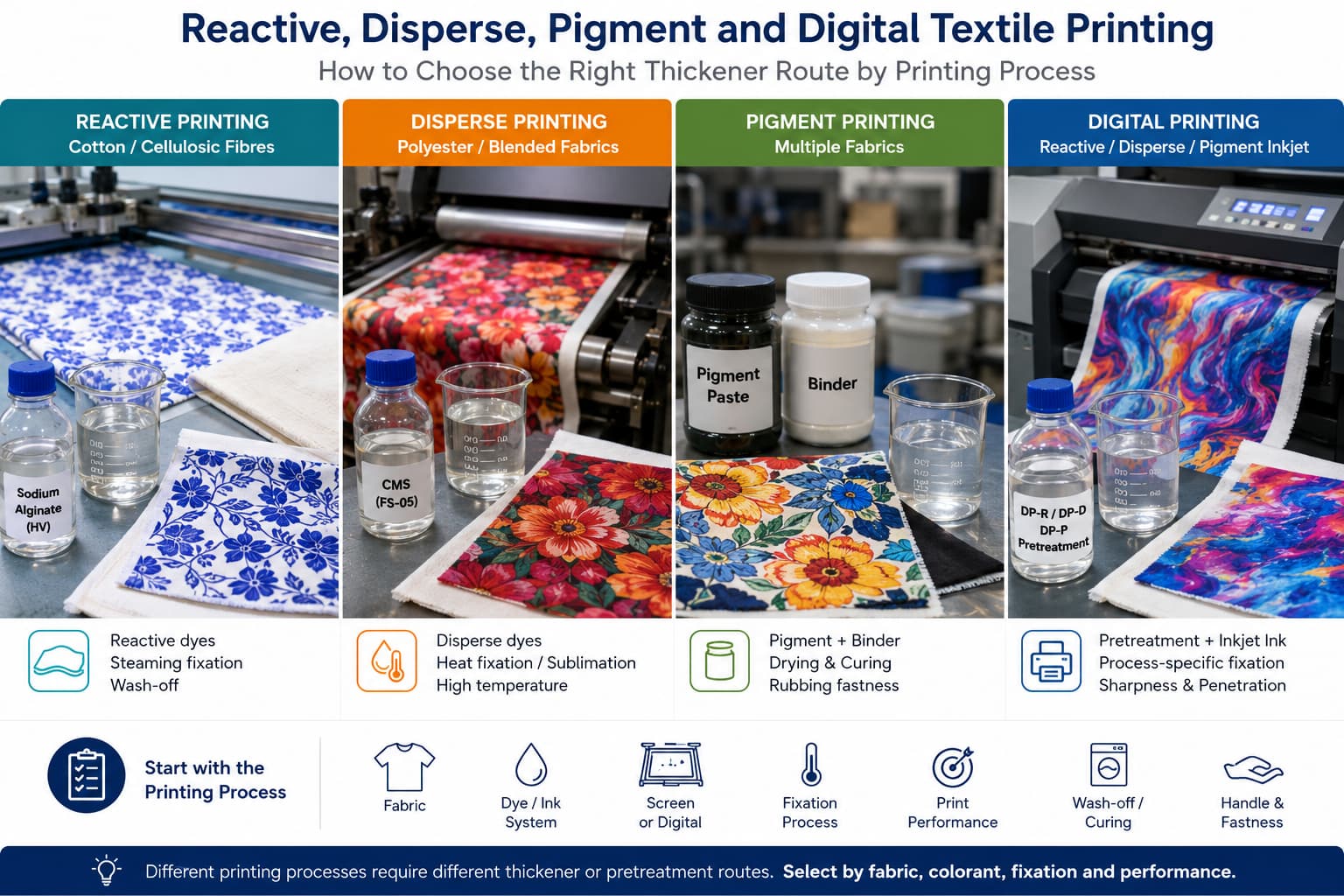
Learn how to choose thickener and pretreatment routes for reactive, disperse, pigment and digital textile printing based on fabric, dye or ink, fixation, wash-off and print-quality requirements.
CMC-based printing paste is used across pigment, reactive, and digital textile printing. This guide explains what parameters matter, how to compare suppliers, and what to request before placing a bulk order.
Both sodium alginate and CMC are used as thickeners in textile printing, but they suit different dye systems and process conditions. This guide explains the key differences and when to use each.
The right textile printing thickener is determined by more than fabric type. Buyers should match the thickener to the dye or pigment system, printing method, target rheology, wash-off requirements and actual factory trial conditions.
Textile printing performance depends on a coordinated chemical system, not one universal additive. This guide explains ten important chemical groups, their functions, where they fit and what buyers should verify before production trials.
Textile printing thickeners differ in chemistry, rheology, dye compatibility and wash-off behavior. This guide compares the main thickener families, their common application directions and the parameters buyers should verify before production trials.
Digital printing pastes should be selected by ink chemistry, fabric, application method and post-treatment. This guide compares sodium alginate, CMC, CMS, synthetic polymer and compound pretreatment routes for textile inkjet printing.
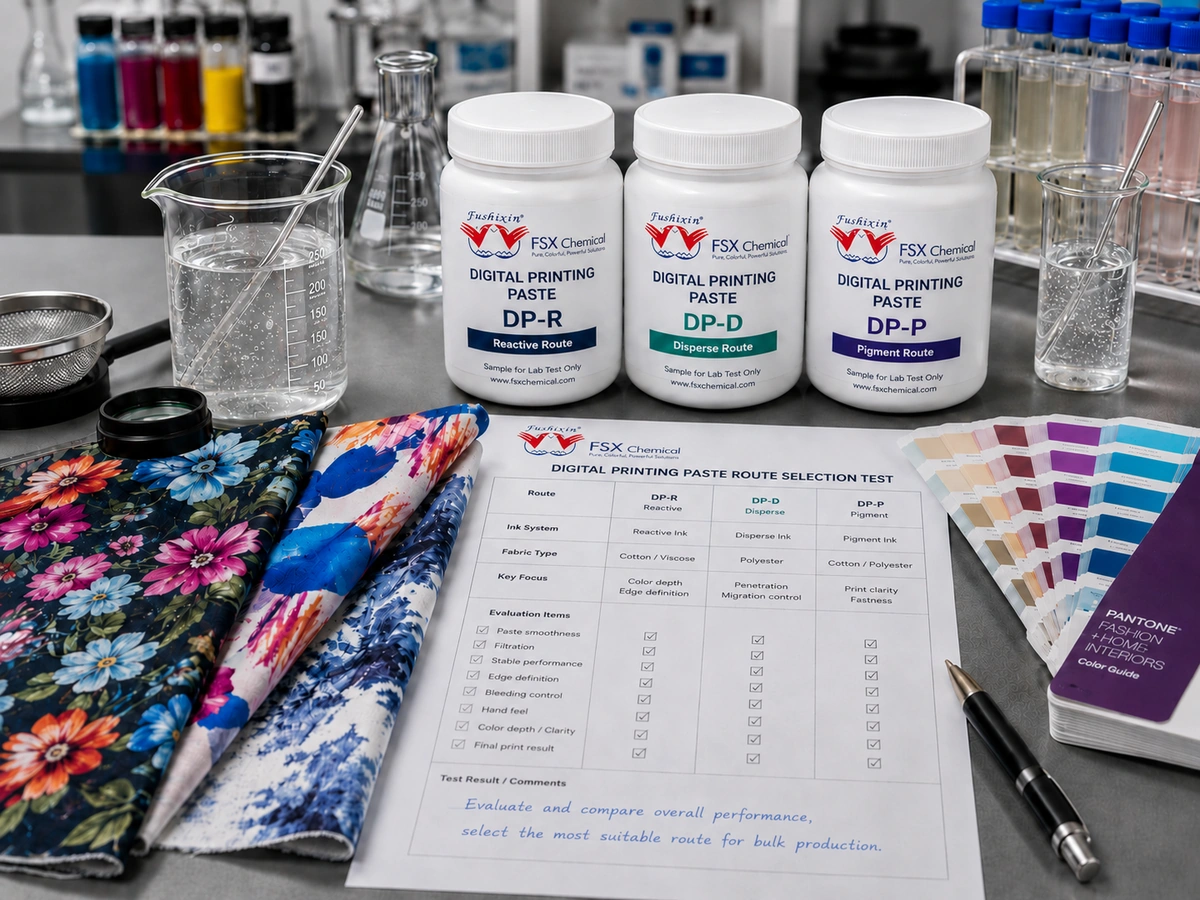
FSX Chemical offers separate digital printing paste routes for reactive, disperse and pigment systems, supported by application review, sample matching and technical documentation. This guide explains how buyers can evaluate the right route before bulk purchasing.
Stable digital printing paste requires more than a target viscosity. This guide explains how product selection, water quality, addition sequence, mixing, pH, temperature, filtration, hygiene, storage and quality records influence pretreatment and production consistency.
This product review examines FSX Digital Printing Paste as a textile inkjet pretreatment and thickening route, focusing on ink-system matching, rheology, filtration, print definition, stability and real production testing.
Digital textile printing requires more than advanced ink and printheads. Explore process-specific chemical solutions for reactive, disperse and pigment inkjet printing, from pretreatment and rheology to filtration, fixation and production validation.
Textile printing chemistry is evolving beyond simple viscosity and price comparisons. Explore five innovation directions shaping 2026, including safer chemical inputs, hybrid biopolymer thickeners, advanced pigment binders, shorter digital processes and multifunctional formulations.
Share the product name, application, quantity, destination and any TDS,
sample photo or document you already have. FSX Chemical will review the
information and recommend the next step for quotation, sample matching
or product selection.
Product InformationProduct name, grade, model, label photo or supplier reference.
Available DocumentsTDS, SDS, COA, sample photo, product list or test data.
Order DetailsEstimated quantity, packaging, destination country, port or trade term.
Application or IssueTextile printing process, formulation need, current issue or target performance.