Synthetic Thickener vs. Traditional Emulsion Thickener for Pigment Printing: Rheology, VOC, Safety and Cost
Synthetic acrylic and traditional emulsion thickeners build pigment-printing viscosity through different mechanisms. A useful comparison...
Synthetic acrylic thickener and traditional emulsion thickener can both produce usable pigment-printing pastes, but they build viscosity in fundamentally different ways. Traditional emulsion systems historically rely on finely dispersed hydrocarbon droplets—often kerosene or mineral-turpentine type solvents—to create body with very low nonvolatile thickener solids. Synthetic acrylic thickeners use polymer swelling, chain interaction and controlled rheology instead. The practical choice should therefore compare not only print definition and fabric hand, but also hydrocarbon emissions, ventilation and fire-safety controls, binder compatibility, electrolyte tolerance, working dosage, curing behavior and Total Cost in Use. A lower purchase price does not automatically mean a lower production cost.
Synthetic Thickener vs. Emulsion Thickener: What Is the Main Difference?
The main difference is how viscosity is created.
A traditional pigment-printing emulsion thickener commonly uses an oil-in-water structure in which a hydrocarbon phase is dispersed through water with an emulsifier. The emulsion itself gives the printing paste body while keeping nonvolatile thickener solids very low.
A synthetic acrylic thickener develops paste body through a polymer mechanism. Depending on the declared grade, this can involve swelling or associative interactions. The words liquid emulsion describe a supply form, not necessarily the traditional hydrocarbon-droplet thickening mechanism. Confirm carrier composition, polymer content and activation instructions for the exact product.
The practical comparison is:
Emulsion Structure vs. Polymer Rheology
followed by:
Print Quality + Fabric Hand + Hydrocarbon Emissions + Safety Controls + Formula Stability + Cost in Use
Neither system should be judged from one viscosity value alone.
What Is a Traditional Emulsion Thickener?
Traditional pigment-printing emulsion thickeners are historically based on two immiscible liquid phases, typically water and a hydrocarbon solvent, stabilized by an emulsifying system.
Common historical hydrocarbon phases include:
Kerosene-type fractions
Mineral turpentine / mineral-spirit type solvents
Other process-specific hydrocarbon mixtures
Not every commercial emulsion system uses the same solvent or the same concentration.
The attraction of traditional emulsion thickening has included:
Very low nonvolatile thickener residue
Good screen transfer
Good apparent color yield
Clear print definition
Potentially soft fabric hand
However, much of the hydrocarbon phase is intended to leave the printed material during drying and curing, so the system also creates air-emission and fire-safety considerations.
What Is a Synthetic Acrylic Thickener?
Synthetic pigment-printing thickeners are commonly based on acrylic or polyacrylate polymers designed to control water-based paste rheology.
Commercial grades can include:
Alkali-swellable acrylic emulsions
Polyacrylate dispersions
Hydrophobically modified associative acrylic systems
Reduced dependence on hydrocarbon thickening medium
Important checks include pH / neutralization, binder compatibility, electrolyte sensitivity, foam, holding stability and finished fabric hand.
The FSX synthetic printing thickener range separates printing routes. Select a pigment-printing candidate from its current grade documents, then verify it in the complete pigment/binder formula. A range-level description does not establish the carrier composition, VOC result or performance of every grade.
Rheology: How the Two Systems Build and Release Viscosity
Traditional Emulsion Thickener
Viscosity is created largely by the physical emulsion structure. The dispersed phase, emulsifier and water ratio control body, flow, stability and screen transfer. The system can give useful flow with extremely low nonvolatile thickener solids.
Synthetic Acrylic Thickener
Viscosity is created by polymer structure and water interaction.
A useful pigment-printing grade should provide:
Low-Shear Body → Shear Thinning Under Squeegee Force → Controlled Recovery After Transfer
This allows the paste to remain stable before printing, flow through the screen under shear and then rebuild enough structure to limit spreading.
The two routes can therefore reach a similar low-shear viscosity while behaving differently during actual printing.
Screen Transfer and Print Definition
Both routes can produce sharp pigment prints when correctly formulated.
For emulsion systems, evaluate emulsion stability, screen lubrication, transfer uniformity and pattern edge control.
For synthetic acrylic systems, evaluate shear thinning, structural recovery, elasticity / stringiness and binder compatibility.
Poor release, trailing or spreading can involve paste flow, recovery, surface wetting, screen geometry and machine settings. A visible filament is a useful screening observation but does not by itself prove polymer elasticity or identify its cause. Compare the actual screen trial and, when needed, use a rheological method appropriate to the proposed mechanism.
The correct comparison is a side-by-side screen test under matched conditions.
Color Yield and Surface Appearance
Traditional emulsion systems have historically been valued for strong apparent color yield and a clear printed surface.
One reason is the low level of nonvolatile thickener solids remaining after the volatile phase leaves during drying and curing.
Synthetic thickener can also produce strong color and sharp definition, but the result depends on working dosage, paste deposit, penetration, binder distribution and recovery after screen transfer.
A low-dose synthetic grade can minimize added polymer solids, but a poorly matched or overdosed grade may increase surface polymer load.
Color yield should therefore be measured after curing—not inferred from wet-paste appearance.
Fabric Hand and Nonvolatile Solids
Fabric hand is one of the most important differences to monitor during conversion.
Traditional Emulsion Route
Because much of the thickening medium is volatile, the nonvolatile thickener residue can be very low. Historically this has helped traditional emulsion systems achieve a soft printed hand when binder level and curing are also optimized.
Synthetic Acrylic Route
The synthetic polymer remains as part of the nonvolatile formula. However, high thickening efficiency may allow relatively low dosage.
Compare hand with the actual fabric, pigment package, binder chemistry, cured deposit and thermal history held in view. The following are contributors to evaluate, not a complete predictive formula:
The comparison must be made at matched color, fastness and print definition.
VOC and Hydrocarbon Emissions
This is one of the strongest reasons mills evaluate synthetic alternatives.
Traditional hydrocarbon emulsion thickening can release volatile hydrocarbon material during drying and curing.
Depending on the solvent composition and local rules, these emissions can create:
VOC / air-emission management requirements
Exhaust and ventilation demand
Запах
Worker-exposure considerations
Customer restricted-substance or sustainability concerns
A candidate route may reduce hydrocarbon input if its declared carrier content and working dose are lower than the reference. Establish that reduction from the complete recipe; the polymer name or an aqueous appearance alone is insufficient.
The complete formula may still contain binder coalescents, fixers, defoamers or other volatile auxiliaries.
VOC evaluation must therefore be made on the full recipe and applicable local definition.
Fire, Ventilation and Worker-Handling Considerations
Hydrocarbon-containing emulsion systems require appropriate fire and ventilation controls.
During drying and curing, solvent vapor concentration must remain within the safe operating limits defined for the specific solvent and equipment.
Key controls can include:
Current SDS review
Flash-point awareness
Approved chemical storage
Ventilation
Oven exhaust
Ignition-source control
Emergency procedures
Review the exact product SDS and the equipment-specific operating assessment before a conversion trial. The OSHA SDS information framework identifies fields such as hazards, composition, handling, exposure controls and physical properties. It is a useful reading framework here, not a statement that US rules govern every customer site.
If the qualified replacement recipe lowers flammable hydrocarbon loading, it can change that specific risk profile. Confirm the new formulation and equipment assessment before changing storage, ventilation or oven controls; an unchanged label such as water-based is not sufficient justification.
Do not market synthetic thickener as “non-hazardous” without reviewing the exact product SDS.
Local EHS and Customer Requirements
The acceptable route depends on location and customer requirements.
Review local air-emission rules, factory fire code, VOC definitions, worker exposure requirements, customer RSL / MRSL programs and sustainability targets.
One hydrocarbon emulsion can have a different solvent profile from another.
Do not use a generic “emulsion thickener = prohibited” claim.
The correct question is:
Does this specific formula meet the factory’s EHS, customer and regulatory requirements?
Совместимость с связующими веществами
Traditional emulsion and synthetic thickener routes can require different binder optimization.
When moving to an acrylic synthetic thickener, binder can change viscosity, electrolyte load, surfactant balance, paste recovery and fabric hand.
The thickener and binder perform different functions:
Thickener: controls flow and deposit.
Binder: fixes pigment to the fabric after curing.
Do not reduce or increase binder only to match the old emulsion viscosity.
First establish a stable synthetic-thickener rheology window, then optimize the binder only if finished fastness or hand requires it.
Electrolyte and pH Sensitivity
Evaluate the response to the actual ionic load in both reference and candidate systems. Polyacrylate swelling and emulsion stability can each depend on formulation conditions; a broad family comparison does not establish which commercial paste will retain useful flow.
Electrolytes can enter from pigment dispersion, binder, fixer, process water and other auxiliaries.
A candidate synthetic thickener should therefore be tested for activation pH, viscosity after pigment, viscosity after binder and holding-time viscosity.
Hydrophobically modified acrylic grades can show different electrolyte tolerance, so do not generalize one polyacrylate result to every synthetic product.
Drying and Curing Differences
Both routes require curing because the pigment binder must form a durable film.
The difference is that a traditional hydrocarbon emulsion also loses a volatile thickening phase during drying / curing.
This can affect oven exhaust demand, drying profile, odor and surface film development.
A lower-hydrocarbon candidate changes the volatile-material balance only to the extent established by the recipe. Water, remaining carrier and other auxiliaries still affect drying and exhaust demand. Compare the drying load and actual binder cure before claiming an energy or emission advantage.
When converting:
Do Not Assume the Old Dryer / Curing Settings Are Automatically Optimal.
Keep curing controlled during the first comparison so print-quality differences can be attributed correctly.
Odor and Production Environment
Hydrocarbon-containing emulsion systems can create noticeable solvent odor during mixing, printing, drying or curing.
A synthetic water-based route can reduce this particular odor source.
However, other auxiliaries may still contribute odor.
Evaluate the complete process, including color kitchen, printing machine, dryer / curing oven and finished fabric.
Do not use “odor-free” as an absolute claim unless the full commercial formulation has been verified.
Cleaning, Wastewater and Housekeeping
Cleaning requirements can also change between the two routes.
Traditional emulsion systems can introduce hydrocarbon-containing residues into screen cleaning, machine cleaning, floor / spill management and waste streams.
Synthetic water-based systems can simplify some housekeeping operations, but polymer residues can still affect wastewater viscosity, foam and sludge handling.
Wastewater performance depends on the complete recipe and local treatment system.
Do not claim a synthetic route automatically reduces every wastewater parameter without plant data.
Dosage and Formula Design
A major difference is the dosage basis.
Traditional emulsion formulas can contain a large hydrocarbon phase because the emulsion itself creates viscosity.
High-efficiency synthetic acrylic thickeners can work at much lower product dosage.
But the comparison should include product solids, neutralizer, binder level, pigment loading and target viscosity.
Do not replace:
100 Parts Emulsion System
с:
100 Parts Synthetic Thickener
or try to use a simple one-to-one weight conversion.
The whole pigment paste must be reformulated.
Purchase Price vs. Total Cost in Use
Price per kilogram is a poor comparison because the two systems can have completely different working dosages and operating costs.
Сравните:
Cost per accepted printed metre = allocated paste ingredients, preparation, processing, cleaning, waste and rework costs ÷ accepted printed length. Use one declared trial or accounting period and the same acceptance specification. Avoid counting waste or rework twice, and report ventilation or energy savings only when measured or transparently estimated.
Traditional Emulsion Cost Factors
Hydrocarbon solvent
Emulsifier
Mixing / emulsion preparation
Ventilation / exhaust
Fire-safety management
Hydrocarbon-related waste handling
Synthetic Thickener Cost Factors
Synthetic thickener price
Working dosage
Neutralizer if required
Electrolyte sensitivity
Совместимость связующих веществ
Polymer solids / hand
The lowest-cost route is the route that produces an acceptable printed meter with stable production—not the route with the lowest raw-material price.
How to Convert from Emulsion Thickener to Synthetic Thickener
Do not change only the thickener. A controlled conversion should review the complete formula.
Step 1: Document the Current Emulsion Formula
Record hydrocarbon type / level, emulsifier, pigment, binder, fixer, water and current viscosity method.
Build a Conversion Passport Before Comparing Pastes
This is a suggested comparison record, not an FSX trial result. Define the actual products and the intended pigment-printing process before adjusting a recipe.
Запись
Reference and candidate checks
Interpretation boundary
Идентификация продукта
Grade, lot, document revision, carrier declaration and activation route
A polymer emulsion and a hydrocarbon-emulsion thickening system are not interchangeable labels.
Material balance
As-supplied dose, declared polymer fraction, hydrocarbon fraction, carrier water and all auxiliary additions
Nonvolatile solids are not automatically active polymer; an SDS may not disclose a complete recipe.
Print outcome
Measured paste deposit, cured colour, detail, rubbing and hand on the same fabric
First compare at controlled deposit, then separately tune each route to the common acceptance target.
Process and EHS
Drying and curing observations, chemical documents and the site’s approved equipment controls
Lower hydrocarbon input is not proof of zero VOC, safe vapor concentration or lower energy demand.
For a material-balance screen, calculate each ingredient’s input as product dose × the supplier-declared constituent mass fraction, then sum the relevant constituents across the full recipe. Record an unknown fraction as unknown rather than zero. This is an input comparison, not an emission measurement: drying losses, capture and the applicable VOC definition require separate evidence.
Release a conversion only when technical performance, usable process conditions, documented handling and cost per accepted metre are all acceptable. A viscosity match alone does not close the comparison.
Step 2: Define the Current Print Standard
Keep reference fabric for K/S / shade, definition, penetration, dry / wet rubbing and hand.
Step 3: Build the Synthetic Route Independently
Start from the candidate grade’s technical guidance, not from the old emulsion ratio.
Step 4: Match Useful Rheology, Not Just Viscosity
Compare shear thinning, transfer and recovery.
Step 5: Cure and Evaluate Finished Fabric
Only then calculate cost.
Recommended Laboratory Comparison
Test Area
Traditional Emulsion
Synthetic Acrylic
Low-shear viscosity
Record current reference
Match useful range
Поток с высоким сдвигом
Measure / observe
Measure / observe
Стабильность при выдержке
Check emulsion stability
Check pH / electrolyte stability
Перенос изображения на экран
Reference
Сравнить
Определение термина «печать»
Reference
Сравнить
Цветоотдача
Reference
Compare after curing
Сухое / влажное протирание
Reference
Compare after curing
Тканевая ручка
Reference
Compare at matched fastness
VOC / hydrocarbon
Review SDS / formula
Review complete synthetic formula
Стоимость
Total system cost
Total system cost
The objective is not to make the synthetic sample look identical in the beaker.
The objective is to reproduce or improve the required production outcome.
Утверждение пробного производства
After laboratory screening, run a controlled production trial.
Do not approve conversion from a short laboratory print if the mill normally runs long rotary-screen production.
Practical Selection Matrix
Decision Area
Traditional Emulsion Thickener
Synthetic Acrylic Thickener
Viscosity mechanism
Physical emulsion structure
Polymer swelling / interaction
Nonvolatile thickener solids
Very low in classic hydrocarbon systems
Low to moderate, grade/dosage dependent
Screen rheology
Can be very good
Highly tunable
Цветоотдача
Historically strong
Can be strong when matched
Тканевая ручка
Potentially soft
Depends on dosage + binder solids
Hydrocarbon emissions
Potentially significant
Establish from grade composition, dose and full recipe
Fire / solvent controls
Important where hydrocarbon is used
Confirm the recipe and equipment risk assessment
Electrolyte sensitivity
Emulsion-specific
Can be important
pH activation
Usually not acrylic-type activation
Common in some grades
Formula conversion
Current legacy route
Requires reformulation and trial
Total cost
Depends on solvent + EHS + process
Depends on dosage + compatibility + efficiency
This matrix describes route-level tendencies. Commercial products must be tested individually.
Common Comparison Mistakes
1. Saying Synthetic Thickener Is Always Safer
A verified lower-hydrocarbon recipe may reduce one hazard contribution. Confirm the exact carrier, auxiliary composition, dose and operating controls before stating that the replacement is safer.
2. Calling Every Emulsion Thickener High-VOC
Traditional hydrocarbon systems can generate substantial volatile emissions, but the actual VOC classification depends on solvent composition and local rules.
3. Comparing Equal Product Weight
The thickening mechanisms and dosage basis are different.
4. Ignoring Fabric Hand
A low-solids emulsion reference can be difficult to match if synthetic dosage is too high.
5. Matching Only Brookfield Viscosity
Screen flow and recovery can still differ.
6. Keeping the Entire Old Formula Unchanged
Binder, water and auxiliary balance may need optimization.
7. Comparing Raw-Material Price Only
EHS, ventilation, cleaning, machine stability and rework affect total cost.
Таблица устранения неисправностей
Observed Problem During Conversion
Первые переменные, которые следует проверить
Не делайте поспешных выводов
Synthetic paste is too thin
Activation pH, dosage, binder/electrolytes
Synthetic thickener is weaker
Synthetic paste gives harsh hand
Dosage, binder solids, paste deposit
All synthetic routes are inherently hard
Color yield drops
Transfer, penetration, binder distribution
More pigment is the first fix
Rubbing fastness drops
Binder, curing, deposit distribution
Thickener alone controls fastness
Screen release becomes poor
Elasticity, shear thinning, recovery
Higher viscosity is needed
Viscosity collapses after binder
Electrolytes, pH, binder compatibility
Old emulsion formula can be copied directly
VOC decreases but odor remains
Binder / auxiliaries / defoamer
All odor came from the old thickener
Synthetic raw material costs more
Working dosage and Total Cost in Use
Higher price/kg means higher print cost
Какую информацию следует отправить поставщику?
For a controlled emulsion-to-synthetic conversion, provide:
Current emulsion thickener type / TDS if available
Hydrocarbon / solvent system if known
Current paste viscosity and test method
Pigment type / dosage
Класс связующего вещества / дозировка
Фиксаторы / вспомогательные элементы
Ткань
Плоское или ротационное сито
Сетка экрана / гравировка
Скорость работы станка
Curing conditions
Current dry / wet rubbing
Fabric-hand target
Main goal: VOC, safety, cost, hand or print definition
Компания FSX Chemical может использовать эту информацию посредством Образцы и подбор продукции to define an initial synthetic-thickener trial route.
How Should a Mill Choose Between Synthetic and Traditional Emulsion Thickener?
A practical decision chain is:
Document Current Emulsion Formula → Define Print Standard → Review Hydrocarbon / EHS Requirements → Select Synthetic Candidate → Build Rheology Window → Print → Cure → Compare Hand / Fastness / Color → Compare Total Cost in Use
Основные принципы заключаются в следующем:
Traditional emulsion and synthetic acrylic thickeners create viscosity through different mechanisms.
Classic hydrocarbon emulsion systems can provide excellent print quality and soft hand, but introduce solvent-emission and fire-safety considerations.
Synthetic acrylic thickeners can reduce dependence on hydrocarbon thickening media, but they must be checked for pH, binder and electrolyte compatibility.
Synthetic does not automatically mean zero VOC, zero odor or zero hazard.
The correct route is the one that meets print quality, hand, EHS and Total Cost in Use requirements together.
Часто задаваемые вопросы
1. What is a traditional emulsion thickener in pigment printing?
It is typically an oil-in-water or related emulsion system that uses a dispersed hydrocarbon phase and emulsifier to build printing-paste viscosity.
2. Why was kerosene historically used in pigment printing?
Kerosene-type hydrocarbon emulsions can create useful rheology with very low nonvolatile thickener solids, supporting good print definition and soft hand.
3. Why replace emulsion thickener with synthetic thickener?
Common reasons include reducing hydrocarbon use, air emissions, solvent odor, ventilation burden and fire-safety concerns while simplifying water-based formulation.
4. Does synthetic thickener mean zero VOC?
No. Determine the exact grade carrier and full-recipe constituent balance. A lower-hydrocarbon thickener input does not establish zero VOC; other ingredients and the applicable measurement definition still matter.
5. Is synthetic thickener always safer than an emulsion thickener?
A documented lower-hydrocarbon recipe may reduce that contribution, but total risk remains formulation- and equipment-specific. Review the exact product SDS and site assessment before changing controls or making a safety claim.
6. Which route gives softer fabric hand?
Traditional emulsion systems can give very soft hand because little nonvolatile thickener remains. A low-dose synthetic system can also give good hand if binder solids and paste deposit are optimized.
7. Which route gives better print definition?
Both can give excellent definition when correctly formulated. Compare shear flow, recovery, screen transfer and penetration on the actual machine.
8. Can I replace emulsion thickener with synthetic thickener at the same dosage?
No. The thickening mechanisms and product solids are different. Build a new synthetic formulation and determine its working dosage experimentally.
9. Why can synthetic paste lose viscosity after binder is added?
Binder can change pH, electrolyte level, surfactant balance and dilution. A binder-compatibility test is required.
10. Will synthetic thickener reduce wastewater load?
It can reduce hydrocarbon-related residues, but overall wastewater performance depends on the complete pigment paste, cleaning practice and treatment system.
11. Which route is cheaper?
Compare Total Cost in Use. Hydrocarbon solvent, emulsifier, ventilation, safety controls, cleaning, synthetic-thickener dosage, neutralizer and machine efficiency can all change the final cost.
12. What should I send FSX Chemical to evaluate a synthetic replacement?
Send the current emulsion formula or TDS if available, viscosity method, pigment, binder, fabric, machine route, curing conditions, hand/fastness target and the main reason for conversion.
Compare a Synthetic Thickener with Your Current Emulsion System
If your mill is evaluating a move away from a traditional hydrocarbon emulsion thickener, FSX Chemical can help structure a controlled current-vs-candidate comparison focused on rheology, fabric hand, curing, EHS requirements and real production cost.
Чтобы получить полезный технический обзор, отправьте:
Your current emulsion thickener or TDS
Current paste recipe and dosage basis
Вязкость и метод испытаний
Pigment and binder system
Fabric and machine type
Screen / squeegee conditions
Curing conditions
Dry / wet rubbing requirements
Fabric-hand target
Main objective: lower VOC, lower solvent use, improved safety, lower cost or better process control
The strongest reason to replace a traditional emulsion thickener is not simply that synthetic technology is newer. The replacement only makes sense when the synthetic route delivers the required print definition, color, rubbing performance and hand while reducing the operational burden of the hydrocarbon-based system at an acceptable Total Cost in Use.
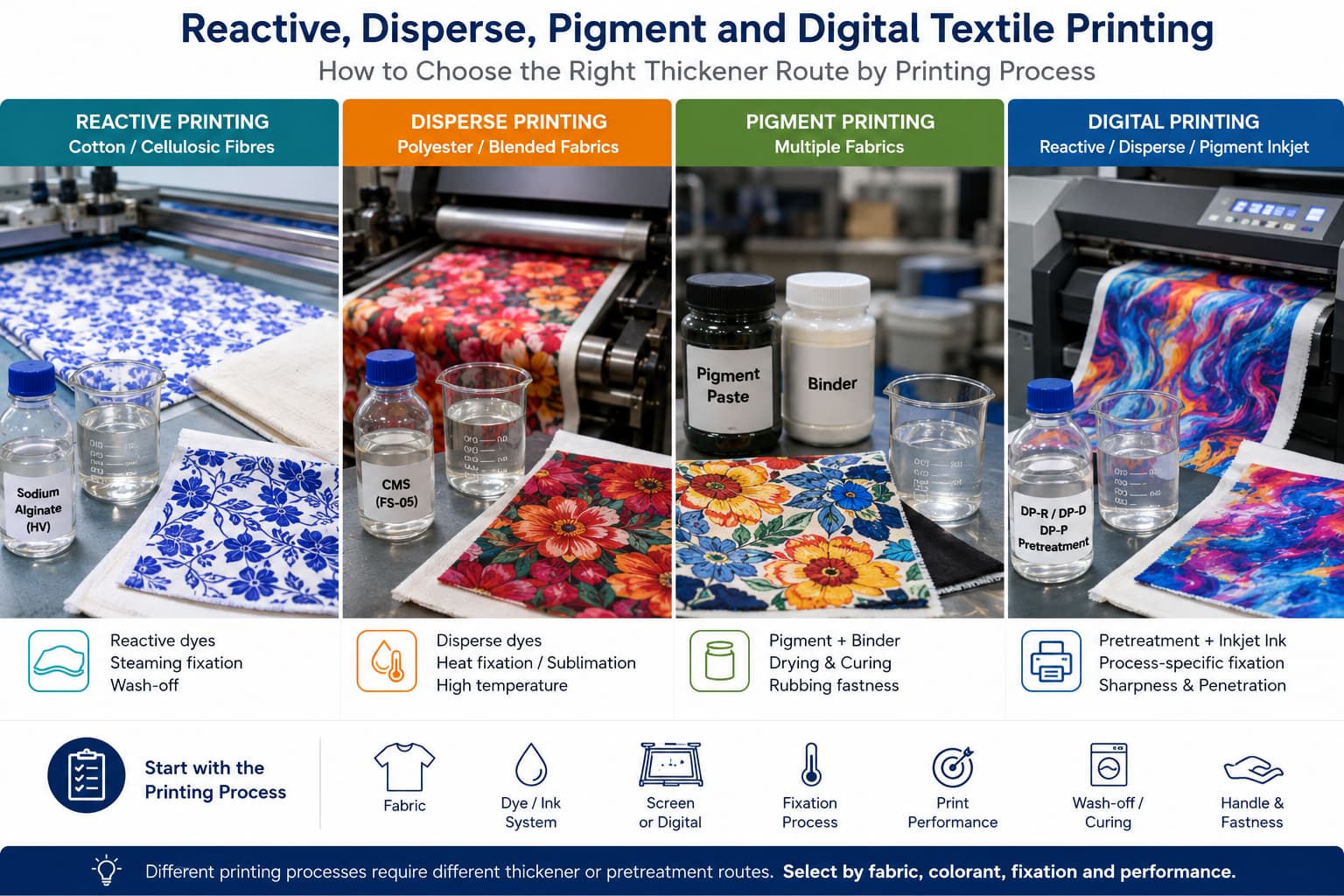
Узнайте, как выбирать загустители и способы предварительной обработки для реактивной, дисперсной, пигментной и цифровой печати на текстиле с учетом требований к ткани, красителю или чернилам, фиксации, вымываемости и качеству печати.
Печатная паста на основе CMC используется в пигментной, реактивной и цифровой текстильной печати. В данном руководстве объясняется, какие параметры имеют значение, как сравнивать поставщиков и что следует уточнить перед размещением оптового заказа.
И альгинат натрия, и CMC используются в качестве загустителей при печати на текстиле, однако они подходят для разных систем окрашивания и условий производства. В данном руководстве объясняются основные различия между ними и приводятся рекомендации по их применению.
Выбор подходящего загустителя для текстильной печати зависит не только от типа ткани. Покупателям следует подбирать загуститель с учетом системы красителей или пигментов, метода печати, требуемых реологических характеристик, требований к стойкости к стирке, а также фактических условий производственных испытаний.
Эффективность печати на текстиле зависит от сбалансированной химической системы, а не от одной универсальной добавки. В данном руководстве описаны десять важных групп химических веществ, их функции, сферу применения, а также то, что покупатели должны проверить перед проведением производственных испытаний.
Загустители для текстильной печати различаются по химическому составу, реологическим свойствам, совместимости с красителями и характеристикам вымывания. В данном руководстве сравниваются основные группы загустителей, их типичные области применения, а также параметры, которые покупатели должны проверить перед проведением производственных испытаний.
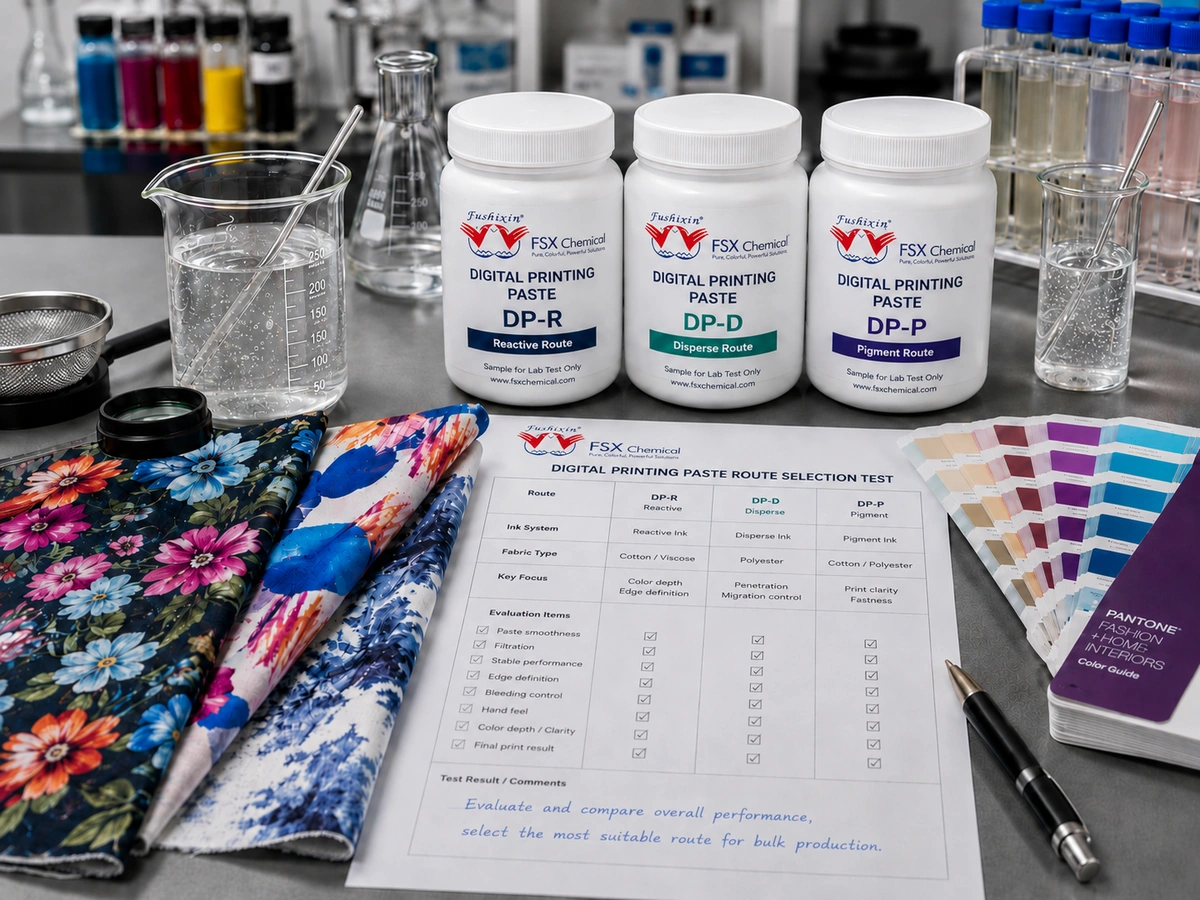
Выбор паст для цифровой печати следует осуществлять с учетом химического состава краски, типа ткани, метода нанесения и последующей обработки. В данном руководстве сравниваются методы предварительной обработки с использованием альгината натрия, CMC, CMS, синтетических полимеров и смешанных составов для струйной печати на текстиле.
An FSX-authored guide to checking digital pretreatment fit, trial evidence, product documents and sample-to-bulk traceability before supplier approval.
Для получения стабильной пасты для цифровой печати недостаточно просто соблюдать заданную вязкость. В данном руководстве объясняется, как выбор продукта, качество воды, последовательность добавления компонентов, перемешивание, уровень pH, температура, фильтрация, соблюдение гигиенических норм, условия хранения и ведение документации по качеству влияют на предварительную обработку и стабильность производственного процесса.
Evaluate FSX fabric pretreatment by confirmed grade, ink route, application architecture and measured add-on. Compare DG-20 or DP-P in a defined trial, and qualify any disperse candidate separately.
Для цифровой печати на текстиле требуется не только современные чернила и печатающие головки. Ознакомьтесь с химическими решениями, специально разработанными для процессов струйной печати реактивными, дисперсными и пигментными чернилами — от предварительной обработки и регулирования реологических свойств до фильтрации, фиксации и проверки производственных процессов.
Textile printing chemistry is evolving beyond simple viscosity and price comparisons. Explore five innovation directions shaping 2026, including safer chemical inputs, hybrid biopolymer thickeners, advanced pigment binders, shorter digital processes and multifunctional formulations.
Сообщите название продукта, область применения, количество, пункт назначения, а также предоставьте техническое описание продукта (TDS),
фотографию образца или имеющиеся у вас документы. Компания FSX Chemical рассмотрит
эту информацию и порекомендует дальнейшие действия для подготовки коммерческого предложения, подбора образца
или выбора продукта.
Информация о продуктеНазвание продукта, марка, модель, фото этикетки или данные о продукте текущего поставщика.
Доступные документыTDS, SDS, COA, фотография образца, перечень продукции или данные испытаний.
Детали заказаПредполагаемый объем, упаковка, страна назначения, порт или условия торговли.
Область применения или проблемаПроцесс печати на текстиле, требования к составу, текущие проблемы или целевые показатели.