Guide to Textile Printing Thickener Selection for Beginners
Selecting a textile printing thickener becomes easier when you begin with the printing process, dye...
Selecting a textile printing thickener becomes easier when you begin with the printing process, dye or ink system, fabric and equipment. This beginner-friendly guide explains the main product families, technical parameters, testing steps and supplier questions required before bulk purchasing.
Textile printing thickeners can appear complicated to new buyers. Product catalogues may include sodium alginate, CMC, CMS, synthetic thickeners, compound thickeners and digital printing pastes, often with several viscosity grades under each product family.
Beginners commonly start by comparing price or viscosity. However, neither value can identify the correct product by itself. A thickener must first match the printing process, colorant chemistry, fabric, equipment and post-treatment conditions.
The most reliable selection process is therefore application-first. Define what will be printed, how it will be printed and which final result is required. Then compare suitable candidates using one standardized preparation and testing procedure.
This guide explains the selection process step by step. It is designed for new procurement staff, laboratory assistants, textile chemical distributors and printing mills evaluating a thickener for the first time.
What Is a Textile Printing Thickener?
A textile printing thickener is a material used to control the flow, transfer and position of a printing paste or pretreatment formulation. Its job is not simply to make water thicker.
During printing, the chemical system must move through a screen, coating unit or pretreatment process and reach the fabric in a controlled manner. After application, it should help limit unwanted spreading while allowing the required penetration and fixation.
Functions a thickener may provide
Builds the required paste viscosity
Controls flow during mixing, pumping and printing
Supports transfer through screens or application equipment
Helps control spreading and penetration on the fabric
Suspends dyes, pigments or other formulation components
Supports uniform application across the fabric
Influences wash-off, fabric handle and production stability
A thickener is part of a complete system
The final result also depends on dyes, pigments, binders, salts, alkalis, auxiliaries, water quality, fabric absorbency, equipment and post-treatment.
A thickener cannot independently guarantee sharp printing, deep color or stable production. It must be evaluated together with the complete process.
The First Rule: Start with the Printing System
Beginners often ask, “Which textile printing thickener is the best?” A more useful question is, “Which thickener route is suitable for my printing system?”
Identify the colorant system
First determine whether the process uses reactive dyes, disperse dyes, pigments, acid dyes or another colorant system. Different chemistries create different compatibility and fixation requirements.
Identify the fibre
Cotton, viscose, polyester, nylon, silk, wool and blended textiles have different absorption, surface and fixation characteristics.
Identify the printing method
Flat-screen, rotary-screen, digital inkjet, coating and transfer-related processes do not expose the paste to the same mechanical conditions.
Identify the role of the thickener
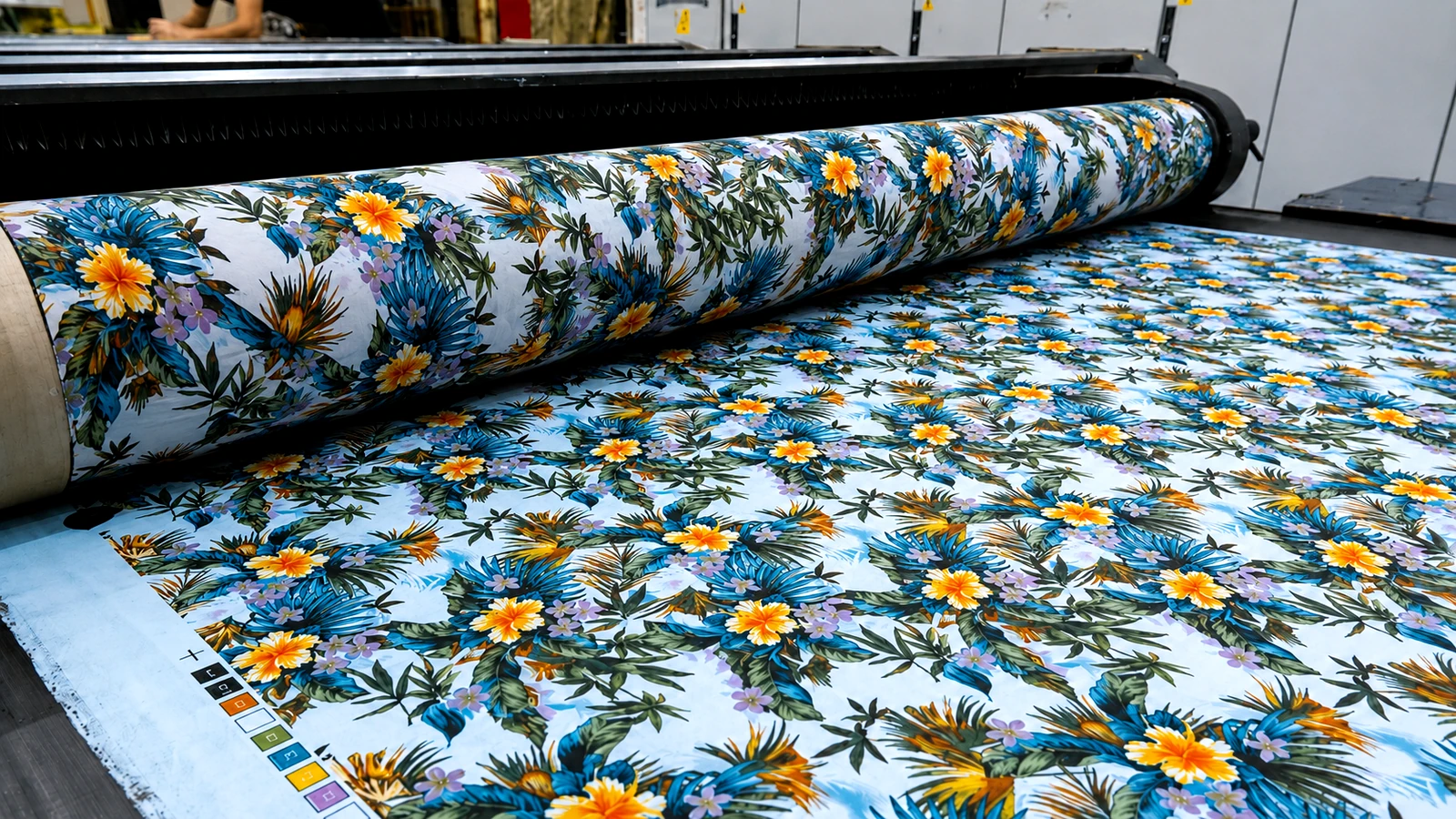
In conventional screen printing, the thickener is normally part of the color paste. In many digital textile printing systems, the thickening function is part of a fabric pretreatment applied before inkjet printing.
Identify the final quality target
Determine whether the main requirement is fine-line definition, uniform solid coverage, controlled penetration, high production speed, easy wash-off, soft handle or lower total cost.
Main Types of Textile Printing Thickeners
The main product families differ in raw material, chemical structure, rheology and application direction. The following comparison provides a starting point rather than a universal ranking.
Product Route
Common Starting Application
Main Features to Evaluate
Important Limitation
Sodium alginate
Reactive printing on suitable cellulosic textiles
Dye compatibility, rheology, filtration, definition and wash-off
Not a universal pigment or disperse printing thickener
Synthetic thickener
Pigment printing and selected specialized formulations
Binder compatibility, shear response, pH and electrolyte tolerance
Preparation and neutralization may be product-specific
Carboxymethyl Starch
Selected printing, mixed thickener and sizing formulations
Viscosity, substitution, dye response, film behavior and wash-off
Not an automatic one-to-one alginate replacement
Carboxymethyl Cellulose
Selected printing, coating, sizing and compound formulations
Viscosity method, DS, purity, salt response and hydration
Performance varies significantly between commercial grades
Compound thickener
Application-specific reactive, pigment or disperse systems
Complete blend identity, stability, rheology and batch consistency
Products with similar viscosity may have different compositions
Digital printing paste
Reactive, disperse or pigment digital pretreatment
Ink control, filtration, uniform application and final fabric result
Must be matched to the specific ink and fabric route
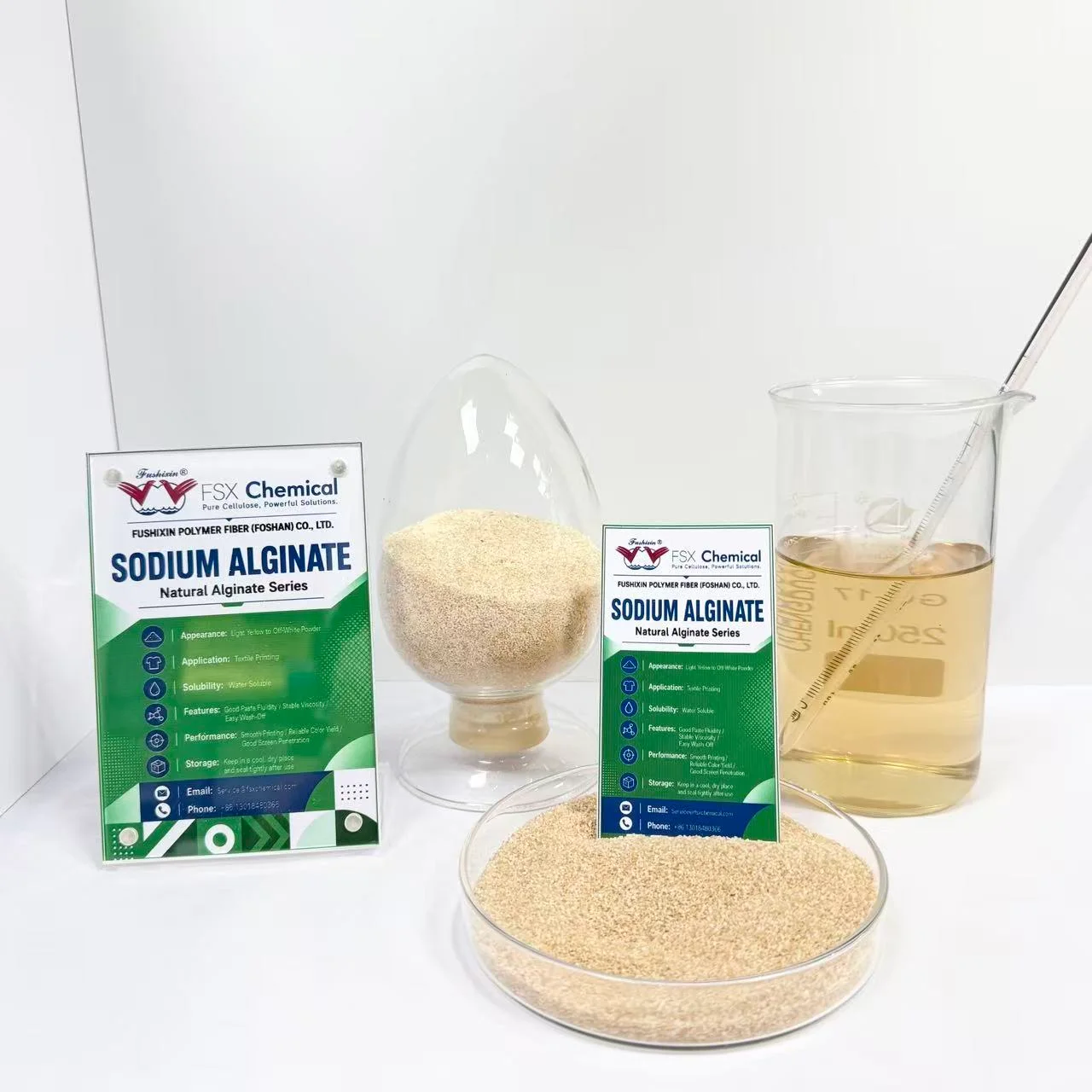
Sodium alginate is a common starting route for reactive dye printing on cotton, viscose and other suitable cellulosic textiles.
Why beginners often start with sodium alginate
It is widely associated with reactive printing because a properly matched grade can provide a useful balance between paste flow, colorant placement and post-print wash-off.
What to compare
Viscosity grade and complete measurement method
Hydration time and lump formation
Particle profile and filtration
Flow under screen pressure
Structural recovery after printing
Response to dyes, salts and alkalis
Print definition and penetration
Wash-off and final fabric handle
Beginner warning
Do not purchase sodium alginate only because its viscosity number is higher. A grade with excessive or unsuitable viscosity may create poor transfer, difficult pumping or screen-passage problems.
2. Synthetic Thickeners
Synthetic thickeners are common starting routes for pigment printing and selected specialized water-based formulations.
Why they may be selected
Efficient viscosity development in a suitable formulation
Adjustable shear-thinning behavior
Compatibility with selected pigment and binder systems
Low addition levels in some matched formulations
What to test
Binder and pigment compatibility
Required neutralization or pH condition
Electrolyte sensitivity
Foam during preparation
Paste recovery after shear
Curing performance
Rubbing durability
Final fabric handle
Beginner warning
A low dosage does not automatically mean a lower total cost. The complete pigment paste, curing process and final textile must meet the same quality requirements as the current product.
3. Carboxymethyl Starch
Carboxymethyl Starch , commonly abbreviated as CMS, is a modified starch derivative used in selected textile printing, sizing and mixed-thickener formulations.
Possible roles
Developing printing-paste viscosity
Adjusting paste body and flow
Serving as part of a compound thickener
Supporting selected disperse or specialized printing routes
Adjusting cost and performance in a blended formulation
Important CMS parameters
Viscosity and measurement method
Degree of substitution
Moisture and purity
Particle size
Dispersion and hydration
Film behavior
Dye and electrolyte response
Beginner warning
CMS should not be treated as a universal direct replacement for sodium alginate. In reactive printing, color response, wash-off and residual handle require particular attention.
4. Carboxymethyl Cellulose
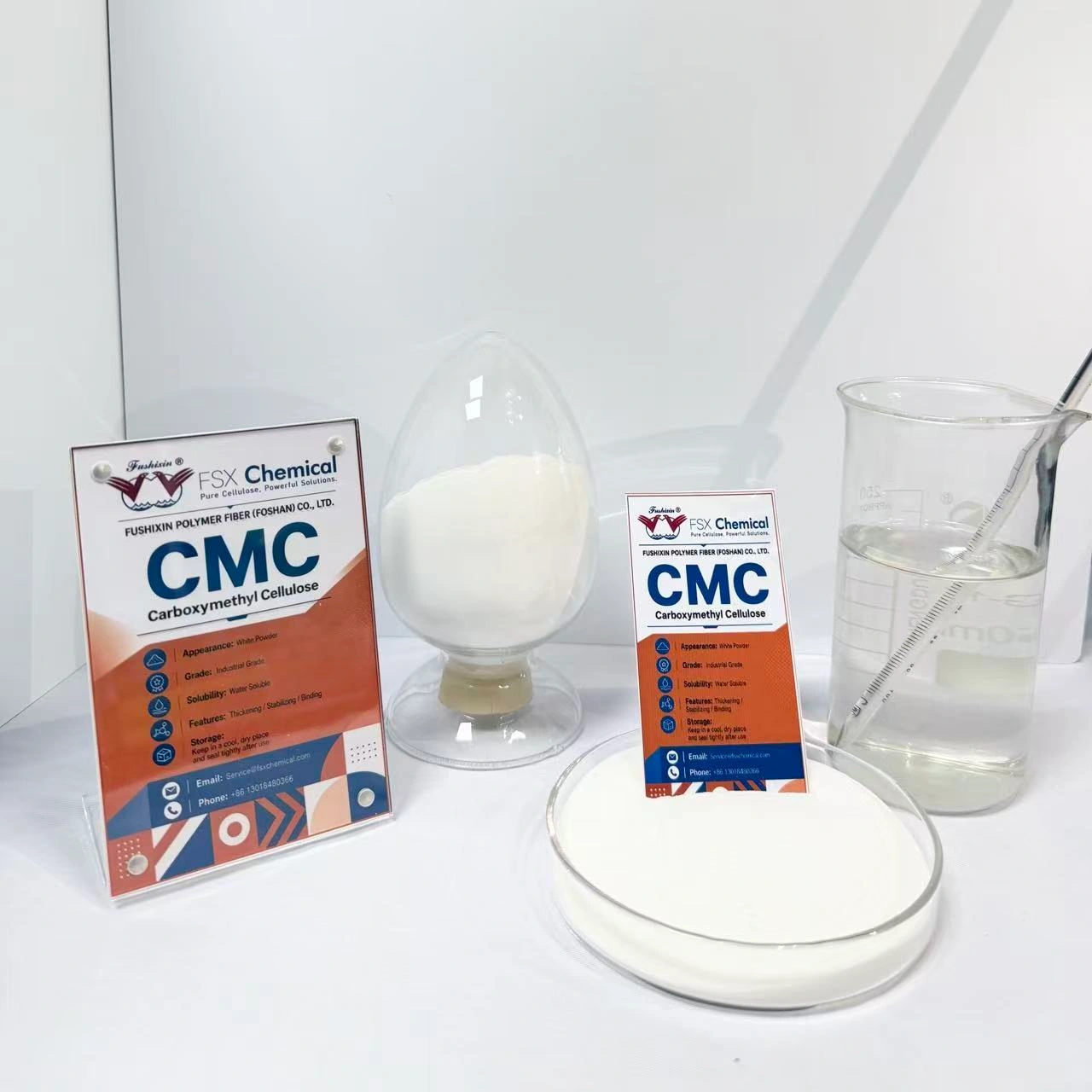
Carboxymethyl Cellulose , commonly abbreviated as CMC, is a modified cellulose derivative available in a wide range of viscosity, substitution and purity grades.
Possible textile roles
Viscosity control in selected printing formulations
Component of a compound thickener system
Warp-sizing formulations
Textile coatings and finishing formulations
Suspension and water-retention adjustment
Important CMC parameters
Degree of substitution
Viscosity and complete test method
Purity and residual salts
Moisture
pH
Particle profile
Electrolyte tolerance
Hydration and solution uniformity
Beginner warning
Two CMC products with a similar viscosity can behave differently because their degree of substitution, purity, particle profile and chemical tolerance may not be the same.
5. Compound Thickeners
A compound thickener combines two or more components to achieve an application-specific balance of viscosity, flow, recovery, chemical tolerance and cost.
Potential advantages
Application-focused rheology
Balanced flow and structural recovery
Improved preparation convenience
Adjustment of salt, alkali or binder tolerance
Reduced need for factory-side blending
What beginners should request
A permanent commercial grade code
A current TDS and preparation procedure
The intended printing system
A representative sample
Proposed batch-control parameters
Known limitations and recommended trial conditions
Beginner warning
Do not assume that two compound thickeners are interchangeable because they produce the same water viscosity. Their polymer compositions and behavior in the complete formulation may be different.
6. Digital Printing Pretreatment Pastes
Digital textile printing should be evaluated separately from traditional screen printing. In many digital processes, a pretreatment is applied to the fabric before inkjet printing.
A dedicated Digital Printing Paste should be selected according to the ink system, fabric, application method, drying, fixation and final textile requirements.
Common digital routes
Reactive digital printing pretreatment
Disperse digital printing treatment
Pigment digital printing pretreatment
Important evaluation points
Uniform pretreatment pickup
Controlled ink spreading
Appropriate penetration
Filtration and smoothness
Compatibility with ink and fabric
Drying, fixation or curing behavior
Final definition, shade and handle
Beginner warning
A digital pretreatment with higher viscosity is not automatically better. Excessive viscosity may cause uneven application, difficult filtration or excessive surface film.
Seven Steps for Beginner Thickener Selection
Step 1: Identify the printing process
Confirm whether the application is reactive, pigment, disperse, acid, digital or another specialized process.
Step 2: Identify the fibre and fabric
Record fibre composition, fabric construction, weight, absorbency and any existing pretreatment.
Step 3: Identify the application equipment
Confirm flat-screen, rotary-screen, digital inkjet, padding, coating or another application method.
Step 4: Define the technical target
State whether the main target is definition, penetration, paste stability, filtration, production speed, wash-off, handle or cost.
Step 5: Select the appropriate product family
Choose a practical starting route instead of requesting every available thickener.
Step 6: Compare representative samples
Prepare the current reference and candidate under identical conditions, then test the complete formulation.
Step 7: Verify the commercial grade
Confirm the product code, specification, TDS, sample identity, quotation and proposed batch documentation before purchasing.
Technical Properties Beginners Should Understand
Viscosity
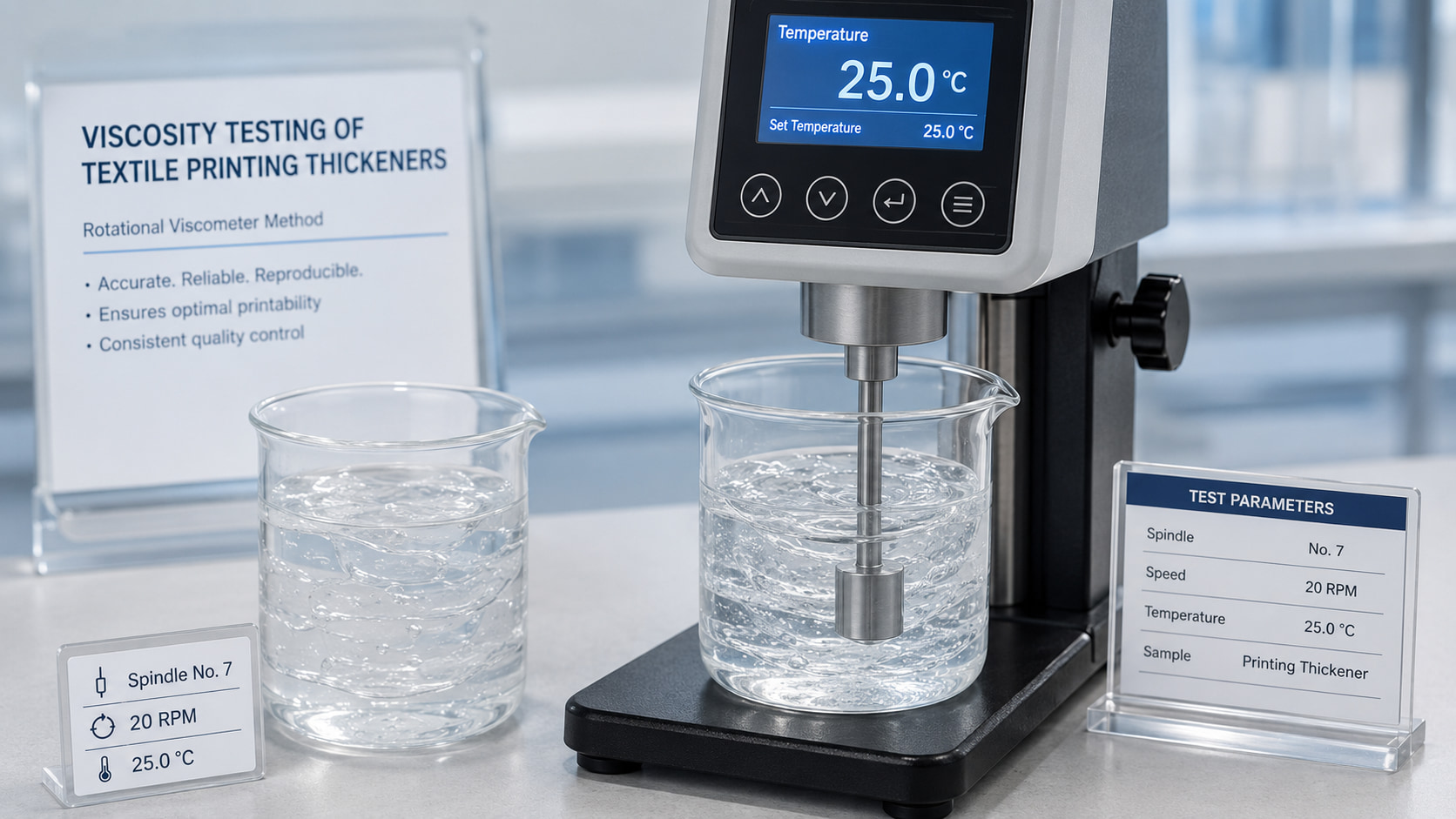
Viscosity represents resistance to flow under a defined test condition. The value is meaningful only when the concentration, temperature, preparation, instrument, spindle and rotational speed are known.
Rheology
Rheology describes how the paste changes when it is mixed, pumped or printed. Two products with the same single-point viscosity may have different flow and recovery behavior.
Shear thinning
A printing paste often needs to become easier to move under screen or machine shear. Excessive resistance may reduce transfer, while excessive thinning may increase spreading.
Structural recovery
After application, the paste should recover enough structure to support the intended design. The correct recovery depends on the fabric, machine and pattern.
Hydration
Hydration is the process by which a powdered polymer develops its final solution or paste properties. Incomplete hydration can cause unstable viscosity and filter residue.
Filtration
Filtration helps identify lumps, gels, coarse particles and contamination that may interfere with screens or application equipment.
Chemical tolerance
Dyes, salts, alkalis, binders and auxiliaries can change paste viscosity and stability. Clean-water testing is not sufficient for final approval.
Holding stability
The paste should remain acceptable during the normal period between preparation and use. Check viscosity drift, separation, settling, foam and filterability.
Quick Selection Guide by Printing Process
Printing Process
Practical Starting Route
Main Tests
Reactive screen printing on cotton
Sodium alginate or a validated reactive compound thickener
Dye compatibility, definition, filtration and wash-off
Reactive rotary-screen printing
Sodium alginate or a high-speed matched compound system
Shear behavior, circulation, screen passage and long-run stability
Pigment printing
Synthetic or binder-compatible compound thickener
Binder compatibility, curing, handle and rubbing performance
Selected disperse printing
CMS, synthetic or application-specific compound route
Paste stability, screen passage, fixation and final print result
Mixed thickener development
Alginate, CMS, CMC or another controlled blend
Blend stability, dye response, wash-off and total cost
Reactive digital printing
Dedicated reactive digital pretreatment paste
Ink control, pickup, definition, fixation and wash-off
Disperse digital printing
Dedicated disperse digital printing route
Fabric compatibility, application uniformity and fixation
Pigment digital printing
Dedicated pigment pretreatment and binder-compatible route
Definition, curing, handle and rubbing durability
These recommendations identify a starting product family. The actual grade must still be tested under the buyer’s conditions.
How to Read a Thickener TDS
A Technical Data Sheet provides useful starting information, but beginners should understand the difference between a product description, a typical value and a controlled specification.
Product identity
Look for the product name and permanent grade code. Avoid approving a sample that cannot be connected to a commercial grade.
Intended application
Confirm that the stated application matches the required printing process. A general industrial thickener may not be a textile printing grade.
Viscosity method
Check concentration, temperature, instrument, spindle and speed. A viscosity number without a method is difficult to compare.
Typical properties
Depending on the product, the TDS may include moisture, pH, purity, degree of substitution, particle size, appearance or solids.
Preparation instructions
Review powder addition, mixing, hydration, temperature and filtration guidance.
Storage information
Confirm storage, package closure and handling after opening using the current product documents.
TDS limitations
A TDS does not prove compatibility with the buyer’s complete formulation. Application testing remains necessary.
How to Test Samples Correctly
Use a current reference
Compare the candidate with the product currently approved for production.
Use the same water
Water hardness, conductivity, pH and temperature can affect hydration and viscosity.
Use the same concentration basis
Confirm whether the calculation is based on supplied product weight, dry material or active content.
Standardize preparation
Use identical containers
Use the same mixer and impeller
Control powder-addition time
Control mixing speed and duration
Use the same hydration period
Measure at the same temperature
Complete basic laboratory checks
Powder wetting and lump formation
Hydration time
Viscosity under the agreed method
Filtration and residue
Foam, settling and separation
Stability after the normal holding period
Test the complete formulation
Add the actual dyes, pigments, salts, alkalis, binders and auxiliaries in the normal production sequence.
Conduct a production-relevant trial
Use representative fabric, equipment, speed, fixation and washing or curing conditions.
How to Evaluate the Printed Fabric
The final fabric is more important than the appearance of the prepared paste. Evaluate the textile after the complete fixation, curing or washing process.
Print definition
Check fine lines, small text, sharp corners and closely spaced design elements.
Spreading and bleeding
Determine whether color moves beyond the intended design boundary.
Penetration
The correct penetration depends on fabric construction and end use. Excessive surface hold and excessive penetration can both be undesirable.
Solid coverage and levelness
Inspect large printed areas for mottling, uneven transfer, foam marks and visible application variation.
Shade response
Compare candidates only after identical fixation and post-treatment.
Wash-off or curing
Check residual paste, binder performance and the efficiency of the normal post-print process.
Fabric handle
A sharp print is not acceptable when the finished textile becomes excessively stiff, sticky or uneven.
How to Compare Total Cost in Use
Beginners often select the lowest price per kilogram. A more accurate comparison includes every cost required to produce acceptable printed fabric.
Include these cost factors
Delivered product price
Actual dosage per paste batch
Mixing and hydration time
Heating or cooling
Filtration and material loss
Screen and machine cleaning
Corrective water or thickener additions
Unused or rejected paste
Post-treatment and washing
Rejected or reprocessed fabric
Packaging, freight and inventory
Compare at equal quality
A lower-cost candidate must meet the same definition, shade, handle, durability and production requirements as the reference.
A product that requires frequent correction or produces off-quality fabric is not economically attractive merely because its purchase price is lower.
Questions to Ask the Supplier
Which printing process is this grade designed for?
Which fabrics and colorant systems have been considered?
What is the complete viscosity measurement method?
What preparation and hydration procedure is recommended?
Which product parameters are controlled?
Which parameters can appear on the batch COA?
Can the supplier review the current TDS or physical sample?
Can a representative sample be supplied before bulk purchasing?
Is the sample linked to a permanent commercial grade?
What known application limitations should be tested?
How is a reported batch or application issue reviewed?
Which packaging and export documents are available?
A professional supplier should ask questions about the application before recommending a product. A recommendation based only on desired viscosity or price may be too general.
Common Beginner Mistakes
Choosing the highest-viscosity product
Higher viscosity may reduce flow, pumping and screen transfer. The correct rheological balance is more important.
Comparing viscosity from different methods
Results measured at different concentrations, temperatures or rotational speeds cannot be compared directly.
Testing only in water
Dyes, salts, alkalis, pigments and binders can substantially change the final paste.
Assuming one thickener fits every printing process
Reactive, pigment, disperse and digital systems have different chemical and mechanical requirements.
Changing several variables at once
When dosage, preparation, auxiliaries and machine settings are all changed together, the reason for improvement or failure becomes unclear.
Ignoring hydration and filtration
Incomplete dispersion can be mistaken for poor product quality or low viscosity.
Approving only one shade or fabric
A product may behave differently with a darker shade, higher electrolyte load or more absorbent fabric.
Buying an unnamed sample
The approved sample should be linked to a repeatable commercial product code and specification.
Skipping the first bulk-batch test
The first commercial shipment should be compared with the approved reference before routine production.
How FSX Chemical Supports New Buyers
FSX Chemical supplies sodium alginate, CMC, CMS and digital printing paste for different textile printing and industrial formulation routes.
New buyers do not need to know the exact grade before making an inquiry. Providing clear application information allows the available product routes to be narrowed before sample testing.
Information buyers can provide
Printing process
Fabric and fibre composition
Dye, pigment or ink system
Current product name or TDS
Current dosage and preparation method
Target viscosity and complete test method
Printing or application equipment
Main quality or production problem
Estimated quantity and destination
Product review may include
Identification of a suitable product family
Review of the current TDS or sample
Recommendation of a candidate commercial grade
Provision of relevant TDS and SDS information
Representative samples for laboratory testing
Guidance for side-by-side preparation
Review of laboratory or printing-trial feedback
Commercial quotation after the grade route is defined
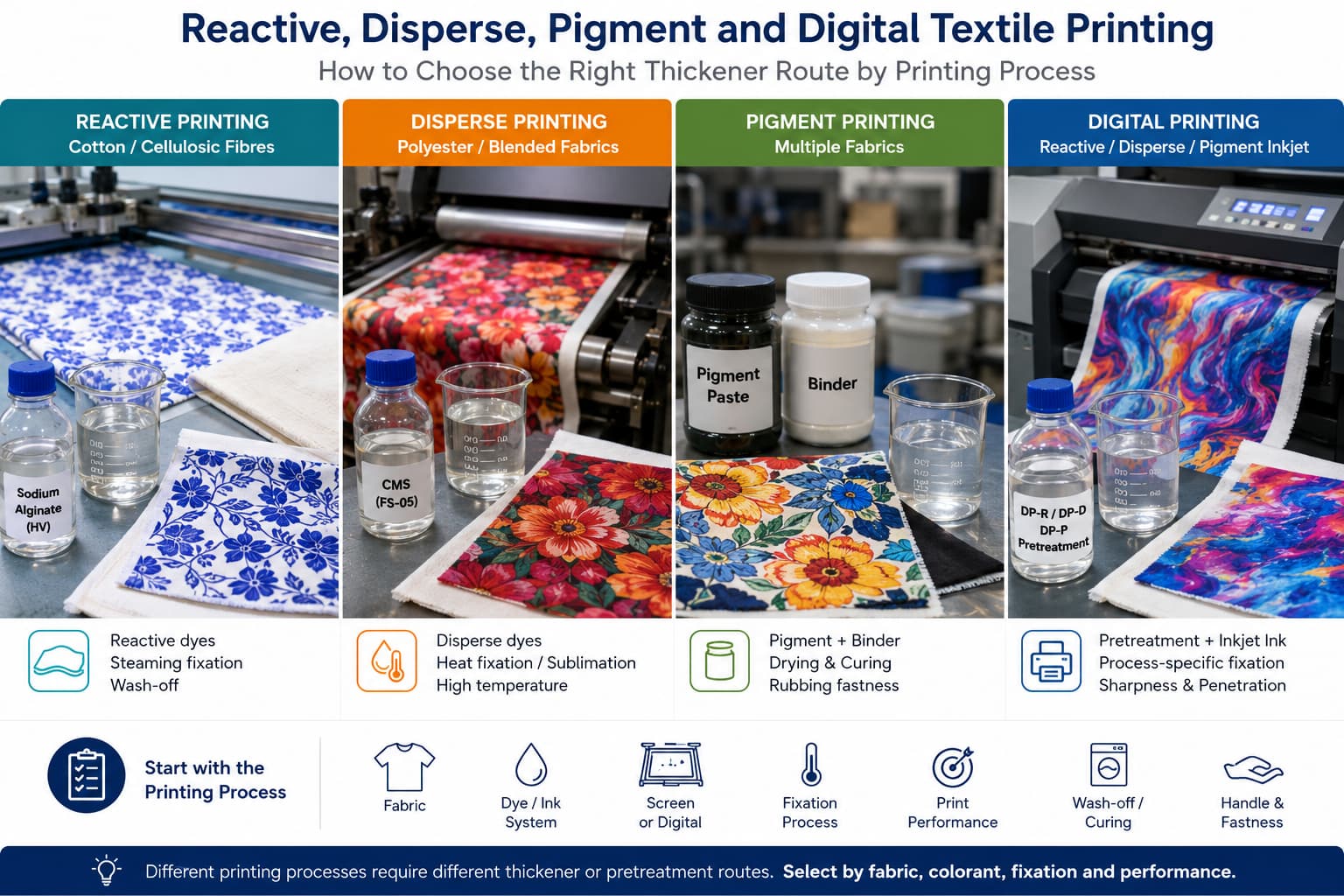
Learn how to choose thickener and pretreatment routes for reactive, disperse, pigment and digital textile printing based on fabric, dye or ink, fixation, wash-off and print-quality requirements.
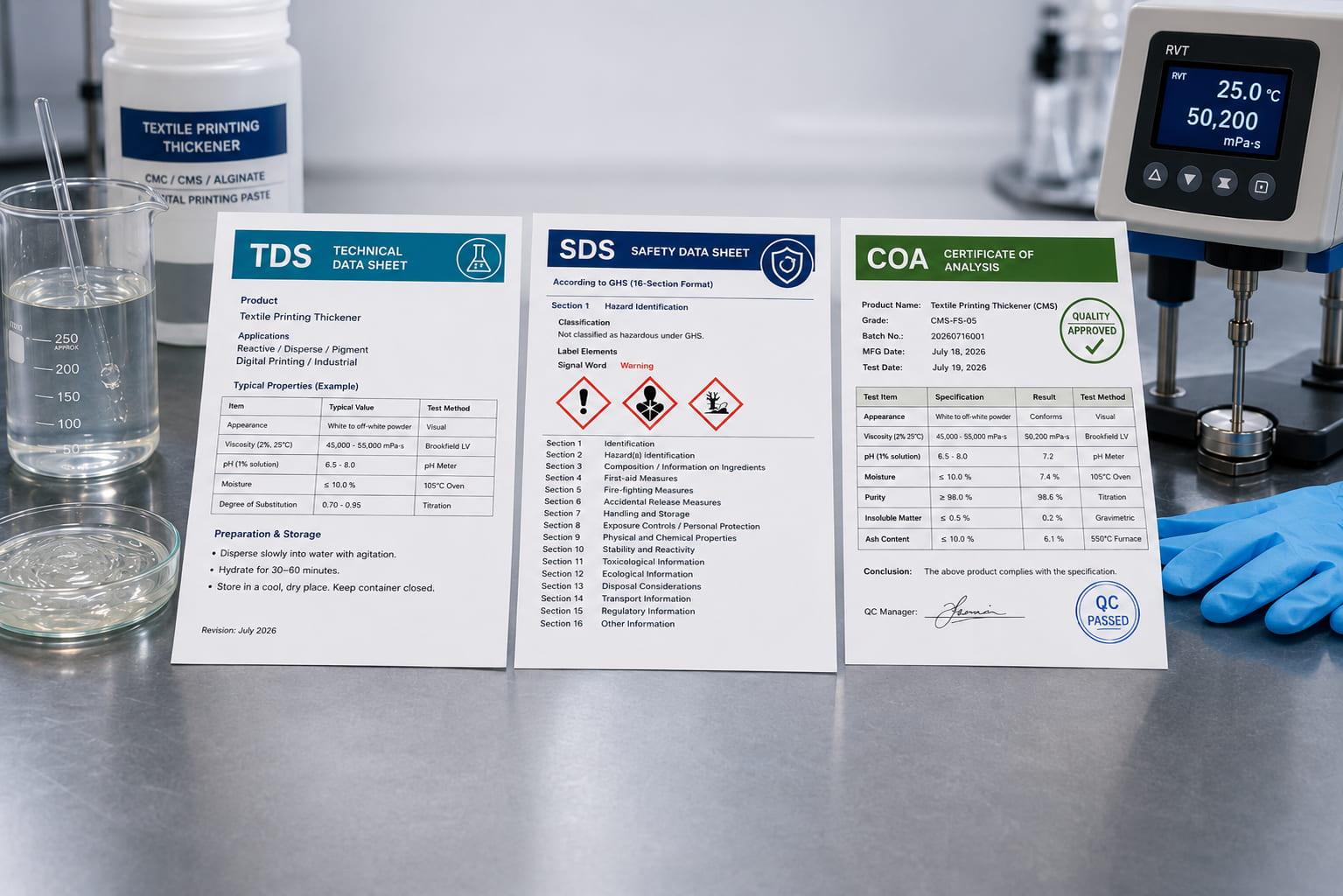
Learn the difference between TDS, SDS and COA documents, what textile printing buyers should verify, and how to check specifications, safety data, test methods, batch results and document issuers.
Compare CMC, CMS, sodium alginate and digital printing paste for textile printing. Learn how each route fits reactive, disperse, pigment and digital processes, and what buyers should review before sample testing, grade matching and bulk purchase.
Sodium alginate is widely used in textile printing as a stable and washable thickener for reactive printing paste. Learn how to evaluate viscosity grade, purity, and application suitability before purchasing, and how FSX Chemical supports global buyers with technical data and samples.
Carboxymethyl cellulose (CMC) is widely used in the printing, sizing, and dyeing processes of textiles. This guide will explain how to evaluate CMC grades, which parameters are most important, and how FSX Chemical can support purchasing decisions.
Carboxymethyl cellulose is used as a thickener and stabilizer in water-based inks, gravure printing, and inkjet pre-treatment. This guide covers the key grade parameters and sourcing considerations for procurement teams.
Choosing the right CMC supplier involves more than comparing price. This guide covers the evaluation criteria, documentation checklist, and trial process that procurement teams should follow before committing to a bulk order.
Both sodium alginate and CMC are used as thickeners in textile printing, but they suit different dye systems and process conditions. This guide explains the key differences and when to use each.
Digital inkjet printing on textiles has different paste and pre-treatment requirements compared to screen printing. This guide explains how sodium alginate is used in digital textile printing and what grade parameters procurement teams should specify.
Food-grade and industrial-grade CMC share the same base chemistry but differ significantly in purity, DS range, and regulatory requirements. This guide explains the key differences and why using the wrong grade creates production problems.
Correct paste preparation is as important as grade selection in reactive dye textile printing. This guide covers sodium alginate dissolution methods, concentration ranges by application, storage conditions, and how to troubleshoot common preparation problems.
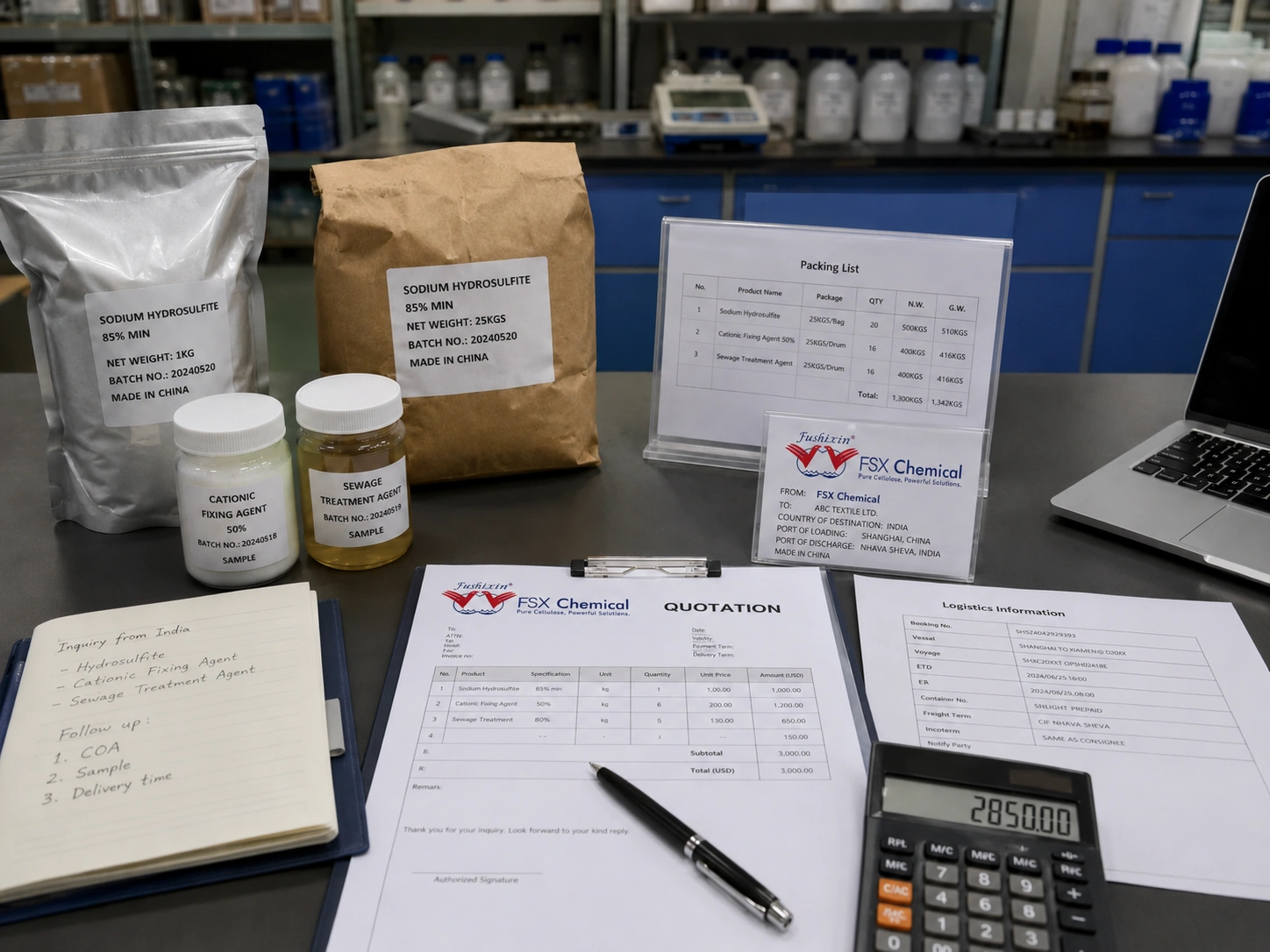
Share the product name, application, quantity, destination and any TDS,
sample photo or document you already have. FSX Chemical will review the
information and recommend the next step for quotation, sample matching
or product selection.
Product InformationProduct name, grade, model, label photo or supplier reference.
Available DocumentsTDS, SDS, COA, sample photo, product list or test data.
Order DetailsEstimated quantity, packaging, destination country, port or trade term.
Application or IssueTextile printing process, formulation need, current issue or target performance.

 EN
EN  BN
BN  ES
ES  TR
TR  FR
FR  ID
ID  RU
RU  AR
AR  UR
UR  VI
VI  TL
TL  HI
HI  UK
UK  KK
KK  KA
KA  UZ
UZ