How Acrylic Thickener Affects Pigment Printing Rubbing Fastness, Fabric Hand and Color Yield
Acrylic thickener affects pigment-printing color yield, rubbing performance and fabric hand mainly through rheology, paste...
Acrylic thickener affects pigment printing indirectly but importantly. It does not replace the binder and it does not create rubbing fastness by itself. Instead, it controls paste rheology, screen transfer, pigment and binder distribution, surface deposit, penetration and the amount of polymer solids left on the fabric. Those changes can influence final color yield, how effectively the binder film develops during curing, and how stiff or soft the printed area feels. The correct evaluation therefore connects thickener dosage and rheology with binder level, curing, K/S, dry and wet rubbing fastness and fabric hand rather than judging the thickener from viscosity alone.
How Does Acrylic Thickener Affect Pigment Printing?
Acrylic thickener mainly affects pigment printing by controlling how the printing paste flows before, during and after screen transfer.
That rheology influences:
How much paste is transferred
How evenly pigment and binder are distributed
How deeply the paste penetrates the textile
How sharply the design remains after printing
How much thickener polymer remains in the printed area
These factors can then influence:
রঙের ফলন
বাঁধাই-ফিল্মের সমতা
ঘর্ষণ কর্মক্ষমতা
কাপড়ের হাত
The relationship is indirect.
Acrylic Thickener → Rheology / Deposit / Distribution → Curing Result → Color / Fastness / Hand
The thickener does not replace correct binder dosage or curing conditions.
Thickener, Binder and Pigment Have Different Jobs
রঞ্জক
Provides the color.
বাইন্ডার
Forms a film during curing that anchors pigment particles to the textile surface and develops rubbing and wash durability.
অ্যাক্রিলিক ঘনকারী
Controls the flow and distribution of the complete printing paste.
This distinction is essential because a rubbing-fastness problem can be incorrectly blamed on the thickener when the real problem is:
Binder dosage
Binder chemistry
Curing temperature
Curing time
পিগমেন্ট লোডিং
Fabric surface
Likewise, a color-yield problem can be caused by excessive penetration even when binder fastness is good.
1. How Acrylic Thickener Can Affect Color Yield
Acrylic thickener can influence apparent color yield because it controls where the pigment-binder paste is deposited.
If the paste is too fluid:
Penetration can increase.
More pigment may move below the surface.
Surface color can appear weaker.
Fine edges can spread.
If the paste is excessively structured:
Transfer can become incomplete.
Solid areas can become uneven.
Surface leveling can decrease.
The optimum color yield therefore comes from balanced rheology rather than maximum viscosity.
Research reviews on acrylic-based pigment-printing thickeners have long identified depth of color, brightness and print sharpness as properties influenced by thickener selection and paste flow.
2. Paste Deposit and Pigment Distribution
The quantity of wet paste placed on the fabric affects how much pigment and binder are available in the printed area.
Paste deposit is influenced by:
ঘনকারী রিয়োলজি
স্ক্রিন জ্যামিতি
Squeegee pressure
মেশিনের গতি
কাপড়ের শোষণক্ষমতা
Acrylic thickener that shear-thins efficiently can pass through the screen while still rebuilding structure after transfer.
This can support more uniform distribution of:
Pigment particles
Binder polymer
ফিক্সার
অন্যান্য সহায়ক
Uneven rheology can create uneven deposit even when the formula itself is chemically correct.
3. Penetration vs. Surface Color
More penetration is not automatically better.
In pigment printing, strong surface color often depends on retaining enough pigment near the fabric surface.
Excessive penetration can reduce apparent surface depth.
Insufficient penetration can create:
Surface-heavy deposits
Poor coverage on textured fabrics
Different hand or film appearance
The target depends on:
Fabric construction
কাপড়ের ওজন
পিগমেন্ট লোডিং
বাইন্ডার স্তর
ডিজাইন কভারেজ
Acrylic thickener should therefore be optimized together with the intended substrate rather than selected only from a laboratory beaker test.
4. Shear Thinning, Recovery and Print Definition
Useful pigment-printing paste normally needs:
Low-Shear Body → Shear Thinning Under the Squeegee → Controlled Recovery After Transfer
Low-shear body helps limit unwanted spreading.
Shear thinning helps the paste move through the screen.
Recovery helps stabilize the pattern after transfer.
5. How Thickener Can Indirectly Affect Rubbing Fastness
Acrylic thickener does not create pigment fixation by itself.
However, it can influence the conditions under which the binder film forms.
Possible indirect effects include:
Uneven pigment / binder distribution
Excess or insufficient paste deposit
Excess penetration
Poor screen transfer
High polymer solids
If the thickener creates an uneven print film, the binder can also be distributed unevenly.
This can contribute to variable rubbing performance even when the binder dosage is nominally correct.
Research on pigment-printing systems has evaluated thickener viscosity together with binder concentration and curing because these variables interact in the final rubbing result.
The correct conclusion is:
Thickener Supports Fastness Through Paste Control; Binder and Curing Create the Main Fixation Film.
6. Why Binder Level Usually Matters More for Fastness
Binder concentration has a direct influence on pigment fixation.
Increasing binder can improve dry and wet rubbing resistance within the useful formulation range because more binder film is available to retain pigment.
But higher binder level can also increase:
প্রবেশ
Surface polymer mass
Fabric stiffness
Published pigment-printing studies have reported improved dry and wet rubbing fastness as acrylic binder concentration increased, while stiffness also increased.
Therefore, if rubbing fastness is low, do not increase thickener first.
Check:
Binder grade
Binder dosage
শুকানো
Pigment/binder ratio
Paste distribution
7. Why Curing Must Be Controlled Before Comparing Thickeners
The binder film develops during curing.
If curing differs between two test samples, the final rubbing-fastness difference cannot be assigned confidently to the thickener.
Keep constant:
Drying condition
Curing temperature
Curing time
Fabric lot
Research on cured pigment prints evaluates color properties, wash fastness, dry/wet rubbing and fabric stiffness after defined curing conditions because the final film develops after the wet printing stage.
A paste that looks excellent before curing can still give poor fastness afterward.
8. How Acrylic Thickener Can Affect Fabric Hand
Fabric hand is influenced by the total polymer and film structure left on the textile.
The main contributors include:
বাঁধাই কঠিন পদার্থ
Thickener solids
Paste deposit
প্রবেশ
শুকানো
Acrylic thickener can support a softer hand when it reaches the required rheology at a relatively low dosage.
But this is not automatic.
If the formula requires:
Excess thickener
Excess binder
ভারী পেষ্ট জমেছে
the printed area can become noticeably stiffer.
Always judge hand after curing, not from the wet paste.
9. Thickener Solids, Binder Solids and Surface Film
Liquid acrylic thickeners can have different active-solids content.
অতএব, তুলনা করুন:
As-Supplied Dosage
and:
Active Polymer Solids Introduced
A low as-supplied dosage does not automatically mean low active polymer addition.
The complete polymer load on the fabric includes:
Binder Solids + Thickener Solids + Other Film-Forming Components
This combined solids load is more relevant to fabric hand than thickener dosage alone.
10. Dosage: Too Little vs. Too Much
Too Little Thickener
Possible symptoms include:
Low paste body
Excess spreading
Excess penetration
Poor edge definition
Too Much Thickener
Possible symptoms include:
Poor screen transfer
High squeegee pressure requirement
অতিরিক্ত স্থিতিস্থাপকতা
Heavy polymer deposit
Stiffer fabric hand
The correct dosage is the lowest stable dosage that keeps the complete pigment paste inside the approved rheology window.
Acrylic thickener should maintain useful rheology across the real production holding time.
Check:
নতুন সান্দ্রতা
Intermediate viscosity
End-of-shift viscosity
পিএইচ
ফেনা
বিচ্ছেদ
A paste that becomes thinner during holding can produce:
আরও অনুপ্রবেশ
Weaker surface color
Less consistent definition
A paste that becomes thicker can create:
Poor transfer
More pressure
Uneven solid areas
Color yield and hand should therefore be compared across the expected production age—not only with fresh paste.
14. Fabric Construction Changes the Result
The same pigment paste can produce different color yield and hand on:
সুতি
পলিয়েস্টার
CVC / PC blends
Knits
Wovens
Light vs. heavy fabrics
Fabric absorbency and surface structure influence:
Paste pickup
প্রবেশ
Surface pigment concentration
Perceived stiffness
Published acrylic-binder work has shown different stiffness responses on cotton, polyester and CVC fabrics under the same general pigment-printing study.
Do not approve an acrylic thickener on one laboratory fabric and assume identical hand on every substrate.
15. Light vs. Dark Pigment Shades
Dark shades typically use more pigment dispersion.
This can increase:
রঞ্জক কঠিন পদার্থ
Dispersant / surfactant level
Electrolyte load
Water added with pigment
Therefore, a thickener dosage that performs well in a light shade may not give the same rheology in a heavy shade.
Test representative:
Light shade
Normal shade
Dark shade
when the product range includes large pigment-loading differences.
16. Flat Screen vs. Rotary Screen
Machine architecture changes shear history.
সমতল পর্দা
Check:
Stroke behavior
Pause / restart
পুনরুদ্ধার
স্ক্রিন শুকানো
ঘূর্ণায়মান স্ক্রিন
Check:
Pumpability
Continuous shear
Circulation
Mid-run viscosity
এন্ড-রান সান্দ্রতা
A thickener that gives good hand and color in a short flat-screen test should still be validated on the real production machine.
The Three-Way Balance: Color Yield, Fastness and Hand
Pigment printing is often a three-way optimization.
রঙের ফলন
needs enough pigment near the useful surface region.
Rubbing Fastness
needs an effective binder film and correct curing.
কাপড়ের হাত
benefits from limiting unnecessary polymer-film mass and excessive surface deposit.
These goals can conflict.
উদাহরণস্বরূপ:
Binder ↑ → Fastness May Improve → Stiffness May Increase
and:
Thickener ↑ → Body May Improve → Polymer Solids / Transfer Resistance May Increase
The best formulation is therefore not the one that maximizes one property.
It is the formulation that meets all three acceptance targets.
Recommended Laboratory Test Plan
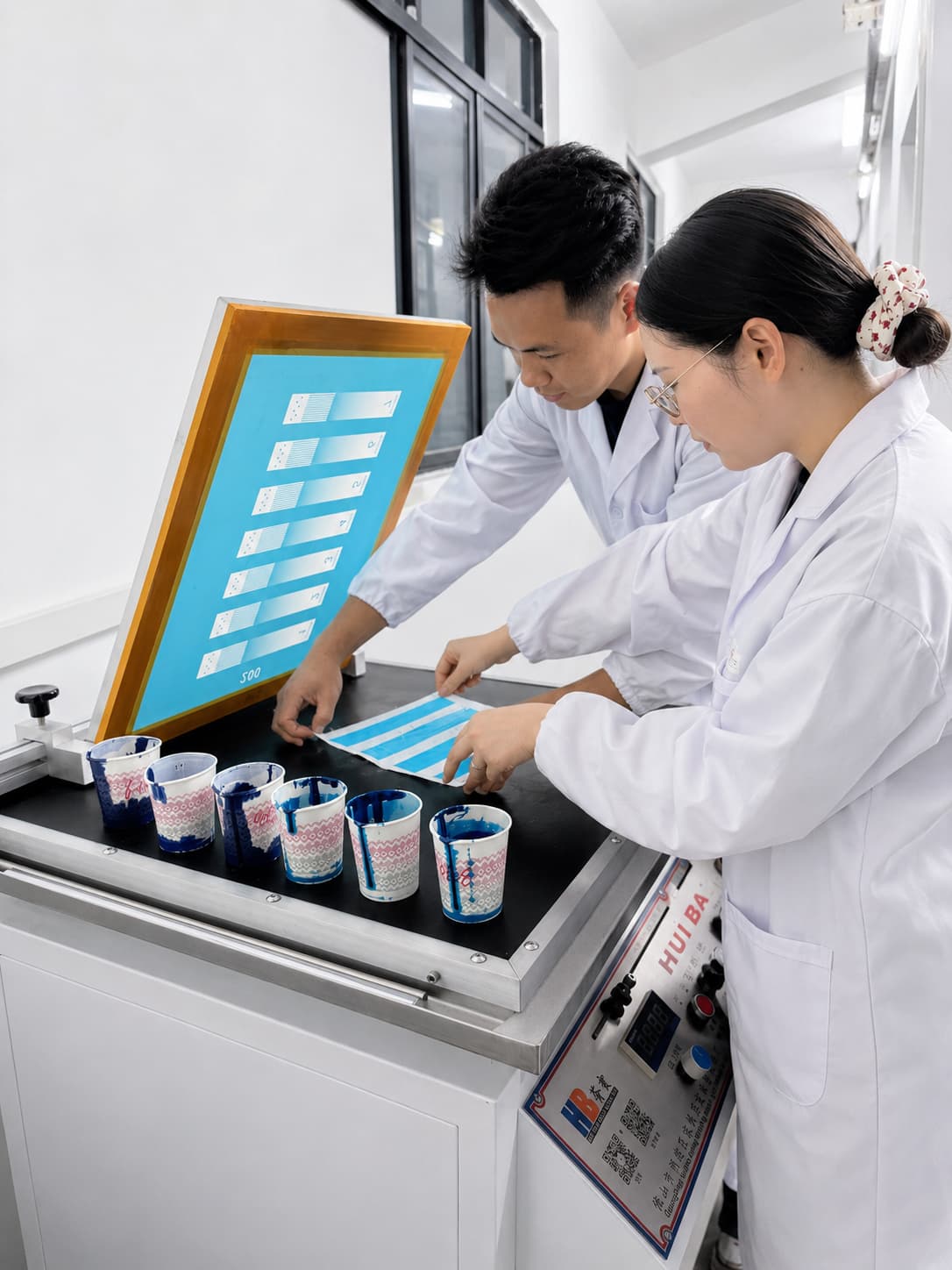
Use the current approved formula as the reference.
Step 1: Fix Pigment and Binder
Do not change binder and thickener simultaneously.
Step 2: Build a Thickener Dosage Curve
Find the useful viscosity/rheology window.
Step 3: Measure Complete-Paste Rheology
Include pigment, binder, fixer and auxiliaries.
Step 4: Print the Same Fabric
Use matched screen and squeegee conditions.
Step 5: Dry and Cure Identically
Do not allow curing variation to distort the comparison.
Step 6: Evaluate Finished Fabric
K/S or relative color yield
সংজ্ঞা মুদ্রণ করুন
প্রবেশ
Dry rubbing fastness
Wet rubbing fastness
কাপড়ের হাত
This creates a complete thickener-performance map instead of a viscosity-only comparison.
Use a Current Production Reference
Run the candidate acrylic thickener beside the current approved product.
Keep constant:
রঞ্জক
বাইন্ডার
ফিক্সার
কাপড়
Screen
Squeegee
শুকানো
শুকানো
If the candidate requires a different dosage to reach the same useful rheology window, use the appropriate dosage and record it.
Do not force equal dosage only for the sake of comparison.
উৎপাদন পরীক্ষার অনুমোদন
Only the best laboratory condition should move to production.
রেকর্ড:
ঘনকারী গ্রেড / ব্যাচ
ঘনকারী মাত্রা
বাইন্ডার গ্রেড / মাত্রা
Pigment shade
চূড়ান্ত pH
শুরু/মধ্য/শেষ-প্রবাহ সান্দ্রতা
স্ক্রিন আচরণ
Beginning-to-end shade
Curing condition
শুকনো/ভেজা ঘষা
কাপড়ের হাত
Approve the thickener only when both production stability and finished fabric pass.
ত্রুটি সমাধান সারণি
পর্যবেক্ষিত সমস্যা
প্রথমে যাচাই করার ভেরিয়েবলসমূহ
অনুমান করবেন না
Color yield is weak
Deposit, penetration, pigment load, rheology
More thickener will deepen color
Rubbing fastness is poor
Binder, curing, pigment/binder distribution
Thickener is the main fixation problem
Fabric hand is too stiff
Binder solids, thickener solids, deposit, curing
Binder alone causes all stiffness
Higher thickener improves definition but K/S drops
Transfer, penetration, leveling
Higher viscosity always improves print quality
Higher binder improves rubbing but paste thins
Binder compatibility, electrolyte load, pH
More thickener is automatically the best correction
Dark shade is weaker or thinner
Pigment loading, dilution, electrolytes
Light-shade dosage fits every shade
Lab result good but rotary run drifts
Holding time, continuous shear, temperature
Short lab test proves production stability
Same viscosity gives different hand
Active solids, binder, paste deposit
Same Brookfield value means same polymer load
ব্যবহারে মোট খরচ
Thickener optimization should include:
Total Cost in Use = Thickener + Binder + Pigment + Preparation + Machine Efficiency + Curing + Rework + Quality Loss
A low-dose acrylic thickener can reduce polymer solids and cost if it remains stable in the complete formula.
But a very low-priced thickener can become expensive if it causes:
More binder adjustment
More screen cleaning
Lower machine speed
More rework
Harder fabric hand
Compare cost per acceptable printed meter rather than price per kilogram.
What Information Should You Send to a Thickener Supplier?
For useful acrylic-thickener matching, provide:
Current thickener product / TDS
বর্তমান মাত্রা
সান্দ্রতা এবং সম্পূর্ণ পরীক্ষণ পদ্ধতি
Pigment type / dosage
বাইন্ডার গ্রেড / মাত্রা
Fixer / auxiliaries
চূড়ান্ত পেস্টের pH
কাপড়
সমতল বা ঘূর্ণায়মান স্ক্রিন
স্ক্রিন মেশ / খোদাই
Curing temperature / time
Current K/S / color-yield concern
Dry / wet rubbing result
Fabric-hand target
FSX কেমিক্যাল এই তথ্যটি ব্যবহার করতে পারে মাধ্যমে নমুনা ও মিলान to define a controlled current-vs-candidate comparison.
How Should a Mill Evaluate Acrylic Thickener Impact on Color, Fastness and Hand?
A practical sequence is:
Fix Pigment & Binder → Optimize Thickener Rheology → Print → Measure Deposit / Penetration → Cure → Measure K/S → Test Dry / Wet Rubbing → Evaluate Hand → Calculate Total Cost in Use
মূল নীতিগুলি হল:
Acrylic thickener affects color yield mainly through rheology, deposit and penetration.
Rubbing fastness is controlled primarily by binder film and curing, while thickener affects it indirectly through paste distribution.
Fabric hand depends on total polymer solids, deposit and curing—not thickener dosage alone.
Higher thickener dosage is not automatically better for color, fastness or hand.
Binder level must be kept constant when comparing thickener grades unless binder optimization is the test objective.
The best formulation balances color yield, rubbing fastness, hand and Total Cost in Use.
প্রায়শই জিজ্ঞাসিত প্রশ্নাবলী
1. Does acrylic thickener directly improve rubbing fastness?
Not directly. Binder and curing create the main pigment-fixation film. Thickener can influence rubbing performance indirectly through pigment/binder distribution, paste deposit and penetration.
2. Can more acrylic thickener increase color yield?
Sometimes up to the useful rheology range, but excessive dosage can reduce transfer or leveling. Color yield should be measured after curing.
3. Why can a low-viscosity pigment paste give weak surface color?
Excessive penetration can move more pigment below the surface, reducing apparent surface color strength.
4. Why can too much thickener make pigment-printed fabric stiff?
Higher thickener dosage can increase polymer solids and surface deposit, adding to the binder-film stiffness.
5. What affects pigment rubbing fastness most?
Binder chemistry, binder dosage, curing and pigment/binder distribution are major factors. Thickener supports the process by controlling paste distribution.
6. Why does more binder improve rubbing but worsen hand?
More binder film can retain pigment more effectively but also increases the polymer layer on the textile, which can raise stiffness.
7. Should binder dosage be changed when comparing two thickeners?
Normally keep binder constant first so the thickener effect can be isolated. Optimize binder separately if needed.
8. Why do dark shades behave differently from light shades?
Higher pigment loading can change water, surfactant, dispersant and electrolyte levels, shifting the complete-paste rheology.
9. Does the same Brookfield viscosity mean the same fabric hand?
No. Active solids, polymer architecture, binder level and paste deposit can differ even when viscosity is similar.
10. Should hand be judged before curing?
No. Final hand should be assessed after the actual drying, curing and any post-treatment used in production.
11. What is the best thickener dosage for pigment printing?
There is no universal dosage. Build a working curve and choose the lowest stable dosage that meets rheology, color, fastness and hand targets.
12. What should I send FSX Chemical for acrylic-thickener optimization?
Send the current thickener/TDS, dosage, viscosity method, pigment, binder, fixer, fabric, machine route, curing conditions, rubbing results and hand target.
Balance Color Yield, Rubbing Fastness and Fabric Hand
If your pigment-printing paste gives acceptable viscosity but the cured fabric shows weak color, poor rubbing or excessive stiffness, FSX Chemical can help structure a controlled thickener–binder comparison.
একটি কার্যকর প্রযুক্তিগত পর্যালোচনার জন্য পাঠান:
আপনার বর্তমান অ্যাক্রিলিক থিকেনার নমুনা, TDS বা COA
ঘনকারী মাত্রা
সান্দ্রতা এবং সম্পূর্ণ পরীক্ষণ পদ্ধতি
Pigment type and dosage
Binder grade and dosage
Fixer / auxiliaries
চূড়ান্ত পেস্টের pH
Fabric and screen-printing route
Curing temperature and time
K/S / color-yield target
Dry / wet rubbing target
Fabric-hand target
দিয়ে শুরু করুন নমুনা ও মিলान for a controlled current-vs-candidate trial.
The best acrylic thickener is not the one that maximizes one property. It is the grade that helps the complete pigment-binder system reach the required color yield, rubbing performance and fabric hand at a stable production cost.
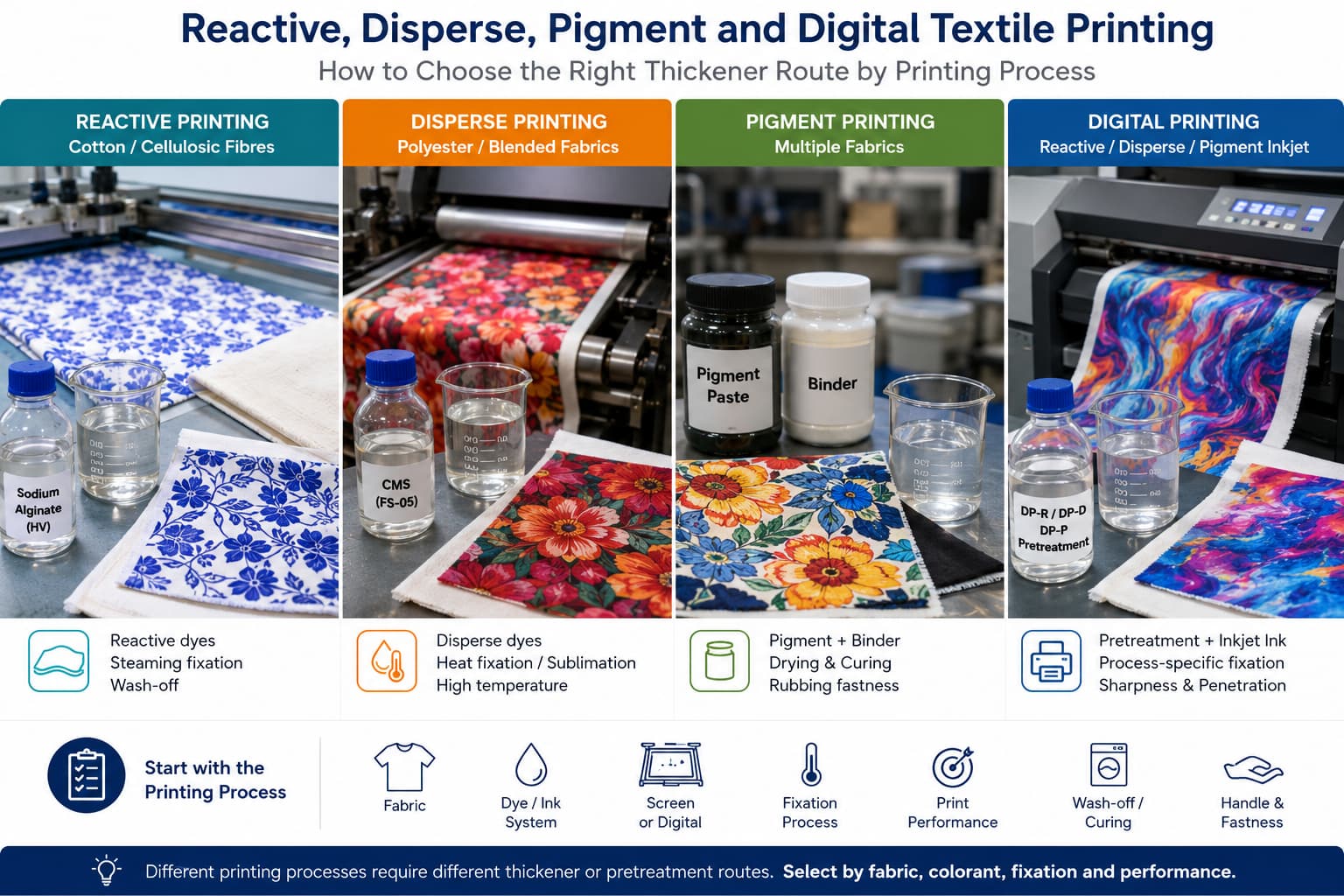
কাপড়, রঞ্জক বা কালি, স্থিরীকরণ, ধুয়ে ফেলার এবং মুদ্রণ-মানের প্রয়োজনীয়তার ভিত্তিতে প্রতিক্রিয়াশীল, বিচ্ছুরিত, পিগমেন্ট এবং ডিজিটাল টেক্সটাইল প্রিন্টিংয়ের জন্য ঘনকারী ও প্রিট্রিটমেন্ট পদ্ধতি কীভাবে নির্বাচন করবেন তা শিখুন।.
CMC-ভিত্তিক প্রিন্টিং পেষ্ট পিগমেন্ট, রিঅ্যাক্টিভ এবং ডিজিটাল টেক্সটাইল প্রিন্টিংয়ে ব্যবহৃত হয়। এই গাইডে কোন প্যারামিটারগুলো গুরুত্বপূর্ণ, সরবরাহকারীদের কীভাবে তুলনা করবেন এবং বড় অর্ডার দেওয়ার আগে কী জানতে হবে তা ব্যাখ্যা করা হয়েছে।.
টেক্সটাইল প্রিন্টিং-এ ঘনকারী হিসেবে সোডিয়াম অ্যালজিনেট এবং CMC উভয়ই ব্যবহৃত হয়, তবে এগুলো ভিন্ন রঞ্জক ব্যবস্থা ও প্রক্রিয়া শর্তের জন্য উপযুক্ত। এই গাইডে মূল পার্থক্যগুলো এবং কখন কোনটি ব্যবহার করতে হবে তা ব্যাখ্যা করা হয়েছে।.
রঙ স্থিরীকরণ হার সরাসরি প্রভাবিত করে রঙের ফলন, ধোয়ার স্থায়িত্ব এবং দূষিত জল নির্গমনের পরিমাণ রিঅ্যাক্টিভ ডাই প্রিন্টিং-এ। এই গাইডে ব্যাখ্যা করা হয়েছে কীভাবে সোডিয়াম অ্যালজিনেট রঙ স্থিরীকরণে সহায়তা করে, কোন পেস্ট পরামিতিগুলো স্থিরীকরণ হারে প্রভাব ফেলে এবং উৎপাদনে কম স্থিরীকরণের সমস্যা কীভাবে সমাধান করতে হয়।.
সঠিক টেক্সটাইল প্রিন্টিং থিকেনার শুধুমাত্র কাপড়ের ধরণের উপর নির্ভর করে না। ক্রেতাদের উচিত থিকেনারকে রঞ্জক বা পিগমেন্ট সিস্টেম, প্রিন্টিং পদ্ধতি, লক্ষ্যকৃত রিয়োলজি, ধুয়ে ফেলার প্রয়োজনীয়তা এবং প্রকৃত কারখানার পরীক্ষামূলক অবস্থার সাথে মিলিয়ে নেওয়া।.
টেক্সটাইল প্রিন্টিংয়ের কর্মক্ষমতা একটি সমন্বিত রাসায়নিক ব্যবস্থার উপর নির্ভর করে, কোনো একক সংযোজকের উপর নয়। এই গাইডে দশটি গুরুত্বপূর্ণ রাসায়নিক গ্রুপ, তাদের কার্যকারিতা, কোথায় ব্যবহার করতে হয় এবং উৎপাদন পরীক্ষার আগে ক্রেতাদের কী যাচাই করা উচিত তা ব্যাখ্যা করা হয়েছে।.
টেক্সটাইল প্রিন্টিং থিকেনারগুলো রসায়ন, রেওলজি, রঞ্জক সামঞ্জস্যতা এবং ধোয়ার সময় অপসারণ আচরণে ভিন্নতা রয়েছে। এই গাইডে প্রধান থিকেনার পরিবারগুলো, তাদের সাধারণ প্রয়োগ নির্দেশিকা এবং উৎপাদন পরীক্ষার আগে ক্রেতাদের যাচাই করা উচিত এমন পরামিতিগুলো তুলনা করা হয়েছে।.
ডিজিটাল প্রিন্টিং পেষ্টগুলিকে ইঙ্কের রসায়ন, কাপড়, প্রয়োগ পদ্ধতি এবং পরবর্তী প্রক্রিয়াকরণ অনুযায়ী নির্বাচন করা উচিত। এই গাইডে টেক্সটাইল ইঙ্কজেট প্রিন্টিংয়ের জন্য সোডিয়াম অ্যালজিনেট, CMC, CMS, সিন্থেটিক পলিমার এবং যৌগিক প্রিট্রিটমেন্ট পদ্ধতিগুলি তুলনা করা হয়েছে।.
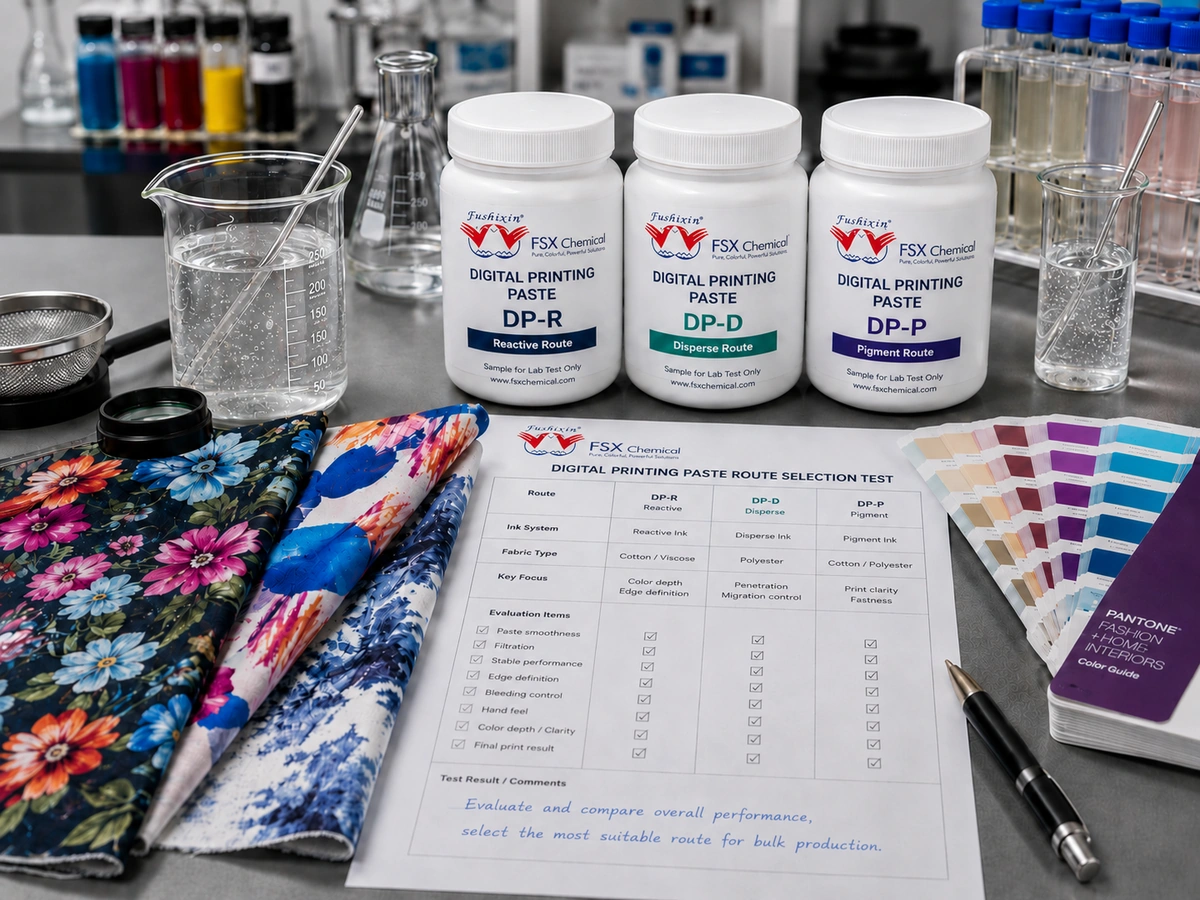
FSX Chemical offers separate digital printing paste routes for reactive, disperse and pigment systems, supported by application review, sample matching and technical documentation. This guide explains how buyers can evaluate the right route before bulk purchasing.
Stable digital printing paste requires more than a target viscosity. This guide explains how product selection, water quality, addition sequence, mixing, pH, temperature, filtration, hygiene, storage and quality records influence pretreatment and production consistency.
এই পণ্য পর্যালোচনায় FSX ডিজিটাল প্রিন্টিং পেস্টকে টেক্সটাইল ইনকজেট প্রিট্রিটমেন্ট এবং ঘনত্ব বৃদ্ধির মাধ্যম হিসেবে পরীক্ষা করা হয়েছে, যেখানে মনোযোগ দেওয়া হয়েছে ইনক-সিস্টেমের সামঞ্জস্য, রেওলজি, ফিল্ট্রেশন, প্রিন্ট সংজ্ঞা, স্থিতিশীলতা এবং বাস্তব উৎপাদন পরীক্ষায়।.
Digital textile printing requires more than advanced ink and printheads. Explore process-specific chemical solutions for reactive, disperse and pigment inkjet printing, from pretreatment and rheology to filtration, fixation and production validation.
পণ্যের নাম, ব্যবহার, পরিমাণ, গন্তব্য এবং আপনার কাছে থাকা যেকোনো TDS, নমুনা ছবি বা ডকুমেন্ট শেয়ার করুন। FSX Chemical এই তথ্য পর্যালোচনা করবে এবং কোটেশন, নমুনা মিলানো বা পণ্য নির্বাচনের পরবর্তী ধাপের জন্য পরামর্শ দেবে।.
পণ্যের তথ্যপণ্যের নাম, গ্রেড, মডেল, লেবেলের ছবি বা সরবরাহকারীর রেফারেন্স।.