How Acrylic Thickener Affects Pigment Printing Rubbing Fastness, Fabric Hand and Color Yield
Acrylic thickener affects pigment-printing color yield, rubbing performance and fabric hand mainly through rheology, paste...
Acrylic thickener affects pigment printing indirectly but importantly. It does not replace the binder and it does not create rubbing fastness by itself. Instead, it controls paste rheology, screen transfer, pigment and binder distribution, surface deposit, penetration and the amount of polymer solids left on the fabric. Those changes can influence final color yield, how effectively the binder film develops during curing, and how stiff or soft the printed area feels. The correct evaluation therefore connects thickener dosage and rheology with binder level, curing, K/S, dry and wet rubbing fastness and fabric hand rather than judging the thickener from viscosity alone.
How Does Acrylic Thickener Affect Pigment Printing?
Acrylic thickener mainly affects pigment printing by controlling how the printing paste flows before, during and after screen transfer.
That rheology influences:
How much paste is transferred
How evenly pigment and binder are distributed
How deeply the paste penetrates the textile
How sharply the design remains after printing
How much thickener polymer remains in the printed area
These factors can then influence:
Rendement en couleur
Binder-film uniformity
Performances au frottement
Tissu à la main
The relationship is indirect.
Acrylic Thickener → Rheology / Deposit / Distribution → Curing Result → Color / Fastness / Hand
The thickener does not replace correct binder dosage or curing conditions.
Thickener, Binder and Pigment Have Different Jobs
Pigment
Provides the color.
Binder
Forms a film during curing that anchors pigment particles to the textile surface and develops rubbing and wash durability.
Acrylic Thickener
Controls the flow and distribution of the complete printing paste.
This distinction is essential because a rubbing-fastness problem can be incorrectly blamed on the thickener when the real problem is:
Binder dosage
Chimie des liants
Curing temperature
Curing time
Pigment loading
Fabric surface
Likewise, a color-yield problem can be caused by excessive penetration even when binder fastness is good.
1. How Acrylic Thickener Can Affect Color Yield
Acrylic thickener can influence apparent color yield because it controls where the pigment-binder paste is deposited.
If the paste is too fluid:
Penetration can increase.
More pigment may move below the surface.
Surface color can appear weaker.
Fine edges can spread.
If the paste is excessively structured:
Transfer can become incomplete.
Solid areas can become uneven.
Surface leveling can decrease.
The optimum color yield therefore comes from balanced rheology rather than maximum viscosity.
Research reviews on acrylic-based pigment-printing thickeners have long identified depth of color, brightness and print sharpness as properties influenced by thickener selection and paste flow.
2. Paste Deposit and Pigment Distribution
The quantity of wet paste placed on the fabric affects how much pigment and binder are available in the printed area.
Paste deposit is influenced by:
Thickener rheology
Screen geometry
Squeegee pressure
Vitesse de la machine
Capacité d'absorption du tissu
Shear thinning can assist screen passage, but the rate of recovery after transfer is a separate property to measure. Compare the actual deposited amount and its distribution under the same screen, squeegee, speed and fabric conditions rather than assuming that a shear-thinning grade automatically rebuilds a useful structure.
This can support more uniform distribution of:
Pigment particles
Binder polymer
Fixer
Autres auxiliaires
Uneven rheology can create uneven deposit even when the formula itself is chemically correct.
3. Penetration vs. Surface Color
More penetration is not automatically better.
In pigment printing, strong surface color often depends on retaining enough pigment near the fabric surface.
Excessive penetration can reduce apparent surface depth.
Insufficient penetration can create:
Surface-heavy deposits
Poor coverage on textured fabrics
Different hand or film appearance
The target depends on:
Composition du tissu
Poids du tissu
Pigment loading
Binder level
Design coverage
Acrylic thickener should therefore be optimized together with the intended substrate rather than selected only from a laboratory beaker test.
4. Shear Thinning, Recovery and Print Definition
Useful pigment-printing paste normally needs:
Measure low-shear body → measure flow under higher shear → separately measure recovery over defined time → verify transfer and the finished print. A flow curve describes the response to shear rate; it does not establish how rapidly viscosity or structure returns after the squeegee stroke. For a proposed comparison, use the same low/high/low-shear sequence, temperature, geometry, sample history and evaluation times. TA Instruments’ recovery-method note explains the time-dependent measurement; its paint examples are not textile-paste acceptance limits.
Low-shear body helps limit unwanted spreading.
Shear thinning helps the paste move through the screen.
Recovery helps stabilize the pattern after transfer.
5. How Thickener Can Indirectly Affect Rubbing Fastness
Acrylic thickener does not create pigment fixation by itself.
However, it can influence the conditions under which the binder film forms.
Possible indirect effects include:
Uneven pigment / binder distribution
Excess or insufficient paste deposit
Excess penetration
Poor screen transfer
High polymer solids
If the thickener creates an uneven print film, the binder can also be distributed unevenly.
This can contribute to variable rubbing performance even when the binder dosage is nominally correct.
Research on pigment-printing systems has evaluated thickener viscosity together with binder concentration and curing because these variables interact in the final rubbing result.
The correct conclusion is:
Thickener Supports Fastness Through Paste Control; Binder and Curing Create the Main Fixation Film.
6. Why Binder Level Usually Matters More for Fastness
Binder concentration has a direct influence on pigment fixation.
Increasing binder can improve dry and wet rubbing resistance within the useful formulation range because more binder film is available to retain pigment.
But higher binder level can also increase:
Pénétration
Surface polymer mass
Fabric stiffness
Published pigment-printing studies have reported improved dry and wet rubbing fastness as acrylic binder concentration increased, while stiffness also increased.
Therefore, if rubbing fastness is low, do not increase thickener first.
Vérifier :
Binder grade
Binder dosage
Durcissement
Pigment/binder ratio
Paste distribution
7. Why Curing Must Be Controlled Before Comparing Thickeners
The binder film develops during curing.
If curing differs between two test samples, the final rubbing-fastness difference cannot be assigned confidently to the thickener.
Keep constant:
Drying condition
Curing temperature
Curing time
Fabric lot
Research on cured pigment prints evaluates color properties, wash fastness, dry/wet rubbing and fabric stiffness after defined curing conditions because the final film develops after the wet printing stage.
A paste that looks excellent before curing can still give poor fastness afterward.
8. How Acrylic Thickener Can Affect Fabric Hand
Fabric hand is influenced by the total polymer and film structure left on the textile.
The main contributors include:
Binder solids
Thickener solids
Paste deposit
Pénétration
Durcissement
Acrylic thickener can support a softer hand when it reaches the required rheology at a relatively low dosage.
But this is not automatic.
If the formula requires:
Excess thickener
Excess binder
Heavy paste deposit
the printed area can become noticeably stiffer.
Always judge hand after curing, not from the wet paste.
9. Thickener Solids, Binder Solids and Surface Film
Commercial acrylic thickeners can differ in supplied-product composition, measured nonvolatile matter and documented active-polymer fraction. A drying-based nonvolatile result can include nonpolymer ingredients; do not use it as an active-polymer assay.
Therefore, compare:
As-Supplied Dosage
and:
Documented Active-Polymer Addition (if available)
A low as-supplied dosage does not automatically mean low active polymer addition.
To estimate polymer delivery, multiply each product’s measured consumption by its separately documented polymer fraction, then relate delivery to the accepted fabric area or dry fabric mass. If that fraction is unknown, report it as unknown. A total-nonvolatile estimate answers a different question and includes retained nonpolymer material.
Documented binder-polymer delivery + documented thickener-polymer delivery + other defined film-forming components can support a component-specific comparison. Actual retained film still depends on paste deposit, migration and curing. Equal polymer delivery does not guarantee equal hand or rubbing performance.
Use the complete deposited system to interpret fabric hand. Record supplied-product dose, any composition estimate and actual print deposit separately, then assess the cured fabric against the approved reference. Do not rank hand from total solids alone.
10. Dosage: Too Little vs. Too Much
Too Little Thickener
Possible symptoms include:
Low paste body
Excess spreading
Excess penetration
Poor edge definition
Too Much Thickener
Possible symptoms include:
Poor screen transfer
High squeegee pressure requirement
Excess elasticity
Heavy polymer deposit
Stiffer fabric hand
The correct dosage is the lowest stable dosage that keeps the complete pigment paste inside the approved rheology window.
Acrylic thickener should maintain useful rheology across the real production holding time.
Vérifier :
Fresh viscosity
Intermediate viscosity
End-of-shift viscosity
pH
Mousse
Séparation
A paste that becomes thinner during holding can produce:
More penetration
Weaker surface color
Less consistent definition
A paste that becomes thicker can create:
Poor transfer
More pressure
Uneven solid areas
Color yield and hand should therefore be compared across the expected production age—not only with fresh paste.
14. Fabric Construction Changes the Result
The same pigment paste can produce different color yield and hand on:
Coton
Polyester
CVC / PC blends
Knits
Wovens
Light vs. heavy fabrics
Fabric absorbency and surface structure influence:
Paste pickup
Pénétration
Surface pigment concentration
Perceived stiffness
Published acrylic-binder work has shown different stiffness responses on cotton, polyester and CVC fabrics under the same general pigment-printing study.
Do not approve an acrylic thickener on one laboratory fabric and assume identical hand on every substrate.
15. Light vs. Dark Pigment Shades
Dark shades typically use more pigment dispersion.
This can increase:
Pigment solids
Dispersant / surfactant level
Electrolyte load
Water added with pigment
Therefore, a thickener dosage that performs well in a light shade may not give the same rheology in a heavy shade.
Test representative:
Light shade
Normal shade
Dark shade
when the product range includes large pigment-loading differences.
16. Flat Screen vs. Rotary Screen
Machine architecture changes shear history.
Écran plat
Vérifier :
Stroke behavior
Pause / restart
Recovery
Screen drying
Crible rotatif
Vérifier :
Pumpability
Continuous shear
Diffusion
Mid-run viscosity
End-run viscosity
A thickener that gives good hand and color in a short flat-screen test should still be validated on the real production machine.
The Three-Way Balance: Color Yield, Fastness and Hand
Pigment printing is often a three-way optimization.
Rendement en couleur
needs enough pigment near the useful surface region.
Rubbing Fastness
needs an effective binder film and correct curing.
Fabric Hand
benefits from limiting unnecessary polymer-film mass and excessive surface deposit.
These goals can conflict.
For example:
Binder ↑ → Fastness May Improve → Stiffness May Increase
and:
Thickener ↑ → Body May Improve → Polymer Solids / Transfer Resistance May Increase
The best formulation is therefore not the one that maximizes one property.
It is the formulation that meets all three acceptance targets.
Recommended Laboratory Test Plan
Use the current approved formula as the reference.
Step 1: Fix Pigment and Binder
Do not change binder and thickener simultaneously.
Step 2: Build a Thickener Dosage Curve
Find the useful viscosity/rheology window.
Step 3: Measure Complete-Paste Rheology
Include pigment, binder, fixer and auxiliaries.
Step 4: Print the Same Fabric
Use matched screen and squeegee conditions.
Step 5: Dry and Cure Identically
Do not allow curing variation to distort the comparison.
Step 6: Evaluate Finished Fabric
K/S or relative color yield
Définition de l'impression
Pénétration
Dry rubbing fastness
Wet rubbing fastness
Tissu à la main
This creates a complete thickener-performance map instead of a viscosity-only comparison.
Use a Current Production Reference
Run the candidate acrylic thickener beside the current approved product.
Keep constant:
Pigment
Binder
Fixer
Tissu
Screen
Squeegee
Séchage
Durcissement
If the candidate requires a different dosage to reach the same useful rheology window, use the appropriate dosage and record it.
Do not force equal dosage only for the sake of comparison.
Production Trial Approval
Only the best laboratory condition should move to production.
Record:
Thickener grade / batch
Dosage de l'épaississant
Binder grade / dosage
Pigment shade
Final pH
Start / mid / end-run viscosity
Screen behavior
Beginning-to-end shade
Curing condition
Dry / wet rubbing
Tissu à la main
Approve the thickener only when both production stability and finished fabric pass.
Troubleshooting Table
Problème constaté
First Variables to Check
Do Not Assume
Color yield is weak
Deposit, penetration, pigment load, rheology
More thickener will deepen color
Rubbing fastness is poor
Binder, curing, pigment/binder distribution
Thickener is the main fixation problem
Fabric hand is too stiff
Binder solids, thickener solids, deposit, curing
Binder alone causes all stiffness
Higher thickener improves definition but K/S drops
Transfer, penetration, leveling
Higher viscosity always improves print quality
Higher binder improves rubbing but paste thins
Binder compatibility, electrolyte load, pH
More thickener is automatically the best correction
Dark shade is weaker or thinner
Pigment loading, dilution, electrolytes
Light-shade dosage fits every shade
Lab result good but rotary run drifts
Holding time, continuous shear, temperature
Short lab test proves production stability
Same viscosity gives different hand
Documented composition, binder, paste deposit
Same Brookfield value means same polymer load
Coût total d'utilisation
Thickener optimization should include:
Total cost per accepted m² = allocated monetary batch costs ÷ accepted fabric area. Calculate thickener, binder and pigment costs from actual supplied-product mass consumed multiplied by delivered price per kilogram. Add consistently allocated preparation, printing, curing, cleaning, rework and disposal costs in the same currency. Keep machine efficiency and capacity separate until a stated monetary allocation is applied, and count each material or quality loss only once.
A lower supplied-product dose may reduce consumption, but it does not by itself prove lower active-polymer delivery, less retained film or a cost saving. Use documented composition, measured deposit, current quotations and equivalent accepted finished quality for the comparison.
But a very low-priced thickener can become expensive if it causes:
More binder adjustment
More screen cleaning
Lower machine speed
More rework
Harder fabric hand
Compare cost per accepted square metre on the same quality and accounting basis. A per-linear-metre comparison is meaningful only when fabric width and the relevant specifications are matched.
What Information Should You Send to a Thickener Supplier?
For useful acrylic-thickener matching, provide:
Current thickener product / TDS
Posologie actuelle
Viscosity and complete test method
Pigment type / dosage
Binder grade / dosage
Fixer / auxiliaries
Final paste pH
Tissu
Flat or rotary screen
Screen mesh / engraving
Curing temperature / time
Current K/S / color-yield concern
Dry / wet rubbing result
Fabric-hand target
FSX Chemical can use this information through Échantillons et correspondances to define a controlled current-vs-candidate comparison.
How Should a Mill Evaluate Acrylic Thickener Impact on Color, Fastness and Hand?
A practical sequence is:
Fix Pigment & Binder → Optimize Thickener Rheology → Print → Measure Deposit / Penetration → Cure → Measure K/S → Test Dry / Wet Rubbing → Evaluate Hand → Calculate Total Cost in Use
Les principes fondamentaux sont les suivants :
Acrylic thickener affects color yield mainly through rheology, deposit and penetration.
Rubbing fastness is controlled primarily by binder film and curing, while thickener affects it indirectly through paste distribution.
Fabric hand depends on total polymer solids, deposit and curing—not thickener dosage alone.
Higher thickener dosage is not automatically better for color, fastness or hand.
Binder level must be kept constant when comparing thickener grades unless binder optimization is the test objective.
The best formulation balances color yield, rubbing fastness, hand and Total Cost in Use.
Foire aux questions
1. Does acrylic thickener directly improve rubbing fastness?
Not directly. Binder and curing create the main pigment-fixation film. Thickener can influence rubbing performance indirectly through pigment/binder distribution, paste deposit and penetration.
2. Can more acrylic thickener increase color yield?
Sometimes up to the useful rheology range, but excessive dosage can reduce transfer or leveling. Color yield should be measured after curing.
3. Why can a low-viscosity pigment paste give weak surface color?
Excessive penetration can move more pigment below the surface, reducing apparent surface color strength.
4. Why can too much thickener make pigment-printed fabric stiff?
Higher thickener dosage can increase polymer solids and surface deposit, adding to the binder-film stiffness.
5. What affects pigment rubbing fastness most?
Binder chemistry, binder dosage, curing and pigment/binder distribution are major factors. Thickener supports the process by controlling paste distribution.
6. Why does more binder improve rubbing but worsen hand?
More binder film can retain pigment more effectively but also increases the polymer layer on the textile, which can raise stiffness.
7. Should binder dosage be changed when comparing two thickeners?
Normally keep binder constant first so the thickener effect can be isolated. Optimize binder separately if needed.
8. Why do dark shades behave differently from light shades?
Higher pigment loading can change water, surfactant, dispersant and electrolyte levels, shifting the complete-paste rheology.
9. Does the same Brookfield viscosity mean the same fabric hand?
No. Documented composition, polymer architecture, binder level, deposited amount and curing can differ even when one viscosity reading is similar. Nonvolatile content and active-polymer content must retain their own measurement bases.
10. Should hand be judged before curing?
No. Final hand should be assessed after the actual drying, curing and any post-treatment used in production.
11. What is the best thickener dosage for pigment printing?
There is no universal dosage. Build a working curve and choose the lowest stable dosage that meets rheology, color, fastness and hand targets.
12. What should I send FSX Chemical for acrylic-thickener optimization?
Send the current thickener/TDS, dosage, viscosity method, pigment, binder, fixer, fabric, machine route, curing conditions, rubbing results and hand target.
Balance Color Yield, Rubbing Fastness and Fabric Hand
If your pigment-printing paste gives acceptable viscosity but the cured fabric shows weak color, poor rubbing or excessive stiffness, FSX Chemical can help structure a controlled thickener–binder comparison.
The best acrylic thickener is not the one that maximizes one property. It is the grade that helps the complete pigment-binder system reach the required color yield, rubbing performance and fabric hand at a stable production cost.
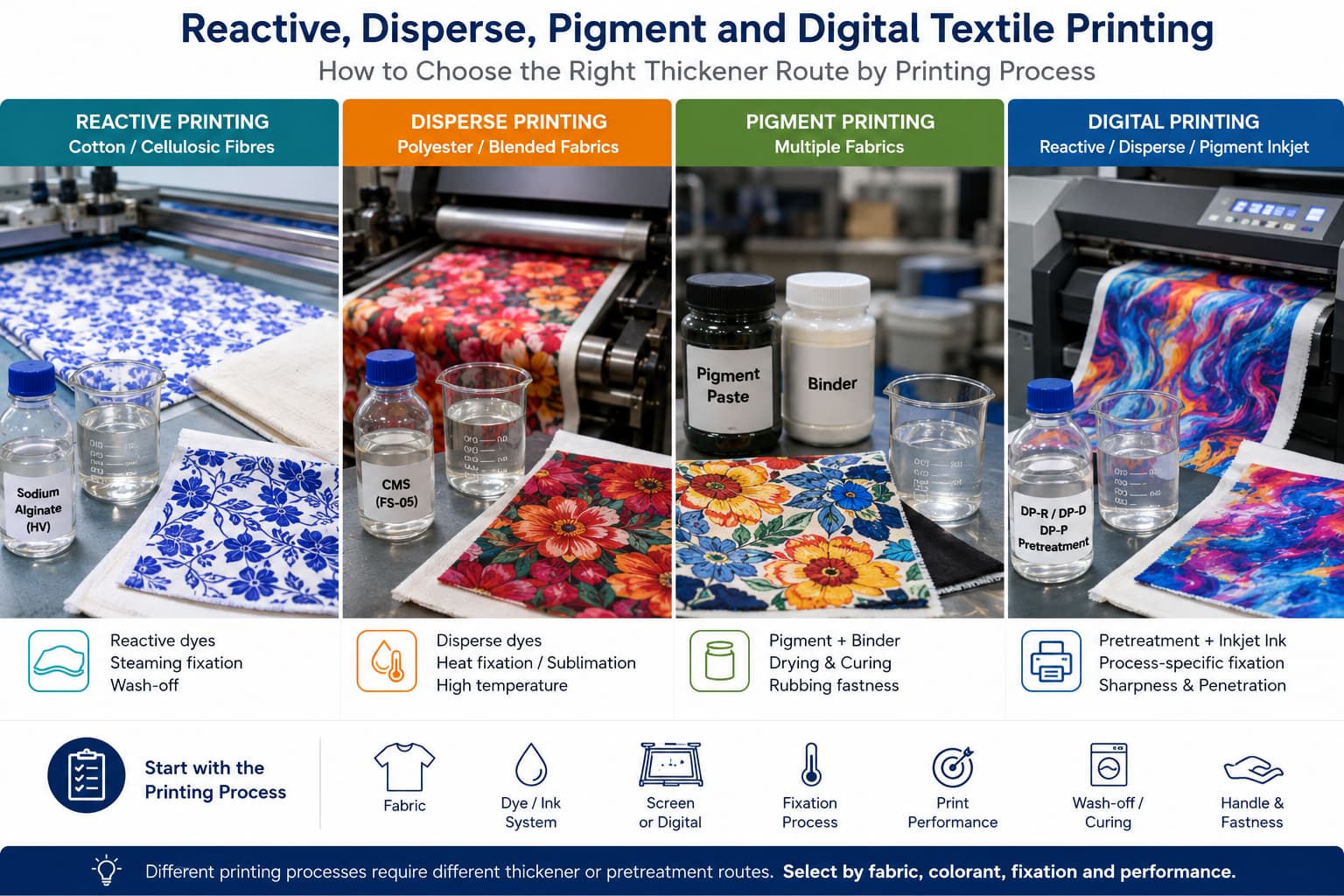
Découvrez comment choisir les agents épaississants et les procédés de prétraitement adaptés à l'impression textile réactive, dispersée, pigmentée et numérique, en fonction des exigences liées au tissu, à la teinture ou à l'encre, à la fixation, à l'élimination au lavage et à la qualité d'impression.
La pâte d'impression à base de CMC est utilisée dans l'impression textile pigmentaire, réactive et numérique. Ce guide explique quels sont les paramètres importants, comment comparer les fournisseurs et ce qu'il faut demander avant de passer une commande en gros.
L'alginate de sodium et la CMC sont tous deux utilisés comme épaississants dans l'impression textile, mais ils conviennent à des systèmes de teinture et à des conditions de traitement différents. Ce guide explique les principales différences entre ces deux produits et précise dans quels cas il convient d'utiliser l'un ou l'autre.
Separate reactive dye fixation from retained color and fastness. Review alginate preparation, application, alkali, paste age, steaming and wash-off through defined control comparisons; shade or rinse color alone does not establish fixation percentage.
Le choix d'un épaississant adapté à l'impression textile ne dépend pas uniquement du type de tissu. Les acheteurs doivent choisir l'épaississant en fonction du système de colorants ou de pigments utilisé, de la méthode d'impression, des propriétés rhéologiques recherchées, des exigences en matière de lavabilité et des conditions réelles d'essai en usine.
Les performances de l'impression textile dépendent d'un système chimique coordonné, et non d'un additif universel. Ce guide présente dix groupes chimiques importants, leurs fonctions, leur rôle dans le processus et les éléments que les acheteurs doivent vérifier avant de procéder à des essais de production.
Les épaississants utilisés dans l'impression textile se distinguent par leurs propriétés chimiques, rhéologiques, leur compatibilité avec les colorants et leur comportement au lavage. Ce guide compare les principales familles d'épaississants, leurs modes d'application courants et les paramètres que les acheteurs doivent vérifier avant de procéder à des essais de production.
Le choix des pâtes d'impression numérique doit tenir compte de la composition chimique de l'encre, du tissu, de la méthode d'application et du post-traitement. Ce guide compare différentes méthodes de prétraitement pour l'impression textile à jet d'encre : l'alginate de sodium, le CMC, le CMS, les polymères synthétiques et les composés.
An FSX-authored guide to checking digital pretreatment fit, trial evidence, product documents and sample-to-bulk traceability before supplier approval.
Stable digital printing paste requires more than a target viscosity. This guide explains how product selection, water quality, addition sequence, mixing, pH, temperature, filtration, hygiene, storage and quality records influence pretreatment and production consistency.
Evaluate FSX fabric pretreatment by confirmed grade, ink route, application architecture and measured add-on. Compare DG-20 or DP-P in a defined trial, and qualify any disperse candidate separately.
L'impression textile numérique ne se limite pas à l'utilisation d'encres et de têtes d'impression de pointe. Découvrez des solutions chimiques adaptées à chaque procédé d'impression jet d'encre réactive, dispersée et pigmentaire, allant du prétraitement et de la rhéologie à la filtration, en passant par la fixation et la validation de la production.
Veuillez nous communiquer le nom du produit, son application, la quantité, la destination, ainsi que toute fiche technique (TDS),
photo ou document dont vous disposez déjà. FSX Chemical examinera ces
informations et vous recommandera la marche à suivre pour obtenir un devis, trouver un échantillon correspondant
ou choisir un produit.
Informations sur le produitNom du produit, référence, modèle, photo de l'étiquette ou référence du fournisseur.
Documents disponiblesFiche technique (TDS), fiche de données de sécurité (SDS), certificat d'analyse (COA), photo d'exemple, liste des produits ou données d'essai.
Détails de la commandeQuantité estimée, conditionnement, pays de destination, port ou conditions commerciales.
Demande ou problèmeProcédé d'impression textile, besoins en matière de formulation, problème actuel ou performances visées.