How Acrylic Thickener Affects Pigment Printing Rubbing Fastness, Fabric Hand and Color Yield
Acrylic thickener affects pigment-printing color yield, rubbing performance and fabric hand mainly through rheology, paste...
Acrylic thickener affects pigment printing indirectly but importantly. It does not replace the binder and it does not create rubbing fastness by itself. Instead, it controls paste rheology, screen transfer, pigment and binder distribution, surface deposit, penetration and the amount of polymer solids left on the fabric. Those changes can influence final color yield, how effectively the binder film develops during curing, and how stiff or soft the printed area feels. The correct evaluation therefore connects thickener dosage and rheology with binder level, curing, K/S, dry and wet rubbing fastness and fabric hand rather than judging the thickener from viscosity alone.
How Does Acrylic Thickener Affect Pigment Printing?
Acrylic thickener mainly affects pigment printing by controlling how the printing paste flows before, during and after screen transfer.
That rheology influences:
How much paste is transferred
How evenly pigment and binder are distributed
How deeply the paste penetrates the textile
How sharply the design remains after printing
How much thickener polymer remains in the printed area
These factors can then influence:
Цветоотдача
Binder-film uniformity
Характеристики при трении
Тканевая ручка
The relationship is indirect.
Acrylic Thickener → Rheology / Deposit / Distribution → Curing Result → Color / Fastness / Hand
The thickener does not replace correct binder dosage or curing conditions.
Thickener, Binder and Pigment Have Different Jobs
Пигмент
Provides the color.
Связующее вещество
Forms a film during curing that anchors pigment particles to the textile surface and develops rubbing and wash durability.
Акриловый загуститель
Controls the flow and distribution of the complete printing paste.
This distinction is essential because a rubbing-fastness problem can be incorrectly blamed on the thickener when the real problem is:
Дозировка связующего вещества
Химия связующих веществ
Температура отверждения
Время отверждения
Pigment loading
Fabric surface
Likewise, a color-yield problem can be caused by excessive penetration even when binder fastness is good.
1. How Acrylic Thickener Can Affect Color Yield
Acrylic thickener can influence apparent color yield because it controls where the pigment-binder paste is deposited.
If the paste is too fluid:
Степень проникновения может увеличиться.
More pigment may move below the surface.
Surface color can appear weaker.
Fine edges can spread.
If the paste is excessively structured:
Transfer can become incomplete.
Solid areas can become uneven.
Surface leveling can decrease.
The optimum color yield therefore comes from balanced rheology rather than maximum viscosity.
Research reviews on acrylic-based pigment-printing thickeners have long identified depth of color, brightness and print sharpness as properties influenced by thickener selection and paste flow.
2. Paste Deposit and Pigment Distribution
The quantity of wet paste placed on the fabric affects how much pigment and binder are available in the printed area.
Paste deposit is influenced by:
Thickener rheology
Screen geometry
Давление скребка
Скорость работы станка
Впитывающая способность ткани
Acrylic thickener that shear-thins efficiently can pass through the screen while still rebuilding structure after transfer.
This can support more uniform distribution of:
Частицы пигмента
Binder polymer
Ремонтник
Другие вспомогательные средства
Uneven rheology can create uneven deposit even when the formula itself is chemically correct.
3. Penetration vs. Surface Color
More penetration is not automatically better.
In pigment printing, strong surface color often depends on retaining enough pigment near the fabric surface.
Excessive penetration can reduce apparent surface depth.
Insufficient penetration can create:
Surface-heavy deposits
Poor coverage on textured fabrics
Different hand or film appearance
The target depends on:
Состав ткани
Плотность ткани
Pigment loading
Уровень наполнения папки
Объем проектирования
Acrylic thickener should therefore be optimized together with the intended substrate rather than selected only from a laboratory beaker test.
4. Shear Thinning, Recovery and Print Definition
Useful pigment-printing paste normally needs:
Low-Shear Body → Shear Thinning Under the Squeegee → Controlled Recovery After Transfer
Low-shear body helps limit unwanted spreading.
Shear thinning helps the paste move through the screen.
Recovery helps stabilize the pattern after transfer.
5. How Thickener Can Indirectly Affect Rubbing Fastness
Acrylic thickener does not create pigment fixation by itself.
However, it can influence the conditions under which the binder film forms.
Possible indirect effects include:
Uneven pigment / binder distribution
Excess or insufficient paste deposit
Excess penetration
Плохое качество переноса изображения на экран
High polymer solids
If the thickener creates an uneven print film, the binder can also be distributed unevenly.
This can contribute to variable rubbing performance even when the binder dosage is nominally correct.
Research on pigment-printing systems has evaluated thickener viscosity together with binder concentration and curing because these variables interact in the final rubbing result.
The correct conclusion is:
Thickener Supports Fastness Through Paste Control; Binder and Curing Create the Main Fixation Film.
6. Why Binder Level Usually Matters More for Fastness
Binder concentration has a direct influence on pigment fixation.
Increasing binder can improve dry and wet rubbing resistance within the useful formulation range because more binder film is available to retain pigment.
But higher binder level can also increase:
Проникновение
Surface polymer mass
Жесткость ткани
Published pigment-printing studies have reported improved dry and wet rubbing fastness as acrylic binder concentration increased, while stiffness also increased.
Therefore, if rubbing fastness is low, do not increase thickener first.
Проверьте:
Binder grade
Дозировка связующего вещества
Отверждение
Pigment/binder ratio
Paste distribution
7. Why Curing Must Be Controlled Before Comparing Thickeners
The binder film develops during curing.
If curing differs between two test samples, the final rubbing-fastness difference cannot be assigned confidently to the thickener.
Keep constant:
Условия сушки
Температура отверждения
Время отверждения
Fabric lot
Research on cured pigment prints evaluates color properties, wash fastness, dry/wet rubbing and fabric stiffness after defined curing conditions because the final film develops after the wet printing stage.
A paste that looks excellent before curing can still give poor fastness afterward.
8. How Acrylic Thickener Can Affect Fabric Hand
Fabric hand is influenced by the total polymer and film structure left on the textile.
The main contributors include:
Binder solids
Thickener solids
Paste deposit
Проникновение
Отверждение
Acrylic thickener can support a softer hand when it reaches the required rheology at a relatively low dosage.
But this is not automatic.
If the formula requires:
Excess thickener
Excess binder
Heavy paste deposit
the printed area can become noticeably stiffer.
Always judge hand after curing, not from the wet paste.
9. Thickener Solids, Binder Solids and Surface Film
Liquid acrylic thickeners can have different active-solids content.
Therefore, compare:
Дозировка в том виде, в котором поставляется
and:
Active Polymer Solids Introduced
A low as-supplied dosage does not automatically mean low active polymer addition.
The complete polymer load on the fabric includes:
Binder Solids + Thickener Solids + Other Film-Forming Components
This combined solids load is more relevant to fabric hand than thickener dosage alone.
10. Dosage: Too Little vs. Too Much
Too Little Thickener
К возможным симптомам относятся:
Low paste body
Excess spreading
Excess penetration
Poor edge definition
Too Much Thickener
К возможным симптомам относятся:
Плохое качество переноса изображения на экран
High squeegee pressure requirement
Excess elasticity
Heavy polymer deposit
Stiffer fabric hand
The correct dosage is the lowest stable dosage that keeps the complete pigment paste inside the approved rheology window.
Acrylic thickener should maintain useful rheology across the real production holding time.
Проверьте:
Свежая вязкость
Intermediate viscosity
Вязкость в конце смены
pH
Пена
Разделение
A paste that becomes thinner during holding can produce:
More penetration
Weaker surface color
Less consistent definition
A paste that becomes thicker can create:
Poor transfer
More pressure
Неравномерные сплошные области
Color yield and hand should therefore be compared across the expected production age—not only with fresh paste.
14. Fabric Construction Changes the Result
The same pigment paste can produce different color yield and hand on:
Хлопок
Полиэстер
CVC / PC blends
Knits
Wovens
Light vs. heavy fabrics
Fabric absorbency and surface structure influence:
Paste pickup
Проникновение
Концентрация пигмента на поверхности
Perceived stiffness
Published acrylic-binder work has shown different stiffness responses on cotton, polyester and CVC fabrics under the same general pigment-printing study.
Do not approve an acrylic thickener on one laboratory fabric and assume identical hand on every substrate.
15. Light vs. Dark Pigment Shades
Dark shades typically use more pigment dispersion.
This can increase:
Pigment solids
Dispersant / surfactant level
Электролитная нагрузка
Water added with pigment
Therefore, a thickener dosage that performs well in a light shade may not give the same rheology in a heavy shade.
Test representative:
Light shade
Normal shade
Dark shade
when the product range includes large pigment-loading differences.
16. Flat Screen vs. Rotary Screen
Machine architecture changes shear history.
Плоскошаблонная печать
Проверьте:
Stroke behavior
Pause / restart
Восстановление
Screen drying
Ротационное сито
Проверьте:
Pumpability
Continuous shear
Тираж
Mid-run viscosity
End-run viscosity
A thickener that gives good hand and color in a short flat-screen test should still be validated on the real production machine.
The Three-Way Balance: Color Yield, Fastness and Hand
Pigment printing is often a three-way optimization.
Цветоотдача
needs enough pigment near the useful surface region.
Rubbing Fastness
needs an effective binder film and correct curing.
Fabric Hand
benefits from limiting unnecessary polymer-film mass and excessive surface deposit.
These goals can conflict.
Например:
Binder ↑ → Fastness May Improve → Stiffness May Increase
and:
Thickener ↑ → Body May Improve → Polymer Solids / Transfer Resistance May Increase
The best formulation is therefore not the one that maximizes one property.
It is the formulation that meets all three acceptance targets.
Recommended Laboratory Test Plan
Use the current approved formula as the reference.
Step 1: Fix Pigment and Binder
Do not change binder and thickener simultaneously.
Step 2: Build a Thickener Dosage Curve
Find the useful viscosity/rheology window.
Step 3: Measure Complete-Paste Rheology
Include pigment, binder, fixer and auxiliaries.
Step 4: Print the Same Fabric
Use matched screen and squeegee conditions.
Step 5: Dry and Cure Identically
Do not allow curing variation to distort the comparison.
Step 6: Evaluate Finished Fabric
K/S or relative color yield
Определение термина «печать»
Проникновение
Dry rubbing fastness
Wet rubbing fastness
Тканевая ручка
This creates a complete thickener-performance map instead of a viscosity-only comparison.
Use a Current Production Reference
Run the candidate acrylic thickener beside the current approved product.
Keep constant:
Пигмент
Связующее вещество
Ремонтник
Ткань
Экран
Скребок
Сушка
Отверждение
If the candidate requires a different dosage to reach the same useful rheology window, use the appropriate dosage and record it.
Do not force equal dosage only for the sake of comparison.
Утверждение пробного производства
Only the best laboratory condition should move to production.
Запись:
Марка загустителя / партия
Дозировка загустителя
Класс связующего вещества / дозировка
Pigment shade
Конечный pH
Вязкость в начале, в середине и в конце пробега
Поведение экрана
Beginning-to-end shade
Условия отверждения
Сухое / влажное протирание
Тканевая ручка
Approve the thickener only when both production stability and finished fabric pass.
Таблица устранения неисправностей
Выявленная проблема
Первые переменные, которые следует проверить
Не делайте поспешных выводов
Color yield is weak
Deposit, penetration, pigment load, rheology
More thickener will deepen color
Rubbing fastness is poor
Binder, curing, pigment/binder distribution
Thickener is the main fixation problem
Fabric hand is too stiff
Binder solids, thickener solids, deposit, curing
Binder alone causes all stiffness
Higher thickener improves definition but K/S drops
Transfer, penetration, leveling
Higher viscosity always improves print quality
Higher binder improves rubbing but paste thins
Binder compatibility, electrolyte load, pH
More thickener is automatically the best correction
Dark shade is weaker or thinner
Pigment loading, dilution, electrolytes
Light-shade dosage fits every shade
Lab result good but rotary run drifts
Holding time, continuous shear, temperature
Short lab test proves production stability
Same viscosity gives different hand
Active solids, binder, paste deposit
Same Brookfield value means same polymer load
Общая стоимость эксплуатации
Thickener optimization should include:
Total Cost in Use = Thickener + Binder + Pigment + Preparation + Machine Efficiency + Curing + Rework + Quality Loss
A low-dose acrylic thickener can reduce polymer solids and cost if it remains stable in the complete formula.
But a very low-priced thickener can become expensive if it causes:
More binder adjustment
More screen cleaning
Lower machine speed
More rework
Harder fabric hand
Compare cost per acceptable printed meter rather than price per kilogram.
Какую информацию следует предоставить поставщику загустителей?
For useful acrylic-thickener matching, provide:
Current thickener product / TDS
Текущая дозировка
Вязкость и полная методика испытаний
Pigment type / dosage
Класс связующего вещества / дозировка
Фиксаторы / вспомогательные элементы
Конечный уровень pH пасты
Ткань
Плоское или ротационное сито
Сетка экрана / гравировка
Curing temperature / time
Current K/S / color-yield concern
Dry / wet rubbing result
Fabric-hand target
Компания FSX Chemical может использовать эту информацию посредством Образцы и подбор продукции to define a controlled current-vs-candidate comparison.
How Should a Mill Evaluate Acrylic Thickener Impact on Color, Fastness and Hand?
Практическая последовательность действий выглядит следующим образом:
Fix Pigment & Binder → Optimize Thickener Rheology → Print → Measure Deposit / Penetration → Cure → Measure K/S → Test Dry / Wet Rubbing → Evaluate Hand → Calculate Total Cost in Use
Основные принципы заключаются в следующем:
Acrylic thickener affects color yield mainly through rheology, deposit and penetration.
Rubbing fastness is controlled primarily by binder film and curing, while thickener affects it indirectly through paste distribution.
Fabric hand depends on total polymer solids, deposit and curing—not thickener dosage alone.
Higher thickener dosage is not automatically better for color, fastness or hand.
Binder level must be kept constant when comparing thickener grades unless binder optimization is the test objective.
The best formulation balances color yield, rubbing fastness, hand and Total Cost in Use.
Часто задаваемые вопросы
1. Does acrylic thickener directly improve rubbing fastness?
Not directly. Binder and curing create the main pigment-fixation film. Thickener can influence rubbing performance indirectly through pigment/binder distribution, paste deposit and penetration.
2. Can more acrylic thickener increase color yield?
Sometimes up to the useful rheology range, but excessive dosage can reduce transfer or leveling. Color yield should be measured after curing.
3. Why can a low-viscosity pigment paste give weak surface color?
Excessive penetration can move more pigment below the surface, reducing apparent surface color strength.
4. Why can too much thickener make pigment-printed fabric stiff?
Higher thickener dosage can increase polymer solids and surface deposit, adding to the binder-film stiffness.
5. What affects pigment rubbing fastness most?
Binder chemistry, binder dosage, curing and pigment/binder distribution are major factors. Thickener supports the process by controlling paste distribution.
6. Why does more binder improve rubbing but worsen hand?
More binder film can retain pigment more effectively but also increases the polymer layer on the textile, which can raise stiffness.
7. Should binder dosage be changed when comparing two thickeners?
Normally keep binder constant first so the thickener effect can be isolated. Optimize binder separately if needed.
8. Why do dark shades behave differently from light shades?
Higher pigment loading can change water, surfactant, dispersant and electrolyte levels, shifting the complete-paste rheology.
9. Does the same Brookfield viscosity mean the same fabric hand?
No. Active solids, polymer architecture, binder level and paste deposit can differ even when viscosity is similar.
10. Should hand be judged before curing?
No. Final hand should be assessed after the actual drying, curing and any post-treatment used in production.
11. What is the best thickener dosage for pigment printing?
There is no universal dosage. Build a working curve and choose the lowest stable dosage that meets rheology, color, fastness and hand targets.
12. What should I send FSX Chemical for acrylic-thickener optimization?
Send the current thickener/TDS, dosage, viscosity method, pigment, binder, fixer, fabric, machine route, curing conditions, rubbing results and hand target.
Balance Color Yield, Rubbing Fastness and Fabric Hand
If your pigment-printing paste gives acceptable viscosity but the cured fabric shows weak color, poor rubbing or excessive stiffness, FSX Chemical can help structure a controlled thickener–binder comparison.
Чтобы получить полезный технический обзор, отправьте:
Ваш текущий образец акрилового загустителя, спецификация TDS или протокол анализа COA
Дозировка загустителя
Вязкость и полная методика испытаний
Pigment type and dosage
Марка и дозировка связующего вещества
Фиксаторы / вспомогательные элементы
Конечный уровень pH пасты
Технология нанесения рисунка на ткань и трафаретной печати
Curing temperature and time
K/S / color-yield target
Dry / wet rubbing target
Fabric-hand target
Начните с Образцы и подбор продукции для проведения контролируемого исследования по сравнению «текущий кандидат против другого кандидата».
The best acrylic thickener is not the one that maximizes one property. It is the grade that helps the complete pigment-binder system reach the required color yield, rubbing performance and fabric hand at a stable production cost.
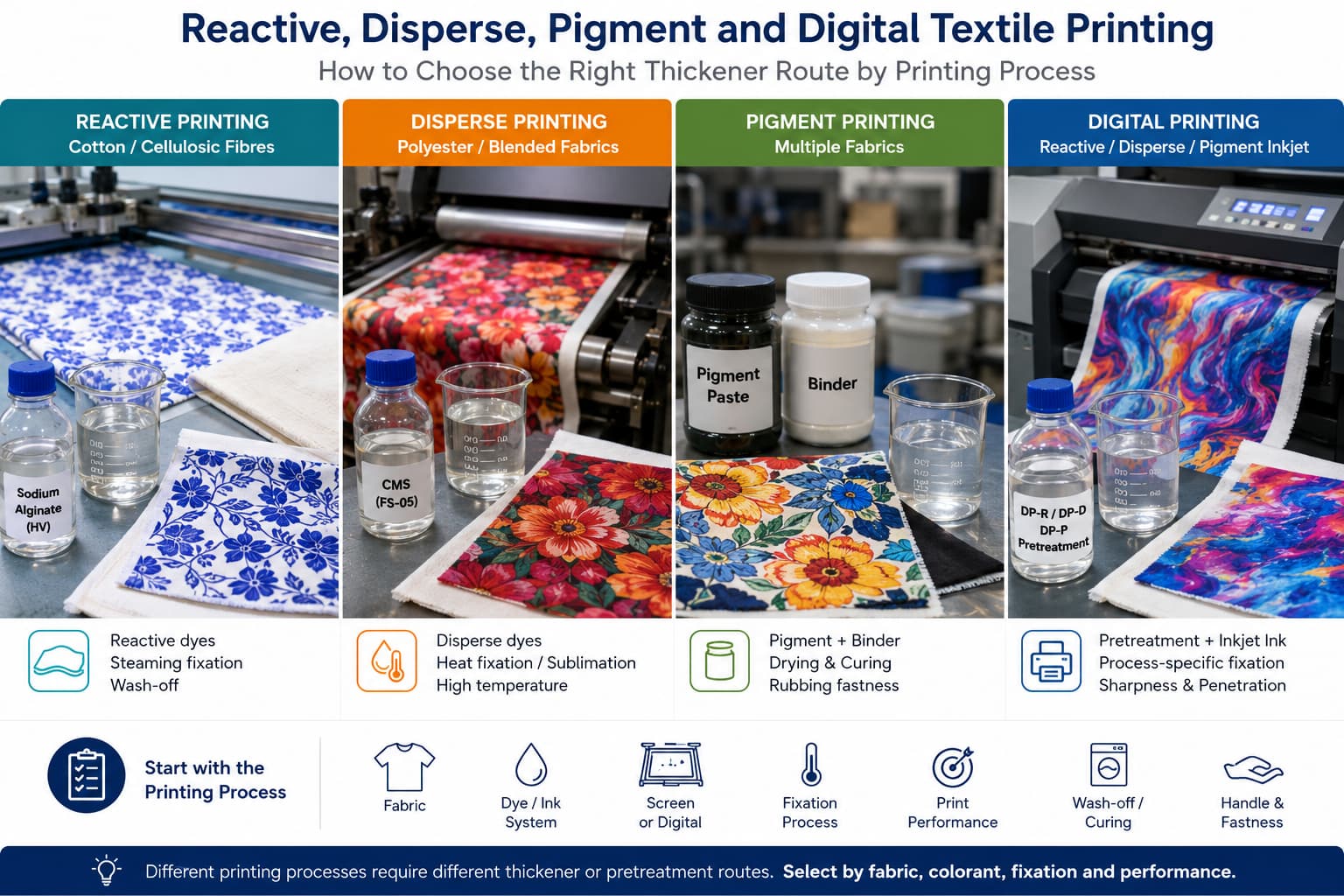
Узнайте, как выбирать загустители и способы предварительной обработки для реактивной, дисперсной, пигментной и цифровой печати на текстиле с учетом требований к ткани, красителю или чернилам, фиксации, вымываемости и качеству печати.
Печатная паста на основе CMC используется в пигментной, реактивной и цифровой текстильной печати. В данном руководстве объясняется, какие параметры имеют значение, как сравнивать поставщиков и что следует уточнить перед размещением оптового заказа.
И альгинат натрия, и CMC используются в качестве загустителей при печати на текстиле, однако они подходят для разных систем окрашивания и условий производства. В данном руководстве объясняются основные различия между ними и приводятся рекомендации по их применению.
Скорость фиксации красителя напрямую влияет на цветоотдачу, стойкость к стирке и загрязнённость сточных вод при печати реактивными красителями. В данном руководстве объясняется, как альгинат натрия способствует фиксации красителя, какие параметры пасты влияют на скорость фиксации и как устранять проблемы, связанные с низкой фиксацией, в производственных условиях.
Выбор подходящего загустителя для текстильной печати зависит не только от типа ткани. Покупателям следует подбирать загуститель с учетом системы красителей или пигментов, метода печати, требуемых реологических характеристик, требований к стойкости к стирке, а также фактических условий производственных испытаний.
Эффективность печати на текстиле зависит от сбалансированной химической системы, а не от одной универсальной добавки. В данном руководстве описаны десять важных групп химических веществ, их функции, сферу применения, а также то, что покупатели должны проверить перед проведением производственных испытаний.
Загустители для текстильной печати различаются по химическому составу, реологическим свойствам, совместимости с красителями и характеристикам вымывания. В данном руководстве сравниваются основные группы загустителей, их типичные области применения, а также параметры, которые покупатели должны проверить перед проведением производственных испытаний.
Выбор паст для цифровой печати следует осуществлять с учетом химического состава краски, типа ткани, метода нанесения и последующей обработки. В данном руководстве сравниваются методы предварительной обработки с использованием альгината натрия, CMC, CMS, синтетических полимеров и смешанных составов для струйной печати на текстиле.
Компания FSX Chemical предлагает отдельные технологические схемы нанесения пасты для цифровой печати, предназначенные для реактивных, дисперсных и пигментных систем, которые сопровождаются анализом условий применения, подбором образцов и технической документацией. В данном руководстве объясняется, как покупатели могут определить подходящую технологическую схему перед оптовой закупкой.
Для получения стабильной пасты для цифровой печати недостаточно просто соблюдать заданную вязкость. В данном руководстве объясняется, как выбор продукта, качество воды, последовательность добавления компонентов, перемешивание, уровень pH, температура, фильтрация, соблюдение гигиенических норм, условия хранения и ведение документации по качеству влияют на предварительную обработку и стабильность производственного процесса.
В данном обзоре продукта рассматривается паста FSX Digital Printing Paste в качестве средства предварительной обработки текстиля для струйной печати и средства для увеличения вязкости, при этом особое внимание уделяется совместимости с системой чернил, реологическим свойствам, фильтрации, четкости печати, стабильности и испытаниям в реальных производственных условиях.
Для цифровой печати на текстиле требуется не только современные чернила и печатающие головки. Ознакомьтесь с химическими решениями, специально разработанными для процессов струйной печати реактивными, дисперсными и пигментными чернилами — от предварительной обработки и регулирования реологических свойств до фильтрации, фиксации и проверки производственных процессов.
Сообщите название продукта, область применения, количество, пункт назначения, а также предоставьте техническое описание продукта (TDS),
фотографию образца или имеющиеся у вас документы. Компания FSX Chemical рассмотрит
эту информацию и порекомендует дальнейшие действия для подготовки коммерческого предложения, подбора образца
или выбора продукта.
Информация о продуктеНазвание товара, класс, модель, фотография этикетки или артикул поставщика.
Доступные документыTDS, SDS, COA, фотография образца, перечень продукции или данные испытаний.
Детали заказаПредполагаемый объем, упаковка, страна назначения, порт или условия торговли.
Область применения или проблемаПроцесс печати на текстиле, требования к составу, текущие проблемы или целевые показатели.