FR
FR  EN
EN  BN
BN  ES
ES  TR
TR  ID
ID  RU
RU  AR
AR  UR
UR  VI
VI  TL
TL  HI
HI  UK
UK  KK
KK  KA
KA  UZ
UZ 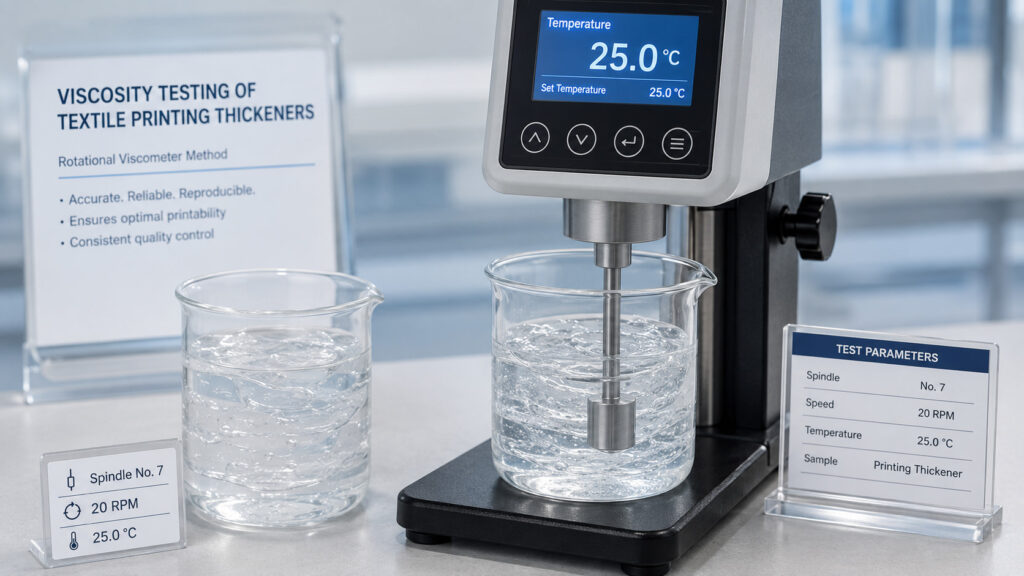
Technical Guide Viscosity Testing & Supplier Comparison Updated July 2026 Direct Answer
Textile printing thickener viscosity values can only be compared when the product form, solution concentration, temperature, instrument, spindle or rotor, rotational speed, sample container, preparation method, hydration time and measurement time are consistent. A value measured at 1% concentration using a Brookfield rotational viscometer cannot be compared directly with a 2% result obtained using another instrument or an unspecified method. Viscosity should first be matched under controlled laboratory conditions and then confirmed through an application or production trial.
Same Number
≠
Same Product
For many textile printing thickener solutions and pastes, the reported result is an apparent viscosity under a defined measurement condition. If the concentration, spindle, speed, temperature or preparation method changes, the reading may also change even when the product itself has not changed.
Understanding the Result
What Does a Thickener Viscosity Number Actually Mean?
A viscosity result describes resistance to flow under the conditions used during the test. It does not describe the complete printing performance of the product.
Many CMC, CMS, sodium alginate and printing-paste systems show non-Newtonian behavior. Their apparent viscosity may change when the applied shear condition changes. ASTM D2196 therefore distinguishes between a viscosity value at one rotational speed and broader characterization using multiple speeds, shear thinning and viscosity recovery.[2]
In practical terms, a paste may flow more easily while it is being mixed, pumped or forced through a screen, and then recover body after the applied force is reduced. These rheological characteristics affect paste transfer, pattern definition and spreading after printing. Textile-printing research has shown that rheological behavior is linked to quality-determining print parameters.[4]
Viscosity is one part of rheology.
Rheology considers how a material flows and deforms under different conditions. A single viscosity number does not fully describe shear thinning, thixotropy, yield behavior or viscosity recovery.
Minimum Comparison Data
Ten Conditions Buyers Should Confirm
A supplier viscosity value is useful only when the associated method is clear enough to reproduce.
| Condition de test | Pourquoi est-ce important ? | What the Buyer Should Request |
|---|---|---|
| Forme du produit | Powder, flake and liquid products may use different preparation and control methods. | Confirm whether the test is performed on the supplied product or on a prepared solution. |
| Concentration | Polymer-solution viscosity can change substantially with concentration. | Confirm the percentage and whether it is w/w, w/v, dry basis or as-supplied basis. |
| Température | Viscosity is temperature dependent. | Record the sample temperature, such as 25°C. |
| Instrument | Different instrument designs and geometries may not generate directly equivalent results. | Record the manufacturer and instrument model. |
| Spindle or rotor | Spindle geometry influences the applied measurement condition. | Record the exact spindle, rotor or measuring geometry. |
| Vitesse de rotation | Non-Newtonian samples may give different apparent viscosity at different RPM. | Record the RPM or defined shear rate. |
| Container and volume | Container diameter, sample volume and boundary conditions can influence rotational-viscometer readings. | Record the container type and minimum sample volume. |
| Preparation method | Mixing sequence, agitation, water addition and dispersion affect hydration and air incorporation. | Record mixing time, speed, order of addition and equipment. |
| Hydration and rest time | Some polymer solutions continue developing viscosity after initial mixing. | Record the defined hydration, resting and deaeration period. |
| Temps de lecture | The indicated value may change before the sample reaches a stable or specified test condition. | Record the measurement duration or defined end condition. |
AMETEK Brookfield specifically advises using the same instrument, spindle, speed, container, temperature and test time when viscosity data must be compared.
Solution Preparation
Why Concentration Must Be Defined Precisely
A statement such as “viscosity at 1%” is incomplete unless the concentration basis is defined. For a 1% w/w laboratory solution with a total mass of 100 g, the usual calculation is:
| Target Concentration | Dry Product | Eau | Total Solution |
|---|---|---|---|
| 1% w/w | 1.00 g | 99.00 g | 100.00 g |
| 2% w/w | 2.00 g | 98.00 g | 100.00 g |
| 5% w/w | 5.00 g | 95.00 g | 100.00 g |
Do not assume that every “1%” method means 1% w/w.
Some documents may use weight per volume, dry basis or an internal preparation method. Liquid digital printing paste may also be tested as supplied or after dilution. The calculation basis should be stated before results are compared.
Example Comparison
Why Two Identical Numbers May Not Be Comparable
SUPPLIER A
50,000 mPa·s
1% w/w solution, 25°C, Brookfield RV instrument, Spindle No. 7, 20 RPM, defined hydration and reading time.
SUPPLIER B
50,000 mPa·s
2% solution, NDJ instrument, rotor and speed not stated, temperature and preparation method not stated.
Conclusion: These values should not be treated as equivalent. The numerical result is the same, but the concentration and measurement conditions are not.
The figures above are an illustrative comparison, not a product specification.
Instrument Conditions
Instrument, Spindle, RPM and Container
Instrument Model
“Brookfield viscosity” is not a complete method by itself. The instrument family, torque range and measuring geometry should be identified. An NDJ result should not automatically be treated as equivalent to a Brookfield result.
Spindle or Rotor
The spindle interacts with the sample and defines part of the measuring geometry. Changing the spindle can change the valid measurement range and, for non-Newtonian materials, the reported apparent viscosity.
Rotational Speed
A shear-thinning paste may show a lower apparent viscosity as rotational speed increases. The RPM must therefore be reported with the result.
Container Geometry
Standard spindles are designed for specific container dimensions and sample volumes. Alternative containers may produce repeatable but different results.[1]
Check the instrument torque or valid operating range.
A reading outside the instrument manufacturer’s recommended range should not be accepted merely because a viscosity number appears on the display.
Sample History
Temperature, Hydration, Mixing and Air Bubbles
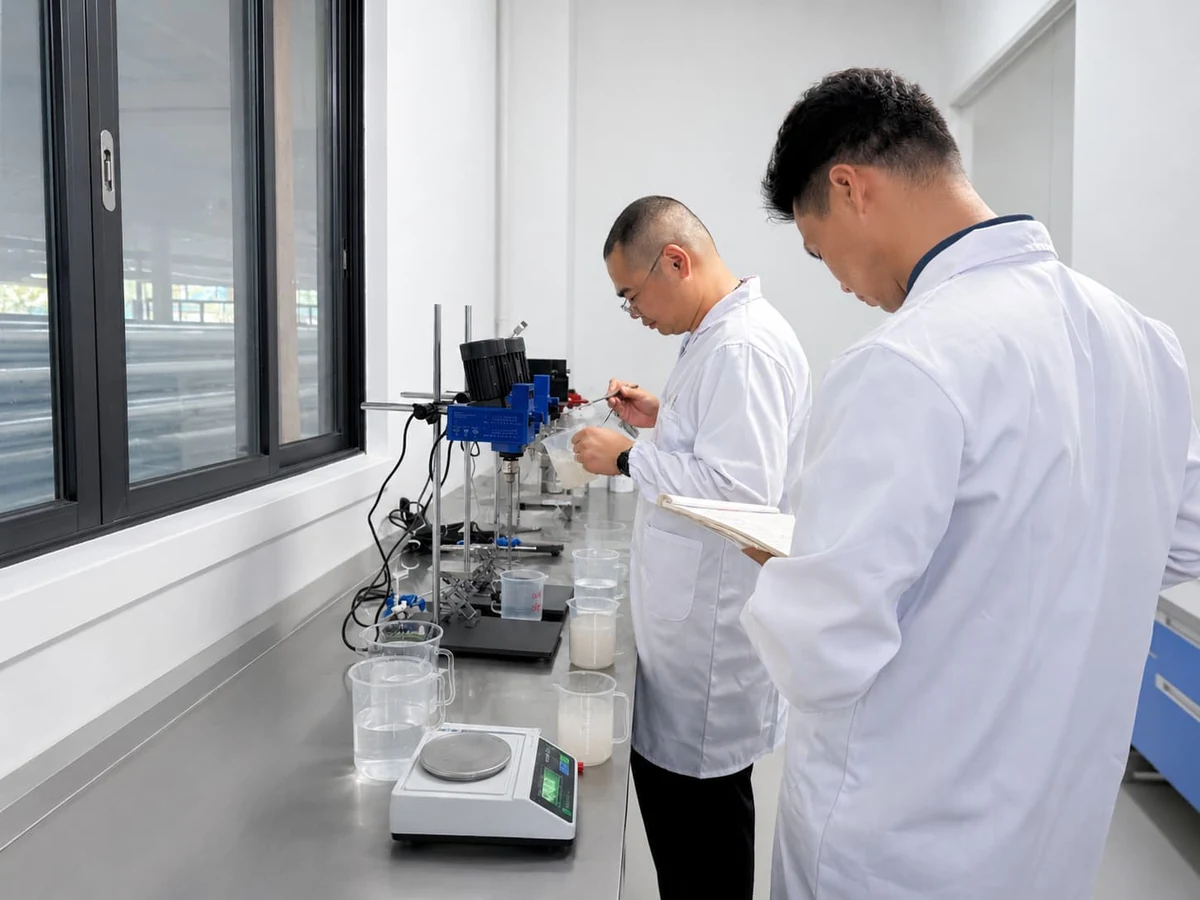
Repeatable viscosity testing requires more than setting the instrument. The sample must be prepared and conditioned in a repeatable way.
- Use the same water source or defined water quality
- Condition the raw sample before weighing
- Use the same order of product and water addition
- Use the same mixer, speed and mixing time
- Control the total preparation temperature
- Use the same hydration or resting period
- Avoid or remove trapped air before measuring
- Measure within the same defined time window
Brookfield guidance notes that the sample, container and spindle should be temperature conditioned, and that air should not be trapped around the spindle during immersion.[1]
Water quality can become a hidden variable.
When a supplier and buyer prepare the same polymer with different water hardness, salt content, pH or temperature, the solutions may not hydrate or behave in exactly the same way. A controlled comparison should use the same water condition wherever possible.
Single-Point vs Multi-Speed
When One Viscosity Reading Is Not Enough
A single-point viscosity result can be useful for routine batch control when the method is fixed. It does not, however, fully describe how a non-Newtonian printing paste behaves at different shear conditions.
ASTM D2196 explains that measurements at two or more rotational speeds provide better characterization of a non-Newtonian material than one speed alone. Increasing- and decreasing-speed measurements can also be used to examine shear thinning, thixotropy and viscosity recovery. [2]
Single-Point Test
Useful for routine specification control when concentration, temperature, instrument, spindle, RPM and reading time are fixed.
- Fast for batch comparison
- Easy to include on a COA
- Limited information about shear behavior
Multi-Speed Test
Useful when the buyer needs to understand how the paste responds as the applied shear condition changes.
- Shows apparent viscosity across speeds
- Can indicate shear-thinning behavior
- May help explain differences in screen running
Do not invent a universal RPM sequence.
The chosen speeds must fit the instrument, spindle, product range and purpose of the test. A supplier method should be reproducible, but it does not need to be identical for every product family.
Product-Specific Boundaries
CMC, CMS, Sodium Alginate and Digital Paste Require Different Checks
| Parcours du produit | Important Preparation Checks | Important Comparison Boundary |
|---|---|---|
| CMC | Concentration, degree of substitution, mixing, hydration, solution stability and test temperature. | CMC grades with similar viscosity may differ in purity, substitution level and application behavior. |
| CMS | Powder or flake form, dispersion sequence, hydration method, concentration and process-specific preparation. | Reactive, disperse and specialty CMS routes should not be compared solely by one viscosity number. |
| Alginate de sodium | Stock-paste concentration, hydration, solution smoothness, temperature and defined spindle-speed method. | HV, MV and LV describe selection routes, not universal quality rankings. |
| Pâte d'impression numérique | Powder or liquid form, dilution or dosage basis, pretreatment recipe and as-supplied versus prepared-product testing. | A liquid digital paste result cannot be compared directly with a prepared powder-thickener solution without a defined basis. |
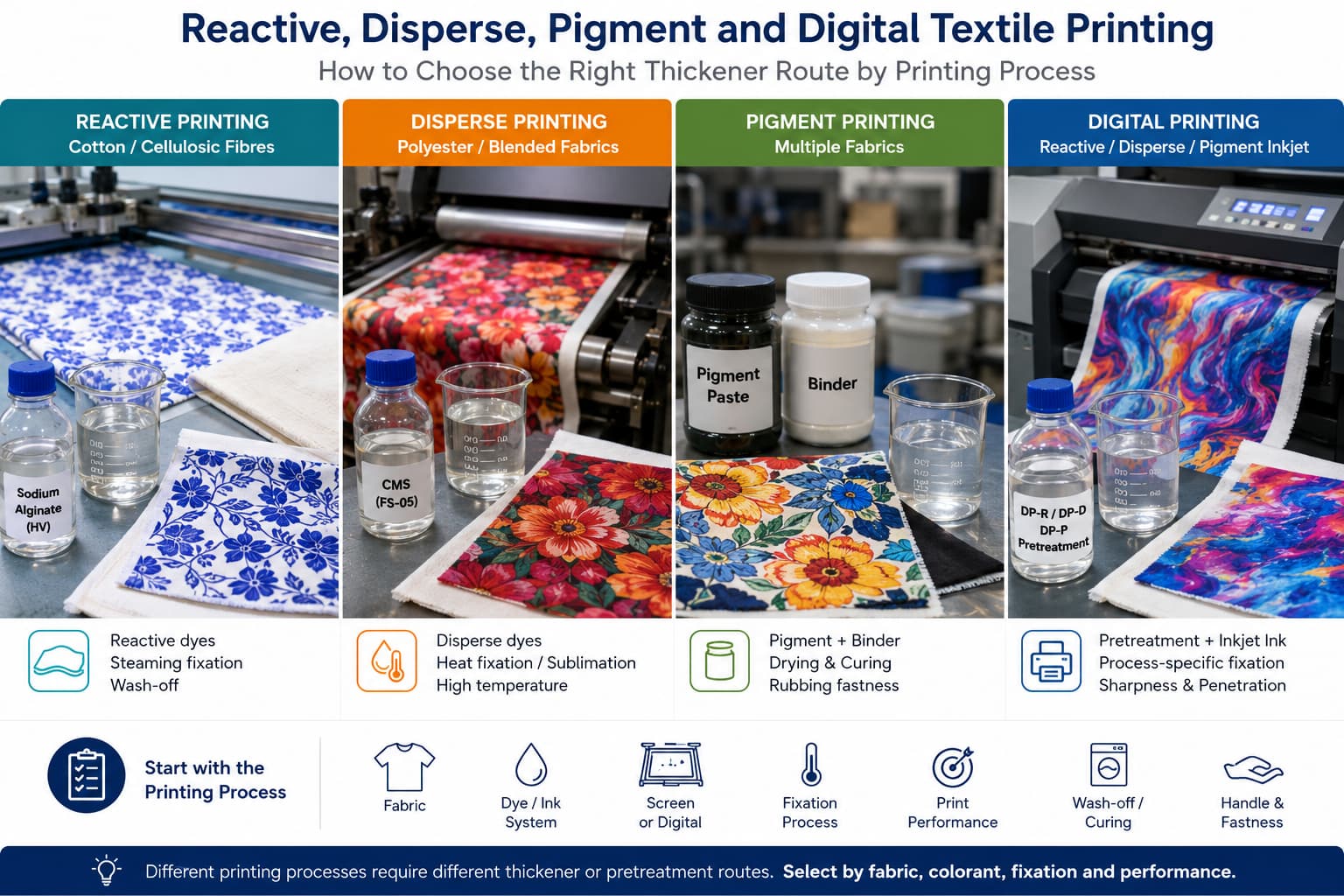
For a broader comparison of the four routes, review the CMC, CMS, sodium alginate and digital printing paste selection guide .
Supplier Documentation
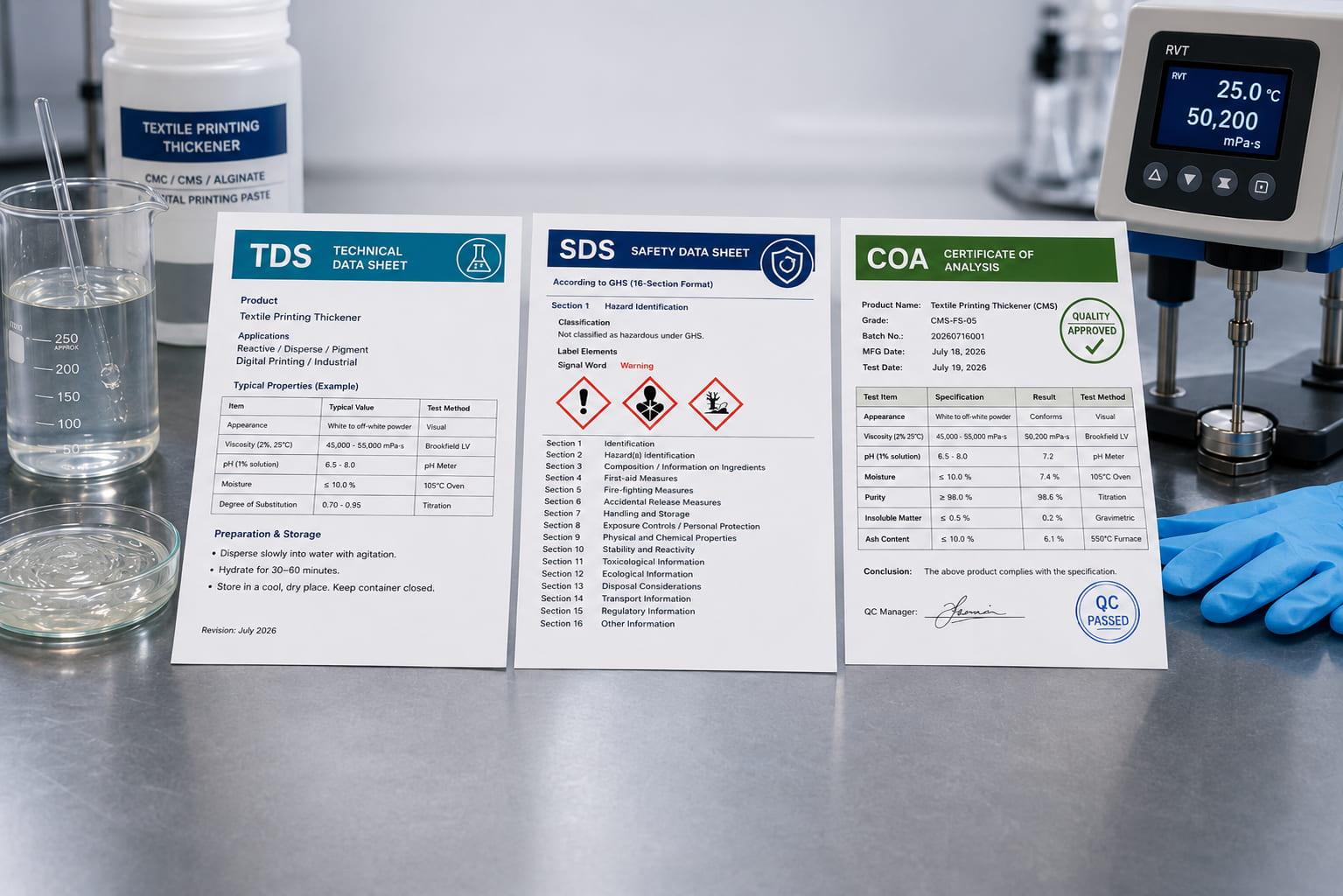
How to Read Viscosity Data on a TDS or COA
TDS
A Technical Data Sheet commonly presents a typical or reference viscosity range together with product and application information.
- Check concentration
- Check temperature
- Check instrument and spindle
- Check whether values are typical or guaranteed
COA
A Certificate of Analysis should relate to a specific batch and report the applicable batch-test result or acceptance status.
- Check batch number
- Check test date where available
- Check method reference
- Confirm that the result belongs to the supplied grade
A viscosity number without a method is incomplete.
Ask the supplier for the missing test conditions before comparing specifications or rejecting a candidate sample.
Application Boundary
What Laboratory Viscosity Can and Cannot Confirm
It Can Help Confirm
- Whether two samples are close under one defined method
- Whether a production batch falls inside a control range
- Whether viscosity development is stable over a defined time
- Whether the current and candidate products require different dosage
- Whether further application testing is reasonable
It Cannot Confirm Alone
- Color yield after fixation
- Edge definition and pattern sharpness
- Fabric penetration
- Background cleanliness
- Efficacité au lavage
- Poignée en tissu
- Digital-print bleeding or fastness
The viscosity test is therefore a screening and quality-control tool, not a substitute for a controlled printing trial.
Processus d'achat
Six Steps for Comparing Two Thickener Samples
ÉTAPE 01
Collect the Methods
Obtain both TDS documents and identify concentration, temperature, instrument, spindle, RPM and preparation method. STEP 02
Choose One Method
Select a method that both samples can be tested under without changing the intended product form or application route. STEP 03
Prepare in Parallel
Use the same water, equipment, batch size, order of addition, mixing time and hydration period. STEP 04
Measure Consistently
Use the same instrument setup, container, temperature and defined reading time for both samples. STEP 05
Run the Application Trial
Compare paste preparation, screen or pretreatment behavior, color, definition, wash-off, handle and production stability. STEP 06
Confirm the Supply Range
Agree on the grade, test method, specification range, batch documentation and commercial conditions before bulk purchase.
Assistance technique FSX pour les produits chimiques
Sample Matching with a Defined Test Method
FSX Chemical can review available viscosity information for CMC, CMS, sodium alginate and digital printing paste before recommending an initial sample route.
For a more useful review, buyers should provide:
- Nom actuel du produit et fournisseur
- Current TDS or batch COA
- Target viscosity and acceptable range
- Concentration and preparation method
- Instrument, spindle and RPM
- Test temperature and reading time
- Printing process and fabric
- Main production issue
- Posologie actuelle
- Expected monthly demand
Send the current sample when the written method is incomplete.
A physical sample, TDS and application information can provide a more practical starting point than a viscosity number copied from a supplier quotation.
Foire aux questions pour les acheteurs
Foire aux questions
Can a 1% viscosity result be compared with a 2% result?
No. Concentration has a major influence on polymer-solution viscosity. Both products should be tested at the same defined concentration before their numerical values are compared. Can Brookfield and NDJ viscosity values be compared directly?
Not automatically. Instrument design, rotor or spindle, speed, container and calculation method may differ. Direct comparison requires an internally validated correlation or testing both samples using the same method. Are cP and mPa·s the same viscosity unit?
They are numerically equivalent for dynamic viscosity: 1 cP equals 1 mPa·s. However, matching units do not make two results comparable when their test methods differ. Why does viscosity decrease when RPM increases?
Many textile thickener solutions and printing pastes are shear-thinning materials. Their apparent viscosity can decrease as the applied shear condition increases. The behavior should be confirmed using a defined multi-speed method. How long should a thickener solution hydrate before testing?
There is no single hydration time suitable for every CMC, CMS, sodium alginate or digital paste product. Use the supplier’s defined preparation method and apply the same time to all samples being compared. Does matching laboratory viscosity prove that two products are equivalent?
No. Matching viscosity is an initial screening result. Product equivalence also depends on paste preparation, rheology, compatibility, color yield, definition, wash-off, handle and production stability. What should be written on a supplier TDS?
A useful viscosity entry should state the value or range together with concentration, temperature, instrument, spindle or rotor, rotational speed and any important preparation condition.
À propos de ce guide technique
Prepared by the FSX Chemical Technical Content Team for textile printing mills, chemical distributors, laboratory personnel and procurement teams comparing thickener specifications, samples and batch data.
FSX Chemical
Foshan Fushixin Polymer Fiber Co., Ltd.
Mise à jour en juillet 2026
Références techniques
Measurement and Rheology References
These references provide general measurement and rheology context. Product specifications should follow the applicable supplier method, internal quality procedure and customer trial requirements.
- AMETEK Brookfield. DV1 Viscometer Operating Instructions. Guidance covers spindle and speed selection, container geometry, temperature conditioning and method consistency. View official manual
- ASTM International. ASTM D2196, Standard Test Methods for Rheological Properties of Non-Newtonian Materials by Rotational Viscometer. View standard record
- International Organization for Standardization. ISO 3219-1, Rheology — Vocabulary and symbols for rotational and oscillatory rheometry. View ISO record
- “Rheological properties of printing pastes and their influence on quality-determining parameters in screen printing of cotton with reactive dyes using recycled polysaccharide thickeners.” Carbohydrate Polymers. View research record
Compare Samples Under One Defined Method
Demander un échantillon correspondant Demander un devis📧 E-mail: Service@fsxchemical.com