Affordable vs Premium Textile Thickeners: Which Products Stand Out?
Affordable and premium textile thickeners should not be compared by price per kilogram alone. This...
Affordable and premium textile thickeners should not be compared by price per kilogram alone. This guide explains how dosage, rheology, preparation, print quality, batch consistency, technical support and production risk determine which products truly stand out.
Textile printing thickeners are available across a wide price range. Some products are positioned as economical alternatives, while others are sold as premium grades with tighter specifications, specialized performance or additional technical support.
The lowest-priced product is not automatically the most economical, and the highest-priced grade is not automatically the best. A thickener creates value only when it performs reliably in the buyer’s actual fabric, colorant system, formulation, equipment and post-treatment process.
A low-cost product may stand out when it provides stable performance at a practical dosage in a standard application. A premium product may justify its price when it reduces preparation problems, improves machine reliability, controls a demanding formulation or provides stronger sample-to-batch consistency.
The correct comparison is therefore based on total cost in use rather than the quotation price alone. Buyers should include dosage, preparation, filtration, machine interruptions, rejected paste, reprocessing and final textile quality when evaluating different grades.
What Do Affordable and Premium Actually Mean?
Affordable and premium are commercial descriptions rather than defined technical grades. Two suppliers may use these terms differently, and a premium price does not reveal which performance features are included.
Affordable textile thickeners
An affordable thickener is generally positioned around competitive purchase price and practical performance for a defined application. It may be a standard commercial grade, a locally available material or a product with a simplified service package.
Affordable does not necessarily mean low quality. A stable standard grade can be the most economical choice when the formulation is not highly demanding and the buyer has sufficient laboratory and production-control capability.
Premium textile thickeners
A premium thickener may be positioned around specialized rheology, higher purity, tighter batch limits, improved filtration, faster preparation, application-specific formulation or additional technical support.
These features may justify a higher price when they solve a measurable production problem. They do not justify the price when the supplier cannot explain or demonstrate the relevant advantage.
Mid-range products
Many industrial products fall between these two categories. They may combine competitive factory pricing with controlled specifications, samples, technical documents and application support.
For many buyers, a well-matched mid-range grade provides a better risk-to-cost balance than either the cheapest available product or the most expensive branded option.
Quick Comparison of Affordable and Premium Thickeners
Domaine d'évaluation
Affordable Grade
Premium Grade
Buyer Verification
Purchase price
Usually lower
Usually higher
Compare identical packing, terms and product basis
Effective dosage
May be lower, similar or higher
May offer improved efficiency in a matched system
Measure actual dosage required for acceptable printing
Rhéologie
May suit standard processes
May provide more specialized flow and recovery
Conduct multi-condition and machine-relevant testing
Préparation
May require standard mixing and hydration
May offer improved dispersion or preparation convenience
Record mixing, hydration, filtration and labor
Batch limits
May use broader standard ranges
May offer tighter or application-specific ranges
Review specification and batch COA
Documents
Basic TDS and SDS may be available
May include broader technical and batch documentation
Verify exact product and document scope
Assistance technique
May be limited or buyer-directed
May include grade matching and trial review
Evaluate response quality rather than sales promises
Best application
Stable, standardized and cost-sensitive production
Demanding, high-risk or tightly controlled production
Select according to process risk and performance need
These are general commercial tendencies, not universal rules. Some competitively priced factory-direct grades may provide stronger technical control than more expensive products sold through several distribution layers.
1. Price per Kilogram vs Cost in Use
Price per kilogram is the easiest number to compare, but it is only one part of the commercial result.
A lower-priced product can become more expensive when it requires higher dosage, longer mixing, additional filtration or more frequent machine cleaning. A premium product can also be poor value when its claimed advantages do not improve production.
Direct material cost
Direct material cost depends on the delivered product price and the quantity used per paste batch. Freight, duty, handling and payment terms may also affect the actual landed cost.
Preparation cost
Include mixing time, heating or cooling, labor, filtration and material remaining in tanks or filters.
Production cost
Include machine interruptions, screen cleaning, viscosity correction, unused paste, design defects and production speed.
Quality cost
Include reprinting, additional washing, rejected fabric, customer claims and laboratory investigation.
Supply-risk cost
Product shortages, unidentified grade changes and inconsistent batches can create emergency purchasing, extra inventory and production delays.
2. Thickening Efficiency and Dosage
Thickening efficiency describes how much product is required to reach a useful paste condition. Buyers often assume a premium product should require less material, but this must be confirmed in the complete formulation.
High water viscosity does not prove low dosage
A product may produce high viscosity in water but lose structure after dyes, salts, alkalis or binders are added.
Another product with a lower water viscosity may provide better formulation stability and require a similar or lower practical dosage.
Compare at equal concentration first
Prepare the affordable and premium candidates at the same concentration under identical conditions. This shows their relative hydration and viscosity development.
Optimize each product separately
After the first comparison, adjust dosage in controlled steps. The final dosage should meet the same printing and fabric-quality requirements.
Consider supplied-product moisture or solids
Equal product weight does not always mean equal dry polymer or active content. Review moisture or solids data where relevant.
3. Rheology and Print Definition
A premium thickener may stand out when it provides a rheological profile that is difficult to achieve with a standard product. However, higher viscosity alone is not sufficient.
Flow under printing shear
The paste must flow when it is exposed to mixing, pumping, screen pressure or coating shear. Insufficient flow can reduce transfer and create uneven prints.
Recovery after application
After reaching the fabric, the paste should recover enough structure to control spreading and penetration. The preferred recovery depends on the machine, design and textile.
Print edge and fine-detail control
Premium pricing may be justified for fine designs, high-speed printing or demanding fabrics when the product produces repeatably sharper results.
The advantage should be demonstrated using fine lines, small text, sharp corners, solid areas and representative production designs.
Standard production may not require specialized rheology
For simple designs and stable machine conditions, an affordable standard grade may produce acceptable quality without the cost of a specialized rheological system.
4. Dispersion, Hydration and Preparation Time
Preparation performance can create a meaningful difference between two products even when their final viscosity is similar.
Powder addition
A product that forms persistent lumps may require slower addition, stronger mixing or repeated filtration.
Pause hydratation
A faster-hydrating grade may reduce waiting time and improve production flexibility. The benefit depends on the factory’s batch schedule and available mixing capacity.
Mixing-energy requirement
Some grades need high mechanical input, while others disperse under more moderate conditions. Compare the products using production-relevant mixers.
Preparation consistency
A premium grade may justify its price when it is less sensitive to minor operator or temperature variation. This benefit should be established through repeated batches rather than one ideal laboratory preparation.
Affordable products can still prepare efficiently
Factory-direct or standard grades may provide reliable dispersion when the correct addition method is used. Poor preparation should not automatically be attributed to price category.
5. Chemical Compatibility
Chemical compatibility is often more important than nominal price. A product that cannot tolerate the required dyes, salts, alkalis, binders or auxiliaries is not economical at any price.
Impression réactive
Alginate de sodium is an important reference route for reactive printing on cellulosic textiles. Affordable and premium alginate grades should be compared by dye compatibility, rheology, filtration, print result and wash-off.
Their suitability depends on grade, substitution level, purity, electrolyte response and the complete application.
Pigment and binder systems
In pigment printing, compatibility with the binder and curing system is essential. A lower-priced thickener that destabilizes the binder can create higher total production cost.
Digital printing
A dedicated Pâte d'impression numérique should be selected according to reactive, disperse or pigment ink, fabric, pretreatment method and fixation process.
6. Filtration and Machine Reliability
Filtration and machine behavior are common areas where an apparently cheap product can create hidden cost.
Undissolved material
Lumps, coarse particles and gels can remain after preparation and interfere with screens, pumps, filters or coating equipment.
Use a process-relevant filter
Compare samples using the same filter opening, quantity and procedure. The method should reflect the actual production equipment.
Measure cleaning and interruption frequency
Record how often screens, filters or lines require cleaning during the trial. The cost of lost machine time can exceed a small difference in material price.
A premium grade should demonstrate the advantage
Claims such as excellent filtration or smooth paste should be verified by actual residue, pressure, cleaning or machine-trial data.
Do not reject an affordable grade from appearance alone
Powder color or visual texture may differ without affecting performance. Filtration and application testing provide a more reliable basis.
7. Paste Stability and Holding Time
Printing paste may remain in a tank or container for several hours before use. Stability during this period can influence both quality and cost.
Check viscosity drift
Measure immediately after preparation, after complete hydration and after the normal factory holding period.
Check physical stability
Separation
Settling
Surface skin formation
Foam retention
Gel development
Filterability after storage
Premium stability may reduce correction work
A more stable grade may reduce water addition, thickener correction and rejected paste in factories with long holding periods.
Short-use formulations may not need extended stability
When paste is prepared and consumed quickly under controlled conditions, paying for unusually long stability may provide limited benefit.
8. Batch-to-Batch Consistency
Batch consistency is one of the strongest potential differences between a basic product and a more controlled commercial grade.
Specification range
Premium products may offer tighter limits for selected parameters. However, tighter limits are useful only when they control properties that affect the application.
Permanent commercial grade
The approved sample, TDS, quotation, package label and COA should use the same permanent grade code.
Batch-specific information
Buyers should review which parameters are reported on the COA and whether the test methods match the agreed specification.
First-batch verification
Even a premium product should be checked when the first commercial batch arrives. Brand reputation does not replace incoming inspection.
Affordable factory-direct grades can still be controlled
A competitive price may come from direct manufacturing, efficient distribution or standardization rather than reduced quality control.
Documentation is part of the commercial value of a textile thickener. Buyers need enough information to approve, receive and trace the product.
Fiche technique
The TDS should identify the product, application direction, relevant properties and preparation information.
Fiche de données de sécurité
The SDS supports handling, storage, transport and workplace-safety review.
Certificat d'analyse
A batch-specific COA should identify the relevant product and batch and report agreed control parameters where applicable.
Certificates and test reports
Premium pricing is sometimes supported by certification or third-party testing. Buyers should confirm that the document applies to the exact supplier, grade, scope and validity period.
More documents do not automatically mean better performance
Documentation supports procurement control, but it does not replace the buyer’s formulation and production trial.
10. Technical Support and Grade Matching
Technical support can justify a higher product price when it reduces testing time, prevents incorrect grade selection or helps solve a production problem.
Application review
A capable supplier should ask about the fabric, dye or ink system, equipment, current dosage, viscosity method and main problem.
Current-product matching
Buyers may provide the current TDS, sample, label, COA or test results for a more targeted comparison.
Sample support
Representative samples allow the buyer to compare the product before a bulk commitment.
Trial-result review
Useful support should help determine whether a problem comes from grade mismatch, preparation, dosage, chemical compatibility, water or machine conditions.
Do not pay a premium for sales language alone
Terms such as technical service or customized support should be connected to clear actions, documents and response procedures.
How Product Families Compare
Gamme de produits
Affordable Grade May Stand Out When
Premium Grade May Stand Out When
Alginate de sodium
Standard reactive printing requires reliable viscosity and acceptable wash-off at a competitive dosage
High-speed, fine-detail or sensitive reactive printing requires tighter filtration, rheology or batch limits
Amidon carboxyméthylique
CMS is used in a standard mixed thickener or sizing formulation with controlled factory conditions
A specialized substitution, purity or film-property profile is needed
Carboxyméthylcellulose
A standard viscosity and purity grade meets the printing, sizing or coating requirement
Tight substitution, purity, electrolyte tolerance or particle requirements affect production
Synthetic thickener
A standard pigment formulation is stable and the buyer can control neutralization and dosage
Specialized shear response, electrolyte tolerance or binder compatibility is required
Compound thickener
A standard supplier formulation meets the production target
The formulation is tailored for a specific machine, colorant or production problem
Pâte d'impression numérique
A standard pretreatment works with the existing ink and fabric system
Fine definition, difficult fabrics, filtration or handle requires application-specific optimization
The commercial category should never replace grade-specific testing. One affordable grade may outperform a premium product when it is better matched to the process.
When an Affordable Thickener Can Be the Better Choice
The process is standardized
Stable recipes, controlled water, experienced operators and consistent equipment reduce the need for an unusually tolerant grade.
The print design is not highly demanding
Simple patterns or solid areas may not require premium fine-detail rheology.
The product passes all critical tests
An affordable grade is a strong choice when it meets filtration, stability, printing, wash-off and final fabric requirements.
The supplier provides an identifiable commercial grade
Competitive price is less risky when the product has a permanent code, defined specification and batch documentation.
The buyer has strong internal technical capability
Factories with capable laboratories may successfully optimize a standard grade without paying for an extensive supplier service package.
The price advantage remains after cost-in-use calculation
The product should still be less expensive after dosage, preparation, cleaning, waste and quality costs are included.
When a Premium Grade May Be Worth the Cost
Production downtime is expensive
High-capacity lines may justify paying more for filtration, stability and batch consistency when a short interruption creates substantial loss.
The design requires high precision
Fine lines, gradients and detailed patterns may benefit from more application-specific rheology.
The formulation has high chemical stress
High salt, alkali, binder or pigment loading may require a grade with proven tolerance.
The fabric is difficult to control
Lightweight, highly absorbent or technically specialized fabrics may require tighter paste or pretreatment behavior.
The factory has limited technical resources
Grade matching, documented preparation and responsive support may reduce the buyer’s internal development burden.
The supply program requires tighter documentation
Brand or export programs may require clearer product identity, COA, certificates or traceability.
The performance advantage is repeatable
Premium pricing is justified only when the benefit appears consistently across representative laboratory and production trials.
Warning Signs of a False Economy
The product requires substantially higher dosage.
Operators repeatedly add water or more thickener to correct the paste.
Preparation creates persistent lumps or excessive filter residue.
Viscosity changes significantly during normal holding time.
Screen or machine cleaning becomes more frequent.
Different batches require recipe adjustment.
Print definition or color response becomes less consistent.
Wash-off, desizing or curing requires additional processing.
Fabric rejection or reprocessing increases.
The supplier cannot connect the sample to a permanent commercial grade.
When several of these problems appear, the lower purchase price may no longer represent a genuine saving.
Warning Signs of an Overpriced Product
The supplier cannot explain which technical feature creates the premium.
Only the brand name and packaging differ from a standard grade.
The TDS provides no meaningful test method or specification detail.
The product does not reduce dosage, preparation or production risk.
Print performance is equivalent to lower-priced candidates.
Technical support is limited to general sales statements.
Certificates do not apply to the specific grade being purchased.
Batch COA parameters are no stronger than standard alternatives.
The product is recommended for every application without qualification.
The supplier discourages controlled side-by-side testing.
A premium product should provide measurable or documentable value. Higher price alone is not a technical feature.
How to Compare Suppliers Fairly
Compare the same application
Do not compare a standard reactive grade with a specialized digital or pigment product.
Compare the same product basis
Confirm whether the quotation refers to powder, liquid, active content or supplied-product weight.
Use the same viscosity method
Concentration, water, preparation, temperature, instrument, spindle and speed must be aligned.
Use equal laboratory conditions
Prepare all samples with the same mixer, containers, hydration time and chemical-addition sequence.
Compare complete formulations
Test the actual dyes, pigments, salts, alkalis, binders and auxiliaries.
Compare commercial supply conditions
Include packaging, freight, payment term, minimum quantity, technical documents and sample-to-bulk control.
Compare more than one batch where practical
One successful sample cannot demonstrate long-term consistency.
How to Calculate Total Cost in Use
A simple total-cost comparison can be built around the following categories.
Cost Category
What to Record
Delivered material
Product price, freight, duty, local handling and payment cost
Dosage
Actual supplied product required per paste or production batch
Préparation
Mixing time, labor, heating, hydration and filtration
Production
Machine speed, interruptions, cleaning and corrective additions
Material waste
Filter residue, rejected paste and unused batch material
Post-treatment
Washing, desizing, drying, steaming or curing requirements
Quality loss
Rejected fabric, reprinting, reprocessing and customer claims
Supply risk
Emergency orders, excess inventory and production delay
Compare both products at equivalent final quality. A candidate that fails the required definition, color, handle or durability standard should not be treated as a lower-cost solution.
Exemple de processus d'évaluation
Step 1: Select the current approved reference
Use a representative sample of the product currently used in production.
Step 2: Define critical acceptance criteria
Identify the required viscosity, filtration, holding stability, machine behavior and final fabric performance.
Step 3: Standardize preparation
Use the same water source
Use the same concentration basis
Use identical mixers and containers
Control powder-addition time
Control mixing and hydration time
Measure all samples at the same temperature
Step 4: Complete basic laboratory checks
Dispersion and lump formation
Pause hydratation
Viscosity under the agreed method
Filtration and residue
Foam, settling and separation
Stability after the normal holding period
Step 5: Test the complete formulation
Add the actual dyes, pigments, salts, alkalis, binders and auxiliaries.
Step 6: Conduct a printing or application trial
Use representative fabric, machine conditions, fixation and washing.
Step 7: Evaluate final performance
Print definition
Spreading and penetration
Shade and levelness
Wash-off or curing
Poignée en tissu
Relevant fastness or durability
Step 8: Calculate cost in use
Use the actual optimized dosage and recorded production data.
Step 9: Verify the commercial grade
Confirm the permanent product code, TDS, specification and proposed COA.
Step 10: Test the first bulk batch
Repeat the approved method before releasing the full shipment to routine production.
Procurement Checklist
Technical information to request
Permanent product and grade code
Current Technical Data Sheet
Current Safety Data Sheet
Complete viscosity test method
Posologie recommandée et mode d'emploi
Relevant purity, moisture, pH or substitution data
Representative sample
Proposed batch COA parameters
Known application limitations
Commercial information to compare
Product price and quotation validity
Packaging and net weight
Quantité minimale de commande
Freight and trade term
Payment conditions
Production and delivery schedule
Sample and courier arrangements
Required export documents
Application information to provide
Fabric and fibre composition
Printing, sizing, coating or digital process
Système à base de colorant, de pigment ou d'encre
Current thickener and dosage
Viscosité cible et méthode d'essai
Preparation and holding conditions
Machine and post-treatment process
Main production or cost problem
How FSX Chemical Positions Its Products
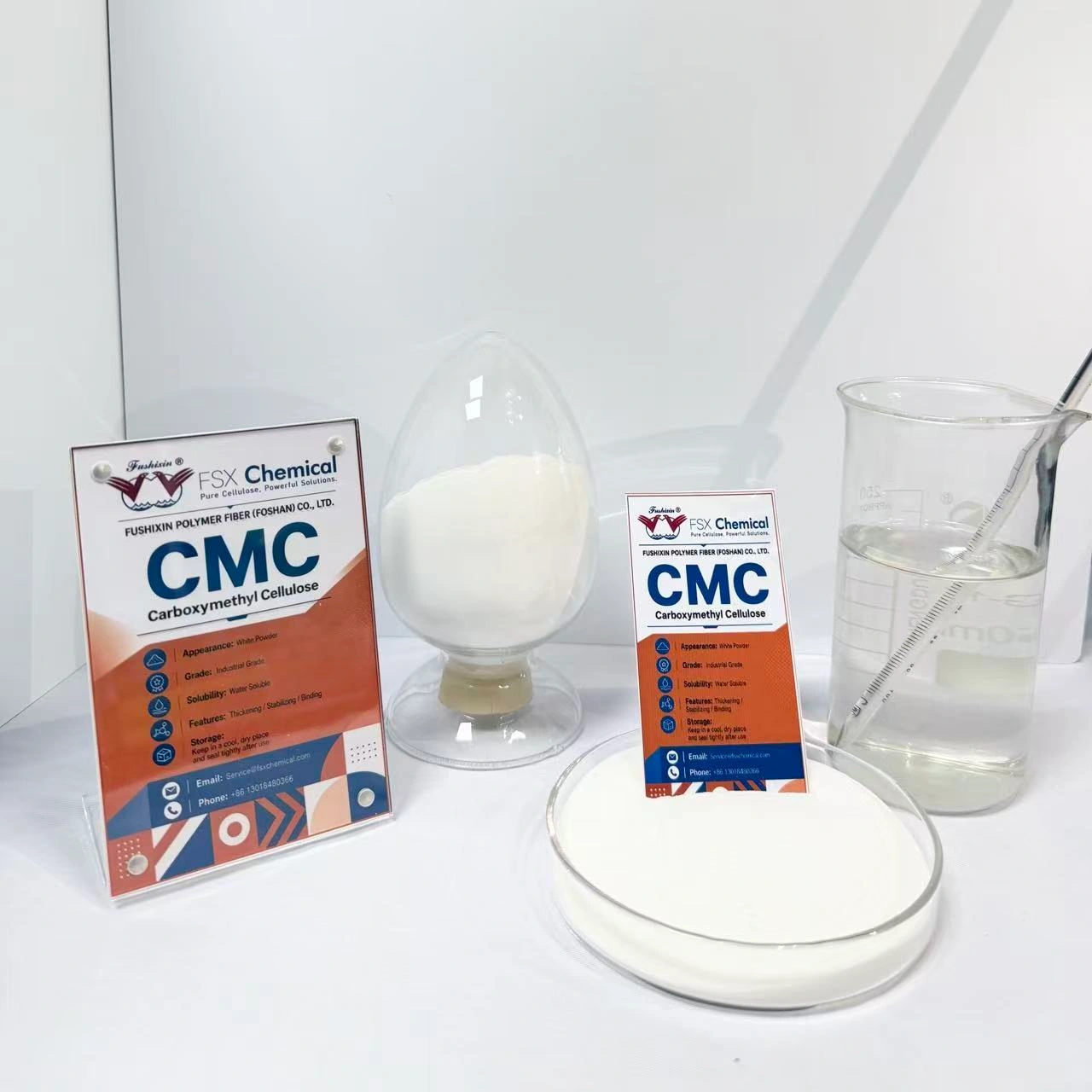
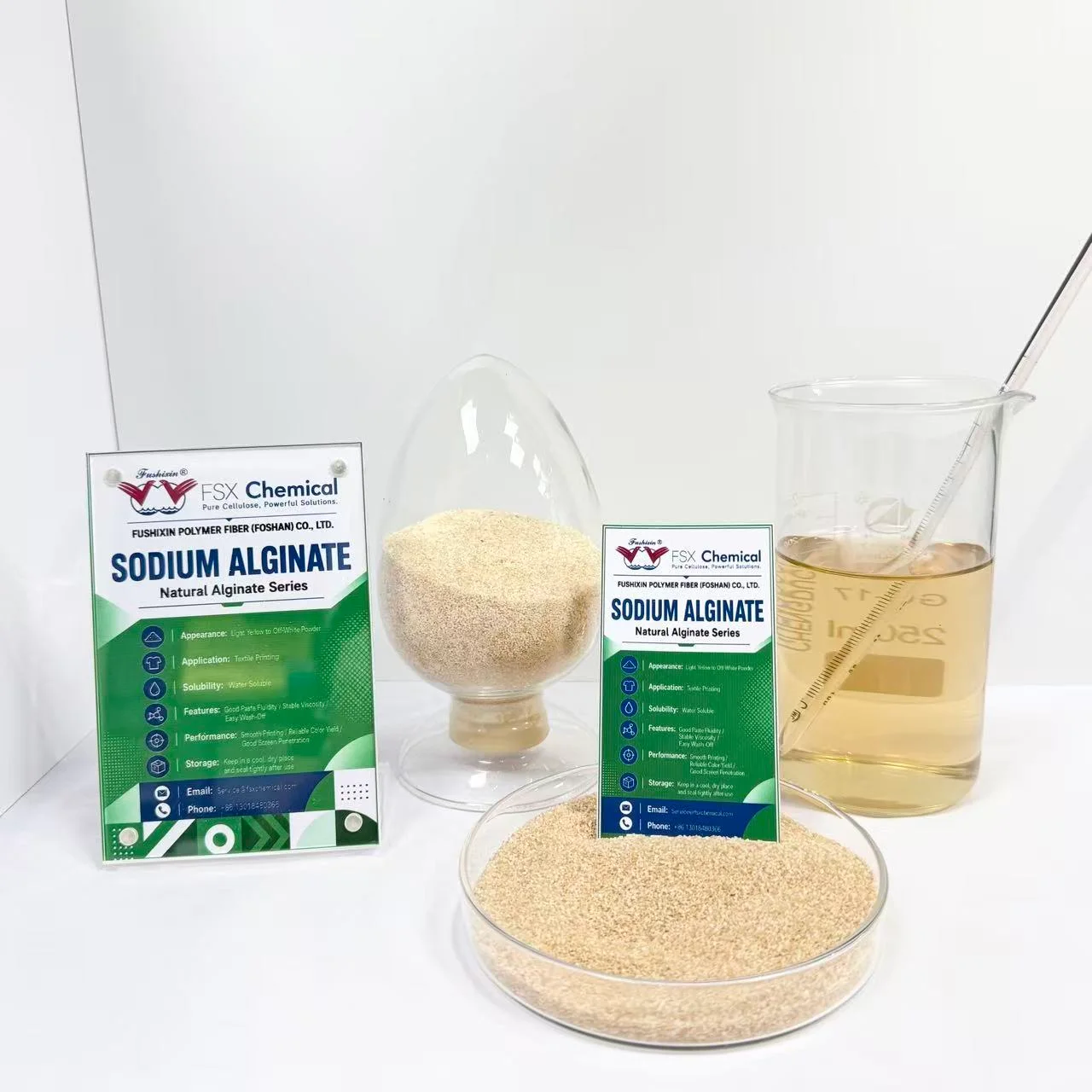
FSX Chemical supplies sodium alginate, CMC, CMS and digital printing paste for different textile applications. The product-selection approach is based on identifying a suitable commercial grade rather than promoting one universal premium product.
The objective is to provide a practical balance of application performance, factory-direct pricing, technical documentation and sample-to-bulk control.
Application-based grade selection
The starting grade can be selected according to the fabric, dye or ink system, formulation, equipment and required viscosity method.
Current-product comparison
Buyers can provide an existing TDS, sample, label, dosage or test result for a more direct comparison.
Representative samples
Candidate samples allow buyers to compare performance and cost before commercial approval.
Technical documents
Relevant TDS and SDS information can support technical and safety review. Batch-level quality information can be connected to the confirmed commercial grade and order stage.
Factory-direct value
Competitive pricing does not need to depend on removing technical controls. Direct manufacturing and focused product matching can create an alternative to both low-documentation budget products and expensive branded grades.
L'alginate de sodium est largement utilisé dans l'impression textile comme épaississant stable et lavable pour les pâtes d'impression réactives. Découvrez comment évaluer le degré de viscosité, la pureté et l'adéquation à l'application avant tout achat, et comment FSX Chemical accompagne les acheteurs du monde entier en leur fournissant des données techniques et des échantillons.
La carboxyméthylcellulose (CMC) est largement utilisée dans les processus d'impression, d'encollage et de teinture des textiles. Ce guide explique comment évaluer les différentes qualités de CMC, quels sont les paramètres les plus importants et comment FSX Chemical peut vous aider dans vos décisions d'achat.
La carboxyméthylcellulose est utilisée comme épaississant et stabilisant dans les encres à base d'eau, l'impression en héliogravure et le prétraitement pour l'impression à jet d'encre. Ce guide présente les principaux paramètres relatifs aux différentes qualités de ce produit ainsi que les éléments à prendre en compte par les équipes d'approvisionnement.
L'alginate de sodium et la CMC sont tous deux utilisés comme épaississants dans l'impression textile, mais ils conviennent à des systèmes de teinture et à des conditions de traitement différents. Ce guide explique les principales différences entre ces deux produits et précise dans quels cas il convient d'utiliser l'un ou l'autre.
L'impression numérique à jet d'encre sur textiles présente des exigences différentes en matière de pâte et de prétraitement par rapport à la sérigraphie. Ce guide explique comment l'alginate de sodium est utilisé dans l'impression textile numérique et quels paramètres de qualité les équipes d'approvisionnement doivent préciser.
Le CMC de qualité alimentaire et celui de qualité industrielle partagent la même composition chimique de base, mais présentent des différences significatives en termes de pureté, de plage de DS et d'exigences réglementaires. Ce guide explique les principales différences et pourquoi l'utilisation d'une qualité inadaptée peut entraîner des problèmes de production.
Dans l'impression textile aux colorants réactifs, une préparation correcte de la pâte est tout aussi importante que le choix de la qualité du tissu. Ce guide aborde les méthodes de dissolution de l'alginate de sodium, les plages de concentration en fonction de l'application, les conditions de stockage, ainsi que la manière de résoudre les problèmes courants liés à la préparation.
L'alginate de sodium est un polymère naturel et biodégradable, mais son utilisation dans l'impression textile génère des eaux usées qui doivent être traitées. Ce guide présente le profil environnemental de l'alginate de sodium, les caractéristiques des effluents de lavage, ainsi que les éléments que les équipes chargées des achats doivent connaître concernant le choix des épaississants et leur impact environnemental.
Le taux de fixation des colorants a une incidence directe sur le rendement chromatique, la résistance au lavage et la charge polluante des eaux usées dans l'impression aux colorants réactifs. Ce guide explique comment l'alginate de sodium favorise la fixation des colorants, quels paramètres de la pâte influencent le taux de fixation et comment remédier à une fixation insuffisante en production.
La granulométrie (maillage) de l'alginate de sodium influe sur la vitesse de dissolution de la poudre, l'uniformité de son hydratation et les performances de la pâte obtenue en sérigraphie. Ce guide explique les implications pratiques du choix du maillage pour les applications de pâte d'impression textile.
Dans l'impression textile aux colorants réactifs, une préparation correcte de la pâte est tout aussi importante que le choix de la qualité du tissu. Ce guide aborde les méthodes de dissolution de l'alginate de sodium, les plages de concentration en fonction de l'application, les conditions de stockage, ainsi que la manière de résoudre les problèmes courants liés à la préparation.
Les spécifications de pureté de l'alginate de sodium ne se résument pas à un simple chiffre. Ce guide explique ce que signifient les données relatives à la teneur en substance active, au NaCl, aux matières insolubles et aux métaux lourds pour les performances des pâtes d'impression textile — et dans quels cas il est préférable de privilégier une pureté supérieure à celle d'un produit de qualité industrielle standard.
Veuillez nous communiquer le nom du produit, son application, la quantité, la destination, ainsi que toute fiche technique (TDS),
photo ou document dont vous disposez déjà. FSX Chemical examinera ces
informations et vous recommandera la marche à suivre pour obtenir un devis, trouver un échantillon correspondant
ou choisir un produit.
Informations sur le produitNom du produit, référence, modèle, photo de l'étiquette ou référence du fournisseur.
Documents disponiblesFiche technique (TDS), fiche de données de sécurité (SDS), certificat d'analyse (COA), photo d'exemple, liste des produits ou données d'essai.
Détails de la commandeQuantité estimée, conditionnement, pays de destination, port ou conditions commerciales.
Demande ou problèmeProcédé d'impression textile, besoins en matière de formulation, problème actuel ou performances visées.

 FR
FR  EN
EN  BN
BN  ES
ES  TR
TR  ID
ID  RU
RU  AR
AR  UR
UR