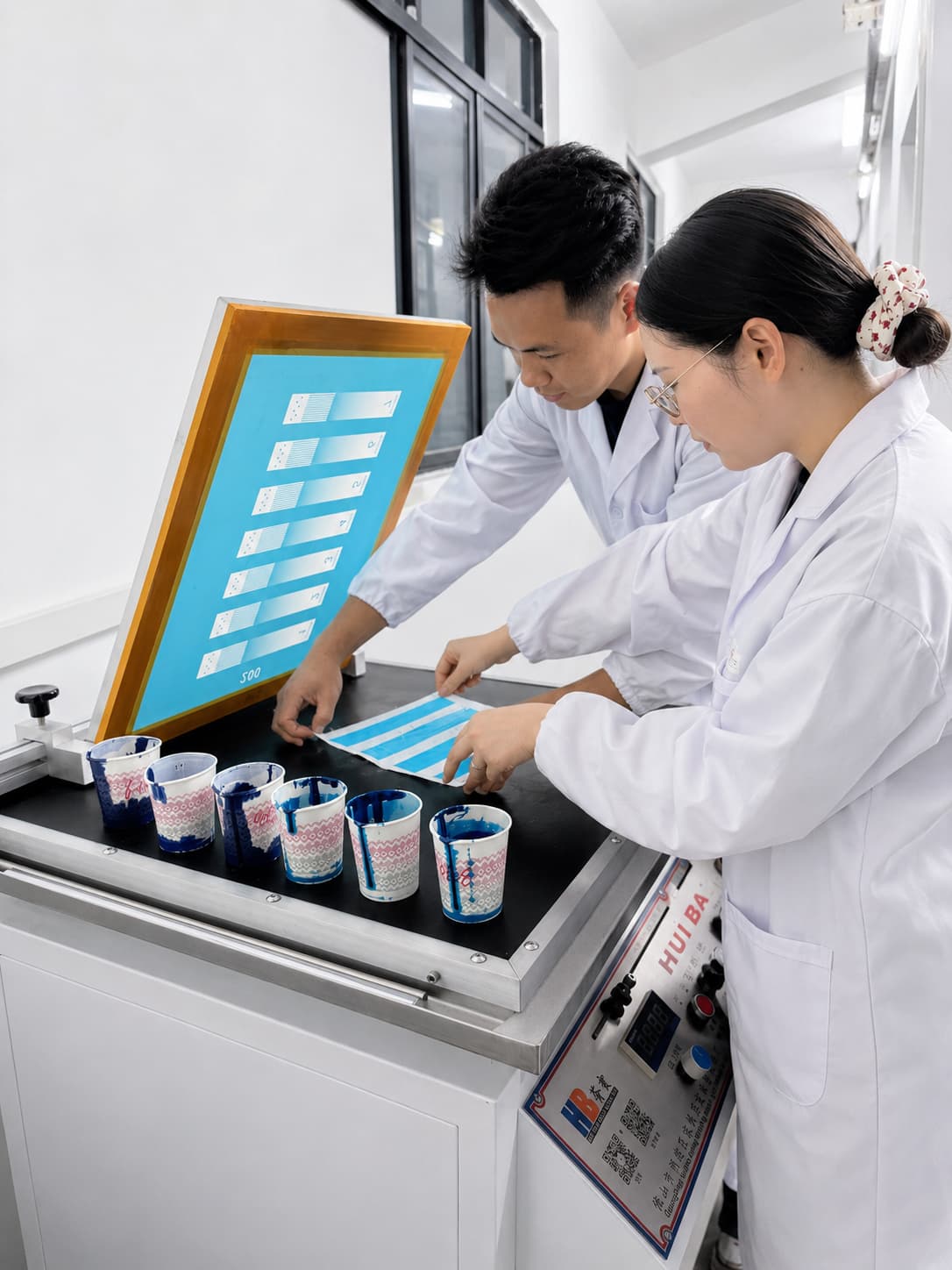
Понимание различий между марками альгинатного натрия высокого, среднего и низкого давления
HV, MV and LV sodium alginate grades describe relative viscosity categories, but the labels are...
Buyers sourcing sodium alginate for textile printing frequently encounter three abbreviations: HV, MV and LV. They normally mean High Viscosity, Medium Viscosity and Low Viscosity sodium alginate.
At first glance, the difference appears simple: HV is thicker, MV is in the middle and LV is thinner. In practical textile printing, however, grade selection is more complicated.
The terms HV, MV and LV are relative commercial classifications rather than one universal international viscosity specification. A product described as HV by one supplier may not have the same viscosity as another supplier’s HV grade if the concentration, temperature, instrument or classification range is different.
More importantly, viscosity grade alone does not determine print definition, screen passage, dye transfer, wash-off or total cost in use. The selected sodium alginate must be evaluated as part of the complete reactive printing system.
What Do HV, MV, and LV Mean?
In sodium alginate terminology, HV normally refers to High Viscosity, MV to Medium Viscosity and LV to Low Viscosity.
The classification describes the relative viscosity produced by a sodium alginate grade under a specified test condition. It should not be interpreted as a direct quality ranking.
HV does not mean high quality
HV means that the product develops relatively high viscosity under the supplier’s specified test method. It does not automatically mean higher purity, better filtration or better printing performance.
MV does not automatically mean general purpose
Medium viscosity may provide a useful balance for many formulations, but the correct grade still depends on the customer’s paste concentration, machine, fabric and design.
LV does not mean inferior quality
Low-viscosity sodium alginate is intentionally produced for formulations requiring a different relationship between polymer concentration, solids and flow behavior.
Therefore, HV, MV and LV should be treated as formulation options rather than quality levels.
There Is No Universal HV, MV, or LV Viscosity Range
One of the most important points for buyers is that HV, MV and LV are not universal viscosity specifications.
Different sodium alginate manufacturers may use different viscosity ranges for the same grade description. They may also use different concentrations, instruments, temperatures or rotational speeds.
A supplier’s HV may resemble another supplier’s MV
This can occur when the two companies define their internal grade ranges differently.
The test method must accompany the grade
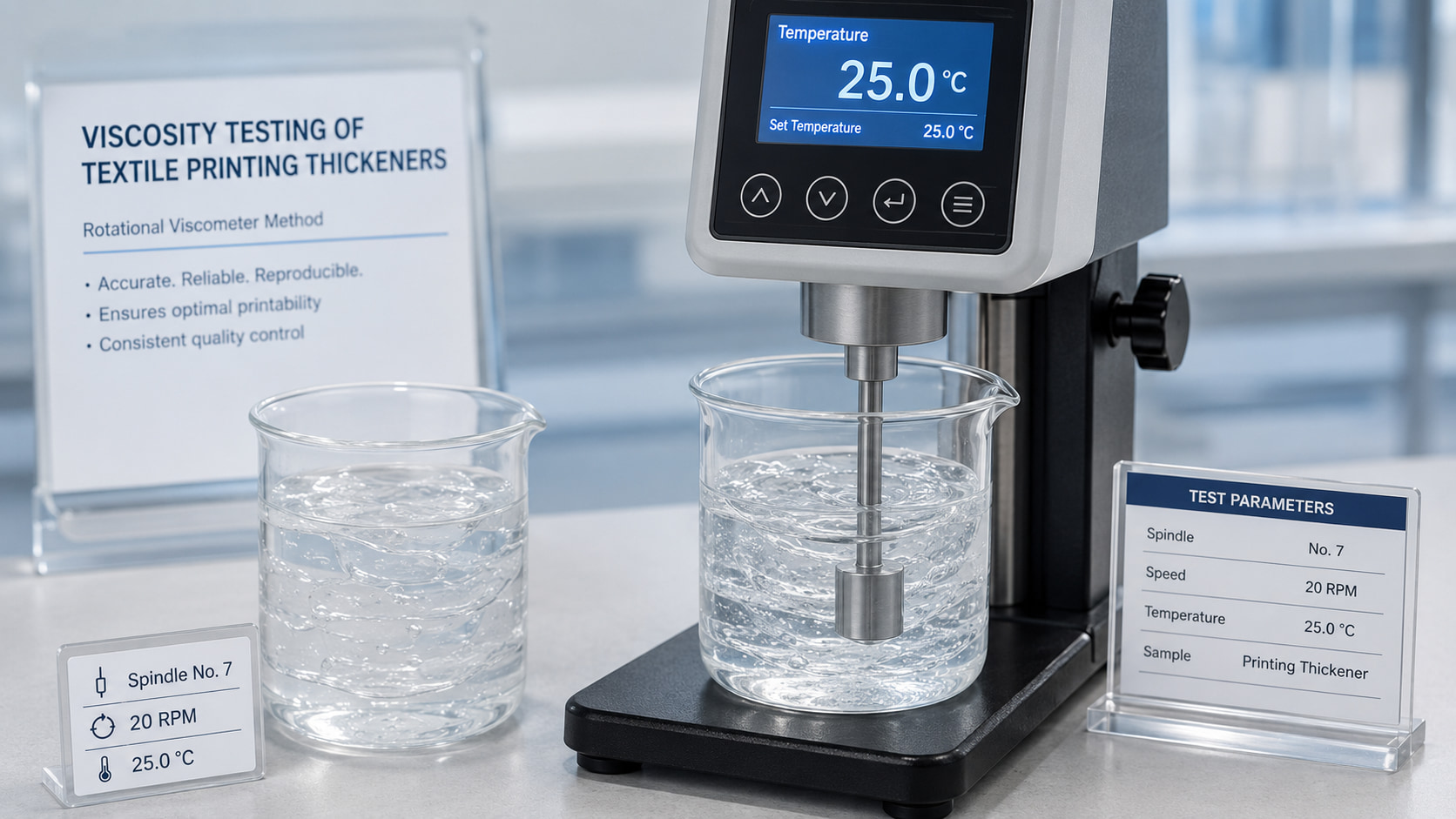
A useful viscosity specification should identify the test concentration, preparation method, temperature, instrument, spindle or rotor, speed, reading procedure and unit.
Do not purchase from the abbreviation alone
A quotation stating only “HV sodium alginate” does not provide enough information for technical comparison.
Request the permanent product code and current TDS before treating two grades as equivalents.
Why Test Concentration Changes the Meaning of Viscosity
Polymer-solution viscosity is strongly dependent on concentration. Increasing the amount of sodium alginate in water can increase viscosity substantially.
This means that a viscosity value is incomplete when the test concentration is missing.
Example of an invalid comparison
If Supplier A reports viscosity at one concentration while Supplier B reports viscosity at another concentration, the two numerical values should not be compared directly.
Commercial dosage and test concentration are different concepts
The concentration used for supplier QC does not necessarily represent the final dosage used in a printing mill.
Always reproduce the same preparation basis
When comparing candidates, prepare the samples using the same concentration calculation, water, temperature and hydration method.
HV Sodium Alginate: What It Really Means
HV sodium alginate develops relatively high viscosity compared with lower viscosity grades when tested under the same defined conditions.
Potential formulation advantage
A high-viscosity grade may require a lower polymer concentration than a lower-viscosity grade to reach a selected routine viscosity target.
Potential limitation
High viscosity should not be confused with ideal rheology. If the complete paste becomes excessively structured, pumping, screen passage, leveling or transfer may become more difficult.
HV may be useful when
A relatively high thickening efficiency is required
The target paste body can be achieved at an acceptable dosage
Screen passage remains suitable
The complete reactive formulation remains stable
The printed design shows acceptable definition and coverage
HV should therefore be selected because its complete performance matches the process, not because “high” appears better than “medium” or “low.”
MV Sodium Alginate: What It Really Means
MV sodium alginate occupies the supplier’s medium-viscosity category under the specified test method.
In some production systems, an MV grade may provide a convenient balance between polymer concentration, preparation, screen passage and printing rheology. This should still be demonstrated experimentally.
Why buyers often begin with MV
When there is insufficient information about the current product, a medium-viscosity candidate can sometimes serve as a practical laboratory reference point before moving higher or lower.
MV is not automatically the safest choice
A customer’s existing thickener may require a substantially different viscosity efficiency or concentration structure. Matching only the MV label can therefore produce an incorrect substitution.
Evaluate the complete paste
The correct MV candidate should be tested with actual reactive dyes, alkali, salts, humectants and the production fabric.
LV Sodium Alginate: What It Really Means
LV sodium alginate produces relatively lower viscosity at the supplier’s defined test concentration.
Lower viscosity does not mean that the product is diluted, impure or lower quality. It may represent a deliberately selected molecular and formulation profile.
Why a formulator may evaluate LV
A lower-viscosity polymer can allow the formulator to use a different polymer-solids level while maintaining workable paste viscosity.
Higher concentration is not automatically required
Actual dosage depends on the required rheology, fabric, machine and complete formulation. The final level should be determined experimentally rather than calculated only from the LV label.
LV still requires filtration and application testing
Lower solution viscosity does not guarantee better filtration, faster printing or better screen passage. These characteristics should be tested independently.
HV vs MV vs LV: Quick Comparison
Factor
HV
MV
LV
Meaning
Высокая вязкость
Средняя вязкость
Низкая вязкость
Relative viscosity at equal test conditions
Higher
Intermediate
Lower
Potential concentration to reach one target viscosity
May be lower
Intermediate
May be higher
Printing quality
Must be tested
Must be tested
Must be tested
Отрывок с экрана
Depends on formula and rheology
Depends on formula and rheology
Depends on formula and rheology
Фильтрация
Independent verification required
Independent verification required
Independent verification required
Best application
Application-specific
Application-specific
Application-specific
Most common purchasing mistake
Assuming higher means better
Assuming medium means universal
Assuming lower means inferior
The table describes relative differences only. Exact viscosity specifications should always come from the individual supplier’s TDS.
Does Higher Viscosity Mean Better Printing?
No. Higher sodium alginate viscosity does not automatically produce better reactive textile printing.
If the paste is too fluid
Excessive spreading or penetration may occur under certain fabric and application conditions.
If the paste is too structured
Screen passage, paste transfer and solid-area leveling may become difficult.
The optimum is a working window
The objective is to establish enough structure to control the design while maintaining suitable flow through the printing equipment.
Finished fabric is the final test
Grade selection should consider definition, penetration, color response, wash-off and handle after the complete printing process.
How Grade Affects Sodium Alginate Dosage
HV, MV and LV grades can require different concentrations to achieve a comparable routine viscosity.
However, the lowest dosage is not automatically the most economical or technically suitable choice.
Сравните эффективную дозировку
Optimize each candidate to the concentration required for acceptable printing rather than comparing all products at one arbitrary dosage.
Compare total paste composition
Changing sodium alginate concentration changes the polymer-solids content of the stock paste and may influence water retention, transfer and wash-off.
Compare cost per acceptable printed metre
Include sodium alginate dosage, preparation, filtration, machine behavior, waste and final fabric quality.
Viscosity vs Rheology
Viscosity is one part of paste behavior. Rheology describes how the paste responds when shear and time change during production.
In the storage tank
The paste experiences relatively low shear and should remain sufficiently uniform.
During pumping
Higher shear is introduced and the paste must move through pipelines without excessive resistance.
During screen passage
The paste experiences significant mechanical force and needs suitable flow behavior.
After reaching the fabric
The paste should recover enough structure to help maintain the intended design.
Why this matters when comparing HV, MV and LV
Two grades adjusted to the same single-point viscosity can still have different shear-thinning and recovery behavior.
How HV, MV, and LV Affect Screen Passage
Screen passage depends on much more than the HV, MV or LV designation.
Important variables include
Final paste viscosity
Свойство сдвигового разжижения
Концентрация полимера
Качество гидратации
Filtration residue
Screen opening
Squeegee or machine pressure
Скорость печати
An HV grade used at a suitable concentration may pass a screen efficiently, while an incorrectly prepared LV grade can still create filtration or transfer problems.
Grade labels should therefore never be used as substitutes for an actual screen-passage trial.
How Grade Can Influence Print Definition and Penetration
Sodium alginate helps control where the reactive color paste moves after it reaches the textile.
Четкость тонких линий
The paste must provide enough post-shear structure to limit unwanted lateral spreading.
Solid-area coverage
The paste must also level and transfer sufficiently to produce uniform larger printed areas.
Проникновение
Excessively deep penetration may reduce surface appearance, while insufficient penetration may be undesirable for some fabric or design requirements.
The grade is only one variable
Fabric absorbency, paste pickup, screen pressure, dye concentration and drying conditions also influence definition and penetration.
Flat-Screen vs Rotary-Screen Considerations
Printing equipment changes the mechanical conditions experienced by the sodium alginate paste.
Печать на плоских поверхностях
Evaluate squeegee transfer, screen release, fine-line definition, solid-area coverage and penetration using the actual production screen.
Ротационная трафаретная печать
Evaluate pumping, continuous circulation, screen passage, repeated shear and consistency over a longer production period.
High-speed production
Production speed changes shear and contact time. Do not assume that moving automatically from HV to MV or LV will solve a speed-related problem.
Match rheology to the machine
The preferred grade is the one that maintains reliable transfer and finished-fabric quality under the intended equipment conditions.
Fabric and Design Considerations
The same sodium alginate grade can behave differently on different fabrics.
Ткань с высокой впитывающей способностью
Rapid liquid movement into the textile can increase penetration and affect edge definition.
Dense woven fabric
More paste may remain near the surface, increasing the importance of leveling and transfer.
Lightweight or open fabric
Excessive strike-through can become more visible and may require adjustment of rheology, pickup or machine pressure.
Fine designs
Small text and narrow lines make spreading and filter residue easier to detect.
Large dark solids
Black, navy and other heavy shades can expose poor transfer or leveling that may not appear in a small light-color test.
Reactive Dye and Chemical Compatibility
Sodium alginate grade selection should be confirmed in the complete reactive printing paste.
Reactive dyes
Test representative dyes and shade depths rather than one low-load laboratory color.
Щелочь
Measure viscosity and paste condition after the actual alkaline system is introduced.
Salts and electrolytes
Ionic components can influence apparent viscosity and polymer behavior.
Humectants and other auxiliaries
These can influence moisture management, drying and fixation as well as the physical characteristics of the paste.
Do not approve the grade in water alone
Clean-water testing is useful for basic QC, but it cannot demonstrate complete reactive-paste performance.
Hydration, Filtration and Paste Preparation
Differences attributed to HV, MV or LV may actually be caused by preparation.
Standardize powder addition
Add sodium alginate gradually into suitable water circulation to minimize lumps and incomplete wetting.
Standardize hydration time
Measure reference and candidate products only after the defined hydration period.
Control temperature
Compare samples at the same measurement temperature.
Test filtration separately
HV, MV and LV do not directly define filtration quality. Use an agreed filter method and inspect retained material.
Test the complete color paste
Repeat viscosity and filtration after the critical printing chemicals are added.
How to Compare Grades from Different Suppliers
When changing sodium alginate suppliers, do not ask only for the same HV, MV or LV label.
Request the full TDS
Compare viscosity specifications together with concentration and test conditions.
Exchange the customer’s viscosity method
Providing the existing method allows the new supplier to evaluate a candidate under more relevant conditions.
Provide a current sample
A physical reference can be more useful than an HV or MV description alone.
Compare equal concentration first
This establishes a baseline for viscosity efficiency, hydration, filtration and rheology.
Then optimize each candidate
Once the behavior is understood, adjust the candidate concentration to determine its practical formulation window.
Compare finished fabric last
A technically meaningful supplier comparison ends with printing, fixation, washing and fabric evaluation.
Why Two HV Grades Can Perform Differently
Two suppliers can both label a product HV while the products behave very differently in the printing mill.
Different viscosity specifications
Their internal HV ranges may not be identical.
Different test methods
Concentration, temperature, spindle and speed can change the reported viscosity.
Different rheology
Equal single-point viscosity does not prove equal shear-thinning or recovery behavior.
Different particle profiles
Powder wetting and hydration may differ even when the final viscosity is similar.
Different filtration behavior
Insolubles, gels and incomplete hydration can influence machine performance independently of viscosity.
Different chemical response
The two products may respond differently when reactive dyes, salts and alkalis are introduced.
Recommended Laboratory Comparison
Step 1: Select the current reference
Use a representative sample of the sodium alginate currently approved in production.
Шаг 3: Совместная подготовка рекомендательного письма и кандидата
Use identical water, containers and mixing conditions.
Step 4: Compare basic properties
Гидратация
Вязкость
Multi-speed behavior where available
Фильтрация
Внешний вид
Пена
Step 5: Prepare the complete reactive paste
Use the same dye, alkali, salt, humectant and addition sequence.
Step 6: Test holding stability
Compare viscosity, pH, appearance and filtration after the normal production holding period.
Шаг 7: Распечатайте ту же ткань
Include fine lines, small details and large solid areas in the test.
Step 8: Complete fixation and wash-off
Use identical conditions for all candidates.
Step 9: Optimize concentration
After baseline comparison, adjust candidate concentration carefully to find the best operating window.
Step 10: Complete a limited production trial
Confirm performance under actual tank, pumping, screen and production conditions.
Common Grade-Selection Mistakes
Assuming HV means premium quality
Viscosity classification is not a general quality ranking.
Ordering “the same HV” from another supplier
Supplier classifications can differ, so the current TDS and viscosity method should be compared.
Ignoring test concentration
A viscosity number without concentration cannot be interpreted properly.
Choosing the highest viscosity to improve sharpness
Excessive paste structure can reduce transfer and create broken details.
Assuming LV is automatically suitable for high-speed machines
Machine performance depends on final rheology, dosage, screen, filtration and formulation rather than the LV label alone.
Changing grades weight for weight
HV, MV and LV may require different optimized concentrations.
Testing only the stock paste
Final selection requires complete reactive paste and fabric evaluation.
Troubleshooting the Wrong Viscosity Grade
Выявленная проблема
Possible Grade-Related Cause
Other Factors to Check
Paste is difficult to pump
Excessive viscosity or unsuitable rheology
Temperature, dosage, pump and hydration
Плохое прохождение экрана
Paste structure too high for the application
Filtration, screen condition and pressure
Fine lines spread
Insufficient post-shear structure
Fabric absorbency, pickup and drying
Fine lines break
Excessive structure or poor flow under shear
Residue, screen opening and application pressure
Solid areas are uneven
Unsuitable leveling or transfer
Foam, screen and fabric variation
Чрезмерное проникновение
Insufficient paste structure
Fabric construction, pressure and pickup
High dosage is required
Candidate may have insufficient viscosity efficiency
Test method and target rheology
Correct viscosity but poor printing
Wrong rheological profile despite correct single-point value
Formula, fabric, machine and fixation
How to Choose Between HV, MV, and LV
A reliable selection process begins with the printing requirement rather than the grade abbreviation.
Choose based on the current benchmark
If the existing sodium alginate works well, match its actual viscosity method and application behavior first.
Choose based on the desired concentration structure
Determine whether the formulation requires high thickening efficiency or a different polymer-solids balance.
Choose based on the machine
Evaluate pumping, circulation and screen passage under the intended production conditions.
Choose based on fabric and design
Fine-line printing, large solid areas, lightweight fabrics and dense constructions may require different rheological balance.
Choose based on the complete reactive paste
Confirm chemical compatibility and holding stability after all important components have been introduced.
Choose based on finished fabric
The final decision should consider print definition, penetration, color response, wash-off, handle and relevant quality requirements.
Information to Send for Grade Matching
Providing detailed information allows a sodium alginate supplier to recommend a more relevant HV, MV or LV candidate.
Current product information
Supplier and commercial grade
HV, MV or LV designation if available
Current TDS or COA
Physical sample if available
Viscosity information
Концентрация в тесте
Current viscosity result
Источник воды
Процедура увлажнения
Температура измерения
Вискозиметр
Шпиндель или ротор
Скорость вращения
Printing information
Система реактивных красителей
Текущая дозировка альгината натрия
Complete paste formulation where possible
Оборудование с плоским или ротационным ситом
Production speed
Normal paste holding time
Fabric information
Fibre composition
Плотность ткани
Woven or knitted construction
Впитывающая способность
Representative fabric sample where possible
Current problem or target
Improve screen passage
Improve fine-line definition
Reduce excessive penetration
Improve solid-area leveling
Improve filtration
Improve holding stability
Optimize dosage or total cost in use
How FSX Chemical Supports Sodium Alginate Selection
FSX Chemical supplies textile-grade sodium alginate and related thickener routes for printing mills, formulation companies, distributors and importers.
Grade matching should be based on the customer’s actual viscosity method, printing paste, fabric and equipment rather than simply matching an HV, MV or LV label.
A recommended HV, MV or LV grade remains a candidate for controlled evaluation. Final suitability depends on the complete formulation, equipment, fabric, fixation and wash-off process.
Узнайте, почему значения вязкости загустителей для текстильной печати нельзя сравнивать без учета таких факторов, как концентрация, температура, прибор, шпиндель, скорость, метод подготовки проб и время испытания.
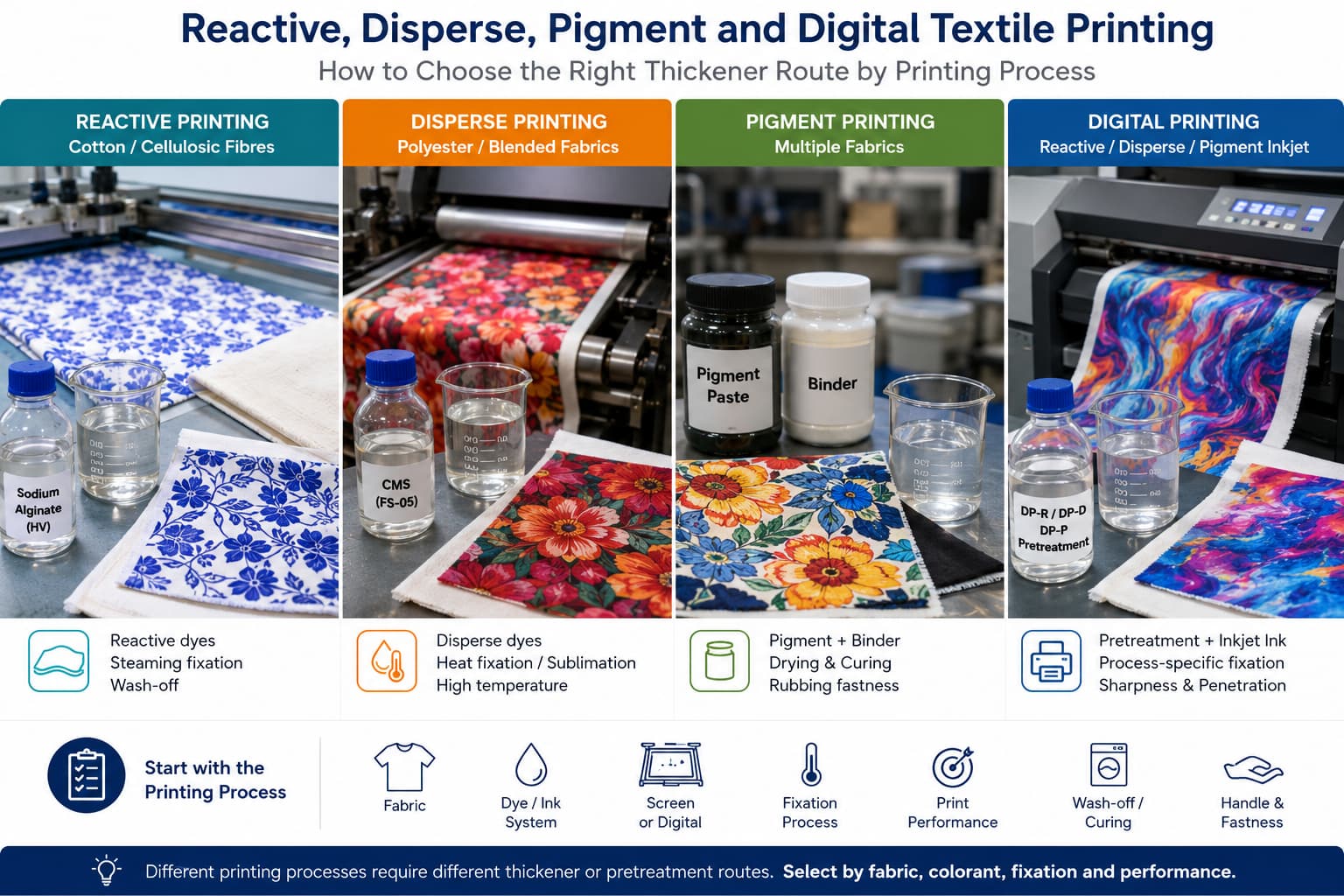
Узнайте, как выбирать загустители и способы предварительной обработки для реактивной, дисперсной, пигментной и цифровой печати на текстиле с учетом требований к ткани, красителю или чернилам, фиксации, вымываемости и качеству печати.
Сравните CMC, CMS, альгинат натрия и пасту для цифровой печати на текстиле. Узнайте, насколько каждый из этих материалов подходит для реактивной, дисперсной, пигментной и цифровой печати, а также на что покупателям следует обратить внимание перед тестированием образцов, подбором марки и оптовой закупкой.
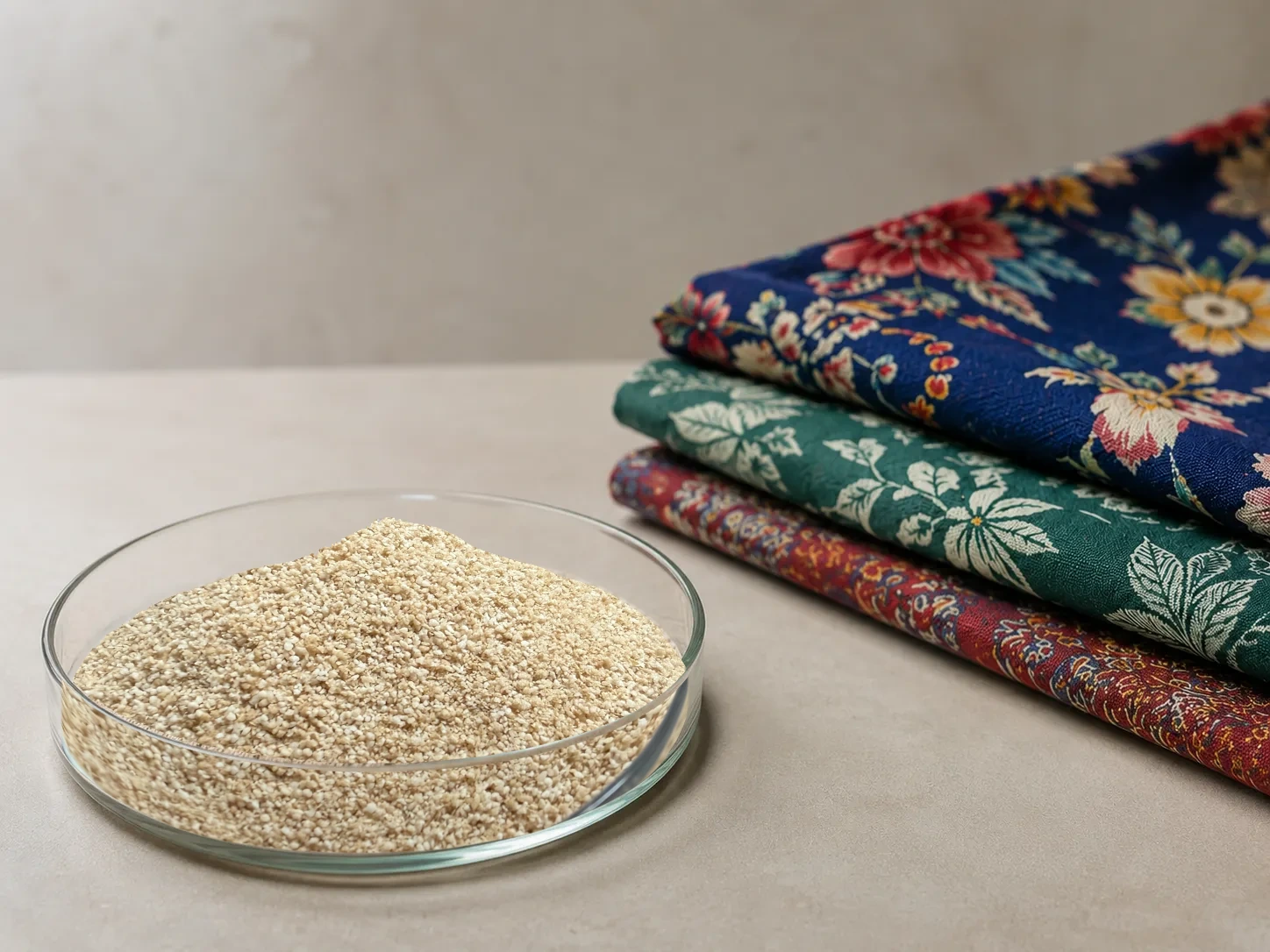
Альгинат натрия широко используется в текстильной печати в качестве стабильного и стойкого к стирке загустителя для реактивных печатных паст. Узнайте, как перед покупкой оценить класс вязкости, степень чистоты и пригодность продукта для конкретного применения, а также о том, как компания FSX Chemical оказывает поддержку покупателям по всему миру, предоставляя технические данные и образцы.
Выбор подходящего поставщика CMC — это не просто сравнение цен. В данном руководстве рассмотрены критерии оценки, перечень необходимых документов и порядок проведения пробных поставок, которым должны руководствоваться отделы закупок перед оформлением крупного заказа.
Печатная паста на основе CMC используется в пигментной, реактивной и цифровой текстильной печати. В данном руководстве объясняется, какие параметры имеют значение, как сравнивать поставщиков и что следует уточнить перед размещением оптового заказа.
И альгинат натрия, и CMC используются в качестве загустителей при печати на текстиле, однако они подходят для разных систем окрашивания и условий производства. В данном руководстве объясняются основные различия между ними и приводятся рекомендации по их применению.
Цифровая струйная печать на текстиле предъявляет иные требования к пасте и предварительной обработке материала, чем трафаретная печать. В данном руководстве объясняется, как альгинат натрия используется в цифровой печати на текстиле и какие параметры качества должны указывать специалисты по закупкам.
При печати на текстиле реактивными красителями правильная подготовка пасты не менее важна, чем выбор сорта краски. В данном руководстве рассматриваются методы растворения альгината натрия, диапазоны концентраций в зависимости от области применения, условия хранения, а также способы устранения типичных проблем при подготовке пасты.
Альгинат натрия — это природный биоразлагаемый полимер, однако его использование в текстильной печати приводит к образованию сточных вод, требующих соответствующей обработки. В данном руководстве рассматриваются экологические характеристики альгината натрия, свойства сточных вод после вымывания, а также то, что специалистам по закупкам необходимо знать о выборе загустителя и его воздействии на окружающую среду.
Скорость фиксации красителя напрямую влияет на цветоотдачу, стойкость к стирке и загрязнённость сточных вод при печати реактивными красителями. В данном руководстве объясняется, как альгинат натрия способствует фиксации красителя, какие параметры пасты влияют на скорость фиксации и как устранять проблемы, связанные с низкой фиксацией, в производственных условиях.
Размер частиц альгината натрия (меш) влияет на скорость растворения порошка, равномерность его гидратации, а также на рабочие характеристики получаемой пасты при трафаретной печати. В данном руководстве объясняются практические последствия выбора размера меш при использовании паст для печати на текстиле.
Сообщите название продукта, область применения, количество, пункт назначения, а также предоставьте техническое описание продукта (TDS),
фотографию образца или имеющиеся у вас документы. Компания FSX Chemical рассмотрит
эту информацию и порекомендует дальнейшие действия для подготовки коммерческого предложения, подбора образца
или выбора продукта.
Информация о продуктеНазвание товара, класс, модель, фотография этикетки или артикул поставщика.
Доступные документыTDS, SDS, COA, фотография образца, перечень продукции или данные испытаний.
Детали заказаПредполагаемый объем, упаковка, страна назначения, порт или условия торговли.
Область применения или проблемаПроцесс печати на текстиле, требования к составу, текущие проблемы или целевые показатели.

 RU
RU  EN
EN  BN
BN  ES
ES  TR
TR  FR
FR  ID
ID  AR
AR  UR
UR  VI
VI  TL
TL  HI
HI  UK
UK  KK
KK  KA
KA  UZ
UZ