مصنوعی پرنٹنگ گاڑھا کرنے والا مادہ رنگدانے، بائنڈر یا الیکٹرولائٹس شامل کرنے کے بعد اپنی گاڑھائی کیوں کھو دیتا ہے؟
Synthetic printing thickener can lose viscosity after pigment, binder or electrolyte is added even when the water-only paste looked perfectly stable. The cause may be simple dilution, a pH shift away from the thickener’s activation window, electrolyte screening of charged polymer chains, incompatibility with pigment dispersants or binder chemistry, local over-concentration during addition, temperature change or incomplete equilibration. Not every synthetic thickener responds in the same way, and some hydrophobically modified acrylic systems can show better electrolyte tolerance than conventional polyacrylate routes. The correct troubleshooting method is to build the pigment paste in stages, measure viscosity and pH after each critical addition, and validate the final rheology on the printing machine instead of correcting the viscosity number blindly.
Why Does Synthetic Printing Thickener Lose Viscosity?
In many pigment-printing formulas, synthetic thickener viscosity can drop after other ingredients are added because the thickener is no longer operating in the same chemical environment as the original water-only test.
The main causes are usually one or more of the following:
- Dilution lowers effective polymer concentration.
- pH shifts away from the grade’s useful activation range.
- Electrolytes screen the charged polymer structure.
- Pigment dispersants or surfactants change polymer interaction.
- Binder introduces salts, surfactants or incompatible ionic chemistry.
- Fixers or auxiliaries change pH or ionic strength.
- Mixing, temperature or holding time changes apparent viscosity.
The correct troubleshooting question is therefore not:
“Why is the thickener weak?”
It is:
“At which formulation step does viscosity change, and what chemical or physical variable changed at that step?”
One Symptom, Several Possible Causes
| Observed Event | Possible Mechanism | First Diagnostic |
|---|---|---|
| Viscosity drops after pigment | Dilution, pigment salts, dispersant, pH shift | Water-dilution control vs. real pigment |
| چسپاں مادہ کے بعد چپچپا پن کم ہو جاتا ہے۔ | Electrolytes, surfactants, ionic compatibility | Binder-only addition test |
| Viscosity drops after fixer | High ionic load or pH change | Fixer dose series |
| Viscosity drops during holding | Delayed interaction, temperature, shear recovery, instability | Timed viscosity curve |
| Water viscosity is high but complete paste is thin | Formula compatibility problem | Staged complete-paste test |
More than one mechanism can occur at the same time.
For example, adding a pigment dispersion can add water, electrolyte and surfactant simultaneously.
If the mill jumps directly from water paste to completed formula, it loses the information needed to identify the cause.
1. Dilution: Did the Polymer Concentration Simply Fall?
Dilution is one of the simplest causes of viscosity loss and one of the easiest to miss.
Suppose the mill prepares a concentrated synthetic-thickener base and then adds:
- رنگدانے کی منتشر
- Binder emulsion
- Fixer solution
- Water-based auxiliaries
The total formula mass increases while the amount of thickener remains unchanged.
The effective thickener concentration therefore falls.
Because viscosity often changes nonlinearly with polymer concentration, a moderate dilution can create a larger-than-expected viscosity decrease.
Calculate:
Final Thickener Concentration = Thickener Active Material ÷ Total Final Paste Mass
Then prepare a control using the same amount of plain water instead of the pigment or binder.
If the control loses nearly the same viscosity, dilution is a major part of the problem.
2. pH Shift: Did the Paste Move Away from the Activation Window?
Many acrylic and polyacrylate thickeners develop viscosity through pH-dependent swelling or neutralization.
The thickener may perform well immediately after activation, but the final pigment formula can shift the pH.
Possible sources of pH change include:
- رنگدانے کی منتشر
- بائنڈر
- انتظام کار
- Defoamer
- دیگر معاون ادارے
If the final pH moves outside the grade’s useful operating window, viscosity can decrease even though the thickener dosage did not change.
Always record:
- pH before pigment
- pH after pigment
- pH after binder
- pH after fixer / auxiliaries
- pH after holding
For the pH-activation mechanism itself, see the related guide on پگمنٹ پرنٹنگ کے لیے ایکریلک پر مبنی مائع گاڑھا کرنے والا: پی ایچ اور نیوٹرلائزیشن کس طرح چپچپا پن کو کنٹرول کرتے ہیں.
3. Electrolyte Screening: Why Salts Can Reduce Thickening Efficiency
Many synthetic polyacrylate thickeners rely on charged carboxylate groups to maintain an expanded polymer structure.
When electrolyte concentration increases, dissolved ions can reduce the effective electrostatic repulsion between charged polymer segments.
A simplified mechanism is:
Electrolyte Addition → Charge Screening → Polymer Contraction → Lower Hydrodynamic Volume → Lower Apparent Viscosity
In pigment printing, electrolyte can enter from:
- Pigment dispersions
- Binders
- Fixers
- پانی کی سختی
- Neutralizer salts
- دیگر معاون ادارے
A grade with very high water viscosity can therefore lose much of its thickening efficiency inside the complete pigment formula.
This is why electrolyte tolerance should be treated as a separate product property from water viscosity.
Important Exception: Not All Synthetic Thickeners Respond to Electrolytes the Same Way
Do not write a universal rule that “salt always reduces synthetic-thickener viscosity.”
Different polymer architectures can respond differently.
Conventional alkali-swellable polyacrylate systems may be strongly affected by ionic screening.
Hydrophobically modified systems can add associative thickening mechanisms that change electrolyte response.
Some commercial HASE / HMASE designs are specifically engineered for better electrolyte compatibility.
Therefore, the correct comparison is:
Grade A vs. Grade B under the same production electrolyte package
نہیں:
“Acrylic thickeners always lose X% viscosity after salt.”
4. Pigment Dispersion Chemistry
A commercial pigment dispersion is more than pigment particles plus water.
It can contain:
- پھیلانے والے مادے
- سطح فعال مادّے
- Wetting agents
- الیکٹرولائٹس
- پی ایچ کنٹرول کیمیکلز
- Preservatives
These components can alter synthetic-thickener performance.
Two black pigment dispersions from different suppliers can therefore produce different viscosity even at the same pigment concentration.
When a viscosity problem appears after pigment addition, test:
- Same thickener with Pigment A
- Same thickener with Pigment B
- Same thickener with equivalent water addition
This helps separate pigment-package chemistry from simple dilution.
5. Binder Addition: Electrolyte Load, Surfactants and Ionic Compatibility
The binder is one of the most important ingredients in conventional pigment printing.
It also represents a major change to the chemistry of the printing paste.
بائنڈر کے اضافے سے تبدیلی واقع ہو سکتی ہے:
- Ionic strength
- پی ایچ
- سرفیکٹنٹ کا توازن
- ٹھوس مواد کا تناسب
- Viscoelastic behavior
If the thickener is strongly anionic and the formula contains a cationic component, interaction risk may increase.
Even when no visible floc forms, the viscosity can still shift.
Use a controlled binder test:
Activated Thickener Base → Binder Level 1 → Binder Level 2 → Binder Level 3
Keep total mass constant and record:
- پی ایچ
- سَانچَر
- ظاہری شکل
- جھاگ
- استحکام برقرار رکھنا
This builds a binder-compatibility curve rather than a single pass/fail result.
6. Fixers and Other Auxiliaries
Fixers, catalysts, hand modifiers, wetting agents and defoamers can also influence the final paste.
A small amount of a highly ionic auxiliary can have a larger viscosity effect than a much larger amount of a low-ionic binder.
Therefore, do not judge influence only by dosage.
When an unexplained viscosity collapse occurs, split the remaining auxiliaries and add them one at a time.
Record the viscosity after each addition.
This often identifies one small but highly influential component.
7. Addition Order and Local High Concentration
The final formula can be chemically acceptable but still fail if concentrated ingredients are added too quickly.
Examples include:
- Concentrated fixer added directly into one tank zone
- Neutralizer added without dilution
- Binder dumped into poorly circulating paste
- Pigment dispersion added before full thickener activation
Local conditions can temporarily be far more extreme than the final average formula.
This can cause:
- Local polymer contraction
- Local over-neutralization
- Gel / floc formation
- Uneven viscosity
The approved formula should therefore include an approved addition order and mixing procedure.
8. Temperature and Measurement Conditions
Viscosity is temperature-dependent.
If pigment or binder is added after warm mixing, the final paste may be warmer than the original thickener base.
A lower viscosity reading may therefore be partly thermal.
Use the same measurement method for every stage:
- Same temperature
- Same instrument
- Same spindle / rotor
- Same RPM or shear condition
- Same reading time
If necessary:
Measure Warm → Condition to Standard Temperature → Measure Again
Do not add more thickener until temperature effects have been excluded.
9. Mixing Shear and Structural Recovery
Synthetic printing pastes are often shear-thinning.
High-speed mixing can temporarily reduce apparent viscosity.
After mixing stops, part of the structure may recover.
If the mill measures immediately after high shear, it may record a lower value than after 10–30 minutes of controlled rest.
Therefore, define:
- ملاپن کی رفتار
- ملاپنے کا وقت
- Rest time before measurement
as part of the viscosity SOP.
A temporary shear effect should not be mistaken for irreversible chemical incompatibility.
10. Holding Time and Delayed Viscosity Loss
Some interactions are immediate.
Others appear slowly.
Possible patterns include:
Immediate Drop, Then Stable
Often consistent with dilution or fast electrolyte response.
Gradual Drop Over Several Hours
Investigate delayed polymer/formula interaction, pH drift, temperature and storage stability.
Initial Drop, Partial Recovery
May indicate shear recovery or equilibration.
Measure fresh, intermediate and end-of-shift viscosity using realistic production holding conditions.
A paste that looks stable at 10 minutes but fails after four hours is not suitable for a four-hour production window.
The Best Diagnostic: Build the Formula in Stages
Use one thickener base and divide the formula into critical stages.
| اسٹیج | Addition | ریکارڈ |
|---|---|---|
| 0 | فعال شدہ گاڑھا کرنے والا بیس | pH, viscosity, temperature |
| 1 | رنگدان | pH, viscosity, appearance |
| 2 | بائنڈر | pH, viscosity, foam |
| 3 | انتظام کار | pH, viscosity, floc/gel |
| 4 | دیگر معاون ادارے | pH, viscosity |
| 5 | Holding period | pH, viscosity, stability |
This produces a:
Formula Viscosity-Loss Map
The first stage with a major drop becomes the priority for the next controlled test.
Use Control Samples to Separate Dilution from Chemical Interaction
For each suspicious ingredient, compare three samples.
| نمونہ | Addition | مقصد |
|---|---|---|
| A | Nothing | بنیادی سطح |
| B | Equivalent water amount | Dilution control |
| C | Real pigment / binder / auxiliary | Dilution + chemistry effect |
If B and C behave similarly, dilution dominates.
If C loses much more viscosity than B, chemistry is contributing.
This is one of the simplest ways to prevent a false “electrolyte sensitivity” diagnosis.
Build a Viscosity-Retention Curve
Instead of recording only final viscosity, calculate viscosity retention.
Viscosity Retention (%) = Viscosity After Addition ÷ Reference Viscosity × 100
Then plot:
Ingredient Level → Viscosity Retention
Useful curves include:
- Pigment level vs. viscosity retention
- Binder level vs. viscosity retention
- Electrolyte level vs. viscosity retention
- Holding time vs. viscosity retention
This makes grade comparison much clearer.
A candidate may have lower starting viscosity but much better retention in the real formula.
Why Light and Dark Pigment Shades Can Behave Differently
Dark shades often use more pigment dispersion.
This can increase:
- Water addition
- Dispersant level
- الیکٹرولائٹ بوجھ
- Surfactant load
Therefore, a formula that is stable for a light shade may become much thinner at high pigment loading.
When qualifying a synthetic thickener, include:
- نمائندہ روشنی کا شیڈ
- معمولی پیداوار کا سایہ
- گہرا/سیاہ شیڈ
if the mill prints across a wide pigment concentration range.
Why Binder Dosage Can Change the Thickener Requirement
Binder dosage is usually selected for fixation, fastness and hand—not for thickener convenience.
If a product change increases or decreases binder dosage, the synthetic-thickener requirement may also change because:
- Electrolyte load changes
- Solids change
- Surfactant level changes
- Viscoelastic behavior changes
Do not assume one thickener dosage can be fixed across every binder level.
Build the thickener curve around the actual approved binder system.
A Lower Brookfield Number Does Not Always Mean Poor Printing
One-point viscosity is only one part of paste rheology.
After pigment or binder addition, the final paste can show a lower low-shear viscosity but still maintain:
- Good screen passage
- Useful shear thinning
- Fast structural recovery
- Sharp print definition
Likewise, adding enough thickener to restore the original water viscosity can create:
- Excess elasticity
- Poor screen release
- Higher polymer solids
- Harsh fabric hand
The target should be:
Approved Complete-Paste Rheology
نہیں:
Restore the Initial Water Viscosity at Any Cost.
Connect Viscosity Loss to Screen Printing Performance
Once the laboratory identifies the viscosity change, print the relevant samples under matched conditions.
جائزہ لیں:
- اسکرین کا گزرگاہ
- سکویجی منتقلی
- پیٹرن کی تعریف
- جامد رقبائی یکسانیت
- دراندازی
- Beginning-to-end consistency
If lower viscosity causes no negative machine or print effect, the original target may have been unnecessarily high.
If lower viscosity causes spreading or excessive penetration, the grade or formulation requires correction.
Curing and Finished-Fabric Checks
Pigment printing is not approved until after binder curing.
After the viscosity troubleshooting trial, compare:
- K/S or shade
- خشک رگڑ کے خلاف پائیداری
- گیلی رگڑ پر رنگ کی مضبوطی
- جہاں مناسب ہو رنگ کی پائیداری کی جانچ
- کپڑے کا ہاتھ
A correction that restores viscosity but requires excessive thickener may increase polymer deposit and worsen hand.
Always evaluate the finished fabric before finalizing the correction.
Should You Add More Synthetic Thickener?
Only after identifying the cause.
Use this sequence:
Check Dilution → Check pH → Check Electrolytes → Check Pigment → Check Binder → Check Temperature / Shear → Print → Then Adjust Dosage
If dosage adjustment is justified:
- Use the approved addition method.
- Avoid adding concentrated thickener directly into a completed paste unless the product is designed for that correction route.
- Recheck pH.
- Allow equilibration.
- Reprint the fabric.
Do not use dosage correction to hide a fundamentally incompatible grade.
When Should You Change Thickener Grade Instead of Dosage?
Consider a different synthetic-thickener grade when:
- Viscosity retention is poor across the normal production electrolyte range.
- Binder compatibility remains unstable after pH optimization.
- The required dosage becomes commercially excessive.
- Screen rheology is poor even when low-shear viscosity is correct.
- Holding stability cannot meet the production window.
- Finished fabric becomes too harsh at the dosage needed for stable printing.
A more electrolyte-tolerant or differently modified acrylic/polyacrylate route may be more efficient than continually increasing the existing grade.
Recommended Laboratory Troubleshooting Workflow
- Prepare one standardized activated thickener base.
- Record pH, temperature and viscosity.
- Prepare a water-dilution control.
- Add pigment and measure again.
- Add binder and measure again.
- Add fixer and auxiliaries separately.
- Hold the complete paste for the real production period.
- Calculate viscosity retention at every stage.
- Print the reference and suspect samples.
- Cure and evaluate rubbing fastness and hand.
For a controlled current-vs-candidate comparison, FSX Chemical can review the formulation route through نمونے اور ملاپ.
Production QC and Batch Control
For a recurring pigment-paste viscosity problem, record:
- Thickener grade / batch
- موٹا کرنے والی خوراک
- فعال کاری پی ایچ
- Neutralizer
- Pigment product / lot
- Pigment dosage
- Binder product / lot
- Binder dosage
- Fixer / auxiliary dosage
- پانی کا ماخذ
- Paste temperature
- تازہ چپچپا پن
- End-of-hold viscosity
Trend these data across batches.
If viscosity loss correlates with one pigment, one binder lot or one auxiliary level, the root cause becomes easier to isolate.
حل مسائل کی جدول
| مشاہدہ شدہ مسئلہ | چیک کرنے کے لیے اولین متغیرات | فرض نہ کریں |
|---|---|---|
| Viscosity drops after pigment | Dilution, pigment salts, pH, dispersant | Pigment itself is incompatible |
| چسپاں مادہ کے بعد چپچپا پن کم ہو جاتا ہے۔ | Electrolytes, surfactants, ionic compatibility, pH | More thickener is always the answer |
| Correct pH but complete paste is still thin | Electrolyte load, active solids, dilution | pH alone controls viscosity |
| Dark shades become much thinner | Pigment loading, dispersant and salt load | All shades can use one thickener dosage |
| Fresh paste is stable but later thins | Holding time, delayed interaction, temperature | Initial viscosity proves full-shift stability |
| Viscosity returns after resting | Shear recovery | Chemical degradation occurred |
| Water viscosity is excellent but machine print spreads | Complete-paste rheology and recovery | High water viscosity means good printability |
| More thickener restores viscosity but hand worsens | پولیمر ٹھوس، بائنڈر فلم، پیسٹ جمع | Original viscosity must be restored exactly |
استعمال میں کل لاگت
Viscosity collapse creates cost through:
- Extra thickener
- Extra neutralizer
- Longer mixing
- Machine adjustments
- Screen defects
- دوبارہ کام
- Harsh fabric
ایک مفید ماڈل یہ ہے:
Total Cost in Use = Thickener + Neutralizer + Formula Correction + Machine Efficiency + Curing + Rework + Quality Loss
A more electrolyte-tolerant grade may cost more per kilogram but require lower dosage and fewer corrections.
Compare cost after pigment, binder and auxiliaries—not water viscosity or purchase price alone.
آپ کو گاڑھا کرنے والے سپلائر کو کون سی معلومات بھیجنی چاہئیں؟
For useful viscosity-loss troubleshooting, provide:
- Current synthetic thickener name, sample or TDS
- موٹا کرنے والی خوراک
- Activation pH / neutralizer
- Water-only viscosity
- Complete viscosity test method
- Pigment dispersion and dosage
- Binder product and dosage
- فکسر / معاون
- حتمی پیسٹ کا پی ایچ
- Viscosity after each major addition if available
- وقت پکڑنا
- کپڑا
- فلیٹ یا گھومنے والی اسکرین
- شفا پانے کی حالت
- Main defect: viscosity loss, spreading, rubbing or hand
A full confidential formulation is not always required for the first review, but ingredient identities, dosage ranges and the stage where viscosity first drops are highly valuable.
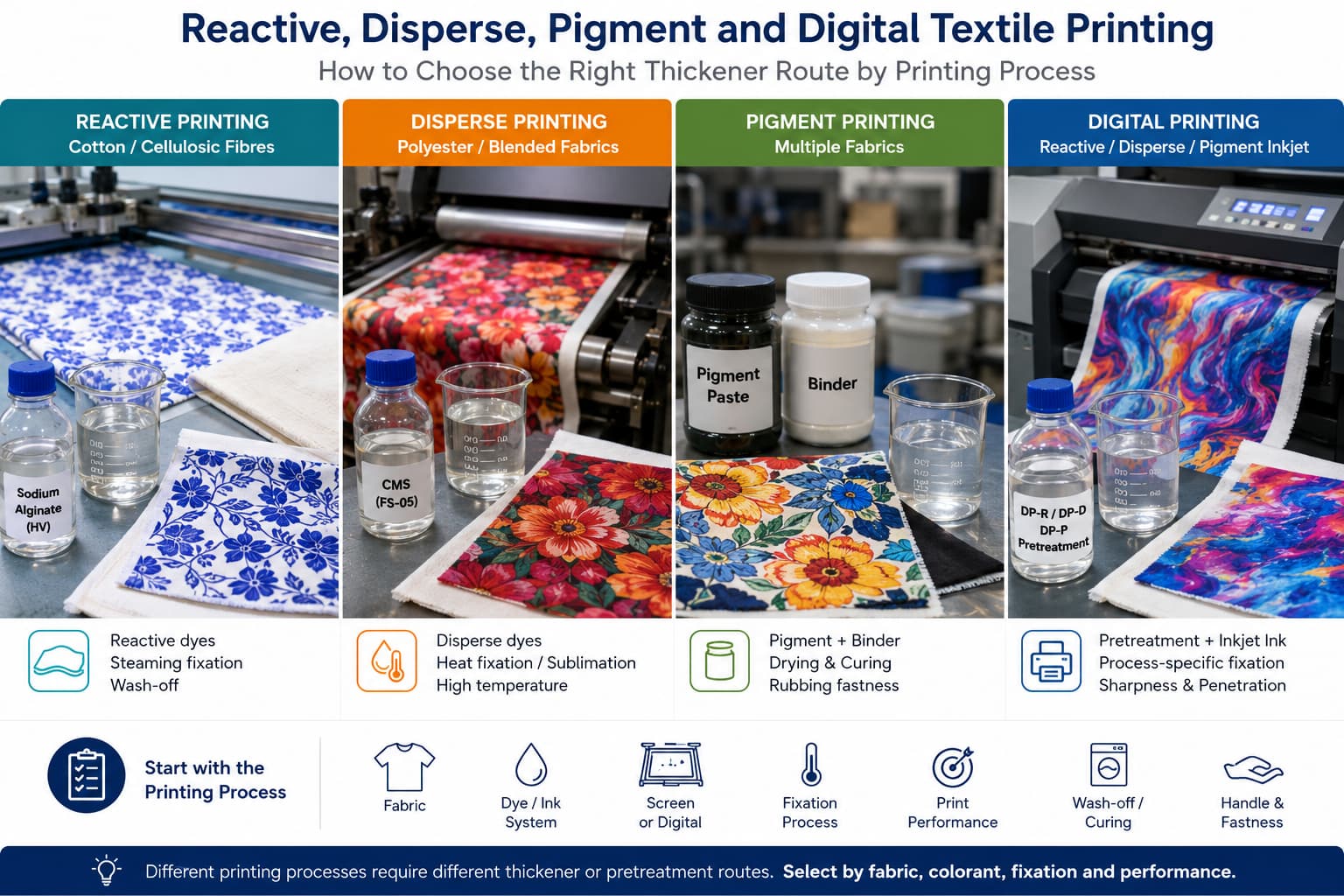
نظرثانی ٹیکسٹائل پرنٹنگ کے لیے گاڑھا کرنے والے کے استعمالات for process-based matching.
How Should a Mill Diagnose Synthetic-Thickener Viscosity Loss?
ایک عملی تسلسل یہ ہے:
Activated Base → Dilution Control → Pigment → Binder → Fixer → Auxiliaries → Holding → Viscosity Retention → Screen Trial → Curing → Finished Fabric
اہم اصول یہ ہیں:
- Viscosity loss after pigment or binder is not automatically a thickener-quality failure.
- Dilution, pH shift and electrolyte screening should be separated experimentally.
- Different synthetic-thickener architectures can show very different electrolyte response.
- The stage where viscosity first drops is usually the most useful clue.
- The correct target is stable complete-paste rheology, not restoration of the original water viscosity at any cost.
- Final approval must include screen printing, curing, rubbing fastness and fabric hand.
اکثر پوچھے جانے والے سوالات
1. Why does synthetic thickener lose viscosity after pigment is added?
Pigment dispersion can dilute the paste and introduce electrolytes, surfactants or pH changes that reduce thickening efficiency.
2. Why does viscosity drop after binder addition?
Binder can change ionic strength, pH, surfactant balance and polymer interactions. Test the binder as a separate formulation step.
3. Do electrolytes always reduce acrylic-thickener viscosity?
No. Many polyacrylate systems are electrolyte-sensitive, but different polymer architectures—including some hydrophobically modified systems—can show different salt responses.
4. Can the pH be correct while viscosity is still low?
Yes. Electrolyte load, dilution, active solids, pigment dispersion and binder chemistry can reduce viscosity even inside the correct pH window.
5. How can I tell whether dilution is the main cause?
Add the same amount of plain water to a control sample. If the viscosity drop is similar to the real ingredient sample, dilution is a major contributor.
6. Why are dark pigment shades sometimes thinner?
Higher pigment loading can introduce more water, dispersant, surfactant and electrolyte into the formula.
7. Should I add more synthetic thickener immediately?
No. First identify whether the cause is dilution, pH, electrolyte, binder compatibility, temperature or shear. Then adjust dosage if justified.
8. Why does viscosity recover after the paste stands?
The paste may be recovering structure after high shear rather than experiencing permanent chemical degradation.
9. Can a lower viscosity paste still print correctly?
Yes. Full rheology, screen transfer and structural recovery matter more than one Brookfield number.
10. When should I change to a different synthetic-thickener grade?
Consider another grade when the current one shows poor viscosity retention, unstable binder compatibility, excessive dosage demand or poor production rheology within the normal process window.
11. What should I measure during troubleshooting?
Record pH, temperature and viscosity after activation, pigment, binder, fixer, auxiliaries and the production holding period.
12. What should I send FSX Chemical for troubleshooting?
Send the current thickener or TDS, dosage, activation pH, viscosity method, pigment, binder, fixer, holding time, machine route and the stage where viscosity first drops.
Find the Ingredient That Is Collapsing Your Pigment-Paste Viscosity
If your synthetic printing thickener works in water but loses viscosity after pigment, binder or fixer is added, FSX Chemical can help structure a controlled stage-by-stage comparison.
مفید تکنیکی جائزے کے لیے بھیجیں:
- Your current synthetic thickener sample, TDS or COA
- موٹا کرنے والی خوراک
- Neutralizer and activation pH
- Water-only viscosity and test method
- Pigment dispersion and dosage
- بائنڈر اور خوراک
- فکسر / معاون
- حتمی پیسٹ کا پی ایچ
- Viscosity after each critical step if available
- وقت پکڑنا
- Fabric, machine and curing conditions
کے ساتھ شروع کریں نمونے اور ملاپ for a controlled current-vs-candidate evaluation.
نظرثانی ٹیکسٹائل پرنٹنگ کے لیے گاڑھا کرنے والے کے استعمالات عمل پر مبنی راستے کے انتخاب کے لیے.
آپ بھی کر سکتے ہیں۔ فیکٹری سے براہِ راست قیمت معلوم کریں after the suitable synthetic-thickener route and working dosage are confirmed or FSX کیمیکل سے رابطہ کریں تکنیکی بحث کے لیے📧 ای میل: Service@fsxchemical.com
When a synthetic printing thickener loses viscosity, do not correct the number first. Find the formulation step that changed the polymer environment, then decide whether the solution is pH control, lower electrolyte load, a different addition sequence, dosage adjustment or a more compatible thickener grade.
متعلقہ پوسٹس
رنگ اور پرنٹنگ کے عمل کے مطابق ٹیکسٹائل پرنٹنگ کے لیے گاڑھا کرنے والے مادّے
سیلولوز پر مبنی ٹیکسٹائل پرنٹنگ پیسٹ: سی ایم سی گریڈ اور سپلائر کا جائزہ
ٹیکسٹائل پرنٹنگ کے لیے سوڈیم الگینیٹ بمقابلہ سی ایم سی: کارکردگی اور لاگت کا موازنہ
اپنے کپڑے کے لیے ٹیکسٹائل پرنٹنگ تھکنر کا انتخاب کیسے کریں
ٹیکسٹائل پرنٹنگ کے کیمیکلز اور ان کے افعال: 10 کلیدی گروپس
ٹیکسٹائل پرنٹنگ کے لیے گاڑھا کرنے والے مادّوں کا موازنہ: سوڈیم الگنیٹ، سی ایم سی، سی ایم ایس اور ڈیجیٹل پیسٹ
ڈیجیٹل ٹیکسٹائل پرنٹنگ پیسٹ کے انتخاب: ردعمل، منتشر اور رنگدانہ نظام
FSX کیمیکل کی ڈیجیٹل پرنٹنگ پیسٹ کیوں آپ کے لیے بہترین انتخاب ہے
ڈیجیٹل ٹیکسٹائل پرنٹنگ پیسٹ کی استحکام: 10 عمل کے کنٹرول
مصنوعہ کا جائزہ: FSX ڈیجیٹل پرنٹنگ پیسٹ اعلیٰ معیار کی ٹیکسٹائل سیاہیوں کے لیے
ڈیجیٹل انک جیٹ پرنٹنگ کے لیے نئے ٹیکسٹائل کیمیائی حلوں کی تلاش
2026 کے لیے ٹیکسٹائل پرنٹنگ کیمیکلز میں ٹاپ 5 اختراعات
تیز روابط
اپنی مصنوعات کی ضروریات بھیجیں
پروڈکٹ کا نام، استعمال، مقدار، منزل اور کوئی بھی TDS، نمونہ کی تصویر یا دستاویز جو آپ کے پاس موجود ہو، فراہم کریں۔ FSX کیمیکل اس معلومات کا جائزہ لے گا اور کوٹیشن، نمونہ کی مطابقت یا پروڈکٹ کے انتخاب کے لیے اگلا قدم تجویز کرے گا۔.