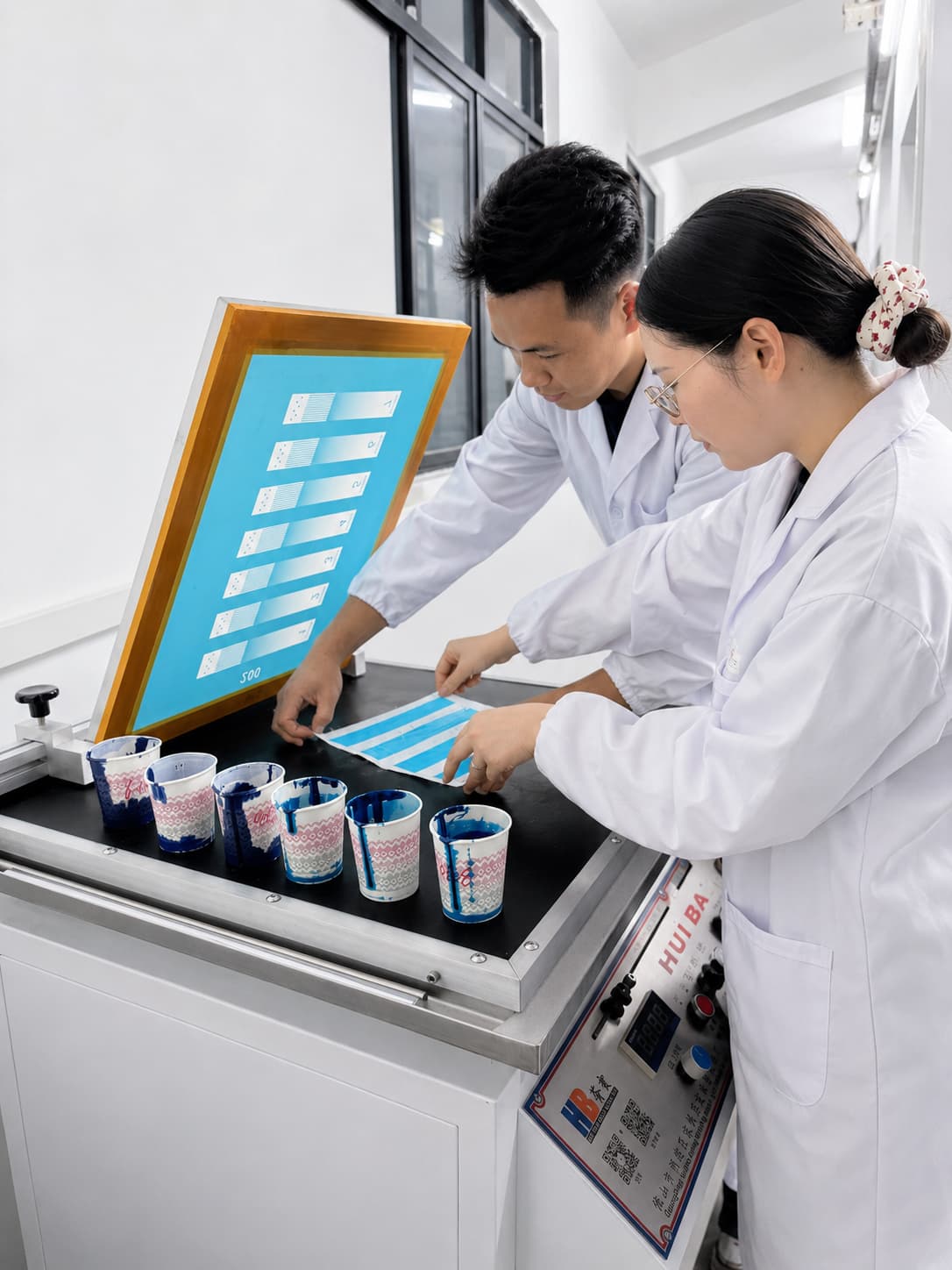
Chất làm đặc acrylic cho các tông màu có hàm lượng sắc tố cao: Tại sao hàm lượng sắc tố cao lại làm thay đổi độ nhớt và hiệu suất màu
High pigment loading changes more than pigment concentration. It also changes water, dispersant, surfactant, electrolyte...
Dark pigment shades are a useful stress test for acrylic thickener because increasing pigment-dispersion dosage changes much more than color concentration. It can also change the amount of water, dispersant, surfactant, electrolyte and suspended pigment solids entering the printing paste. Depending on the pigment package, binder and acrylic-thickener architecture, viscosity may decrease, increase or become less stable during holding. Those rheology changes then affect screen transfer, penetration, surface pigment concentration and apparent color yield. The correct response is not to increase thickener automatically, but to build a pigment-loading–viscosity map, compare light and dark shades under the same test method, and approve the lowest stable thickener dosage that keeps the complete paste inside the required printing window.
Why Does High Pigment Loading Change Acrylic Thickener Performance?
High pigment loading changes the chemical and physical environment of the acrylic thickener.
When more commercial pigment dispersion is added, the paste can receive more:
Pigment solids
Nước
Dispersant
Surfactant
Chất điện giải
Hóa chất điều chỉnh pH
Each of these variables can change viscosity or rheology.
The final response can therefore be:
Lower viscosity
Higher viscosity
Similar initial viscosity but poorer holding stability
Similar Brookfield viscosity but different screen rheology
The correct diagnostic chain is:
Pigment Loading → Complete-Paste Rheology → Screen Transfer → Penetration → Surface Color Yield → Curing / Fastness / Hand
Do not assume that every dark shade simply needs more thickener.
Why Dark Shades Are a Useful Stress Test
Dark shades often use a higher dose of pigment dispersion than pale shades.
This makes them a practical stress test for:
Khả năng dung nạp chất điện giải
Surfactant sensitivity
Khả năng tương thích của chất kết dính
Thickener efficiency
Screen-transfer uniformity
Dark solid areas also make certain defects easier to see:
Uneven transfer
Weak coverage
Excessive penetration
Surface nonuniformity
Edge spreading
A thickener that works in a pale shade should therefore not be approved automatically for a high-pigment black or navy formula.
Pigment Dispersion Is More Than Pigment
A commercial pigment dispersion is a formulated liquid, not pure dry pigment.
It can contain:
Pigment particles
Nước
Anionic or nonionic dispersants
Chất làm ướt
Chất hoạt động bề mặt
Preservatives
Hóa chất điều chỉnh độ pH
Chất điện giải
Do đó:
More Pigment Dispersion ≠ Only More Colorant.
Two black pigment dispersions with the same pigment content can still influence acrylic thickener differently because their dispersant, surfactant and salt packages differ.
For this reason, supplier changes in pigment dispersion should trigger a viscosity and compatibility recheck.
High Pigment Loading Can Lower or Raise Viscosity
The direction of viscosity change is system-specific.
Viscosity can decrease because:
The pigment dispersion dilutes the thickener concentration.
Electrolytes screen charged polyacrylate groups.
Surfactants disrupt associative thickening.
pH moves outside the ideal activation window.
Viscosity can increase because:
Pigment solids increase the suspended-particle volume fraction.
Particle crowding increases flow resistance.
Surfactants strengthen an associative HASE network in a certain concentration range.
Pigment or binder particles participate in associative thickening.
This is why the article title says high pigment loading changes viscosity rather than always lowers it.
Measure the response of the real formula.
1. Dilution from Pigment Dispersion
Commercial pigment dispersion introduces liquid into the paste.
If thickener dosage stays constant while pigment-dispersion dosage increases, the effective thickener concentration can fall.
Acrylic thickeners often show a nonlinear dosage–viscosity relationship, so a modest dilution can produce a meaningful viscosity change.
Use a control:
Sample A: Normal Pigment Level
Sample B: Normal Pigment Level + Equivalent Water
Sample C: High Pigment Level
If B and C show similar viscosity loss, dilution is a major contributor.
If C changes much more, pigment-package chemistry is also involved.
2. Dispersants and Surfactants
Pigment dispersants and surfactants keep pigment particles separated and wettable.
But these surface-active chemicals can change acrylic-thickener rheology.
For a conventional ASE-type thickener, they can modify the aqueous and particle environment.
For a HASE-type associative thickener, surfactants can participate directly in hydrophobic associations.
Depending on concentration, this can:
Increase viscosity
Decrease viscosity
Change elasticity
Change recovery after shear
Therefore, a high-pigment formula can move the thickener into a different surfactant-response region.
3. Electrolyte Load
Many acrylic/polyacrylate thickeners contain ionized carboxylate groups after neutralization.
Electrolytes can screen those charged groups and reduce polymer expansion.
A simplified mechanism is:
Electrolyte Load ↑ → Charge Screening ↑ → Polymer Expansion Can Decrease → Thickening Efficiency Can Fall
Dark shades can create more ionic stress if the higher pigment dose also introduces more salts or ionic dispersants.
But the effect remains grade-specific.
Hydrophobically modified systems can respond differently because associative interactions provide another rheological mechanism.
Do not assume one electrolyte-retention result applies to every acrylic thickener.
4. Pigment Solids and Particle Crowding
At higher pigment solids, the particles themselves occupy more volume inside the paste.
As particle concentration increases, interactions between particles can increase flow resistance.
This can partially offset dilution or electrolyte-related viscosity loss.
In some systems, the result can be:
More Pigment → Higher Apparent Viscosity
rather than thinning.
The particle effect depends on:
Pigment concentration
Particle size distribution
Dispersion quality
Binder particles
Kiến trúc bộ làm đặc
This is another reason not to diagnose dark-shade viscosity from pigment percentage alone.
5. HASE and Associative-Thickener Interaction
HASE acrylic thickeners use both pH-driven swelling and hydrophobic association.
The hydrophobic groups can associate with:
Other HASE chains
Binder particles
Surfactant aggregates
Pigment-dispersion components
High pigment loading can therefore change the associative network in both directions.
Research on associative thickeners shows that pigment, dispersant, surfactant and latex concentration can all alter rheological behavior.
The practical implication is:
HASE Dark-Shade Performance Must Be Tested with the Real Pigment and Binder System.
6. Binder-to-Pigment Ratio
Dark shades often require attention to binder-to-pigment balance.
If pigment loading rises while binder stays fixed, there may be less binder available relative to the amount of pigment.
If binder is increased to maintain fixation, the paste also receives more:
Chất rắn trong chất kết dính
Nước
Chất hoạt động bề mặt
Chất điện giải
This can shift thickener demand again.
Therefore, dark-shade optimization should not isolate pigment from binder.
How Should a Mill Optimize Acrylic Thickener for Dark Pigment Shades?
Một chuỗi quyết định thực tiễn là:
Define Light / Dark Reference → Measure Pigment Loading → Check pH / Dilution / Surfactants / Electrolytes → Build Pigment-Loading Curve → Hold → Print Fine Lines & Dark Solids → Adjust Thickener Only If Needed → Cure → Check Color / Rubbing / Hand
Các nguyên tắc chính là:
Higher pigment-dispersion dosage changes more than pigment concentration; it also changes the water, dispersant, surfactant and ionic environment.
High pigment loading can decrease or increase viscosity depending on dilution, electrolyte effects, particle loading and associative interactions.
Dark shades should not automatically use more thickener.
Color yield depends on transfer, penetration and surface pigment concentration—not pigment dosage alone.
Binder-to-pigment balance, foam and holding stability should be checked at the same time.
The best dark-shade formulation is the one that remains inside the approved rheology and finished-fabric window at the lowest practical Total Cost in Use.
Các câu hỏi thường gặp
1. Why does dark pigment paste become thinner?
Higher pigment-dispersion dosage can add more water, surfactant, dispersant and electrolytes, which may dilute the paste or reduce acrylic-thickener efficiency.
2. Can high pigment loading make the paste thicker instead?
Yes. Higher pigment solids can increase particle crowding, and associative thickener interactions can also raise viscosity in some formulas.
3. Should I always add more thickener for black pigment printing?
No. First measure the complete-paste rheology and printing result. Add more thickener only if the dark shade falls outside the validated production window.
4. Why can two black pigment dispersions give different viscosity?
They can contain different pigment solids, particle size, dispersants, surfactants, salts and pH-control chemistry.
5. Why can dark shades give weaker surface color than expected?
Excessive penetration, incomplete screen transfer, poor pigment dispersion or binder distribution can reduce surface color even when pigment dosage is higher.
6. Does higher pigment loading require more binder?
It may require a binder-ratio review to maintain rubbing fastness, but the correct level depends on pigment, fabric, binder chemistry and curing.
7. Why do dark shades foam more?
Higher pigment loading can introduce more surfactant/dispersant and can require longer or stronger mixing, increasing air entrainment and foam stability.
8. How can I tell whether viscosity loss is just dilution?
Run a control with the same amount of added water as the extra pigment dispersion. If the real pigment causes a larger change, pigment-package chemistry is contributing.
9. Should I test only the darkest shade?
No. A light–medium–dark ladder shows how the formula changes across the normal pigment-loading range and helps define a production window.
10. Why can HASE thickener behave differently at high pigment loading?
HASE uses hydrophobic association, so changes in pigment particles, dispersants, surfactants and binder can alter the associative network.
11. What should be checked after printing?
Evaluate print definition, solid-area uniformity, penetration, K/S or shade, dry/wet rubbing, foam-related defects and fabric hand after controlled curing.
12. What should I send FSX Chemical for dark-shade matching?
Send the current thickener/TDS, light and dark pigment dosage, viscosity method, binder, pH, water quality, machine route, holding time and the main color or rheology problem.
Match Acrylic Thickener to High-Pigment Dark Shades
If your light shades print well but black, navy or other dark pigment pastes become thinner, thicker, foamier or less uniform, FSX Chemical can help structure a controlled pigment-loading comparison.
Để nhận được bài đánh giá kỹ thuật hữu ích, vui lòng gửi:
Your current acrylic thickener sample, TDS or COA
Current thickener dosage
Light- and dark-shade pigment products / dosages
Độ nhớt và phương pháp thử nghiệm toàn diện
Loại chất kết dính và liều lượng
Fixer / auxiliary route
Final paste pH
Độ cứng của nước / Độ dẫn điện
Fabric and screen-printing route
Thời gian giữ
Current color yield, transfer, rubbing, foam or hand target
Bắt đầu bằng Mẫu và việc kết hợp for a controlled current-vs-candidate evaluation.
The correct dark-shade thickener dosage is not determined by pigment percentage alone. It is the lowest stable dosage that keeps the high-pigment paste inside the required rheology, screen-transfer, color-yield, fastness and fabric-hand window.
Tỷ lệ cố định thuốc nhuộm ảnh hưởng trực tiếp đến hiệu suất màu, độ bền màu khi giặt và lượng chất thải trong quá trình in bằng thuốc nhuộm phản ứng. Hướng dẫn này giải thích cách natri alginat hỗ trợ quá trình cố định thuốc nhuộm, các thông số của hỗn hợp thuốc nhuộm nào ảnh hưởng đến tỷ lệ cố định, cũng như cách khắc phục tình trạng tỷ lệ cố định thấp trong quá trình sản xuất.
Các chất làm đặc dùng trong in vải có sự khác biệt về thành phần hóa học, tính lưu biến, khả năng tương thích với thuốc nhuộm và đặc tính phai màu khi giặt. Hướng dẫn này so sánh các nhóm chất làm đặc chính, các hướng ứng dụng phổ biến của chúng và các thông số mà người mua cần kiểm tra trước khi tiến hành thử nghiệm sản xuất.
Low color yield or poor fastness in reactive dye printing rarely has a single cause. This guide explains how fabric preparation, dye selection, thickener rheology, alkali, moisture, steaming and wash-off interact, and provides a practical troubleshooting and quality-control workflow.
Fabric pick-up determines how much pretreatment chemistry and water actually remain on the fabric after application. Too little or excessive pick-up can change color yield, bleeding, penetration, drying and fixation. This guide explains how to measure and optimize a stable working window for reactive inkjet printing.
Việc lựa chọn chất làm đặc tổng hợp cho in màu nên dựa trên toàn bộ hệ thống sắc tố-chất kết dính. Cần so sánh các yếu tố như khả năng kích hoạt, độ pH, khả năng chịu điện giải, tính tương thích với chất kết dính, tính lưu biến, hiệu quả liều lượng, kết quả đóng rắn và cảm giác sờ vào vải thành phẩm — chứ không chỉ dựa vào độ nhớt trong nước.
Nhiều chất làm đặc lỏng acrylic sẽ tăng độ nhớt sau khi trung hòa, nhưng mức pH phù hợp lại phụ thuộc vào từng loại sản phẩm. Các yếu tố như bột màu, chất kết dính, chất điện giải, hàm lượng chất rắn hoạt tính, loại chất trung hòa và thời gian ủ phải được đánh giá tổng thể trước khi xác định khoảng điều kiện sản xuất.
Độ nhớt của chất làm đặc tổng hợp có thể giảm sau khi thêm bột màu, chất kết dính hoặc các chất phụ gia do hiện tượng pha loãng, sự thay đổi pH, hiện tượng che chắn điện giải hoặc sự không tương thích trong công thức. Cách chẩn đoán chính xác là tiến hành pha chế hỗn hợp theo từng giai đoạn và xác định thời điểm đầu tiên mà sự ổn định độ nhớt bắt đầu thay đổi.
Chất kết dính sắc tố có thể thay đổi độ nhớt của chất làm đặc acrylic thông qua các yếu tố như pha loãng, hàm lượng điện giải, sự thay đổi pH, tương tác với chất hoạt động bề mặt và tính tương thích ion. Một thử nghiệm tương thích toàn diện cần bao gồm các yếu tố: khả năng duy trì độ nhớt, độ ổn định khi bảo quản, in lụa, quá trình đóng rắn, độ bền khi cọ xát và cảm giác khi sờ vào vải.
Hiệu suất của chất làm đặc tổng hợp trong in lụa không chỉ phụ thuộc vào độ nhớt tĩnh. Đặc tính lưu biến lý tưởng phải kết hợp giữa tính chất chất lỏng ít chịu tác động của lực cắt, hiện tượng giảm độ nhớt dưới tác động của lưỡi gạt và khả năng phục hồi có kiểm soát sau khi chuyển mực, nhằm duy trì khả năng in qua lưới, độ thấm mực và độ sắc nét của hình ảnh in.
Mối quan hệ giữa liều lượng chất làm đặc lỏng acrylic và độ nhớt không phải lúc nào cũng mang tính tuyến tính. Các nhà máy nên xây dựng một đường cong làm việc được kiểm soát bằng cách sử dụng sản phẩm thương mại thực tế, với phương pháp cố định pH và độ nhớt, sau đó lặp lại các điểm liều lượng phù hợp trong công thức hoàn chỉnh gồm sắc tố và chất kết dính.
Chất làm đặc acrylic tổng hợp, CMC và CMS có thể tạo ra những đặc tính lưu biến khác nhau, yêu cầu về liều lượng, khả năng tương thích với chất kết dính, hành vi của cặn và cảm giác khi sờ vào vải trong quá trình in bằng bột màu. Nên so sánh chúng trong cùng một công thức hoàn chỉnh gồm bột màu và chất kết dính, thay vì chỉ dựa vào độ nhớt trong nước hoặc giá cả.
Chất làm đặc acrylic ảnh hưởng đến độ bão hòa màu khi in bằng bột màu, độ bền khi cọ xát và cảm giác khi sờ vào vải chủ yếu thông qua các yếu tố như tính lưu biến, quá trình lắng đọng hỗn hợp bột màu, sự phân bố của bột màu và chất kết dính, cũng như hàm lượng chất rắn polymer. Việc kiểm soát chất kết dính và quá trình đóng rắn phải được thực hiện riêng biệt trước khi đánh giá chất làm đặc.
Vui lòng cung cấp tên sản phẩm, ứng dụng, số lượng, điểm đến và bất kỳ tài liệu kỹ thuật (TDS),
hình ảnh mẫu hoặc tài liệu nào mà quý khách đã có. FSX Chemical sẽ xem xét
thông tin này và đề xuất bước tiếp theo liên quan đến báo giá, đối chiếu mẫu
hoặc lựa chọn sản phẩm.
Thông tin sản phẩmTên sản phẩm, cấp loại, mẫu mã, ảnh nhãn mác hoặc mã tham chiếu của nhà cung cấp.
Các tài liệu có sẵnTDS, SDS, COA, ảnh mẫu, danh mục sản phẩm hoặc dữ liệu thử nghiệm.
Chi tiết đơn hàngSố lượng dự kiến, hình thức đóng gói, nước nhập khẩu, cảng hoặc điều kiện thương mại.
Yêu cầu hoặc Vấn đềQuy trình in trên vải, yêu cầu về công thức, vấn đề hiện tại hoặc chỉ tiêu hiệu suất.