| Fiber and color route | Role of sodium alginate | Selection rule |
|---|---|---|
| Cotton or viscose with reactive dyes | Established printing-paste thickener route | Confirm viscosity method, filtration, dye/alkali compatibility, print definition and wash-off. |
| Polyester with disperse dyes | Usually not the preferred default | Evaluate a disperse-printing thickener or CMS/synthetic route in the complete paste and heat-fixation process. |
| Cotton-polyester blend | Depends on whether one or two dye classes are used | Separate the cellulosic and polyester requirements; do not assume one thickener will optimize both stages. |
| Pigment printing on polyester or blends | Dye-fiber reaction is not the controlling mechanism | Select a binder-compatible rheology system and test handle, crocking, curing and print definition. |
Why This Question Comes Up
Sodium Alginate’s Reputation in Reactive Printing
The Assumption That Doesn’t Transfer to Polyester
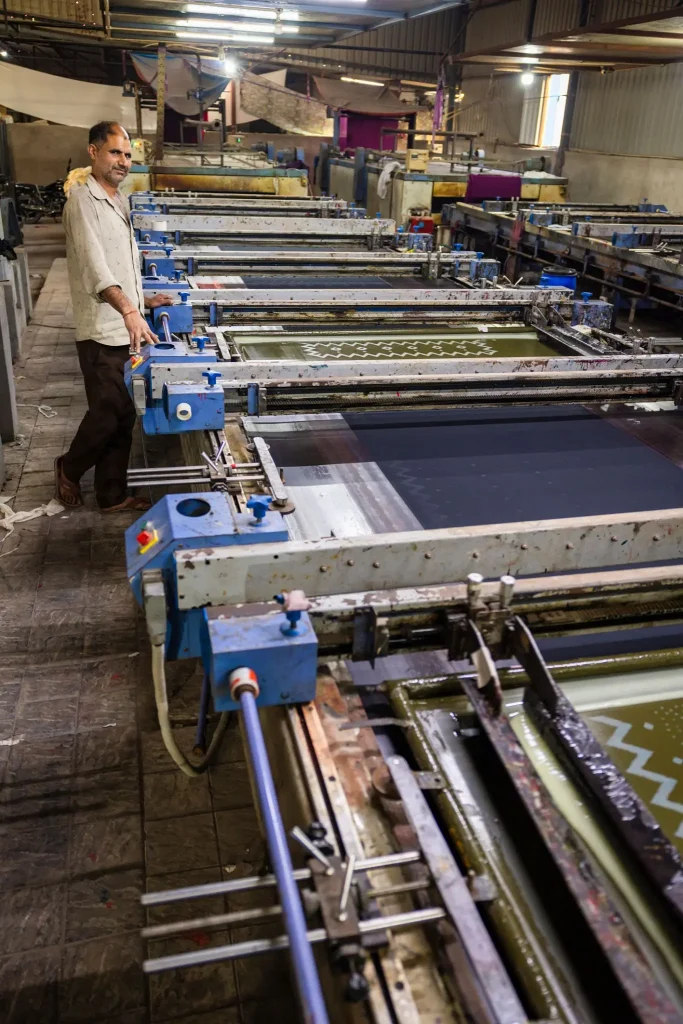
Why Polyester Requires a Different Dyeing Approach
Disperse Dyes and How They Fix to Polyester
Polyester is a synthetic fiber with no reactive hydroxyl groups available for the covalent bonding mechanism used in reactive dyeing. Polyester is colored using disperse dyes — small, water-insoluble dye molecules that are dispersed (not dissolved) in the printing paste as fine particles, then diffuse into the polyester fiber structure during high-temperature fixation.

Why Reactive Dye Chemistry Doesn’t Apply to Polyester
Because disperse dye fixation relies on physical diffusion into the fiber rather than a chemical reaction with available hydroxyl groups, the entire chemical logic that makes sodium alginate advantageous for reactive printing — its non-reactivity preserving dye for fiber bonding — has no equivalent function in disperse dye printing. There is no competing reaction to avoid, because there is no reactive bonding mechanism involved at all.
Why Sodium Alginate Is Not Suited to Disperse Dye Printing
No Functional Role in Disperse Dye Fixation
Sodium alginate provides no specific chemical advantage in disperse dye printing because its key functional property — inertness to reactive dye chemistry — is simply not relevant to a fixation mechanism based on thermal diffusion. Using sodium alginate in a disperse dye paste does not improve dye fixation or color yield the way it does in reactive printing.
Practical Paste Performance Issues
Beyond the lack of functional advantage, sodium alginate has practical performance limitations in disperse dye printing conditions. Disperse dye paste requires good thermal stability at the high temperatures used in HT steaming or thermofixation. Sodium alginate paste can show viscosity breakdown at sustained high temperature, which can affect paste integrity and pattern definition during the fixation stage.
Additionally, sodium alginate paste formulations are typically optimized for the alkaline pH conditions of reactive printing, while disperse dye paste formulations are generally neutral to slightly acidic, reflecting the different chemistry of disperse dye dispersion and stability. The pH and ionic environment optimal for one system is not necessarily optimal for the other.
Where Sodium Alginate Still Has a Role with Polyester
What Thickeners Are Used for Disperse Dye Printing on Polyester
Synthetic Thickeners for Disperse Printing
Disperse dye printing paste typically uses synthetic thickeners — most commonly polyacrylate-based or polyacrylamide-based thickeners — rather than natural polysaccharide thickeners like sodium alginate or CMC. These synthetic thickeners are formulated specifically for compatibility with disperse dye dispersions and for thermal stability at the high fixation temperatures used in polyester printing.
Some disperse printing formulations also use modified starches or specific synthetic emulsion thickeners selected for their compatibility with disperse dye chemistry and their behavior at HT steaming or thermofixation temperatures.
Why These Thickeners Suit High-Temperature Fixation
Synthetic thickeners used in disperse dye printing are selected and formulated to maintain paste integrity and rheological stability through the thermal stress of HT steaming or thermofixation — conditions under which natural polysaccharide thickeners like sodium alginate are more prone to degradation. This thermal stability is a primary selection criterion for disperse printing paste systems, distinct from the dye-inertness criterion that drives thickener selection in reactive printing.
Printing on Cotton-Polyester Blends
The Two-Stage Printing Challenge
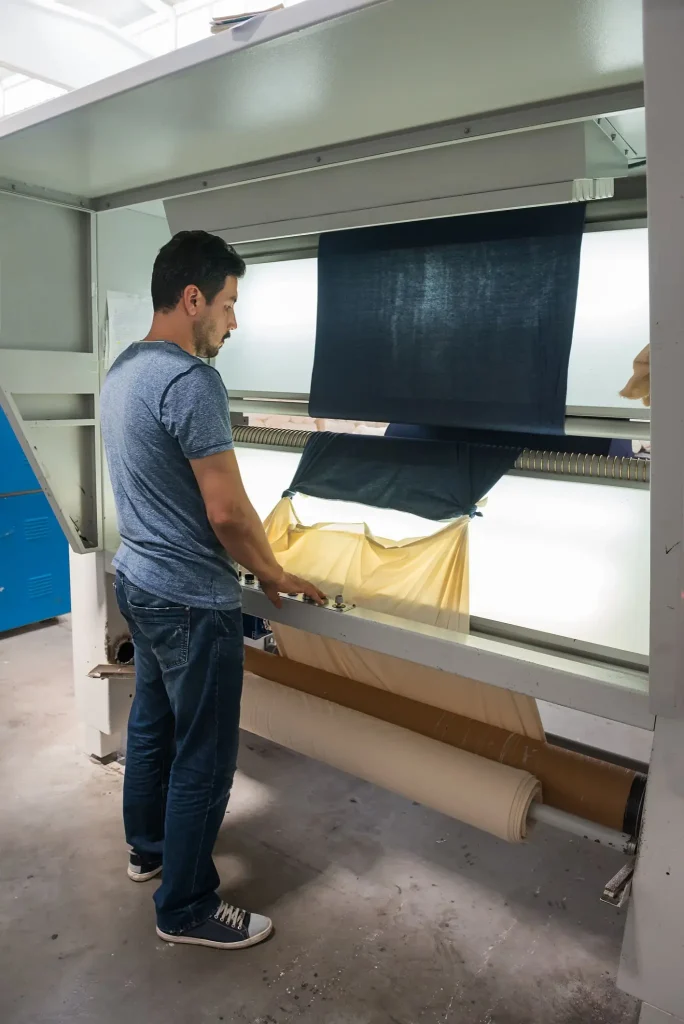
Cotton-polyester blend fabrics present a particular formulation challenge because achieving full coverage requires addressing both fiber types: reactive dye for the cotton component and disperse dye for the polyester component. These two dye classes have different chemistry, different fixation conditions, and different appropriate thickener systems.
Practical Approaches for Blend Printing
If your production involves cotton-polyester blends and you are currently using a single combined paste system, evaluate whether color yield and fastness on both fiber components meet your requirements. If the polyester component shows weaker color depth or fastness than the cotton component, the combined paste formulation — including thickener selection — may be limiting disperse dye performance.
For blends where polyester content is significant and full-coverage color matching across both fibers is critical, consulting with a formulation specialist on a dual-dye-class approach with separate thickener systems for each printing stage is often the more reliable path to consistent results, compared to attempting to optimize a single thickener system for both reactive and disperse dye requirements simultaneously.
How to Confirm the Right Thickener for Your Fiber and Dye System
Before finalizing a thickener choice for any printing application, confirm the following:
- What fiber are you printing on? Cellulosic fibers (cotton, viscose, linen) use reactive or pigment dye systems; polyester uses disperse dyes; protein fibers (silk, wool) use acid or protein-reactive dyes.
- What dye class does your fixation process use? This determines whether thickener chemical inertness to the dye is relevant, and what fixation temperature and pH conditions the paste must withstand.
- What does your supplier’s documentation say about intended application? A sodium alginate TDS for textile printing will specify reactive dye and cellulosic fiber applications — it will not claim suitability for disperse dye printing on polyester, because that is outside the product’s functional chemistry.
Frequently Asked Questions
Can sodium alginate be used for disperse printing on polyester?
It is usually not the preferred default. Disperse printing requires a thickener system compatible with the complete paste and heat-fixation route. Confirm suitability through formulation, filtration, printing and fixation trials.
Why does sodium alginate work well in reactive printing but not automatically in polyester printing?
Reactive printing on cellulosic fibers and disperse printing on polyester use different dye chemistries and fixation conditions. A thickener successful in one route does not automatically provide the rheology, stability or removal behavior required in the other.
What thickener should be tested for polyester disperse printing?
Start with a grade designed for disperse printing, such as an appropriate CMS or synthetic thickener route. Match the recommendation to the dye system, auxiliaries, machine, fixation method and fabric.
What about cotton-polyester blends?
First determine whether the mill uses one color class, two dye classes or separate process stages. The cellulosic and polyester components may require different chemistry and testing.
Which tests should be completed before changing the thickener?
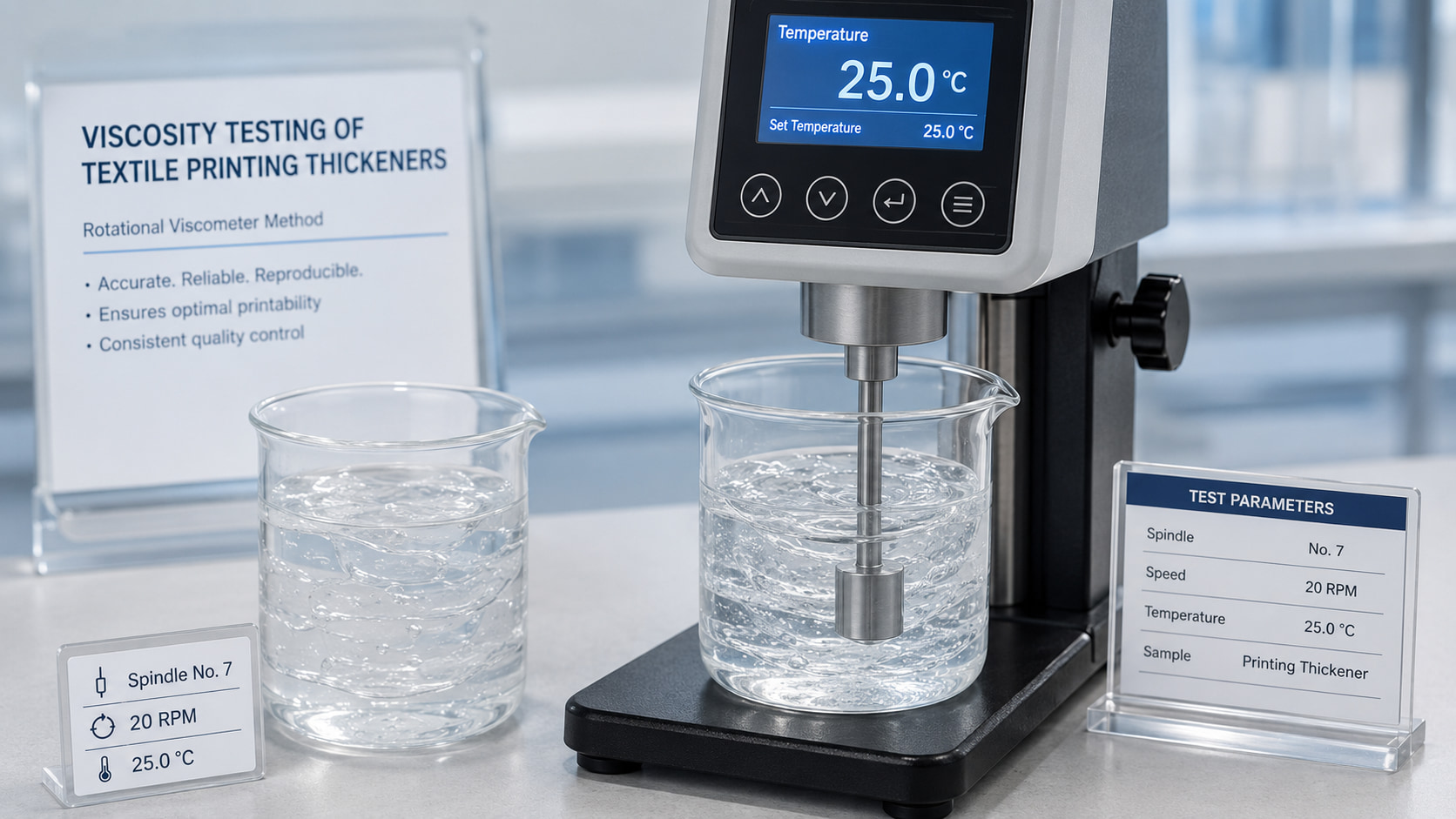
Compare hydration, complete-paste viscosity, multi-speed flow, filtration, storage stability, screen or machine transfer, print definition, color yield, fixation, wash-off and fabric handle.
How FSX Chemical Supports Fiber-Appropriate Sourcing
Next steps:
- Request a TDS — confirm the intended fiber type and dye class for any sodium alginate or CMC grade you are considering
- Contact Our Technical Team — for guidance on which of our products are appropriate for your specific fiber and dye system
- Ask About Blend Printing — if you are formulating for cotton-polyester blends, we can advise on the cellulosic component of a dual-dye-class approach📧 Email: Service@fsxchemical.com