















Product Identification Fields
Product Name and Grade Designation
CAS Number

Intended Application
Physical and Chemical Specification Fields
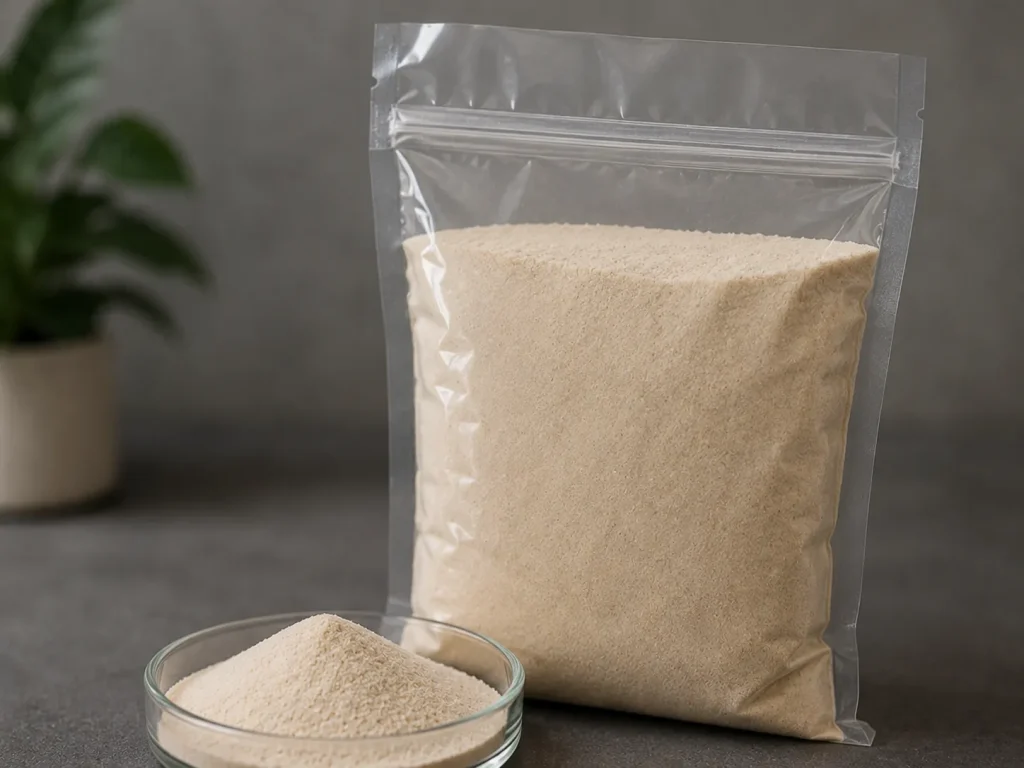
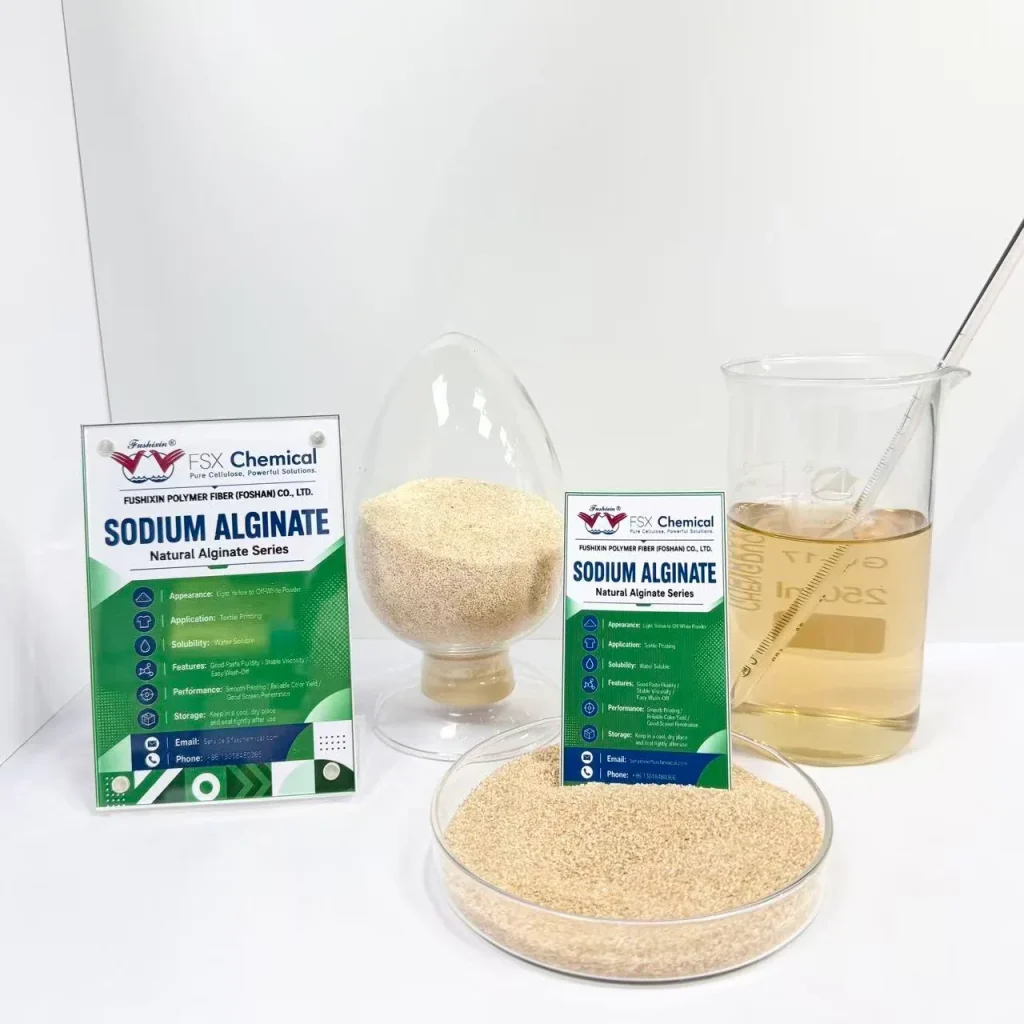
Appearance
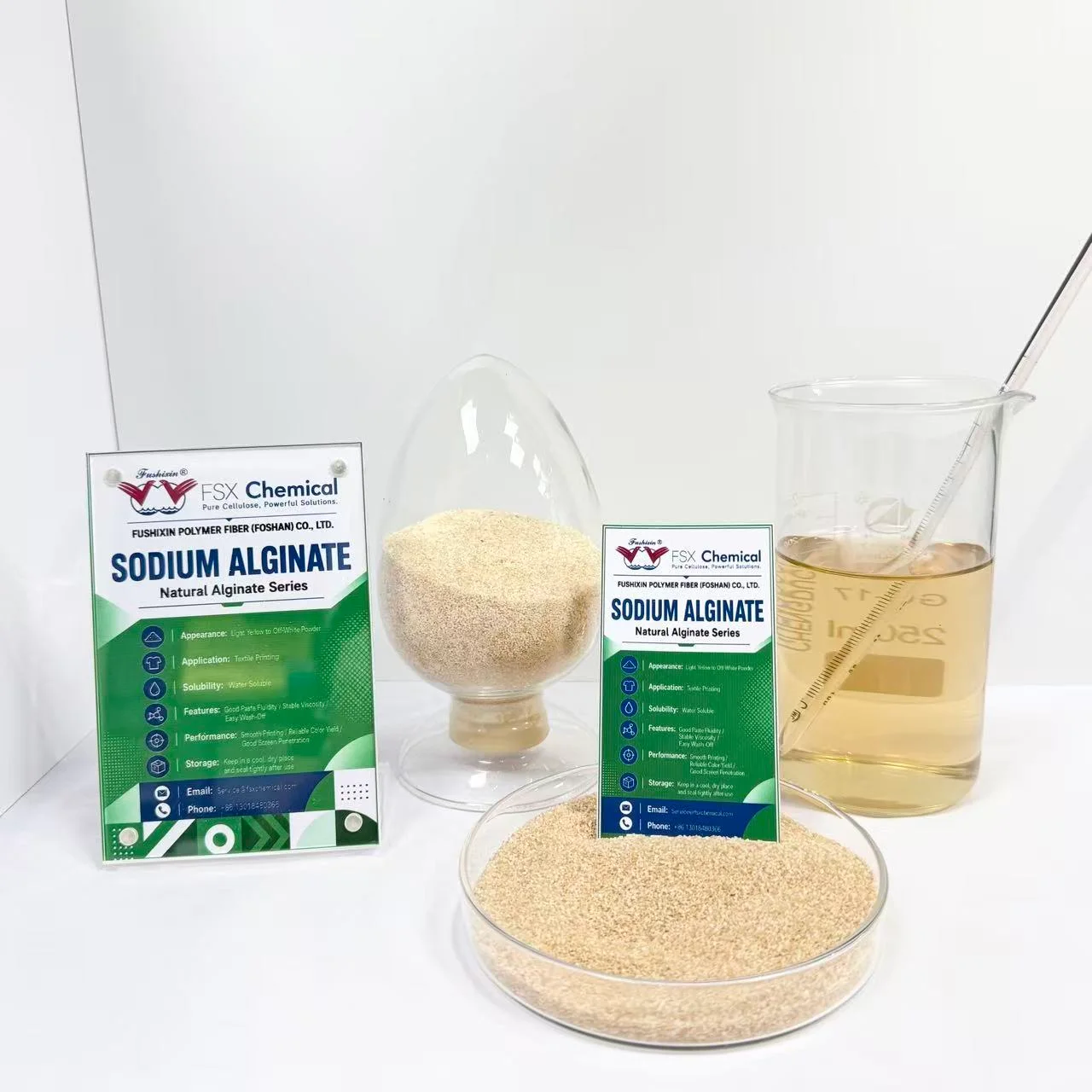
Typically describes the product as a white to off-white (sometimes light yellow) powder or granule. This field is mainly useful for incoming inspection — confirming visually that a received shipment matches the expected appearance before more detailed testing.
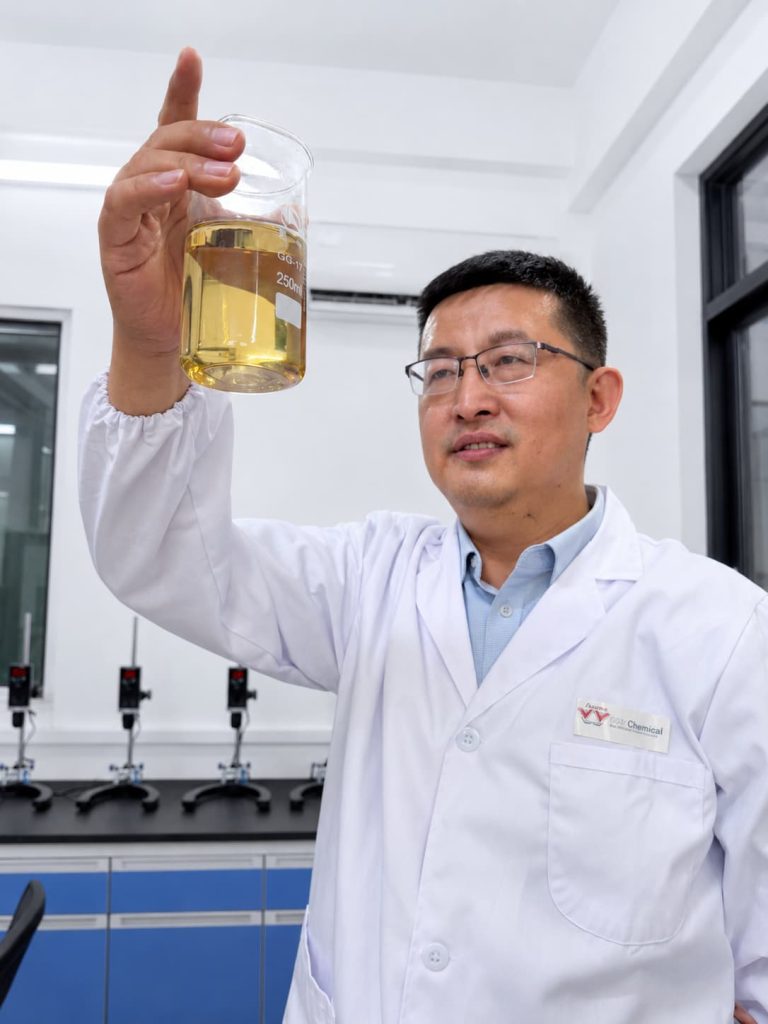
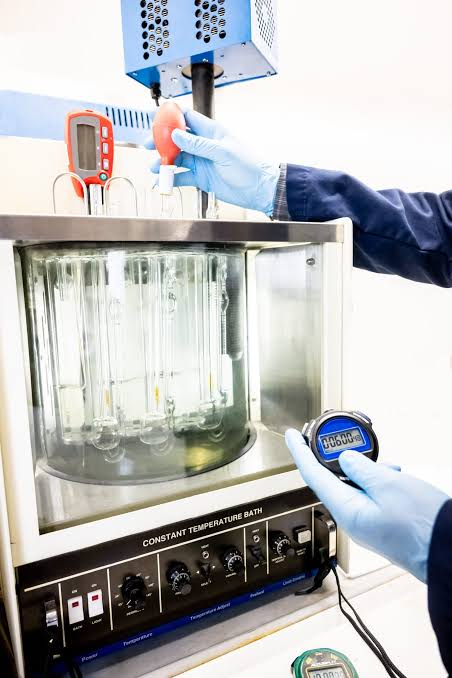
Viscosity
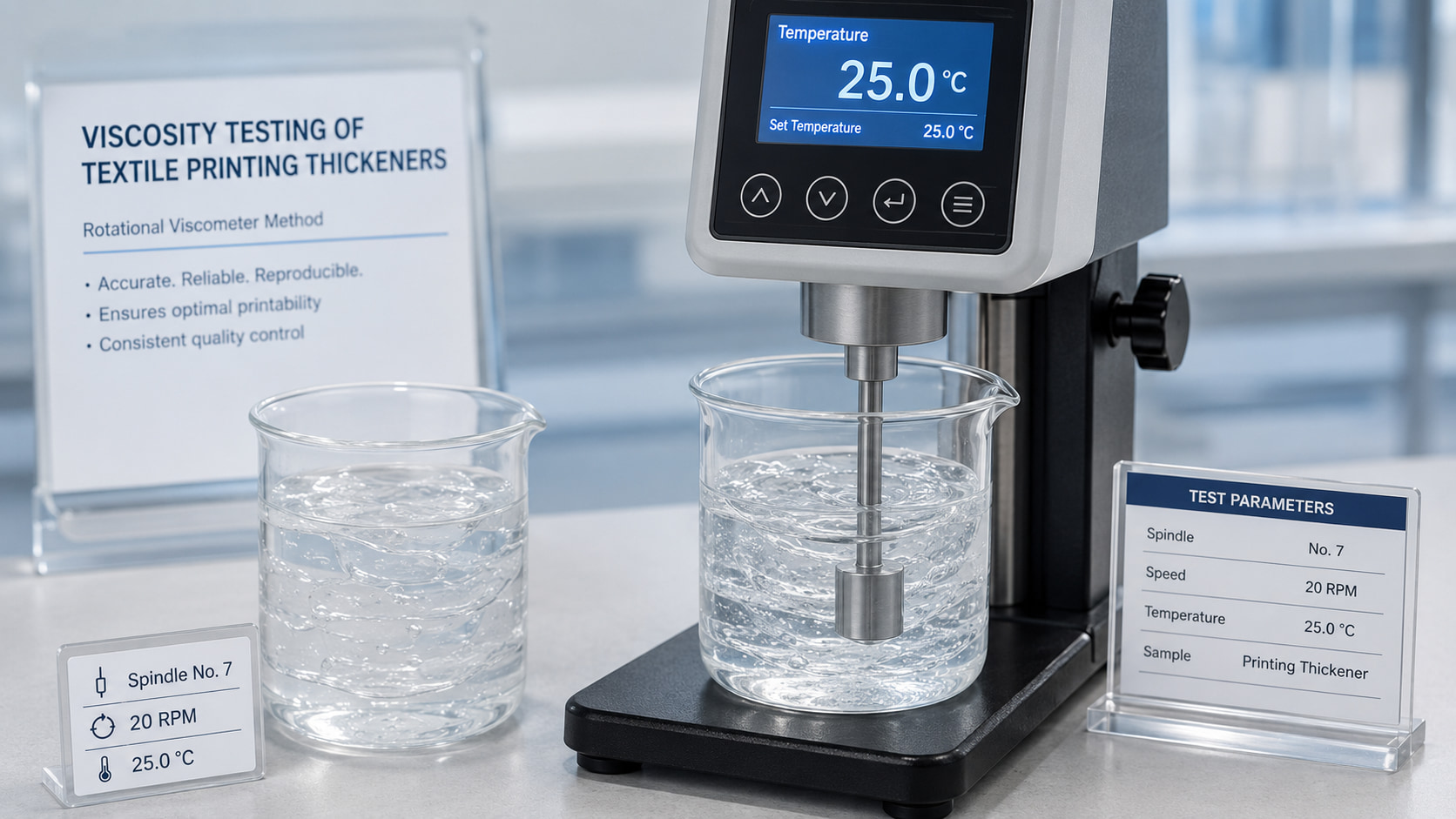
The most commercially important specification field for most textile applications. Viscosity is reported as a numerical range (e.g., “200–400 mPa·s” or “800–1200 mPa·s”) along with the measurement conditions: concentration (commonly 1% solution), temperature (commonly 25°C), and sometimes the specific viscometer spindle and speed used.
M/G Ratio and Molecular Structure (When Relevant)
Degree of substitution (DS) is not a sodium alginate specification; it applies to substituted polymers such as CMC. If a sodium alginate TDS lists DS, ask the supplier to clarify the parameter and test method rather than using it for grade comparison.
Some specialist documents may report the mannuronic-to-guluronic acid ratio (M/G ratio) or other structural information. These values can influence gel behavior, but they are not always routine textile-grade purchasing fields. For printing, a defined viscosity method, purity or active-content basis, moisture, pH, insoluble matter, particle size, filtration and multi-batch consistency are usually more actionable.
Active Content / Assay
Reports the percentage of the dry product that is actual sodium alginate polymer, as distinct from residual impurities. As discussed in our guide to purity specifications, this is usually reported on a dry basis and should be read alongside the moisture content field to understand effective active content as received.
Moisture Content
The percentage of water in the product as packaged. This affects both the effective active content (as discussed above) and the product’s susceptibility to clumping and microbial degradation during storage, as covered in our storage guide. A moisture specification that is notably higher than typical industry range for the grade type is worth asking about.
pH (1% Solution)
Particle Size / Mesh
Impurity and Purity-Related Fields
Sodium Chloride (NaCl) Content
Reports the maximum residual NaCl as a percentage of the product. As discussed in our purity guide, NaCl content affects paste viscosity (through ionic interaction with the polymer) and is one of the more practically significant impurity parameters for textile printing applications.
Water-Insoluble Matter
Reports the maximum percentage of material that does not dissolve under standard test conditions — directly relevant to screen blockage risk in fine-mesh printing, as covered in our purity and troubleshooting guides. Lower values indicate cleaner dissolution behavior.
Heavy Metal Content
May be reported as a single “total heavy metals” figure, or as individual values for specific metals (lead, arsenic, mercury, cadmium) depending on the grade and intended market. Relevant primarily where buyer specifications include heavy metal limits for textile chemicals, or for food-grade and higher-purity applications where heavy metal control is a standard quality parameter.
Microbiological Fields (Where Present)
Industrial textile-grade sodium alginate TDS documents do not always include microbiological specifications, as this is more commonly associated with food or pharmaceutical-grade products. If your application has specific microbial limit requirements (uncommon for textile printing but possible in certain specialty applications), confirm whether this testing is available rather than assuming it is included by default on an industrial-grade TDS.
Regulatory and Compliance Statement Fields
How to Read Compliance Claims Correctly
TDS documents sometimes include statements referencing regulatory frameworks — REACH, food additive regulations, or other standards. The critical skill here is distinguishing a specific, verifiable claim from a general assurance. A specific claim includes a standard name, the relevant clause or substance list, and ideally a certificate or registration number you can independently verify. A general assurance simply states “compliant with international standards” without specifics.
As discussed in our guide to customization claims, treat compliance statements without verifiable specifics with caution, and request the underlying documentation (registration numbers, test reports, certificate validity dates) for any compliance claim that is material to your sourcing decision.
Standards That Apply to Food-Grade vs. Industrial-Grade Products
Storage and Shelf Life Fields
Sodium Alginate TDS Field-by-Field Decision Table
| TDS field | What it tells the buyer | What it does not prove | Recommended check |
|---|---|---|---|
| Viscosity | Grade range under the stated method | Rheology, color yield or performance under a different method | Confirm concentration, temperature, instrument, spindle, speed, hydration and reading time |
| Moisture | Water content limit of the powder | Complete active performance or storage history | Compare the COA and incoming result on the same basis |
| pH | Solution acidity or alkalinity under stated conditions | Compatibility with the complete printing paste | Test at the stated concentration and in the production formula |
| Insoluble matter | Limit for material that does not dissolve under the method | Actual screen passage or filtration under the buyer’s preparation | Run a defined sieve or filtration test after full hydration |
| Particle size or mesh | Powder-size distribution or sieve limit | Hydration speed under every mixer and water condition | Record wetting, lumping and full-hydration time |
| Purity, active content or salt | The supplier’s compositional control basis | Print quality without an application trial | Clarify method and compare effective dosage and wash-off |
| Storage and shelf life | Recommended unopened storage period and conditions | Fitness after moisture exposure or damaged packaging | Inspect packaging and retest aged or exposed stock |
What to Do When TDS Information Is Incomplete
Common Gaps and How to Address Them
It is common for a standard TDS to omit some fields that matter for your specific application — a complete viscosity measurement method, filtration or insoluble-matter limits, or specific impurity data beyond the headline figures. This is not necessarily a red flag; it often simply reflects that the standard document wasn’t built with your specific use case in mind.
The appropriate response is to request the missing information directly, referencing the specific field and why it matters for your application. A supplier’s willingness and ability to provide this additional detail — versus deflecting the request — is itself useful information for your supplier evaluation, as discussed in our supplier evaluation guide.
Requesting Batch-Specific Data (CoA) Alongside the TDS
Sodium Alginate TDS FAQ
Is a TDS the same as a batch COA?
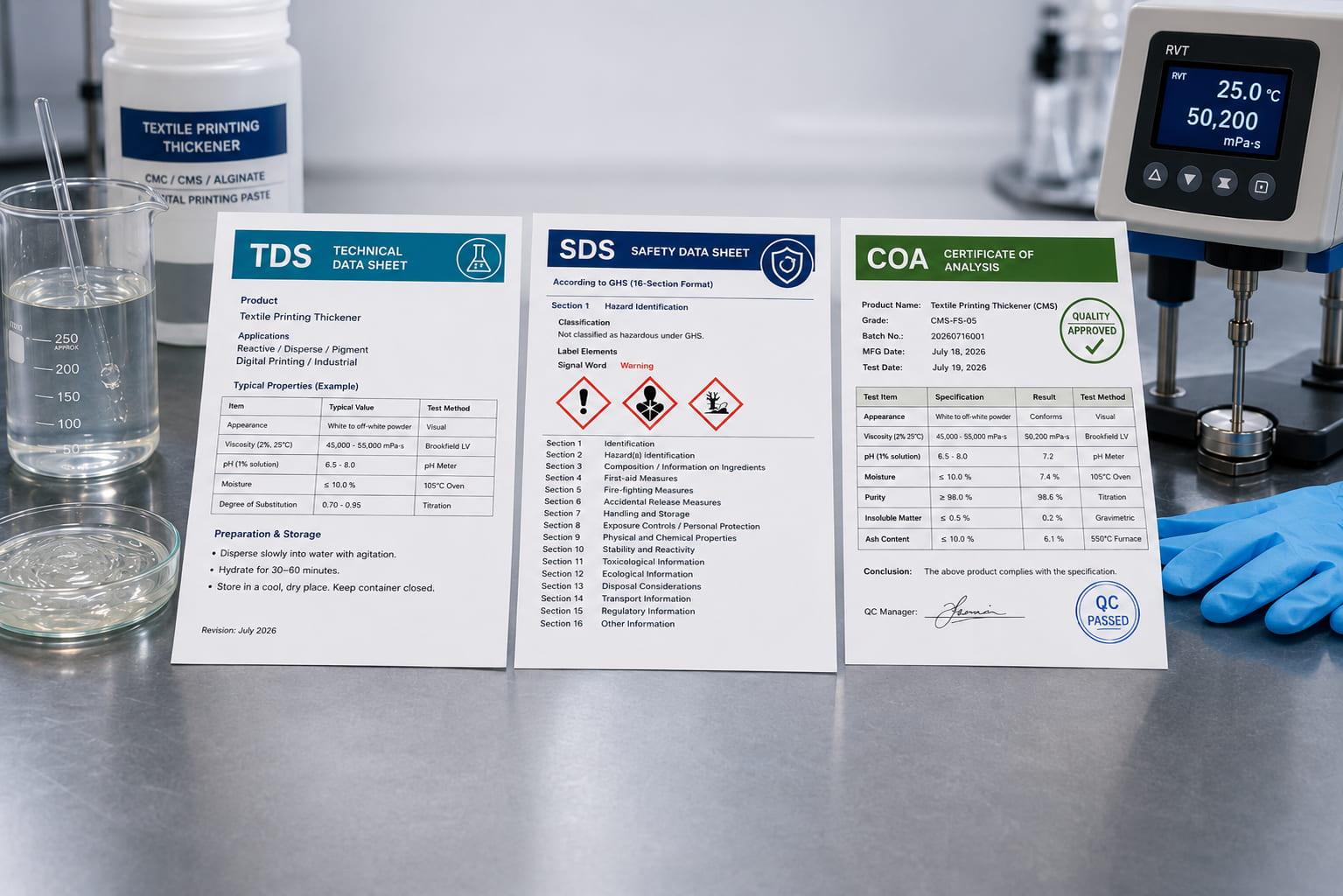
No. A TDS describes the grade, intended use and typical or guaranteed specification framework. A COA reports results or conformity for a specific production batch. Use both documents and confirm that the grade code and methods match.
Can two sodium alginate viscosity values be compared directly?
Only when the concentration, temperature, instrument, spindle, speed, hydration and reading time are equivalent. A viscosity number without the method is not a reliable basis for grade or price comparison.
What should a buyer do if DS appears on a sodium alginate TDS?
Ask the supplier to identify exactly what the field means and which method is used. DS is normally associated with substituted polymers such as CMC, not sodium alginate, so it should not be treated as a standard alginate grade parameter.
What if an important TDS field is missing?
Request the specific method and limit in writing, review a representative COA and test a sample. A missing field is not automatically disqualifying, but the buyer should not assume an unstated value before sample or bulk approval.
How FSX Chemical Approaches TDS Documentation
Next steps:
- Request a TDS — review the full specification for the grade relevant to your application
- Request a CoA — confirm batch-specific values before or upon receipt of your order
- Request a Sample — verify performance against the TDS specification in your own preparation and process conditions
- Contact Our Technical Team — for clarification on any specification field or additional technical data relevant to your sourcing decision📧 Email: Service@fsxchemical.com