List of Essential Tests for Quality Control of Textile Thickeners
A textile thickener should not be approved by viscosity alone. This guide explains the essential...
Quality control of a textile thickener requires more than checking whether a laboratory solution reaches a target viscosity. Two products can produce similar readings under one test condition while behaving differently during hydration, paste preparation, screen passage, printing, steaming and wash-off.
A practical quality control program should therefore combine batch-release tests with application testing. The objective is to confirm not only that the delivered material matches its specification, but also that it remains suitable for the buyer’s fabric, dye system, formulation and printing equipment.
Key takeaway: Viscosity is an essential textile thickener quality control test, but it is not a complete measure of print performance. Reliable evaluation should also cover moisture, pH, hydration, filtration, rheology, formulation compatibility, paste stability, print definition and wash-off.
What Should a Textile Thickener QC Program Confirm?
A textile thickener quality control program should answer three separate questions. Treating them as one question often leads to incorrect approvals or unnecessary batch rejection.
Does the batch match the agreed product specification?
This is the batch-release level. Typical checks may include appearance, moisture, viscosity, pH and other properties specified for the confirmed product grade.
The exact release parameters depend on the thickener chemistry. A CMC specification, for example, may include degree of substitution or related chemical data, while a formulated compound thickener may require a different control panel.
Can the material be prepared consistently?
A product may meet its basic specification but still be difficult to disperse under the customer’s preparation conditions. Hydration time, lump formation, undissolved particles and filtration residue can affect production efficiency and paste uniformity.
These properties should be evaluated using the plant’s normal water quality, mixing equipment and preparation sequence whenever possible.
Does the prepared paste perform in the intended printing process?
Application testing connects laboratory measurements with production requirements. Depending on the process, the test may cover screen passage, edge definition, penetration, colour yield, wash-off, fabric handle or storage stability.
No individual raw-material result can independently guarantee final print quality. Fabric preparation, dyes, auxiliaries, printing parameters, fixation and washing conditions must also remain controlled.
Standardize the Test Method Before Comparing Results
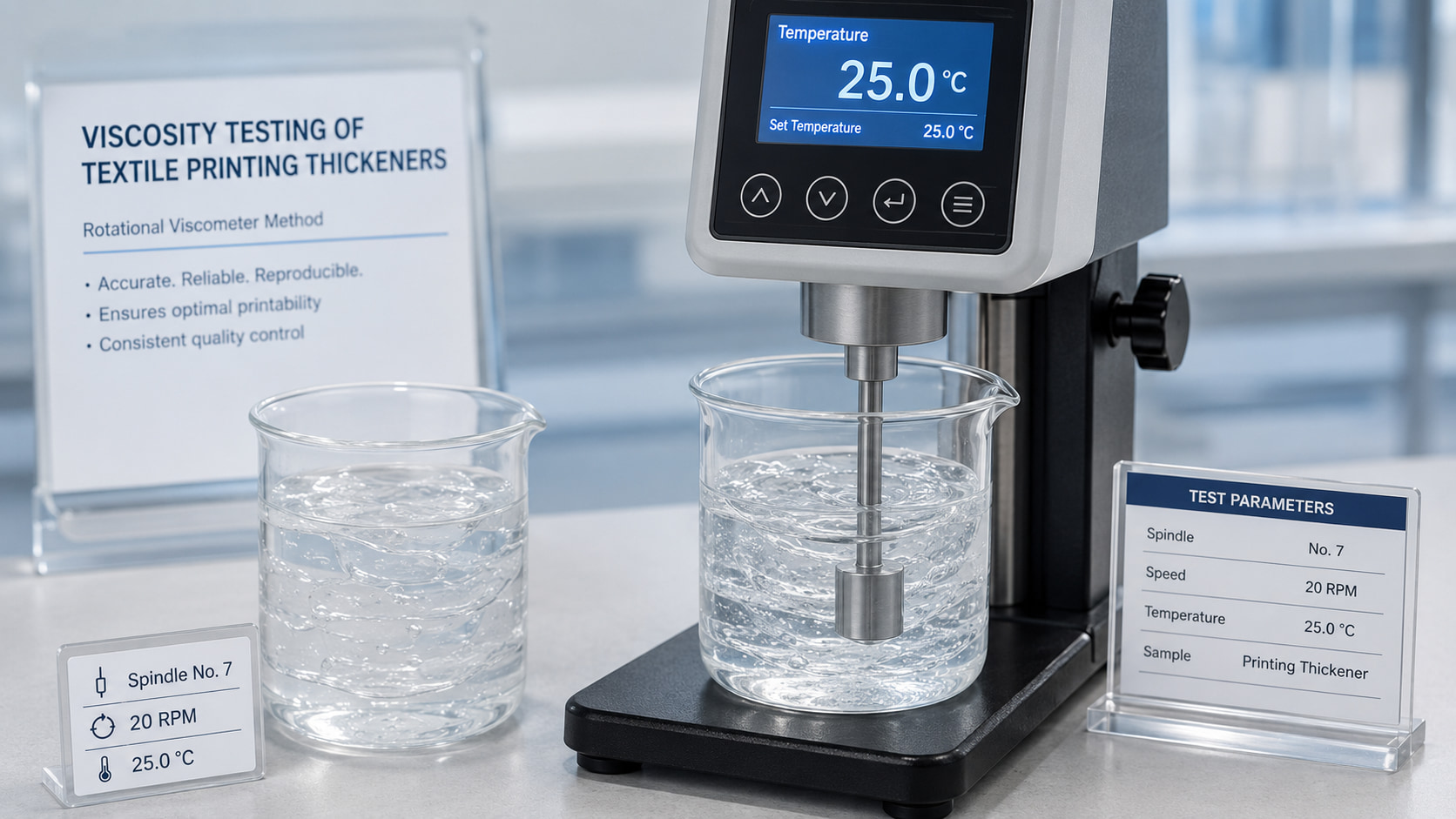
A viscosity value without a complete test method has limited value. Concentration, water quality, hydration time, temperature, instrument, spindle and rotational speed can all change the reported result.
Before comparing suppliers or production batches, the laboratory should document at least the following conditions:
Sample mass and solution concentration
Whether concentration is calculated on an as-received or dry basis
Water type, hardness and temperature
Powder addition sequence and mixing speed
Mixing and hydration time
Resting or deaeration time before measurement
Viscometer or rheometer model
Spindle or measuring geometry
Rotational speed or shear-rate program
Measurement temperature
Number of replicate measurements
A result from a 2% solution cannot be directly compared with a result from a 4% solution. Likewise, two readings obtained with different spindles or rotational speeds should not be treated as equivalent simply because both are reported in mPa·s or cP.
The agreed method should appear in the purchasing specification, internal laboratory procedure or product TDS. Any change in the method should be documented before historical results are compared.
Essential Tests for Powder and Batch Release
The following tests form a practical starting point for textile thickener quality control. Not every test belongs on every batch COA, and the appropriate panel should be selected according to the material chemistry and application risk.
Test
What It Evaluates
Why It Matters
Typical Control Level
Sampling and identification
Batch identity and sample representativeness
Prevents testing the wrong or unrepresentative material
Every received or produced lot
Appearance
Colour, physical form, caking and visible contamination
Provides an early indication of handling or storage problems
Every lot
Moisture or loss on drying
Volatile or water content under the selected method
Affects active material, weighing and storage behavior
According to specification
Viscosity
Apparent viscosity under fixed conditions
Supports batch consistency and grade identification
Usually every lot
pH
Acidity or alkalinity of a defined solution
May influence compatibility and paste preparation
According to grade
Particle size
Powder-size distribution or sieve residue
Influences dispersion, dusting and hydration rate
Qualification or routine control
Hydration and dissolution
Time to form a uniform solution or paste
Identifies lumps, slow hydration and preparation difficulty
Qualification and incoming checks
Filtration or undissolved residue
Coarse particles, gels or insoluble matter
Relevant to screen passage and digital pretreatment preparation
Application-dependent
Material-specific chemistry
DS, purity, salts, ash or other grade-specific properties
Confirms chemical consistency where relevant
Based on material and specification
Rheology and recovery
Flow across different shear conditions
Provides more process information than one viscosity reading
Qualification or investigation
Formulation compatibility
Response to dyes, alkali, salts, binders and process water
Detects instability not visible in water-only testing
Grade qualification
Paste stability
Viscosity, separation and uniformity over time
Supports production scheduling and repeatability
Qualification or periodic verification
Laboratory print trial
Transfer, sharpness, penetration, wash-off and colour response
Confirms fitness for the actual printing process
Supplier or grade approval
1. Sampling and identification
Reliable testing begins with a representative sample. The laboratory record should include the supplier, product name, grade, batch number, production or receipt date, package number and sampling location.
For a multi-bag shipment, one conveniently located bag should not automatically represent the entire lot. The sampling plan should reflect batch size, packaging and the buyer’s quality risk.
Reference and retained samples should be sealed, labelled and stored under defined conditions. They are valuable when comparing a future batch or investigating a production complaint.
2. Appearance and foreign matter
Visual inspection is a fast screening test for colour variation, caking, moisture exposure, damaged packaging and visible foreign material. The result should be compared with an approved reference rather than described only as “normal.”
Appearance alone does not confirm chemical identity or performance. A visually acceptable powder can still differ in viscosity, hydration or formulation compatibility.
3. Moisture or loss on drying
Moisture affects the amount of active material delivered in an as-received powder. It can also influence weighing accuracy, flowability, caking and storage behavior.
The drying temperature, time, sample mass and endpoint must be specified. Different loss-on-drying methods may remove different amounts of volatile material, so results from different procedures should not be compared without method review.
For CMC, ASTM D1439 includes moisture among its specified test areas. This does not mean that the same procedure or acceptance limit automatically applies to CMS, sodium alginate or a formulated compound thickener.
4. Apparent viscosity
Viscosity is commonly used for grade identification and batch release because it is practical and sensitive to polymer concentration and molecular characteristics. It should always be reported together with its test conditions.
Where possible, run duplicate preparations rather than measuring the same beaker twice. Duplicate preparation helps identify errors caused by weighing, powder addition, mixing or incomplete hydration.
A batch may pass a single-point viscosity test and still show different flow under printing shear. For a new grade, supplier change or recurring print defect, a rheological comparison is more informative.
5. pH
Measure pH at a defined concentration, temperature and hydration time. The result may help identify batch variation or predict compatibility with other paste ingredients.
There is no universal ideal pH for every textile thickener. The acceptable range should be linked to the confirmed product grade and the intended dye or pigment system.
6. Particle size, hydration and dissolution
Particle size affects how a powder wets, disperses and hydrates. Very fine powder may disperse quickly under suitable mixing but can be more difficult to add without agglomeration. Coarser material may require a longer hydration period.
A practical hydration test should record:
Ease of powder addition
Tendency to form surface lumps or fish-eyes
Time required to reach a stable viscosity
Uniformity of the prepared solution
Foam or entrained air after mixing
Residue after filtration or screening
Use the same mixer, vessel geometry, batch size and addition sequence when comparing products. Changing the laboratory preparation method can create a difference that is incorrectly attributed to the thickener.
7. Filtration and undissolved residue
A filtration or screen-residue test helps detect coarse particles, gels, contaminants and incompletely hydrated material. The mesh or filter size, pressure, sample volume and prepared-paste age should be documented.
For conventional screen printing, the test can support an assessment of screen passage. For digital textile pretreatment, filtration and residue are important for preparing a uniform treatment bath.
A textile pretreatment thickener should not be added directly to ink unless the ink and equipment suppliers have specifically approved that practice. Pretreatment-paste testing and ink-jetting testing are different evaluation routes.
8. Material-specific chemical properties
Some chemical tests are relevant only to certain material families. For example, a CMC quality plan may consider degree of substitution, purity, sodium chloride, sodium glycolate or density when these properties form part of the agreed specification.
Sodium alginate, CMS and compound thickeners require specifications suited to their own composition. Buyers should not copy a CMC test panel and use it unchanged for every product described as a textile thickener.
Only place a parameter on the purchase specification when its method, unit, acceptance range and connection to the application are understood.
Functional Tests for Prepared Thickener Pastes
9. Rheology and shear recovery
Printing pastes experience different shear conditions during storage, pumping, screen passage, transfer to the fabric and leveling after application. A single rotational speed shows only one part of this behavior.
A rheometer or multi-speed viscometer can be used to compare viscosity across a defined shear range. Depending on the laboratory capability, the program may also evaluate thixotropy, yield behavior or recovery after high shear.
The purpose is not to identify one universally correct flow curve. It is to establish a reproducible profile that correlates with acceptable performance on the buyer’s equipment.
10. Formulation compatibility
Water-only viscosity does not show how a thickener responds to a complete printing formulation. Salts, alkali, acids, dyes, pigments, binders and other auxiliaries may change the final paste structure.
Compatibility testing should use the intended formulation and actual addition sequence. Useful observations include viscosity change, gel formation, precipitation, separation, colour variation and filter residue.
Water quality should also be controlled. Multivalent ions and variable hardness can affect some anionic polysaccharide systems, including alginate-based pastes. Testing with both standardized water and plant water can help separate raw-material variation from water-related effects.
11. Prepared-paste stability
Paste stability testing monitors whether a prepared system remains usable during the required production window. The laboratory may record viscosity, pH, separation, surface skin, sediment, odour changes or filtration behavior at defined intervals.
Storage temperature, container closure, sampling method and observation times should reflect the plant process. An accelerated test can be useful for comparison, but it should not be presented as a direct shelf-life claim unless the correlation has been validated.
Printing Performance Tests
A laboratory print trial is the most direct way to determine whether a candidate thickener is fit for an application. Use an approved current product as the control and change only the thickener whenever the formulation allows.
12. Screen passage and paste transfer
For flat-screen or rotary-screen printing, observe how the paste moves across and through the screen. Record screen passage, paste build-up, transfer uniformity and any visible blocking or foaming.
Laboratory equipment cannot reproduce every production variable, but it can identify obvious differences before a plant-scale trial. Mesh specification, squeegee settings, print speed and fabric should remain consistent across comparisons.
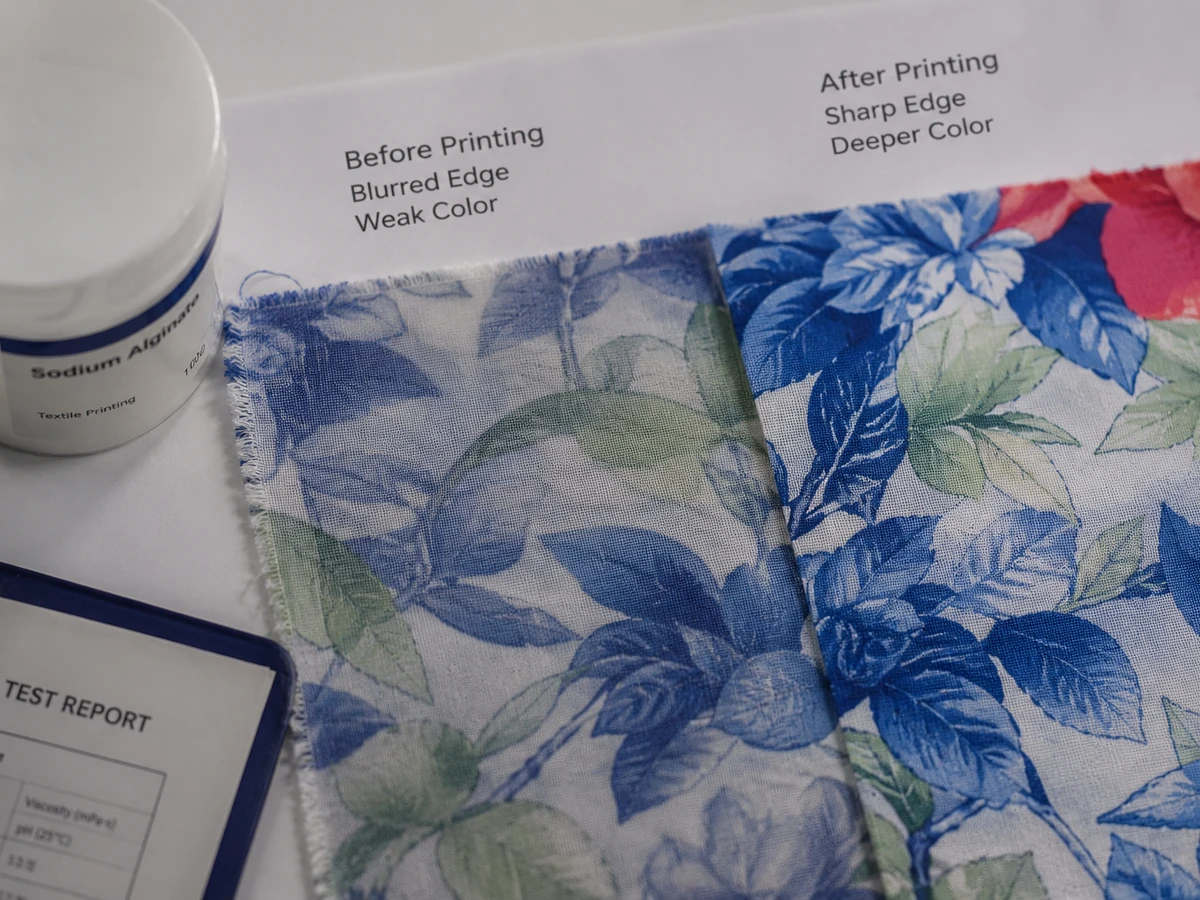
13. Print sharpness, migration and penetration
Print sharpness should be assessed with a controlled test design containing fine lines, corners, open areas and larger colour blocks. Compare edge spreading, line width, missing detail and colour uniformity.
Penetration should be evaluated according to the desired printing style. Excessive penetration may reduce face colour or definition, while insufficient penetration may be unsuitable for products requiring colour coverage through the fabric structure.
Use standardized image analysis where available. If visual assessment is used, establish reference samples and controlled viewing conditions.
14. Colour yield
Colour yield can be compared instrumentally or by an internally validated colour-strength procedure. The same fabric, dye lot, recipe, print deposit, drying, fixation and washing conditions must be used.
A colour difference does not automatically prove a thickener-quality problem. Paste add-on, fabric absorbency, dye concentration, steaming moisture, fixation conditions and washing efficiency should be reviewed before assigning the cause.
15. Wash-off and fabric handle
Wash-off testing assesses how readily unfixed colour and thickener residue can be removed under the intended washing sequence. Observe wash-water behaviour, residual surface film, fabric appearance and handle after drying.
The washing recipe, liquor ratio, temperature, time and mechanical action should be fixed. Changing these conditions can conceal or exaggerate a difference between thickeners.
Claims such as “complete wash-off” or “zero residue” should be avoided unless they are supported by a defined method and confirmed acceptance criteria.
16. Colourfastness
Fastness testing may include laundering, wet and dry rubbing or other end-use requirements. Applicable methods can include AATCC TM61 for accelerated laundering and AATCC TM8 for crocking, subject to the buyer’s market and specification.
Colourfastness is a property of the completed printed and processed textile. It depends on the dye or pigment, fibre, fixation, binder where applicable, washing and finishing—not on the thickener alone.
Fastness should therefore be used as a system-validation result rather than a routine claim that a raw thickener independently guarantees.
Recommended Test Panels by Printing Process
Printing Route
Priority Tests
Important Process Variables
Reactive screen printing
Viscosity, rheology, alkali and dye compatibility, sharpness, colour yield, wash-off and handle
Cellulosic fabric, reactive dye type, alkali, steaming and washing
Polyester construction, disperse dye, drying and thermal fixation
Pigment printing
Binder compatibility, rheology, print definition, handle and rubbing or laundering fastness
Pigment dispersion, binder, catalyst, curing and fabric finish
Reactive digital pretreatment
Hydration, filtration, treatment uniformity, storage stability, bleeding control and colour response
Fabric pretreatment, ink system, drying, steaming and washing
Direct disperse digital pretreatment
Filtration, compatibility, coating uniformity, edge definition and thermal-process response
Polyester substrate, ink, pretreatment add-on and fixation route
The table is a starting framework, not a universal product specification. Each mill should remove irrelevant tests and add customer-specific requirements based on its process risk.
How Often Should Each Test Be Performed?
Running every possible test on every batch is rarely practical. A risk-based plan separates routine release tests from qualification and periodic verification.
Control Stage
Recommended Test Level
Purpose
Supplier qualification
Full physical, chemical, compatibility and printing evaluation
Confirm that the product route is suitable before purchasing
First commercial batches
Routine incoming tests plus selected application trials
Confirm transfer from sample approval to bulk supply
Routine incoming inspection
Identity, appearance and selected critical specification checks
Verify batch consistency efficiently
Periodic verification
Expanded rheology, compatibility and laboratory print testing
Confirm continued application performance
Supplier or process change
Targeted requalification
Evaluate the effect of a changed raw material, method or process
Complaint investigation
Retained-sample comparison and expanded testing
Separate material, preparation and process causes
The actual frequency should be documented in the buyer’s control plan. High-risk applications, new suppliers and unstable processes may require more frequent verification than established product routes.
How to Investigate an Out-of-Specification Result
An unexpected result should not be accepted or rejected without checking whether the test itself was valid. Begin by reviewing the sample identity, preparation record, instrument condition and calculation.
Place the material on hold. Prevent unintended use while the result is reviewed.
Check sample traceability. Confirm the product, batch, package and sampling record.
Review the test method. Check concentration, water, mixing, hydration, temperature, spindle and speed.
Verify instrument status. Confirm calibration or performance checks and inspect the measuring system.
Prepare a new test sample. Do not rely only on repeating a reading from the original beaker.
Compare retained samples. Test an approved batch and the supplier’s retained sample where available.
Review production variables. Consider water quality, formula, fabric, dye, machine and fixation conditions.
Document the conclusion. Record whether the cause relates to the material, test method or application process.
Repeated testing should not be used only to obtain a passing number. The laboratory procedure should define when retesting is allowed and how all original and repeat results are recorded.
What Buyers Should Request from a Supplier
Before approving a textile thickener for bulk purchasing, request enough information to reproduce the supplier’s test result and evaluate the grade in your own process.
Current Technical Data Sheet for the proposed grade
Safety Data Sheet for handling and internal review
Complete viscosity test method
Relevant specification parameters and units
Batch-specific COA for the confirmed shipment
Representative pre-shipment or evaluation sample where agreed
Recommended preparation and hydration procedure
Packaging and storage information
Change-notification expectations
Technical contact for result review and grade matching
A COA confirms only the tests and specification shown on that document. It does not replace the buyer’s application trial or guarantee results under every printing condition.
If replacing an existing grade, provide the supplier with the current TDS, test method, approved sample and main production issue. A comparison based only on product name or nominal viscosity can lead to an unsuitable recommendation.
How FSX Chemical Supports Grade and Batch Evaluation
Based on the available information, the team can review the appropriate product route and prepare a sample for the buyer’s laboratory testing. TDS and SDS can be supplied for the selected product, while batch-specific COA information should be confirmed against the actual product and production batch.
Final approval should be based on the customer’s laboratory or production trial. Results may vary with formulation, fabric, water quality, equipment, fixation and washing conditions.
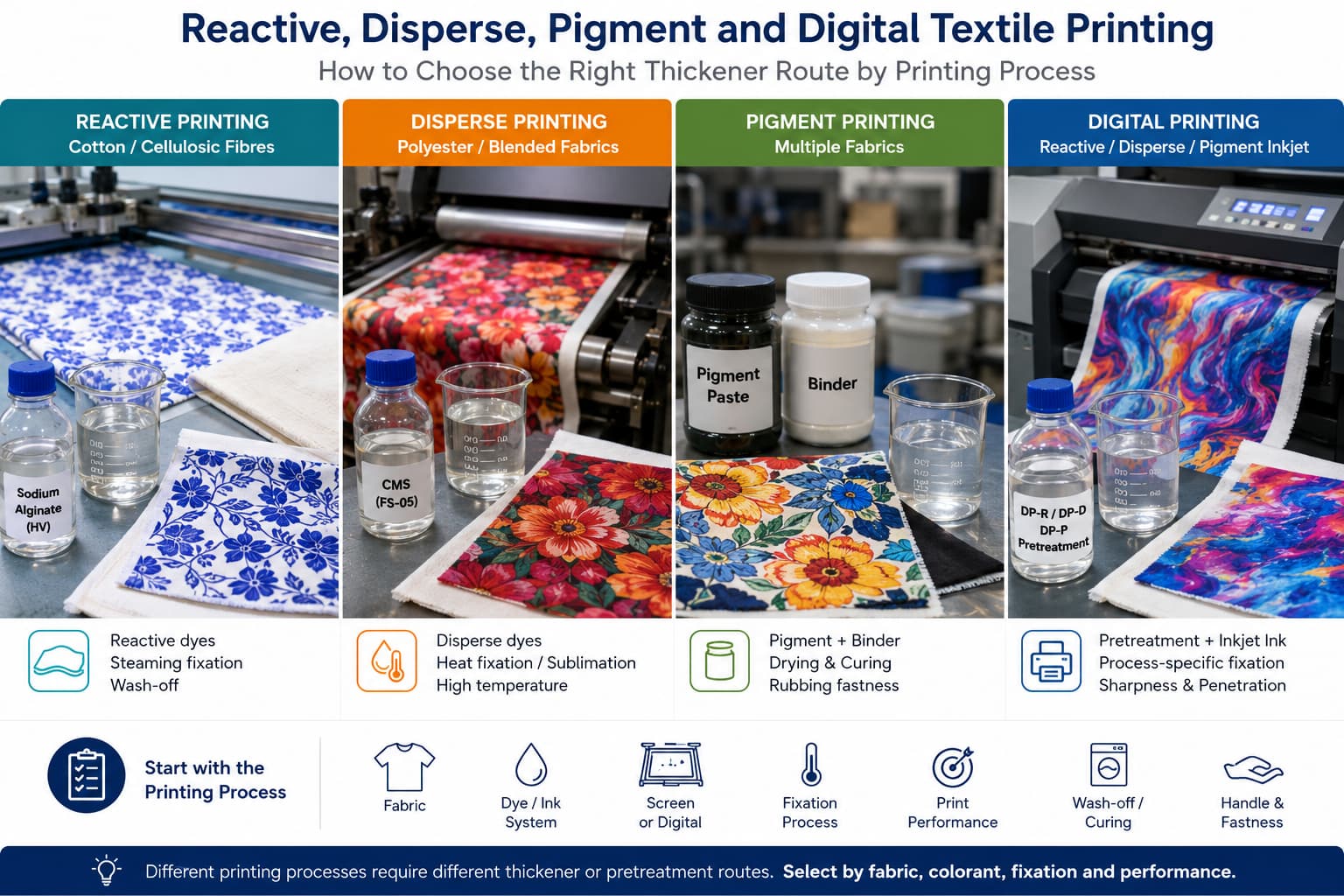
Learn how to choose thickener and pretreatment routes for reactive, disperse, pigment and digital textile printing based on fabric, dye or ink, fixation, wash-off and print-quality requirements.
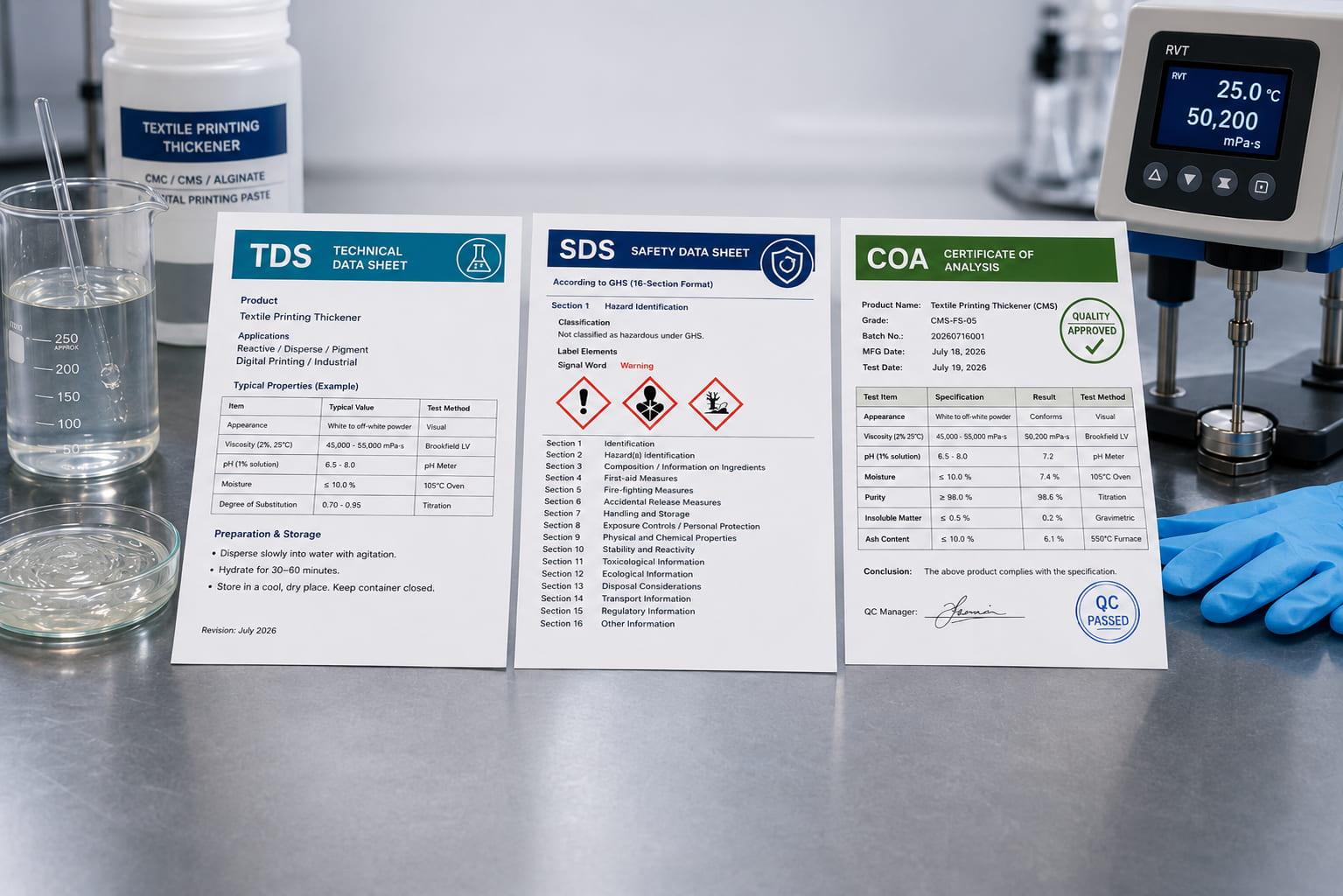
Learn the difference between TDS, SDS and COA documents, what textile printing buyers should verify, and how to check specifications, safety data, test methods, batch results and document issuers.
Compare CMC, CMS, sodium alginate and digital printing paste for textile printing. Learn how each route fits reactive, disperse, pigment and digital processes, and what buyers should review before sample testing, grade matching and bulk purchase.
Carboxymethyl cellulose (CMC) is widely used in the printing, sizing, and dyeing processes of textiles. This guide will explain how to evaluate CMC grades, which parameters are most important, and how FSX Chemical can support purchasing decisions.
Both sodium alginate and CMC are used as thickeners in textile printing, but they suit different dye systems and process conditions. This guide explains the key differences and when to use each.
Wholesale sodium alginate purchasing requires more than comparing unit price. This guide explains how textile printing buyers can confirm viscosity, mesh size, purity grade, packaging, COA, sample testing, and batch consistency before placing bulk orders.
Choosing a sodium alginate manufacturer in China requires more than comparing price or product name. This guide explains how textile printing buyers can evaluate viscosity grades, mesh size, TDS, COA, sample testing, batch consistency, packaging, and export support before placing bulk orders.
Specialty sodium alginate is used in textile printing paste where viscosity, dissolution behavior, paste smoothness, and batch consistency are important. This guide explains how textile printing buyers can evaluate sodium alginate grades by application, specification, TDS, COA, sample testing, and bulk order consistency.
Choosing a textile grade sodium alginate manufacturer requires more than comparing price or general claims. This guide explains how textile printing buyers can review viscosity grade, mesh size, dissolution behavior, TDS, COA, sample testing, batch consistency, packaging, and export documents before bulk purchase.
Environmentally friendly sodium alginate claims should be reviewed carefully before bulk purchase. This guide explains how textile printing buyers can check product specifications, TDS, COA, SDS, environmental documents, sample testing, batch consistency, and application suitability for textile printing paste.
Sodium alginate is commonly used as a reactive dye thickener in textile printing paste. This guide explains how buyers can evaluate viscosity grade, mesh size, dissolution behavior, paste smoothness, TDS, COA, sample testing, batch consistency, and export documents before bulk purchase.
Share the product name, application, quantity, destination and any TDS,
sample photo or document you already have. FSX Chemical will review the
information and recommend the next step for quotation, sample matching
or product selection.
Product InformationProduct name, grade, model, label photo or supplier reference.
Available DocumentsTDS, SDS, COA, sample photo, product list or test data.
Order DetailsEstimated quantity, packaging, destination country, port or trade term.
Application or IssueTextile printing process, formulation need, current issue or target performance.

 EN
EN  BN
BN  ES
ES  TR
TR  FR
FR  ID
ID  RU
RU  AR
AR  UR
UR  VI
VI  TL
TL  HI
HI  UK
UK  KK
KK  KA
KA  UZ
UZ