Top Features to Consider When Buying Textile Printing Thickeners
Buying a textile printing thickener requires more than comparing viscosity and price. This guide explains...
Textile printing thickeners have a direct influence on paste preparation, machine handling, colorant placement, print definition and production consistency. However, commercial grades that appear similar on a Technical Data Sheet may perform differently in the actual printing formulation.
A purchasing decision based only on product name, nominal viscosity or price per kilogram may overlook important differences in hydration, rheology, filtration, chemical tolerance, wash-off and batch stability.
The correct purchasing approach is to begin with the intended printing process, define measurable acceptance criteria and compare representative samples under standardized laboratory and production conditions.
This guide presents the main features textile printers, formulators and procurement teams should review before approving a thickener for commercial supply.
A textile printing thickener is not purchased as an isolated polymer. It becomes part of a formulation containing dyes, pigments, binders, salts, alkalis, humectants, defoamers and other auxiliaries.
Its performance is also influenced by fabric absorbency, water quality, mixing equipment, printing speed, fixation and washing conditions. Consequently, a grade that performs well in one factory may require a different dosage or may be unsuitable in another process.
Product names provide only a starting point
Sodium alginate, Carboxymethyl Starch, Carboxymethyl Cellulose and synthetic thickener are product families. Each family can contain multiple grades with different viscosity, purity, substitution, particle-size and application characteristics.
Purchasing and technical approval should be connected
Procurement teams may focus on price, packing and delivery, while laboratories focus on viscosity and printing performance. A reliable approval process connects both groups.
The selected product should meet technical requirements, carry a permanent commercial grade code and remain practical for routine supply.
1. Compatibility with the Printing Process
The first feature to evaluate is whether the thickener is designed for the intended dye, pigment or ink system. No later specification can compensate for choosing the wrong chemical route.
Impression réactive
Alginate de sodium is an important starting route for reactive dye printing on cotton, viscose and other suitable cellulosic textiles.
Selected CMS, CMC or compound products may also be evaluated in blended or specialized formulations, but dye interaction, color response and wash-off must be confirmed.
Impression pigmentaire
Pigment printing usually requires a thickener that is compatible with the binder, pigment dispersion, curing system and required fabric handle. Synthetic and compound systems are common starting routes.
Digital textile printing
Digital printing frequently uses a dedicated fabric pretreatment rather than a conventional screen-printing paste. A Pâte d'impression numérique should be selected according to the reactive, disperse or pigment ink route.
Ask the supplier a specific application question
Instead of asking whether a thickener is suitable for textile printing, provide the fabric, colorant system, equipment and fixation method. This allows the supplier to recommend a relevant grade rather than a general industrial product.
2. Clearly Defined Viscosity Specifications
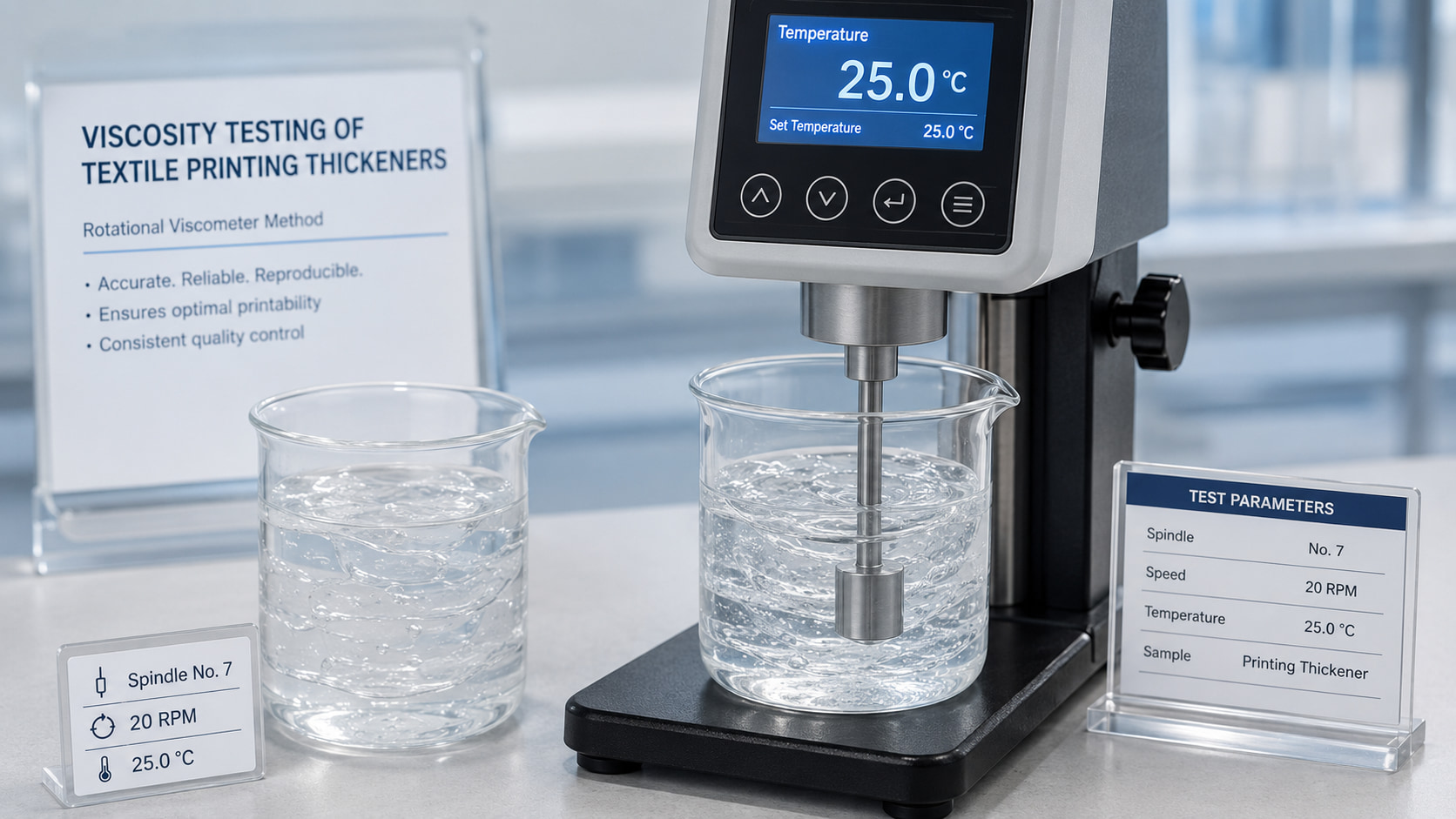
Viscosity is one of the most important purchasing parameters, but the number is meaningful only when the complete measurement method is known.
A viscosity specification should identify
Product concentration and calculation basis
Water source or water-quality condition
Mixing equipment, speed and preparation time
Hydratation ou temps de repos
Température de mesure
Viscometer model or measurement principle
Spindle, rotor or measurement geometry
Vitesse de rotation ou condition de cisaillement
Reported unit and reading procedure
Do not compare different methods directly
A result measured at one concentration or rotational speed should not be treated as equivalent to a result obtained using another procedure.
Supplier and buyer laboratories may both obtain correct results while reporting different numbers because their methods are different.
Request a side-by-side comparison
When replacing an existing grade, prepare the reference and candidate together using one agreed method. This provides more useful information than comparing isolated values from two different Technical Data Sheets.
3. Suitable Rheological Behavior
Textile printing pastes are generally evaluated as non-Newtonian systems. Their apparent viscosity can change as mixing, pumping, screen pressure or coating shear changes.
A single viscosity reading cannot fully describe this behavior.
Shear-thinning performance
A suitable paste often becomes easier to move when exposed to printing shear. This helps it pass through screens or application equipment.
If the paste does not flow sufficiently, transfer may be incomplete. If it becomes excessively fluid, spreading and uncontrolled penetration may increase.
Récupération après l'application
After passing through the printing equipment, the paste should recover enough structure to support the required outline and pattern definition.
Recovery that is too slow may contribute to bleeding, while excessive recovery may affect leveling and surface uniformity.
Evaluate rheology through application
Multi-speed viscosity or rheometer data can improve technical understanding, but actual printing remains essential. The best rheological profile depends on the machine, fabric and design.
4. Thickening Efficiency and Practical Dosage
Thickening efficiency describes how much product is needed to reach a useful paste condition. However, reaching a viscosity target does not automatically mean the dosage is suitable for printing.
Compare equal dosages first
During initial screening, compare the reference and candidate at the same concentration where practical. This helps identify differences in hydration and viscosity development.
Then optimize the dosage
After the equal-dosage comparison, adjust the candidate dosage if technically justified. Record every change and confirm that the lower or higher dosage still provides acceptable printing performance.
A high-viscosity grade is not automatically more economical
A high nominal viscosity may be associated with poor filtration, unsuitable shear recovery or difficult preparation. Cost should be calculated using the quantity required for an acceptable production batch.
Use actual product basis
Confirm whether dosage is calculated from the supplied product, dry matter or active polymer. Moisture or solids differences can make two apparently equal additions technically different.
5. Dispersion and Hydration Performance
Powdered thickeners must wet, disperse and hydrate before they can provide their intended performance. Poor preparation may create lumps, nonuniformity and misleading viscosity results.
Powder wetting
A product should disperse under the factory’s available mixing conditions. Very rapid hydration can be useful, but it may also create surface-wetted lumps if the powder is added too quickly.
Pause hydratation
Some grades develop most of their viscosity during mixing, while others require a defined resting period. Buyers should consider whether the hydration time fits the production schedule.
Mixing energy and equipment
Laboratory mixing does not always represent production-scale preparation. Impeller design, vessel shape, filling level and batch size influence dispersion.
Useful preparation checks
Powder-addition behavior
Lump formation
Temps de mélange et d'hydratation
Temperature increase during mixing
Foam development
Uniformity at the top, middle and bottom of the vessel
Need for filtration after preparation
6. Chemical Compatibility and Process Tolerance
A thickener that performs well in clean water may change significantly after dyes, salts, alkalis, binders and auxiliaries are added.
Salt and electrolyte tolerance
Electrolytes can alter polymer-chain interactions and change apparent viscosity. The effect depends on the polymer family, grade and concentration.
pH and alkali stability
Reactive and other printing formulations may expose the thickener to alkaline or changing pH conditions. Measure the complete paste both immediately and after the normal holding time.
Compatibilité des liants
In pigment printing, the thickener must remain compatible with the binder, pigment dispersion and curing system. Instability may appear as thinning, over-thickening, separation or poor final handle.
Water-quality tolerance
Hardness, conductivity and dissolved ions vary between factories. Final approval should include the buyer’s process water where practical.
Temperature tolerance
Preparation and measurement temperature can change apparent viscosity. Seasonal factory conditions should be considered when approving a narrow viscosity range.
7. Filtration and Screen-Passage Performance
Filtration is important for conventional screen printing, coating and digital pretreatment. Undissolved particles, gels and contamination can interfere with transfer and create visible printing defects.
What filtration testing can reveal
Hydratation insuffisante
Persistent lumps
Particules de gel
Contamination par des corps étrangers
Excessive residue
Instability after other chemicals are added
Use a process-relevant method
A very coarse laboratory filter may not reveal problems that appear on a fine screen or digital pretreatment line. The filter size and procedure should reflect the intended equipment.
Screen passage is not determined by viscosity alone
Two pastes with similar viscosity may differ in smoothness, gel content and flow under shear. Include an actual screen, coating or machine trial whenever equipment reliability is critical.
8. Paste Stability and Holding Time
Printing paste may be prepared several hours before it is used. The thickener must remain sufficiently stable during the factory’s normal storage and production period.
Measure at defined time points
Record viscosity and appearance immediately after preparation, after complete hydration and after the normal holding period.
Look for more than viscosity drift
Séparation
Régularisation
Formation de la couche superficielle de la peau
Rétention de mousse
Color or odor change
Loss of uniformity
Capacité de filtration après stockage
Control storage conditions during comparison
Use closed containers to limit evaporation and record storage temperature. A sample stored uncovered may become more concentrated and appear to gain viscosity.
Check the complete formulation
A thickener stock solution may remain stable while the final color paste changes after dyes, alkalis or binders are added. Both stages should be evaluated.
9. Final Printing Performance
Laboratory specifications support product screening, but final approval should be based on printing performance under representative conditions.
Définition de l'impression
Evaluate fine lines, small text, sharp corners and closely spaced design elements where these features are relevant to production.
Spreading and bleeding
Check whether color moves beyond the intended boundary before or during fixation. Fabric absorbency and paste rheology should be considered together.
Pénétration et couverture
The preferred penetration depends on fabric construction and end use. Excessive surface hold and excessive penetration can both create unacceptable results.
Ombre et planéité
Compare the reference and candidate after the same fixation, curing and washing process. Color response should not be judged from the wet paste alone.
Production consistency
Observe performance from the beginning to the end of the trial. A paste that works for a small laboratory print may drift during a longer machine run.
10. Wash-Off and Fabric Handle
The thickener must not only support printing. It must also fit the post-print process and final textile-quality requirements.
Wash-off behavior
Reactive and other washable systems should be evaluated after the normal rinsing and washing sequence. Check residual paste, shade, levelness and the efficiency of removal.
Wash-off is influenced by the complete formulation, including dye, electrolyte, alkali and fixation conditions. It should not be attributed to the thickener alone.
Poignée en tissu
Residual polymer, binder interaction or excessive surface deposition may affect softness and flexibility. A sharp print is not acceptable if the fabric becomes too stiff for its intended use.
Relevant durability tests
Pigment and functional printing may require rubbing, washing or other durability tests after curing. The selected thickener should be evaluated as part of the complete printed system.
11. Batch-to-Batch Consistency
A successful sample does not guarantee reliable commercial supply. Buyers should evaluate how the supplier controls routine production batches.
Permanent grade identification
The sample, TDS, quotation, purchase order, package label and COA should use the same permanent product and grade code.
Defined commercial specification
The commercial grade should have agreed limits for relevant parameters. Depending on the product, these may include viscosity, moisture, pH, purity or substitution-related data.
Batch-specific quality information
A Certificate of Analysis should correspond to the actual production batch and use the test methods stated in the commercial specification.
Incoming inspection
Buyers should inspect packaging, batch identity and product appearance, then complete the agreed viscosity or application test before releasing the full shipment.
Retained samples
Supplier and buyer retention samples can support investigation if a later production issue occurs.
12. Technical Documents and Product Traceability
Technical documents support safe handling, product comparison, internal approval and batch traceability.
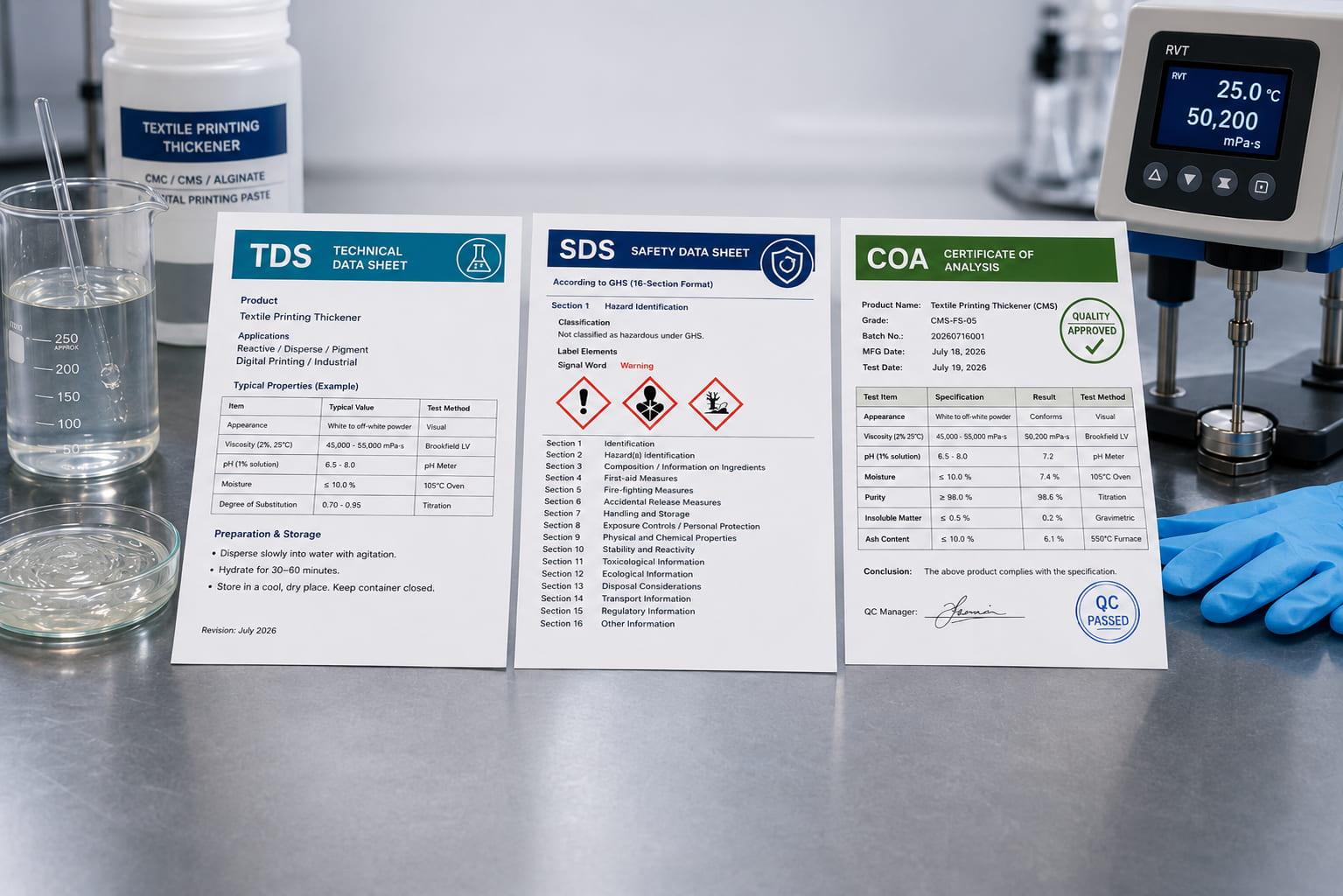
Fiche technique
The TDS should identify the product, intended application, typical or specified properties and recommended preparation method.
Fiche de données de sécurité
The SDS supports workplace handling, storage, transport and safety review. Buyers should check that the document applies to the exact grade being purchased.
Certificat d'analyse
The COA reports selected results for a confirmed sample or commercial batch. It does not replace the customer’s application trial.
Product labels and batch numbers
Packages should provide sufficient product and batch identification for warehouse control and complaint investigation.
Certification and compliance claims
When a chemical-management or environmental document is required, verify the certificate holder, product scope, issuing organization, validity period and exact grade coverage.
Do not assume that one document applies to every product from the same supplier.
13. Sample Matching and Technical Support
Textile thickeners often require application-specific selection. Technical support can reduce the number of unsuitable samples and improve the quality of the trial.
Existing-product review
A supplier should be able to review the buyer’s current TDS, sample, dosage, test method and production issue before recommending a candidate.
Preparation guidance
The supplier should explain concentration, powder-addition sequence, mixing, hydration, temperature and measurement conditions.
Analyse des résultats des essais cliniques
When a sample does not meet the target, useful technical support should distinguish between grade mismatch, preparation error, dosage, incompatibility and equipment conditions.
Standard grade before customization
A standard commercial grade is generally the most efficient starting point. Custom development can be considered when the application requirement is clearly defined and standard options are unsuitable.
Price per kilogram does not show the full cost of a textile printing thickener. The relevant comparison is the cost required to produce an acceptable batch of printed fabric.
Cost factors to include
Actual product dosage
Temps de mélange et d'hydratation
Heating or cooling requirements
Filtration and preparation loss
Screen or equipment cleaning
Machine interruptions
Unused or rejected paste
Washing and post-treatment
Rejected or reprocessed fabric
Packaging, freight and inventory
Technical support and quality documentation
Compare equivalent quality
The reference and candidate should meet the same print definition, shade, penetration, handle and durability requirements.
A lower material price is not a saving if the product increases machine downtime or off-quality production.
15. Packaging, Storage and Supply Reliability
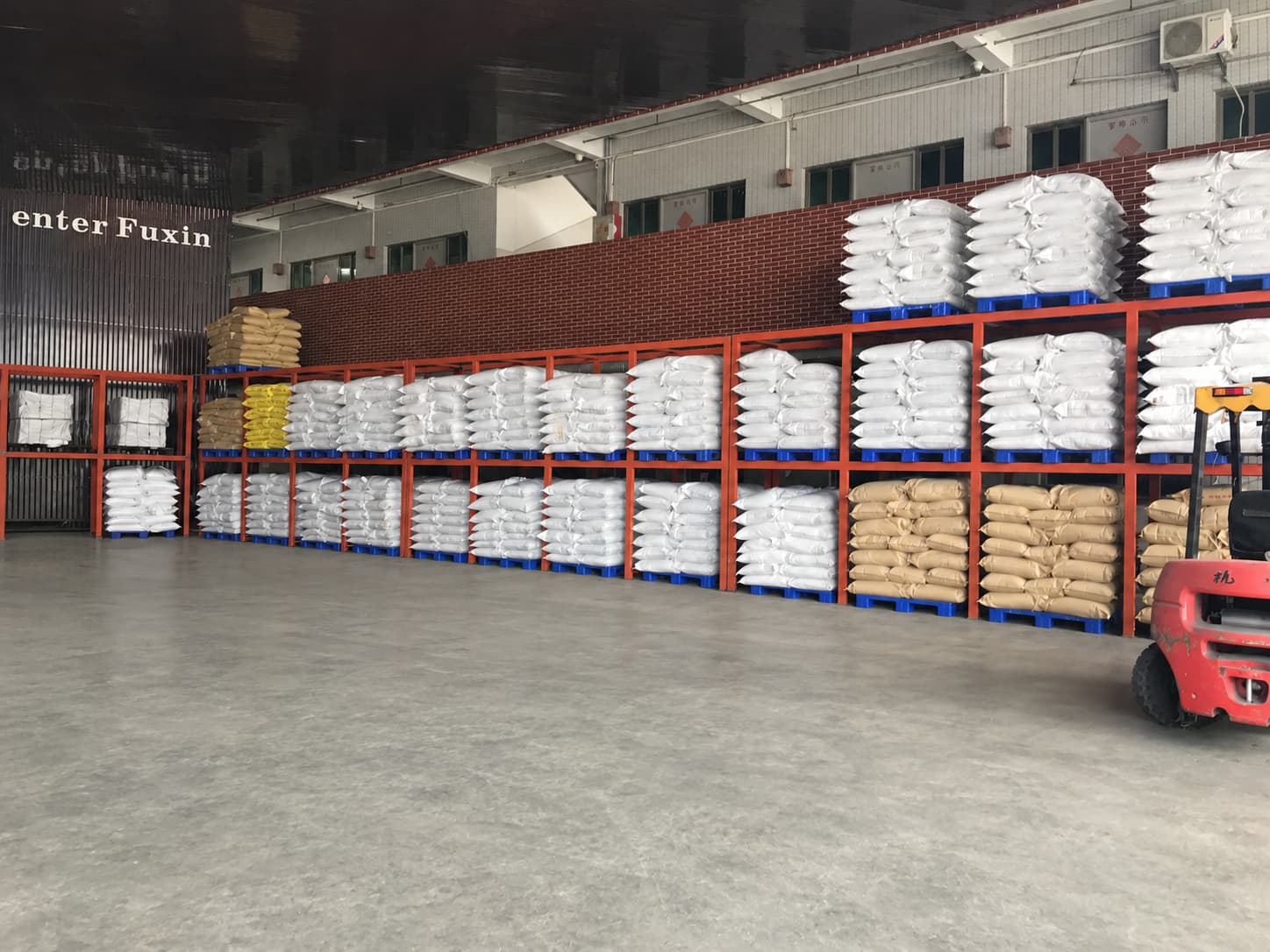
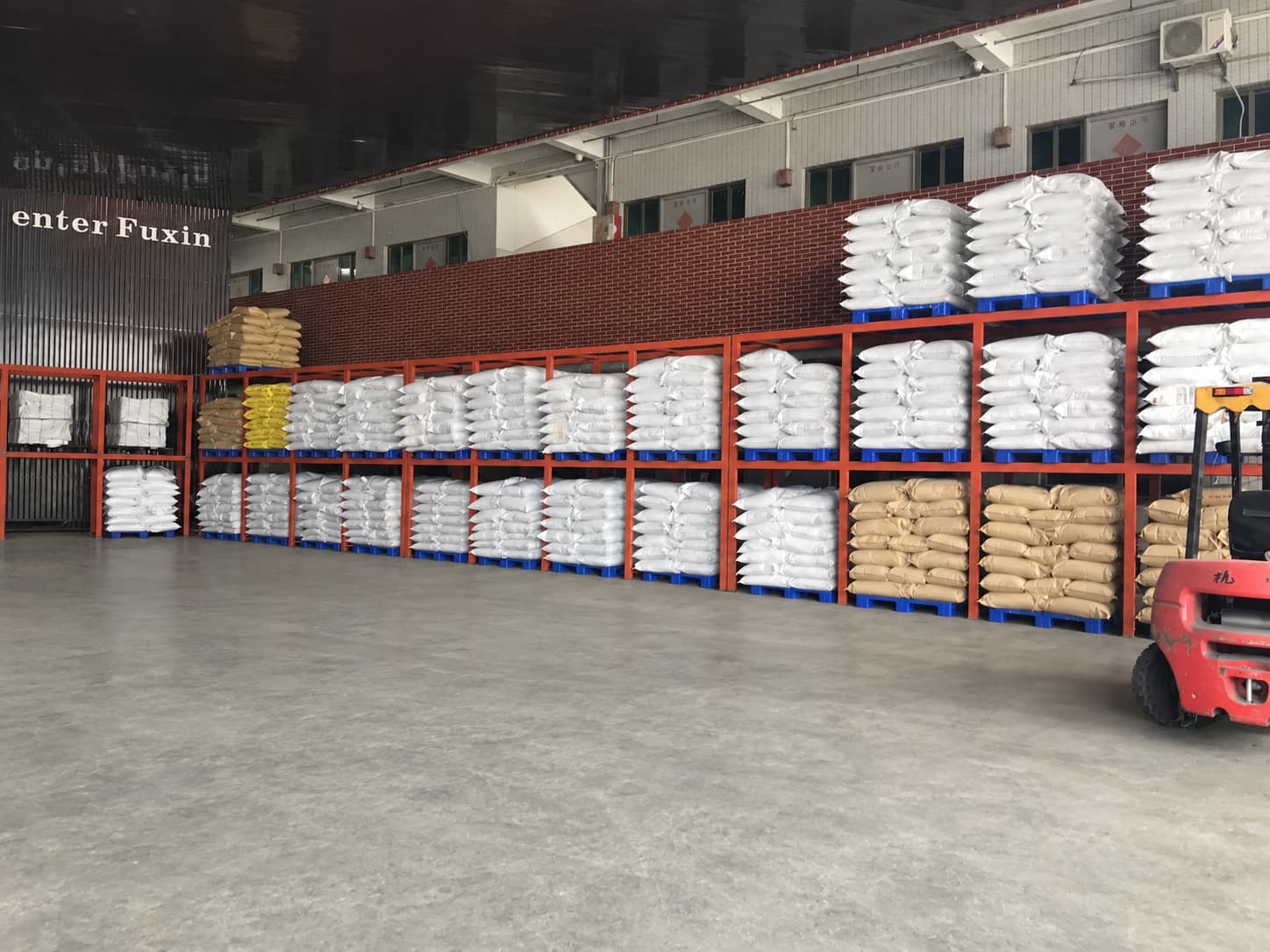
Packaging and logistics can influence product quality before the thickener reaches the mixing vessel.
Moisture protection
Powdered products should be protected from humidity. Moisture pickup can affect flow, weighing, lump formation and effective dry-material content.
Packaging size
Package size should match normal consumption. Very large packages may remain open too long, while very small packages may increase handling and packaging requirements.
Storage conditions
Buyers should confirm recommended storage, stacking, package closure and handling after opening.
Continuité de l'approvisionnement
Review normal production lead time, order quantity, packing options and the supplier’s ability to provide repeat commercial batches.
Change control
Significant changes to the agreed grade, specification or manufacturing route may require notification and partial requalification. Expectations should be discussed during supplier approval.
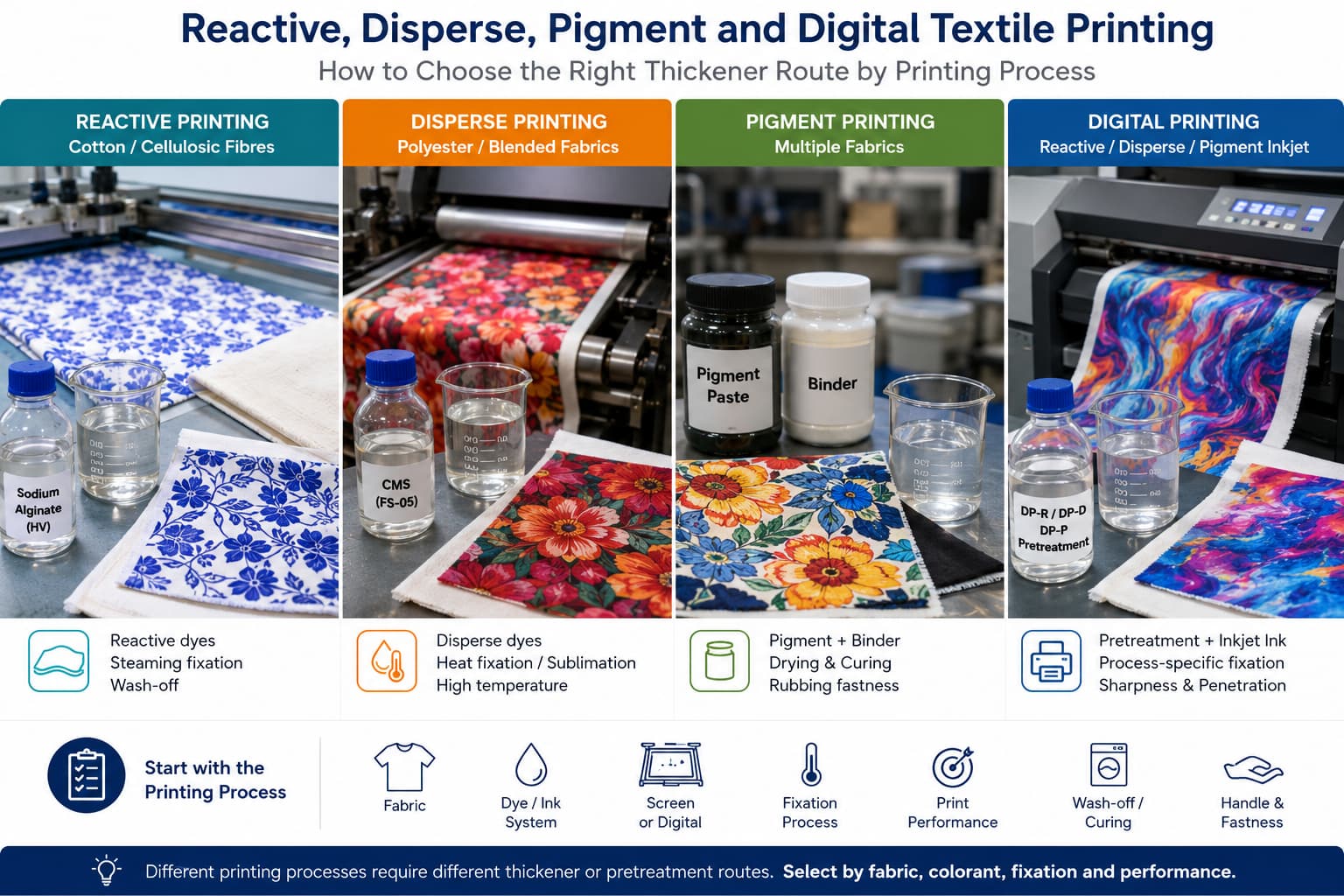
Quick Selection Guide by Printing Process
Procédé d'impression
Practical Starting Route
Most Important Buying Features
Reactive screen printing on cotton
Sodium alginate or a validated reactive compound thickener
Dye compatibility, rheology, filtration, definition and wash-off
Reactive rotary printing
Sodium alginate or a high-speed matched compound system
Shear behavior, recovery, pumping and long-run stability
Impression pigmentaire
Binder-compatible synthetic or compound thickener
Binder compatibility, curing, handle and rubbing performance
Mixed reactive thickener development
Alginate, CMS or another validated blended route
Blend stability, color response, wash-off and cost in use
Selected coating formulation
CMC, CMS or an application-specific compound grade
Coating flow, stability, adhesion and downstream compatibility
Reactive digital printing
Dedicated reactive digital pretreatment paste
Ink control, filtration, coating uniformity and wash-off
Disperse digital printing
Dedicated disperse digital printing paste
Fabric compatibility, filtration and fixation performance
Pigment digital printing
Dedicated pigment pretreatment and binder-compatible system
Definition, handle, curing and rubbing durability
These routes are starting points rather than guaranteed selections. Grade-specific laboratory and production testing remains necessary.
How to Test a Thickener Before Bulk Purchasing
Step 1: Define the reference product
Use the current approved thickener, TDS and representative batch as the control.
Step 2: Establish acceptance criteria
Separate critical requirements from preferences. Critical requirements may include compatibility, screen passage, paste stability and final textile quality.
Étape 3 : Uniformiser la préparation
Utilisez la même source d'eau
Utilisez la même base de concentration
Use identical containers and mixing equipment
Control mixing speed and time
Control hydration and resting time
Measure at the same temperature
Step 4: Complete laboratory screening
Aspect
Dispersion et formation d'agrégats
Pause hydratation
Viscosité selon la méthode convenue
Filtration et résidus
Mousse, décantation et séparation
Stabilité après la période de détention normale
Étape 5 : Tester la formulation complète
Add the actual dyes, pigments, binders, salts, alkalis and auxiliaries. Change only one major variable at a time during the initial comparison.
Step 6: Conduct an application trial
Use representative fabric, equipment, fixation and washing conditions. Include the current approved product as the control.
Step 7: Evaluate the final textile
Définition de l'impression
Épandage et pénétration
Coverage and levelness
Shade response
Lavage ou durcissement
Poignée en tissu
Solidité ou durabilité pertinente
Step 8: Verify the first commercial batch
Confirm the permanent grade code, packaging, batch COA and incoming performance before releasing the shipment for routine production.
Information to Include in an RFQ
A complete Request for Quotation allows the supplier to recommend a more relevant grade and prepare a more accurate commercial offer.
Application information
Reactive, pigment, disperse, acid or digital process
Composition du tissu et des fibres
Printing machine or application method
Système à base de colorant, de pigment ou d'encre
Current product and dosage
Target viscosity and complete measurement method
Water quality and preparation process
Normal paste holding time
Fixation, curing or washing route
Main technical problem
Commercial information
Estimated sample and bulk quantity
Preferred packaging
Destination country and port
Preferred trade term
Required delivery schedule
Required technical and shipping documents
Reference information
TDS actuel
Product label photograph
Current COA where available
Échantillon représentatif
Viscosity report with test conditions
Printed-fabric or defect photographs
Common Purchasing Mistakes
Buying only by product family
A general name such as sodium alginate, CMS or CMC does not define the commercial grade.
Comparing only viscosity numbers
Values measured using different concentrations, temperatures or instruments should not be treated as directly equivalent.
Choosing the highest-viscosity grade
High viscosity does not guarantee suitable shear response, filtration or printing performance.
Approving from water testing alone
The full formulation may behave differently after dyes, salts, alkalis or binders are added.
Evaluating only one shade or fabric
A grade may perform differently when colorant concentration, fabric absorbency or electrolyte load changes.
Ignoring sample-to-bulk identity
An approved sample should be linked to a permanent commercial grade and repeatable specification.
Choosing by price per kilogram
Dosage, mixing, filtration, machine reliability and rejected production can have a larger effect on total cost.
Relying on unverified certification claims
Certification or compliance documents should apply to the exact product, supplier and validity period.
How FSX Chemical Supports Thickener Procurement
FSX Chemical supplies sodium alginate, CMS, CMC and digital printing paste for different textile applications. Candidate grades can be reviewed according to the customer’s current product, fabric, colorant system, equipment and production objective.
Buyers can provide
Nom actuel du produit, fiche technique (TDS) ou échantillon représentatif
Composition du tissu et des fibres
Système à base de colorant, de pigment ou d'encre
Printing method and equipment
Current dosage and preparation method
Target viscosity with the complete test procedure
Main printing or production problem
Required packaging, quantity and destination
Technical review may include
Review of the current product specification
Selection of an appropriate thickener route
Recommendation of a candidate grade
Provision of relevant TDS and SDS documents
Representative samples for laboratory evaluation
Guidance for standardized side-by-side testing
Review of laboratory and printing-trial feedback
Batch documentation for the selected commercial grade
A recommended product should be treated as a candidate for controlled evaluation rather than an automatically approved replacement. Final suitability depends on the buyer’s complete production process📧 E-mail: Service@fsxchemical.com
Découvrez pourquoi les valeurs de viscosité des épaississants utilisés dans l'impression textile ne peuvent pas être comparées sans tenir compte de la concentration, de la température, de l'instrument, de l'axe, de la vitesse, de la méthode de préparation et de la durée de l'essai.
Découvrez comment choisir les agents épaississants et les procédés de prétraitement adaptés à l'impression textile réactive, dispersée, pigmentée et numérique, en fonction des exigences liées au tissu, à la teinture ou à l'encre, à la fixation, à l'élimination au lavage et à la qualité d'impression.
Découvrez la différence entre les documents TDS, SDS et COA, ce que les acheteurs de produits d'impression textile doivent vérifier, ainsi que la manière de contrôler les spécifications, les données de sécurité, les méthodes d'essai, les résultats des lots et les émetteurs des documents.
Comparez le CMC, le CMS, l'alginate de sodium et la pâte d'impression numérique pour l'impression textile. Découvrez comment chaque solution s'adapte aux procédés réactifs, dispersés, pigmentés et numériques, et ce que les acheteurs doivent vérifier avant de procéder à des tests d'échantillons, à la mise en correspondance des qualités et à l'achat en gros.
L'alginate de sodium est largement utilisé dans l'impression textile comme épaississant stable et lavable pour les pâtes d'impression réactives. Découvrez comment évaluer le degré de viscosité, la pureté et l'adéquation à l'application avant tout achat, et comment FSX Chemical accompagne les acheteurs du monde entier en leur fournissant des données techniques et des échantillons.
La carboxyméthylcellulose (CMC) est largement utilisée dans les processus d'impression, d'encollage et de teinture des textiles. Ce guide explique comment évaluer les différentes qualités de CMC, quels sont les paramètres les plus importants et comment FSX Chemical peut vous aider dans vos décisions d'achat.
La carboxyméthylcellulose est utilisée comme épaississant et stabilisant dans les encres à base d'eau, l'impression en héliogravure et le prétraitement pour l'impression à jet d'encre. Ce guide présente les principaux paramètres relatifs aux différentes qualités de ce produit ainsi que les éléments à prendre en compte par les équipes d'approvisionnement.
L'alginate de sodium et la CMC sont tous deux utilisés comme épaississants dans l'impression textile, mais ils conviennent à des systèmes de teinture et à des conditions de traitement différents. Ce guide explique les principales différences entre ces deux produits et précise dans quels cas il convient d'utiliser l'un ou l'autre.
L'impression numérique à jet d'encre sur textiles présente des exigences différentes en matière de pâte et de prétraitement par rapport à la sérigraphie. Ce guide explique comment l'alginate de sodium est utilisé dans l'impression textile numérique et quels paramètres de qualité les équipes d'approvisionnement doivent préciser.
Le CMC de qualité alimentaire et celui de qualité industrielle partagent la même composition chimique de base, mais présentent des différences significatives en termes de pureté, de plage de DS et d'exigences réglementaires. Ce guide explique les principales différences et pourquoi l'utilisation d'une qualité inadaptée peut entraîner des problèmes de production.
Dans l'impression textile aux colorants réactifs, une préparation correcte de la pâte est tout aussi importante que le choix de la qualité du tissu. Ce guide aborde les méthodes de dissolution de l'alginate de sodium, les plages de concentration en fonction de l'application, les conditions de stockage, ainsi que la manière de résoudre les problèmes courants liés à la préparation.
L'alginate de sodium est un polymère naturel et biodégradable, mais son utilisation dans l'impression textile génère des eaux usées qui doivent être traitées. Ce guide présente le profil environnemental de l'alginate de sodium, les caractéristiques des effluents de lavage, ainsi que les éléments que les équipes chargées des achats doivent connaître concernant le choix des épaississants et leur impact environnemental.
Veuillez nous communiquer le nom du produit, son application, la quantité, la destination, ainsi que toute fiche technique (TDS),
photo ou document dont vous disposez déjà. FSX Chemical examinera ces
informations et vous recommandera la marche à suivre pour obtenir un devis, trouver un échantillon correspondant
ou choisir un produit.
Informations sur le produitNom du produit, référence, modèle, photo de l'étiquette ou référence du fournisseur.
Documents disponiblesFiche technique (TDS), fiche de données de sécurité (SDS), certificat d'analyse (COA), photo d'exemple, liste des produits ou données d'essai.
Détails de la commandeQuantité estimée, conditionnement, pays de destination, port ou conditions commerciales.
Demande ou problèmeProcédé d'impression textile, besoins en matière de formulation, problème actuel ou performances visées.

 FR
FR  EN
EN  BN
BN  ES
ES  TR
TR  ID
ID  RU
RU  AR
AR  UR
UR  VI
VI  TL
TL  HI
HI  UK
UK  KK
KK  KA
KA  UZ
UZ