Disperse Digital Printing Pretreatment on Polyester: How Viscosity, Pick-Up and Drying Affect Print Sharpness
Disperse digital printing pretreatment on polyester is primarily a surface-control process. The pretreatment must apply...
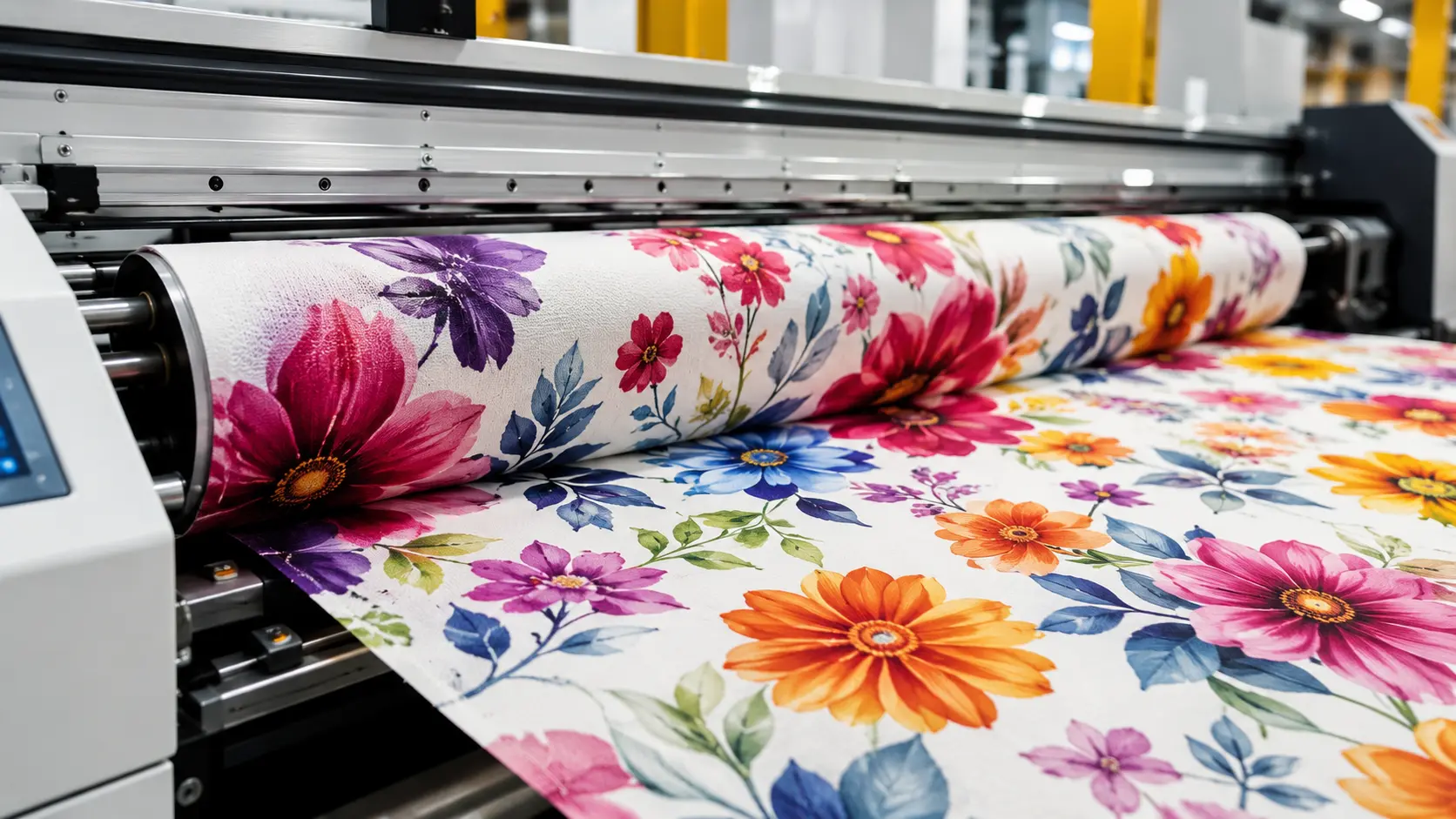
Disperse digital printing pretreatment on polyester is primarily a surface-control process. The pretreatment must apply enough migration-control polymer to slow uncontrolled ink spreading without creating an uneven, overly heavy or difficult-to-dry film. Viscosity controls how the pretreatment wets, penetrates and remains near the polyester surface; wet pick-up controls how much liquid and chemistry the fabric actually receives; drying determines where that chemistry finally remains before inkjet printing. If any one of these variables drifts, print sharpness can change even when the disperse ink, printer and artwork remain unchanged. The correct target is therefore a validated viscosity–pick-up–drying window that gives repeatable droplet localization, color yield, fixation and wash-off on the actual polyester fabric.
How Do Viscosity, Pick-Up and Drying Affect Disperse Digital Print Sharpness?
For direct disperse inkjet printing on polyester, pretreatment sharpness control can be summarized as:
Viscosity → Where the Pretreatment Flows
Wet Pick-Up → How Much Pretreatment Liquor Reaches the Fabric
Drying → Where the Pretreatment Chemistry Finally Remains
Those three variables determine the surface condition that receives the disperse ink.
If the surface does not control the droplet correctly, the ink can:
Spread laterally
Follow yarn capillaries
Penetrate more deeply than intended
Produce wider lines and less-defined edges
The useful target is not the highest pretreatment viscosity or the highest chemical add-on.
It is:
The Minimum Stable Pretreatment Condition That Provides the Required Droplet Localization and Print Sharpness Across the Production Fabric.
Direct-to-Fabric Disperse Printing vs. Transfer Sublimation
This article focuses on direct-to-fabric disperse inkjet printing on polyester.
That process is different from sublimation transfer printing.
In transfer printing:
Ink is first printed on transfer paper.
Dye is transferred to polyester during heat pressing / calendaring.
Fabric pretreatment for direct inkjet sharpness is therefore not automatically relevant to transfer-paper printing.
For direct-to-fabric polyester, the aqueous disperse ink lands directly on the textile surface, so fabric wetting, droplet spreading and penetration become immediate process variables.
Why Polyester May Need Pretreatment Before Direct Disperse Inkjet Printing
Polyester has relatively low surface polarity compared with cellulose fibers.
Aqueous disperse ink droplets can spread over yarn and fabric surfaces before drying and fixation.
Pretreatment can help by placing a controlled polymer layer on the textile.
Depending on formulation, the pretreatment can:
Increase local liquid viscosity after droplet impact
Reduce uncontrolled lateral spreading
Control penetration
Improve edge definition
Improve apparent surface color
Published polyester inkjet studies have demonstrated that thickening-polymer pretreatment can improve both K/S and print sharpness.
However, modern research also shows that specially engineered disperse inks can sometimes control bleeding without chemical pretreatment.
That does not make conventional pretreatment unnecessary in every production process; it shows that droplet-rheology control can be engineered either on the fabric side or, in specialized inks, on the ink side.
What Does “Print Sharpness” Mean on Polyester?
Print sharpness is more than a visual impression.
It can include:
Printed line width
Edge roughness
Small-text clarity
Droplet spread area
Warp / weft spreading difference
Color-to-color boundary definition
On woven and knitted polyester, ink diffusion can be anisotropic because yarn geometry creates different liquid pathways.
Therefore, an ink droplet may form an ellipse rather than a perfect circle.
A useful sharpness test should measure geometry, not rely only on visual ranking.
The Three Pretreatment Variables That Must Be Controlled Together
Variable
Primary Function
Main Sharpness Risk
Viscosity / rheology
Controls flow, penetration and surface hold
Too fluid: spreading; too structured: uneven application
Wet pick-up / add-on
Controls amount of liquor and chemistry delivered
Too low: insufficient control; too high: excess water / film
Сушка
Removes water and establishes final pretreatment distribution
Uneven or severe drying changes polymer location / moisture
A trial should not optimize these variables independently without checking their interactions.
1. Pretreatment Viscosity
Pretreatment viscosity affects how the treatment bath:
Wets polyester
Moves into yarn pores
Remains near the printable surface
Responds to padding / coating / spray
But viscosity is meaningful only when measured under a defined method.
Запись:
Концентрация
Температура
Прибор
Шпиндель / ротор
Скорость вращения
Время чтения
For polymeric pretreatments, a single Brookfield value does not describe complete rheology.
What Happens When Pretreatment Viscosity Is Too Low?
Possible effects include:
Deeper penetration into yarn structure
Lower surface polymer concentration
More sensitivity to fabric absorbency / porosity
Greater lateral movement of ink after printing
On some polyester constructions, a low-viscosity pretreatment can still wet very uniformly and perform well.
Therefore, do not judge it from viscosity alone.
Сравните:
Wet pick-up
Dry polymer add-on
Droplet spread
Printed line width
What Happens When Pretreatment Viscosity Is Too High?
Excess viscosity or structure can create:
Poor fabric wetting
Uneven pickup
Coating streaks
Spray / filtration problems
Excess surface film
A very thick surface layer can improve localization but may also:
Increase drying demand
Change hand
Increase wash-off / cleaning requirements
The correct viscosity is a process window, not a maximum value.
Why Same Brookfield Viscosity Does Not Guarantee Same Sharpness
Two pretreatments can have the same apparent viscosity at one rotational speed but differ in:
Сдвиговое разжижение
Эластичность
Thixotropic recovery
Задержка воды
Wetting
Film formation
These differences change how the pretreatment behaves during application and how it interacts with the incoming ink.
Следовательно:
Same Viscosity ≠ Same Surface Rheology ≠ Same Print Sharpness.
Shear Thinning and Surface Hold
A shear-thinning pretreatment can flow more easily during padding or coating while maintaining greater structure at lower shear.
This can be useful for:
Заявка
Surface localization
Limiting uncontrolled flow after application
But excessive shear thinning followed by slow recovery can allow the treatment to penetrate too deeply before drying.
For difficult sharpness problems, use multi-speed viscosity or rheology testing together with an actual fabric trial.
2. Fabric Wet Pick-Up
Wet pick-up tells the mill how much pretreatment liquor is retained by the fabric after application.
Both can deliver approximately the same dry polymer add-on.
But Condition A carries more water into the fabric.
That can change:
Polymer penetration
Drying rate
Chemical migration
Residual moisture
Следовательно:
Same Dry Add-On Does Not Guarantee Same Print Sharpness.
3. Pretreatment Drying
Drying converts a wet-applied pretreatment into the final surface condition that receives the ink.
It controls:
Water removal
Polymer distribution
Residual moisture
Surface-film structure
The correct drying condition is not necessarily the highest temperature or longest time.
The target is a repeatable dry / moisture state that preserves the intended polymer distribution.
What Happens When Pretreatment Is Under-Dried?
Excess residual water can cause:
Greater ink spreading
Softened edges
More penetration
Uneven sharpness when moisture varies across width
Under-drying can also create unstable fabric handling before printing.
Проверьте:
Wet pick-up
Fabric GSM
Line speed
Airflow
before increasing temperature alone.
What Happens When Drying Is Too Severe?
Over-drying can change the pretreatment surface by:
Driving water out very rapidly
Changing polymer distribution
Creating a very dry surface with different wetting behavior
For polyester, which is relatively hydrophobic, an excessively dry and uneven polymer film can produce different ink wetting from the laboratory reference.
Maximum dryness is therefore not a universal sharpness target.
Chemical Migration During Drying
As water moves toward an evaporating surface, dissolved or dispersed pretreatment components can move with it.
Higher water load or nonuniform airflow can therefore create:
Surface enrichment
Face-to-back redistribution
Widthwise differences
A uniform wet pretreatment can become less uniform after drying.
Compare the fabric before and after drying when sharpness changes unexpectedly.
Residual Moisture Before Printing
Residual moisture affects the first interaction between disperse ink and the pretreated polyester surface.
Too much moisture can increase droplet mobility.
A very dry surface can change wetting and capillary uptake.
For production, define a repeatable residual-moisture condition rather than relying on fabric touch.
Widthwise Drying Uniformity
If sharpness differs left-to-right or edge-to-center, map:
Wet pick-up
Dry add-on where practical
Residual moisture
Printed line width
at matching positions.
If the wet profile is uniform but the print profile becomes uneven after drying, investigate:
Stenter airflow
Nozzles
Exhaust
Fabric tension / width
Polyester Surface Chemistry and Ink Spreading
PET is less hydrophilic than cellulose.
Its surface chemistry and fabric structure can therefore make aqueous ink wetting highly sensitive to:
Surfactants in the ink
Pretreatment polymer
Surface finish
Fabric porosity
Pretreatment modifies this interface.
The objective is not to make polyester maximally hydrophilic.
It is to create a surface on which disperse ink deposits continuously without uncontrolled bleeding.
Fabric Construction Changes the Pretreatment Window
Polyester fabrics can differ greatly in:
Weave / knit
Yarn denier
Filament count
GSM
Porosity
Растяжка
These variables influence both pretreatment pickup and ink diffusion.
One viscosity / pick-up condition should not be treated as universal across all polyester fabrics.
Woven Polyester
Stable woven polyester often gives repeatable padding or coating geometry.
But tight and open weaves can require different pretreatment behavior.
Tight woven fabric can favor surface localization.
Open structures can allow more penetration through inter-yarn spaces.
Knitted Polyester
Knit fabric can change:
Width
Толщина
Porosity
with tension.
Это может повлиять на:
Wet pick-up
Coating add-on
Сушка
Ink penetration
Record production tension and width when transferring a lab pretreatment to knitted polyester.
Heavy vs. Lightweight Polyester
Heavy fabrics can carry more water and require more drying.
Lightweight fabrics can be sensitive to:
High wet pick-up
Strike-through
Fabric distortion
A lower-liquid coating or spray route may be worth testing on lightweight constructions, but application uniformity must still be proven.
Microfiber / High-Surface-Area Polyester
Fine-filament polyester provides more surface area and can show different:
Wetting
Dye uptake
Pretreatment retention
than conventional filament fabric.
Use the real production microfiber construction during pretreatment qualification.
Padding, Coating and Spray on Polyester
The application route changes how the same pretreatment is distributed.
Следовательно:
Same Product + Same Bath Concentration ≠ Same Pretreated Polyester.
Compare routes on:
Dry active add-on
Surface localization
Water load
Резкость
Padding Route
Padding thoroughly wets the fabric before the squeeze nip controls retained liquor.
It is a strong route when uniform through-wetting is acceptable.
Управление:
Nip condition
Actual wet pick-up
Bath viscosity
Widthwise uniformity
Coating Route
Coating can keep more polymer near the printable surface.
This can be useful for sharpness but requires control of:
Gap
Натяжение ткани
Реология
Coating weight
Excess surface add-on can increase film thickness without proportional sharpness improvement.
Spray Route
Spray can reduce carrier-water load and apply chemistry selectively.
But sharpness depends on uniform deposition.
Управление:
Nozzle flow
Overlap
Droplet size
Line speed
Actual deposited add-on
Do not judge spray by pump flow alone.
Salts and Other Pretreatment Auxiliaries
Some polyester disperse-inkjet pretreatment studies have used salts together with thickening polymers and reported changes in:
Реология
Ink diffusion
K/S
Резкость
However, the effect depends strongly on:
Salt identity
Ion valence
Polymer chemistry
Концентрация
Do not add Ca²⁺, Mg²⁺ or other salts universally to disperse pretreatment based on one published formulation.
Treat them as grade-specific formulation variables requiring controlled compatibility and wash-off testing.
Pretreatment Sharpness vs. Ink Rheology
Print sharpness is created by both:
Ink Jetting / Droplet Properties
and:
Pretreated Fabric Surface
A correctly jetted low-viscosity disperse ink can still bleed on untreated polyester.
Conversely, modern research has created specially engineered thermoresponsive or thixotropic disperse inks that suppress spreading without conventional fabric pretreatment.
For a conventional production ink, do not change ink viscosity first if the nozzle and jetting performance are stable.
Optimize the fabric pretreatment before reformulating a commercial ink.
Droplet Spreading and Anisotropy on Polyester
A droplet on textile does not necessarily spread as a perfect circle.
Yarn and pore geometry can create directional liquid transport.
A quantitative sharpness test can therefore record:
Long-axis spread
Short-axis spread
Droplet area
Anisotropy / ellipse ratio
Published polyester pretreatment research has used ellipse geometry to quantify how pretreatment changes droplet spreading.
Measure Line Width, Not Visual Sharpness Alone
For production-relevant evaluation, print defined line patterns.
Measure:
Target digital line width
Actual printed line width
Edge roughness
Warp / weft direction differences
If a pretreatment reduces droplet spread but creates uneven coating, average sharpness can improve while widthwise consistency becomes worse.
Use both microscopic / image-analysis data and full-width observation.
Sharpness vs. Color Yield
Better localization can increase apparent color because the same dye remains more concentrated near the visible face.
But higher K/S does not automatically mean sharper printing.
Likewise, sharper lines do not automatically mean maximum dye fixation.
Evaluate separately:
Резкость
K/S
Fixation / fastness
Проникновение
Sharpness vs. Penetration
Too much penetration can reduce face-side color even if lateral spreading is limited.
Сравните:
Face color
Back-side show-through
Line width
to distinguish lateral bleeding from through-fabric penetration.
Drying After Printing Before Fixation
After direct inkjet printing, the wet printed fabric may require controlled drying before high-temperature fixation, depending on the production route.
This second drying stage should be distinguished from pretreatment drying before printing.
Poor control can allow:
Continued ink migration
Contact transfer
Uneven fixation conditions
Do not use the same term “drying” for both stages without recording which one is being adjusted.
Thermofixation / High-Temperature Fixation
Disperse dyes require thermal energy to diffuse into polyester.
Depending on ink, fabric and equipment, fixation may use:
High-temperature steaming
Thermofixation
Another validated heat-fixation route
Do not use one universal temperature/time specification.
The correct window depends on:
Класс красителей
Ткань
Ink supplier
Оборудование
When pretreatment changes, keep fixation constant first so that sharpness differences can be attributed correctly.
Reduction Clearing and Final Sharpness
After fixation, direct disperse printing can require washing / reduction clearing to remove unfixed or surface dye and residual chemicals.
The final commercial evaluation should therefore be made after the validated after-treatment.
Сравните:
Post-wash K/S
Определение края
White-ground cleanliness
Rubbing / washing fastness
before approving the pretreatment.
What Pretreatment-Free Disperse Ink Research Tells Us
Recent studies have developed disperse inks that increase viscosity or thixotropic structure after printing and thereby reduce bleeding on polyester without conventional chemical pretreatment.
This research is important because it confirms the mechanism:
Higher Local Resistance to Ink Flow → Less Uncontrolled Spreading → Better Printing Accuracy
But those inks are purpose-designed complete formulations.
They do not mean that a mill should add conventional textile thickener directly to a commercial disperse ink.
For conventional disperse inks, fabric pretreatment remains a practical surface-control route where required.
Build a Pretreatment-Viscosity Ladder
Keep the rest of the formulation constant and prepare several controlled viscosity / polymer levels.
Например:
Lower structure
Reference
Higher structure
At each point, measure:
Viscosity using one standardized method
Wet pick-up
Dry polymer add-on
Droplet spread
Printed line width
Post-wash K/S
Do not change drying simultaneously in the first screen.
Build a Viscosity × Pick-Up Matrix
Pretreatment Condition
Lower Pick-Up
Reference Pick-Up
Higher Pick-Up
Lower structure
Тест
Тест
Diagnostic
Reference
Тест
Управление
Тест
Higher structure
Diagnostic
Тест
Тест
For each sample, compare:
Application uniformity
Droplet area / line width
Проникновение
Color
This helps identify whether poor sharpness is caused mainly by insufficient polymer structure or insufficient polymer add-on.
Build a Pick-Up × Drying Matrix
Condition
Wet Pick-Up
Drying Severity
Residual Moisture
Sharpness Result
A
Reference
Lower
Measure
Оценить
B
Reference
Reference
Measure
Управление
C
Reference
Higher controlled
Measure
Оценить
D
Lower
Adjusted
Measure
Оценить
E
Выше
Adjusted
Measure
Оценить
Use the matrix to build a working window, not one perfect dryer setting.
Build a Quantitative Sharpness Test
A practical test image can include:
Single droplets or controlled drop test where available
Тонкие горизонтальные линии
Тонкие вертикальные линии
Мелкий шрифт
High-coverage solid block
Color-to-color boundaries
Запись:
Droplet spread area
Long / short axis
Printed line width
Edge roughness
K/S
Using a fixed image and measurement method makes pretreatment comparison much more reliable than visual ranking alone.
Рекомендуемый порядок проведения лабораторных работ
Use one representative polyester fabric lot.
Freeze the disperse ink, printer and print mode.
Prepare pretreatment candidates at controlled polymer / viscosity levels.
Measure viscosity under one defined method.
Apply at a measured wet pick-up or coating / spray add-on.
Calculate dry active add-on.
Dry under controlled conditions.
Measure residual moisture where useful.
Print a fixed sharpness test image.
Measure droplet / line spreading and penetration.
Fix under one validated temperature / time route.
Wash / reduction clear consistently and compare post-treatment K/S, sharpness and fastness.
Actual production add-on, drying, fabric tension, bath drift
The pretreatment batch failed
Общая стоимость эксплуатации
Polyester pretreatment cost should not be judged only by product price or dosage.
Полезной моделью является:
Total Cost in Use = Pretreatment + Application + Drying + Ink + Fixation + Reduction Clearing + Rework + Quality Loss
Excessive pretreatment can increase:
Chemical use
Сушка
Wash-off / clearing load
Insufficient pretreatment can increase:
Кровотечение
Ink consumption
Переработка
The optimum is the lowest stable viscosity / add-on / drying combination that delivers acceptable sharpness and color at production speed.
Какую информацию следует отправить поставщику?
For useful disperse-polyester pretreatment matching, provide:
Polyester fabric construction / GSM
Direct disperse ink supplier / TDS
Printer / printhead
Current pretreatment product / TDS
Pretreatment concentration
Вязкость и полная методика испытаний
Application route
Measured wet pick-up / wet add-on
Dry active add-on if known
Pretreatment drying conditions
Residual moisture if available
Printed line / sharpness problem
Thermofixation / steaming conditions
Reduction clearing / washing route
Main target: sharper edges, higher K/S, lower penetration, lower chemical use or higher production speed
Компания FSX Chemical может использовать эту информацию посредством Образцы и подбор продукции to compare pretreatment viscosity, application add-on and drying on a consistent basis.
How Should a Mill Optimize Disperse Digital Pretreatment on Polyester?
A practical workflow is:
Freeze Polyester / Ink → Standardize Viscosity Method → Measure Application Pick-Up / Add-On → Control Pretreatment Drying → Measure Droplet / Line Sharpness → Fix → Reduction Clear / Wash → Compare Final Performance → Lock Production Window
Основные принципы заключаются в следующем:
Pretreatment viscosity controls how the formulation flows and remains at the polyester surface, but one viscosity number does not describe full rheology.
Wet pick-up controls both chemical dose and water load, so it must be measured rather than inferred from machine pressure.
Drying establishes the final polymer distribution that receives the disperse ink; under-drying and nonuniform drying can both reduce sharpness.
Same dry polymer add-on can still produce different sharpness when wet pick-up, water load and chemical migration differ.
Sharpness should be measured through droplet / line geometry and evaluated separately from K/S and fixation.
The best pretreatment is the viscosity–pick-up–drying window that gives stable full-width sharpness, color and after-treatment performance at the lowest practical Total Cost in Use.
Часто задаваемые вопросы
1. Why is pretreatment used before direct disperse digital printing on polyester?
It can control ink spreading and penetration on the polyester surface, helping improve line definition, printed-dot localization and color performance.
2. Is higher pretreatment viscosity always better for print sharpness?
No. Excess viscosity can create poor wetting, uneven application or heavy surface film. The correct value depends on fabric and application route.
3. Why can two pretreatments with the same viscosity give different sharpness?
They can differ in shear thinning, recovery, water retention, wetting and film formation, so the final polyester surface can be different.
4. How does wet pick-up affect sharpness?
Wet pick-up changes polymer add-on and water load. Too little can give insufficient migration control; too much can increase drying demand and chemical migration.
5. Can two processes have the same dry polymer add-on but different sharpness?
Yes. Different wet pick-up changes penetration, water load, drying and polymer distribution even when total dry polymer mass is similar.
6. Why does under-dried pretreatment make polyester printing blurry?
Excess residual moisture can increase ink mobility, lateral spreading and penetration before the printed pattern is stabilized.
7. Should pretreatment be dried as completely as possible?
Not necessarily. The target is a repeatable production moisture / surface condition. Very severe drying can change wetting and polymer distribution.
8. Is this article about sublimation transfer printing?
No. It focuses on direct-to-fabric disperse inkjet printing on polyester, where the aqueous ink is deposited directly on the textile.
9. Do salts improve disperse digital pretreatment?
Some research formulations show that selected salts can modify polymer rheology and improve color/sharpness, but ion type and dosage are formulation-specific and should not be generalized.
10. How should print sharpness be measured?
Useful methods include printed line width, edge roughness, droplet spread area, long/short-axis dimensions and direction-dependent spreading on the fabric.
11. Why can production sharpness differ from the lab?
Production can change actual pick-up, widthwise uniformity, drying airflow, bath temperature, fabric tension and residual moisture.
12. What should I send FSX Chemical for polyester disperse pretreatment matching?
Send the polyester construction, disperse ink/TDS, current pretreatment, viscosity method, application route, pick-up/add-on, drying, fixation, wash-off and the exact sharpness or penetration problem.
Control the Polyester Surface Before Trying to Correct the Ink
If direct disperse digital printing on polyester shows wide lines, fuzzy edges, deep penetration or unstable sharpness between laboratory and production, FSX Chemical can help compare pretreatment viscosity, wet pick-up, dry add-on and drying as one process.
Начните с Образцы и подбор продукции and provide your current polyester, disperse ink, pretreatment and fixation conditions.
The correct polyester pretreatment does not simply make the fabric “thicker.” It creates a controlled surface where the disperse ink droplet lands, spreads only as much as required for continuous image formation, avoids unnecessary penetration and remains uniform through drying and high-temperature fixation.
Альгинат натрия является стандартным загустителем для печати реактивными красителями на хлопке, однако он не подходит для печати дисперсными красителями на полиэстере. В данном руководстве объясняется, почему это так, в чем заключаются химические различия между красителями и какие типы загустителей подходят для печати на полиэстере и полиэстеровых смесях.
Чёткость печати и качество смыва зависят не только от вязкости печатной пасты. В данном руководстве объясняется, как следует оценивать марки CMC и CMS, реологические свойства, степень замещения, процесс приготовления пасты, совместимость красителей и условия промывки.
Choosing a textile printing thickener starts with more than viscosity. Learn how fiber type, fabric construction, absorbency, dye chemistry and printing technology determine the most suitable thickener route.
Padding and stenter are often discussed as alternative reactive digital pretreatment methods, but technically they perform different functions. Padding controls liquor application and wet pick-up, while the stenter controls open-width drying, tension and fabric condition. This guide explains which route to test according to fabric, equipment and production requirements.
CMS can be evaluated as a thickener or compound-thickener component in selected polyester disperse printing systems, but performance depends on complete-paste stability, screen rheology, dye release during thermal fixation and finished print quality—not stock-paste viscosity alone.
CMS and tamarind-derived thickeners can both work in polyester disperse printing, but they differ in hydration, rheology, screen running, dye release, wash-off and batch behavior. The correct choice should be made from controlled printing trials rather than viscosity or price alone.
Pretreatment drying temperature and residual moisture are critical process variables in reactive digital textile printing because they determine the physical condition of the pretreated fabric before ink deposition and fixation. Drying redistributes water, migration-control polymer, alkali, urea or other moisture-management chemicals across the textile structure, while residual moisture influences droplet wetting, penetration, color localization and the moisture available during steaming. The correct target is therefore not maximum dryness or one universal dryer temperature, but a controlled drying and residual-moisture window matched to pretreatment solids, wet pick-up, fabric construction, reactive ink and steaming conditions.
Water hardness is a hidden formulation variable in reactive digital textile pretreatment because calcium and magnesium enter the pretreatment bath before the fabric ever reaches the printer. These divalent ions can change the hydration, viscosity, association, filtration and washability of some anionic thickeners, while also adding ionic load to the alkali, urea and auxiliary system. The result may appear as viscosity drift, gel particles, uneven fabric pick-up, bleeding, lower color yield, difficult wash-off or batch-to-batch inconsistency. The correct control strategy is not one universal hardness limit, but a defined plant-water specification that separates total hardness, calcium, magnesium, conductivity and pH, then verifies the complete pretreatment on the actual fabric.
Low-urea reactive digital printing pretreatment is not created by simply reducing one ingredient in a conventional recipe. Urea traditionally supports dye solubility, moisture retention and cellulose swelling during reactive fixation, so lowering its dosage changes the moisture balance of the entire pretreatment–drying–printing–steaming process. A successful low-urea route therefore controls residual fabric moisture, steam moisture, alkali add-on, migration-control polymer, fabric pick-up and ink load together. The objective is to reduce unnecessary urea and nitrogen-containing wash-off load while maintaining color yield, dye fixation, bleeding control and production stability on the actual cotton, viscose or lyocell substrate.
Sodium bicarbonate and sodium carbonate can both provide the alkaline environment required for reactive digital textile printing, but they do not behave as interchangeable alkalis. Sodium bicarbonate is the milder, more buffered route and is widely used in pretreatment because it can keep the cold fabric system less alkaline before stronger fixation conditions develop during heating. Sodium carbonate provides stronger alkalinity immediately and can accelerate cellulose activation and dye fixation, but excessive alkalinity can also increase dye hydrolysis, pretreatment instability and process sensitivity. The correct alkali choice therefore depends on reactive ink chemistry, fabric type, pretreatment polymer, wet pick-up, drying, steaming and wash-off—not on equal product weight or one universal pH target.
Reactive digital pretreatment can become uneven across the fabric width even when the bath formula, average viscosity and machine setpoints appear correct. The widthwise difference may begin at the padding nip, the coating head, the incoming fabric itself or the drying section. Uneven wet pick-up creates unequal polymer, alkali and moisture-management add-on; uneven coating can create left-to-right differences in surface film thickness and penetration; uneven drying can redistribute soluble chemicals or leave different residual moisture across the width. The correct troubleshooting method is to locate the first stage where the width profile appears, then separate application, fabric and drying causes before changing the pretreatment formula.
Padding, coating and spray can all be used to apply textile pretreatment before digital printing, but they do not create the same chemical distribution inside the fabric. Padding thoroughly wets the textile and uses a squeeze nip to control retained liquor. Coating meters a controlled layer onto the surface and is highly sensitive to coating gap, fabric tension, thickness and rheology. Spray meters droplets onto one or both fabric faces and can reduce the amount of water carried into drying, but nozzle overlap, atomization, line speed and fabric wetting become critical. The correct route should therefore be selected from fabric structure, required penetration, target dry chemical add-on, surface localization, drying capacity and widthwise uniformity—not from application-method preference alone.
Сообщите название продукта, область применения, количество, пункт назначения, а также предоставьте техническое описание продукта (TDS),
фотографию образца или имеющиеся у вас документы. Компания FSX Chemical рассмотрит
эту информацию и порекомендует дальнейшие действия для подготовки коммерческого предложения, подбора образца
или выбора продукта.
Информация о продуктеНазвание товара, класс, модель, фотография этикетки или артикул поставщика.
Доступные документыTDS, SDS, COA, фотография образца, перечень продукции или данные испытаний.
Детали заказаПредполагаемый объем, упаковка, страна назначения, порт или условия торговли.
Область применения или проблемаПроцесс печати на текстиле, требования к составу, текущие проблемы или целевые показатели.