Wet Pick-Up vs. Dry Chemical Add-On in Digital Textile Pretreatment: Which Number Should You Control?
Wet pick-up and dry chemical add-on describe two different parts of digital textile pretreatment. Wet...
Wet pick-up and dry chemical add-on describe two different parts of digital textile pretreatment. Wet pick-up tells the mill how much pretreatment liquor the fabric retains after application, while dry chemical add-on tells the mill how much nonvolatile chemistry is actually deposited on the textile after water is removed. Wet pick-up is therefore a key machine and moisture-control parameter; dry add-on is the more direct chemistry/dosage parameter. Neither should be used alone. A stable production process controls the liquor concentration, measures wet pick-up or deposited wet add-on, calculates the resulting chemical add-on, verifies drying and residual moisture, and then confirms the finished print after fixation and washing.
Wet Pick-Up vs. Dry Chemical Add-On: Which Number Should You Control?
The most useful answer is:
Control both—but use them for different purposes.
Wet pick-up tells you how much pretreatment liquor is retained by the fabric immediately after application.
Dry chemical add-on tells you how much chemical or active solids are actually delivered to the fabric after the water carrier is removed.
In production:
Wet pick-up is a direct application / machine-control parameter.
Bath concentration or solids is a formulation-control parameter.
Dry chemical add-on is the calculated or verified dosage result created by those two variables together.
Практическая цепочка управления выглядит следующим образом:
because the dry add-on must remain uniform across width.
Spray: Control Deposited Mass, Not Pump Flow Alone
In spray application, pump flow or nozzle output does not automatically equal fabric add-on.
Some sprayed liquid can be affected by:
Overspray
Nozzle overlap
Edge loss
Droplet bounce / poor wetting
Therefore, production should verify actual deposited mass on fabric.
К полезным элементам управления относятся:
Total wet spray add-on
Dry solids add-on
Widthwise deposition uniformity
Do not compare spray with padding solely from liters of liquor used.
Wet-on-Wet Printing: Pick-Up Also Becomes a Moisture Variable
In controlled wet-on-wet printing, wet pick-up does two jobs at once.
It determines:
Chemical add-on
Moisture present when printing begins
This makes wet pick-up especially important.
Two fabrics with the same theoretical dry add-on can behave differently if one carries more water at the moment of inkjet printing.
Запись:
Initial wet pick-up
Time between pretreatment and printing
Fabric moisture immediately before printing
The correct target is a reproducible wet-state window—not maximum wetness.
Dry Pretreatment: Dry Add-On Becomes More Visible
In the conventional dry route:
Pretreat → Dry → Print → Steam / Fix → Wash
most carrier water is removed before printing.
Therefore, the remaining dry chemistry becomes a central variable.
However, the drying process can redistribute that chemistry.
Two fabrics with equal total dry add-on can still differ if:
One has more surface-localized polymer.
One has more face-to-back migration.
One has uneven alkali distribution.
Dry add-on should therefore be connected to distribution—not treated as the complete pretreatment description.
Water Load and Drying Energy
Wet pick-up directly changes the amount of carrier water entering the dryer.
Higher wet pick-up generally increases:
Water to evaporate
Drying energy
Required residence time
Textile finishing references have long used lower-wet-pick-up application methods to reduce drying load when the same required dry add-on can be maintained through a more concentrated bath.
But lower wet pick-up is not automatically better.
The pretreatment must still:
Apply uniformly
Wet the textile correctly
Deliver the required chemical add-on
Wet Pick-Up and Chemical Migration During Drying
More water means more liquid must move through and out of the textile during drying.
Soluble pretreatment chemicals can move with that water.
Possible effects include:
Surface concentration changes
Face-to-back migration
Edge-center distribution differences
Therefore, two routes with the same dry add-on but different wet pick-up can produce different final chemical distribution.
This is another reason wet pick-up remains important even after dry add-on has been calculated.
Dry Add-On Does Not Describe Chemical Distribution
Dry add-on is a mass value.
It does not tell you whether chemistry is:
On the printable face
Inside yarns
On the reverse side
Even across fabric width
For digital printing, distribution strongly affects:
Ink localization
Проникновение
Цветоотдача
Фиксация
Следовательно:
Dry Add-On Controls “How Much”; Application and Drying Control “Where.”
Component-Specific Add-On: Polymer, Alkali and Urea
Total dry solids can hide component differences.
A reactive pretreatment may contain:
Migration-control polymer
Щелочь
Urea / moisture-management chemistry
Другие вспомогательные средства
For a fixed wet pick-up, the add-on of each component follows its concentration in the bath.
This means mills can calculate separate theoretical add-ons for:
Polymer
Щелочь
Мочевина
when troubleshooting color or fixation.
This is more informative than total solids alone when the formulation itself changes.
Effect on Color Yield
Low chemical add-on can reduce the ability of pretreatment to:
Control ink localization
Provide sufficient alkali
Manage moisture during fixation
Increasing add-on into the useful range can improve post-wash color.
But:
More Add-On ≠ Unlimited Color Increase.
Excess polymer or total chemistry can increase:
Surface-film thickness
Drying demand
Wash-off demand
and can change hand.
Build an add-on working curve instead of maximizing dosage.
Effect on Bleeding and Edge Definition
Insufficient polymer add-on can reduce migration control.
Excessive wet pick-up can also create too much moisture before drying or printing.
Therefore, bleeding can appear at both ends of the process window for different reasons.
Оцените:
Wet pick-up
Polymer add-on
Residual moisture
Printed line width
together.
Effect on Ink Penetration
The amount and location of polymer affect how deeply ink penetrates.
If dry polymer add-on is too low, ink can move deeper into the textile.
If polymer is high but distributed too deeply because wet pick-up is high, the surface may still not receive the same localization effect as a lower-pick-up surface-biased route.
Сравните:
Face-side K/S
Reverse-side show-through
Dry add-on
rather than treating total add-on alone as proof of correct distribution.
Effect on Reactive Dye Fixation
Reactive fixation depends on sufficient alkali and moisture.
If wet pick-up or bath concentration changes, alkali add-on changes unless the formula is compensated.
This can produce:
Different fixation
Different wash-off loss
Different post-wash K/S
For reactive printing, component-specific alkali add-on can therefore be more useful than total pretreatment solids when fixation is the problem.
Effect on Wash-Off and Fabric Hand
Higher dry chemical add-on means more pretreatment material must remain useful during printing and later be removed or tolerated after fixation.
Excessive add-on can increase:
Wash-off demand
Residual film
Harsh or coated hand
The commercial target is the lowest stable chemical add-on that achieves the required:
Color
Определение
Фиксация
Тканевая ручка
Хлопок
Cotton wet pick-up varies with:
Scouring
Mercerization
GSM
Weave / knit structure
A pick-up target developed on one cotton construction should not be transferred automatically to another.
Normalize trials by:
Measured wet pick-up
Calculated dry add-on
Final print result
Viscose / Modal
Viscose and modal often absorb more liquid and swell strongly.
This can increase:
Wet pick-up
Water load
Drying demand
For viscose, a lower bath concentration may still produce high chemical add-on if wet pick-up is high.
This is why bath recipe alone cannot define the treatment level.
Lyocell
Lyocell should be validated independently because moisture uptake and fabric construction can differ from both cotton and viscose.
Record actual wet pick-up and add-on rather than relying on fiber category alone.
Woven vs. Knit
Knitted fabrics can change:
Width
GSM
Толщина
Absorbency under tension
during processing.
This can change measured wet pick-up even at the same padder pressure.
Woven fabrics are often dimensionally more stable but still require fabric-specific validation.
Widthwise Uniformity
Average wet pick-up can hide left-center-right differences.
Use fixed positions such as:
Left → Left-Middle → Center → Right-Middle → Right
At each position, compare:
Wet pick-up / coating add-on
Calculated dry add-on
Residual moisture
Post-wash K/S
If dry add-on differs across width, investigate application uniformity before changing the formulation.
Why Pick-Up and Add-On Drift During Production
Wet pick-up can drift because of:
Roll wear / pressure changes
Fabric-lot changes
Line-speed changes
Bath viscosity / temperature changes
Fabric tension changes
Bath concentration can drift because of:
Water evaporation
Make-up errors
Incorrect replenishment
Неполное перемешивание
This means dry chemical add-on can drift even when only one side of the equation changes.
Monitor both.
Calculated Add-On vs. Measured Add-On
Calculated add-on is useful for process design and daily control.
But it is theoretical.
Measured add-on can be useful for verification, especially when:
A new application route is introduced.
A new product has different solids.
Production differs from laboratory results.
Bath carryover or nonuniformity is suspected.
Calculated and measured values should be compared on the same conditioned mass basis.
How to Verify Dry Add-On
A gravimetric verification can compare the conditioned fabric mass before treatment with the conditioned dry mass after pretreatment and drying.
However, the method must account for:
Residual moisture
Fabric conditioning
Natural fabric-weight variability
Volatile or thermally changing components
For critical component-specific verification, a chemical analytical method may be more appropriate than total weight gain.
Wet pick-up and dry add-on affect cost in different ways.
Wet pick-up changes:
Water load
Drying energy
Line capacity
Dry add-on changes:
Chemical consumption
Wash-off demand
Тканевая ручка
Полезной моделью является:
Total Cost in Use = Pretreatment Dry Add-On + Water / Drying + Printing + Fixation + Washing + Rework + Quality Loss
The lowest-cost process is not automatically the lowest wet pick-up or lowest chemical add-on.
It is the lowest stable combination that delivers the required finished quality.
Какую информацию следует отправить поставщику?
For useful pick-up / add-on matching, provide:
Fabric fiber / construction / GSM
Current pretreatment product / TDS
Product solids / active content if known
Bath concentration
Application method
Measured wet pick-up / coating / spray add-on
Calculated or measured dry add-on if available
Bath viscosity / pH
Условия сушки
Residual moisture
Ink system
Steaming / washing
Main target: lower chemical cost, lower drying load, better color, less bleeding or more uniform fixation
Компания FSX Chemical может использовать эту информацию посредством Образцы и подбор продукции to compare pretreatment dosage on a consistent dry-add-on basis.
How Should a Mill Control Wet Pick-Up and Dry Chemical Add-On?
A practical workflow is:
Control Bath Concentration → Measure Actual Wet Pick-Up → Calculate Chemical Add-On → Verify Width Uniformity → Dry → Measure Residual Moisture → Print → Fix → Wash → Confirm Final Performance
Основные принципы заключаются в следующем:
Wet pick-up tells you how much pretreatment liquor the fabric retained; it does not directly tell you how much dry chemistry was delivered.
Dry chemical add-on is calculated from wet pick-up and bath active concentration, but the calculation should use compatible mass bases and product solids where relevant.
Wet pick-up remains important even when dry add-on is matched because it changes water load, drying and chemical migration.
Dry add-on tells you how much chemistry is present but not where it is distributed through or across the textile.
For production, wet pick-up is an excellent application-control variable while dry add-on is a stronger chemistry-normalization variable.
The most reliable digital pretreatment process controls both and validates the final result after fixation and washing.
Часто задаваемые вопросы
1. What is wet pick-up in digital textile pretreatment?
It is the mass of pretreatment liquor retained by the fabric after application, expressed relative to the original dry fabric mass.
2. What is dry chemical add-on?
It is the amount of dry or active pretreatment chemistry delivered to the fabric relative to the untreated dry fabric mass.
For a homogeneous bath on a compatible mass basis, Dry Add-On (%) = Wet Pick-Up (%) × Active Bath Concentration (wt%) ÷ 100.
5. Which is more important: wet pick-up or dry add-on?
Both. Wet pick-up controls liquid and water load; dry add-on describes chemistry dosage. Production should link the two rather than choose one.
6. Can two fabrics have the same wet pick-up but different chemical add-on?
Yes. If bath concentration differs, the dry chemical add-on differs even when wet pick-up is identical.
7. Can two processes have the same dry add-on but different wet pick-up?
Yes. A lower-pick-up process can use a more concentrated bath to achieve similar dry add-on. Drying and migration can still differ.
8. Is dry add-on the same as pretreatment product dosage?
Not always. Liquid commercial products may contain only part active solids, so product concentration and product solids content must both be considered.
9. Why is bath density important when using g/L?
Because g/L is mass per liquid volume, while add-on calculations are often performed on a mass fraction basis. Bath density allows conversion to wt% more accurately.
10. Should coating and spray also be controlled by wet pick-up?
The same mass-balance principle applies, but wet/dry coating weight or deposited spray add-on may be more practical than padding-style wet pick-up.
11. Why can equal dry add-on produce different color?
Because water load, penetration, drying, migration and where the chemistry is located can differ even when total retained dry mass is equal.
12. What should I send FSX Chemical for pick-up and add-on troubleshooting?
Send the fabric, current pretreatment/TDS, product solids if known, bath concentration, measured pick-up or wet add-on, application route, drying, moisture, ink, steaming and final print problem.
Control the Liquid Applied and the Chemistry Left Behind
If your digital textile pretreatment shows unstable color, bleeding, drying cost or fabric-to-fabric variation, FSX Chemical can help separate wet pick-up from actual dry chemical add-on and build a controlled trial around your fabric and application equipment.
Начните с Образцы и подбор продукции and provide your current bath concentration, product solids and measured application add-on.
The correct control strategy is not wet pick-up versus dry add-on. Wet pick-up controls how much liquor and water enter the fabric; dry add-on controls how much chemistry remains. Stable digital pretreatment requires both numbers to remain inside a validated process window, together with uniform distribution, controlled drying and acceptable final printing performance.
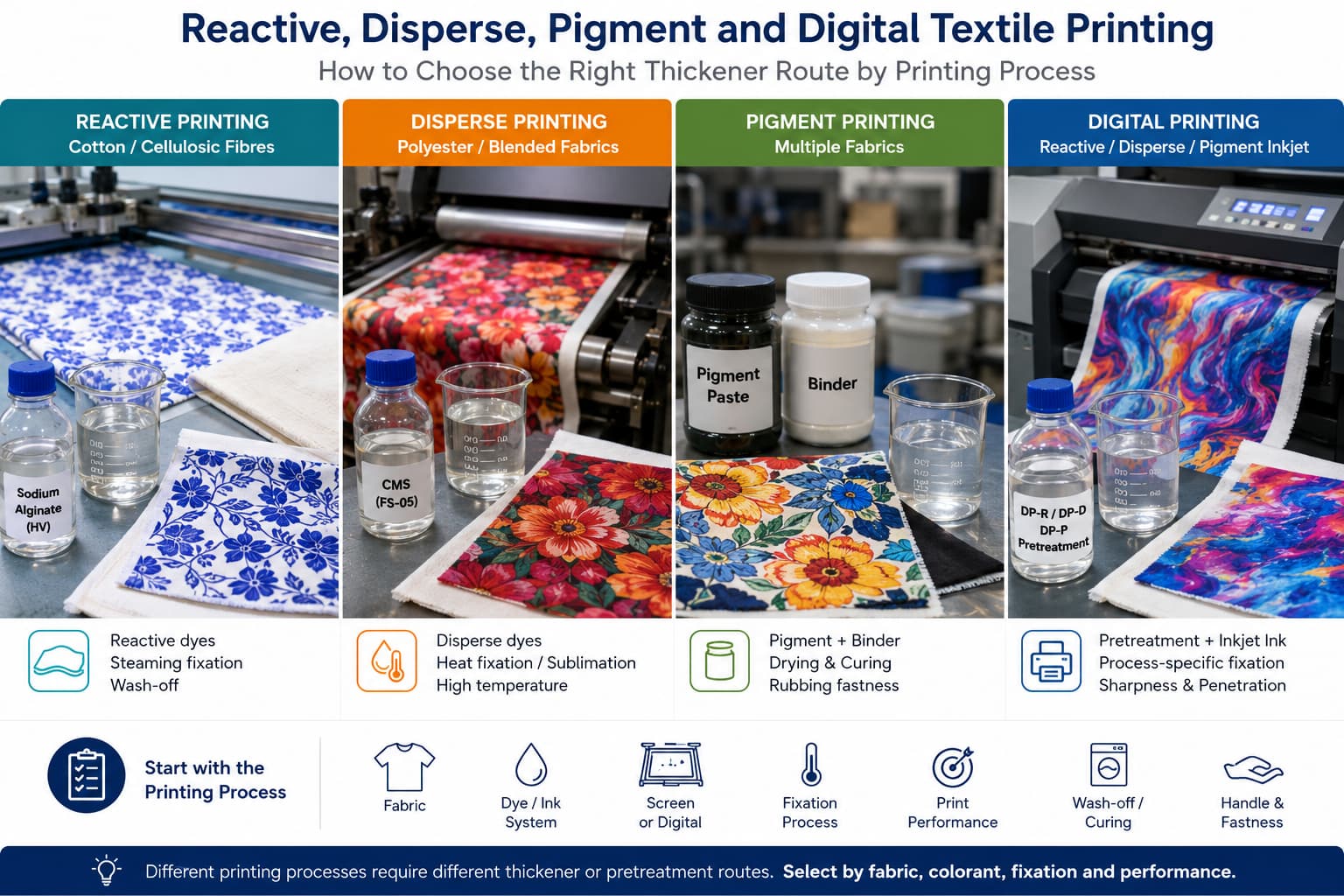
Узнайте, как выбирать загустители и способы предварительной обработки для реактивной, дисперсной, пигментной и цифровой печати на текстиле с учетом требований к ткани, красителю или чернилам, фиксации, вымываемости и качеству печати.
Цифровая струйная печать на текстиле предъявляет иные требования к пасте и предварительной обработке материала, чем трафаретная печать. В данном руководстве объясняется, как альгинат натрия используется в цифровой печати на текстиле и какие параметры качества должны указывать специалисты по закупкам.
Альгинат натрия широко используется в качестве загустителя в пастах для реактивной печати на текстиле, однако его применение в других областях текстильной промышленности требует подтверждения пригодности для конкретных задач. В данном руководстве проводится сравнение таких процессов, как печать, цифровая предварительная обработка, проклеивание основы, рецептуры для окрашивания, нанесение покрытий и последующая обработка, с учетом их функциональных особенностей, технических требований, рисков, необходимой документации и типовых испытаний.
Регулирование вязкости при цифровой печати на текстиле осуществляется с помощью двух различных систем: состава чернил для струйной печати и состава для предварительной обработки ткани. В данном руководстве объясняется, как температура, состав, методы измерения и условия технологического процесса влияют на стабильность струйной печати и качество отпечатка.
Лучшая паста для цифровой печати — это та, которая подобрана с учетом химического состава чернил, типа ткани и способа закрепления. В данном руководстве сравниваются требования к предварительной обработке при реактивной струйной печати на целлюлозных тканях и при прямой дисперсной струйной печати на полиэстере, а также объясняется, как покупателям следует оценивать образцы перед закупкой партии товара.
The future of textile printing thickeners will be shaped by application-specific rheology, digital pretreatment, bio-based materials, hybrid formulations, faster preparation and data-driven process control. This guide explains which trends are commercially relevant and which still require industrial validation.
Компания FSX Chemical предлагает отдельные технологические схемы нанесения пасты для цифровой печати, предназначенные для реактивных, дисперсных и пигментных систем, которые сопровождаются анализом условий применения, подбором образцов и технической документацией. В данном руководстве объясняется, как покупатели могут определить подходящую технологическую схему перед оптовой закупкой.
Для получения стабильной пасты для цифровой печати недостаточно просто соблюдать заданную вязкость. В данном руководстве объясняется, как выбор продукта, качество воды, последовательность добавления компонентов, перемешивание, уровень pH, температура, фильтрация, соблюдение гигиенических норм, условия хранения и ведение документации по качеству влияют на предварительную обработку и стабильность производственного процесса.
В 2026 году инновации в области химических веществ для текстильной печати выходят за рамки простого повышения вязкости и насыщенности цвета. Ведущие разработки сосредоточены на более безопасных исходных материалах, полимерах на основе возобновляемых источников, наносвязующих веществах на водной основе, стабильных пигментных дисперсиях, энергоэффективной фиксации и многофункциональных системах печати.
Регулирование вязкости в цифровой текстильной печати не сводится к достижению какого-то одного показателя. Для обеспечения стабильной производительности необходимо правильно подобрать реологические характеристики при предварительной обработке, метод испытаний, температуру, химическую совместимость, систему фильтрации, степень впитывания краски тканью и стабильность удержания краски.
Для цифровой печати на текстиле требуется не только современные чернила и печатающие головки. Ознакомьтесь с химическими решениями, специально разработанными для процессов струйной печати реактивными, дисперсными и пигментными чернилами — от предварительной обработки и регулирования реологических свойств до фильтрации, фиксации и проверки производственных процессов.
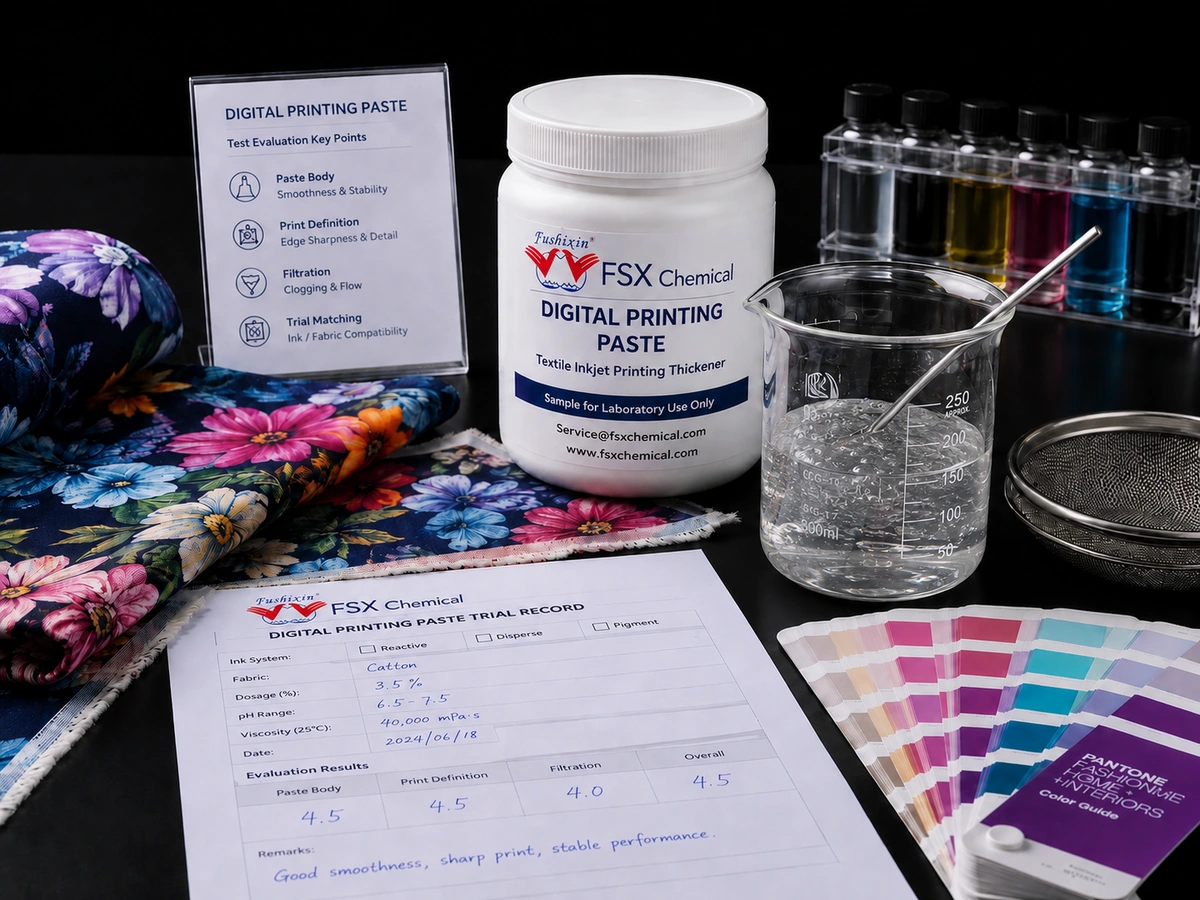
A top-performing digital printing paste is not defined by viscosity alone. Reactive, disperse and pigment textile inks require different pretreatment chemistry, rheology and post-treatment conditions. This guide explains how to select digital printing pastes by ink system, fabric, print definition, color performance, fixation and total production performance.
Сообщите название продукта, область применения, количество, пункт назначения, а также предоставьте техническое описание продукта (TDS),
фотографию образца или имеющиеся у вас документы. Компания FSX Chemical рассмотрит
эту информацию и порекомендует дальнейшие действия для подготовки коммерческого предложения, подбора образца
или выбора продукта.
Информация о продуктеНазвание товара, класс, модель, фотография этикетки или артикул поставщика.
Доступные документыTDS, SDS, COA, фотография образца, перечень продукции или данные испытаний.
Детали заказаПредполагаемый объем, упаковка, страна назначения, порт или условия торговли.
Область применения или проблемаПроцесс печати на текстиле, требования к составу, текущие проблемы или целевые показатели.