What Causes Acrylic Thickener Stringing and Poor Screen Release in Pigment Printing?
Stringing and poor screen release are often elasticity and extensional-flow problems rather than simple viscosity...
Stringing and poor screen release in pigment printing are not simply “high-viscosity” problems. A printing paste can show an acceptable Brookfield viscosity and still form filaments between the screen, squeegee and fabric because its extensional elasticity, associative network or post-shear recovery is too strong for the application. High acrylic-thickener dosage, high molecular weight, HASE-type hydrophobic association, binder/surfactant interaction, pH activation, pigment loading and low-electrolyte or high-electrolyte conditions can all change the balance between shear flow and filament break-up. The correct troubleshooting method is therefore to separate shear viscosity from stringing behavior, observe the paste during screen release, compare multi-speed rheology and recovery, and then adjust thickener grade, dosage or the complete pigment-binder formula rather than chasing one viscosity number.
What Causes Acrylic Thickener Stringing and Poor Screen Release?
Stringing usually appears when the printing paste stretches into a filament instead of separating cleanly after deformation.
Important causes can include:
Excess extensional elasticity
High thickener dosage
Long polymer chains / high effective molecular weight
Strong HASE associative networking
Binder–thickener interaction
Surfactant-induced association
Incorrect pH activation
Pigment / electrolyte effects
Machine settings that increase stretching during release
The useful troubleshooting logic is:
Confirm Stringing → Standardize Viscosity Method → Compare Shear Profile → Observe Filament Break-Up → Check Recovery / Elasticity → Change Formula or Machine Variable One at a Time
Do not assume:
Stringing = Viscosity Too High.
A paste can be relatively low in shear viscosity and still be highly elastic under stretching.
What Does “Stringing” Mean in Textile Printing?
Stringing describes a paste forming threads, tails or filaments when two surfaces separate.
In pigment printing, this may be observed when:
A spatula is lifted from the paste.
A screen lifts away from the fabric.
A squeegee leaves the paste bead.
Paste separates from a transfer surface.
A useful paste should normally break cleanly enough to avoid long filament dragging.
Excessive stringing can lead to:
Dragging
Smearing
Dirty screen release
باریک تفصیل کا نقصان
Uneven deposit
Stringing is therefore a rheological problem, not only a visual nuisance.
What Is Poor Screen Release?
Poor screen release occurs when the paste does not separate cleanly from the screen / substrate interface after transfer.
Depending on the machine, it can appear as:
Paste filaments between screen and fabric
Trailing paste after squeegee movement
جالی کے نشانات
Disturbed printed edges
Sticky screen behavior
Screen release depends on both:
پیسٹ ریولوجی
اور:
Machine Separation Mechanics.
A strong elastic paste can resist filament break-up even when the low-shear viscosity appears normal.
Why Normal Viscosity Can Still Produce Stringing
Brookfield or similar rotational viscosity mainly describes resistance to shear under a defined condition.
Stringing, however, occurs when the paste is stretched.
These are not the same deformation modes.
Two acrylic-thickened pastes can have:
Same Brookfield Viscosity
but different:
لچک
Extensional viscosity
Filament break-up time
ساختی بحالی
This explains why one grade releases cleanly while another forms long threads at the same measured viscosity.
Shear Rheology vs. Extensional Rheology
During pumping and screen passage, shear rheology is critical.
During filament stretching and screen separation, extensional behavior becomes important.
A useful pigment paste needs:
Enough Shear Thinning for Transfer
but also:
Fast Enough Filament Break-Up for Clean Release.
Published associative-polymer research shows that hydrophobically modified polymers can show strong extensional thickening or elastic behavior at specific deformation rates.
This is why the thickener’s network architecture can matter even when standard viscosity values are similar.
Elasticity and Filament Dragging
An elastic paste stores part of the applied deformation energy.
When stretched, it can resist breaking and instead form a longer filament.
Excess elasticity can therefore increase:
String length
String lifetime
Filament dragging
Snap-off difficulty
Research on polyacrylate printing thickeners has used filament-dragging ability as a specific rheological evaluation parameter because it directly relates to application behavior.
For pigment printing, the ideal level is not zero elasticity.
Some structure helps:
Pattern hold
Anti-spreading
بحالی
The problem is excessive elasticity relative to the machine and formulation.
Polymer Molecular Weight and Chain Length
Higher molecular weight can increase thickening efficiency, but long chains can also increase:
Entanglement
لچک
Filament formation
This does not mean high-molecular-weight thickener is always stringy.
Polymer architecture also includes:
Crosslinking
Charge density
آب سے بے اثر تبدیلی
Molecular-weight distribution
The practical decision should be based on the complete rheology rather than molecular weight alone.
Thickener Dosage and Polymer Concentration
Increasing thickener dosage can increase more than low-shear viscosity.
At higher polymer concentration:
Chain overlap increases.
Entanglement can increase.
Associative junctions can become more numerous.
Elasticity can rise.
Therefore, correcting a thin-looking paste by adding more thickener can create:
HASE thickeners combine pH-driven acrylic swelling with hydrophobic associative interactions.
The hydrophobic groups can connect:
Thickener chains
Binder particles
Surfactant structures
Pigment-dispersion components
This transient network can give excellent rheology control.
But if association becomes too strong for the application, it can increase:
لچک
تار نما پن
Slow filament break-up
لہٰذا:
More Associative Structure ≠ Automatically Better Screen Release.
Binder–Thickener Interaction
Binder chemistry can materially change associative-thickener rheology.
The same HASE thickener can show different:
سَانچَر
لچک
بحالی
Stringing
with different binder types or surfactant packages.
If stringing appears only after binder is added, compare:
Thickener Base
کے ساتھ:
Thickener + Production Binder.
Do not assume the thickener alone is responsible.
Surfactants and Hydrophobic Association
Surfactants can interact with associative thickener hydrophobes.
Depending on type and concentration, they can:
Strengthen intermolecular association
Compete for hydrophobic sites
Change network size
Change viscosity and elasticity
Pigment and binder products already bring their own surfactants into the paste.
Changing:
Pigment supplier
Binder supplier
Wetting agent
Defoamer
can therefore change stringing even when thickener dosage remains unchanged.
Pigment Loading and Dispersant Effects
Higher pigment loading changes the complete formulation.
It can add more:
پانی
Dispersant
Surfactant
Electrolyte
Pigment solids
These components can weaken or strengthen an associative network.
Therefore, stringing may be:
Worse in dark shades
Better in dark shades
Unchanged but accompanied by different viscosity
Test representative light, medium and dark formulas where pigment loading varies widely.
pH and Neutralization
Many acrylic thickeners are pH-responsive.
Under-neutralization can produce poor thickening and unstable flow.
Over-adjustment or an unnecessarily high pH can change:
Polymer expansion
Ionic load
بائنڈر مطابقت
For an associative grade, pH can also change the balance between:
Swelling + Association.
Record pH before changing dosage.
Do not solve stringing by changing neutralizer blindly.
Electrolytes and Ionic Strength
Electrolytes can screen charged polyacrylate groups and change polymer expansion.
In HASE systems, salt can also change the relative importance of hydrophobic association.
The result can be complex:
Viscosity can fall.
Elasticity can change.
Stringing can decrease or increase.
لہٰذا:
Lower Viscosity After Salt ≠ Automatically Better Release.
Evaluate the full rheology and actual screen behavior.
درجہ حرارت اور برقرار رکھنے کا وقت
Paste temperature changes viscosity and can alter associative interactions.
Holding time can also change network equilibration.
If stringing appears only after several hours, record:
Fresh temperature
Held temperature
تازہ چپچپا پن
محفوظ شدہ ویسکوسٹی
پی ایچ
Stringing behavior
A paste that becomes more elastic during holding may need a different grade or complete-formula adjustment even if its Brookfield viscosity remains acceptable.
Foam and Entrained Air
Entrained air can disturb the visual assessment of filament break-up.
Foam can also produce:
Interrupted filaments
Uneven transfer
Apparent stringiness
Pinholes
Deaerate or standardize foam before comparing candidate thickeners.
Do not confuse foam-related trailing with true polymer stringing.
Flat-Screen Stringing and Lift-Off
Flat-screen printing includes a clear separation stage when the screen lifts or snaps away from the printed fabric.
If the paste is too elastic, filaments can bridge the separating surfaces.
چیک کریں:
Off-contact / lift behavior
Screen tension
سکویجی دباؤ
Paste recovery
Filament break-up
A paste that transfers well during the stroke but releases poorly after the stroke may have acceptable shear viscosity but excessive extensional elasticity.
Rotary-Screen Release and Continuous Shear
Rotary-screen printing does not reproduce the same lift-off geometry as flat-screen printing, but the paste still experiences:
مسلسل کٹاؤ
Screen opening deformation
Transfer separation
Pumping and recirculation
A stringy associative paste can show:
Dirty release
Trailing
Unstable deposit
Long-run viscosity / elasticity drift
Rotary qualification should therefore include circulation time and end-run screen behavior.
Screen Mesh, Engraving and Open Area
Screen geometry changes how strongly the paste is deformed.
Finer openings can:
Increase local shear
Reduce paste deposit
Make release defects more visible
Coarser openings can increase deposit and create larger paste bridges during separation.
Do not select the thickener without considering:
Mesh
Open area
Engraving depth
Pattern type
One grade can release cleanly on one screen and string on another.
Squeegee Pressure, Speed and Angle
Machine settings change both shear and paste deformation.
Higher pressure or repeated strokes can increase:
پیسٹ ٹرانسفر
Paste stretch during separation
Deposit weight
During a thickener comparison, keep:
دباؤ
رفتار
زاویہ
حروف کی تعداد
constant.
Otherwise machine changes can be mistaken for a polymer-rheology difference.
Fabric Surface and Paste Release
Fabric surface affects how the paste separates after transfer.
متعلقہ متغیرات میں شامل ہیں:
Hairiness
Roughness
جذب کرنے کی صلاحیت
Knit / woven structure
Surface finish
A rough or hairy fabric can physically pull filaments differently from a smooth fabric.
If stringing occurs only on one substrate, do not change the thickener before checking the fabric effect.
Typical Production Symptoms
Stringing / poor release can appear as:
Long paste threads
Trailing after the squeegee
Smearing
Dirty fine lines
جالی کے نشانات
نامتناسب ٹھوس علاقے
Higher screen-cleaning demand
Record where the symptom appears:
During mixing
At the squeegee
During screen separation
After long circulation
The location helps narrow the root cause.
Build a Simple Filament-Dragging Test
A simple internal comparison can standardize filament behavior.
For example, use the same tool, lifting speed and sample temperature for each candidate.
ریکارڈ:
Whether a filament forms
Approximate filament length before break
Whether the filament snaps cleanly or trails
Repeatability
This is not a universal industry specification.
It is an internal comparative test.
Use it to screen candidates before a machine trial.
Use Multi-Speed Viscosity, Not One Reading
Measure the paste at multiple controlled shear conditions.
A useful comparison can include:
Low-speed viscosity
Medium-speed viscosity
Higher-speed viscosity
This helps estimate:
کم برش جسم
Shear-thinning strength
Flow through screen openings
But multi-speed shear viscosity still does not directly measure extensional stringing.
Combine it with a filament-dragging / release observation.
Measure Structural Recovery
After a defined high-shear step:
Measure immediate post-shear viscosity.
Measure after a short rest.
Measure after a longer rest.
A very fast or highly elastic rebuild can preserve pattern edges but may also contribute to poor leveling or stringing.
A very slow recovery can reduce stringing but create spreading.
The goal is:
Controlled Recovery, Not Maximum Recovery Speed.
Build a Thickener Candidate Map
Candidate
Low-Shear Body
Shear Thinning
Filament Dragging
بحالی
Screen Release
A
ریکارڈ
ریکارڈ
ریکارڈ
ریکارڈ
ریکارڈ
B
ریکارڈ
ریکارڈ
ریکارڈ
ریکارڈ
ریکارڈ
C
ریکارڈ
ریکارڈ
ریکارڈ
ریکارڈ
ریکارڈ
This prevents selection from becoming:
Highest Viscosity = Best Thickener.
The best grade should balance all five behaviors.
Build a Binder–Thickener Compatibility Map
If stringing changes after binder addition, test:
نمونہ
Condition
اہم سوال
A
Thickener + water
Base polymer behavior
B
Thickener + equivalent water dilution
Dilution control
C
Thickener + binder
Binder-association effect
D
مکمل رنگین پیسٹ
Production behavior
Measure both viscosity and filament behavior.
A binder can improve viscosity while worsening screen release if elasticity becomes too high.
Build a Thickener-Dosage Ladder
Test several dosage points around the production level.
For each point, record:
سَانچَر
Multi-speed profile
Filament length / break-up
بحالی
اسکرین ٹرانسفر
تعریف پرنٹ کریں
کپڑے کا ہاتھ
The optimum is:
Lowest Dosage That Gives Stable Transfer and Clean Release.
Do not increase dosage simply to reproduce an old Brookfield number.
Connect Laboratory Stringing to Machine Release
Laboratory string tests are screening tools.
The real approval must use:
Production screen
Production squeegee
Actual fabric
Representative machine speed
موازنہ کریں:
Paste release
Fine-line cleanliness
جامد رقبائی یکسانیت
Screen contamination
Beginning-to-end consistency
A candidate with slightly more laboratory filament length can still print better if its machine shear profile is better matched.
Corrective Actions by Root Cause
If Thickener Dosage Is Too High
Reduce dosage carefully and rebuild the complete viscosity / print window.
If HASE Association Is Too Strong
Evaluate a different architecture or binder/surfactant combination rather than simply lowering pH.
If Binder Triggers Stringing
Run compatibility tests and check whether another binder or thickener grade produces lower elasticity at the same print performance.
If Surfactant / Defoamer Triggers the Problem
Recheck the additive package and addition sequence.
If Screen / Squeegee Conditions Trigger the Problem
Optimize pressure, speed, mesh or separation mechanics before changing the chemistry.
If Stringing Appears Only After Holding
Check temperature, pH, associative network equilibration and complete-paste stability.
پیداواری آزمائش کی منظوری
For the best candidate, record:
Thickener grade / batch
موٹا کرنے والی خوراک
رنگدانہ/بائنڈر فارمولا
حتمی پی ایچ
Viscosity method
Low / medium / higher-shear readings
Filament-dragging observation
وقت پکڑنا
اسکرین / کندہ کاری
سکویجی کی ترتیبات
مشین کی رفتار
Screen release
تعریف پرنٹ کریں
جامد رقبائی یکسانیت
پختہ کرنا
خشک/گیلی رگڑ
کپڑے کا ہاتھ
Approve a rheology window, not only a viscosity number.
Common Stringing Troubleshooting Mistakes
1. Assuming Stringing Means Viscosity Is Too High
Extensional elasticity can be excessive even when shear viscosity is normal.
2. Selecting by Brookfield Viscosity Only
Brookfield does not directly measure filament break-up.
3. Adding More Thickener to Improve Print Definition
More polymer can increase elasticity and worsen release.
4. Blaming HASE Chemistry Automatically
Binder, surfactant and dosage can determine how strong the associative network becomes.
5. Ignoring Machine Settings
Pressure, speed, mesh and separation geometry can amplify stringing.
6. Testing Only the Thickener in Water
Binder and pigment can change elasticity dramatically.
7. Ignoring Holding Time
Associative structure can change during storage or circulation.
8. Solving Release by Making the Paste Too Fluid
Stringing may improve while spreading and penetration become worse.
حل مسائل کی جدول
مشاہدہ شدہ مسئلہ
چیک کرنے کے لیے اولین متغیرات
فرض نہ کریں
Long filaments but normal viscosity
Elasticity, extensional behavior, HASE association
Brookfield target proves rheology is correct
Stringing increases after binder
Binder-thickener association, surfactants
More dilution alone will solve it
Stringing increases with thickener dosage
Polymer concentration / entanglement
Higher viscosity improves release
Release improves after salt but edges spread
Rheology balance, electrolyte sensitivity
Lower viscosity equals better formulation
Only fine mesh shows poor release
Mesh opening, high-shear profile, deposit
The thickener is universally unsuitable
Only flat screen shows stringing
Lift-off, screen tension, snap-off behavior
Rotary and flat requirements are identical
Stringing appears after long holding
Temperature, pH, associative equilibration
The fresh sample predicts end-run behavior
Paste stops stringing but spreads badly
Recovery / low-shear body
Eliminating stringing is the only objective
استعمال میں کل لاگت
Stringing and poor release create hidden production cost through:
Lower machine speed
More screen cleaning
Pattern defects
دوبارہ کام
Extra thickener correction
رد شدہ کپڑا
ایک مفید ماڈل یہ ہے:
Total Cost in Use = Thickener + Formula Adjustment + Machine Speed + Cleaning + Rework + Quality Loss
A higher-priced thickener can still be more economical if it provides:
Cleaner release
Lower dosage
Better long-run consistency
Less screen cleaning
Compare cost per acceptable printed meter, not thickener price per kilogram alone.
آپ کو سپلائر کو کون سی معلومات بھیجنی چاہئیں؟
For useful stringing / screen-release troubleshooting, provide:
موجودہ ایکریلک گاڑھا کرنے والا / ٹی ڈی ایس
موٹا کرنے والی خوراک
ASE / HASE information if known
سانچاقی اور مکمل آزمائشی طریقہ
حتمی پی ایچ
Pigment product and dosage
بائنڈر گریڈ اور خوراک
Wetting agent / defoamer / fixer
وقت پکڑنا
فلیٹ یا گھومنے والی اسکرین
Mesh / engraving
Squeegee pressure / speed
کپڑا
Where stringing appears: mixing, squeegee, lift-off or long-run circulation
FSX کیمیکل اس معلومات کو کے ذریعے استعمال کر سکتا ہے۔ نمونے اور ملاپ to structure a controlled rheology and release comparison.
How Should a Mill Fix Acrylic-Thickener Stringing?
ایک عملی کنٹرول چین ہے:
Confirm Filament Dragging → Standardize Temperature / Viscosity Method → Compare Multi-Speed Rheology → Check Dosage → Add Binder / Pigment → Observe Recovery → Control Machine Settings → Run Screen Trial → Approve Complete Working Window
اہم اصول یہ ہیں:
Stringing is often an elasticity / extensional-flow problem rather than a simple viscosity problem.
Same Brookfield viscosity can produce very different filament break-up and screen release.
Higher thickener dosage can increase polymer entanglement and worsen stringing.
HASE associative networks can change significantly with binder, surfactants, pigment and defoamer chemistry.
Screen mesh, squeegee settings and fabric surface can amplify or reduce poor release.
The best synthetic thickener is the grade that balances low-shear body, shear thinning, recovery and clean filament break-up at the lowest practical Total Cost in Use.
اکثر پوچھے جانے والے سوالات
1. Why does acrylic thickener form long strings?
Possible causes include high polymer concentration, molecular entanglement, strong associative networking, binder/surfactant interaction or excessive elasticity under extensional deformation.
2. Does stringing mean the viscosity is too high?
No. A paste can have acceptable shear viscosity but excessive extensional elasticity and poor filament break-up.
3. Why does stringing become worse after binder is added?
Binder particles and surfactants can strengthen or change the associative network of HASE-type thickeners.
4. Can reducing thickener dosage improve screen release?
Yes, if excess polymer concentration is increasing entanglement or elasticity. Recheck print definition and penetration after dosage reduction.
5. Is HASE always more stringy than ASE?
No. HASE can provide excellent screen rheology, but its associative network is more formulation-dependent. Commercial grade, binder and dosage determine the result.
6. Can electrolytes reduce stringing?
They can change polyacrylate expansion and associative rheology, but they may also reduce viscosity too much or destabilize the paste. Do not use salt as a universal stringing correction.
7. Why does a paste string only on fine screens?
Fine screens create different shear and separation conditions. Mesh opening and deposit interact with the paste’s elasticity and recovery.
8. Why is poor release more obvious on flat-screen printing?
Flat-screen printing includes a distinct screen lift / snap-off step, which can stretch elastic paste filaments between the screen and fabric.
9. Can fabric surface cause apparent stringing?
Yes. Hairy, rough or absorbent surfaces can change paste separation. Compare the same paste on a controlled reference fabric.
10. What laboratory test should I use?
Combine a standardized filament-dragging observation with multi-speed viscosity and a post-shear recovery test. Use these as internal comparative methods, not universal specifications.
11. What matters more: viscosity or screen release?
Both matter, but the production decision should be based on complete printing performance. A target viscosity that causes poor release is not a useful target.
12. What should I send FSX Chemical for stringing troubleshooting?
Send the current thickener/TDS, dosage, viscosity method, pH, pigment, binder, additives, screen/mesh, squeegee settings, fabric and a description or video of where the filament dragging occurs.
Match Acrylic Thickener for Clean Screen Release
If your pigment paste reaches the viscosity target but forms long strings, trails behind the squeegee or releases poorly from the screen, FSX Chemical can help structure a controlled rheology and filament-dragging comparison.
مفید تکنیکی جائزے کے لیے بھیجیں:
آپ کے موجودہ ایکریلک تھکنر کے نمونے کا TDS یا COA
موٹا کرنے والی خوراک
Complete viscosity test method
حتمی پیسٹ کا پی ایچ
Pigment and binder system
Wetting / defoamer / fixer package
وقت پکڑنا
Flat or rotary screen route
اسکرین میش / کندہ کاری
Squeegee pressure / speed
کپڑا
Photo or video of the stringing / poor-release behavior if available
کے ساتھ شروع کریں نمونے اور ملاپ for a controlled current-vs-candidate evaluation.
Clean screen release is not created by one viscosity number. It comes from balancing shear thinning, low-shear body, elastic recovery and filament break-up with the binder, pigment, screen, squeegee and fabric used in the real production process.
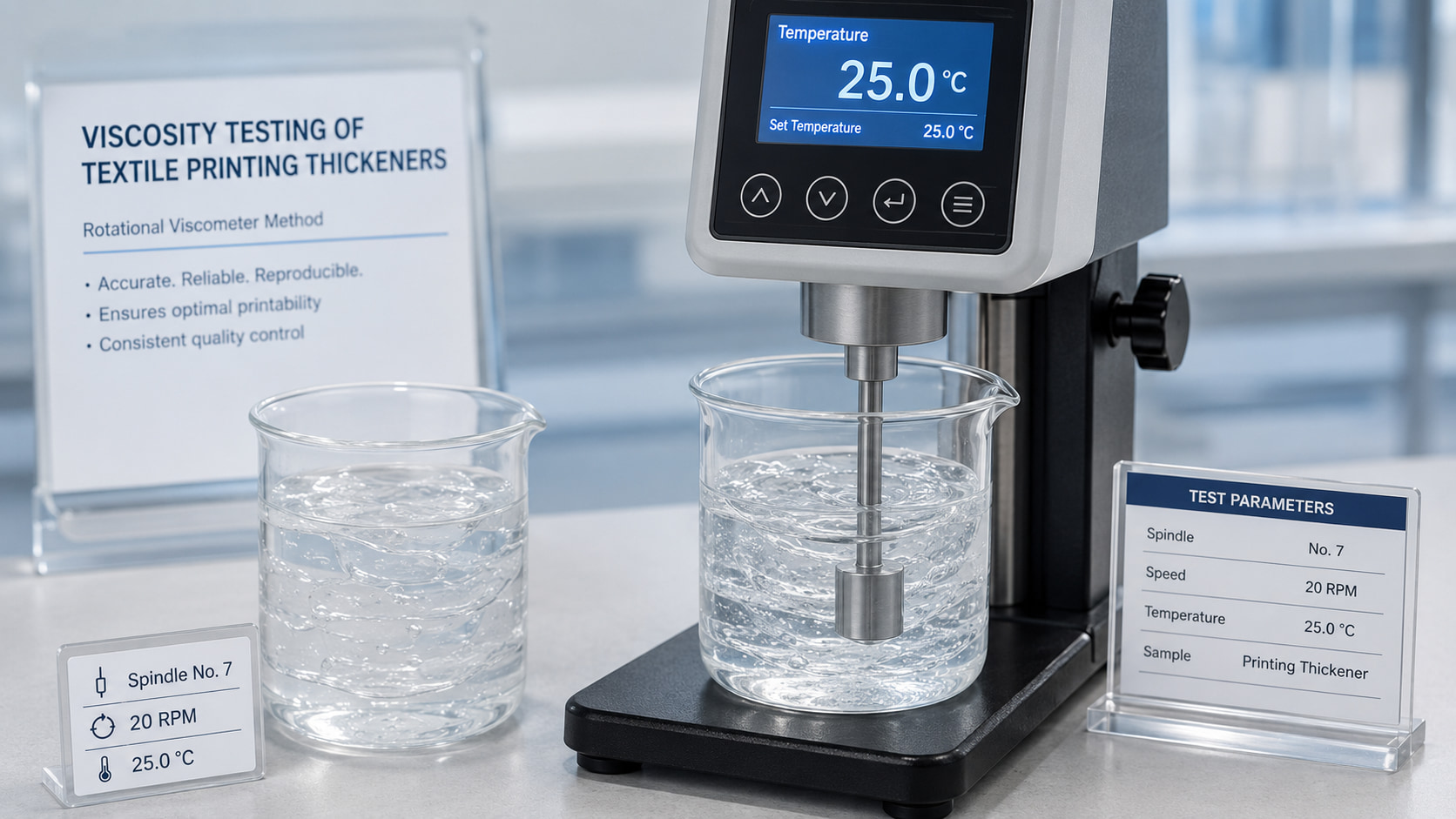
جانیں کہ ٹیکسٹائل پرنٹنگ کے گاڑھا کرنے والے کے وسکوسیٹی اقدار کا موازنہ کیوں نہیں کیا جا سکتا جب تک کہ ارتکاز، درجہ حرارت، آلہ، اسپنڈل، رفتار، تیاری کا طریقہ اور ٹیسٹ کا وقت یکساں نہ ہوں۔.
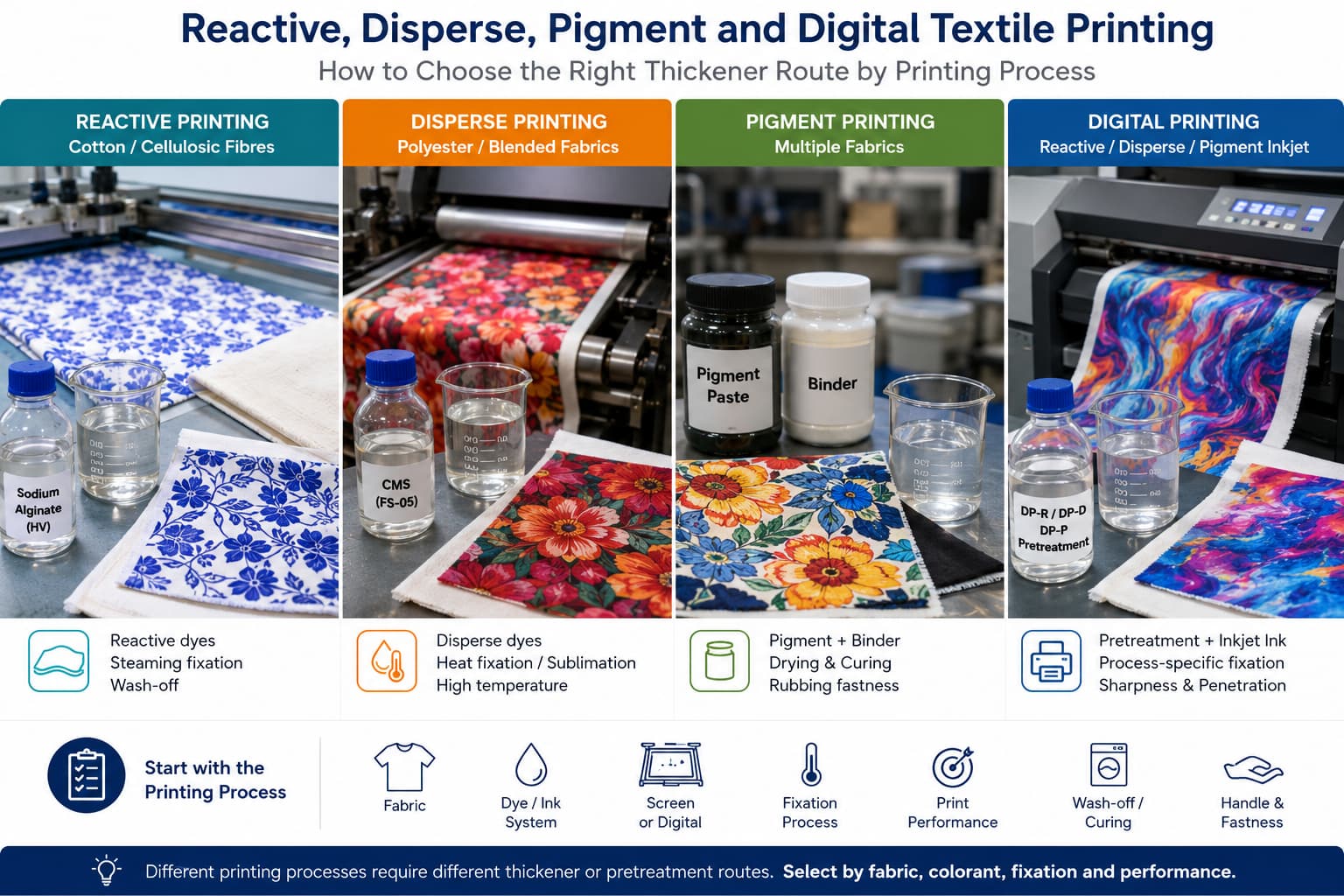
سیکھیں کہ ردعمل کرنے والی، منتشر، رنگین اور ڈیجیٹل ٹیکسٹائل پرنٹنگ کے لیے کپڑے، رنگ یا سیاہی کی بنیاد پر گاڑھا کرنے والا مادہ اور پری ٹریٹمنٹ کے راستے کیسے منتخب کیے جائیں، تاکہ فکسیشن، دھونے کے قابل ہٹانے اور پرنٹ کے معیار کی ضروریات پوری ہوں۔.
CMC پر مبنی پرنٹنگ پیسٹ کو رنگدار، ردعمل پذیر اور ڈیجیٹل ٹیکسٹائل پرنٹنگ میں استعمال کیا جاتا ہے۔ یہ رہنما بتاتا ہے کہ کون سے پیرامیٹرز اہم ہیں، سپلائرز کا موازنہ کیسے کریں اور بڑے آرڈر دینے سے پہلے کیا درخواست کریں۔.
سوڈیم الگینٹ اور سی ایم سی دونوں ٹیکسٹائل پرنٹنگ میں گاڑھا کرنے کے لیے استعمال ہوتے ہیں، لیکن یہ مختلف رنگ ساز نظاموں اور عمل کے حالات کے لیے موزوں ہیں۔ یہ رہنما اہم فرق اور ہر ایک کے استعمال کے اوقات کی وضاحت کرتی ہے۔.
صحیح ٹیکسٹائل پرنٹنگ تھکنر کا تعین صرف کپڑے کی قسم سے نہیں ہوتا۔ خریداروں کو چاہیے کہ وہ تھکنر کو رنگ یا پگمنٹ کے نظام، پرنٹنگ کے طریقہ کار، مطلوبہ ریولوجی، دھونے کی ضروریات اور حقیقی فیکٹری ٹرائل کے حالات کے مطابق منتخب کریں۔.
ٹیکسٹائل پرنٹنگ کی کارکردگی ایک مربوط کیمیائی نظام پر منحصر ہوتی ہے، نہ کہ کسی ایک یونیورسل اضافی مادّے۔ یہ رہنما دس اہم کیمیائی گروپوں، ان کے افعال، ان کی جگہ اور وہ چیزیں جن کی خریداروں کو پیداواری تجربات سے پہلے تصدیق کرنی چاہیے، بیان کرتی ہے۔.
ٹیکسٹائل پرنٹنگ کے گاڑھا کرنے والے مادے کیمسٹری، ریولوجی، رنگ کے مطابقت اور دھونے پر اثر پذیری کے لحاظ سے مختلف ہوتے ہیں۔ یہ رہنما اہم گاڑھا کرنے والے خاندانوں، ان کے عام استعمال کے طریقہ کار اور ان پیرامیٹرز کا موازنہ پیش کرتا ہے جن کی خریداروں کو پیداواری تجربات سے قبل تصدیق کرنی چاہیے۔.
ڈیجیٹل پرنٹنگ کے پیسٹ کا انتخاب سیاہی کی کیمسٹری، کپڑے، اطلاق کے طریقہ کار اور بعد از علاج کی بنیاد پر کیا جانا چاہیے۔ یہ رہنما ٹیکسٹائل انک جیٹ پرنٹنگ کے لیے سوڈیم الگنیٹ، سی ایم سی، سی ایم ایس، مصنوعی پولیمر اور مرکب پری ٹریٹمنٹ کے راستوں کا موازنہ پیش کرتا ہے۔.
FSX کیمیکل ردعمل پذیر، منتشر اور رنگدانہ نظاموں کے لیے الگ الگ ڈیجیٹل پرنٹنگ پیسٹ کے راستے پیش کرتا ہے، جنہیں درخواست کے جائزے، نمونہ ملاپ اور تکنیکی دستاویزات کی حمایت حاصل ہے۔ یہ رہنما بتاتا ہے کہ خریدار بڑے پیمانے پر خریداری سے پہلے مناسب راستہ کیسے منتخب کر سکتے ہیں۔.
مستحکم ڈیجیٹل پرنٹنگ پیسٹ کے لیے مطلوبہ چپچپا پن سے زیادہ درکار ہوتا ہے۔ یہ رہنما بتاتا ہے کہ مصنوعات کے انتخاب، پانی کے معیار، اضافے کے تسلسل، مکسنگ، پی ایچ، درجہ حرارت، فلٹریشن، حفظانِ صحت، ذخیرہ اور معیار کے ریکارڈز پری ٹریٹمنٹ اور پیداوار کی یکسانیت کو کیسے متاثر کرتے ہیں۔.
Reliable textile printing thickener evaluation requires more than checking viscosity. This guide explains the essential raw-material, solution, paste, stability, application and finished-fabric testing parameters.
یہ پروڈکٹ جائزہ FSX ڈیجیٹل پرنٹنگ پیسٹ کو ٹیکسٹائل انک جیٹ پری ٹریٹمنٹ اور گاڑھا کرنے کے ایک طریقہ کار کے طور پر جانچتا ہے، جس میں سیاہی کے نظام کی مطابقت، ریولوجی، فلٹریشن، پرنٹ کی وضاحت، استحکام اور حقیقی پیداواری جانچ پر توجہ مرکوز کی گئی ہے۔.
پروڈکٹ کا نام، استعمال، مقدار، منزل اور کوئی بھی TDS، نمونہ کی تصویر یا دستاویز جو آپ کے پاس موجود ہو، فراہم کریں۔ FSX کیمیکل اس معلومات کا جائزہ لے گا اور کوٹیشن، نمونہ کی مطابقت یا پروڈکٹ کے انتخاب کے لیے اگلا قدم تجویز کرے گا۔.
مصنوعات کی معلوماتمصنوعہ کا نام، گریڈ، ماڈل، لیبل کی تصویر یا سپلائر کا حوالہ.
دستیاب دستاویزاتٹی ڈی ایس، ایس ڈی ایس، سی او اے، نمونہ کی تصویر، مصنوعات کی فہرست یا ٹیسٹ کے اعداد و شمار۔.
آرڈر کی تفصیلاتمتوقع مقدار، پیکیجنگ، منزل ملک، بندرگاہ یا تجارتی اصطلاح۔.
درخواست یا مسئلہٹیکسٹائل پرنٹنگ کا عمل، فارمولیشن کی ضرورت، موجودہ مسئلہ یا ہدف کارکردگی۔.