Synthetic Thickener vs. CMC and CMS for Pigment Printing: What Changes in Rheology, Wash-Off and Fabric Hand?
Synthetic acrylic thickener, CMC and CMS can create different rheology, dosage requirements, binder compatibility, residue...
Synthetic acrylic thickeners, CMC and CMS can all be evaluated in selected pigment-printing systems, but they do not create the same rheology, solids load, binder interaction or finished-fabric feel. Synthetic thickeners are commonly favored where high thickening efficiency, tailored shear thinning and low addition levels are required, while CMC and CMS can provide useful pseudoplastic flow and may be considered in selected formulations or compound-thickener systems. The correct comparison should therefore be made in the complete pigment-binder paste and on the cured fabric—not from water viscosity alone. This guide compares the three routes through rheology, binder compatibility, post-cure washability or residue behavior, fabric hand, dosage and Total Cost in Use.
Which Thickener Route Is Best for Pigment Printing?
There is no universal winner.
For many conventional pigment-printing systems, synthetic acrylic or polyacrylate thickeners are a common starting route because they can deliver strong thickening efficiency at relatively low dosage and can be designed for useful shear-thinning and recovery behavior.
CMC and CMS can still be evaluated in selected pigment systems, especially when the mill is exploring:
Different rheological profiles
Higher water retention
Compound-thickener systems
Cost optimization
Specific binder / pigment combinations
The correct selection sequence is:
Complete Paste Compatibility → Rheology → Screen Transfer → Curing → Fastness → Post-Cure Residue / Washability → Fabric Hand → Total Cost in Use
Do not select by viscosity, raw-material name or price per kilogram alone.
Important Comparison Boundary: Pigment Printing Is Binder-Film Printing
Pigment printing differs fundamentally from reactive printing.
Pigment particles do not chemically react with the fiber in the same way reactive dyes do.
The binder forms a film that holds pigment on the textile surface after drying and curing.
Therefore, the thickener should be evaluated as a rheology-control component inside the binder system.
This changes how “wash-off” should be interpreted.
In conventional pigment printing:
The binder film is intended to remain.
The process may not include the same intensive wash-off used after reactive printing.
Residual thickener, surface cleanliness and hand still matter.
If a post-cure wash is used, the thickener’s removability and interaction with the binder film should be checked.
Do not apply reactive-printing wash-off rules directly to pigment printing.
The Three Thickener Routes at a Glance
Itinéraire
Typical Strength
Main Risk to Check
Synthetic acrylic / polyacrylate
High thickening efficiency, tunable rheology, low dosage potential
Electrolyte / pH / binder sensitivity
CMC
Pseudoplastic flow, water retention, broad availability
These are route-level tendencies, not product guarantees.
Commercial grades can behave very differently inside each category.
Synthetic Acrylic / Polyacrylate Thickener
Synthetic acrylic thickeners are widely used in pigment-printing systems because the chemistry can be designed for:
High thickening efficiency
Low addition level
Strong shear thinning
Controlled recovery
Easy liquid dosing
Many grades are pH-responsive and may require correct neutralization.
Their most important technical checks are:
Activation pH
Compatibilité des liants
Electrolyte tolerance
Stabilité de la prise
Complete-paste rheology
A synthetic grade that gives very high water viscosity can still fail in the real pigment formula if binder or pigment salts collapse the polymer structure.
CMC for Selected Pigment-Printing Systems
CMC is an anionic cellulose derivative with well-known pseudoplastic behavior.
Its performance depends strongly on:
Degré de substitution
Molecular weight
Purity
Concentration
Salt / binder environment
CMC can be worth evaluating when the mill wants:
A polysaccharide-based rheology route
Strong water retention
A different low-shear / high-shear balance
A compound-thickener component
However, CMC should not be assumed to be a direct one-for-one substitute for a synthetic pigment-printing thickener.
It may require a different dosage and can create different:
Matières solides en pâte
Elasticity
Screen transfer
Post-cure residue
Tissu à la main
Grade selection should be based on the complete binder-containing formula.
CMS for Selected Pigment-Printing Systems
CMS is a carboxymethylated starch derivative with pseudoplastic rheology.
Selected CMS grades can be evaluated as:
Primary rheology-control components in specific pigment systems
Compound-thickener components
Cost-optimization routes
Published pigment-printing work has compared carboxymethylated starch with carboxymethyl cellulose in cotton pigment printing and found that performance depended on the formulation and binder conditions rather than polymer identity alone.
This is important because CMS should not be treated as “cheap CMC.”
Its:
Substitution
Starch structure
Molecular weight
Purity
Hydratation
can produce a distinctly different rheological profile.
Rheology Comparison: Shear Thinning, Recovery and Elasticity
All three routes can show pseudoplastic behavior, but the degree and recovery profile can differ.
Synthetic Acrylic
Often provides strong, designable shear thinning and can be formulated for rapid recovery.
CMC
Typically shows non-Newtonian pseudoplastic behavior, with flow strongly influenced by DS, molecular weight and concentration.
CMS
Also commonly shows pseudoplastic behavior, but the exact profile depends on starch source, substitution and modification route.
For screen printing, the key comparison is:
Low-Shear Body → High-Shear Flow → Recovery → Elasticity
not:
Which sample has the highest Brookfield number?
Why the Same Viscosity Does Not Mean the Same Printing Behavior
Two pastes can both measure 30,000 mPa·s under one viscometer condition and still differ in:
Flow through the screen
Squeegee pressure requirement
Pénétration
Reprise structurelle
Stringiness
Leveling
One-point viscosity should therefore be treated as a QC value, not a complete rheological description.
When possible, compare:
Multi-speed viscosity
Recovery after controlled shear
Machine screenability
Binder Compatibility
Binder compatibility is critical in pigment printing.
Binder can change:
pH
Electrolyte level
Surfactant balance
Total solids
Viscoelasticity
Synthetic Thickener
Can be highly efficient but may be sensitive to the specific binder chemistry or ionic load.
CMC
Can respond to binder salts and ionic conditions and should be checked for viscosity drift or flocculation.
CMS
Can also interact with binder / auxiliaries and should be evaluated for delayed thickening, thinning, separation or foam.
Use the same binder and pigment package for all three comparisons.
Electrolyte and pH Sensitivity
All three routes can respond to ionic conditions, but not in the same way.
Synthetic Polyacrylate
Often sensitive to charge screening, especially in conventional highly ionic systems, although hydrophobically modified grades can show improved tolerance.
CMC
Salt tolerance depends strongly on DS, molecular weight and substitution uniformity.
CMS
Salt / alkali response depends on substitution, starch backbone and grade design.
Therefore, compare:
Water Viscosity
and:
Complete Pigment-Paste Viscosity
for every route.
Dosage and Polymer Solids
Synthetic thickeners are often attractive because relatively low addition levels can create strong viscosity.
CMC and CMS may require higher as-supplied dosage depending on grade.
Higher dosage can increase:
Polymer solids in the paste
Dry surface residue
Viscosity sensitivity
Potential impact on fabric hand
But dosage alone is not enough.
For liquid synthetic thickeners, calculate active polymer solids.
For CMC / CMS, account for moisture and active dry material.
The fair comparison is:
Required Dosage → Actual Polymer Solids → Printing Performance → Finished Hand → Cost
Screen Transfer and Print Definition
Good print definition requires:
Clean screen passage
Controlled paste deposit
Limited lateral spreading
Appropriate structural recovery
Synthetic thickener can offer a strong balance where high-shear flow and rapid recovery are required.
CMC or CMS can also provide useful definition when the grade and dosage create the right pseudoplastic profile.
Do not compare print sharpness at unmatched viscosity or unmatched paste deposit.
Penetration and Surface Color
Thickener route changes how the pigment-binder paste moves into the textile.
Too much penetration can reduce:
Surface color concentration
Netteté des contours
Too little penetration can create:
Surface-heavy deposits
Uneven coverage in some constructions
Compare penetration on the same:
Tissu
Screen
Squeegee
Binder level
Otherwise, process variation can be mistaken for thickener behavior.
Wash-Off, Residue and Post-Cure Cleanliness
Wash-off must be interpreted carefully in pigment printing.
Conventional pigment printing is designed around a cured binder film, so the objective is not to remove the entire printed film after curing.
Instead, evaluate:
Loose surface residue
Hydrophilic thickener residue
Post-cure washing response if the process includes washing
Fabric cleanliness
Hand after any post-treatment
Synthetic Thickener
Low dosage can reduce total thickener solids, but the polymer may remain partly associated with the cured binder film. “Easy wash-off” should not be assumed without testing.
CMC
CMC is water-soluble before curing, but in a pigment system some polymer can become physically trapped in the binder film or remain as surface residue. Post-cure washability must therefore be measured on the actual binder system.
CMS
CMS is also hydrophilic and can be removable in water before film formation, but final residue depends on formulation, binder cure and dosage.
Do not transfer reactive-printing wash-off assumptions directly into pigment printing.
Fabric Hand
Fabric hand is often where the thickener routes become commercially different.
Hand depends on:
Binder film
Thickener solids
Paste deposit
Durcissement
Composition du tissu
A lower-dose synthetic thickener can reduce added polymer solids and may help support a softer hand if binder and curing are also optimized.
CMC or CMS may require higher solids depending on the grade, which can increase the risk of a heavier or stiffer surface.
But this is not universal.
A well-optimized CMC or CMS compound system can still produce acceptable hand, while an over-bindered synthetic-thickener system can become very stiff.
The final comparison must be made after curing.
Rubbing Fastness and Curing
Rubbing fastness is primarily controlled by the pigment binder and curing process.
The thickener contributes indirectly by affecting:
Pigment distribution
Binder distribution
Paste deposit
Pénétration
Higher binder concentration can improve rubbing fastness but may also increase stiffness.
Therefore, do not select a thickener route only because it produces a deeper wet print.
Comparez :
Dry rubbing
Wet rubbing
Wash fastness where relevant
Tissu à la main
after identical curing.
Stabilité de la position
Compare fresh paste with held paste.
Record:
Viscosité
pH
Température
Mousse
Séparation
Gel / floc
Synthetic
Watch for pH or electrolyte-related viscosity drift.
CMC
Watch for hydration completion, salt response and delayed viscosity change.
CMS
Watch for hydration, formulation interaction and storage stability.
A paste that is stable only when fresh is not suitable for a long production holding window.
Flat Screen vs. Rotary Screen
The thickener route should be evaluated on the intended machine.
Écran plat
Important factors include:
Low-shear hold
Pause / restart behavior
Recovery after squeegee stroke
Crible rotatif
Important factors include:
Pumpability
Continuous shear
Circulation stability
Mid-run and end-run viscosity
A route that works in flat screen may need dosage or grade adjustment in rotary screen.
Can Synthetic Thickener Be Blended with CMC or CMS?
Yes, compound-thickener systems can be evaluated.
The purpose of blending is not simply to reduce cost.
A blend can be designed to change:
Low-shear body
Shear-thinning profile
Recovery
Rétention d'eau
Réponse électrolytique
Polymer solids
Published textile-printing research has shown that mixtures of modified polyacrylic acid with small amounts of CMS can create useful rheological behavior in selected systems.
However, there is no universal synthetic/CMC or synthetic/CMS ratio.
Compound systems must be tested for:
Compatibilité
Stabilité de la prise
Screen transfer
Durcissement
Hand
Practical Selection Matrix
Selection Area
Synthetic Acrylic
CMC
CMS
Typical thickening efficiency
Often high
Grade-dependent
Grade-dependent
Shear-thinning design flexibility
Élevé
Moderate / grade-dependent
Moderate / grade-dependent
pH activation requirement
Common in some grades
Normally no acrylic-style activation
Normally no acrylic-style activation
Electrolyte sensitivity
Can be significant
Depends on DS / grade
Depends on substitution / grade
Typical dosage level
Often lower
Often higher
Often higher
Compatibilité des liants
Must verify
Must verify
Must verify
Post-cure residue / hand
Often benefits from low solids if optimized
Depends on dosage / binder trapping
Depends on dosage / binder trapping
Compound-thickener potential
Élevé
Possible
Possible
This table is a route-selection aid, not a product specification.
How to Compare the Three Routes in the Laboratory
Use the same:
Pigment
Binder
Fixer
Auxiliaries
Tissu
Durcissement
Then:
Step 1: Build Each Grade to a Useful Rheology Window
Only the best laboratory candidates should move to production.
Record:
Thickener route and grade
Posologie
Complete formula
Start / mid / end-run viscosity
Vitesse de la machine
Screen behavior
Beginning-to-end shade
Curing result
Résistance au frottement
Tissu à la main
Approve a route only if it remains stable across the intended production window.
When Does Synthetic Thickener Usually Make More Sense?
Synthetic acrylic thickener is often worth prioritizing when the mill needs:
High thickening efficiency
Low dosage
Tailored shear thinning
Fast liquid incorporation
Low added polymer solids
It is especially attractive when the binder / pigment system has already been optimized for synthetic rheology modifiers.
But electrolyte tolerance and pH activation must be checked.
When Can CMC Be Worth Evaluating?
CMC may be worth testing when the mill wants:
A polysaccharide rheology route
Strong water retention
A different screen-transfer profile
A compound formulation
An alternative supply route
Selection should focus on:
DS
Molecular weight
Purity
Compatibilité des liants
Required dosage
Do not assume one generic CMC grade represents all textile CMC products.
When Can CMS Be Worth Evaluating?
CMS may be worth evaluating when the mill wants:
Cost optimization
Compound-thickener flexibility
Pseudoplastic flow
Alternative rheology
Selection should focus on:
Substitution
Purity
Hydratation
Compatibilité des liants
Stabilité de la prise
Selected CMS grades can be technically useful, but the result is formulation-specific.
Common Comparison Mistakes
1. Comparing Equal Dosage Only
Different grades have different thickening efficiency.
2. Comparing Water Viscosity Only
Pigment and binder can change the complete paste substantially.
3. Assuming Synthetic Always Gives Softer Hand
Binder solids, dosage and curing can dominate hand.
4. Assuming CMC / CMS Must Wash Out Completely
In pigment printing, binder film can retain or trap part of the hydrophilic thickener.
5. Treating CMS as Cheap CMC
The polymer backbone and rheology are different.
6. Using Reactive-Printing Wash-Off Logic
Pigment printing is binder-film printing and must be evaluated differently.
7. Selecting by Price per Kilogram
Working dosage and finished-fabric result determine real cost.
Troubleshooting Table
Observed Difference
First Variables to Check
Do Not Assume
Synthetic paste is thinner after binder
pH, electrolytes, binder compatibility
Synthetic route is unsuitable
CMC needs higher dosage
Grade, DS, molecular weight, target rheology
Higher dosage means worse overall cost
CMS gives different screen feel
Shear thinning, recovery, hydration
Same viscosity means same rheology
Synthetic gives softer hand
Polymer solids, binder film, paste deposit
All synthetic grades will do the same
CMC/CMS leaves more residue
Dosage, curing, post-cure wash, binder trapping
Polysaccharide route is automatically poor
Rubbing fastness differs
Binder distribution, curing, paste deposit
Thickener chemistry alone controls fastness
Lab result good, rotary run drifts
Continuous shear, holding time, temperature
Lab viscosity predicts long-run stability
Compound system outperforms single polymer
Blend rheology and compatibility
One polymer must always be best
Coût total d'utilisation
Compare the three routes using:
Total Cost in Use = Thickener Cost + Dosage + Preparation + Binder / Formula Adjustment + Machine Efficiency + Curing + Rework + Quality Loss
A synthetic thickener can have a higher price per kilogram but lower working dosage.
CMC or CMS can have a lower raw-material cost but require more solids or different preparation.
A compound system may reduce cost only if it also maintains:
Stabilité de la pâte
Screen performance
Fastness
Hand
Compare cost per acceptable printed meter—not cost per kilogram of thickener.
What Information Should You Send to a Thickener Supplier?
For a useful synthetic-vs-CMC-vs-CMS comparison, provide:
Current thickener product / TDS
Posologie actuelle
Viscosity and complete test method
Pigment dispersion
Binder and dosage
Fixer / auxiliaries
Final paste pH
Tissu
Flat or rotary screen
Screen mesh / engraving
Durée de maintien
Curing condition
Main target: rheology, hand, residue, fastness or cost
FSX Chemical can use this information through Échantillons et correspondances to identify whether a synthetic, CMC, CMS or compound route deserves the next controlled trial.
How Should a Mill Compare Synthetic Thickener, CMC and CMS for Pigment Printing?
A practical sequence is:
Match Complete-Paste Rheology → Compare Dosage & Solids → Hold → Screen Print → Cure → Check Fastness → Check Residue / Wash Response → Check Hand → Calculate Total Cost in Use
Les principes fondamentaux sont les suivants :
Synthetic thickener, CMC and CMS should not be compared at equal dosage alone.
Same viscosity does not mean same shear thinning, recovery or print definition.
Binder compatibility must be checked for all three routes.
Wash-off in pigment printing means post-cure residue and cleanliness, not reactive-style removal of the printed film.
Fabric hand depends on binder film, thickener solids, paste deposit and curing together.
The best route is the one that delivers the required production window at the lowest Total Cost in Use.
Foire aux questions
1. Is synthetic thickener better than CMC or CMS for pigment printing?
Not universally. Synthetic acrylic thickeners are a common starting route because of high efficiency and tailored rheology, while selected CMC, CMS or compound systems can be useful in specific formulations.
2. Why do synthetic thickeners often use lower dosage?
Many acrylic/polyacrylate products are designed for high thickening efficiency, but actual dosage still depends on solids, pH, electrolyte load and formula.
3. Can CMC be used in pigment printing?
Selected CMC grades can be evaluated, especially where a polysaccharide rheology route or compound system is desired. Binder compatibility and dosage must be verified.
4. Can CMS be used in pigment printing?
Yes, selected CMS grades have been studied in pigment-printing systems, but the result depends on grade, binder, pigment and formulation.
5. Which route gives the best shear thinning?
It depends on the commercial grade. Synthetic acrylic systems often offer more rheology-design flexibility, but CMC and CMS are also pseudoplastic and can provide useful screen behavior.
6. Which route gives the softest fabric hand?
There is no universal answer. Lower polymer solids can help, but binder dosage, curing and paste deposit often dominate final hand.
7. Does CMC wash off better than synthetic thickener?
Not automatically in pigment printing. CMC is water-soluble before curing, but part of it can be retained in or under the cured binder film. Test the real post-cure process.
8. Does CMS leave more residue?
Residue depends on grade, dosage, hydration, binder film and post-treatment. Do not assume residue from polymer family alone.
9. Can synthetic thickener be blended with CMC or CMS?
Yes. Compound systems can be evaluated to tune rheology, solids, water retention or cost, but the blend must be tested for compatibility and curing performance.
10. Should the three routes be compared at the same viscosity?
Compare them inside the same useful complete-paste rheology window, then evaluate screen transfer, definition, curing, hand and cost.
11. Which route is cheapest?
Compare Total Cost in Use. A lower raw-material price can be offset by higher dosage, longer preparation, lower machine efficiency or poorer hand.
12. What should I send FSX Chemical for comparison testing?
Send your current thickener or TDS, dosage, viscosity method, pigment, binder, fabric, machine route, curing conditions and main target so the most relevant route can be selected for trial.
Compare Synthetic Thickener, CMC and CMS Under the Same Pigment Formula
If your mill is deciding between synthetic acrylic thickener, CMC, CMS or a compound-thickener route, FSX Chemical can help structure a controlled comparison based on complete-paste rheology and finished-fabric performance rather than water viscosity alone.
For a useful technical review, send:
Your current thickener sample, TDS or COA
Posologie actuelle
Viscosity and complete test method
Pigment dispersion
Binder and fixer system
Final paste pH
Fabric and screen route
Durée de maintien
Curing condition
Current rheology, wash/residue, hand or cost target
The best pigment-printing thickener is not determined by polymer family alone. It is the route that gives the required rheology, binder compatibility, cured fastness, acceptable residue and hand, and the lowest practical Total Cost in Use.
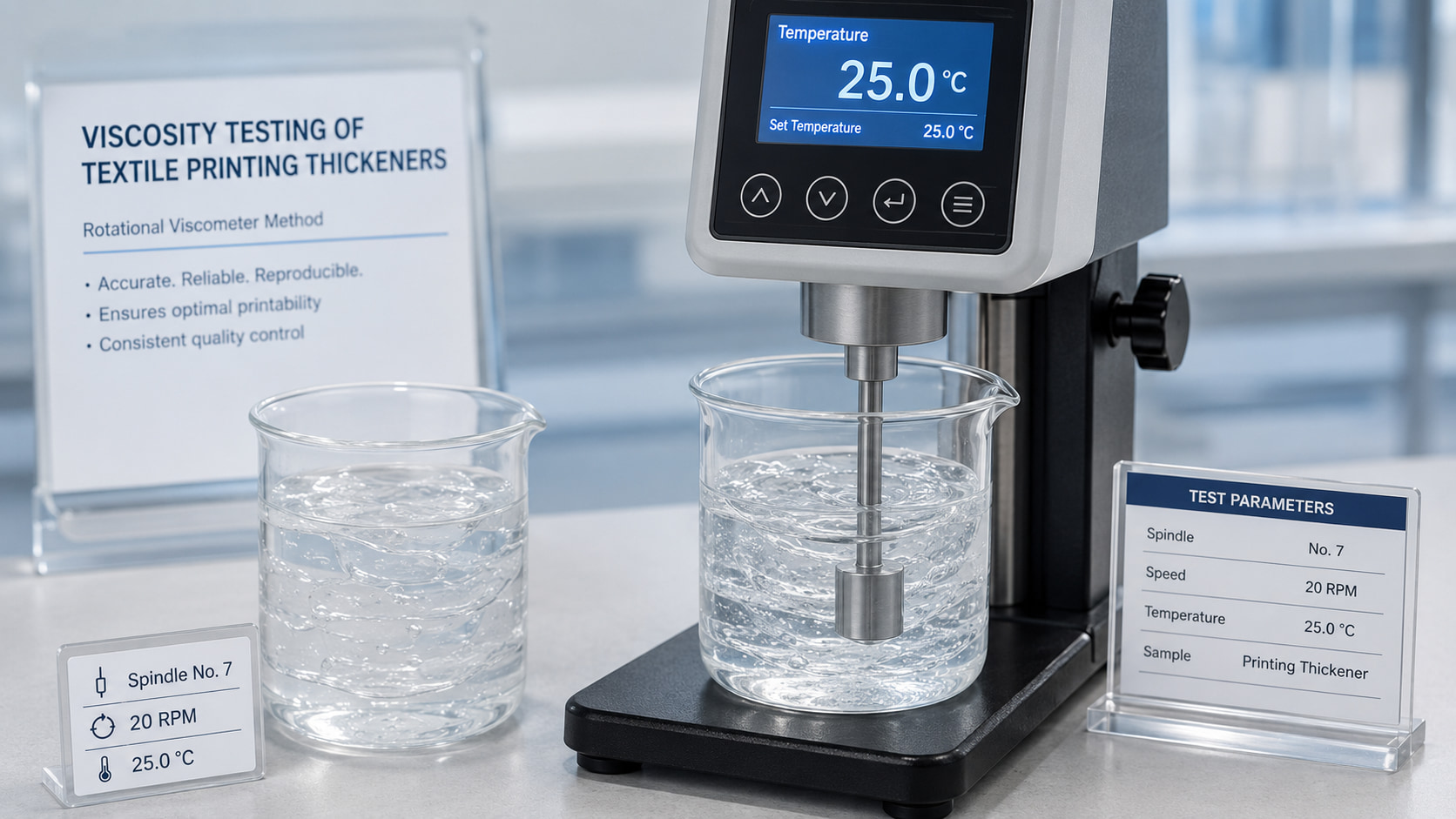
Découvrez pourquoi les valeurs de viscosité des épaississants utilisés dans l'impression textile ne peuvent pas être comparées sans tenir compte de la concentration, de la température, de l'instrument, de l'axe, de la vitesse, de la méthode de préparation et de la durée de l'essai.
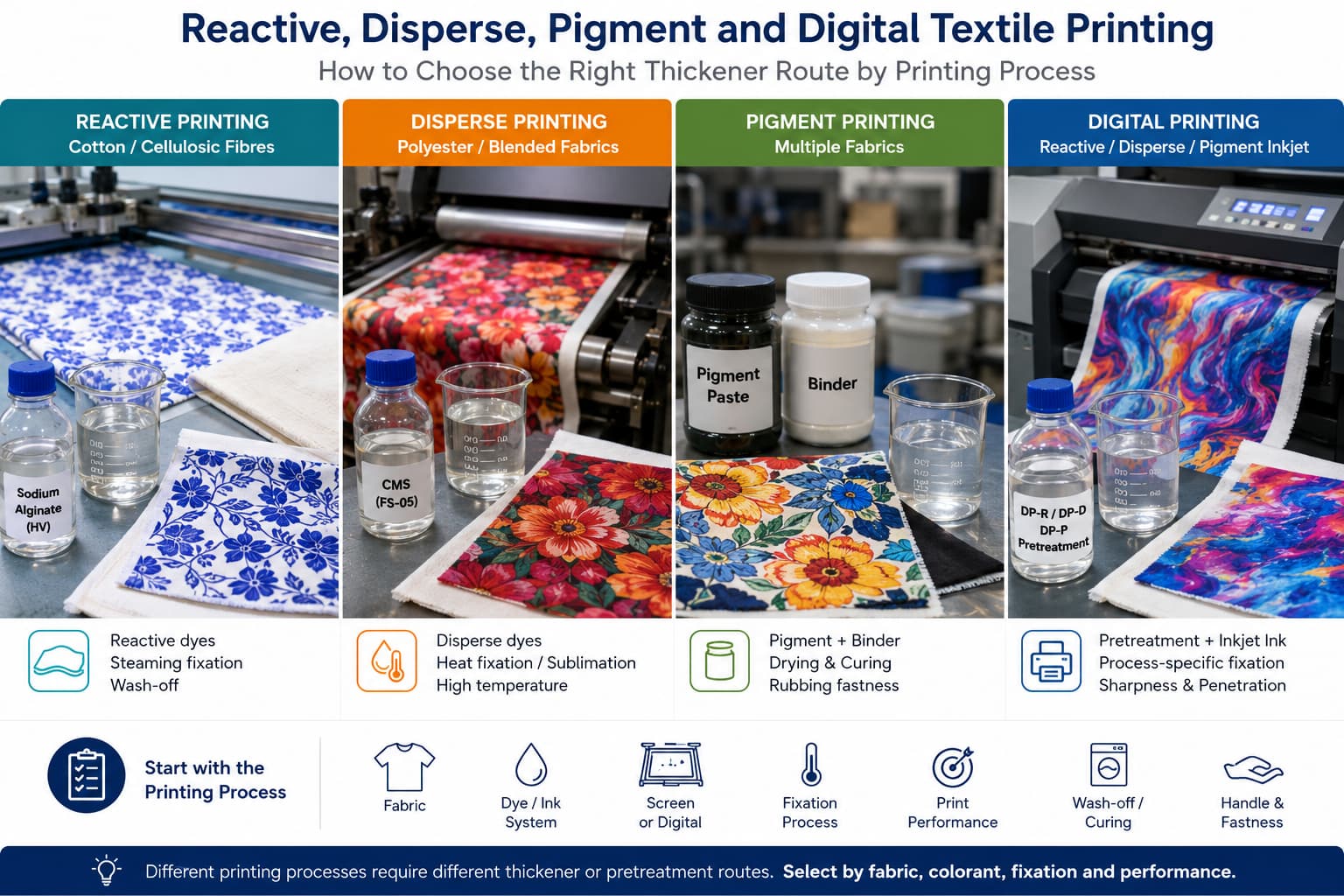
Découvrez comment choisir les agents épaississants et les procédés de prétraitement adaptés à l'impression textile réactive, dispersée, pigmentée et numérique, en fonction des exigences liées au tissu, à la teinture ou à l'encre, à la fixation, à l'élimination au lavage et à la qualité d'impression.
Comparez le CMC, le CMS, l'alginate de sodium et la pâte d'impression numérique pour l'impression textile. Découvrez comment chaque solution s'adapte aux procédés réactifs, dispersés, pigmentés et numériques, et ce que les acheteurs doivent vérifier avant de procéder à des tests d'échantillons, à la mise en correspondance des qualités et à l'achat en gros.
La carboxyméthylcellulose (CMC) est largement utilisée dans les processus d'impression, d'encollage et de teinture des textiles. Ce guide explique comment évaluer les différentes qualités de CMC, quels sont les paramètres les plus importants et comment FSX Chemical peut vous aider dans vos décisions d'achat.
La carboxyméthylcellulose est utilisée comme épaississant et stabilisant dans les encres à base d'eau, l'impression en héliogravure et le prétraitement pour l'impression à jet d'encre. Ce guide présente les principaux paramètres relatifs aux différentes qualités de ce produit ainsi que les éléments à prendre en compte par les équipes d'approvisionnement.
La pâte d'impression à base de CMC est utilisée dans l'impression textile pigmentaire, réactive et numérique. Ce guide explique quels sont les paramètres importants, comment comparer les fournisseurs et ce qu'il faut demander avant de passer une commande en gros.
L'alginate de sodium et la CMC sont tous deux utilisés comme épaississants dans l'impression textile, mais ils conviennent à des systèmes de teinture et à des conditions de traitement différents. Ce guide explique les principales différences entre ces deux produits et précise dans quels cas il convient d'utiliser l'un ou l'autre.
Le CMC de qualité alimentaire et celui de qualité industrielle partagent la même composition chimique de base, mais présentent des différences significatives en termes de pureté, de plage de DS et d'exigences réglementaires. Ce guide explique les principales différences et pourquoi l'utilisation d'une qualité inadaptée peut entraîner des problèmes de production.
CMS for textile printing paste can help adjust viscosity, improve paste handling, and support stable formulation performance. This guide explains how buyers can evaluate CMS grades by viscosity, DS, solubility, pH, moisture, and sample testing before bulk purchase.
Les matières premières à base de cellulose sont utilisées dans l'impression textile, la préparation des pâtes d'impression, l'épaississement et l'optimisation des formulations. Ce guide explique comment les acheteurs peuvent évaluer le CMC, le CMS, l'alginate de sodium, les épaississants pour l'impression textile et les pâtes d'impression en se basant sur les spécifications, la documentation, les essais d'échantillons et l'assistance fournie par les fournisseurs.
Les dérivés de la cellulose sont largement utilisés dans l'impression textile, la préparation des pâtes d'impression, l'épaississement et comme adjuvants de formulation. Ce guide explique comment les acheteurs étrangers peuvent s'approvisionner en CMC, CMS, alginate de sodium, épaississants pour l'impression textile et pâtes d'impression auprès de FSX Chemical, avec à leur disposition des fiches techniques (TDS), des certificats d'analyse (COA), des tests d'échantillons, la mise en correspondance des qualités et une assistance pour les documents d'exportation.
Le choix des produits chimiques destinés à l'industrie textile ne se résume pas à une simple comparaison des noms de produits. Ce guide explique comment les acheteurs spécialisés dans l'impression textile peuvent sélectionner les produits CMC, CMS, l'alginate de sodium, les épaississants pour l'impression textile et les pâtes d'impression en fonction de l'application, des spécifications, des fiches techniques (TDS), des certificats d'analyse (COA), des tests sur échantillons et de l'uniformité des lots.
Veuillez nous communiquer le nom du produit, son application, la quantité, la destination, ainsi que toute fiche technique (TDS),
photo ou document dont vous disposez déjà. FSX Chemical examinera ces
informations et vous recommandera la marche à suivre pour obtenir un devis, trouver un échantillon correspondant
ou choisir un produit.
Informations sur le produitNom du produit, référence, modèle, photo de l'étiquette ou référence du fournisseur.
Documents disponiblesFiche technique (TDS), fiche de données de sécurité (SDS), certificat d'analyse (COA), photo d'exemple, liste des produits ou données d'essai.
Détails de la commandeQuantité estimée, conditionnement, pays de destination, port ou conditions commerciales.
Demande ou problèmeProcédé d'impression textile, besoins en matière de formulation, problème actuel ou performances visées.