Alkali is required for reactive dye fixation, but adding it too early can expose reactive...
Alkali is essential for reactive dye fixation, but when it is added to a sodium alginate printing paste can materially affect the usable working window. Adding alkali too early exposes the reactive dye to an alkaline aqueous environment before printing and steaming, increasing the risk of premature dye hydrolysis and shade loss. At the same time, alkali changes pH and ionic strength, which can also change the rheology of the complete printing paste depending on the alginate grade, water quality, temperature and auxiliary package. This guide explains why alkali-last addition is often used, how sodium bicarbonate differs from stronger alkali routes, and how textile mills should validate paste stability from preparation through steaming and wash-off.
Why Alkali Addition Timing Matters
Reactive dyes require alkaline conditions to react efficiently with suitable cellulose fibers such as cotton and viscose.
That creates a practical tension:
The dye needs alkali for fixation—but the color paste should not spend unnecessary time in alkaline water before printing.
If alkali is added too early, the paste may remain alkaline for hours before it reaches the fabric and steamer.
During that time, several changes can occur:
Reactive dye can hydrolyze in the aqueous phase.
Shade and color yield can drift.
Paste viscosity can change.
The usable production window can shorten.
Warm color-kitchen conditions can accelerate instability.
This is why many reactive-printing procedures prepare the sodium alginate base first, dissolve the dye and auxiliaries, cool the system where needed, and add alkali as close to printing as practical.
The exact timing should be validated by the mill rather than copied as a universal rule.
Two Different Aging Mechanisms: Dye Hydrolysis vs. Paste Rheology
When an alkali-containing reactive paste ages, two different types of instability can occur.
1. Reactive Dye Chemical Aging
The reactive dye is designed to react with nucleophilic hydroxyl groups on cellulose under alkaline conditions.
But water also contains hydroxyl functionality.
If the dye remains in an alkaline aqueous paste before reaching the fiber, part of the reactive group can hydrolyze.
Hydrolyzed reactive dye has lost the reactive functionality needed for efficient covalent fixation to cellulose.
This can reduce useful fixation and increase unfixed dye in washing.
2. Printing-Paste Rheological Aging
Separately, the complete paste may change in:
Вязкость
Реакция на сдвиг
Gel or particle formation
Пена
Работа экрана
These changes can come from pH, ionic strength, temperature, water hardness, auxiliaries or the alginate grade.
Do not assume that every old-paste color loss is caused by sodium alginate degradation.
Likewise, a stable viscosity reading does not prove the reactive dye is still chemically fresh.
What Does Alkali Actually Do in Reactive Printing?
Alkali raises the pH so cellulose hydroxyl groups become more reactive toward the reactive dye during fixation.
The target is enough alkalinity during fixation without creating unnecessary pre-print hydrolysis or paste instability.
Single-Phase Printing: Why Alkali Is Commonly Added Late
In single-phase reactive printing, dye, thickener and alkali are present in the same printing paste.
A practical preparation sequence often follows:
Sodium Alginate Base → Dye/Auxiliary Solution → Mix → Cool if Needed → Add Alkali → Final Adjustment → Print
The purpose of late alkali addition is not to suggest that sodium alginate instantly fails in alkaline conditions.
It is mainly to minimize the time during which reactive dye is exposed to alkaline water before fixation.
Late addition can also help the mill:
Keep a neutral or lower-pH master paste available longer.
Activate only the quantity needed for the upcoming print run.
Reduce waste from unused alkaline color paste.
Compare pot life more predictably.
This is particularly useful in color kitchens preparing multiple shades.
Two-Phase Printing: Separating Alkali from the Color Paste
In two-phase reactive printing, the alkali is not necessarily stored inside the dye-containing printing paste.
Instead, the alkaline component can be introduced in a separate process stage, depending on the mill’s equipment and dye system.
This can reduce the time that reactive dye remains in alkaline water before fixation.
К потенциальным преимуществам относятся:
Longer color-paste storage window
Lower risk of premature dye hydrolysis
More stable shade during long runs
However, the process becomes more dependent on:
Uniform alkali application
Забор ткани
Сушка
Registration of the complete process
Steaming/fixation control
Two-phase printing is therefore not automatically better; it is a different process architecture with different control points.
Sodium Bicarbonate vs. Sodium Carbonate and Stronger Alkali Routes
Sodium bicarbonate is widely used in reactive printing because it is a relatively mild alkali at room temperature and can provide a useful balance between paste stability and fixation.
During heating and steaming, the effective alkalinity can increase, supporting reactive dye fixation.
Stronger alkali systems can provide faster or stronger alkaline conditions but may also reduce the pre-print stability window for some dye systems.
That means alkali timing becomes more important as:
Alkalinity increases
Paste temperature increases
Dye reactivity increases
Holding time increases
Do not replace sodium bicarbonate with sodium carbonate or another stronger alkali on a universal one-to-one basis.
Validate the actual reactive dye class and fixation route.
How Early Alkali Addition Can Increase Reactive Dye Hydrolysis
Reactive dye hydrolysis is one of the main reasons alkali timing matters.
When the reactive dye remains in alkaline water, part of the dye can react with water instead of cellulose.
This can produce:
Lower effective fixation
Lower final K/S
Shade drift
More unfixed color in washing
Higher wash-water color load
The rate depends on:
Dye reactive group chemistry
pH
Температура
Time
Концентрация красителя
A more reactive dye may require a shorter alkaline holding window than a more storage-stable dye system.
This is why “paste can stand for X hours” should not be treated as a universal sodium alginate property.
Pot life belongs to the complete dye + alkali + thickener + temperature system.
How Alkali Can Change Sodium Alginate Paste Rheology
Sodium alginate is generally compatible with the moderate alkaline conditions used in many reactive printing systems, but the complete paste can still show rheological changes after alkali addition.
Possible causes include:
Higher ionic strength
Different sodium-ion concentration
Жесткость воды
Interaction with dyes or auxiliaries
Температура
Long holding time
Possible observations include:
Viscosity decrease
Viscosity increase
Different shear thinning
Частицы геля
Different screen release
Do not diagnose “alkaline hydrolysis of alginate” from one viscosity change alone.
First compare the same alginate paste with and without alkali under the same temperature, holding time and water conditions.
Why Temperature Makes Timing More Important
Temperature accelerates chemical reactions.
A color paste prepared at 20–25°C may age differently from the same paste held in a hot production area.
Higher temperature can accelerate:
Reactive dye hydrolysis
Paste viscosity drift
Evaporation
Microbial or storage changes in longer holding situations
This creates an important production rule:
Alkali timing should be validated at the real color-kitchen temperature—not only under laboratory air conditioning.
If seasonal conditions are very different, repeat the pot-life study in the hotter season.
Paste Holding Time: Build a Real Working Window
Do not approve an alkali-containing printing paste with only an immediate test.
Record the paste at several realistic time points, for example:
Immediately after alkali addition
Before printing starts
During the expected production run
Near the end of the planned working period
At each point, check:
Вязкость
pH
Внешний вид
Работа экрана
Printed color
Final K/S after steaming/washing
The correct maximum holding time is the point at which all important properties remain inside the mill’s approved window.
Do not use a universal “same-day” or “24-hour” rule without validation.
Recommended Trial Logic for Addition Order
A useful development comparison can include several preparation routes.
Route A: Alkali Added Early
Prepare the full color paste including alkali and hold for the realistic pre-print period.
Route B: Alkali Added Late
Prepare the alginate/dye master paste, hold it under the same conditions, then add alkali shortly before printing.
Route C: Two-Phase Reference Where Available
Keep the dye paste and main alkali function in separate process stages.
Then compare all routes using the same:
Ткань
Dye loading
Печатная машина
Сушка
Обработка паром
Промывка
This makes the effect of timing visible instead of relying on assumptions.
Water Hardness, Calcium and Alkali Timing
Plant water is another variable.
Calcium can strongly interact with sodium alginate and create:
Local viscosity increase
Частицы геля
Остаток после фильтрации
Calcium-alginate-type insoluble structures
Alkali addition can also change the ionic environment of the paste.
If paste stability changes after alkali addition, compare:
Полив растений
Soft/DI reference water
Общая жёсткость
Calcium level
Проводимость
Otherwise, a water-quality problem can be mistaken for an alkali-timing problem.
Screen Running and Print Definition After Alkali Addition
A paste can maintain acceptable average viscosity but still change its machine behavior after alkali addition.
Оцените:
Отрывок с экрана
Перенос с помощью ракеля
Fine-line sharpness
Равномерность по площади твердой фазы
Пена
Screen drying
Long-run consistency
If late alkali addition produces a better fresh paste but the viscosity has not fully equilibrated before printing, the machine may see another kind of variation.
Therefore, “add immediately before printing” does not necessarily mean “add seconds before the screen.”
Define a short but controlled mixing/equilibration period that gives uniform alkali distribution before the paste enters production.
Color Yield, Shade and Background Cleanliness
When comparing alkali timing, evaluate the finished print—not only the wet paste.
Look for:
K/S or color strength
Shade change
Brightness
Background staining
Чёткость краёв
Проникновение
An old alkaline paste can still print cleanly but give lower final color because part of the reactive dye has already hydrolyzed.
Conversely, a very fresh high-alkali paste can produce acceptable color but poor screen stability if the chemical package is not fully compatible.
This is why color and rheology must be approved together.
Steaming: Where Alkali Must Finally Do Its Job
The purpose of delaying alkali is not to reduce fixation.
The goal is to preserve dye reactivity before printing while still creating the correct alkaline condition during fixation.
During steaming, moisture and heat allow:
Dye dissolution/mobility
Fiber swelling
Alkali activation
Dye-fiber reaction
The correct steaming temperature and time depend on the reactive dye class, fabric and process.
Do not publish or adopt one universal steaming schedule from a generic article.
Use the dye supplier’s process as the starting condition and validate the complete paste.
Wash-Off and Hydrolyzed Dye
After fixation, unfixed and hydrolyzed reactive dye must be removed during rinsing and soaping.
If early alkali addition increases dye hydrolysis, the mill can see:
More color in wash water
More intensive washing demand
Higher risk of back-staining
Lower useful fixation efficiency
Sodium alginate itself should also wash away cleanly under the validated water conditions.
Final approval should therefore include:
Полнота удаления загустителя при промывке
White-ground cleanliness where relevant
Rubbing/washing fastness
Тканевая ручка
How to Build an Alkali-Timing Stability Test
Step 1: Prepare One Sodium Alginate Master Paste
Use the same alginate batch, concentration, water and hydration method.
Step 2: Prepare One Dye/Auxiliary Master
Use the same dye lot and supporting chemicals.
Step 3: Split into Equal Samples
This reduces batch-to-batch preparation variation.
Step 4: Add Alkali at Different Times
Например:
Sample A: Alkali added at time zero
Sample B: Alkali added after part of the holding period
Sample C: Alkali added shortly before the controlled printing trial
The exact intervals should match the factory’s real workflow.
Step 5: Standardize Mixing After Alkali Addition
Use the same mixing time and intensity.
Step 6: Measure Before Printing
Запись:
Вязкость
pH
Температура
Внешний вид
Step 7: Print and Process Identically
Use the same fabric, screen, drying, steaming and washing conditions.
Step 8: Evaluate Finished Results
Сравните:
K/S
Shade
Определение термина «печать»
Смываемость
Fastness
This test directly shows whether late alkali addition creates a measurable production benefit.
Production Approval Workflow
After laboratory screening, approve the preferred timing route at production scale.
Verify:
Large-batch mixing uniformity
Alkali dosing accuracy
Short equilibration after alkali addition
Color-kitchen holding time
Machine running stability
Beginning-to-end shade consistency
Steaming repeatability
Смываемость
Repeat-batch consistency
Keep a record of:
Alginate batch
Dye lot
Alkali type and dosage
Time of alkali addition
Paste temperature
Time printing started
Time printing ended
Finished color reference
This turns alkali timing from an operator habit into a controlled process variable.
Таблица устранения неисправностей
Выявленная проблема
Первые переменные, которые следует проверить
Не делайте поспешных выводов
Old alkaline paste gives lower K/S
Dye hydrolysis, holding time, temperature, pH
Alginate viscosity is the only cause
Viscosity changes immediately after alkali
Ionic strength, water hardness, alginate grade, mixing
Alginate has necessarily degraded
Fresh paste prints well but changes during shift
Pot life, paste temperature, evaporation, dye hydrolysis
Machine settings are the only cause
Late-added alkali gives uneven first meters
Mixing/equilibration time, dosing uniformity
Late addition is inherently unstable
Shade drifts but viscosity stays constant
Reactive dye hydrolysis and temperature
Stable viscosity proves fresh dye chemistry
Gel particles appear after alkali addition
Calcium, hard water, local concentration, mixing order
Alkali alone is responsible
Wash water becomes more heavily colored
Hydrolyzed/unfixed dye, alkali timing, fixation
More washing chemical is the first solution
Общая стоимость эксплуатации
Alkali timing is also a commercial variable.
Early alkali addition can increase:
Unused color-paste waste
Shade correction
Перепечатка
Wash-off load
Wastewater color
Late controlled addition can reduce some of those losses, but it may require:
More disciplined color-kitchen procedures
Accurate alkali dosing
Additional mixing control
A useful framework is:
Total Cost in Use = Alginate + Dye + Alkali/Auxiliaries + Color-Paste Waste + Machine Loss + Steaming/Washing + Rework
The best alkali-timing policy is the one that gives stable shade and rheology at the lowest repeatable production cost.
What Information Should You Send to a Sodium Alginate Supplier?
If your reactive paste changes after alkali addition, send:
Current sodium alginate TDS or sample
Концентрация альгината
Вязкость и полная методика испытаний
Reactive dye brand/class
Dye loading
Alkali type and dosage
Exact timing of alkali addition
Paste pH
Paste temperature
Holding time before and during printing
Water hardness/calcium where relevant
Complete or simplified formula
Плоское или ротационное сито
Steaming conditions
Washing/soaping process
Current viscosity, shade, fixation or wash-off problem
Компания FSX Chemical может использовать эту информацию посредством Образцы и подбор продукции to compare a relevant sodium alginate route under the customer’s actual alkali-timing and process conditions.
How Should a Mill Control Alkali Addition Timing?
A practical decision chain is:
Prepare Stable Alginate/Dye Master → Define Alkali Type → Add at Controlled Time → Mix/Equilibrate → Print Within Validated Window → Steam → Wash → Check Shade and Fastness
Основные принципы заключаются в следующем:
Alkali is required for fixation, but unnecessary alkaline holding time increases pre-print risk.
Reactive dye hydrolysis and sodium alginate rheology are separate stability questions.
Late alkali addition is often useful, but it still requires controlled mixing and a defined equilibration time.
Sodium bicarbonate and stronger alkali systems should not be treated as interchangeable.
Temperature and water quality can shorten the usable working window.
Approve timing from the finished print after steaming and washing—not from paste viscosity alone.
Часто задаваемые вопросы
1. Why is alkali added to reactive printing paste?
Alkali creates the alkaline condition needed for reactive dye fixation with suitable cellulose fibers during steaming or another approved fixation process.
2. Should alkali be added to sodium alginate paste at the beginning?
Not automatically. In many single-phase systems, alkali is added relatively late to reduce the time reactive dye spends in alkaline water before printing.
3. Why can early alkali addition reduce color yield?
Reactive dye can hydrolyze in alkaline water before reaching cellulose, reducing the amount of dye still capable of covalent fixation.
4. Does alkali destroy sodium alginate?
Not necessarily. Sodium alginate is compatible with many normal reactive-printing alkali conditions. A viscosity change after alkali addition should be investigated for ionic strength, water hardness, temperature and other formula effects before concluding polymer degradation.
5. Is sodium bicarbonate better than sodium carbonate?
Neither is universally better. Sodium bicarbonate is milder and often offers a useful paste-stability/fixation balance, while stronger alkali routes may suit other dye classes and processes.
6. How long can reactive printing paste be stored after alkali addition?
There is no universal holding time. It depends on dye reactivity, alkali type, pH, temperature, alginate grade and complete formulation. Build a mill-specific pot-life test.
7. Can viscosity stay stable while the dye is already hydrolyzing?
Yes. Rheological stability and dye chemical stability are different. Always compare the finished print as well as paste viscosity.
8. Does late alkali addition mean printing immediately after dosing?
Not necessarily. The paste still needs controlled mixing and enough time for uniform alkali distribution. Define a short, repeatable equilibration step.
9. Does hot weather shorten reactive paste pot life?
It can. Higher temperature generally accelerates reactive dye hydrolysis and can also increase paste viscosity drift or evaporation.
10. Can hard water make alkali-related paste instability worse?
Yes. Calcium can interact strongly with sodium alginate, so a water-quality problem can appear when the ionic environment changes after alkali addition.
11. Is two-phase reactive printing more stable?
Separating the main alkali function from the stored color paste can extend dye-paste stability, but two-phase routes require separate control of alkali application, pickup and fixation.
12. What should I send FSX Chemical for alkali-timing troubleshooting?
Send the alginate TDS/sample, reactive dye, alkali type/dosage, timing of addition, pH, temperature, holding time, water data, viscosity method and steaming/washing conditions.
Optimize Sodium Alginate Paste Stability Before Alkali Becomes a Problem
If your reactive printing paste loses color strength, drifts in viscosity or becomes less consistent during long runs after alkali addition, FSX Chemical can help separate dye hydrolysis from thickener and water-quality effects.
For a useful technical comparison, send:
Your current sodium alginate sample, TDS or COA
Концентрация альгината
Вязкость и полная методика испытаний
Reactive dye class and loading
Alkali type and dosage
When alkali is added
Paste pH and temperature
Holding time before/during printing
Plant-water hardness where relevant
Complete or simplified paste formula
Screen-printing route
Steaming and washing conditions
Current shade, viscosity, fixation or wash-off target
In reactive printing, alkali should be present strongly enough and long enough to drive fixation—but not unnecessarily early enough to consume dye reactivity before the paste reaches the fabric.
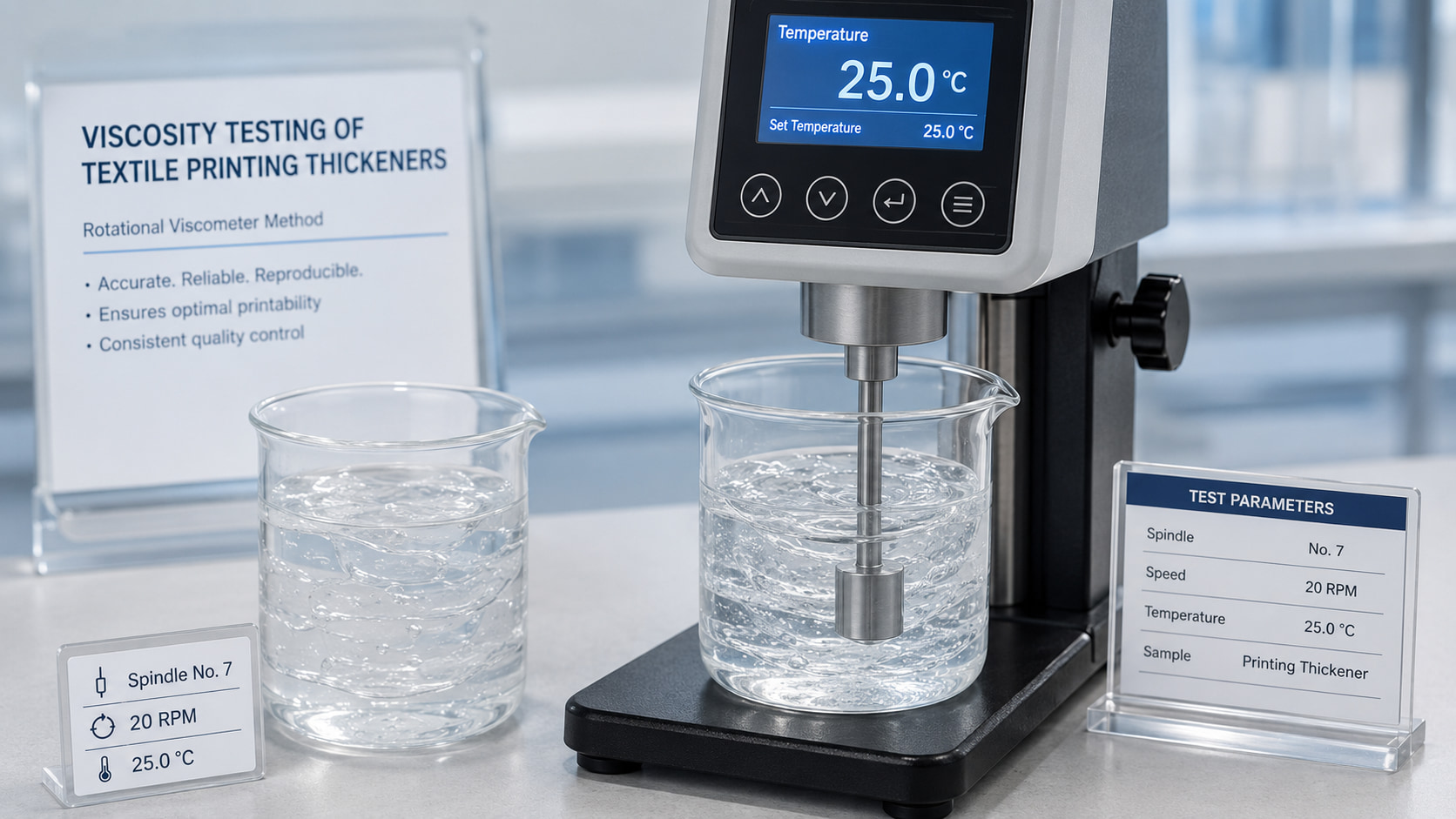
Узнайте, почему значения вязкости загустителей для текстильной печати нельзя сравнивать без учета таких факторов, как концентрация, температура, прибор, шпиндель, скорость, метод подготовки проб и время испытания.
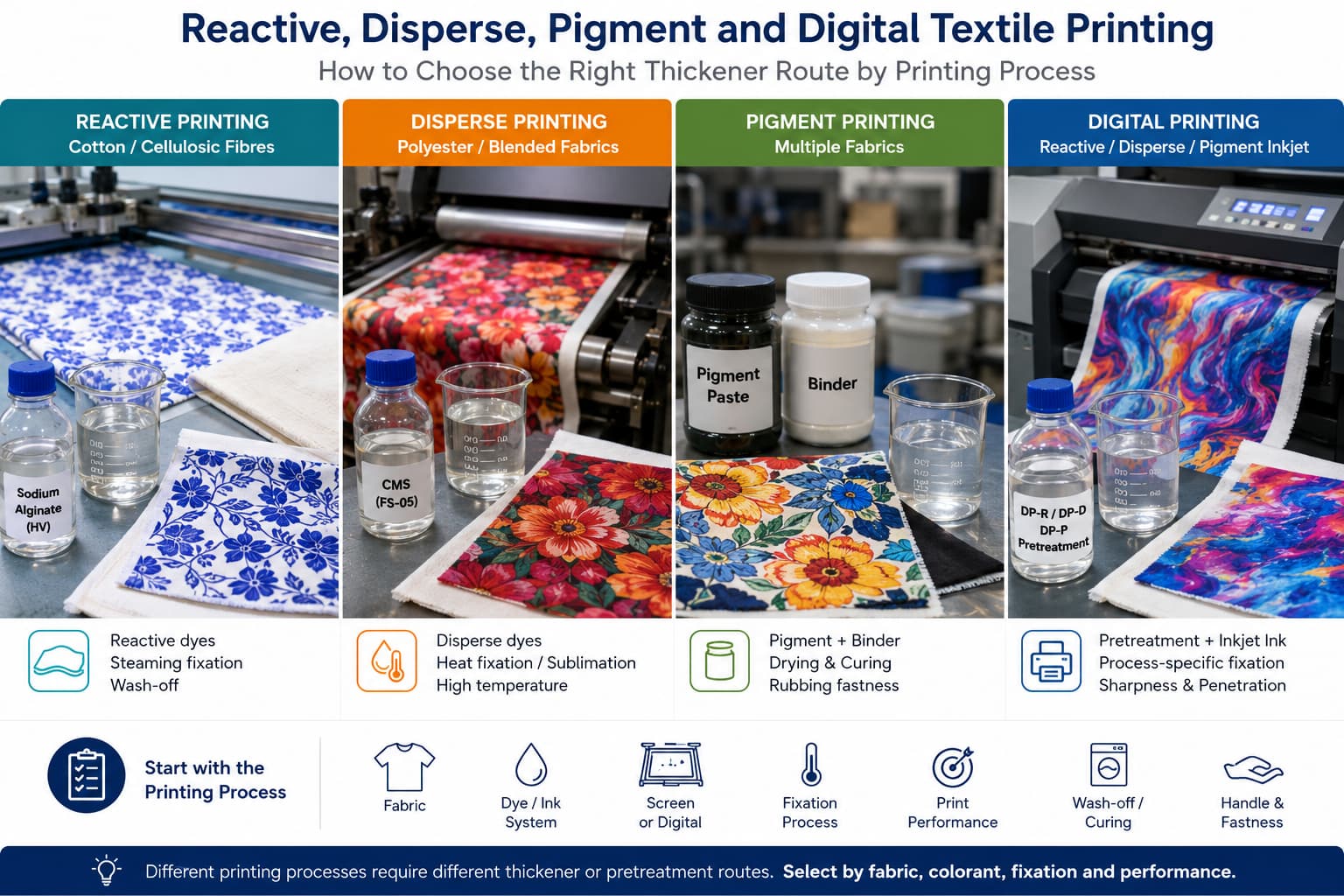
Узнайте, как выбирать загустители и способы предварительной обработки для реактивной, дисперсной, пигментной и цифровой печати на текстиле с учетом требований к ткани, красителю или чернилам, фиксации, вымываемости и качеству печати.
Сравните CMC, CMS, альгинат натрия и пасту для цифровой печати на текстиле. Узнайте, насколько каждый из этих материалов подходит для реактивной, дисперсной, пигментной и цифровой печати, а также на что покупателям следует обратить внимание перед тестированием образцов, подбором марки и оптовой закупкой.
Альгинат натрия широко используется в текстильной печати в качестве стабильного и стойкого к стирке загустителя для реактивных печатных паст. Узнайте, как перед покупкой оценить класс вязкости, степень чистоты и пригодность продукта для конкретного применения, а также о том, как компания FSX Chemical оказывает поддержку покупателям по всему миру, предоставляя технические данные и образцы.
И альгинат натрия, и CMC используются в качестве загустителей при печати на текстиле, однако они подходят для разных систем окрашивания и условий производства. В данном руководстве объясняются основные различия между ними и приводятся рекомендации по их применению.
Цифровая струйная печать на текстиле предъявляет иные требования к пасте и предварительной обработке материала, чем трафаретная печать. В данном руководстве объясняется, как альгинат натрия используется в цифровой печати на текстиле и какие параметры качества должны указывать специалисты по закупкам.
При печати на текстиле активными красителями правильная подготовка пасты не менее важна, чем выбор сорта краски. В данном руководстве рассматриваются методы растворения альгината натрия, диапазоны концентраций в зависимости от области применения, условия хранения, а также способы устранения типичных проблем при подготовке пасты.
Assess sodium alginate in reactive-printing wastewater using measured COD load, product-specific biodegradation evidence and controlled process comparisons. Includes a buyer checklist and illustrative load calculation.
Скорость фиксации красителя напрямую влияет на цветоотдачу, стойкость к стирке и загрязнённость сточных вод при печати активными красителями. В данном руководстве объясняется, как альгинат натрия способствует фиксации красителя, какие параметры пасты влияют на скорость фиксации и как устранять проблемы, связанные с низкой фиксацией, в производственных условиях.
Размер частиц альгината натрия (меш) влияет на скорость растворения порошка, равномерность его гидратации, а также на рабочие характеристики получаемой пасты при трафаретной печати. В данном руководстве объясняются практические последствия выбора размера меш при использовании паст для печати на текстиле.
Evaluate sodium alginate for warp sizing through grade-specific bath, yarn and desizing trials. Compare dry size add-on, yarn protection and removal using appropriate residue methods and downstream fabric checks.
Требования к чистоте альгината натрия не сводятся к одному-единственному показателю. В данном руководстве объясняется, какое значение для эксплуатационных характеристик пасты для текстильной печати имеют показатели активного вещества, содержания NaCl, нерастворимых веществ и тяжелых металлов, а также в каких случаях целесообразно выбирать продукт с более высокой степенью чистоты вместо стандартного промышленного сорта.
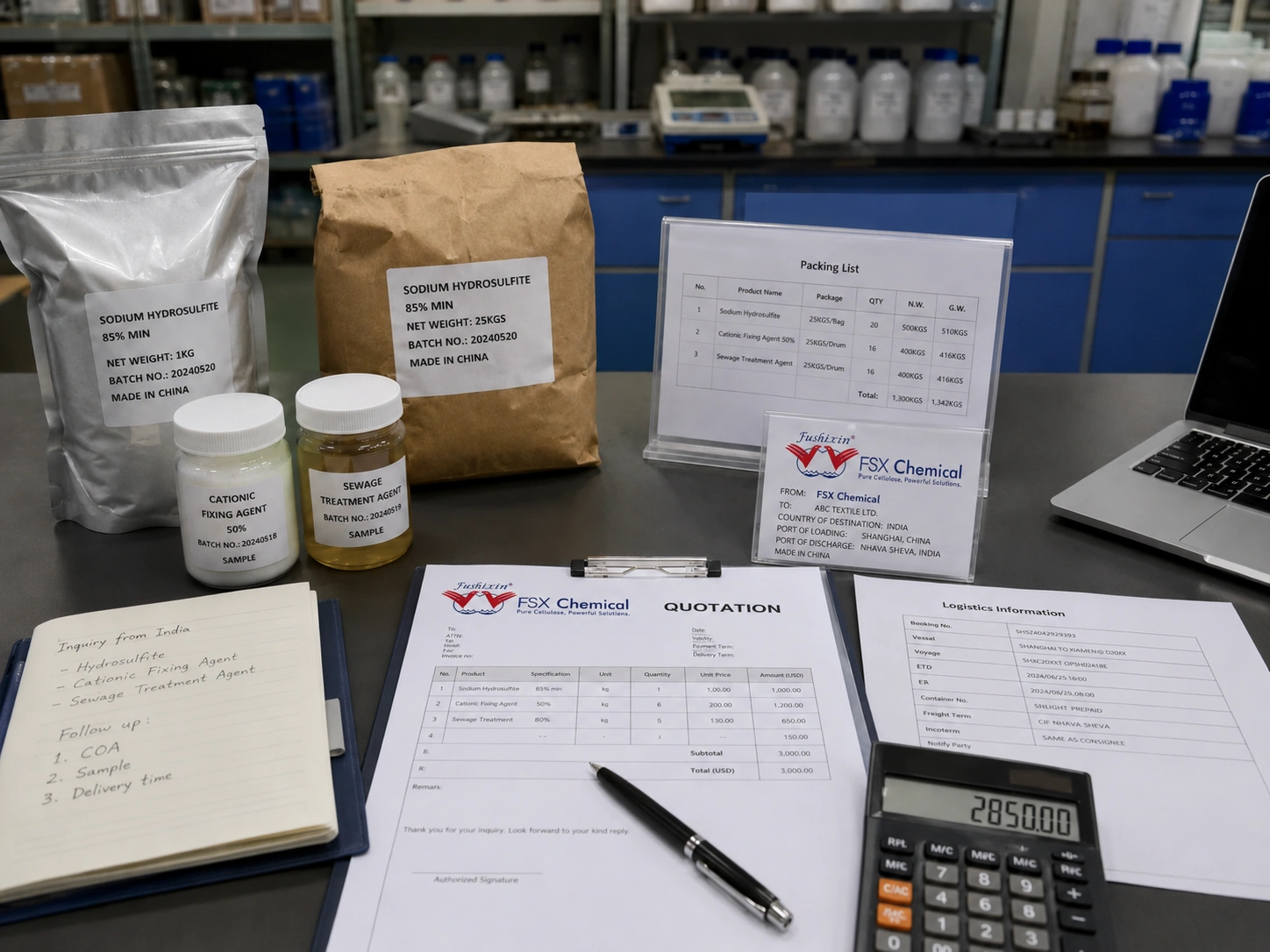
Сообщите название продукта, область применения, количество, пункт назначения, а также предоставьте техническое описание продукта (TDS),
фотографию образца или имеющиеся у вас документы. Компания FSX Chemical рассмотрит
эту информацию и порекомендует дальнейшие действия для подготовки коммерческого предложения, подбора образца
или выбора продукта.
Информация о продуктеНазвание продукта, марка, модель, фото этикетки или данные о продукте текущего поставщика.
Доступные документыTDS, SDS, COA, фотография образца, перечень продукции или данные испытаний.
Детали заказаПредполагаемый объем, упаковка, страна назначения, порт или условия торговли.
Область применения или проблемаПроцесс печати на текстиле, требования к составу, текущие проблемы или целевые показатели.