Acrylic Thickener for Dark Pigment Shades: Why High Pigment Loading Changes Viscosity and Color Yield
High pigment loading changes more than pigment concentration. It also changes water, dispersant, surfactant, electrolyte...
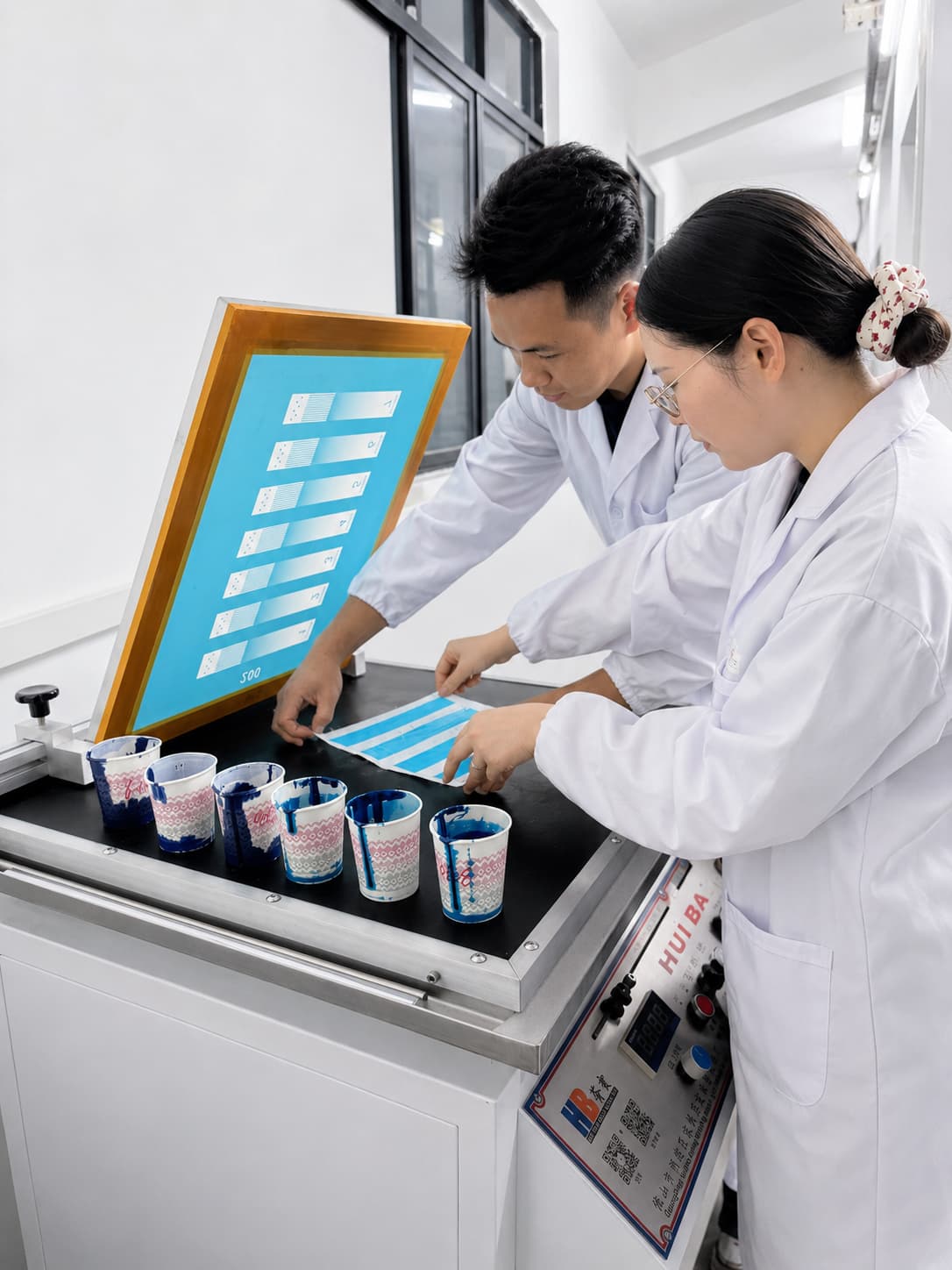
Dark pigment shades are a useful stress test for acrylic thickener because increasing pigment-dispersion dosage changes much more than color concentration. It can also change the amount of water, dispersant, surfactant, electrolyte and suspended pigment solids entering the printing paste. Depending on the pigment package, binder and acrylic-thickener architecture, viscosity may decrease, increase or become less stable during holding. Those rheology changes then affect screen transfer, penetration, surface pigment concentration and apparent color yield. The correct response is not to increase thickener automatically, but to build a pigment-loading–viscosity map, compare light and dark shades under the same test method, and approve the lowest stable thickener dosage that keeps the complete paste inside the required printing window.
Why Does High Pigment Loading Change Acrylic Thickener Performance?
High pigment loading changes the chemical and physical environment of the acrylic thickener.
When more commercial pigment dispersion is added, the paste can receive more:
Pigment solids
پانی
Dispersant
Surfactant
الیکٹرولائٹس
پی ایچ کنٹرول کیمیکلز
Each of these variables can change viscosity or rheology.
The final response can therefore be:
Lower viscosity
Higher viscosity
Similar initial viscosity but poorer holding stability
Similar Brookfield viscosity but different screen rheology
The correct diagnostic chain is:
Pigment Loading → Complete-Paste Rheology → Screen Transfer → Penetration → Surface Color Yield → Curing / Fastness / Hand
Do not assume that every dark shade simply needs more thickener.
Why Dark Shades Are a Useful Stress Test
Dark shades often use a higher dose of pigment dispersion than pale shades.
This makes them a practical stress test for:
الیکٹرولائٹ برداشت
Surfactant sensitivity
بائنڈر مطابقت
Thickener efficiency
Screen-transfer uniformity
Dark solid areas also make certain defects easier to see:
Uneven transfer
Weak coverage
Excessive penetration
سطح کی غیر یکسانیت
کنارے کا پھیلاؤ
A thickener that works in a pale shade should therefore not be approved automatically for a high-pigment black or navy formula.
Pigment Dispersion Is More Than Pigment
A commercial pigment dispersion is a formulated liquid, not pure dry pigment.
It can contain:
Pigment particles
پانی
Anionic or nonionic dispersants
Wetting agents
سطح فعال مادّے
Preservatives
pH-adjusting chemicals
الیکٹرولائٹس
لہٰذا:
More Pigment Dispersion ≠ Only More Colorant.
Two black pigment dispersions with the same pigment content can still influence acrylic thickener differently because their dispersant, surfactant and salt packages differ.
For this reason, supplier changes in pigment dispersion should trigger a viscosity and compatibility recheck.
High Pigment Loading Can Lower or Raise Viscosity
The direction of viscosity change is system-specific.
Viscosity can decrease because:
The pigment dispersion dilutes the thickener concentration.
Electrolytes screen charged polyacrylate groups.
Surfactants disrupt associative thickening.
pH moves outside the ideal activation window.
Viscosity can increase because:
Pigment solids increase the suspended-particle volume fraction.
Particle crowding increases flow resistance.
Surfactants strengthen an associative HASE network in a certain concentration range.
Pigment or binder particles participate in associative thickening.
This is why the article title says high pigment loading changes viscosity rather than always lowers it.
Measure the response of the real formula.
1. Dilution from Pigment Dispersion
Commercial pigment dispersion introduces liquid into the paste.
If thickener dosage stays constant while pigment-dispersion dosage increases, the effective thickener concentration can fall.
Acrylic thickeners often show a nonlinear dosage–viscosity relationship, so a modest dilution can produce a meaningful viscosity change.
Use a control:
Sample A: Normal Pigment Level
Sample B: Normal Pigment Level + Equivalent Water
Sample C: High Pigment Level
If B and C show similar viscosity loss, dilution is a major contributor.
If C changes much more, pigment-package chemistry is also involved.
2. Dispersants and Surfactants
Pigment dispersants and surfactants keep pigment particles separated and wettable.
But these surface-active chemicals can change acrylic-thickener rheology.
For a conventional ASE-type thickener, they can modify the aqueous and particle environment.
For a HASE-type associative thickener, surfactants can participate directly in hydrophobic associations.
Depending on concentration, this can:
Increase viscosity
Decrease viscosity
Change elasticity
Change recovery after shear
Therefore, a high-pigment formula can move the thickener into a different surfactant-response region.
3. Electrolyte Load
Many acrylic/polyacrylate thickeners contain ionized carboxylate groups after neutralization.
Electrolytes can screen those charged groups and reduce polymer expansion.
A simplified mechanism is:
Electrolyte Load ↑ → Charge Screening ↑ → Polymer Expansion Can Decrease → Thickening Efficiency Can Fall
Dark shades can create more ionic stress if the higher pigment dose also introduces more salts or ionic dispersants.
But the effect remains grade-specific.
Hydrophobically modified systems can respond differently because associative interactions provide another rheological mechanism.
Do not assume one electrolyte-retention result applies to every acrylic thickener.
4. Pigment Solids and Particle Crowding
At higher pigment solids, the particles themselves occupy more volume inside the paste.
As particle concentration increases, interactions between particles can increase flow resistance.
This can partially offset dilution or electrolyte-related viscosity loss.
In some systems, the result can be:
More Pigment → Higher Apparent Viscosity
rather than thinning.
The particle effect depends on:
رنگ کے ذرات کی کثافت
Particle size distribution
Dispersion quality
Binder particles
Thickener architecture
This is another reason not to diagnose dark-shade viscosity from pigment percentage alone.
5. HASE and Associative-Thickener Interaction
HASE acrylic thickeners use both pH-driven swelling and hydrophobic association.
The hydrophobic groups can associate with:
Other HASE chains
Binder particles
Surfactant aggregates
Pigment-dispersion components
High pigment loading can therefore change the associative network in both directions.
Research on associative thickeners shows that pigment, dispersant, surfactant and latex concentration can all alter rheological behavior.
The practical implication is:
HASE Dark-Shade Performance Must Be Tested with the Real Pigment and Binder System.
6. Binder-to-Pigment Ratio
Dark shades often require attention to binder-to-pigment balance.
If pigment loading rises while binder stays fixed, there may be less binder available relative to the amount of pigment.
If binder is increased to maintain fixation, the paste also receives more:
بائنڈر ٹھوس مادّے
پانی
سطح فعال مادّے
الیکٹرولائٹس
This can shift thickener demand again.
Therefore, dark-shade optimization should not isolate pigment from binder.
How Should a Mill Optimize Acrylic Thickener for Dark Pigment Shades?
ایک عملی فیصلہ سازی کا سلسلہ ہے:
Define Light / Dark Reference → Measure Pigment Loading → Check pH / Dilution / Surfactants / Electrolytes → Build Pigment-Loading Curve → Hold → Print Fine Lines & Dark Solids → Adjust Thickener Only If Needed → Cure → Check Color / Rubbing / Hand
اہم اصول یہ ہیں:
Higher pigment-dispersion dosage changes more than pigment concentration; it also changes the water, dispersant, surfactant and ionic environment.
High pigment loading can decrease or increase viscosity depending on dilution, electrolyte effects, particle loading and associative interactions.
Dark shades should not automatically use more thickener.
Color yield depends on transfer, penetration and surface pigment concentration—not pigment dosage alone.
Binder-to-pigment balance, foam and holding stability should be checked at the same time.
The best dark-shade formulation is the one that remains inside the approved rheology and finished-fabric window at the lowest practical Total Cost in Use.
اکثر پوچھے جانے والے سوالات
1. Why does dark pigment paste become thinner?
Higher pigment-dispersion dosage can add more water, surfactant, dispersant and electrolytes, which may dilute the paste or reduce acrylic-thickener efficiency.
2. Can high pigment loading make the paste thicker instead?
Yes. Higher pigment solids can increase particle crowding, and associative thickener interactions can also raise viscosity in some formulas.
3. Should I always add more thickener for black pigment printing?
No. First measure the complete-paste rheology and printing result. Add more thickener only if the dark shade falls outside the validated production window.
4. Why can two black pigment dispersions give different viscosity?
They can contain different pigment solids, particle size, dispersants, surfactants, salts and pH-control chemistry.
5. Why can dark shades give weaker surface color than expected?
Excessive penetration, incomplete screen transfer, poor pigment dispersion or binder distribution can reduce surface color even when pigment dosage is higher.
6. Does higher pigment loading require more binder?
It may require a binder-ratio review to maintain rubbing fastness, but the correct level depends on pigment, fabric, binder chemistry and curing.
7. Why do dark shades foam more?
Higher pigment loading can introduce more surfactant/dispersant and can require longer or stronger mixing, increasing air entrainment and foam stability.
8. How can I tell whether viscosity loss is just dilution?
Run a control with the same amount of added water as the extra pigment dispersion. If the real pigment causes a larger change, pigment-package chemistry is contributing.
9. Should I test only the darkest shade?
No. A light–medium–dark ladder shows how the formula changes across the normal pigment-loading range and helps define a production window.
10. Why can HASE thickener behave differently at high pigment loading?
HASE uses hydrophobic association, so changes in pigment particles, dispersants, surfactants and binder can alter the associative network.
11. What should be checked after printing?
Evaluate print definition, solid-area uniformity, penetration, K/S or shade, dry/wet rubbing, foam-related defects and fabric hand after controlled curing.
12. What should I send FSX Chemical for dark-shade matching?
Send the current thickener/TDS, light and dark pigment dosage, viscosity method, binder, pH, water quality, machine route, holding time and the main color or rheology problem.
Match Acrylic Thickener to High-Pigment Dark Shades
If your light shades print well but black, navy or other dark pigment pastes become thinner, thicker, foamier or less uniform, FSX Chemical can help structure a controlled pigment-loading comparison.
مفید تکنیکی جائزے کے لیے بھیجیں:
آپ کے موجودہ ایکریلک تھکنر کے نمونے کا TDS یا COA
Current thickener dosage
Light- and dark-shade pigment products / dosages
سانچاقی اور مکمل آزمائشی طریقہ
بائنڈر گریڈ اور خوراک
Fixer / auxiliary route
حتمی پیسٹ کا پی ایچ
Water hardness / conductivity
کپڑے اور سکرین پرنٹنگ کا راستہ
وقت پکڑنا
Current color yield, transfer, rubbing, foam or hand target
کے ساتھ شروع کریں نمونے اور ملاپ for a controlled current-vs-candidate evaluation.
The correct dark-shade thickener dosage is not determined by pigment percentage alone. It is the lowest stable dosage that keeps the high-pigment paste inside the required rheology, screen-transfer, color-yield, fastness and fabric-hand window.
رنگیت کے ٹھہراؤ کی شرح براہِ راست رنگ کی پیداوار، دھونے کی مضبوطی، اور ردعمل دار رنگ چھپائی میں گندے پانی کے بوجھ کو متاثر کرتی ہے۔ یہ رہنما بتاتا ہے کہ سوڈیم الگنیٹ رنگیت کے ٹھہراؤ میں کس طرح مدد کرتا ہے، کون سے پیسٹ کے پیرامیٹرز ٹھہراؤ کی شرح کو متاثر کرتے ہیں، اور پیداوار میں کم ٹھہراؤ کے مسائل کو کیسے حل کیا جائے۔.
ٹیکسٹائل پرنٹنگ کے گاڑھا کرنے والے مادے کیمسٹری، ریولوجی، رنگ کے مطابقت اور دھونے پر اثر پذیری کے لحاظ سے مختلف ہوتے ہیں۔ یہ رہنما اہم گاڑھا کرنے والے خاندانوں، ان کے عام استعمال کے طریقہ کار اور ان پیرامیٹرز کا موازنہ پیش کرتا ہے جن کی خریداروں کو پیداواری تجربات سے قبل تصدیق کرنی چاہیے۔.
ری ایکٹیو ڈائی پرنٹنگ میں رنگ کی کم مقدار یا رنگ کی گرفت کی کمزوری شاذ و نادر ہی کسی ایک وجہ کی بنا پر ہوتی ہے۔ یہ رہنما بتاتا ہے کہ کپڑے کی تیاری، رنگ کے انتخاب، گاڑھا کرنے والے مادے کی rheology، الکلی، نمی، بھاپ دینے اور دھونے کے عمل کس طرح باہم تعامل کرتے ہیں، اور ایک عملی مسئلہ حل کرنے اور معیار کنٹرول کے عمل کا خاکہ فراہم کرتا ہے۔.
Fabric pick-up determines how much pretreatment chemistry and water actually remain on the fabric after application. Too little or excessive pick-up can change color yield, bleeding, penetration, drying and fixation. This guide explains how to measure and optimize a stable working window for reactive inkjet printing.
Synthetic thickener selection for pigment printing should be based on the complete pigment-binder system. Compare activation, pH, electrolyte tolerance, binder compatibility, rheology, dosage efficiency, curing result and final fabric hand—not water viscosity alone.
Many acrylic liquid thickeners develop viscosity after neutralization, but the correct pH is grade-specific. Pigment, binder, electrolytes, active solids, neutralizer type and holding time must be evaluated together before defining the production window.
Synthetic thickener viscosity can fall after pigment, binder or auxiliaries are added because of dilution, pH shift, electrolyte screening or formulation incompatibility. The correct diagnosis is to build the paste in stages and identify the first point where viscosity retention changes.
Pigment binder can change acrylic thickener viscosity through dilution, electrolyte load, pH shift, surfactant interaction and ionic compatibility. A complete compatibility test should include viscosity retention, holding stability, screen printing, curing, rubbing fastness and fabric hand.
Synthetic thickener performance in screen printing depends on more than static viscosity. The useful rheology combines low-shear body, shear thinning under the squeegee and controlled recovery after transfer to maintain screenability, penetration and print definition.
Acrylic liquid thickener dosage and viscosity are not reliably linear. Mills should build a controlled working curve using the actual commercial grade, fixed pH and viscosity method, then repeat the useful dosage points in the complete pigment-binder formulation.
Synthetic acrylic thickener, CMC and CMS can create different rheology, dosage requirements, binder compatibility, residue behavior and fabric hand in pigment printing. Compare them inside the same complete pigment-binder formula rather than by water viscosity or price alone.
Acrylic thickener affects pigment-printing color yield, rubbing performance and fabric hand mainly through rheology, paste deposit, pigment/binder distribution and polymer solids. Binder and curing must be controlled separately before the thickener is judged.
پروڈکٹ کا نام، استعمال، مقدار، منزل اور کوئی بھی TDS، نمونہ کی تصویر یا دستاویز جو آپ کے پاس موجود ہو، فراہم کریں۔ FSX کیمیکل اس معلومات کا جائزہ لے گا اور کوٹیشن، نمونہ کی مطابقت یا پروڈکٹ کے انتخاب کے لیے اگلا قدم تجویز کرے گا۔.
مصنوعات کی معلوماتمصنوعہ کا نام، گریڈ، ماڈل، لیبل کی تصویر یا سپلائر کا حوالہ.
دستیاب دستاویزاتٹی ڈی ایس، ایس ڈی ایس، سی او اے، نمونہ کی تصویر، مصنوعات کی فہرست یا ٹیسٹ کے اعداد و شمار۔.
آرڈر کی تفصیلاتمتوقع مقدار، پیکیجنگ، منزل ملک، بندرگاہ یا تجارتی اصطلاح۔.
درخواست یا مسئلہٹیکسٹائل پرنٹنگ کا عمل، فارمولیشن کی ضرورت، موجودہ مسئلہ یا ہدف کارکردگی۔.