Cách kiểm tra chất làm đặc dùng trong in vải tổng hợp trước khi phê duyệt sản xuất
A synthetic textile printing thickener should not be approved from one viscosity result. Production approval...
A synthetic textile printing thickener should not be approved for production because one laboratory sample reaches a target viscosity. Production approval should connect product identity, solids and pH, activation behavior, electrolyte tolerance, binder and pigment compatibility, rheology, filtration, holding stability, screen performance, curing, rubbing fastness, fabric hand and first-commercial-batch consistency. The most reliable qualification method is a staged current-reference comparison with clear go / conditional / fail decision gates. This guide shows printing mills, formulators and buyers how to move a synthetic thickener from candidate sample to controlled production approval without confusing one good laboratory result with a repeatable commercial grade.
How Should a Synthetic Textile Printing Thickener Be Tested Before Production Approval?
Does it meet production and finished-textile requirements?
Screen running, definition, color, curing, rubbing, hand
Production approval is achieved only when all relevant levels pass.
Start with a Current Production Reference
The current approved thickener is the most useful control.
Run:
Current Approved Product vs. Candidate Synthetic Thickener
under the same:
Nước
Chất màu
Binder
Thiết bị cố định / thiết bị phụ trợ
Vải
Screen
Squeegee conditions
Sấy khô
Quá trình làm cứng
Do not force equal dosage if the products have different thickening efficiency.
Instead, find the useful rheology window for each grade and compare the complete printing result.
A current reference prevents the laboratory from approving a candidate that looks technically acceptable in isolation but performs worse than the existing production standard.
1. Confirm Product Identity and Batch Traceability
Before technical testing, confirm exactly what has been received.
Bản ghi:
Supplier
Commercial grade
Batch / lot
Manufacturing or retest date where supplied
Package identification
TDS version
SDS version
COA
A development sample without a permanent commercial grade code can be useful for early screening, but it should not move directly into purchasing approval.
The approved sample must be connected to a repeatable production grade.
2. Inspect Appearance and Physical Condition
For liquid synthetic thickeners, check:
Color and uniformity
Sự tách biệt
Thanh toán
Surface skin
Gel particles
Graininess
Unusual odor
Damaged or swollen packaging
Appearance does not prove application performance, but abnormal physical condition should be investigated before the product enters the formulation.
If the product has experienced suspected freeze or heat exposure, use a separate storage-excursion review instead of normal approval testing.
3. Check Solids or Active Content
Liquid acrylic thickeners can have different supplied solids.
Solids affect:
Effective polymer addition
Dosage comparison
Cost
Final polymer deposit
So sánh:
As-Supplied Dosage
và:
Active Polymer Solids Introduced
A lower dosage does not automatically mean a more efficient or lower-solids product.
If the supplier specification uses total solids rather than active polymer, keep the terminology exactly defined in the test record.
4. Check pH and Activation Behavior
Many acrylic and polyacrylate thickeners are pH-responsive.
Before comparing viscosity, determine:
Is the product supplied ready to use?
Is it partially neutralized?
Does it require controlled alkali activation?
What activation window does the TDS recommend?
Then standardize:
Neutralizer identity
Nồng độ chất trung hòa
Thứ tự cộng
Tốc độ trộn
Thời gian cân bằng
Giá trị pH cuối cùng
Do not reject an alkali-swellable grade as “low viscosity” before confirming it has been activated correctly.
5. Build a Dosage–Viscosity Working Curve
Do not test only one dosage.
Prepare several controlled points around the supplier-recommended or current working region.
Đơn vị đo lường:
Liều lượng
pH
Độ nhớt ban đầu
Held viscosity
Hình thức
Cốt truyện:
Dosage → Complete-Paste Viscosity
The objective is to find:
A stable useful region
A steep region where small dosage changes create large viscosity changes
The lowest practical dosage that remains inside the production window
Do not assume dosage and viscosity are linear.
6. Compare Rheology, Not One Viscosity Number
A synthetic thickener can pass one Brookfield viscosity target and still print poorly.
Screen printing requires a flow sequence:
Chất lỏng có độ ma sát cắt thấp → Hiện tượng loãng khi cắt → Chuyển giao qua lưới → Phục hồi cấu trúc
Đánh giá:
Độ nhớt ở điều kiện cắt thấp
Multi-speed viscosity where available
Shear thinning
Quá trình phục hồi sau khi chịu lực cắt có kiểm soát
Elasticity / stringiness
Thixotropy
Published polyacrylate-thickener research shows that shear sensitivity and viscosity recovery can be important application properties.
Do đó:
Same Brookfield Viscosity ≠ Same Printing Performance.
7. Run an Electrolyte-Tolerance Test
Many conventional polyacrylate thickeners are sensitive to ionic load.
Electrolytes can enter from:
Dung dịch phân tán sắc tố
Binder
Fixer
Process water
Other auxiliaries
Run the candidate under a representative production electrolyte environment.
One viscosity number does not qualify a synthetic thickener.
Use the current production product as the reference.
Test the complete pigment-binder formula before printing.
Evaluate rheology, holding stability and screen performance separately.
Final approval requires cured-fabric color, rubbing and hand results.
Commercial approval requires grade traceability and first-batch verification.
Các câu hỏi thường gặp
1. What is the first test for a synthetic textile printing thickener?
Start by confirming the commercial grade, batch, TDS/COA and physical condition, then standardize solids, pH and activation before comparing viscosity.
2. Is water viscosity enough to approve a synthetic thickener?
No. The product must also be tested with the real pigment, binder, fixer and auxiliaries, followed by printing and curing.
3. Should two synthetic thickeners be compared at the same dosage?
Not as the only comparison. Find the useful rheology window for each grade, then compare printing, finished fabric and cost.
4. Why is electrolyte testing important?
Pigment, binder, fixer and process water can introduce ions that reduce thickening efficiency in some acrylic/polyacrylate systems.
5. How should binder compatibility be tested?
Add the binder under controlled conditions, record pH and viscosity, compare with a water-dilution control and check holding stability and final printing behavior.
6. Why should dark pigment shades be included?
High pigment loading can add more water, surfactant, dispersant and electrolyte, creating a stronger compatibility challenge.
7. How long should holding stability be tested?
Use the real production holding period. A four-hour production process requires evidence that the paste remains acceptable over that period.
8. What should be checked on the printed fabric?
Evaluate agreed color or K/S, print definition, penetration, dry/wet rubbing, relevant wash fastness, surface residue and fabric hand.
9. Is a successful laboratory trial enough for purchase approval?
No. Run a controlled production trial and verify the first commercial batch against the approved sample and specification.
10. Why keep retained samples?
They allow complaint batches to be compared with the approved reference using the same method and help separate batch issues from process issues.
11. What incoming QC is useful after approval?
Typical controls include identity, appearance, pH, solids or active-content parameter, applicable viscosity and batch documentation, with periodic application verification.
12. What should I send FSX Chemical before requesting a candidate synthetic thickener?
Send the current thickener/TDS, dosage, viscosity method, pigment, binder, pH, fabric, machine route, curing conditions, finished-fabric targets and estimated usage.
Qualify a Synthetic Thickener Before Bulk Production
If your mill is evaluating a new synthetic textile printing thickener, FSX Chemical can help structure a controlled current-vs-candidate comparison from laboratory screening through first commercial batch verification.
Để nhận được bài đánh giá kỹ thuật hữu ích, vui lòng gửi:
A synthetic thickener should be approved as a repeatable commercial system, not as one successful laboratory sample. Production approval begins with grade identity and ends with first-batch consistency, cured-fabric performance and a defined incoming-QC specification.
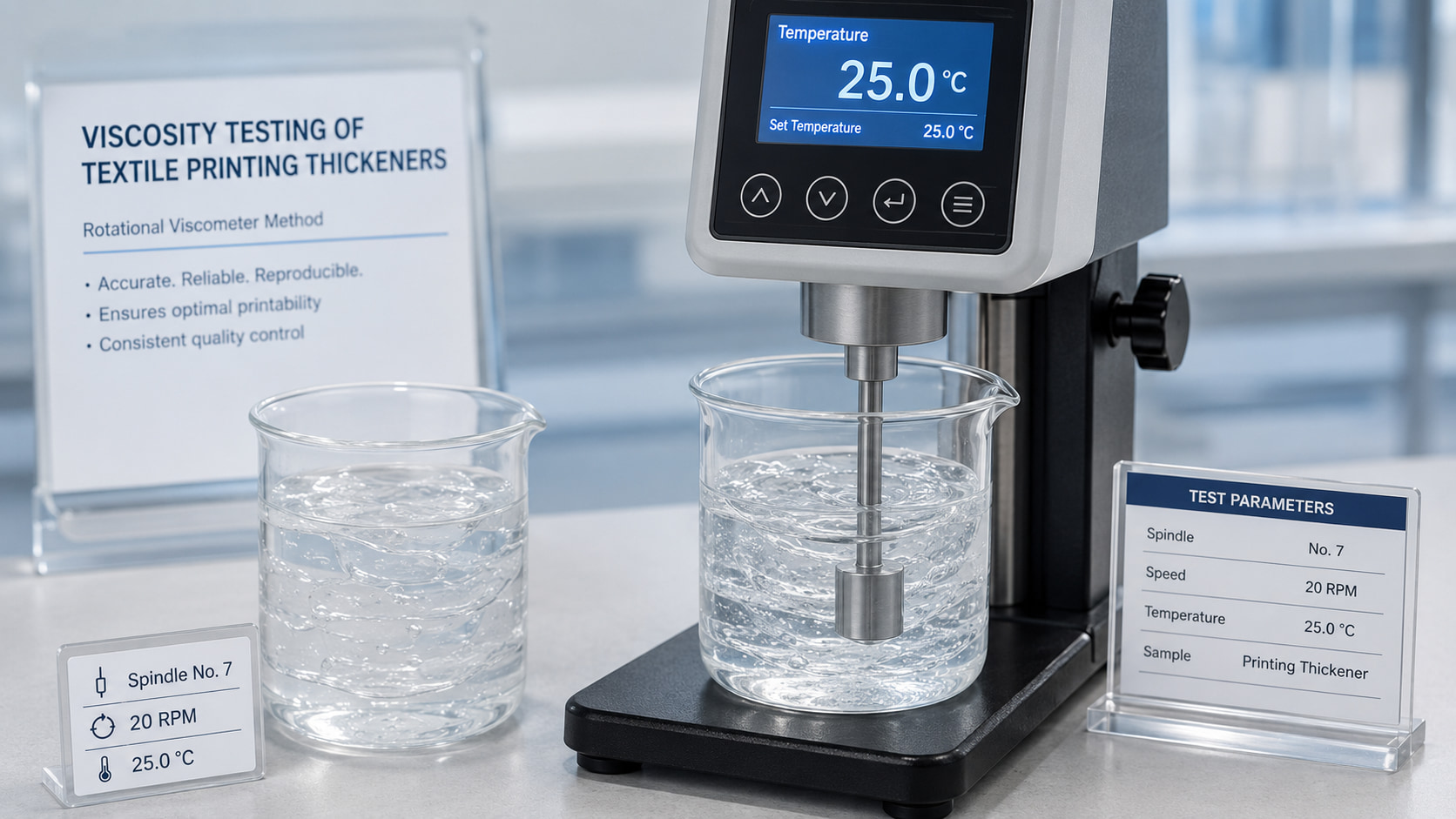
Tìm hiểu lý do tại sao không thể so sánh các giá trị độ nhớt của chất làm đặc trong in ấn dệt may nếu không đảm bảo các yếu tố như nồng độ, nhiệt độ, thiết bị, trục quay, tốc độ, phương pháp chuẩn bị và thời gian thử nghiệm đều giống nhau.
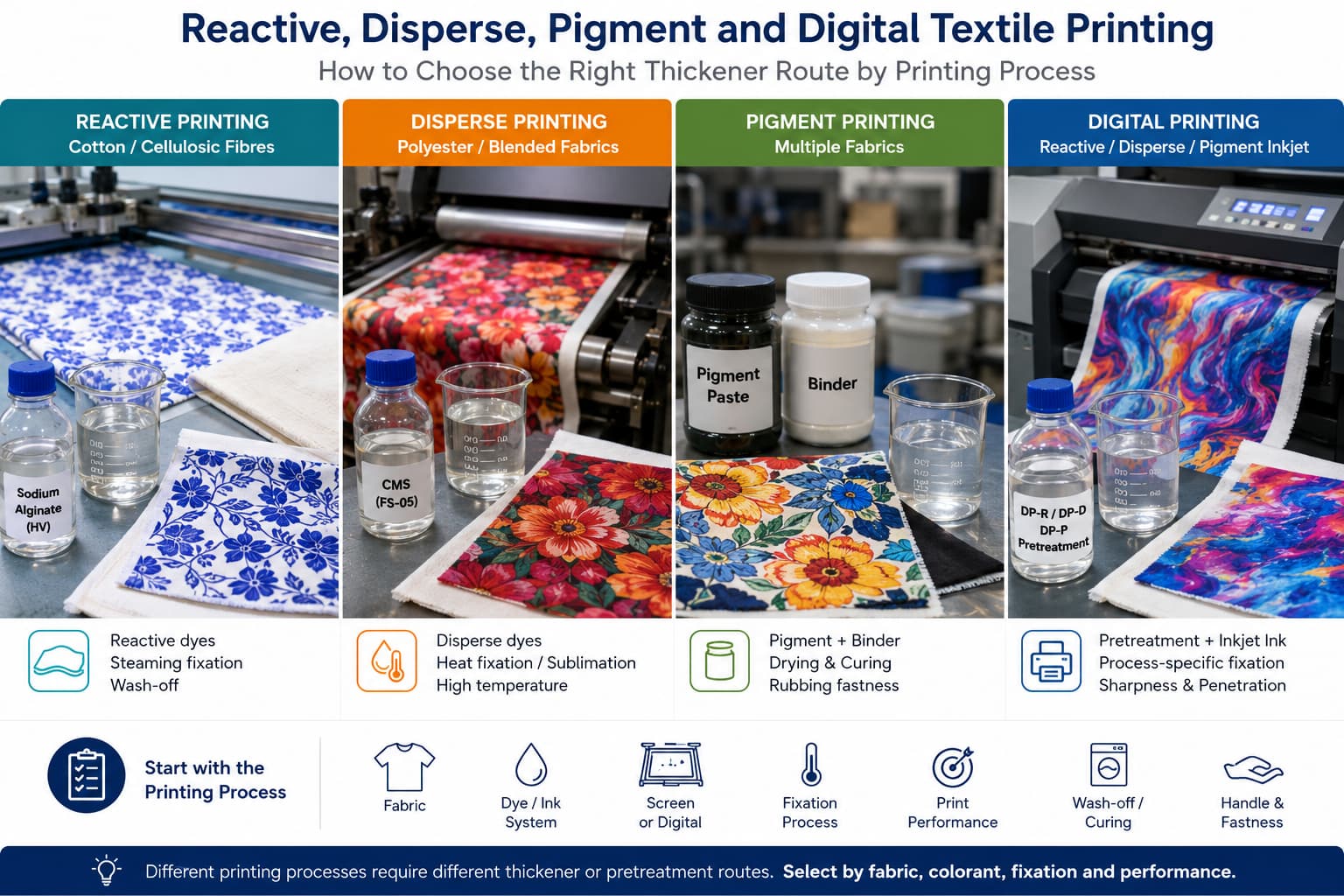
Tìm hiểu cách lựa chọn chất làm đặc và quy trình tiền xử lý cho các phương pháp in dệt phản ứng, in phân tán, in sắc tố và in kỹ thuật số, dựa trên các yêu cầu về vải, thuốc nhuộm hoặc mực in, quá trình cố định màu, khả năng rửa trôi và chất lượng in.
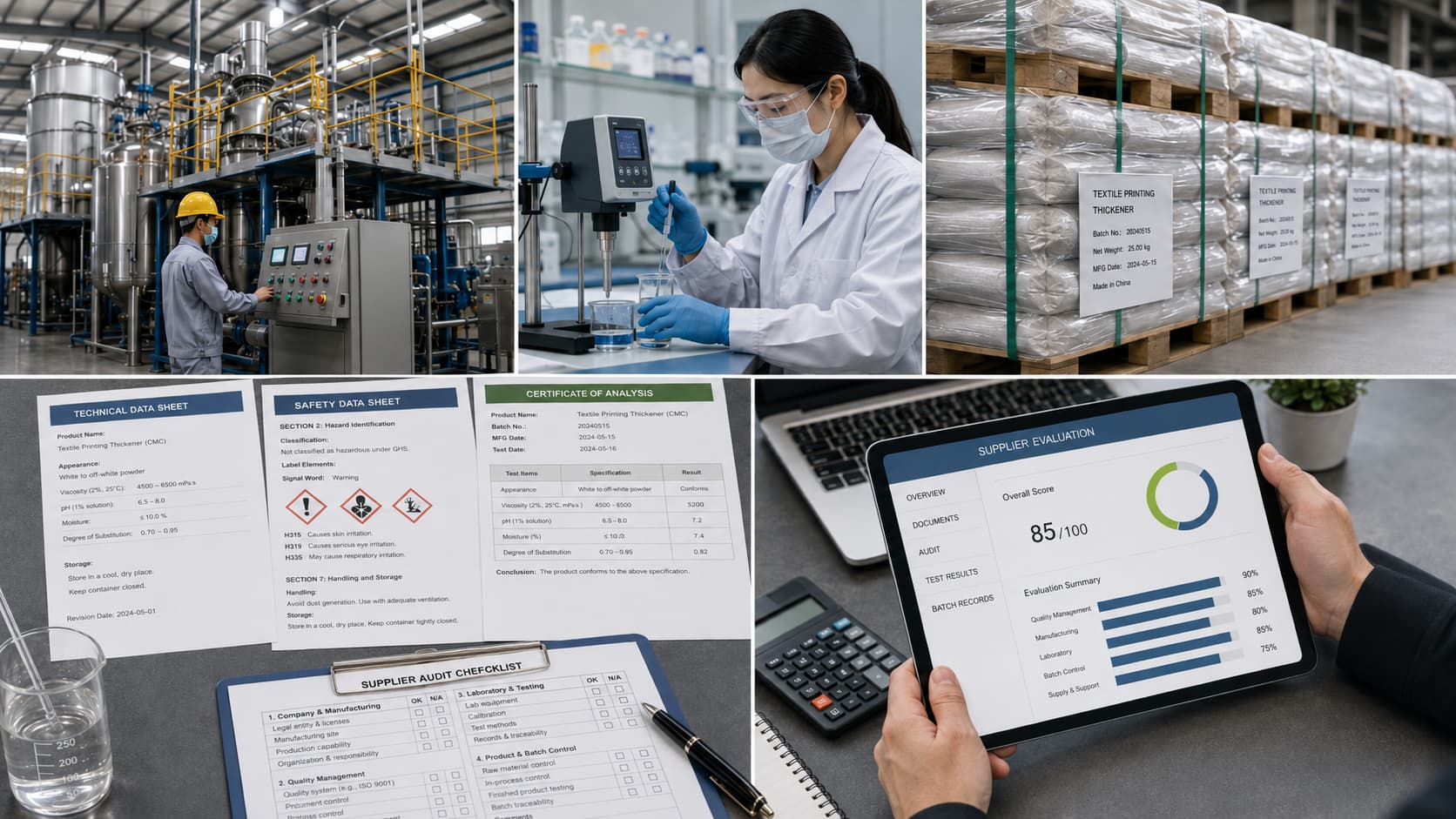
Tìm hiểu cách đánh giá một nhà sản xuất chất làm đặc dùng trong in ấn dệt may bằng cách kiểm tra thông tin nhận diện doanh nghiệp, năng lực sản xuất, phương pháp thử nghiệm, khả năng truy xuất nguồn gốc lô hàng, tài liệu kỹ thuật, hỗ trợ mẫu thử và khả năng cung ứng xuất khẩu.
Hỗn hợp in dựa trên CMC được sử dụng rộng rãi trong in vải bằng bột màu, in phản ứng và in kỹ thuật số. Hướng dẫn này giải thích các thông số quan trọng, cách so sánh các nhà cung cấp và những yêu cầu cần đưa ra trước khi đặt hàng số lượng lớn.
Cả natri alginat và CMC đều được sử dụng làm chất làm đặc trong in vải, nhưng chúng phù hợp với các hệ thống thuốc nhuộm và điều kiện quy trình khác nhau. Hướng dẫn này giải thích những điểm khác biệt chính và thời điểm nên sử dụng từng loại.
Việc hiểu rõ nguồn gốc nguyên liệu và quy trình sản xuất natri alginat sẽ giúp các đội ngũ mua hàng đặt ra những câu hỏi phù hợp hơn và đánh giá nhà cung cấp hiệu quả hơn. Cẩm nang này đề cập đến các loài tảo biển, các bước chiết xuất, nguồn gốc của tạp chất, cũng như những tiêu chí về quy trình sản xuất nhất quán cần có trong hồ sơ của nhà cung cấp.
Việc bảo quản không đúng cách là một trong những nguyên nhân phổ biến nhất dẫn đến các vấn đề về hiệu suất của natri alginat trong in ấn dệt may. Hướng dẫn này đề cập đến các điều kiện bảo quản dạng bột và dạng bột nhão, thời hạn sử dụng dự kiến, các dấu hiệu suy giảm chất lượng, cũng như những điều cần kiểm tra khi nhận hàng mới.
Các bảng dữ liệu kỹ thuật (TDS) có sự khác biệt về định dạng và mức độ đầy đủ giữa các nhà cung cấp, và không phải mọi trường thông tin đều có tầm quan trọng như nhau đối với mọi ứng dụng. Hướng dẫn này sẽ phân tích chi tiết từng phần của một bảng dữ liệu kỹ thuật (TDS) điển hình về natri alginat, giải thích ý nghĩa của từng thông số và cách nhận diện những thiếu sót hoặc dấu hiệu cảnh báo.
Nhiều nhà cung cấp quảng cáo sản phẩm "alginat natri tùy chỉnh", nhưng trên thực tế, thuật ngữ này lại bao hàm những khái niệm rất khác nhau. Hướng dẫn này sẽ giải thích những thông số nào thực sự có thể điều chỉnh, những thông số nào bị giới hạn bởi các quy luật hóa học cơ bản, và cách đánh giá các tuyên bố về khả năng tùy chỉnh của nhà cung cấp.
Khi xuất hiện lỗi in trên sàn, thách thức đặt ra là phải nhanh chóng xác định nguyên nhân. Cẩm nang tham khảo này phân loại các lỗi thường gặp liên quan đến hỗn hợp natri alginat theo triệu chứng, trong đó các nguyên nhân có khả năng xảy ra được xếp hạng theo mức độ khả năng và kèm theo các bước kiểm tra ban đầu thực tế cho từng trường hợp.
Giá alginat natri có sự chênh lệch đáng kể giữa các nhà cung cấp và các loại sản phẩm, nhưng không phải mọi sự chênh lệch về giá đều phản ánh sự khác biệt thực sự về chất lượng. Hướng dẫn này giải thích các yếu tố ảnh hưởng đến chi phí, cách so sánh báo giá trên cơ sở tương đương và những dấu hiệu cảnh báo cần lưu ý khi đánh giá các đề xuất của nhà cung cấp.
Việc lựa chọn chất làm đặc phù hợp cho in ấn trên vải không chỉ phụ thuộc vào loại vải. Người mua nên lựa chọn chất làm đặc sao cho phù hợp với hệ thống thuốc nhuộm hoặc bột màu, phương pháp in, tính lưu biến mong muốn, yêu cầu về khả năng rửa trôi và các điều kiện thử nghiệm thực tế tại nhà máy.
Vui lòng cung cấp tên sản phẩm, ứng dụng, số lượng, điểm đến và bất kỳ tài liệu kỹ thuật (TDS),
hình ảnh mẫu hoặc tài liệu nào mà quý khách đã có. FSX Chemical sẽ xem xét
thông tin này và đề xuất bước tiếp theo liên quan đến báo giá, đối chiếu mẫu
hoặc lựa chọn sản phẩm.
Thông tin sản phẩmTên sản phẩm, cấp loại, mẫu mã, ảnh nhãn mác hoặc mã tham chiếu của nhà cung cấp.
Các tài liệu có sẵnTDS, SDS, COA, ảnh mẫu, danh mục sản phẩm hoặc dữ liệu thử nghiệm.
Chi tiết đơn hàngSố lượng dự kiến, hình thức đóng gói, nước nhập khẩu, cảng hoặc điều kiện thương mại.
Yêu cầu hoặc Vấn đềQuy trình in trên vải, yêu cầu về công thức, vấn đề hiện tại hoặc chỉ tiêu hiệu suất.