Выбор подходящего текстильного загустителя для ваших производственных нужд
Choosing the right textile thickener requires more than comparing viscosity or price. This guide explains...
Textile thickeners influence much more than the apparent thickness of a printing paste. They affect preparation, pumping, screen passage, pretreatment pickup, print definition, penetration, fixation, washing and final fabric handle.
Selecting an unsuitable thickener may lead to persistent lumps, unstable viscosity, excessive filter residue, poor paste transfer, uncontrolled spreading or repeated production adjustment. A product with an attractive price can therefore become expensive when it increases labor, waste, cleaning or rejected fabric.
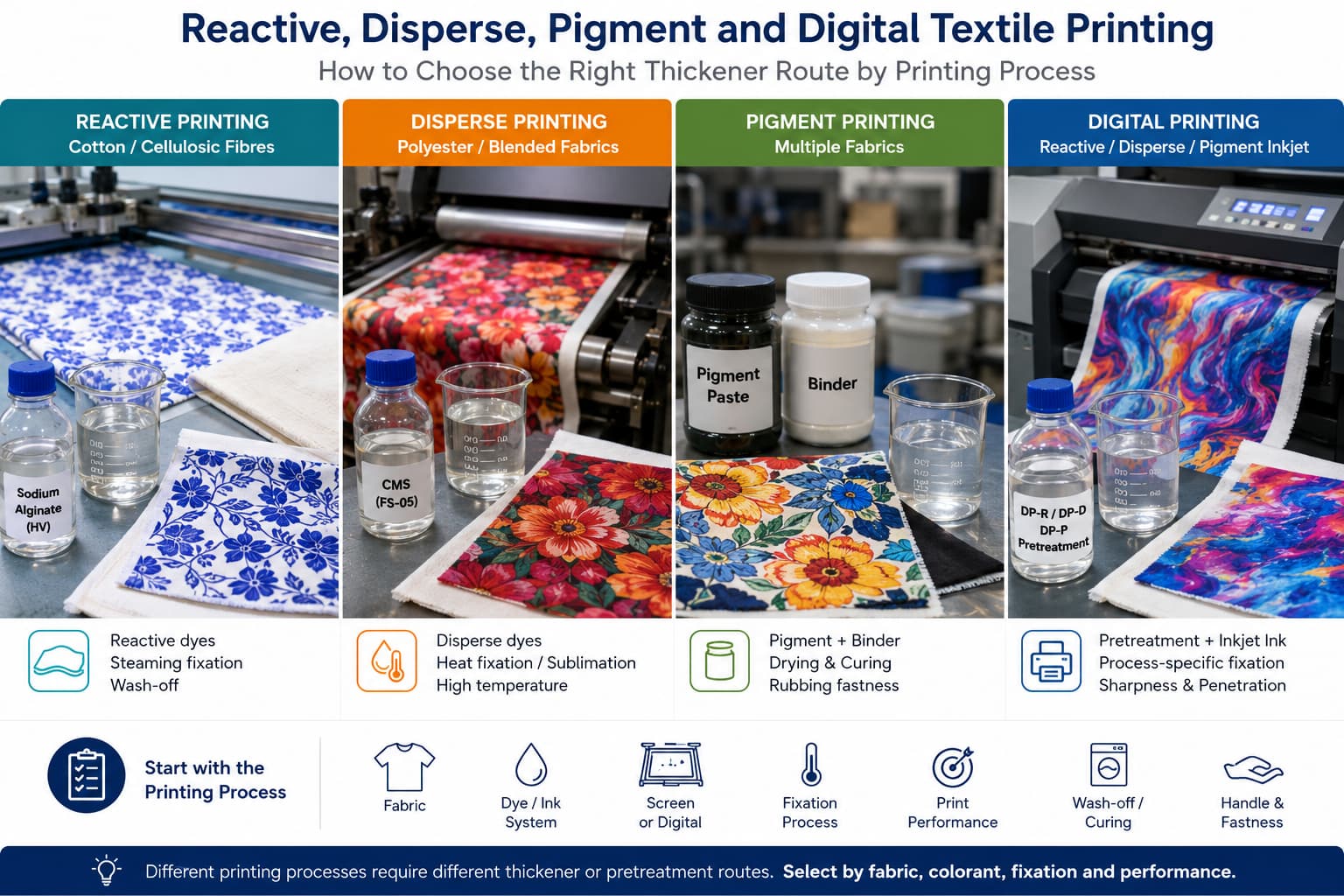
There is no universal textile thickener that performs best in every manufacturing process. Reactive, pigment, disperse and digital textile printing systems use different colorant chemistries, fabrics, equipment and post-treatment conditions.
The correct selection process begins with the manufacturing application, not with the thickener name. Buyers should define what the material must do, identify suitable product families and compare representative samples under controlled laboratory and production conditions.
Why Textile Thickener Selection Matters
A textile thickener is part of the complete manufacturing system. Its performance depends on the colorant, fabric, water, auxiliary chemicals, mixing equipment, printing method and post-treatment process.
It affects paste preparation
Powder wetting, hydration rate, mixing time, foam and filter residue can influence labor requirements and production scheduling.
It affects machine operation
The paste must move through tanks, pumps, pipes, screens, coating units or pretreatment equipment without creating excessive resistance or uncontrolled flow.
It affects print quality
Flow under shear and structural recovery can influence print-edge definition, spreading, penetration, solid-area uniformity and application pickup.
It affects post-treatment
The thickener system may influence fixation, washing, desizing, curing, residual surface material and final fabric handle.
It affects manufacturing cost
Actual cost includes dosage, preparation, filtration, machine cleaning, corrective additions, unused paste, rejected fabric and supply consistency.
Start with the Manufacturing Process
Before requesting a sample, define where and how the thickener will be used. A general inquiry for “textile-grade thickener” is usually too broad for accurate product selection.
Identify the printing route
Печать активными красителями
Пигментная печать
Disperse dye printing
Acid dye printing
Digital reactive printing
Digital disperse printing
Digital pigment printing
Identify the application equipment
Печать на плоских поверхностях
Ротационная трафаретная печать
Digital inkjet pretreatment
Padding
Coating
Spraying
Warp-sizing equipment
Identify the main manufacturing target
The main objective may be improved fine-line definition, better screen passage, more stable viscosity, uniform pretreatment pickup, easier wash-off, softer handle, lower dosage or improved batch consistency.
Identify the current problem
A supplier can make a more relevant recommendation when the buyer explains the existing problem rather than requesting only a target viscosity.
Main Textile Thickener Product Families
Textile thickeners can be based on natural polymers, modified natural polymers, synthetic polymers or compound formulations. Each route has different strengths and limitations.
Семейство продуктов
Common Starting Application
Important Selection Factors
Main Caution
Альгинат натрия
Reactive dye printing on suitable cellulosic textiles
Viscosity method, rheology, filtration, dye compatibility and wash-off
Not a universal thickener for pigment, disperse or every digital process
Карбоксиметилцеллюлоза
Selected printing, compound thickener, sizing and coating applications
Viscosity, degree of substitution, purity, hydration and electrolyte response
Similar viscosity does not confirm equivalent performance
Карбоксиметилкрахмал
Selected disperse printing, compound formulations and sizing
Viscosity, substitution, film behavior, stability and wash-off
Not an automatic one-to-one replacement for sodium alginate
Synthetic thickener
Pigment printing and selected specialized formulations
Binder compatibility, pH, electrolyte tolerance and shear response
Preparation and neutralization may be product-specific
Compound thickener
Application-specific reactive, disperse or pigment systems
Formula identity, rheology, stability, dosage and batch consistency
Two compound products may contain very different polymer systems
Паста для цифровой печати
Reactive, disperse or pigment digital pretreatment
Ink route, fabric, pickup, filtration, drying and fixation
Must be matched to the actual ink and pretreatment process
The dye, pigment or ink system is one of the first selection filters. Different colorant routes contain different salts, alkalis, binders, dispersions and fixation requirements.
Reactive dyes
Reactive printing typically requires a thickener that provides suitable paste flow while supporting colorant placement and later wash-off. Sodium alginate is a common starting route, but the specific grade must still be tested with the actual dye, salt and alkali system.
Пигменты
Pigment printing requires compatibility with the binder and curing system. A thickener that destabilizes the binder may create flocculation, viscosity loss, poor rubbing performance or uneven fabric handle.
Disperse dyes
Disperse printing candidates may include CMS, selected synthetic thickeners or compound systems. Selection should consider paste stability, screen passage, fixation and final polyester print quality.
Digital inks
Reactive, disperse and pigment digital routes should be evaluated separately. The pretreatment must be matched to the ink, fabric, application method and fixation or curing process.
2. Consider the Fabric and Fibre
The same paste can behave differently on fabrics with different fibre chemistry, construction, weight, absorbency and pretreatment.
Cellulosic fabrics
Cotton and viscose are common substrates for reactive printing. Fabric absorbency and construction influence penetration, edge definition and pretreatment pickup.
Полиэстер
Polyester printing may use disperse dyes or pigment systems. The thickener route should be evaluated together with fixation temperature, migration behavior and surface quality.
Смешанные ткани
Blends may require a more complex formulation because the fibres respond differently to dyes, binders and post-treatment.
Lightweight or absorbent fabrics
Highly absorbent or lightweight constructions may show spreading or excessive penetration with a paste that performs well on a heavier fabric.
Use representative production fabric
Final approval should include the actual fabric or a technically representative production lot.
3. Define the Required Viscosity and Rheology
Viscosity is important, but one isolated value cannot fully describe printing-paste behavior.
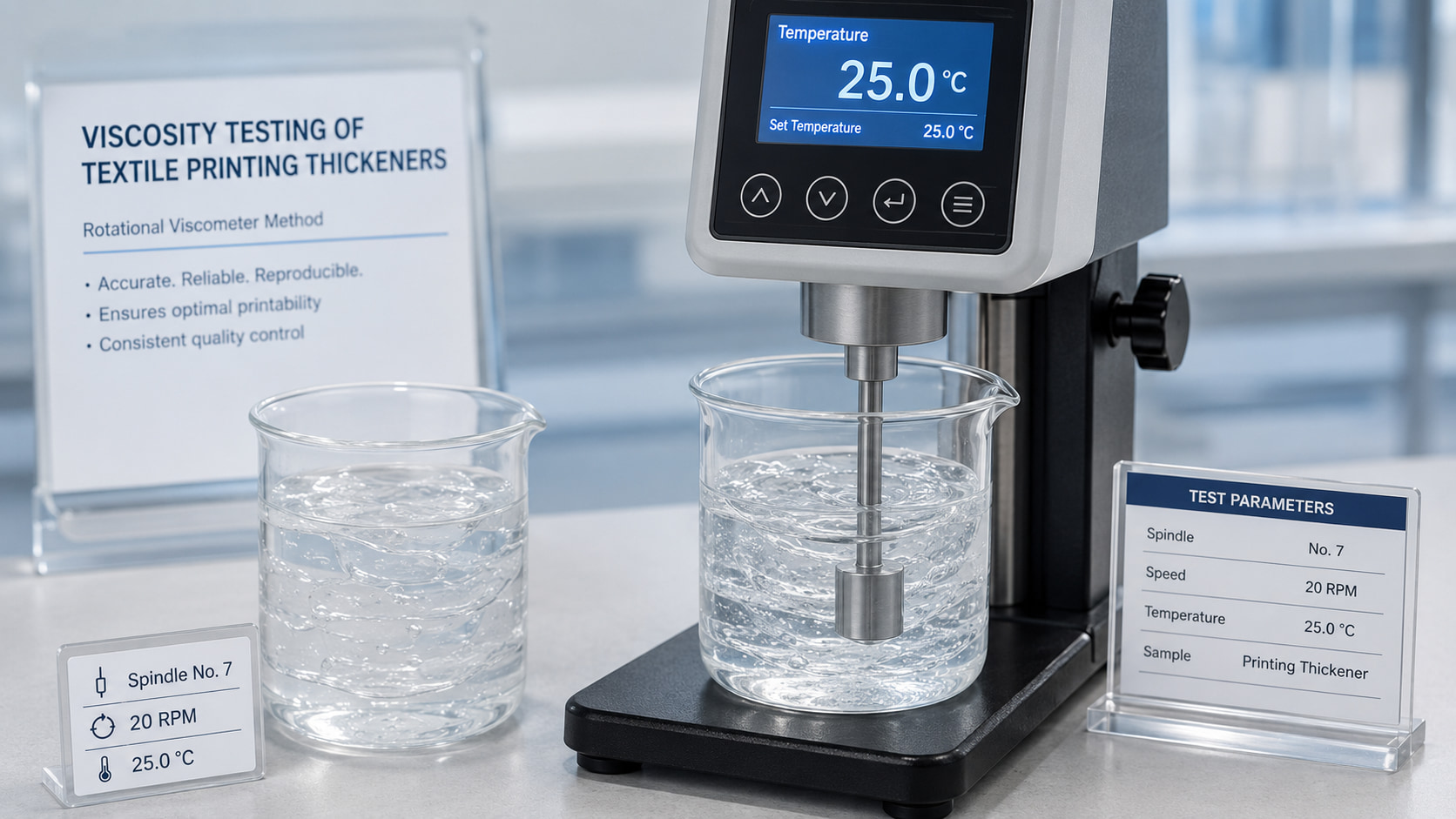
Confirm the complete viscosity method
Концентрация пробы
Источник воды
Preparation and hydration procedure
Температура измерения
Instrument model
Шпиндель, ротор или геометрия
Скорость вращения
Reading time and unit
Evaluate flow under shear
The paste must flow during pumping, screen passage, coating or padding. Excessive resistance can reduce transfer and production speed.
Evaluate recovery after application
After reaching the fabric, the paste should recover enough structure to control spreading without causing poor leveling.
Do not select the highest viscosity automatically
Excessive viscosity may increase pumping resistance, reduce screen passage or create uneven application.
Use multi-speed testing where useful
Measurements at more than one rotational speed can reveal differences between products that appear similar in a routine single-point test.
4. Evaluate Chemical Compatibility
Clean-water viscosity is only an initial screening result. The thickener must remain suitable after the rest of the manufacturing formula is added.
Test realistic chemical levels
Use the actual dyes, pigments, salts, alkalis, binders, humectants and auxiliaries found in production.
Control the order of addition
Local exposure to concentrated alkali, electrolyte or binder may cause thinning, gel formation or flocculation.
Record immediate and delayed changes
Some incompatibility appears immediately, while other changes develop during the normal holding period.
Test more than one representative shade
Dark shades or formulations with higher chemical loading may behave differently from a light laboratory shade.
Do not correct incompatibility only by changing viscosity
Adding more thickener may restore a numerical value without correcting the underlying chemical problem.
5. Check Dispersion and Hydration
A technically suitable product can fail when it is prepared incorrectly. Powder addition, mixing and hydration should be standardized.
Create stable circulation first
Start the mixer before introducing powdered thickener. The liquid should move sufficiently without drawing excessive air into the batch.
Добавляйте порошок постепенно
Dumping the entire quantity into one location can trap dry powder inside a hydrated outer layer.
Record addition and mixing time
Different operators may produce different results when addition time and mixer settings are not controlled.
Allow sufficient hydration
Visible dispersion does not always mean that the polymer has developed its final properties.
Inspect the complete vessel
Check for dry powder, gel particles, settling or nonuniform viscosity near the surface, wall and bottom.
6. Review Filtration and Machine Reliability
Filtration performance can influence screens, pumps, coating units, transfer lines and pretreatment equipment.
Use a defined filtration test
Record filter material, opening size, sample quantity, pressure condition and filtration time.
Test both stock and final paste
A stock solution may filter well but form particles after dyes, binders or salts are added.
Inspect retained material
Identify whether residue is undissolved powder, hydrated gel, precipitated chemical, fibre contamination or foreign matter.
Monitor machine interruptions
Record screen cleaning, filter replacement, pressure variation and production stops during the trial.
Do not rely on visual smoothness
A paste can look smooth while still containing particles that affect fine manufacturing equipment.
7. Test Holding and Production Stability
Textile pastes may remain in a tank for hours before use or circulate during a long production run. Their condition should remain acceptable throughout the approved period.
Define the required holding time
Test the period actually used by the factory rather than an arbitrary short laboratory interval.
Monitor viscosity at defined stages
Immediately after preparation
After complete hydration
After full formulation
After the normal holding period
During a representative production run
Check physical stability
Разделение
Settling
Surface skin formation
Foam retention
Gel development
Filterability after storage
Control storage temperature and evaporation
Open containers and changing temperature can alter concentration and apparent viscosity.
Compare production from beginning to end
Fabric from the beginning, middle and end of a run should remain within the required quality range.
8. Evaluate Final Textile Quality
A thickener should not be approved from solution viscosity alone. Final evaluation must include the printed, fixed, washed or cured textile.
Определение термина «печать»
Use designs containing fine lines, small text, sharp corners and closely spaced elements.
Spreading and penetration
Determine whether the color remains within the intended boundary and reaches the required depth in the fabric.
Равномерность по площади твердой фазы
Inspect large printed areas for mottling, foam marks, poor transfer or uneven pickup.
Shade and color response
Compare samples only after identical fixation, steaming, curing and washing conditions.
Wash-off or curing
Check residual paste, binder performance and the efficiency of the normal post-treatment process.
Тканевая ручка
A sharp print is not acceptable when the finished fabric becomes excessively stiff, sticky or uneven.
9. Confirm Batch Quality and Documents
After a grade passes the application trial, buyers should confirm how the approved sample will be connected to commercial supply.
Permanent commercial grade
The sample, TDS, quotation, purchase order, package label and COA should identify the same product route.
Технический паспорт
The TDS should identify the grade, application direction, relevant properties and preparation guidance.
Паспорт безопасности
The SDS supports handling, storage, transport and internal safety review.
Сертификат анализа
The COA should identify the commercial product and production batch and report the agreed control parameters where applicable.
First-batch verification
The first commercial shipment should be compared with the approved reference before routine production use.
Price per kilogram is only one part of the purchasing decision. A product with a lower quotation may require higher dosage, longer preparation or more production correction.
Material cost
Calculate the delivered price and actual optimized dosage per paste or production batch.
Preparation cost
Include mixing, hydration, heating, cooling, labor and filtration.
Machine cost
Include cleaning, downtime, pressure problems, slower production and corrective additions.
Waste cost
Include filter residue, unused paste, tank residue and rejected formulation.
Quality cost
Include reprinting, additional washing, rejected fabric and customer claims.
Supply cost
Include packaging, freight, import charges, inventory and batch verification.
Candidates should be compared only after they meet the same final textile and production requirements.
Selection Guidance by Manufacturing Process
Технологический процесс
Practical Starting Route
Critical Evaluation
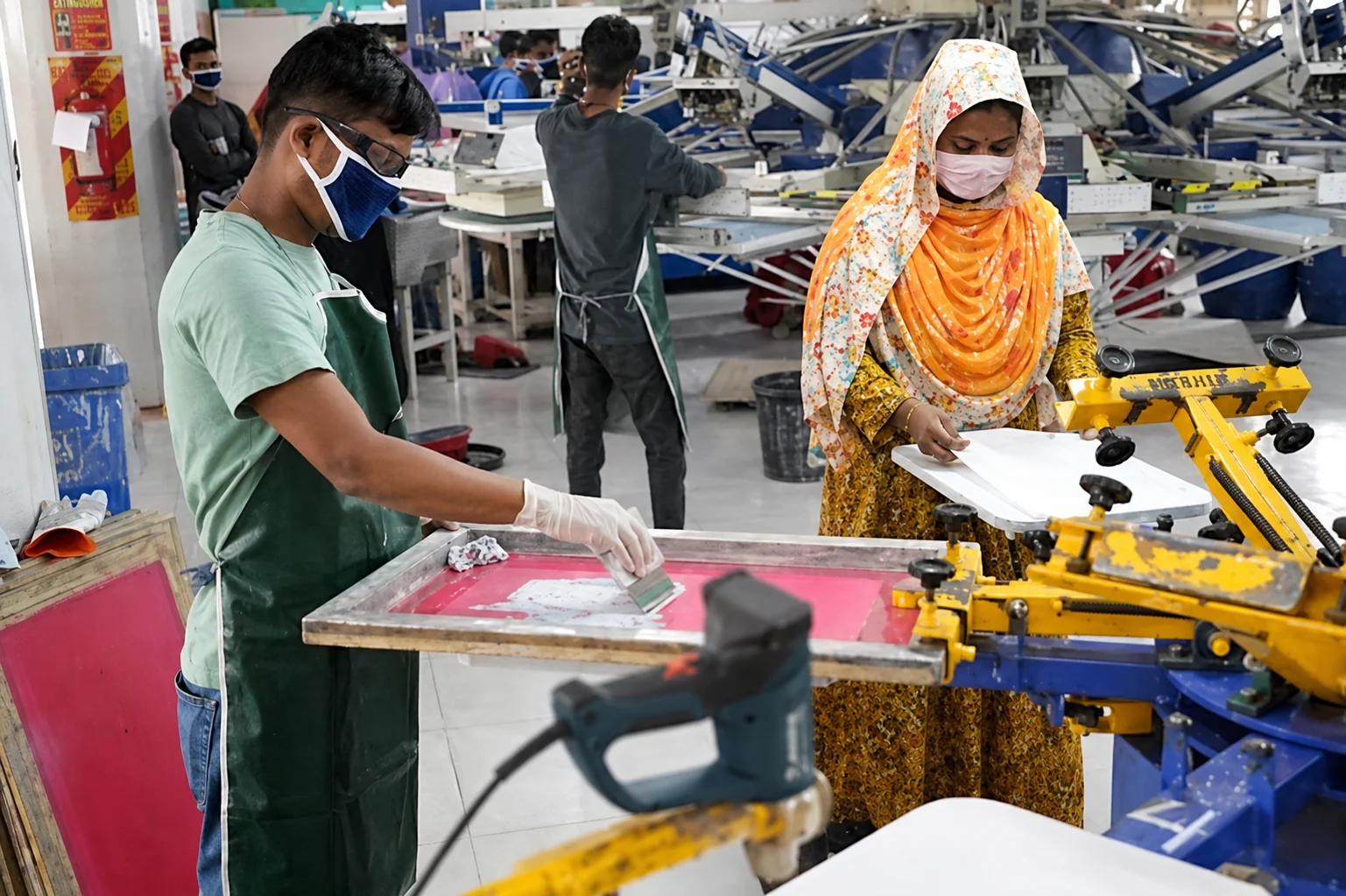
Reactive flat-screen printing
Sodium alginate or validated reactive compound thickener
Paste transfer, definition, dye compatibility, filtration and wash-off
Reactive rotary-screen printing
Matched sodium alginate or high-speed compound route
Circulation, shear response, screen passage and long-run stability
Pigment screen printing
Synthetic or binder-compatible compound thickener
Binder stability, curing, rubbing durability and fabric handle
Selected disperse printing
CMS, synthetic or application-specific compound system
Paste stability, transfer, fixation and polyester surface result
Реактивная цифровая предварительная обработка
Dedicated reactive digital printing paste
Uniform pickup, ink spreading, fixation, wash-off and handle
Цифровая предварительная обработка методом диспергирования
Dedicated disperse digital printing route
Application uniformity, drying, fixation and migration behavior
Pigment digital pretreatment
Dedicated pigment and binder-compatible route
Particle stability, curing, rubbing performance and handle
Warp sizing
Selected CMC, CMS or controlled blend
Adhesion, film flexibility, abrasion, weaving and desizing
Textile coating
CMC, synthetic or compound rheology modifier
Binder compatibility, pickup, leveling, adhesion and curing
These recommendations identify a suitable product family for initial testing. They do not establish automatic grade approval.
When to Consider Sodium Alginate
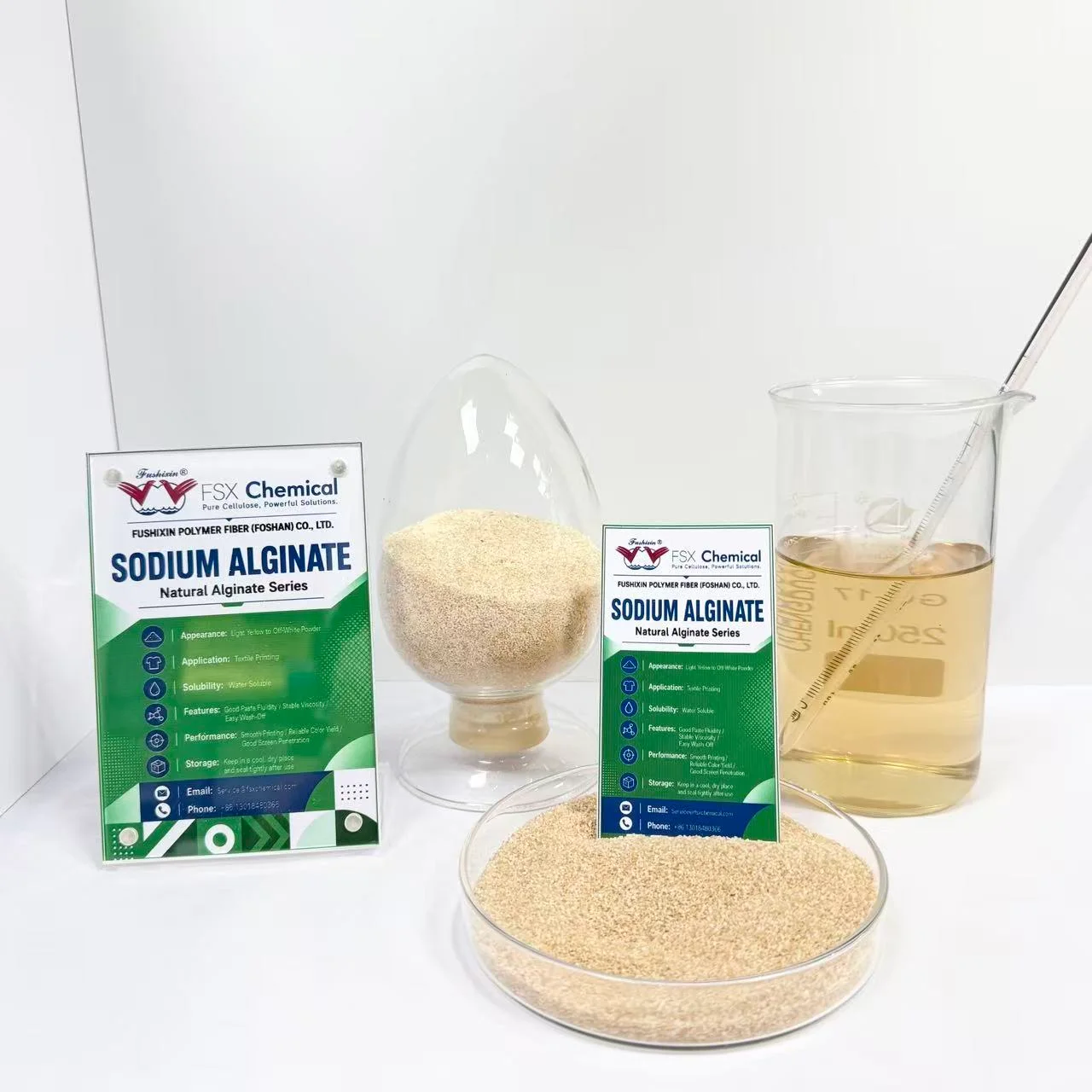
Альгинат натрия is a practical starting route for reactive dye printing on suitable cellulosic fabrics.
Important evaluation areas
Полный метод определения вязкости
Powder hydration and solution uniformity
Filtration and insoluble residue
Flow through flat or rotary screens
Structural recovery and print definition
Dye, salt and alkali compatibility
Fixation, wash-off and fabric handle
Batch-to-batch consistency
Do not select sodium alginate only by its highest viscosity or a general purity description. The grade should be tested in the complete reactive printing formula.
When to Consider CMC
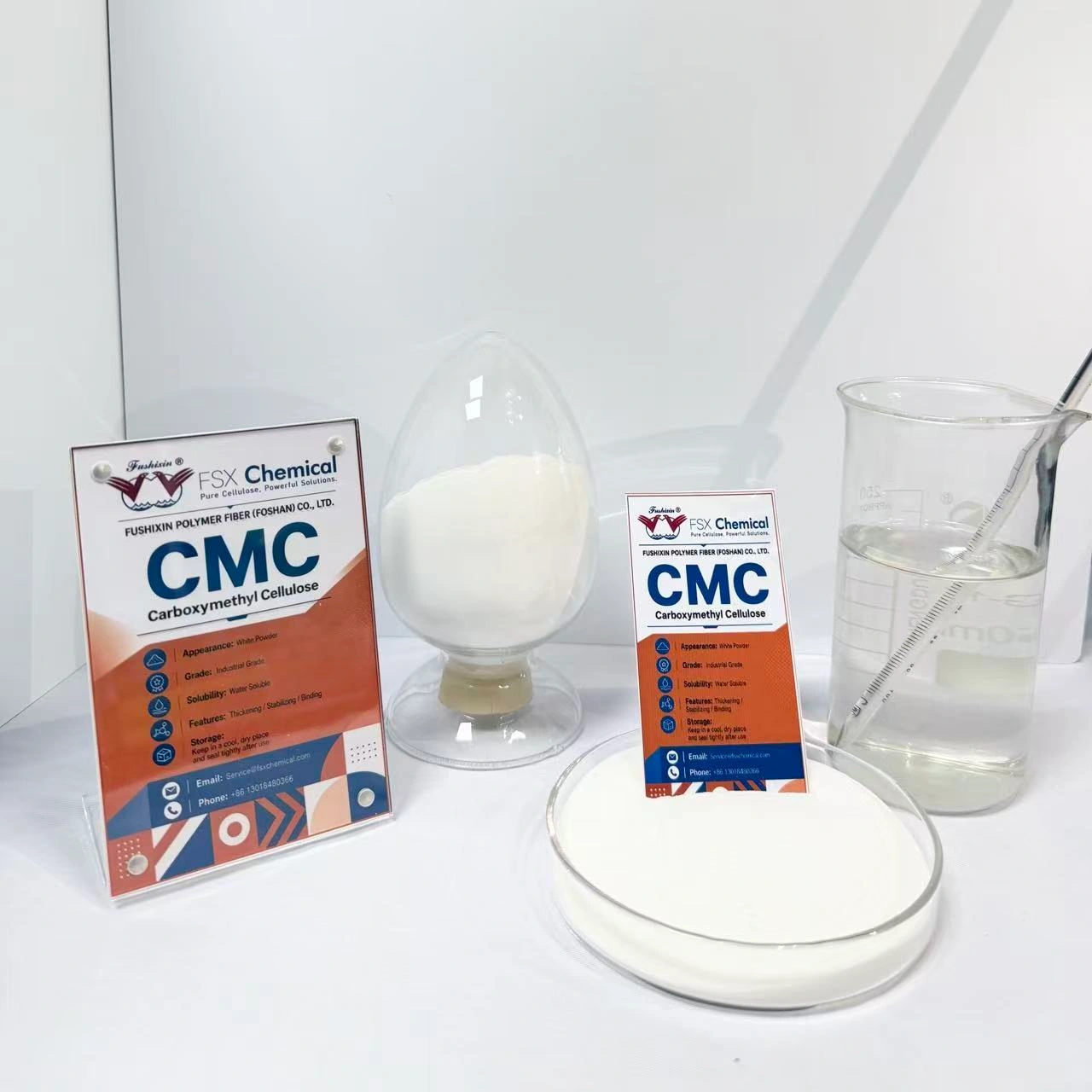
Карбоксиметилцеллюлоза , commonly abbreviated as CMC, can be evaluated in selected printing, compound thickener, sizing and coating formulations.
Important evaluation areas
Viscosity grade and complete measurement method
Степень замещения
Purity and residual salts
Particle size and hydration
pH and electrolyte response
Rheology and holding stability
Film behavior and removal
Compatibility with other polymers
Two CMC grades with similar viscosity may perform differently because their substitution, purity, particle characteristics and chemical tolerance are not identical.
When to Consider CMS
Карбоксиметилкрахмал , commonly abbreviated as CMS, may be evaluated in selected disperse printing, compound thickener and sizing formulations.
Important evaluation areas
Viscosity and preparation method
Степень замещения
Hydration and particle behavior
Стабильность пасты
Dye and electrolyte compatibility
Film properties
Wash-off or desizing
Total cost at the optimized dosage
CMS should not be considered a universal direct replacement for sodium alginate or CMC. Its suitability depends on the complete application.
When to Consider Synthetic or Compound Thickeners
Synthetic and compound thickeners may be appropriate when the manufacturing process requires application-specific rheology, binder compatibility or a simplified preparation route.
Synthetic thickeners
These are commonly evaluated in pigment printing and specialized formulations. Buyers should check pH requirements, neutralization, electrolyte tolerance, binder compatibility and final curing performance.
Compound thickeners
A compound thickener can combine natural, modified and synthetic components to balance flow, recovery, stability, dosage and cost.
Confirm product identity
Compound products should have a permanent commercial code, current TDS, intended application and clear sample-to-bulk route.
Test the complete formulation
Similar water viscosity does not indicate that two compound products have the same composition or manufacturing performance.
When to Use a Dedicated Digital Printing Paste
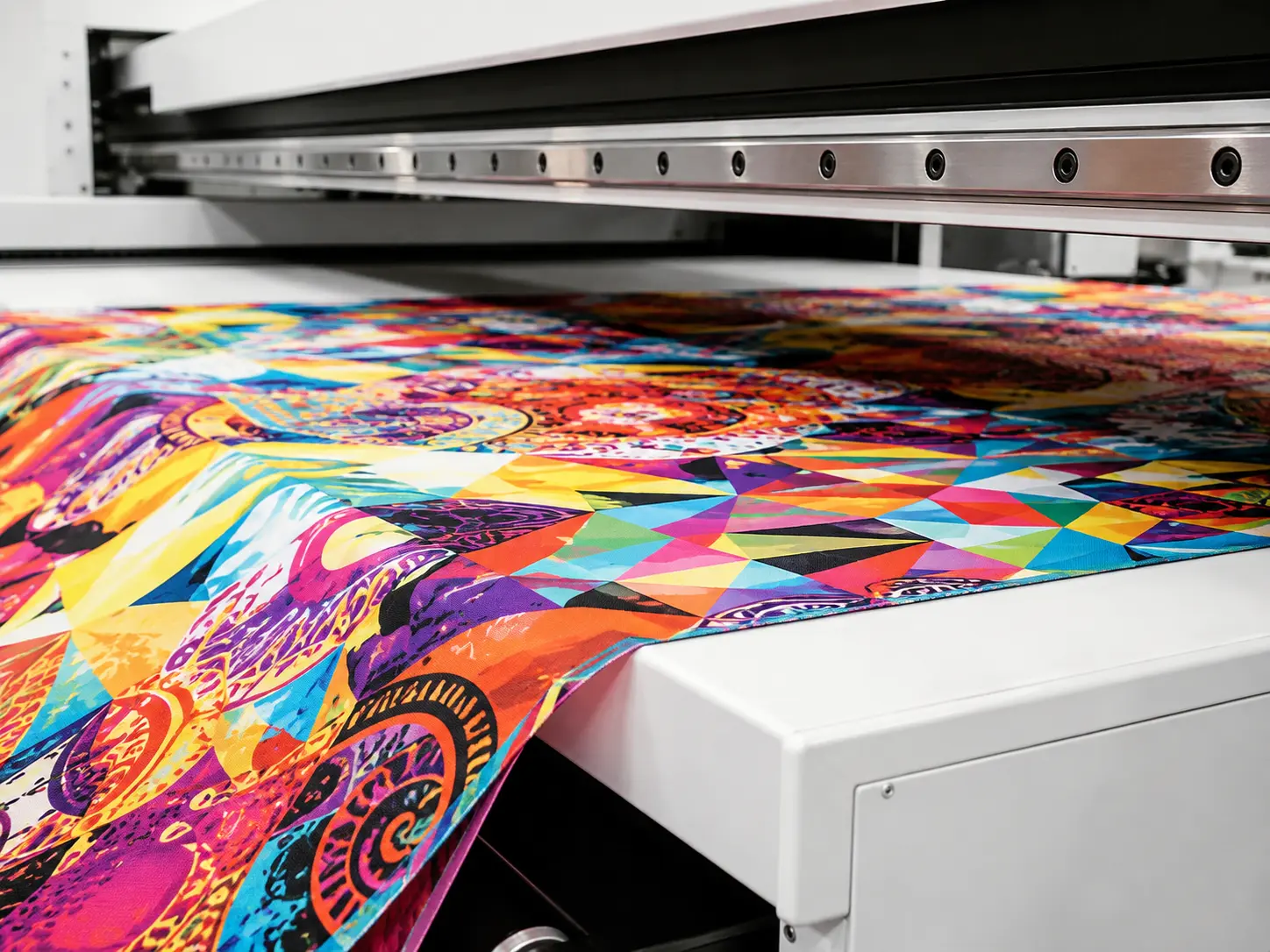
Digital textile manufacturing often applies a pretreatment to the fabric before inkjet printing. This process should not be treated as identical to conventional color-paste screen printing.
Review addition rate, mixer pattern, water temperature and hydration time
Вязкость ниже заданного значения
Incorrect concentration, incomplete hydration, chemical interaction or method difference
Check weighing, water, temperature, chemicals and test method
Вязкость превышает заданное значение
Excess dosage, evaporation, lower temperature or unsuitable grade
Review concentration, container closure, temperature and product route
Excessive filter residue
Undissolved material, gels, chemical precipitation or contamination
Inspect residue and test the stock and final paste separately
Print edges spread
Low paste structure, slow recovery, excessive pickup or high fabric absorbency
Review rheology, dosage, application amount and fabric
Poor paste transfer
Excessive viscosity, unsuitable shear response or screen restriction
Review multi-speed behavior, filtration and machine settings
Paste separates during storage
Product mismatch, incompatible chemicals, poor dispersion or insufficient structure
Review product route, addition sequence and complete formulation
Finished fabric feels stiff
Excess dosage, poor removal, binder interaction or excessive surface film
Review dosage, washing, curing and complete formulation
Bulk batch differs from sample
Grade identity, batch variation, storage, water or test-method difference
Compare product codes, COA, retained samples and complete methods
How FSX Chemical Supports Grade Matching
FSX Chemical supplies sodium alginate, CMC, CMS, digital printing paste and related textile thickener routes for printing mills, formulators, importers and distributors.
Grade matching begins with the buyer’s manufacturing process rather than with one general product recommendation.
Buyers can provide
Printing or manufacturing process
Fabric and fibre composition
Система красителей, пигментов или чернил
Current product name, TDS or sample
Current dosage and preparation method
Target viscosity and complete test method
Application equipment and production speed
Main technical or cost problem
Estimated quantity, packaging and destination
Technical review may include
Identification of the suitable thickener family
Review of the current product specification
Alignment of viscosity methods
Recommendation of a candidate commercial grade
Provision of relevant TDS and SDS information
Поддержка репрезентативной выборки
Guidance for side-by-side preparation
Review of laboratory and production-trial feedback
Batch documentation for the confirmed commercial grade
A recommended product remains a candidate for controlled evaluation. Final approval depends on the customer’s complete formulation, fabric, equipment, process conditions and finished-textile requirements📧 Электронная почта: Service@fsxchemical.com
Узнайте, почему значения вязкости загустителей для текстильной печати нельзя сравнивать без учета таких факторов, как концентрация, температура, прибор, шпиндель, скорость, метод подготовки проб и время испытания.
Узнайте, как выбирать загустители и способы предварительной обработки для реактивной, дисперсной, пигментной и цифровой печати на текстиле с учетом требований к ткани, красителю или чернилам, фиксации, вымываемости и качеству печати.
Сравните CMC, CMS, альгинат натрия и пасту для цифровой печати на текстиле. Узнайте, насколько каждый из этих материалов подходит для реактивной, дисперсной, пигментной и цифровой печати, а также на что покупателям следует обратить внимание перед тестированием образцов, подбором марки и оптовой закупкой.
Альгинат натрия широко используется в текстильной печати в качестве стабильного и стойкого к стирке загустителя для реактивных печатных паст. Узнайте, как перед покупкой оценить класс вязкости, степень чистоты и пригодность продукта для конкретного применения, а также о том, как компания FSX Chemical оказывает поддержку покупателям по всему миру, предоставляя технические данные и образцы.
Карбоксиметилцеллюлоза (КМЦ) широко используется в процессах печати, проклеивания и окрашивания текстиля. В данном руководстве рассказывается, как оценивать марки КМЦ, какие параметры являются наиболее важными и как компания FSX Chemical может помочь в принятии решений о закупках.
Карбоксиметилцеллюлоза используется в качестве загустителя и стабилизатора в чернилах на водной основе, в глубокой печати и при предварительной обработке для струйной печати. В данном руководстве рассмотрены основные параметры марок этого материала и рекомендации по его закупке для специалистов по снабжению.
Печатная паста на основе CMC используется в пигментной, реактивной и цифровой текстильной печати. В данном руководстве объясняется, какие параметры имеют значение, как сравнивать поставщиков и что следует уточнить перед размещением оптового заказа.
И альгинат натрия, и CMC используются в качестве загустителей при печати на текстиле, однако они подходят для разных систем окрашивания и условий производства. В данном руководстве объясняются основные различия между ними и приводятся рекомендации по их применению.
Цифровая струйная печать на текстиле предъявляет иные требования к пасте и предварительной обработке материала, чем трафаретная печать. В данном руководстве объясняется, как альгинат натрия используется в цифровой печати на текстиле и какие параметры качества должны указывать специалисты по закупкам.
Пищевой и промышленный CMC имеют одинаковый химический состав, но значительно различаются по степени очистки, диапазону степени дефибринации (DS) и нормативным требованиям. В данном руководстве объясняются основные различия и причины, по которым использование несоответствующего класса продукта приводит к проблемам в производстве.
При печати на текстиле реактивными красителями правильная подготовка пасты не менее важна, чем выбор сорта краски. В данном руководстве рассматриваются методы растворения альгината натрия, диапазоны концентраций в зависимости от области применения, условия хранения, а также способы устранения типичных проблем при подготовке пасты.
Альгинат натрия — это природный биоразлагаемый полимер, однако его использование в текстильной печати приводит к образованию сточных вод, требующих соответствующей обработки. В данном руководстве рассматриваются экологические характеристики альгината натрия, свойства сточных вод после вымывания, а также то, что специалистам по закупкам необходимо знать о выборе загустителя и его воздействии на окружающую среду.
Сообщите название продукта, область применения, количество, пункт назначения, а также предоставьте техническое описание продукта (TDS),
фотографию образца или имеющиеся у вас документы. Компания FSX Chemical рассмотрит
эту информацию и порекомендует дальнейшие действия для подготовки коммерческого предложения, подбора образца
или выбора продукта.
Информация о продуктеНазвание товара, класс, модель, фотография этикетки или артикул поставщика.
Доступные документыTDS, SDS, COA, фотография образца, перечень продукции или данные испытаний.
Детали заказаПредполагаемый объем, упаковка, страна назначения, порт или условия торговли.
Область применения или проблемаПроцесс печати на текстиле, требования к составу, текущие проблемы или целевые показатели.

 RU
RU  EN
EN  BN
BN  ES
ES  TR
TR  FR
FR  ID
ID  AR
AR  UR
UR  VI
VI  TL
TL  HI
HI  UK
UK  KK
KK  KA
KA  UZ
UZ