Compare the Top 3 Textile Printing Thickeners for Cost and Performance
The cheapest textile printing thickener is not necessarily the lowest-cost option in production. This guide...
Choosing a textile printing thickener by price per kilogram can lead to the wrong purchasing decision. Sodium alginate, CMC and CMS can differ substantially in effective dosage, rheology, filtration, print definition, dye compatibility and downstream processing. This guide compares the three routes from both technical and commercial perspectives, with one objective: identifying the technically suitable thickener that delivers the required printing result at a competitive total cost in use.
Why Thickener Cost Cannot Be Compared by Price per Kilogram Alone
For a purchasing manager, comparing textile printing thickeners may initially appear simple: obtain quotations for sodium alginate, carboxymethyl cellulose and carboxymethyl starch, compare the price per kilogram and select the cheaper material.
In actual textile production, this calculation is incomplete.
A printing thickener is not purchased simply to create viscosity in water. Its purpose is to control the complete printing paste during preparation, storage, transfer to the fabric, printing, fixation and washing. Two products with different prices can therefore generate very different production economics.
A practical comparison should include:
Delivered product price
Effective thickener dosage
Stock-paste concentration
Время гидратации
Mixing requirements
Filtration loss
Стабильность пасты
Отрывок с экрана
Printing speed and continuity
Определение термина «печать»
Проникновение
Цветоотдача
Fixation performance
Wash-off behavior
Cleaning frequency
Простои оборудования
Paste waste
Rejected or reprocessed fabric
This is why a lower product price does not automatically mean a lower production cost.
The more useful purchasing question is:
Which technically suitable thickener achieves the required printing performance at the lowest stable total cost in use?
Quick Comparison: Sodium Alginate, CMC and CMS
Three polysaccharide-based routes are frequently evaluated in textile printing: sodium alginate, CMC and CMS. They should not be treated as universally interchangeable products. Each material family contains multiple grades, and the behavior of a commercial grade depends on its manufacturing specifications and the complete printing formulation.
Comparison Area
Альгинат натрия
CMC
CMS
Polymer origin
Alginate derived from brown algae
Cellulose-derived polymer
Starch-derived polymer
Typical evaluation position
Common benchmark for conventional reactive printing
Candidate for selected textile printing and compound systems
Candidate for selected disperse, specialty and compound systems; selected reactive applications require validation
Важные переменные, влияющие на оценку
Viscosity, concentration, rheology, hydration and filtration
DS, viscosity, concentration, hydration, electrolyte response and filtration
Viscosity efficiency, hydration, filtration, paste stability and formulation compatibility
Cost evaluation
Compare benchmark reliability with actual dosage and processing cost
Compare effective dosage and complete-paste performance, not price alone
Often evaluated where formulation economics are important, but actual cost advantage must be demonstrated in trials
Replacement logic
Often used as the reference product
Not a universal 1:1 substitute for sodium alginate
Not a universal 1:1 substitute for sodium alginate
Best decision method
Standardized laboratory comparison followed by printing, fixation/washing and production validation
The table provides a starting point, not a universal ranking. The correct decision changes with the dye system, fabric, printing equipment, paste recipe and production target.
1. Sodium Alginate: The Reactive Printing Benchmark
Альгинат натрия remains an important reference thickener in conventional reactive printing on suitable cellulosic fabrics.
Its value is not simply that it produces a high viscosity. Buyers usually evaluate sodium alginate because of the overall balance it can provide in an established reactive printing process.
Where Sodium Alginate Can Offer Strong Value
Conventional reactive printing on cotton and suitable cellulosic fabrics
Production lines where the existing recipe has already been optimized around alginate
Applications where print definition and controlled penetration are critical
Operations where predictable fixation and wash-off are important
Factories that prefer a proven benchmark before testing alternative thickener routes
For a factory with a stable sodium alginate process, changing to another polymer only because its quotation is lower may create hidden costs. A new thickener can change paste rheology, screen behavior, color development, penetration or washing requirements.
What Buyers Should Compare Between Sodium Alginate Grades
The words “high viscosity,” “medium viscosity” or “low viscosity” are not sufficient specifications by themselves.
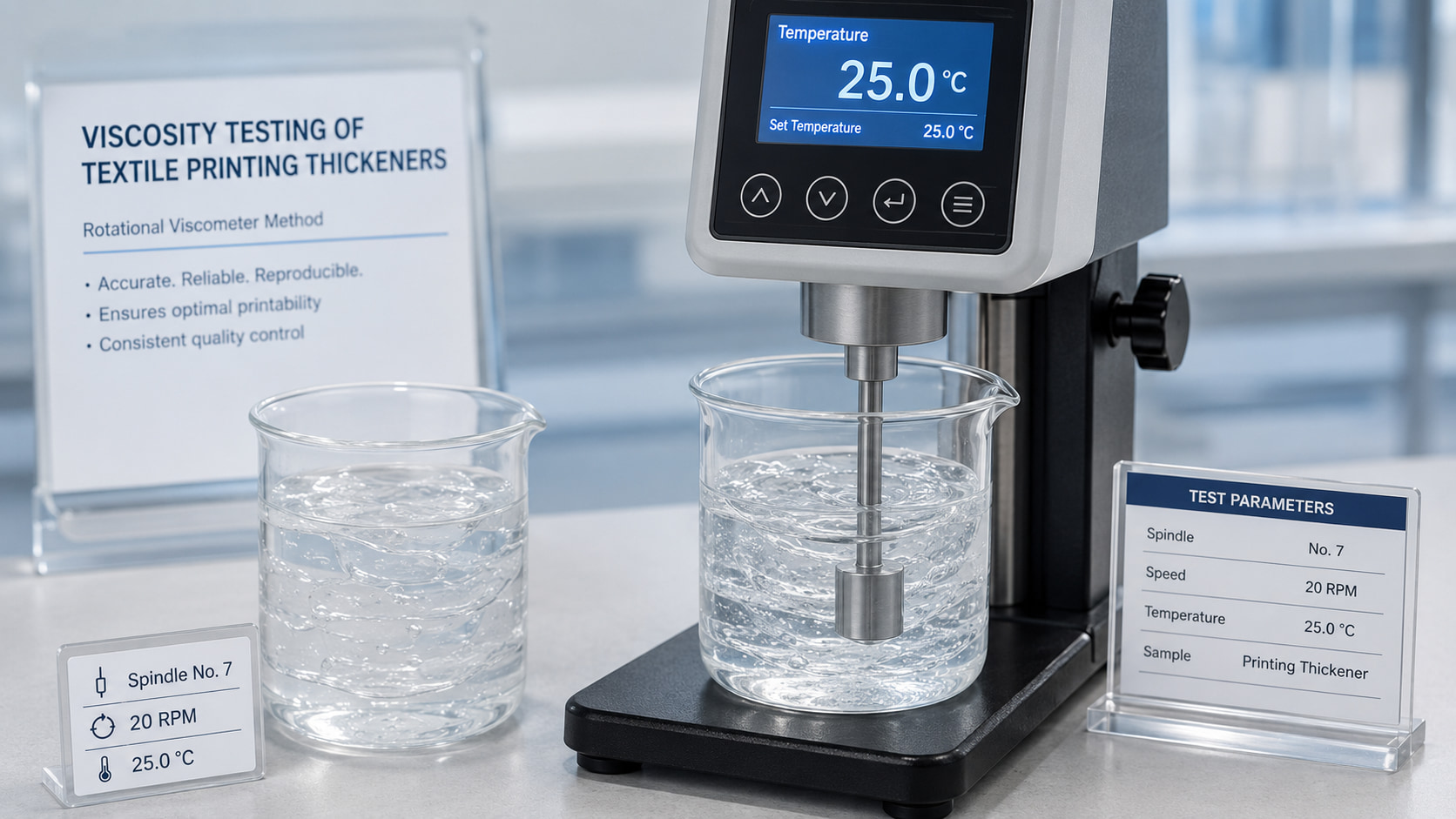
Request the supplier’s test conditions, including:
Polymer concentration used for viscosity testing
Качество воды
Процедура увлажнения
Температура испытания
Viscometer type
Шпиндель или ротор
Скорость вращения
Время чтения
A 1% viscosity result cannot be compared directly with a 2% result, and even two values measured at the same concentration can be misleading if the instruments or measurement conditions differ.
Cost Consideration
Sodium alginate should therefore be evaluated as a production benchmark rather than classified automatically as either the cheapest or most expensive option.
If an established alginate provides consistent printing with low waste, good screen performance and predictable washing, its higher purchase price relative to another candidate may still produce a competitive total production cost.
2. CMC: A Flexible Route for Selected Printing Systems
Карбоксиметилцеллюлоза (CMC) is a cellulose-derived water-soluble polymer available in a wide range of viscosity and substitution levels.
In textile applications, CMC should be selected by commercial grade rather than simply by polymer name. Two CMC products can behave differently because of differences in degree of substitution, molecular characteristics, purity, hydration and salt response.
Important CMC Selection Parameters
Degree of substitution (DS)
Вязкость и концентрация в испытании
Hydration rate
Solution uniformity
Фильтрация
Реакция электролитов
Shear behavior
Полная совместимость с вставкой текста
For selected textile printing systems, CMC can be evaluated as part of a cost-performance optimization project or as a component of a compound thickener formulation.
However, this does not mean that a CMC grade with the same measured viscosity as sodium alginate will automatically deliver the same printing result.
Where CMC Can Become Commercially Interesting
CMC becomes worth evaluating when a buyer is trying to improve one or more of the following:
Effective formulation cost
Эффективность вязкости
Подготовка пасты
Rheology control
Selected electrolyte-response requirements
Compound-thickener formulation flexibility
Supplier diversification
The technically correct approach is to identify a candidate grade and test it in the buyer’s real formulation rather than promise a universal sodium alginate replacement.
This distinction matters commercially. A cheaper CMC that requires a substantially higher dosage or produces more filtration loss may provide no real saving. Conversely, a properly selected CMC grade or compound system can be commercially attractive when the dosage and printing performance are optimized for the specific process.
3. CMS: A Cost-Performance Candidate for Selected Applications
Карбоксиметилкрахмал (CMS) is a starch-derived polymer that can be evaluated in selected textile printing and compound-thickener systems.
Its potential should be assessed using the complete printing formula rather than by comparing dry-powder price or stock viscosity alone.
Important CMS Evaluation Points
Эффективность вязкости
Гидратация
Фильтрация
Стабильность пасты
Отрывок с экрана
Эффективная доза
Dye-system compatibility
Определение термина «печать»
Finished fabric performance
CMS can be commercially interesting in selected disperse printing, specialty printing and compound-thickener systems. Selected reactive systems can also be investigated, but they require formulation-specific validation.
This is particularly important because thickener performance can be dye-dependent. A system that works well with one dye or recipe may behave differently after the dye concentration or chemistry changes.
CMS and Compound Thickener Systems
CMS can also be evaluated as one component in a compound formulation.
A compound system may combine different rheology-control components to target a balance between:
Базовая вязкость
Сдвиговое разжижение
Восстановление конструкции
Фильтрация
Paste holding stability
Определение термина «печать»
Толерантность к электролитам
Cost in use
This does not mean that a compound product is automatically better than a single-polymer thickener. It simply provides another formulation route when one polymer alone does not achieve the required balance.
Why the Same Viscosity Does Not Mean the Same Printing Performance
This is one of the most important principles when comparing textile printing thickeners:
Same viscosity does not mean the same printing performance.
Viscosity is only one measurable property of a printing paste.
Consider three thickener solutions that all produce a laboratory reading of 20,000 mPa·s under a specific test method. They can still behave differently during printing because their flow curves, shear response and structural recovery may not be the same.
During actual printing, the paste experiences different shear conditions as it moves through pumps, pipes, screens, squeegees and the fabric surface.
Performance can therefore differ in:
Flow under shear
Recovery after shear
Выпуск фильма
Четкость тонких линий
Чёткость краёв
Проникновение
Равномерность по площади твердой фазы
Paste holding stability
Polymer chemistry also affects interactions with dyes, salts, alkalis, binders and other auxiliaries.
For this reason, viscosity should be treated as a controlled QC parameter, not as the sole predictor of production performance.
How to Calculate Total Cost in Use
Price per kilogram is still relevant, but it should be placed inside a larger cost model.
Step 1: Calculate the Direct Thickener Cost
The first calculation is straightforward:
Direct Thickener Cost = Product Price × Effective Dosage
Consider this simplified illustration. The figures below are hypothetical and are not market quotations.
Candidate
Illustrative Price
Illustrative Effective Dosage per 1,000 kg Paste
Direct Thickener Cost
Grade A
USD 3.20/kg
35 kg
USD 112
Grade B
USD 2.40/kg
45 kg
USD 108
Grade C
USD 1.80/kg
60 kg
USD 108
Grade C is 43.75% cheaper per kilogram than Grade A in this illustration, but the direct thickener cost per 1,000 kg of paste is almost the same because the effective dosage is different.
This is why quotation comparison without dosage information can be misleading.
Step 2: Add Preparation Cost
Оцените:
Время смешивания
Время гидратации
Energy consumption
Labor
Need for additional filtration
Undissolved material or gel loss
Step 3: Add Printing-Line Cost
Check whether the candidate changes:
Screen cleaning frequency
Скорость работы станка
Перенос с помощью наклейки
Printing interruptions
Foam formation
Paste waste
Step 4: Add Finished-Quality Cost
A thickener should ultimately be evaluated on the finished textile, not only in the mixing tank.
Сравните:
Цветоотдача
Резкость
Проникновение
Levelness
Закрепление красителя
Смываемость
Чистота фона
Fabric handle where relevant
Reject rate
Reprinting or corrective processing
A small reduction in chemical cost is not attractive if it increases rejected fabric or machine downtime.
A Better Commercial Formula
A more realistic model is:
Total Cost in Use = Delivered Product Cost + Effective Dosage Cost + Preparation Cost + Process Loss + Downtime + Washing/Cleaning Impact + Quality Loss
Not every factory needs to assign an exact monetary value to every item. Even a relative score can make supplier comparisons much more accurate.
Which Thickener Fits Which Printing Process?
The best thickener cannot be selected without first identifying the printing chemistry.
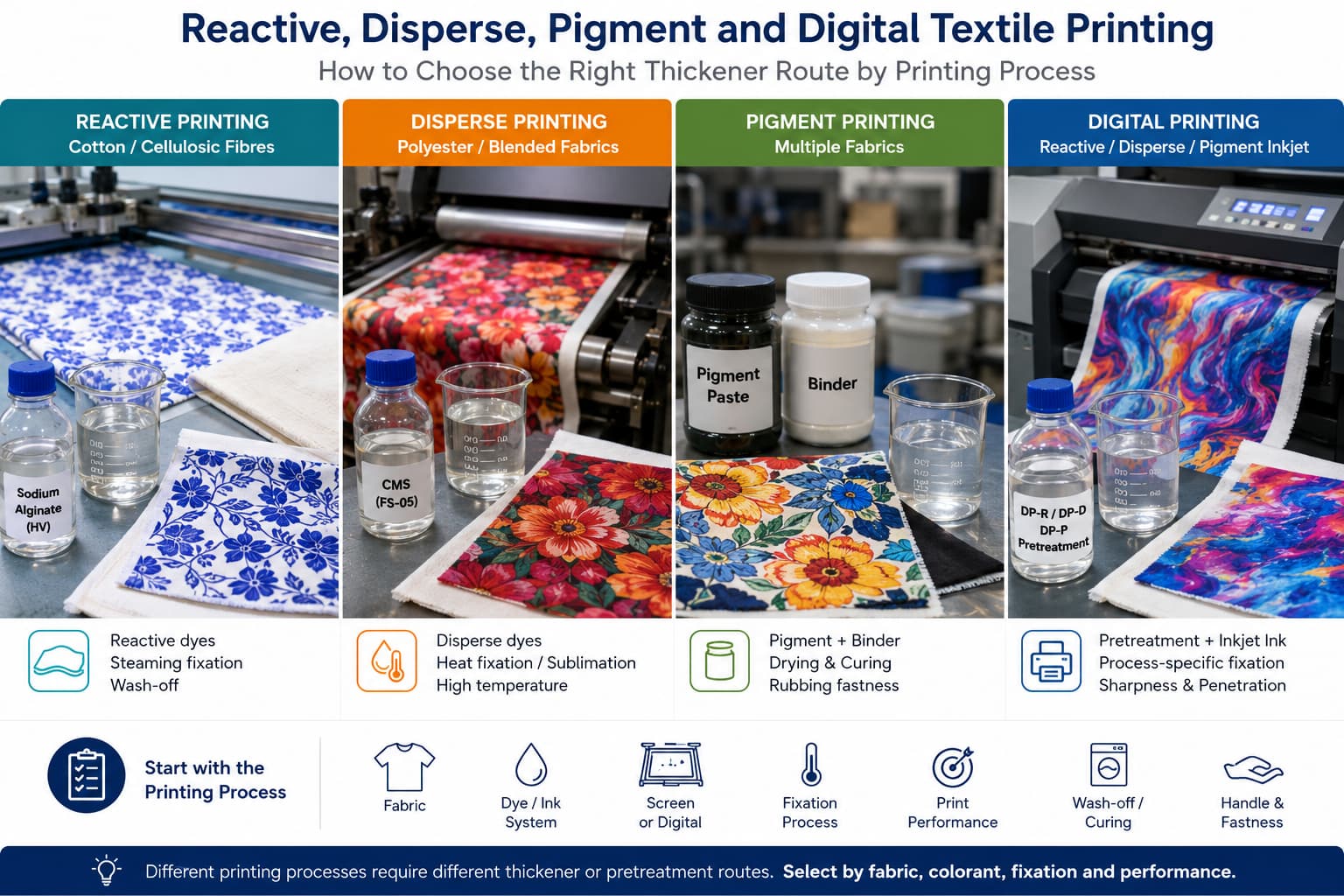
Технология печати
Recommended Evaluation Logic
Conventional reactive printing
Sodium alginate is a common benchmark. CMC, CMS or compound candidates should be tested through the complete paste, printing, fixation and washing sequence.
Печать дисперсными красителями
Focus on paste stability, filtration, screen passage, transfer, solid-area uniformity, print definition and thermal fixation. Do not automatically apply reactive-printing selection rules.
Пигментная печать
Evaluate the thickener together with binder and pigment-dispersion chemistry, including compatibility, rheology, curing and fabric handle.
Digital textile processes
Evaluate the exact digital route separately. Pretreatment rheology, filtration, fabric wetting, ink control and machine requirements can differ significantly from conventional screen-printing paste.
Печать активными красителями
For conventional reactive printing, the comparison should include:
Complete-paste viscosity
Реология
Совместимость с активными красителями
Отрывок с экрана
Четкость тонких линий
Solid-area performance
Проникновение
Закрепление красителя
Смываемость
Чистота фона
A candidate should not be approved only because the stock paste looks similar to the current sodium alginate.
Дисперсная печать
For polyester disperse printing, the technical priorities change.
Important parameters can include:
Стабильность пасты
Фильтрация
Отрывок с экрана
Transfer characteristics
Равномерность по площади твердой фазы
Определение края
Thermal fixation
Эффективная доза
The thickener route that performs best in reactive cotton printing should not automatically be transferred to disperse polyester printing.
Пигментная печать
Pigment printing requires another evaluation approach because the thickener operates inside a formulation containing pigment dispersion and binder.
Проверьте:
Совместимость связующих веществ
Pigment dispersion compatibility
Реакция электролитов
Стабильность пасты
Реология
Определение термина «печать»
Curing behavior
Finished fabric hand feel
Comparing pigment-printing thickeners without the actual binder system can therefore produce misleading conclusions.
How to Compare Sodium Alginate, CMC and CMS in the Laboratory
A controlled comparison is more valuable than comparing three supplier TDS sheets.
Step 1: Define the Printing Process
Identify whether the application is reactive, disperse, pigment, digital or another process.
Step 2: Define the Fabric
Запись:
Состав волокон
Состав ткани
Подготовка ткани
Relevant pretreatment conditions
Step 3: Define the Existing Benchmark
Record the current:
Manufacturer
Commercial grade
TDS
Дозировка
Viscosity test method
Printing formula
Step 4: Standardize the Laboratory Method
Use the same:
Polymer calculation basis
Источник воды
Оборудование для смешивания
Powder addition procedure
Время смешивания
Время гидратации
Температура
Viscometer settings
Step 5: Compare Stock Properties
Оцените:
Внешний вид
Вязкость
Гидратация
Фильтрация
pH, если это имеет значение
Step 6: Compare Rheology
If equipment is available, use multi-speed viscosity measurements or a rheometer rather than relying on one single-speed viscosity value.
The objective is to understand how each paste behaves under different shear conditions.
Step 7: Prepare the Complete Printing Paste
Add the actual production chemicals, including the relevant:
Dyes or pigments
Связующее вещество
Щелочь
Salt
Мочевина
Вспомогательные средства
Only at this stage can formulation compatibility be evaluated properly.
Step 8: Test Holding Stability
Monitor:
Viscosity change
Разделение
Пена
Внешний вид
Характеристики фильтрации
Step 9: Print the Actual Fabric
A useful test design should contain both difficult and easy printing areas, such as:
Fine lines
Sharp edges
Small details
Solid areas
Large coverage areas
Step 10: Complete the Real Post-Treatment
Depending on the process, complete the actual:
Сушка
Обработка паром
Thermal fixation
Отверждение
Промывка
Отделка
Step 11: Optimize Dosage
Do not assume that the new candidate should be used at exactly the same dosage as the current product.
Each candidate should be optimized until it reaches its technically appropriate dosage range. Only then should the commercial comparison be finalized.
Buyer Decision Matrix: Cost vs Performance
The following matrix can help purchasing and technical teams organize the decision.
Buyer Priority
What to Evaluate
Почему это важно
Lowest product price
Price plus actual dosage
Low price per kg may disappear after dosage adjustment
Stable reactive printing
Alginate benchmark plus qualified alternatives
Changing polymer chemistry can affect the complete process
Cost optimization
CMC, CMS and compound candidates where technically relevant
Alternative routes may provide useful cost-performance options after validation
Sharp patterns
Rheology, shear behavior, penetration and structural recovery
A single viscosity value cannot predict print definition
High production reliability
Filtration, screen passage, paste stability and batch consistency
Production interruptions can cost more than chemical savings
Lower total manufacturing cost
Общая стоимость эксплуатации
Includes dosage, waste, downtime, washing and reject risk
Supplier change
Sample-to-bulk verification
Prevents the approved laboratory sample from becoming disconnected from commercial shipments
How to Compare Textile Thickener Suppliers Correctly
A technically meaningful supplier comparison requires more than three quotations.
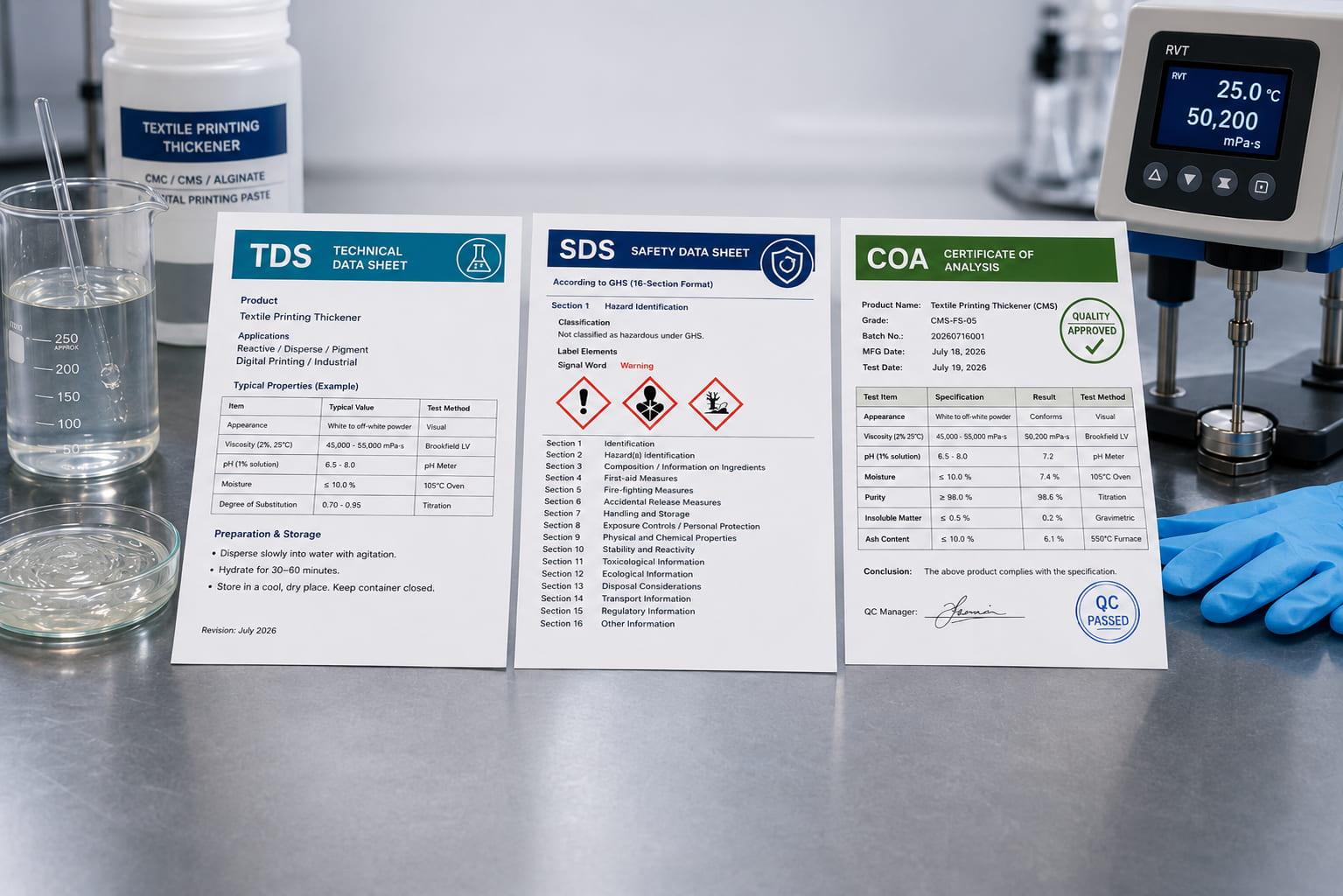
Ask each supplier for:
Exact commercial grade
Технический паспорт
Паспорт безопасности
Batch-specific COA or quality data where applicable
Viscosity test method
Recommended preparation conditions
Recommended dosage range
Relevant application guidance
When requesting technical matching, provide the supplier with enough information to identify a relevant candidate.
Useful information includes:
Current supplier and commercial grade
Текущие данные TDS
Physical sample if available
Current viscosity method
Текущая дозировка
Complete printing formula
Fabric type
Печатная машина
Процесс фиксации или отверждения
Current technical problem
Commercial cost target
A responsible supplier should not promise a guaranteed identical replacement based only on a product name and viscosity value.
A better approach is to select a technically relevant candidate for controlled side-by-side testing.
From Approved Sample to Commercial Batch
The commercial comparison is not complete when the laboratory sample passes.
For industrial buyers, the approved sample should remain connected to the commercial product supplied later.
A practical workflow is:
Select the candidate commercial grade.
Confirm its TDS and test method.
Obtain a representative sample.
Run laboratory testing.
Complete printing and post-treatment trials.
Optimize and approve the working dosage.
Compare the commercial quotation based on the approved dosage.
Confirm the production batch specification.
Obtain batch-specific quality documentation where appropriate.
Verify the first commercial shipment against the approved benchmark.
This process reduces the risk of selecting an attractive laboratory sample that does not represent routine commercial production.
So Which of the Top 3 Textile Printing Thickeners Offers the Best Cost and Performance?
There is no technically responsible universal ranking of sodium alginate, CMC and CMS.
For conventional reactive printing, sodium alginate remains an important benchmark and may provide a strong balance of process compatibility and production reliability.
CMC can be evaluated in selected textile printing and compound-thickener systems where its grade characteristics match the actual formulation and process requirements.
CMS can be an important candidate in selected disperse, specialty and compound systems, while selected reactive applications should be validated through complete formulation testing.
The final decision should therefore follow this sequence:
Printing Process → Fabric → Current Benchmark → Candidate Grade → Standardized Laboratory Test → Complete Paste → Printing Trial → Fixation/Washing → Dosage Optimization → Total Cost in Use
This approach prevents two common purchasing mistakes:
Choosing a product only because its price per kilogram is lower
Assuming that equal viscosity means equal production performance
The best-value thickener is the one that provides the required technical result with stable production economics under your actual factory conditions.
Часто задаваемые вопросы
1. Which textile printing thickener is the cheapest?
There is no universal cheapest option. Compare delivered price together with effective dosage, preparation loss, printing stability, machine downtime, washing requirements and rejected fabric. The lowest price per kilogram may not produce the lowest total production cost.
2. Is sodium alginate better than CMC for textile printing?
Not in every application. Sodium alginate is a common benchmark for conventional reactive printing, while selected CMC grades can be evaluated in appropriate textile printing and compound-thickener systems. The correct choice depends on the printing chemistry, fabric, formulation and production conditions.
3. Can CMC replace sodium alginate 1:1?
A universal 1:1 replacement should not be assumed. CMC and sodium alginate have different polymer characteristics and rheological behavior. Candidate grades should be compared using the complete printing formula and optimized dosage.
4. Can CMS replace sodium alginate?
CMS can be evaluated in selected applications and compound systems, but it should not be treated as a universal sodium alginate substitute. Reactive printing requires particular attention to dye compatibility, fixation and finished fabric performance.
5. Does higher viscosity mean better printing performance?
No. Higher viscosity does not automatically mean better print definition or production performance. Rheology, shear response, structural recovery, filtration, dye compatibility and penetration are also important.
6. If two thickeners have the same viscosity, are they equivalent?
No. The same viscosity reading can be produced by materials with different flow behavior and formulation compatibility. Viscosity is meaningful only when concentration, water, hydration, temperature, instrument and measurement conditions are clearly defined.
7. Which thickener is best for reactive textile printing?
Sodium alginate is commonly used as a benchmark for conventional reactive printing on suitable cellulosic fabrics. Alternative CMC, CMS or compound routes should be evaluated through controlled complete-paste, printing, fixation and washing tests.
8. Which thickener should be evaluated for disperse printing?
The selection should focus on paste stability, filtration, screen passage, print definition, solid-area uniformity, thermal fixation and effective dosage. Selected CMS and compound-thickener systems can be relevant candidates, but the exact grade requires production-specific testing.
9. How should I compare quotations from three thickener suppliers?
Do not compare quotation price alone. Request the exact grade, TDS, viscosity test method, recommended dosage and representative sample. Standardize laboratory testing and compare the commercial cost only after the effective dosage has been optimized.
10. What information should I send for thickener grade matching?
Provide your current product grade or TDS, current dosage, viscosity method, printing formula, fabric, machine, fixation process, technical problem and commercial target. A physical sample of the current product can make matching more relevant.
11. How much sample is needed before changing suppliers?
The appropriate quantity depends on your laboratory and production equipment. A laboratory screening quantity may be sufficient for initial comparison, but a larger sample is normally required before an industrial machine trial. The objective is to complete both formulation and production validation before approving a supplier change.
12. What is the best way to reduce textile printing thickener cost?
Optimize total cost rather than simply purchasing a cheaper polymer. Compare effective dosage, preparation efficiency, filtration, printing stability, machine downtime, fixation, washing and reject rate. A technically stable formulation often creates more meaningful savings than a small reduction in chemical price.
Compare Your Current Textile Printing Thickener with FSX Chemical
If you are currently using sodium alginate, CMC, CMS or another textile printing thickener, FSX Chemical can help select a technically relevant candidate for controlled comparison.
The objective is not to replace one polymer name with another. The objective is to identify the thickener system that provides the required printing performance at a competitive and controllable total cost in use.
Узнайте, почему значения вязкости загустителей для текстильной печати нельзя сравнивать без учета таких факторов, как концентрация, температура, прибор, шпиндель, скорость, метод подготовки проб и время испытания.
Узнайте, как выбирать загустители и способы предварительной обработки для реактивной, дисперсной, пигментной и цифровой печати на текстиле с учетом требований к ткани, красителю или чернилам, фиксации, вымываемости и качеству печати.
Узнайте, в чём заключается разница между документами TDS, SDS и COA, на что следует обратить внимание покупателям текстильной печати, а также как проверять технические характеристики, данные по безопасности, методы испытаний, результаты испытаний партий продукции и информацию об издателях документов.
Сравните CMC, CMS, альгинат натрия и пасту для цифровой печати на текстиле. Узнайте, насколько каждый из этих материалов подходит для реактивной, дисперсной, пигментной и цифровой печати, а также на что покупателям следует обратить внимание перед тестированием образцов, подбором марки и оптовой закупкой.
Альгинат натрия широко используется в текстильной печати в качестве стабильного и стойкого к стирке загустителя для реактивных печатных паст. Узнайте, как перед покупкой оценить класс вязкости, степень чистоты и пригодность продукта для конкретного применения, а также о том, как компания FSX Chemical оказывает поддержку покупателям по всему миру, предоставляя технические данные и образцы.
Карбоксиметилцеллюлоза (КМЦ) широко используется в процессах печати, проклеивания и окрашивания текстиля. В данном руководстве рассказывается, как оценивать марки КМЦ, какие параметры являются наиболее важными и как компания FSX Chemical может помочь в принятии решений о закупках.
Карбоксиметилцеллюлоза используется в качестве загустителя и стабилизатора в чернилах на водной основе, в глубокой печати и при предварительной обработке для струйной печати. В данном руководстве рассмотрены основные параметры марок этого материала и рекомендации по его закупке для специалистов по снабжению.
Печатная паста на основе CMC используется в пигментной, реактивной и цифровой текстильной печати. В данном руководстве объясняется, какие параметры имеют значение, как сравнивать поставщиков и что следует уточнить перед размещением оптового заказа.
И альгинат натрия, и CMC используются в качестве загустителей при печати на текстиле, однако они подходят для разных систем окрашивания и условий производства. В данном руководстве объясняются основные различия между ними и приводятся рекомендации по их применению.
Цифровая струйная печать на текстиле предъявляет иные требования к пасте и предварительной обработке материала, чем трафаретная печать. В данном руководстве объясняется, как альгинат натрия используется в цифровой печати на текстиле и какие параметры качества должны указывать специалисты по закупкам.
Пищевой и промышленный CMC имеют одинаковый химический состав, но значительно различаются по степени очистки, диапазону степени дефибринации (DS) и нормативным требованиям. В данном руководстве объясняются основные различия и причины, по которым использование несоответствующего класса продукта приводит к проблемам в производстве.
При печати на текстиле активными красителями правильная подготовка пасты не менее важна, чем выбор сорта краски. В данном руководстве рассматриваются методы растворения альгината натрия, диапазоны концентраций в зависимости от области применения, условия хранения, а также способы устранения типичных проблем при подготовке пасты.
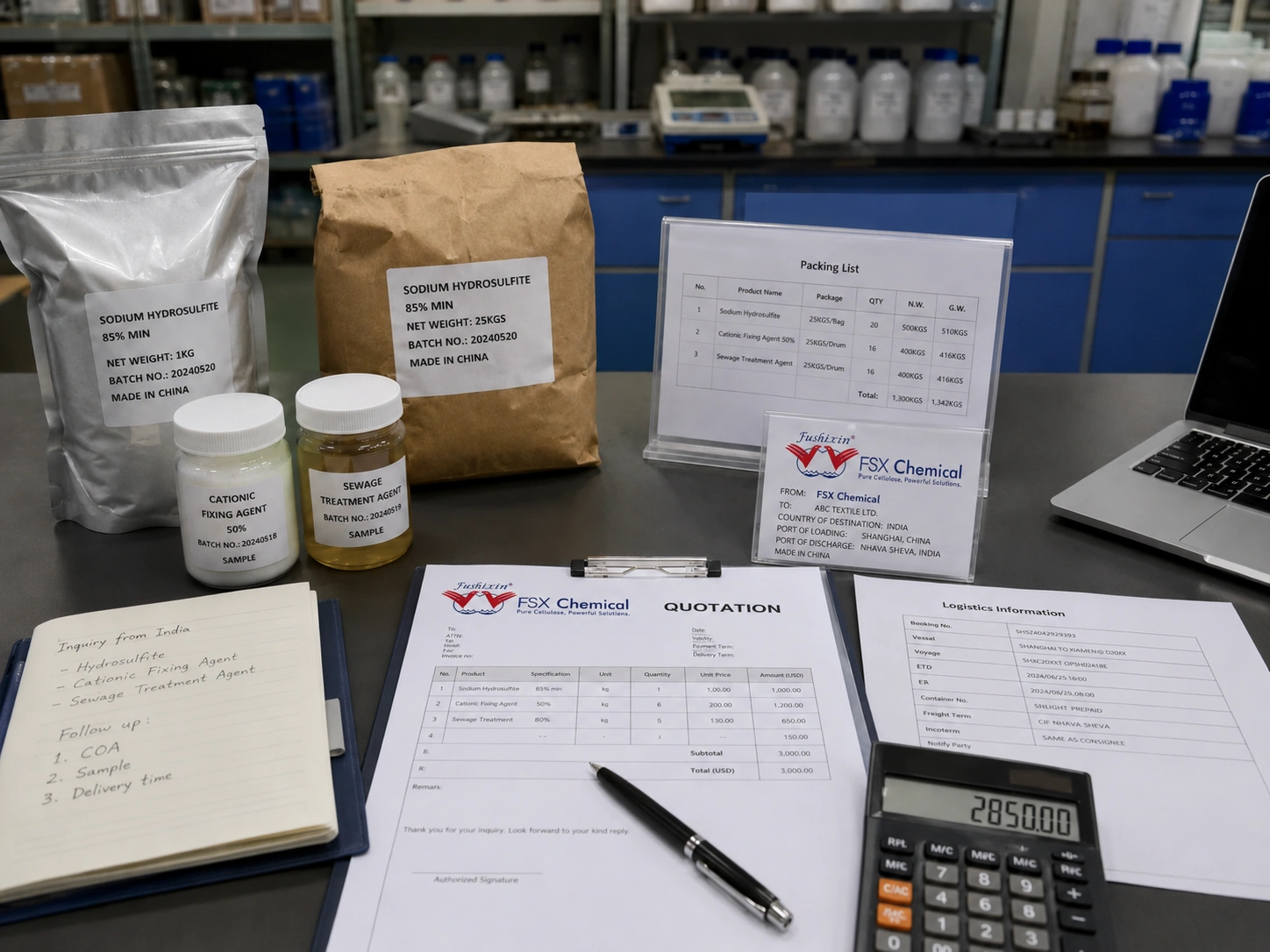
Сообщите название продукта, область применения, количество, пункт назначения, а также предоставьте техническое описание продукта (TDS),
фотографию образца или имеющиеся у вас документы. Компания FSX Chemical рассмотрит
эту информацию и порекомендует дальнейшие действия для подготовки коммерческого предложения, подбора образца
или выбора продукта.
Информация о продуктеНазвание продукта, марка, модель, фото этикетки или данные о продукте текущего поставщика.
Доступные документыTDS, SDS, COA, фотография образца, перечень продукции или данные испытаний.
Детали заказаПредполагаемый объем, упаковка, страна назначения, порт или условия торговли.
Область применения или проблемаПроцесс печати на текстиле, требования к составу, текущие проблемы или целевые показатели.